316-Exam 2 Preview Fall 2020
Newborn Nutrition
• Pros and cons of breastfeeding
• Colostrum vs mature breastmilk
o Colostrum
Yellow colored fluid, present from end of pregnancy until 2 days post-partum
Higher
...
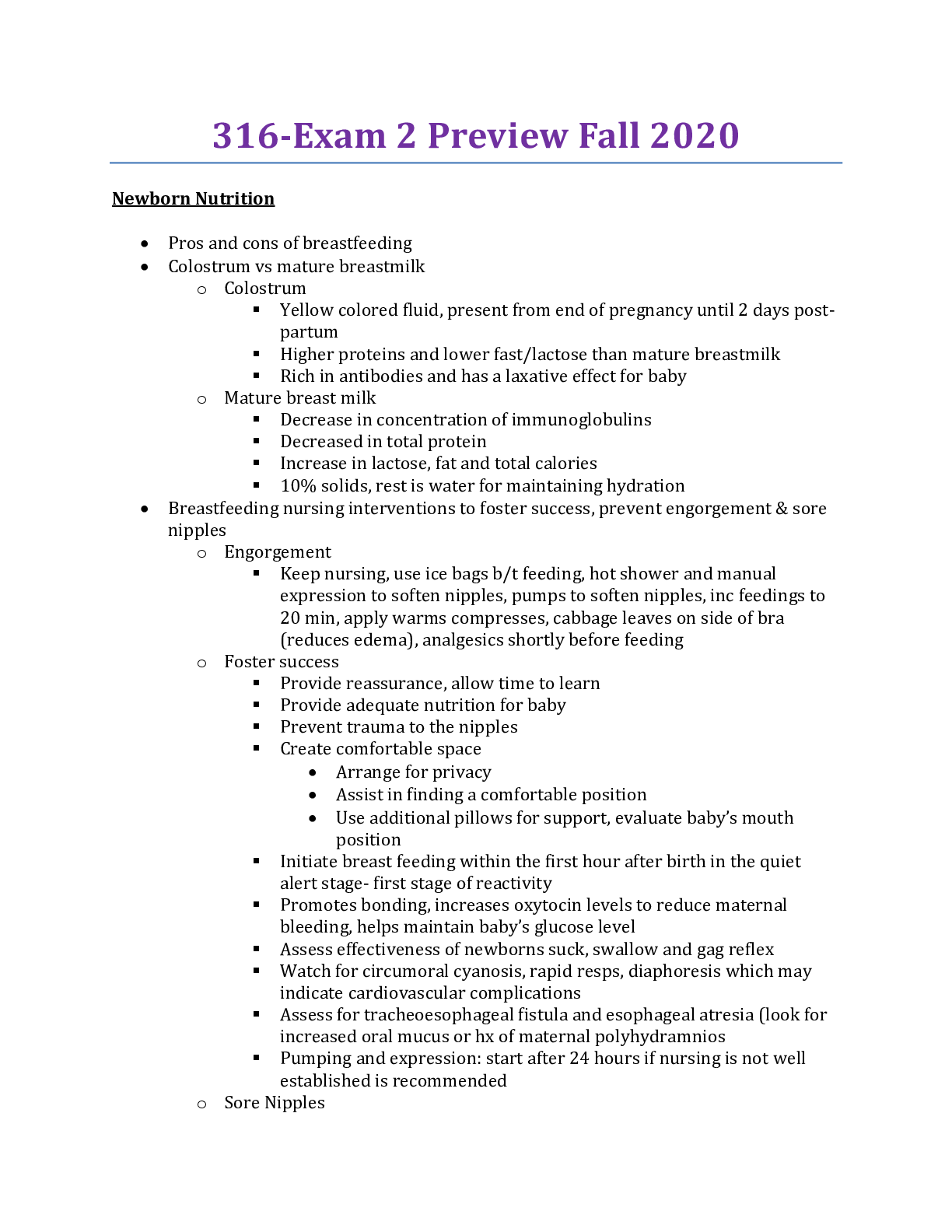
316-Exam 2 Preview Fall 2020
Newborn Nutrition
• Pros and cons of breastfeeding
• Colostrum vs mature breastmilk
o Colostrum
Yellow colored fluid, present from end of pregnancy until 2 days post-partum
Higher proteins and lower fast/lactose than mature breastmilk
Rich in antibodies and has a laxative effect for baby
o Mature breast milk
Decrease in concentration of immunoglobulins
Decreased in total protein
Increase in lactose, fat and total calories
10% solids, rest is water for maintaining hydration
• Breastfeeding nursing interventions to foster success, prevent engorgement & sore nipples
o Engorgement
Keep nursing, use ice bags b/t feeding, hot shower and manual expression to soften nipples, pumps to soften nipples, inc feedings to 20 min, apply warms compresses, cabbage leaves on side of bra (reduces edema), analgesics shortly before feeding
o Foster success
Provide reassurance, allow time to learn
Provide adequate nutrition for baby
Prevent trauma to the nipples
Create comfortable space
• Arrange for privacy
• Assist in finding a comfortable position
• Use additional pillows for support, evaluate baby’s mouth position
Initiate breast feeding within the first hour after birth in the quiet alert stage- first stage of reactivity
Promotes bonding, increases oxytocin levels to reduce maternal bleeding, helps maintain baby’s glucose level
Assess effectiveness of newborns suck, swallow and gag reflex
Watch for circumoral cyanosis, rapid resps, diaphoresis which may indicate cardiovascular complications
Assess for tracheoesophageal fistula and esophageal atresia (look for increased oral mucus or hx of maternal polyhydramnios
Pumping and expression: start after 24 hours if nursing is not well established is recommended
o Sore Nipples
Common causes are poor positioning and improper latch
To treat: warm compressions, air dry, lanonolin, breast milk on areola a natural emollient, frequently change position
• Hormones that facilitate preparation for breastfeeding during pregnancy.
o Hormonal pathways (postpartum)
Birth results in a rapid in estrogen and progesterone and an in the secretion of prolactin. Prolactin promotes milk production by stimulating the alveolar cells of the breast. Prolactin levels rise in response to suckling.
o Let-down reflex (postpartum)
Suckling also stimulates the release of oxytocin from the pituitary gland.
Oxytocin increases the contractility of the myoepithelial cells lining the walls of the mammary ducts, and a flow of milk results this is called the letdown reflex.
Often described as a tingling, prickling sensation as milk comes down, mothers may feel increased cramping, increased lochia, leaking from other breast, and a sense of relaxation. Letdown reflex is stimulated by infants cry, infants presence, suckling, mothers thoughts of infant, and sexual orgasm.
• How does breastfeeding promote the infant’s immune system?
Fetal Assessment Worksheet: (will not have to read a strip)
• Know the expected results for a non-stress test (NST), contraction stress test (CST), how results are determined
o NST (noninvasive)
Looking at the late decelerations w/ contractions and how baby responds to oxytocin
Fetal heart monitor
Want to get a baseline
Looking of 2 or more accelerations of 15 beats per minute lasting for 15 seconds having this = reactive (normal)
o CST (invasive)
Fetal heart monitor, iv pump (Pitocin)
Looking for the absence of any late decelerations in response to uterine activity
Want baseline to stay variable, no reflection of utero in sufficiency
Want Negative result (no reaction)
The presence of any deceleration is not good
Deceleration interventions:
Late: change position is always going to be first (trying to improve cardiac return), O2 therapy
Variable : change position is always going to be first (trying to avoid compression of cord)
• Differentiate purpose and timing of chorionic villi sampling (CVS), Amniocentesis, PUBS, MS-AFP .
• Understand pathophysiology and description of Variability
o Baseline variability is a measure of the interplay effect between the sympathetic nervous system and the parasympathetic nervous system
o Fluctuations in the FHR of two cycles per min or greater
o Variability is visually quantitated as the amplitude of peak-to-trough in bpm
Absent – amplitude range undetectable
Minimal – amplitude range detectable but 5 bpm or fewer
Moderate(normal)- amplitude range 6-25 bpm
Marked – amplitude range greater than 25 bpm
o Beat to beat variability is probably the most accurate indicator of fetal well being that the nurse has, if BTBV is poor, the fetus is probably in distress and needs to be delivered SOON
• Accelerations, Early decelerations, Variable Decelerations, Late decelerations and appropriate nursing interventions.
o Accelerations
A visually apparent abrupt increase (onset to peak less than 30 seconds) in the FHR from the most recently calculated baseline
The duration of an acceleration is defined as the time from the initial change in FHR from baseline to the return of the FHR to baseline
At 32 weeks of gestation and beyond, an acceleration has an acme of 15 bpm or more above baseline, with duration of 15 sec or more but less than 2 min
Before 32 weeks, an acceleration has an acme of 10 bpm or more above baseline, with a duration of 10 seconds or more but less than 2 min
If an acceleration lasts 10 min or longer it is a baseline change
• Cause: stimulation of autonomic nervous system of the fetus seen with fetal movement, vaginal exams, abdominal palpations, uterine contractions – usually signs of fetal well being
• No NI’s
o Early Deceleration
“mirrors” contraction
In association with uterine contraction, a visually apparent, gradual (onset to nadir 30 sec or more) decrease in FHR with return to baseline. **Nadir of the deceleration occurs at the same time as the peak of the contraction
Cause – head compression after uterine contraction (bc baby is moving down), vaginal exam, fundal pressure, placing internal fetal scalp electrode
NI’s – benign pattern, no intervention required
o Variable Deceleration
V,U or W shaped
An abrupt (onset to nadir less than 30 sec) visually apparent decrease in the FHR below the baseline. The decrease in FHR is 15 bpm or more, with duration of 15 seconds or more but <2 minutes
Cause – umbilical cord compression, if repetitive in may indicate nuchal cord (neck)
NI’s – change maternal position, if severe may need to try amnioinfusion
o Late Deceleration
In association with uterine contraction, a visually apparent, gradual (onset to nadir 30 sec or more) decreases in FHR with return to baseline. Onset, nadir and recovery of the deceleration occur after the beginning, peak and end of the contraction, respectively
Very ominous when associated with loss of variability, rising baseline or tachycardia
Repetitious
Cause- uteroplacental insufficiency or decreased maternal fetal exchange during contradictions causing hypoxemia
• See with – hyperstimulation of uterus with oxytocin, toxemia, posterity, SGA, maternal diabetes, anemia or cardiac disease, placenta previa or abruption
NI’s – change maternal positions to left lateral, stop Pitocin/oxytocin if being used, O2/mask at 7-10L/min, correct maternal hypotension, increase mainline IV rate (Bolus), elevate legs
• Recognize reassuring and non-reassuring FHR patterns
o VEAL CHOP
V – variable deceleration is caused by the C-cord
E – early deceleration is caused by H – head compression
A – acceleration is O – okay
L- late deceleration P- placental insufficiency
• nurse’s responsibility in fetal monitoring and care of the mother and fetus.
o
• Parameters of significance in ultrasound testing for gestational age, nurse’s role in preparation of patient and assisting with ultrasound, parameters for BPP (biophysical profile).
o First trimester
o Second trimester -
o Nurses role – don’t go to the bathroom (bladder must be full, drink 20 0z of water) full bladder pushed uterus up allows more to be seen, for the first 20 weeks) should not be the her back, use wedge
o Biophysical profile : 8 or greater (8-10)
Ultrasound (looking at pockets of amniotic fluid, flexion of the baby and fetal heart monitor are needed
Physiology of Labor:
• Know definitions of terms; effacement, dilatation, engagement, lie, presentation, position, station, lightening, ballotable, flexed attitude.
o Effacement – the drawing up of the internal os of the cervical canal into the uterine side walls
The cervix changes progressively from a long and thick structure to a structure that is tissue or paper tine
Primip effacement usually precedes dilation
o Dilatation
Cervical os and cervical canal widen from <1cm to approx. 10 cm allowing for delivery
• The patient is complete or 10 cm when the cervix is no longer palpable
o Engagement (0)
The largest diameter of the presenting part passes through the pelvic inlet
Determined by VE, occurs 2 weeks before term
Multiparas may experience several weeks before term
o Lie
Relationship of the spinal column (long axis) of fetus to the spinal column (long cephalocaudal axis) of mother
Longitudinal or transverse
o Presentation
Determined by fetal lie
Refers to the body part of the fetus that enters the pelvis first
Presenting part portion of the fetus felt through cervis determines presentation (vertex (cephalic most common), breech, face, brow, shoulder)
o Positions
o Station
The ischial spines mark the narrowest diameter through the fetus must pass
The ischial spines are used as a landmark to establish a station of zero
If the presenting part is higher than the ischial spines a negative number is assigned, beginning with -5 (floating) at the inlet of the pelvis and going through +4 (crowing) at the outlet, moving from a negative station to zero to the positive station
o Lightening
Decent of fetal head into the cervix
Primip 10-14 days before delivery
Multip during labor
o Ballotable
Floating or freely movable above pelvic inlet
o Flexed attitude
the relationship of the fetal body parts to one another
Fetal posture is generally flexed
Head is flexed so that chin is on the chest and arms crossed over chest with legs flexed at the knees with thighs on abdomen
• Know the stages of labor and the 3 phases in the first stage of labor.
o SEE CLINICAL CONTENT
• Understand common behaviors the mother will experience and uterine contractions in these phases.
o SEE CLINICAL CONTENT
• Review the 7 cardinal movements of labor. (Mechanisms of Labor)
o Engagement and descent
4 forces
Pressure of amniotic fluid
Direct pressure of the fundus of the uterus on the breech of the fetus
Contraction of the abdominal muscles
Extension and straightening of the fetal body
o Flexion
Fetal head meets resistance from pelvic floor causing chin to flex downward to chest
o Internal rotation to OA position
Head rotates to fit pelvic cavity by rotating the occiput from left to right and sagittal sutures align with the anteroposterior pelvic diameter
o Extension
Crowning occurs as the fetal head meets resistance from pelvic floor allowing fetal head to pass under symphysis pubis
o Restitution
Neck is twisted (b/c of internal rotation) once free turns to one side
o External Rotation
Shoulder in anteroposterior position, the head is turned farther to one side to assist in birth
o Expulsion
After external rotation the anterior shoulder meets the undersurface of pubis and slips under, shoulders are born then body
• Review fetal positions for example ROA, LOA.
o LOA – left occiput anterior
o REVIEW 1st 20 slides on intrapartum physiology
• Premonitory signs of labor and factor that differentiates true from false labor.
o Pg 541 olds
Nursing Care in the Intrapartal Period
• Appropriate nursing measures in 4 stages of labor- positioning, frequency of assessments, expected physiologic changes & causes of those changes-- (review systems)
::::::::::::::::::::::::::::::::::::::::CONTENT CONTINUED IN THE ATTACHMENT:::::::::::::::::::::::::::::::::::::::::::::::::::
[Show More]