SCIENCE 101  >  QUESTIONS & ANSWERS  >  SCIENCE 101 Quadrat Sampling Lab (All)

SCIENCE 101 Quadrat Sampling Lab

Document Content and Description Below

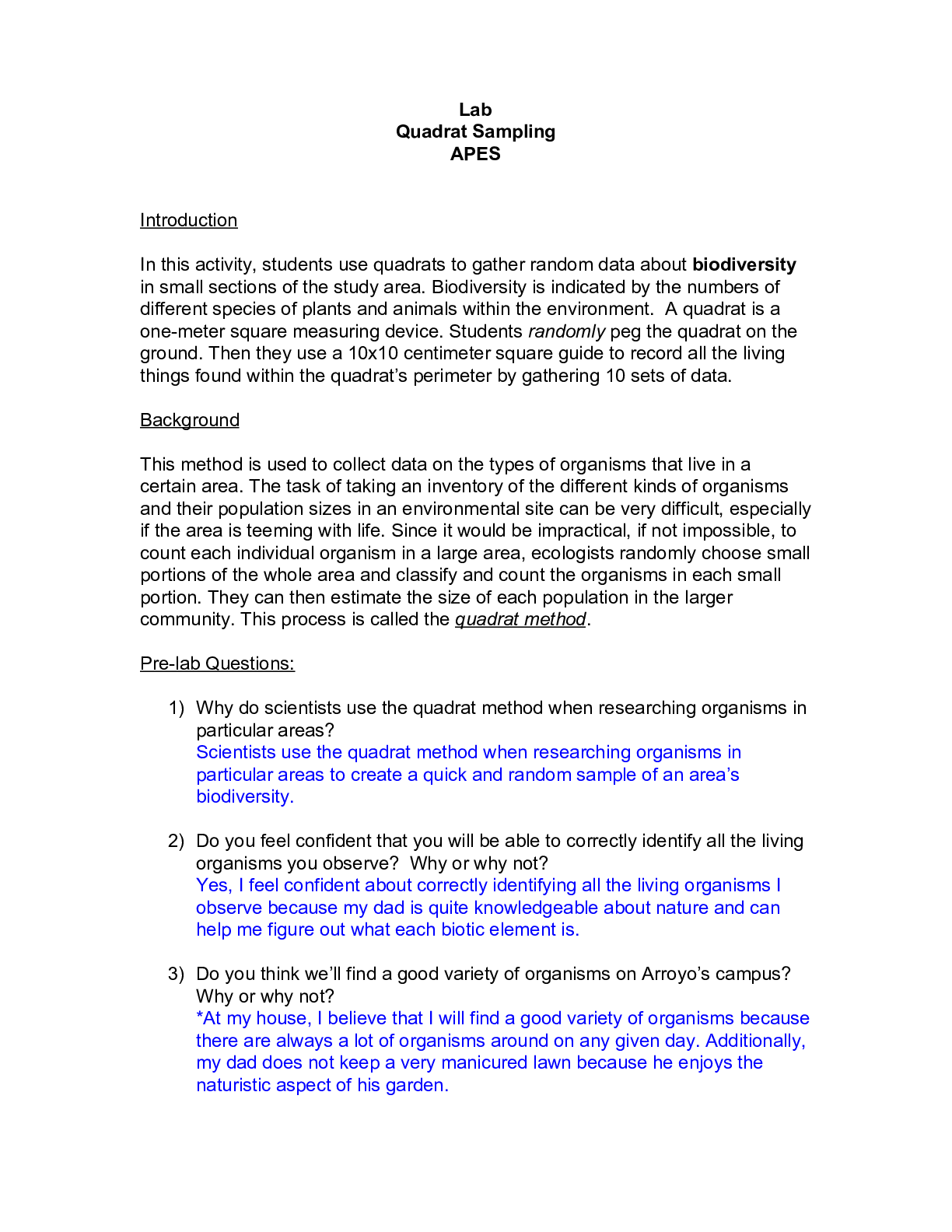
Lab Quadrat Sampling APES Introduction In this activity, students use quadrats to gather random data about biodiversity in small sections of the study area. Biodiversity is indicated by the n ... umbers of different species of plants and animals within the environment. A quadrat is a one-meter square measuring device. Students randomly peg the quadrat on the ground. Then they use a 10x10 centimeter square guide to record all the living things found within the quadrat’s perimeter by gathering 10 sets of data. Background This method is used to collect data on the types of organisms that live in a certain area. The task of taking an inventory of the different kinds of organisms and their population sizes in an environmental site can be very difficult, especially if the area is teeming with life. Since it would be impractical, if not impossible, to count each individual organism in a large area, ecologists randomly choose small portions of the whole area and classify and count the organisms in each small portion. They can then estimate the size of each population in the larger community. This process is called the quadrat method. Pre-lab Questions: 1) Why do scientists use the quadrat method when researching organisms in particular areas? 2) Do you feel confident that you will be able to correctly identify all the living organisms you observe? Why or why not? 3) Do you think we’ll find a good variety of organisms on Arroyo’s campus? Why or why not? 4) Explain biodiversity. Does the biodiversity of any given area ever change? If so, why does it occur? Materials Meter stick, 4 stakes per group (we will be using plastic utensils), string, scissors, 10 colored discs, 10x10 centimeter square guide, this lab sheet. Procedure 1. Set up the quadrat for sampling Working in groups of two, students randomly place a one-meter quadrat on the ground somewhere in the study area. The quadrat is to be secured with stakes at each corner to minimize movement. 2. Random sampling for 10 sets of data Randomly place the 10x10 centimeter square guide in ten places within the quadrat, one by one, and mark the center with a colored disc. After marking each of the areas, go back and place the guide in the same spot, remove the colored disc and record the living things found in each area. You will have to move things around, but try not to disrupt the organisms too much. Fill in the data table with all living organisms in each area. Drawings ● Draw your location on the campus ● Draw and color all of the organisms which you are recording in your data table. Name the organisms that you are familiar with (ants, grass, etc.). For unidentifiable organisms, give them a code (such as organism #1, a, etc.). Write their names/codes next to each drawing, as well as within the *patch= full 10x10cm square While out on the field, you will record your data in the charts above. Afterwards, you will re-create these in your lab book. Calculations Set up and show each calculation in your lab book. Average Population Density: For each species, add the number of organisms found in all 10 quadrats and divide by 10. Estimated Population Size in Site: Multiply the population density by 10 to estimate the total number of organisms in the larger site. Biodiversity varies from place to place – this is called ‘variation over distance’. Variations between years or seasons are called ‘variations over time’. Biodiversity changes over distance and time. Post-lab Questions: 1) Why was it necessary to randomly choose the quadrat? 2) Which was the dominant plant species within the site? The dominant animal species? 3) Did you observe any unusual features in one quadrat that were not found elsewhere on the site, such as an anthill? 4) Compare your results with those of other groups. Did any abiotic factors contribute to similarities or differences in your population sizes? Explain. 5) Using the quadrat method, how could you better estimate the actual population sizes of species within your one-meter square area? 6) How is the sampling of animal populations more difficult than that of plant populations? 7) Predict how the removal of the dominant plant species from the site would affect the population sizes of the other organisms. Explain. [Show More]

Last updated: 3 years ago

Preview 1 out of 7 pages

Buy Now

Instant download

We Accept:

Payment methods accepted on Scholarfriends (We Accept)
Preview image of SCIENCE 101 Quadrat Sampling Lab document

Buy this document to get the full access instantly

Instant Download Access after purchase

Buy Now

Instant download

We Accept:

Payment methods accepted on Scholarfriends (We Accept)

Reviews( 0 )

$12.00

Buy Now

We Accept:

Payment methods accepted on Scholarfriends (We Accept)

Instant download

Can't find what you want? Try our AI powered Search

70
0

Document information


Connected school, study & course


About the document


Uploaded On

Feb 10, 2021

Number of pages

7

Written in

All

Seller


Profile illustration for QuizMaster
QuizMaster

Member since 6 years

1109 Documents Sold

Reviews Received
185
56
29
11
17
Additional information

This document has been written for:

Uploaded

Feb 10, 2021

Downloads

 0

Views

 70

Document Keyword Tags


$12.00
What is Scholarfriends

Scholarfriends.com Online Platform by Browsegrades Inc. 651N South Broad St, Middletown DE. United States.

We are here to help

We're available through e-mail, Twitter, and live chat.
 FAQ
 Questions? Leave a message!


Copyright © Scholarfriends · High quality services·