CFA Level 1 - 101 Must Knows 368 Questions with Verified Answers
Addition Rule of Probability - CORRECT ANSWER ADDITION: P(A or B) = P(A) + P(B) - P(AB)
Roy's Safety First Criterion - CORRECT ANSWER Safety First Ra
...
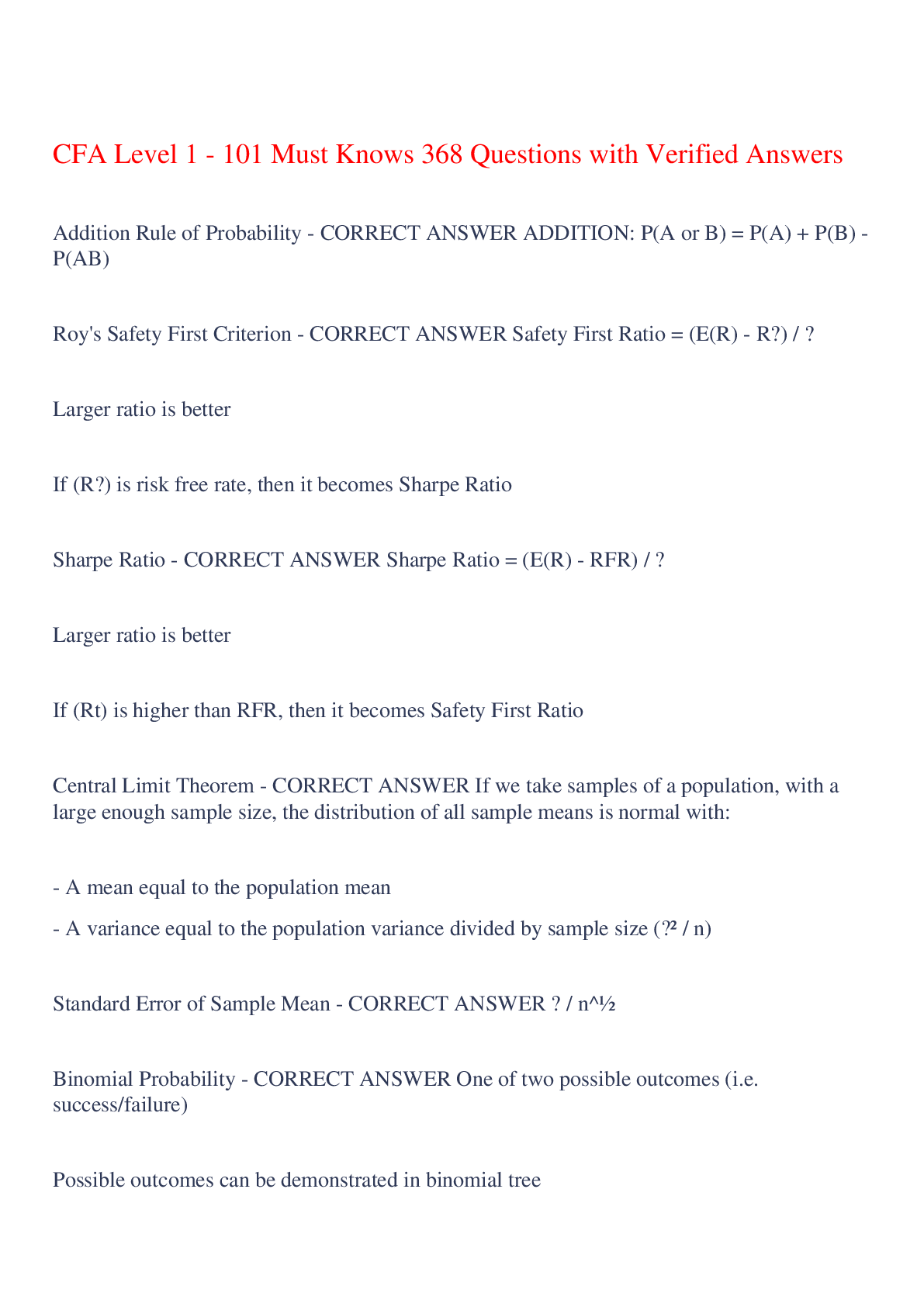
CFA Level 1 - 101 Must Knows 368 Questions with Verified Answers
Addition Rule of Probability - CORRECT ANSWER ADDITION: P(A or B) = P(A) + P(B) - P(AB)
Roy's Safety First Criterion - CORRECT ANSWER Safety First Ratio = (E(R) - Rₜ) / σ
Larger ratio is better
If (Rₜ) is risk free rate, then it becomes Sharpe Ratio
Sharpe Ratio - CORRECT ANSWER Sharpe Ratio = (E(R) - RFR) / σ
Larger ratio is better
If (Rt) is higher than RFR, then it becomes Safety First Ratio
Central Limit Theorem - CORRECT ANSWER If we take samples of a population, with a large enough sample size, the distribution of all sample means is normal with:
- A mean equal to the population mean
- A variance equal to the population variance divided by sample size (σ² / n)
Standard Error of Sample Mean - CORRECT ANSWER σ / n^½
Binomial Probability - CORRECT ANSWER One of two possible outcomes (i.e. success/failure)
Possible outcomes can be demonstrated in binomial tree
Use "nCr" on calculator to solve:
nCr = P(success)^x * P(failure)^(n-x)
P - Value - CORRECT ANSWER Based on a calculated test statistic, rather than a significance level (which is chosen)
p-value = smallest significance level at which an analyst can reject the null hypothesis
one-tailed test - "less than or equal to"
two-tailed test - "equal to"
Cumulative Distribution Function - CORRECT ANSWER Gives the probability that a random variable will have an outcome less than or equal to a specific value (represented by F(x))
F(x) = probability of an outcome less than or equal to x
Standard normal table (z) shows cumulative probabilities
Effective Annual Yield - CORRECT ANSWER EAY = (1 + (i/n))^n - 1
Stated Rate = (EAY^(1/n) - 1) * n
Continuous Compounding - CORRECT ANSWER ln(EAY) = continuously compounded stated rate
e^(continuously compounded stated rate) = EAY
Type I Error - CORRECT ANSWER Incorrectly rejecting a true null hypothesis
(convicting an innocent person is Type I)
Type II Error - CORRECT ANSWER Failure to reject a false null hypothesis
(failure to convict a guilty person is Type II)
Significance Level / Power of a Test - CORRECT ANSWER Significance Level = Probability of Type I
Power of a Test = (1 - Probability of Type I)
Covariance (Probability Model) - CORRECT ANSWER Covariance of random variables A and B from probability model
On the calculator:
1) Enter returns for set A and joint probabilities for AB; find mean A
2) Enter returns for set B and joint probabilities for AB; find mean B
3) Multiply each joint probability AB by each set's returns minus means
(ex: P(AB1)(A1 - Mean A)(B1 - Mean B) + P(AB2)(A2 - Mean A)(B2 - Mean B) + ... + P(ABn)(An - Mean A)(Bn - Mean B))
4) The summed total is your covariance
Covariance (Sample) - CORRECT ANSWER Covariance of random variables A and B from sample with historical data with n observations
Correlation Coefficient - CORRECT ANSWER COVab / σaσb
Bank Discount Yield (Discount basis) - CORRECT ANSWER (Discount / Face Value) * (360 / Days)
Money Market Yield - CORRECT ANSWER (HPY) * (360 / Days)
Bond Equivalent Yield - CORRECT ANSWER (HPY) * (365 / Days)
Most appropriate for comparing yields!
Technical Analysis Indicators - CORRECT ANSWER Continuation:
TRIANGLE (or pennant) = Suggests a pause in the stock price movement that will be followed by a continuation of the previous trend
Reversal:
HEAD AND SHOULDERS = Suggests a future decline in the stock price regardless of prior trend
DOUBLE BOTTOM = Increasing stock price in the future (reversal of a downtrend)
Trendlines:
SUPPORT / RESISTANCE = Range that stock price trades in based on supply/demand. Stock is "supported" from going below a certain low price, and "resists" going above a certain high price
Price Elasticity - CORRECT ANSWER %ΔQuantity / %ΔPrice = (ΔQ / ΔP) * (P₀ / Q₀)
Demand is elastic if less than -1
Demand is inelastic if 0 to -1
Income Elasticity - CORRECT ANSWER %ΔQuantity / %ΔIncome
Positive for normal good
Negative for inferior good
Cross-Price Elasticity - CORRECT ANSWER %ΔQuantity / %ΔPriceʳᵉˡᵃᵗᵉᵈ ᵍᵒᵒᵈ
Positive for substitutes
Negative for complements
Sources of Economic Growth - CORRECT ANSWER Increases in:
- Labor
- Physical Capital
- Technology
- Natural Resources
- Human Capital
(LPT:HN)
"Life Pro Tip: No Hangovers"
Production Function Approach (GDP) - CORRECT ANSWER Potential GDP = A * f(L,K)
L = Labor
K = Capital
A = "total factor productivity" aka increased growth not explained by growth of labor and capital
This is a proxy for growth of technology
Solow (neoclassical) model (GDP) - CORRECT ANSWER Growth in Potential GDP = growth in technology + Wₗ(growth in labor) + Wₖ(growth in capital)
Growth in a country's per capita GDP = growth in technology + Wₖ(growth in K/L ratio)
No Arbitrage Forward Rate - CORRECT ANSWER (1 + price currency int. rate) / (1 + base currency int. rate) = forward exchange rate / spot exchange rate
((1 + price currency int. rate) / (1 + base currency int. rate)) * spot rate = no arbitrage forward rate
Exchange Rate Quotes - CORRECT ANSWER Price Currency / Base Currency
Read as "units of price currency for each unit of base currency"
Business Cycle - Leading Indicators - CORRECT ANSWER Precede:
Weekly Hours Manufacturing
Manufacturing New Orders; Non-defense
Consumer Goods
ISM New Orders Index
Stock Prices
Yield Curve
New Unemployment Ins. Claims
Building Permits
Capital Goods ex. Aircraft
Leading Credit Index
Consumer Expectations
Business Cycle - Coincident Indicators - CORRECT ANSWER Coincide:
Nonfarm payrolls
Personal Income - Transfer Payments
Manufacturing and Trade Sales
Business Cycle - Lagging Indicators - CORRECT ANSWER Follow:
*Unemployment Rate
Duration of Unemployment
Inventory / Sales Ratio
Manufacturing and Trade
Commercial and Individual Loans
Prime Rate
Manufacturing Labor Cost per Unit of Input
Commercial / Personal Credit
Income Ratio
CPI
The Fundamental Relationship (GDP) - CORRECT ANSWER Expenditures: GDP = C + I + G + (X - M)
Income: GDP = (C + S) + T
Fundamental Macro Relationship - CORRECT ANSWER (S-I) = (G-T) + (X-M)
S = Personal Savings
I = Personal Investment
G = Government Spending
T = Tax Revenue
X = Exports
M = Imports
If G > T, government deficit
If X > M, trade surplus
Inflationary Gap - CORRECT ANSWER Real output above full employment (LRAS)
Upward pressure on wages will decrease SRAS, reducing output and increasing prices (SRAS moves up)
Recessionary Gap - CORRECT ANSWER Real output below full employment (LRAS)
Downward pressure on wages should increase SRAS, increasing output to full employment, but recessionary gap may persist if "downward sticky."
Kenesyian theory suggests government spends to step in and increase AD up to equilibrium (stimulus or expansionary monetary policy)
Effects of Trade Restrictions - CORRECT ANSWER Trade restrictions typically increase the welfare of domestic producers, but decrease welfare of domestic consumers and foreign producers.
Overall welfare is decreased by trade restrictions (deadweight loss)
Types of Trade Restrictions - CORRECT ANSWER Tariffs (Oldest) - Taxes on imported goods; benefits government who collects tariff revenue
Quotas - Limits quantity of imports in a time period; benefits government if selling licenses; benefits foreign producers through quota rents
Voluntary Export Restraints - Foreign countries limits on quantity of exports to domestic nation. Effects are similar to quota, but government gets no revenue.
Consumer Price Indexes - CORRECT ANSWER Designed to measure change in cost of basket of goods/services
Weights in CPI reflect purchases of typical urban household
Annual inflation rate is year over year % change in CPI
Laspeyres Index (US CPI) - CORRECT ANSWER (Base year basket at current prices / Base year basket at base prices) * 100
Doesn't account for introduction of new goods, substitutions, or quality improvements (tends to overstate inflation).
Paasche Index - CORRECT ANSWER (Current year basket at current prices / Current year basket at base prices) * 100
Does allow for substitution
Fischer Index - CORRECT ANSWER Chain weighted: Geometric mean of Paasche & Laspeyres Indexes
Market Stuctures - CORRECT ANSWER Perfect Competition
Monopolistic Competition
Oligopoly
Monopoly
Perfect Competition - CORRECT ANSWER Many Firms
"Commodity" Products
No pricing power (price taker)
Compete only on price
Monopolistic Competition - CORRECT ANSWER Many Firms
Differentiated Products
Slight pricing power
Compete on price, features, advertising
Oligopoly - CORRECT ANSWER Few Firms
May be differentiated
May be significant pricing power
Compete on price, features, advertising
Monopoly - CORRECT ANSWER One Firm
No Good Substitutes
Significant pricing power
No need to compete; only advertise
Expansionary Fiscal Policy - CORRECT ANSWER Fiscal policy is expansionary if deficit increases or surplus decreases (G > T)
policy rate < neutral interest rate
Contractionary Fiscal Policy - CORRECT ANSWER Fiscal policy is contractionary if deficit decreases or surplus increases (G < T)
policy rate > neutral interest rate
Neutral Interest Rate - CORRECT ANSWER Long Term Trend of GDP Growth + Target Inflation Rate
Cash Flow from Operations (CFO) - CORRECT ANSWER Transactions that affect Net Income
CFO = Net income + noncash - WC investments
Typically, cash flows are operating if they affect current assets/liabilities
IFRS:
Interest or dividends received CFO or CFI
Interest or dividends paid CFO or CFF
US GAAP:
Interest or dividends received CFO
Cash Flow from Investing (CFI) - CORRECT ANSWER Purchases and sales of assets, some financial investments
Typically, cash flows are investing if they affect long-lived assets
IFRS:
Interest or dividends received CFO or CFI
Cash Flow from Financing (CFF) - CORRECT ANSWER Transactions that affect firm's capital structure (equity; long-term debt)
Typically, cash flows are financing if they affect long-lived liabilities and equity
IFRS:
Interest or dividends paid CFO or CFF
US GAAP:
Dividends paid are CFF
Non-Cash Transactions - CORRECT ANSWER Disclosed in footnotes of cash flow statement
Operating Cycle - CORRECT ANSWER Days inventory on hand + Days Sales Outstanding (DSO)
Cash Conversion Cycle (Net Operating Cycle) - CORRECT ANSWER Days inventory on hand + Days Sales Outstanding (DSO) - Days payables
Days Inventory on Hand - CORRECT ANSWER 365 / Inventory Turnover
Days Sales Outstanding (DSO) - CORRECT ANSWER 365 / Receivables Turnover
Days of Payables - CORRECT ANSWER 365 / Payables Turnover
Net Profit Margin - CORRECT ANSWER Net Income / Revenue
Asset Turnover - CORRECT ANSWER Revenue / Assets
Leverage Ratio - CORRECT ANSWER Avg. Total Assets / Avg. Total Equity
DuPont Decomposition of ROE (1-3 Stage) - CORRECT ANSWER ROE (1 Stage)
= (Net Income / Equity)
ROE (2 Stage)
= (Net Income / Revenue)
* (Revenue / Equity)
= Net Profit Margin
* Equity Turnover
ROE (3 Stage)
= (Net Income / Revenue)
* (Revenue / Assets)
* (Assets / Equity)
= Net Profit Margin
* Asset Turnover
* Financial Leverage (or Equity Multiplier)
DuPont Decomposition of ROE (5 Stage) - CORRECT ANSWER ROE
= (Net Income / EBT)
* (EBT / EBIT)
* (EBIT / Revenue)
* (Revenue / Assets)
* (Assets / Equity)
= tax burden
* interest burden
* EBIT margin
* asset turnover
* Financial Leverage (or Equity Multiplier)
Free Cash Flow to Firm (FCFF) - CORRECT ANSWER Cash flow available to debt and equity holders
FCFF = Net income + noncash charges + after-tax interest - FC (fixed) investment - WC (working) investment
FCFF = CFO + after-tax interest - FC investment
Free Cash Flow to Equity (FCFE) - CORRECT ANSWER Cash flow available to equity holders after meeting obligations of debt holders
Can sometimes be used in lieu of dividends to evaluate value of firm
FCFE = CFO - FC Investment + net borrowing
Impairment of Long-Lived Assets - CORRECT ANSWER Asset is impaired if market value falls below B/S carrying value
IFRS: check for impairment annually
US GAAP: Assess when circumstances dictate; apply recoverability test
Recoverable Amount - CORRECT ANSWER Greater of fair value less selling costs (what you can net for it if you sell it) or value in use (PV of future cash flows)
Recoverability Test - CORRECT ANSWER Asset is impaired if sum of undiscounted cash flows is less than carrying value
Recovery of Impairment - CORRECT ANSWER May be recognized under IFRS; not allowed under US GAAP
Financial Statement effect of Impairment - CORRECT ANSWER - Long-lived asset decreases by impairment amount
- Income decreases by impairment amount when recognized
- Taxes due not affected because tax deductions are not recognized until asset is sold/disposed (unrealized loss)
- If DTL for asset exists, reduces DTL to narrow gap between carrying and tax base
- cash flows not affected (non-cash)
- Depreciation expense in future periods will decrease (reduces depreciable value)
Revaluation of Long-Lived Assets - CORRECT ANSWER US GAAP: prohibited
IFRS: allowed if fair market value can be determined reliably
Revaluation Up - CORRECT ANSWER Revaluation up to fair value
Goes directly to S/E as revaluation surplus unless they reverse a previous loss on I/S
Revaluation Down - CORRECT ANSWER Revaluation down to fair value
Reduces any previous reevaluation surplus first; if no previous surplus exists, go to I/S and recognize as loss
Fair Value Model for Investment Property - CORRECT ANSWER IFRS only; long-lived assets held for rental income or price appreciation
FVM is similar to trading securities
Carry asset at fair value; recognize gains/losses on I/S
Revaluation vs. Fair Value Models - CORRECT ANSWER If no losses have been recognized, Fair Value model will value asset higher because any gains will be sent to S/E as revaluation surplus under revaluation model
Types of Leases - CORRECT ANSWER Operating Lease
Finance Lease (IFRS) / Capital Lease (US GAAP)
Finance Leases - CORRECT ANSWER Treat as if borrowing to purchase asset
Treat liability as if amortizing loan
IFRS: Finance Lease if rights/risks of ownership transferred to lessee
US GAAP: Finance Lease if any of these are met:
- Title Transfers at end of lease
- Bargain purchase option at end of lease
- Lease period is 75% or more of useful life
- PV of lease payments if 90% or more of value
Operating Leases - CORRECT ANSWER Treat as if renting the asset
Payments are rental expense on I/S
Payments are CFO outflows on C/F
Finance Lease (B/S) - CORRECT ANSWER Recognize long-lived asset equal to lower of fair value or PV of lease payments, and recognize a liability equal in value to the long-lived asset
Long-term liability has a current portion, same as LT debt
Finance Lease (I/S) - CORRECT ANSWER Depreciation expense on asset and interest expense on liability
- greater than lease payments in early years of lease; less than payments in later years
Finance Lease (C/F) - CORRECT ANSWER Payments are part interest (CFO outflow) and part principal (CFF outflow)
Interest portion can be classified as CFF under IFRS
Cash Flow from Operations (CFO) - CORRECT ANSWER Transactions from firm's regular business activities
CFO (Direct Method) - CORRECT ANSWER Direct Method: Start with cash from customers; add all other CFO receipts; subtract all CFO payments
CFO (Indirect Method) - CORRECT ANSWER Indirect Method: Start with net income and undo anything that isn't CFO
Requires adjusting accruals to a cash basis
Sources of Cash - CORRECT ANSWER Increase in a liability; decrease in an asset
Uses of Cash - CORRECT ANSWER Decrease in a liability; increase in an asset
Expensing Asset - CORRECT ANSWER Cost is an expense on I/S
Classified as operating cash outflow
Capitalizing Asset - CORRECT ANSWER Cost is recorded as asset on B/S
Classified as an investing cash outflow
Expense (depreciation or amortization) on I/S, cost spread over asset's life
Effects of Capitalizing vs. Expensing - CORRECT ANSWER Capitalization:
- smooths earnings
- Higher NI in current period, lower in later periods
- Higher assets and S/E
- Increase CFO, decrease CFI
Total Debt Ratio - CORRECT ANSWER Debt / Assets
Fixed Asset Turnover Ratio - CORRECT ANSWER Sales / Fixed Assets
Deferred Taxes - CORRECT ANSWER Result from different accounting rules for financial reporting and tax reporting
Income tax expense (fin. reporting) might not always equal taxes payable (tax reporting)
If differences are temporary, B/S will reflect DTA or DTL
Deferred Tax Examples - CORRECT ANSWER Accelerated depreciation
warranty expense
Warranty Expense - CORRECT ANSWER Recognized over warranty period for fin. reporting, but not actually paid for tax reporting
Tax Loss Carryforward - CORRECT ANSWER Taxable losses from earlier period can be carried forward. Losses can be used to reduce taxable income in subsequent periods.
Reduction in future taxes payable is DTA
Valuation Allowance - CORRECT ANSWER DTA reduced for probability that it won't be realized; contra account under US GAAP
(DTAs are directly reduced under IFRS; no such thing as valuation allowance)
Revenue Recognition LT Projects (Reliable) - CORRECT ANSWER Firms may recognize revenue and profit for LT projects if outcome can be reliably estimated.
Loss (if any), must all be recognized in current period
Percentage of Completion (Method) - CORRECT ANSWER Revenue each period = Total project revenue * percentage of completion - revenue recognized to date
Revenue Recognition LT Projects (unreliable) - CORRECT ANSWER IFRS: Expense costs when incurred, recognize revenue up to costs, no profit until completion
US GAAP: Completed contract method; all revenue, expense, and profit at completion
Percentage of Completion (Formula) - CORRECT ANSWER Costs incurred to date / total estimated costs
Ending Inventory - CORRECT ANSWER Beg. Inventory + Purchases - COGS
LIFO - CORRECT ANSWER Last In First Out
Is not allowed under IFRS!
Choosing an Inventory Costing Method - CORRECT ANSWER Choose the one that matches flow of physical goods most appropriately
LIFO Layer - CORRECT ANSWER Layer of goods at certain LIFO price
FIFO Inventory (calculation) - CORRECT ANSWER LIFO Inventory + LIFO reserve
FIFO Retained Earnings - CORRECT ANSWER LIFO Retained Earnings + LIFO reserve * (1 - tax rate)
FIFO COGS - CORRECT ANSWER LIFO COGS + Change in LIFO reserve
Inventory Preferences for Analysis - CORRECT ANSWER FIFO values for Inventory
LIFO values for COGS
These valuations are closer to true replacement cost
Accounting for Investment in Securities - CORRECT ANSWER Trading Securities:
- Intended to sell in short term; marked to market each period; unrealized gains/losses reported on I/S
Available for Sale:
- May sell prior to maturity; marked to market each period; unrealized gains/losses reported on S/E (OCI)
Held to Maturity:
- Not to be sold; B/S value is amortized cost (unless impaired, then market value)
Change in Security Value (Accounting) - CORRECT ANSWER Realized Gains/Losses, Interest, dividend income
always to I/S
Accounting for fixed-coupon bond liabilities - CORRECT ANSWER IFRS: Proceeds - Issuance Costs
US GAAP: Proceeds (issuance costs amortized on B/S as asset)
YTM when issued will determine interest expense for each period
Effective Interest Method - CORRECT ANSWER Discount or Premium amortized over life of bond, so that at maturity B/S liability will equal face value
Follows Constant Yield Price Trajectory
Straight Line Method (EIM) - CORRECT ANSWER Total discount (premium) / #periods
Permitted under US GAAP
Fair Value Alternative (EIM) - CORRECT ANSWER IFRS and US GAAP allow reporting liability at fair value; cannot change to another method once selecting (changes I/S value)
Effects of Leasing vs. buying Long-Lived Asset - CORRECT ANSWER Purchase Long Lived Asset:
Recognize asset on B/S at original cost
Recognize depreciation each period on I/S
Cash paid for asset is CFI in purchase period
Lease long lived asset (finance lease):
Recognize asset & liability on B/S
Lower of: PV of payments, fair value
Each period: recognize expenses on I/S
Depreciation expense on asset; Int. exp on liability
Cash paid for lease payments is part CFF (principal repaid) and CFO (interest paid)
Finance Lease Liability - CORRECT ANSWER Treated as an amortizing loan
(lease liability and loan liability are the same)
Temporary and Permanent Tax Differences - CORRECT ANSWER Difference between income tax expense and taxes payable
DTAs and DTLs are temporary differences and will eventually be reversed
Tax-exempt interest income is permanent and will not be reversed
Permanent Tax Difference Formula - CORRECT ANSWER Tax Rate = Income Tax Expense / Pre-Tax Income
Aggressive Accounting Decisions - CORRECT ANSWER Increase current income or improve reported financial position
Conservative Accounting Decisions - CORRECT ANSWER Decrease current income or worsen reported financial position
Basic EPS Calculation - CORRECT ANSWER (Net Income - Preferred Dividends) / Weighted avg. common shares
Weighted avg. common shares includes share issuance, share repurchases, stock splits / dividends
Diluted EPS Calculation - CORRECT ANSWER Company must report diluted EPS if they have them
Potentially Dilutive Securities - CORRECT ANSWER Stock Options or Warrants
Convertible Bonds
Convertible Preferreds
Stocks & Warrants (Dilutive EPS) - CORRECT ANSWER Exercise does not affect earnings to common, but does increase common shares
Use Treasury Stock Method:
Assume company purchases shares w/ proceeds of options / warrants, and issues new share for the rest, all at average price for the year
Convertible Preferred Shares (Dilutive EPS) - CORRECT ANSWER Conversion affects earnings to common, and increases common shares
Test for dilution:
Convertible Preferred Dividends / #New Shares if converted
Convertible Bonds (Dilutive EPS) - CORRECT ANSWER Conversion affects earnings to common, and increases common shares
Test for Dilution:
(Convertible Bond Interest) * (1-tax rate) / #New shares if converted
Current Ratio - CORRECT ANSWER Current Assets / Current Liabilities
Net Profit Margin - CORRECT ANSWER Net Income / Sales
Debt to Equity Ratio - CORRECT ANSWER Total Debt / Shareholder's Equity
Effect of Changes in Tax Rate on DTA / DTL - CORRECT ANSWER Values of DTA / DTL based on tax rate expected when temporary diff. reverses
If tax rate decreases, deferring tax good; prepaying bad - DTAs & DTLs both decrease
If tax rate increases, deferring tax bad; prepaying good - DTAs & DTLs both increase
Income Tax Expense Formula - CORRECT ANSWER Taxes Due + Change in DTL - Change in DTA
Capital Project Analysis (NPV) - CORRECT ANSWER NPV = sum of initial cash flows - initial outlay
Independent: Accept NPV > 0
Multiple Projects: Maximize NPV to best projects
Mutually Exclusive: Project with highest NPV > 0
Capital Project Analysis (IRR) - CORRECT ANSWER IRR = Discount rate where NPV = 0
Independent: IRR > Cost of Capital
Multiple Projects: Use NPV; higher IRR doesn't mean better
Projects with unconventional CFs may have multiple IRRs or none
Profitability Index - CORRECT ANSWER Ratio of discounted CFs to initial outlay
Independent: Accept if PI > 1 (NPV will be > 0)
Ex: PI = 1.1 means CFs 110% of initial outlay = NPV 10% of initial outlay
Payback Period; Discounted Payback - CORRECT ANSWER Time until initial outlay is recovered
Not recommended for accept/reject decisions
Breakeven Quantity of Sales - CORRECT ANSWER Sales in units at which revenue = total cost
Breakeven = (Fixed Operating Costs + Fixed Financing Costs) / (Price - Variable CPU)
Breakeven = Fixed Costs / Contribution Margin
Operating Breakeven Quantity of Sales - CORRECT ANSWER Sales in units at which revenue = operating costs
Operating Breakeven = (Fixed Operating Costs) / (Price - Variable CPU)
Weighted Avg. Cost of Capital (Sources) - CORRECT ANSWER Debt
Preferred Equity
Common Equity
Cost of Preferred Capital - CORRECT ANSWER Cost of Preferred = Dividend / Market Price
Cost of Debt Capital - CORRECT ANSWER Use after-tax cost because interest is tax deductible (after-tax = before-tax * (1-tax rate))
YTM approach: before-tax cost is YTM on firm's outstanding debt (not coupon)
Debt-rating approach: before-tax cost is YTM of debt with same rating as firm (adjust for differences in maturity, seniority, covenants)
Cost of Common Equity - CORRECT ANSWER CAPM: R(e) = R(rf) + B(R(m) - R(rf)
DDM: (expected dividend / current price) + constant growth rate
Bond Yield Plus Risk Prem.: YTM of firm's debt + est. risk premium for equity (typically 3 to 5% for equity)
Capital Structure Weighting - CORRECT ANSWER Use firm's target capital structure first if known or
use firm's current capital structure based on market values or
use industry average capital structure
Marginal cost of capital - CORRECT ANSWER The cost of capital increases as firms raise larger amounts of capital
Optimal capital budget - CORRECT ANSWER Amount of capital where MCC intersects investment opportunity schedule
Investment Opportunity Schedule - CORRECT ANSWER Ranking of projects from lowest to highest IRR
Breakpoints in MCC - CORRECT ANSWER Breakpoint is amount of capital where MCC increases
Breakpoint amt of total capital = Breakpoint in component's cost / Component's weight in capital structure
Cost of Not Taking Advantage of Trade Discount - CORRECT ANSWER Example, 2/10 net 30:
2% discount if paid by day 10, full amount due by day 30
Effective 20 day cost of forgoing discount: 0.02 / (1 - 0.02) = 2.04%
Annualized: (1 + Effective)^[365 / (Net days - discount days)] - 1
Annualized = (1 + 2.04)^[365 / (30 - 10)] - 1 = 44.56%
Effects of Share Repurchases (EPS) - CORRECT ANSWER Effects on EPS: Repurchase decreases both #shares outstanding and earnings
Repurchase w/ Cash: Interest income decreases
Repurchase w/ Borrowed Funds: Interest Expense Increases
MUST CONSIDER TAX EFFECTS REGARDLESS OF STRATEGY = i% * (1 - tax rate)
Earnings Yield - CORRECT ANSWER EPS / Share Price
Effects of Share Repurchases (BV) - CORRECT ANSWER Effects on BV: Share repurchase decrease both shares and book value
Book value decreases by amount of share repurchase
If repurchase price > original BVPS, share repurchase decrease BVPS
Business Risk - CORRECT ANSWER Result of Sales Risk (variability of sales) and operating risk
Operating Risk - CORRECT ANSWER Variability of operating earnings that comes from having fixed operating costs
Financial Risk - CORRECT ANSWER Variability of EPS using debt financing
Degree of Operating Leverage (DOL) - CORRECT ANSWER Leverage Ratio
DOL = % change in EBIT / % change in sales
DOL = (sales - VC) / (sales - VC - FC)
Degree of Financial Leverage (DFL) - CORRECT ANSWER Leverage Ratio
DFL = % change in EPS / % change in EBIT
DFL = (sales - VC - FC) / (sales - VC - FC - Int.)
DFL = EBIT / (EBIT - Int.)
Degree of Total Leverage (DTL) - CORRECT ANSWER Leverage Ratio
DTL = DOL x DFL
DTL = % change in EPS / % change in sales
DTL = (sales - VC) / (sales - VC - FC - Int.)
Price Calculation - CORRECT ANSWER Price = (Total FC / Breakeven Qty.) + Unit VC
Investment Objectives and Constraints - CORRECT ANSWER Two objectives and five constraints (all should be on IPS):
RRLLTTU (Red Rover Likes Lots of Tasty Treats Uninterrupted)
Objectives:
Return Requirements
Risk Tolerance
Constraints:
Liquidity Needs
Legal and Regulatory
Time Horizon
Tax Considerations
Unique Preferences
Risk Management Framework - CORRECT ANSWER 1. Identify Risk Tolerance
2. Identify and Measure Risks Faced
3. Modify / monitor risk
Risks are not necessarily minimized or avoided.
Financial Risks - CORRECT ANSWER Credit Risk
Liquidity Risk
Market Risk
Non-Financial Risks - CORRECT ANSWER Operational Risk
Solvency Risk
Regulatory Risk
Government Risk
Legal Risk
Model Risk
Tail Risk
Accounting Risk
Methods for Modifying Exposures to Risk - CORRECT ANSWER PASTA
Prevent
Avoid
Shift
Transfer
Accept
Capital Market Line (CML) - CORRECT ANSWER Some combination of the risk-free asset and market portfolio
E(R) = R(rf) + ((E(R) of market port. - R(rf)) / Std. Dev. mkt. port) * Std. Dev. of port. P
Slope = ((E(R) of market port. - R(rf)) / Std. Dev. mkt. port)
Efficient Frontier - CORRECT ANSWER Portfolios with greatest expected return for given level of risk
Capital Allocation Line (CAL) - CORRECT ANSWER Combines the risk-free and an investor's optimal risky portfolio
Market Portfolio - CORRECT ANSWER Portfolio that is point of tangency with efficient frontier. All investors hold some level of it if you assume homogeneous expectations.
Security Market Line (SML) - CORRECT ANSWER Relationship between expected return and systematic risk
Measured by beta (Covariance w/ Mkt. Return / Variance of Mkt. Return)
SML = CAPM = R(rf) +B(R(m) - R(rf))
Slope of SML is mkt risk premium
All portfolios plot on SML in equilibrium
Risk Aversion - CORRECT ANSWER Preferring Less risk to more risk, all things equal
Portfolio theory suggests that ALL investors are risk averse. To accept more risk, they need more return.
Indifference Curves - CORRECT ANSWER Illustrate trade off between risk/return for various portfolios on CAL
Characteristics of Institutional Investors - CORRECT ANSWER BELPMD (Broke Extra Leg Please Mail Drugs)
Bank (Low RT, Short TH, High Liq, Specific Income)
Endowment (High RT, Long TH, Low Liq, Specific Income)
Life Insurer (Low RT, Long TH, High Liq, Low Income)
P&C Insurer (Low RT, Short TH, High Liq, Low Income)
Mutual Fund (Specific RT, Specific TH, High Liq, Specific Income)
DB Pension (High RT, Long TH, Low Liq, Specific Income)
Common vs. Preferred Shares - CORRECT ANSWER Equity securities are ownership shares with no maturity. Dividends are not required to be paid.
Common shares have voting rights
Preferred shares have higher priority claims to earnings than common, but don't have voting rights (typically)
Securities Market Structures - CORRECT ANSWER Corn "QOB"
Quote Driven (aka dealer, price-driven, or OTC markets) - Market makers post bid/ask prices, buy/sell from inventory
Order Driven - Use rules for order matching and trade pricing; includes exchanges and automated trading systems
Brokered - Buyers and sellers use broker to find counterpart; most often used for trading illiquid assets (such as real estate)
Initial Margin Requirement - CORRECT ANSWER % cash required to buy on margin
Maintenance Margin - CORRECT ANSWER Min % equity an account must have
If equity falls below maintenance margin; investor gets margin call
Stocks - Must restore to maintenance margin
Futures - Must restore to initial margin
Leverage Ratio (Margin) - CORRECT ANSWER 1 / initial margin requirement
Return on Margin Transaction (before costs) - CORRECT ANSWER Unleveraged return * leverage ratio (margin)
Margin Returns - CORRECT ANSWER Unleveraged return includes dividends
Realized return is reduced by (TIC):
- Transaction Costs
- Interest
- Commissions
Margin Call Calculation - CORRECT ANSWER Price paid per share * [ (1 - Initial Margin %) / (1 - Maintenance Margin %) ]
Price Index Weighting Method - CORRECT ANSWER Securities can be weighted by price, market cap, or fundamentals
Equal Weighted Index - CORRECT ANSWER Arithmetic average return of index securities
Invest equal money amounts in each index stock; portfolio must be rebalanced as prices change
Price Weighted Index - CORRECT ANSWER Arithmetic average price of index securities
Buy equal number of shares in each index stock; portfolio must be rebalanced for stock splits or stock dividends
Market Cap Weighted Index - CORRECT ANSWER Market Value of all index securities are relative to a base period (may be float adjusted to exclude shares not available for trading)
Invest proportionally by market cap of each stock; larger weight on stocks that have been increasing in price (similar to momentum strategy).
Fundamental Weighted Index - CORRECT ANSWER Weights based on firm metrics such as dividends or earnings
Invest proportionally by firm fundamental weight; larger weight on stocks with high earnings yield (similar to value strategy)
The Efficient Markets Hypothesis - CORRECT ANSWER Market it informationally efficient when prices reflect available information fully and quickly
Implies that active trading on information will not earn positive risk adjusted returns over time compared to passive investing (can't beat the market)
Markets become more efficient when... - CORRECT ANSWER MGFL (Most Goats Love Flowers)
- More participants
- Greater access to information
- Lower transaction costs
- Fewer impediments to trading
Weak Form Efficiency - CORRECT ANSWER Prices reflect all available price/volume data
No positive returns from technical analysis
Semi-Strong Form Efficiency - CORRECT ANSWER Prices reflect all available publically available information
No positive returns from fundamental analysis
If semi strong, must also be weak form
Strong Form Efficiency - CORRECT ANSWER Prices reflect all existing information, both public and private
No positive returns from insider information
If strong form, must be semi strong and weak form
Industry Analysis & Porter's 5 Forces - CORRECT ANSWER Pricing power depends on degree of competitive pressure in industry
A firm is likely to have more pricing power if... - CORRECT ANSWER CBUS (Charlie's Unique Butt Songs)
- Concentration
- Undercapacity
- Barriers to entry
- Stable market shares
Porter's Five Forces - CORRECT ANSWER RTTPP (Run Through The Purple Pasture)
- Rivalry Among Existing Competitors
- Threat of Entry
- Threat of Substitutes
- Power of Buyers
- Power of Suppliers
Peer Groups - CORRECT ANSWER BDCA (Baby Don't Act Crazy)
Firms with similar:
- Business activities
- Demand drivers
- Availability of capital
- Cost drivers
Equity Valuation using Price Multiples - CORRECT ANSWER Price multiple is a ratio of share price to measure of firm's value or performance
P/E = Share price / EPS
Other Price Multiples - CORRECT ANSWER Price / Sales
Price / CF
Price / BV
Justified (leading) P/E Ratio - CORRECT ANSWER Based on constant-growth dividend model
P(0) = D(1) / (k - g)
Divide both sides by next period's earnings
(P(0) / E(1)) = (D(1) / E(1)) / (k - g)
where D(1) / E(1) = div payout ratio
Justified P/E = Dividend Payout Ratio / (k - g)
Dividend Discount Model (Concept) - CORRECT ANSWER Principle that asset's intrinsic value is PV of future cash flows
DDM (Preferred) - CORRECT ANSWER Treat as perpetuity:
P(0) = Dividend / k
DDM (Constant Growth) or Gordon Growth Model - CORRECT ANSWER P(0)
= (D(0)*(1+g)) / (1+k)
+ (D(0)*(1+g))^2 / (1+k)^2
+ (D(0)*(1+g))^n / (1+k)^n
This converges to:
P(0) = D(1) / (k-g)
DDM (Rapid Growth) or Two Stage - CORRECT ANSWER REMEMBER: Constant growth DDM estimates value one period before dividend you use (see photo)
The first dividend we can use for constant-growth is one that grows at constant rate
Approximate Modified Duration - CORRECT ANSWER Linear estimate of the sensitivity of a bond's price to change in YTM
(Price after (up) YTM - Price after (down) YTM) / (2 * Original Price * Change in YTM as a decimal)
Convexity - CORRECT ANSWER Estimate of the curvature of the price-yield relationship
Greater for bonds with longer maturity dates and lower coupons
Percent Change in Bond Price - CORRECT ANSWER - Duration * Change in YTM + (0.5) * Convexity * (Change in YTM)^2
Spot & Forward Rates - CORRECT ANSWER Regardless of when you borrow (whether spot or forward), rates should be equal
(1 + S1)^3 = (1 + S1) * (1 + 1y2y)^2
(1 + S1)^3 = (1 + S1) * (1 + 1y1y) * (1 + 2y1y)
(1 + S1)^3 = (1 + S2)^2 * (1 + 2y1y)
Yield Spreads - CORRECT ANSWER G-Spread: Bond YTM minus YTM of maturity matched gov't bond yield
I-Spread: "Interpolated" spread, relative to maturity-matched swap rate
Z-Spread: "Zero-volatility" spread, parallel spread to the benchmark yield curve
Option Adjusted Spread: Z-Spread on a bond if the embedded option is removed
Effects of embedded bond options - CORRECT ANSWER Callable bond - may be called by issuer, bondholder receives a premium
Callable price = option free price - call option value
Putable bond - may be put back to issuer, bondholder pays a premium
Putable price = option free price + put value
Convertible bond - may be redeemed for common stock
Convertible price = option free price + convertible value
Sources of bond return - CORRECT ANSWER CGI
Coupon payments
Gain/Loss on sale of bond
Interest income on reinvestment of coupons
Bond Price Risk - CORRECT ANSWER If int. rates increase; bond price dec.
No price risk if held to maturity
Bond Reinvestment Risk - CORRECT ANSWER When int. rates decrease, reinvestment income dec.
We assume coupons are reinvested at YTM
Investment Horizon < Macaulay Duration - CORRECT ANSWER Price risk has greater effect
Investment Horizon > Macaulay Duration - CORRECT ANSWER Reinvestment risk has greater effect
Investment Horizon = Macaulay Duration - CORRECT ANSWER Price & Reinvestment risk offset each other
Full or Invoice or Dirty Price - CORRECT ANSWER Includes interest owed to seller, with compounding at YTM
Clean or Flat Price - CORRECT ANSWER Full price - accrued interest, which does not include compounding
accrued interest = coupon pmt * portion of coupon period
Accrued bond interest types - CORRECT ANSWER Gov't: actual/actual
Corporate: 30/360
Factors affecting duration - CORRECT ANSWER Longer maturity increases duration
Higher coupon lower duration
Higher YTM lower duration
Repurchase agreements (Repos) - CORRECT ANSWER Form of borrowing; using a debt security as collateral
Borrower sells security to counterparty and agrees to "repurchase" at higher price (actually sells it too)
Overnight / Term Repo - CORRECT ANSWER Repo set up for a single day or term
Repo Rate - CORRECT ANSWER Interest rate implied by the difference between the sale and repurchase rates
Repurchase price / sale price - 1 = repo rate (also just HPY)
Repo Margin (Haircut) - CORRECT ANSWER Percent difference between repo price and sale price
Factors Affecting Repo Rate - CORRECT ANSWER Higher rate:
- longer term
- low credit quality of collateral (junk bonds)
- other funding sources have higher costs (market forces)
Lower rate:
- deliver custody of asset
Factors Affecting Repo Margin (haircut) - CORRECT ANSWER Higher rate:
- length of term
- low credit quality of collateral (junk bonds)
- low credit quality of borrower
- supply and demand of collateral (higher margin when security is in low demand)
Bond Ratings - CORRECT ANSWER Assigned by credit rating agencies (Moody's, S&P, etc.)
From Investment grade to junk to default
Corporate Family Rating (CFR) - CORRECT ANSWER Applies to the bond issuer
CFR is rating for senior unsecured debt
Corporate Credit Rating (CCR) - CORRECT ANSWER Applies to the bond issue
CCRs for other issues may be "notched" up or down based on seniority, collateral, or other provisions
Capital Gains/Losses on Bonds - CORRECT ANSWER Capital Gain/Loss on bond is relative to carrying value, not purchase price
Carrying value reflects amortization of premium/discount at purchase (carrying value is constant YTM price trajectory)
Bond tenor - CORRECT ANSWER Remaining years to maturity
Mortgage-Backed Securities (MBS) - CORRECT ANSWER Pool of mortgage loans is underlying collateral for security
Pass-Through Security - CORRECT ANSWER Each security has a proportional claim to mortgage payment
Interest
Prepayments of principal
Scheduled Payments
Collateralized Mortgage Obligations (CMOs) - CORRECT ANSWER Securities issued in tranches, each of which has a claim to different cash flows
While RMBS are backed by pools of mortgages, CMOs are backed by RMBSs
Issued in tranches (redistributes credit risk); such as senior and subordinated (also referred to "waterfall structure")
First tranche has most contraction risk
Last tranche has most extension risk
Agency Residential Mortgage Backed Securities (RMBS) - CORRECT ANSWER Issued by government agencies (GNMA) or government sponsored enterprises (FNMA, FHLMC)
Mortgages must be conforming such as max loan-to-value, insurance, documentation, etc.
Agency RMBS are pass-through
Weighted Average Maturity (WAM) - CORRECT ANSWER Average remaining years for mortgages in the RMBS pool, weighted by outstanding principal
Weighted Average Coupon (WAC) - CORRECT ANSWER Average interest rate in mortgages in RMBS pool
Non-agency RMBS - CORRECT ANSWER Issued by private companies; may include non-conforming loans
Prepayment Risk - CORRECT ANSWER Residential mortgage borrowers typically may repay principal at any time without penalty
Contraction Risk - CORRECT ANSWER Mortgages in pool repay sooner than expected
Extension Risk - CORRECT ANSWER Mortgages in pool repay later than expected
Conditional Prepayment Rate (CPR) - CORRECT ANSWER Annualized measure of actual prepayments
Public Securities Association (PSA) prepayment benchmark - CORRECT ANSWER Monthly series of CPRs
100 PSA = Prepayment rate expected to match PSA benchmark
50 PSA = Prepayments 50% slower than expected (50% of benchmark)
Time Tranching - CORRECT ANSWER Redistributes prepayment risk
Sequential Pay CMO (interest/principal to first tranche, then second, etc.)
Planned Amortization Class CMO - CORRECT ANSWER Has PAC and support tranches
Support tranches absorb both contraction/extension risk
PAC tranches make scheduled payments as long as prepayment rate remains within a defined range (PAC collar)
Factors that Affect Put Option Values - CORRECT ANSWER Increase in:
Price of asset - Decrease
Exercise Price - Increase
Risk Free Rate - Decrease
Volatility - Increase
Time to Expiration - Increase
Cost of Holding - Decrease
Benefits of Holding - Increase
Factors that Affect Call Option Values - CORRECT ANSWER Increase in:
Price of asset - Increase
Exercise Price - Decrease
Risk Free Rate - Increase
Volatility - Increase
Time to Expiration - Increase
Cost of Holding - Increase
Benefits of Holding - Decrease
Put-Call Parity - CORRECT ANSWER Call + Bond = Stock + Put
Synthetic equivalents:
Call = Stock + Put - Bond
Bond = Stock + Put - Call
Stock = Call + Bond - Put
Put = Call + Bond - Stock
Put-Call Forward Parity - CORRECT ANSWER Call + Bond = Stock + Put,
where Bond = X / (1 + R(rf))^T
Spot-Forward Price Relationship:
Spot Price = Forward price / (1 + R(rf))^T
Forward Price / (1 + R(rf))^T is the synthetic equivalent of underlying asset
So, put-call parity formula can be restated as:
Call + X / (1 + R(rf))^T = Forward Price / (1 + R(rf))^T + Put
Profit/Loss from Call Options - CORRECT ANSWER Long:
Losses limited to premiums paid
Gains unlimited
Breakeven = X + premium (X = Exercise)
Short:
Gains limited to premium received
Losses unlimited
Breakeven = X + premium (X = Exercise)
Moneyness of Option - CORRECT ANSWER How much an option is "in the money"
Profit/Loss from Put Options - CORRECT ANSWER Long:
Losses limited to premiums paid
Gains limited to stock price = 0
Breakeven = X - premium (X = Exercise)
Short:
Gains limited to premium received
Losses limited to stock price = 0
Breakeven = X - premium (X = Exercise)
Forward Contract Pricing and Valuation - CORRECT ANSWER Forward contract price is the asset price at a future date
Forward contract value is zero at initiation (may be positive or negative during life)
Costs of Holding Asset in Forward Contract - CORRECT ANSWER Opportunity cost of funds
Storage
Insurance
Benefits of Holding Asset in Forward Contract - CORRECT ANSWER Monetary (cash or dividends)
Non-monetary (convenience yield)
No-Arbitrage Relationship Between Spot/Forward Prices - CORRECT ANSWER Two ways to own asset at time T:
1. Buy asset at S(0) and hold until time T
- with no costs/benefits, cost = S(0)(1 + R(rf))^T
- with costs/benefits, cost = (S(0) + PV(0) of costs - PV(0) of benefits)(1 + R(rf))^T
2. Go long the forward at F(T), invest PV of F(T): cost = F(0)(T) / (1 + R(rf))^T
At contract initiation, both methods must equal
Interest Rate Swaps - CORRECT ANSWER "Plain Vanilla" = One party pays fixed, one party pays floating
Payments based on "notional" principal and netted each period
Hedge Fund Fees - CORRECT ANSWER Typical "2 and 20"
Management fees can be charged on beginning or ending value
Incentive fees are percent of gains during period; may be net or independent of management fees
Restrictions on Hedge Fund Fees - CORRECT ANSWER Hurdle Rate: Minimum percentage increase before management may collect incentive fees
- Soft Hurdle: Calculate incentive on entire gains, but only if above hurdle
- Hard Hurdle: Calculate incentive fees only on gains above hurdle
High Water Mark: No incentives paid unless value exceeds previous high
Investing in Commodities - CORRECT ANSWER Commodity investing typically done with futures contracts
Sources of return from (long-only) commodity futures position:
- Price return: increase/decrease in spot price
- Collateral yield: Interest on ST securities deposited as margin (always positive)
- Roll yield: Convergence of futures price to spot price over life of contract
Backwardation - CORRECT ANSWER Futures Price < Spot Price
Positive Roll Yield
Contango - CORRECT ANSWER Futures Price > Spot Price
Negative Roll Yield
Benefits of Alternative Investments - CORRECT ANSWER Alternatives offer diversification benefits due to low correlation with equity & fixed income
However, returns correlation tend to increase in crisis periods
Some alts may enhance expected returns
Valuation issues with Alternatives - CORRECT ANSWER Alt portfolios may include securities that are non-traded, distressed, or illiquid
Conservative valuation: longs at bid, shorts at ask
Non-traded securities: valued at valuation models;
some hedge funds calculate a trading NAV that adjust NAV downward for illiquidity
Ethics - CORRECT ANSWER Shared beliefs about what is good or acceptable behavior and what is bad or unacceptable behavior
Ind. and Objectivity Std. 1: Professionalism - CORRECT ANSWER Members and candidates must not offer, solicit, accept any gift, benefit, or consideration that COULD REASONABLY BE EXPECTED to compromise their independence and objectivity
Must distinguish between gifts from CLIENTS or gifts from ENTITIES SEEKING INFLUENCE
Gifts from clients - CORRECT ANSWER Members and candidates should disclose to employer; before accepting when possible, or after accepting gift otherwise
Gifts from Other Entities - CORRECT ANSWER Best practice is to reject gifts that could be seen to threaten ind. and object.
Additional Compensation Agreements - Std. IV: Duties to Employers - CORRECT ANSWER Offers that are contingent on member or candidate's future action or performance MAY CREATE a conflict with employer's interests. Require employer's WRITTEN consent in advance of accepting (may create conflict with other client's interests)
Compensation that doesn't conflict with employer's interests is OK (if outside employment takes a lot of time, should discuss with employer)
Misconduct (Std 1: Professionalism) - CORRECT ANSWER Members/cand. should not engage in any professional conduct involving DISHONESTY, FRAUD, OR DECEIT
Std. I (A): Knowledge of the Law - CORRECT ANSWER Addresses professional activities
Std. I (D): Misconduct - CORRECT ANSWER Addresses all conduct by a member or candidate
Investment Recommendations and Actions - Std. V (A): Diligence and Reasonable Basis - CORRECT ANSWER Must have a REASONABLE AND ADEQUATE basis for any investment recommendation
Primary - your own research
Secondary - your peer's research (must determine that data is good); may rely on firm's information with little screening
Integrity of Capital Markets - Std. II (A): Material Nonpublic Information - CORRECT ANSWER If information used to form the basis of a recommendation is MATERIAL AND NONPUBLIC, a member or candidate must not act or cause others to act on it.
Mosaic Theory - CORRECT ANSWER May combine public information with NONMATERIAL nonpublic information
Duties to Employers - Std. IV (A): Loyalty - CORRECT ANSWER Member/cand. MUST ACT in employer's best interest until no longer employed by firm.
May not solicit employer's clients BEFORE leaving firm
May use public information to contact former clients AFTER leaving (unless doing so would violate non-compete)
May not take records or files WITHOUT WRITTEN EMPLOYER permission
May make arrangements to open competitive business BEFORE terminating employment
Communicating with Clients, Prospects, Public - CORRECT ANSWER Standards that Apply:
- Std. 1 (C): Misrepresentation
- Std. III (D): Performance Presentation
- Std. V (B): Communication with Clients/Prospects
Std. V (B): Communication with Clients/Prospects - CORRECT ANSWER Disclose BASIC FORMAT AND GENERAL PRINCIPLES OF INVESTMENT PROCESS and any changes
Identify RISKS AND LIMITATIONS of investing
Use reasonable judgement to determine WHICH FACTORS ARE IMPORTANT to investing
Distinguish between FACT AND OPINION
Std. III (D): Performance Presentation - CORRECT ANSWER Must make reasonable efforts to present investment performance FAIRLY AND ACCURATELY
Must not misrepresent past or expected performance
Recommended way to comply: ADOPT GIPS
Std. 1 (C): Misrepresentation - CORRECT ANSWER Must not KNOWINGLY omit or misrepresent information or give false impression
PROHIBITED from guaranteeing a return on investment; that is unless the investment is guaranteed (e.g. CD), and if guaranteed, must be clear about nature of guarantee
PLAGIARISM is considered misrepresentation; attributing material to "investment experts" or "leading analysts" is as well (must cite source)
OK to use data from recognized statistical sources (e.g. S&P, etc.)
Std. VII (B): Reference to CFA Institute, CFA Designation, CFA Program - CORRECT ANSWER Charterholder may use "CFA" or "Chartered Financial Analyst" after name; otherwise must be used as ADJECTIVE ONLY, not as a noun
May NOT alter designation to be larger/bolder type than own name
MUST use capitals with no periods
May NOT use in firm name
Candidate may refer to status but must not imply any partial designation, "Level 1 candidate in the CFA Program" is OK; "CFA Level 1" is not
Must NOT imply superior ability
Performance Presentation and Measurement Duties to Clients - Std. III (D): Performance Presentation - CORRECT ANSWER Goal: FAIR, ACCURATE, AND COMPLETE picture of investment performance
Do NOT misrepresent past performance or expected future performance
MAY show manager's past performance at prior firm WITH disclosure of where performance was achieved and manager's role in achieving it
MAY present simulated results with full disclosure
Brief presentation OK, but must provide detailed information on request (may consider audience's knowledge and sophistication)
Present performance of weighted average composites of similar portfolios
Include terminated accounts
Recommended: Adopt GIPS
Global Investment Performance Standards (GIPS) - CORRECT ANSWER Voluntary standards for measuring and presenting investment performance
GIPS are adopted by firms (if adopted, must be adopted firm wide)
May not claim partial compliance
Initial GIPS compliant presentation must include compliant performance history for five years or since inception (subsequent presentations add to history until it reaches 10 years; then periods older can go away)
If firm accepts GIPS, must be audited by independent auditor
GIPS Composites - CORRECT ANSWER Groups of portfolios managed to a similar style (e.g. US Large Cap)
ALL FEE-PAYING DISCRETIONARY accounts must be included at least one composite
Must provide compliant presentation for any composite for any client who requests one
May not alter composite performance history for changes in firm's organization
Terminated accounts must be included
Total Firm Assets - CORRECT ANSWER ALL ACCOUNTS (discretionary or not; fee-paying or not)
Includes accounts managed by sub-advisors
Based on fair value periods after January 1, 2011 (market value for earlier periods)
6 Components of Code of Ethics - CORRECT ANSWER APUMPP
- Act with integrity, competence, diligence, respect and in an ethical manner
- Place the integrity of the investment profession and interest of clients above their own
- Use reasonable care and exercise independent professional judgement
- Practice and encourage others to practice in a professional manner
- Promote the integrity and viability of capital markets
- Maintain and improve professional competence
7 Standards of Professional Conduct - CORRECT ANSWER PIDDCR
- Professionalism
- Integrity of Capital Markets
- Duties to Clients
- Duties to Employers
- Conflicts of Interest
- Responsibilities of a CFA Institute Member or CFA Candidate
Conflicts of Interest - Std. VI (C): Referral Fees - CORRECT ANSWER Before entering into agreement to provide services, must disclose to employer, client, and prospective client:
- Any benefit given for recommendation
- Nature of benefit and its estimated monetary value
NO distinction made between third-party outside firm, or internal referrals
Std. III (B): Fair Dealing - CORRECT ANSWER PROHIBITS favoring one client over another (i.e. putting interests ahead of other clients)
Treat all clients FAIRLY AND IMPARTIALLY; may offer different levels of service, but MUST NOT DISADVANTAGE other clients.
Must disclose ALL LEVELS OF SERVICE to clients and prospects (all levels must be available to any client)
Must disseminate investment recommendations FAIRLY to all clients (not equally)
IPO Treatment by Standards - CORRECT ANSWER Std. VI (B): Priority of Transactions:
- SUGGESTS participation in IPOs by members or candidates involved in issuing them creates an appearance of a conflict of interest
Std. III (B): Fair Dealing:
- Addresses oversubscribed IPOs
- Distribute IPO info to ALL clients for whom investment is appropriate
- If oversubscribed; distribute pro rata to subscribers (may distribute in round lots)
- If issues is oversubscribed, members should FORGO ANY SALES TO THEMSELVES OR IMMEDIATE FAMILY (if beneficial interest)
- Family members who are clients should be treated as any other client
- Members are PROHIBITED from withholding such securities for their own benefit
Relationship between applicable law and Code and Standards - Std. I (A): Knowledge of the Law - CORRECT ANSWER In all cases, members MUST comply with most strict of:
- Code and Standards
- Laws where member resides
- Laws where member works
"Most strict" PERMITS THE LEAST or REQUIRES THE MOST
Suitability - Std. III: Duties to Clients - CORRECT ANSWER When in an ADVISORY RELATIONSHIP:
- Inquired into client's INVESTMENT EXPERIENCE
- Only make recommendations that ARE SUITABLE
- Suitability is determined in context of CLIENT'S TOTAL PORTFOLIO
- Document objectives and constrains in IPS
- Update IPS at least annually
Diluted EPS Equation (Expanded) - CORRECT ANSWER Diluted EPS = [(Net income − Preferred dividends) + Convertible preferred dividends + (Convertible debt interest)(1 − t)] / [(Weighted average shares) + (Shares from conversion of conv. pfd shares) + (Shares from conversion of conv. debt) + (Shares issuable from stock options)]
Holding Period Yield (with EAY) - CORRECT ANSWER HPY = (1 + EAY)^(Days/365) - 1
Baye's Formula - CORRECT ANSWER P(A|B) = [P(A) * P(B|A)] / P(B)
Multiplication Rule of Probability - CORRECT ANSWER MULTIPLICATION: P(A and B) = P(A|B) * P(B)
Total Rule of Probability - CORRECT ANSWER TOTAL PROBABILITY: P(X) = [P(X|Y₁)*P(Y₁)] + [P(X|Y₂)*P(Y₂)] + [P(X|Yₙ)*P(Yₙ)]
Independent / Dependent Probabilities - CORRECT ANSWER INDEPENDENT: If P(A|B) = P(A)
DEPENDENT: If P(A|B) ≠ P(A)
T-Statistic - CORRECT ANSWER A test of a hypothesis that the means of two normally distributed populations are equal based on two independent random samples
Calculating Variance of Returns - CORRECT ANSWER Step 1: Find Arithmetic Mean of sample
Step 2: Subtract mean from each value
Step 3: Square each value
Step 4: Sum values
Step 5: Divide by sample size - 1 (n-1) unless population
*Take the square root of this result to get std. dev.*
Test Statistic Calculation - CORRECT ANSWER (observation - population mean) / [standard deviation / n^0.5]
General properties of the normal distribution - CORRECT ANSWER 68% within 1.00 Std. Dev
90% within 1.65 Std. Dev
95% within 2.00 Std. Dev
99% within 3.00 Std. Dev
Std. Deviation of Portfolio - CORRECT ANSWER p
[(w1)^2(σ1)^2 + (w2)^2(σ2)^2 + 2w1w2σ1σ2(r1,2)]^1/2
If the probability of an event is 0.10, what are the odds for the event occurring? - CORRECT ANSWER 1 to 9
Discrete Uniform Probability Characteristics - CORRECT ANSWER Characterized by an equal probability for each outcome (e.g. dice roll from single die). Does not work with two random variables.
Descriptive statistics - CORRECT ANSWER Used to summarize a large data set
Inferential Statistics - CORRECT ANSWER Used to make forecasts or judgments about a large data set by examining a smaller set of data (based on procedure)
Hypothesis Testing Rules - CORRECT ANSWER SISSCMM (Sally IS Selling Cookies Most Mornings)
1. Stating the hypotheses.
2. Identifying the test statistic and its probability distribution.
3. Specifying the significance level.
4. Stating the decision rule.
5. Collecting the data and performing the calculations.
6. Making the statistical decision.
7. Making the economic or investment decision.
Coefficient of Variation - CORRECT ANSWER s / mean
F Test - CORRECT ANSWER Used to test the differences of variance between two samples
Formula for determining quantiles - CORRECT ANSWER Ly = (n + 1)(y) / (100)
Priori Probability - CORRECT ANSWER Probability based on formal reasoning and inspection
Difference in means test - CORRECT ANSWER Tests means of two independent samples
Calculate F-Statistic - CORRECT ANSWER F = s1^2 / s2^2
When do you report segment data? - CORRECT ANSWER When more than 10% of revenue generated from segment (IFRS & US GAAP)
Competitive Firms Stop Expanding Output When... - CORRECT ANSWER MC = MR = P
GDP Deflator - CORRECT ANSWER Nominal GDP / Real GDP
> 100 - Prices increasing
< 100 - Prices decreasing
Relationship between saving, investment, and the trade deficit - CORRECT ANSWER (exports - imports) = private savings + government savings - investment
Central Bank Target vs. Operational Independence - CORRECT ANSWER Target - Defines how inflation is computed, sets the target inflation level, and determines the horizon over which the target is to be achieved
Operational - Allowed to determine the policy rate
Current Account Sub-Accounts - CORRECT ANSWER Merchandise and services, income receipts, and unilateral transfers
If both aggregate demand and short-run aggregate supply increase, real GDP... - CORRECT ANSWER Will Increase
Financial Account Sub-Accounts - CORRECT ANSWER Government-owned assets abroad and foreign-owned assets in the country
P/E Ratio - CORRECT ANSWER P0/E1 = (D1/E1)/(k(e) - g)
Enterprise value - CORRECT ANSWER Equity value + debt − cash
Can also be stated as:
Average Equity Value/EBITDA × company EBITDA
It's the cost to take over the firm
Porter's five competitive forces - CORRECT ANSWER (1) rivalry among existing competitors
(2) threat of entry
(3) threat of substitutes
(4) power of buyers
(5) power of suppliers
Bond Percentage Price Change - CORRECT ANSWER -(duration)(ΔYTM)
Estimated percent change in bond price (spread) - CORRECT ANSWER −duration(change in spread) + (½)(convexity)(change in spread)^2
Money duration per $100 par value - CORRECT ANSWER annual modified duration × full price per $100 par value
Key rate duration - CORRECT ANSWER Price sensitivity of a bond or portfolio to a change in the interest rate at one specific maturity on the yield curve
"four Cs" of credit analysis - CORRECT ANSWER capacity, collateral, covenants, and character
Bond's approximate price change formula (when duration is known) - CORRECT ANSWER −DΔi
When Bond selling at Premium - CORRECT ANSWER Coupon > CY > YTM
When Bond selling at Discount - CORRECT ANSWER Coupon < CY < YTM
Effective convexity formula - CORRECT ANSWER [ V- + V+ - 2V(0) ] / [ (V0)(change in curve)^2 ]
Assets (Formula) - CORRECT ANSWER liabilities + contributed capital + beginning retained earnings + revenues - expenses - dividends
Capital Account - CORRECT ANSWER Sales and purchases of non-financial assets in a foreign country
Monopoly Pricing Strategy - CORRECT ANSWER A firm in a monopoly position will reduce output to where MC = MR, which will increase price, decrease consumer surplus, and increase producer surplus
Calculating AD with IS-LM Curve - CORRECT ANSWER Holding the NOMINAL MONEY SUPPLY constant and changing the price level results in a new LM curve with a different real money supply. The intersections of the IS curve with LM curves at each price level illustrate a negative relationship between the price level and real income (i.e., the aggregate demand curve).
Best tool for measuring variability of sales - CORRECT ANSWER Coefficient of Variation (s / mean)
Appendix to the IPS - CORRECT ANSWER Usually includes the client's strategic asset allocation and rebalancing policy
Offsetting active positions is most likely addressed by employing... - CORRECT ANSWER Core / Satellite approach
Risk is defined as (Markowitz) - CORRECT ANSWER A variance of returns
Contingent convertible bonds - CORRECT ANSWER Convert to equity automatically based on a triggering event
The Fisher Effect - CORRECT ANSWER Nominal interest rate = Real interest rate + Expected rate of inflation
Promoting stability in exchange rates is among the goals of the... - CORRECT ANSWER International Monetary Fund
Double Declining Balance Formula - CORRECT ANSWER (2 / n ) * (Original Cost - Accumulated Depreciation)
n = asset useful life
Research and Development Costs - CORRECT ANSWER US GAAP: Expensed against income as incurred
IFRS: May be recorded as intangible asset
Capital Rationing - CORRECT ANSWER Prioritizing projects to maximize the increase in company value
Theoretical CML Portfolio - CORRECT ANSWER Market weighted portfolio of all risky assets
Historically, returns on major asset classes have exhibited: - CORRECT ANSWER Negative skewness and positive excess kurtosis.
According to capital market theory, any portfolio that plots on the CML... - CORRECT ANSWER Will also plot on the SML
Put-Call Relationships with Interest Rates - CORRECT ANSWER Put = Inverse
Call = Direct
Venture Capital Stages - CORRECT ANSWER Angel - Planning
Seed - Research
Early - Initial Production
Repeat Sales Indexes - CORRECT ANSWER Based on actual selling prices of properties; have higher standard dev than appraisal indexes
Calculating Asset Beta - CORRECT ANSWER (Equity Beta) * ( 1 / (1 + (1-t) * (D/E)))
Yield Calculation Relationships - CORRECT ANSWER Discount Yield < BEY
Money Market Yield < BEY
Effective Annual Yield > BEY
Beta Formula (SML) - CORRECT ANSWER (Cov(stock,market))/(Var(market))
Fama and French Three Factors - CORRECT ANSWER Firm size
Firm's book value-to-market value ratio
Excess return on the market portfolio
M-Squared - CORRECT ANSWER Measures the excess return of a leveraged portfolio relative to the market portfolio
Replications of future payoffs - CORRECT ANSWER Risky asset + derivative = risk-free asset
Risky asset - risk-free asset = (- derivative position)
Derivative position - risk-free asset = (- risky asset).
Fixed Charge Coverage Ratio - CORRECT ANSWER EBIT + Fixed Charge (before tax) / Interest + Fixed Charge (before tax)
Debt Coverage Ratio - CORRECT ANSWER Net Operating Income / Total Debt Service
Interest Coverage Ratio - CORRECT ANSWER EBIT / Interest
Debt to Capital Ratio - CORRECT ANSWER Debt / Equity + Debt
Sustainable Growth Rate - CORRECT ANSWER RR * ROE
Gross Profit - CORRECT ANSWER Sales - COGS
Elliot Wave Theorist - CORRECT ANSWER Uses Fibonacci Ratios to predict waves
five-eighths is one
sequence: 0, 1, 1, 2, 3, 5, 8, 13...
Std. V (C) - Record Retention - CORRECT ANSWER RECOMMENDS seven year retention policy in cases WHERE NO OTHER POLICY EXISTS
Equation of Exchange - CORRECT ANSWER MV = PY
M = Money Supply
V = Velocity
P = Inflation
Y = Real Output
Return on Assets - CORRECT ANSWER NI / Assets
Income Tax Expense - CORRECT ANSWER Taxes payable + ΔDTL - ΔDTA
Portfolio Management Process - CORRECT ANSWER Planning - Create IPS
Execution - Asset Allocate & Security Analysis
Feedback - Performance Measurement & Rebalancing
Reinvestment Ratio - CORRECT ANSWER CFO / Cash paid for long-term assets
[Show More]