Phil 201 Week 2 quiz new test liberty univesity
Question 1
0 out of 3 points
Plato’s forms exist apart from the physical objects that they represent in the world experienced by our senses.
Question 2
...
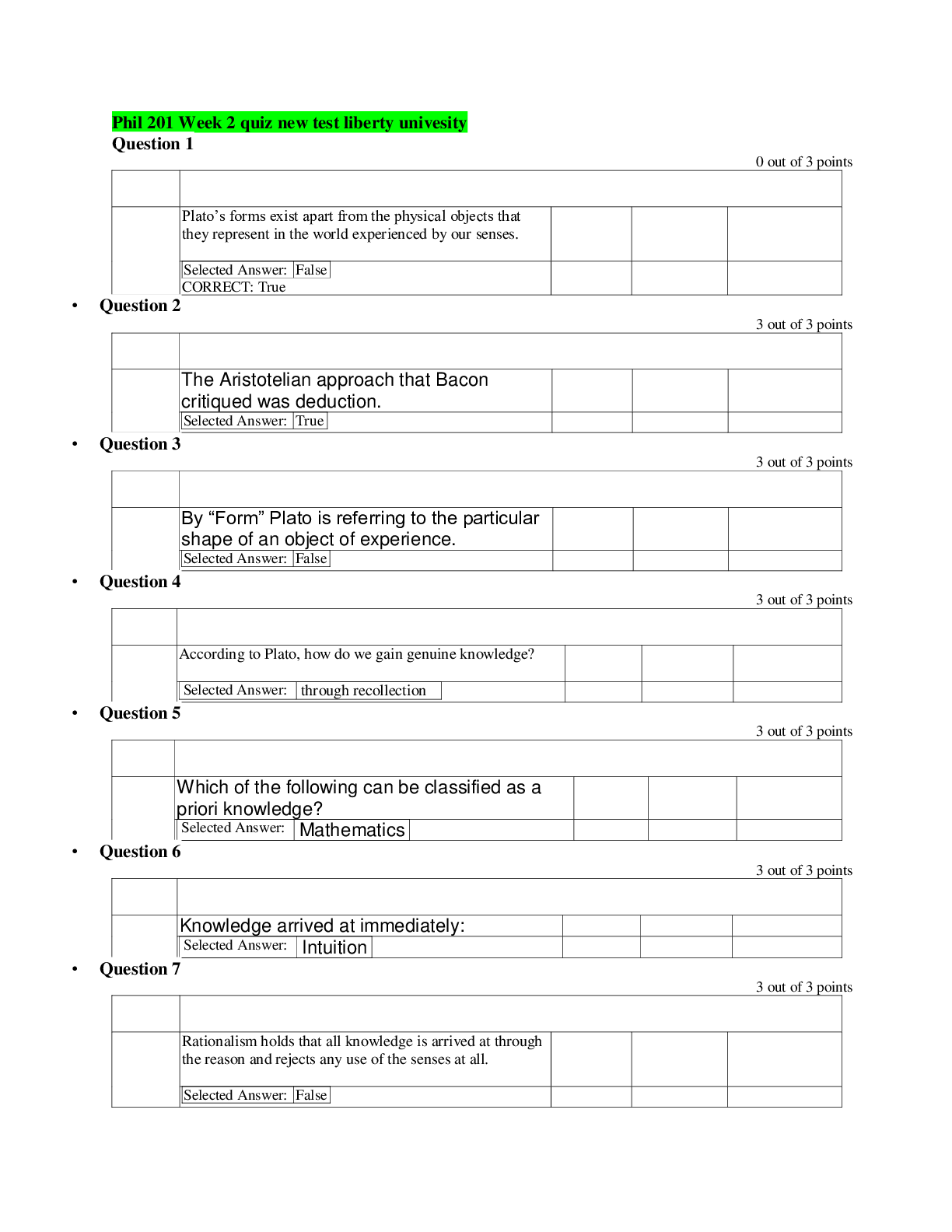
Phil 201 Week 2 quiz new test liberty univesity
Question 1
0 out of 3 points
Plato’s forms exist apart from the physical objects that they represent in the world experienced by our senses.
Question 2
3 out of 3 points
The Aristotelian approach that Bacon critiqued was deduction.
Question 3
3 out of 3 points
By “Form” Plato is referring to the particular shape of an object of experience.
Question 4
3 out of 3 points
According to Plato, how do we gain genuine knowledge?
Question 5
3 out of 3 points
Which of the following can be classified as a priori knowledge?
Question 6
3 out of 3 points
Knowledge arrived at immediately:
Question 7
3 out of 3 points
Rationalism holds that all knowledge is arrived at through the reason and rejects any use of the senses at all.
Question 8
3 out of 3 points
According to the presentation on truth theories, Coherence is a sufficient condition for truth, but it is not a necessary condition for truth.
Question 9
3 out of 3 points
The elements of a proposition include:
Question 10
3 out of 3 points
The philosopher who believed we are born with innate “categories of understanding” was:
Question 11
3 out of 3 points
The type of knowledge epistemology is primarily concerned with:
Question 12
3 out of 3 points
In the end Kant concluded
Question 13
0 out of 3 points
Gettier Problems show that:
Question 14
3 out of 3 points
The study of epistemology has had positive impact of which of the following?
Question 15
3 out of 3 points
As long as justification is present, one can be assured that he/she has real knowledge.
Question 16
3 out of 3 points
We should study epistemology so that we can find confidence on the biggest questions of life.
Question 17
3 out of 3 points
In order to count as knowledge, there must be some form of justification for the claim.
Question 18
3 out of 3 points
A sufficient condition is:
Question 19
3 out of 3 points
Gettier examples are aimed at showing that JTB is not a necessary condition of truth.
Question 20
3 out of 3 points
For a statement to be true, it need not correspond to reality, it need only be consistent with everything else that we believe to be true.
Question 21
3 out of 3 points
Which of the following is not one of the major pragmatists mentioned by Dew and Foreman?
Question 22
3 out of 3 points
Since coherentism and pragmatism fail as definitions of truth, we should refrain form using them as tests for truth.
Question 23
3 out of 3 points
Definitions of truth tell us the best ways to identify truth.
Question 24
3 out of 3 points
In coherentist theories of truth, the primary concern is how well (or consistently) one belief fits with all the other beliefs within the system.
Question 25
3 out of 3 points
The correspondence theory of truth is thought by some philosophers to be a pre-theoretic intuition that we philosophize with, not to.
[Show More]