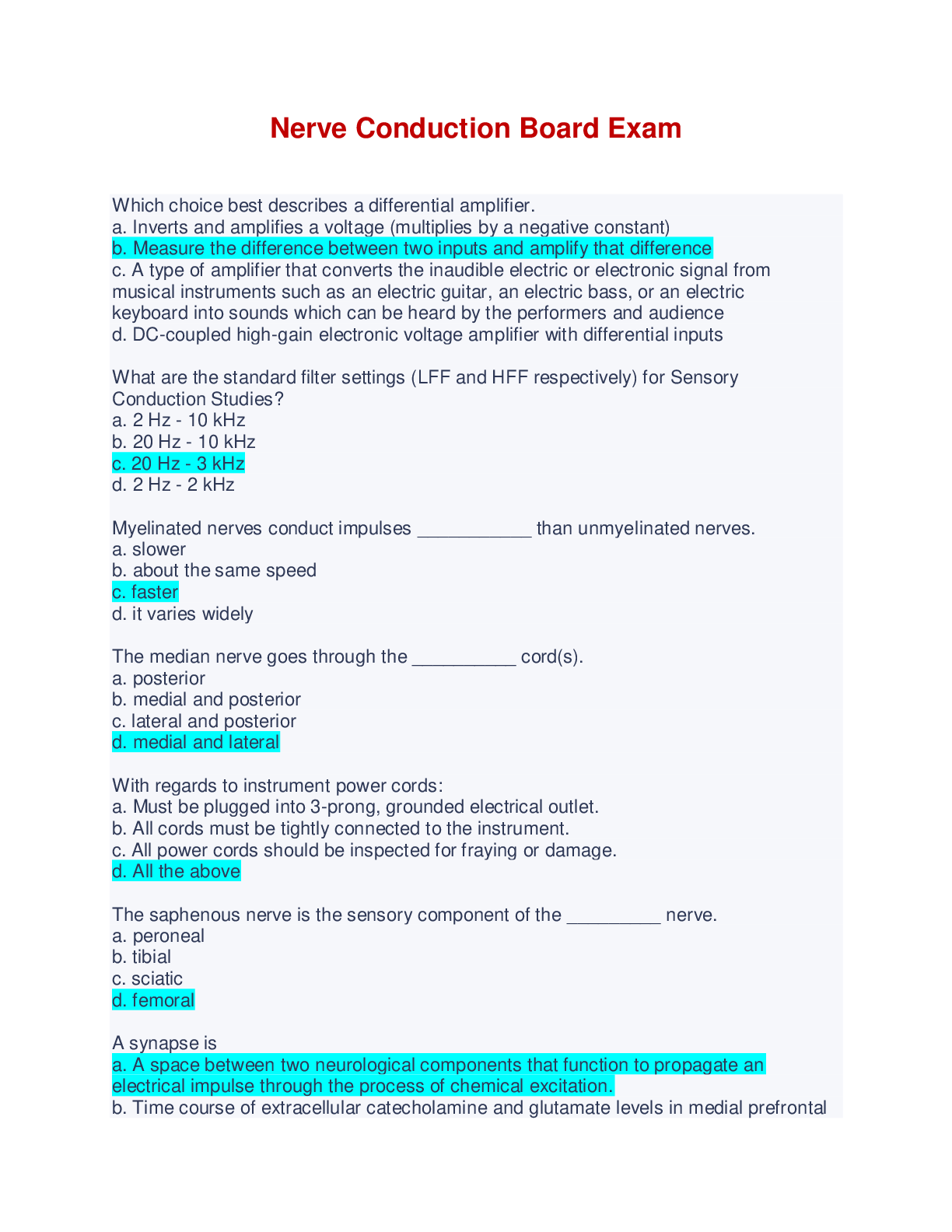
Nerve Conduction Board Exam - (Answered, Summer 2023) Which choice best describes a differential amplifier. a. Inverts and amplifies a voltage (multiplies by a negative constant) b. Measure the difference between two in
...
Nerve Conduction Board Exam - (Answered, Summer 2023) Which choice best describes a differential amplifier. a. Inverts and amplifies a voltage (multiplies by a negative constant) b. Measure the difference between two inputs and amplify that difference c. A type of amplifier that converts the inaudible electric or electronic signal from musical instruments such as an electric guitar, an electric bass, or an electric keyboard into sounds which can be heard by the performers and audience d. DC-coupled high-gain electronic voltage amplifier with differential inputs What are the standard filter settings (LFF and HFF respectively) for Sensory Conduction Studies? a. 2 Hz - 10 kHz b. 20 Hz - 10 kHz c. 20 Hz - 3 kHz d. 2 Hz - 2 kHz Myelinated nerves conduct impulses ___________ than unmyelinated nerves. a. slower b. about the same speed c. faster d. it varies widely The median nerve goes through the __________ cord(s). a. posterior b. medial and posterior c. lateral and posterior d. medial and lateral With regards to instrument power cords: a. Must be plugged into 3-prong, grounded electrical outlet. b. All cords must be tightly connected to the instrument. c. All power cords should be inspected for fraying or damage. d. All the above The saphenous nerve is the sensory component of the _________ nerve. a. peroneal b. tibial c. sciatic d. femoral A synapse is a. A space between two neurological components that function to propagate an electrical impulse through the process of chemical excitation. b. Time course of extracellular catecholamine and glutamate levels in medial prefrontal cortex during and after extinction of conditioned fear c. Electrically excitable cells in the nervous system that process and transmit information d. Contractile tissue of the body and is derived from the mesodermal layer of embryonic germ cells. Which statement is true? a. Orthodromic conduction has to do with depolarization of a nerve cell and Antidromic conduction has to do with repolarization of a nerve cell. b. Orthodromic conduction has to do with in the normal physiological direction and Antidromic conduction has to do with other than normal physiological direction. c. Orthodromic conduction has to do with presynaptic Ach and Antidromic has to do with postsynaptic receptors. d. Orthodromic conduction has to do with Sodium ions and Antidromic conduction has to do with Potassium ions. What are two chemicals that are instrumental in generating the electrical polarity of a nerve? a. Ne- and Ar+ b. Y- and Se+ c. Li+ and Cs- d. Na+ and K+ Find the resistance R if V=12 Volts and I=100 mA a. 120 Ohms b. 12 Ohms c. 1.2 Ohms d. 12K Ohms The _____________________________ is the point at which stimulation causes depolarization of the nerve cell. a. nodes of Ranvier b. orthodromic conduction c. saliatory conduction d. depolarization threshold Which choice best describes common mode rejection. a. The ratio of a signal power to the noise power corrupting the signal b. The ratio of the sum of the powers of all components to the power of the fundamental frequency c. A measurement of a waveform, calculated from the peak amplitude of the waveform divided by the RMS (time-averaged) value of the waveform d. Reject input signals common to both input leads Saltatory conduction is - a. Electrical chain reaction between cells b. The fatty tissue surrounding nerves c. The abrupt change of polarity of a cell d. Electrical chain reaction between nodes of myelinated axons Dorsal ulnar sensory innervation in the hand includes the dorsal surface of a. Digit V and half of digit IV b. Digits I-V c. Digits II-III and half of digit IV d. Digits I-III and half of digit IV There are three types of sensory receptors in a sensory nerve unit. They are - a. nociceptors, receptors, and endotheliocytes b. chemorecptors, acceptors, and exteroceptors c. exteroceptors, proprioceptors
[Show More]