NURSING.  >  STUDY GUIDE  >  NCSBN - Lesson 3: Health Promotion & Maintenance Study Guide,100% CORRECT (All)

NCSBN - Lesson 3: Health Promotion & Maintenance Study Guide,100% CORRECT

Document Content and Description Below

NCSBN - Lesson 3: Health Promotion & Maintenance Study Guide Lesson 3 – A: Antepartum, Intrapartum, & Postpartum Weight gain during pregnancy is one of the strongest predictors of infant birth w ... eight. Specifically, teens need to increase their intake of protein, vitamins and minerals including iron. Pregnant teens who gain between 26-35 pounds (11.79- 15.87 kg) have the lowest incidence of low-birth-weight babies. During the first trimester, the developmental focus is directed toward accepting the pregnancy and adjusting to pregnancy-related physical changes and discomforts. It is expected that the client will have some ambivalence during the first trimester, but the client can maintain physical intimacy with her partner if she wishes, including sexual intercourse. Looking at the fetus as a separate being and overcoming fears related to giving birth will occur in the third trimester, closer to the due date. A Rh negative mother who delivers a Rh positive baby may develop antibodies to the fetal red cells to which the mother may have been exposed during pregnancy or at placental separation. If the Coombs test is negative, no sensitization has occurred. To assess contractions for frequency, duration and intensity, the nurse will place one hand on the uterine fundus and use his or her fingers to feel the changes in the uterus as it contracts. The nurse can determine the frequency of the contractions by noting the time from the beginning of one contraction to the beginning of the next one. To determine the duration of the contraction, the nurse will note the time when tensing of the fundus is first felt (the beginning of one contraction) and again as relaxation occurs (end of contraction). It's best to time several consecutive contractions before charting frequency or duration. The uterus should be felt at the level of the umbilicus from about 1-24 hours after birth Family Planning The process of childbearing starts with education that takes into account when a couple desires children and how to prevent unwanted pregnancies. The nurse works with the woman, her partner and other health care providers to assess knowledge and educate and/or reinforce information about contraception with the client and her partner. Key Components of the Nurse-Client Relationship • Build trust • Acknowledge cultural and religious factors about family planning • Assess prior use of and knowledge about contraception • Address lifestyle • Determine desire for more children • Provide information about safe-sex practice Methods of Contraception There are many different methods of contraception. It is important that the client and her partner understand that other than celibacy or sexual abstinence, all forms or methods of contraception have health risks and are never 100% effective in preventing pregnancy. Fertility Awareness • The three most common methods include: o The calendar method (also called "rhythm method" or "natural family planning") estimates the date of ovulation based on length of cycle o Basal body temperature charting involves a woman taking her temperature in the morning every day before getting out of bed; a rise in temperature indicates ovulation o The cervical mucous method identifies ovulation by the increase in and "stretchability" of mucous • Symptothermal method: the combination of all three of the above methods Chemical Agents Chemical agents or spermicides in the form of creams, foams, jellies or suppositories prevent pregnancy by keeping sperm from joining with an egg (by blocking the cervix) or by keeping the sperm from moving. They are inserted deep into the vagina shortly before intercourse. Mechanical Barriers • Diaphragm – a shallow latex cup is inserted into the vagina; it should be used with spermicide cream or jelly to be as effective as possible • Cervical cap – a silicone cup inserted into the vagina to cover the cervix; it should be used with spermicide cream or jelly to be as effective as possible • Birth Control Sponge – a foam sponge is inserted into the vagina, which covers the cervix and blocks sperm from entering the uterus, while continuously releasing a spermicide • Condoms for females – a plastic pouch with flexible rings at each end covers the inside of the vagina and collects semen, preventing sperm from joining with an egg • Condoms for males – a thin latex or plastic sheath worn on the penis during intercourse to collect semen, which prevents sperm from joining with an egg Hormonal The hormones work by keeping a woman's ovaries from releasing eggs, thickening a woman's cervical mucus and thinning the lining of the uterus: • Single-hormone contraceptive pills containing progestin • Combined-hormone therapy containing estrogen and progestin o Most common side effects may include bleeding between periods, breast tenderness, nausea and vomiting (take at bedtime to help control this) o Contraindicated with (family) history of stroke, migraines, hypertension, diabetes, chronic renal disease, thrombophlebitis or tobacco use (particularly if the client is older than 35-years-old) • Emergency contraception (also called the "morning after pill") – this medication provides the body with a brief high dose of synthetic hormones similar to the traditional birth control pill to prevent pregnancy by stopping either fertilization or ovulation o The client typically takes two pills as soon as possible after having unprotected sexual intercourse; some brands/types require additional dosing o Most common side effects include nausea or vomiting; sometimes women may experience headache, dizziness and breast tenderness • Birth control patch – a plastic patch that sticks to the skin and releases estrogen and progestin is placed on the skin once a week for three weeks in a row, followed by a patch-free week • Birth control vaginal ring – a small ring that releases estrogen and progestin is placed in the vagina once a month for three weeks • Hormonal injections – the injection contains the hormone progestin and is intended to prevent pregnancy for three months. This method may delay conception for up to two years after discontinuing IUD An intrauterine device (IUD) is a small T-shaped plastic device that is wrapped in copper or contains hormones. It is an extremely effective, long-acting, cost-effective and reversible form of birth control. An IUD is inserted into the uterus by a physician. A plastic string tied to the end of the IUD hangs down through the cervix, into the vagina for the client to check if it is in place. • Hormonal IUD: o Releases levonorgestrel, which is a form of the hormone progestin and may prevent pregnancy for 3-5 years. o Advantages: It reduces menstrual bleeding and cramps and may even eventually stop menstrual periods. It does not cause weight gain. • Copper IUD: o This is the most commonly used IUD. o It can stay in place for up to 10 years. Even women who are breastfeeding can use this type of contraceptive o It can even be used for emergency contraception if the client has had unprotected sex and needs to avoid pregnancy AND if the client plans to continue using the IUD for birth control. o Disadvantages: may increase menstrual bleeding or cramps Although rare, there is a chance that the IUD may get stuck in or puncture the uterus. Permanent Sterilization A vasectomy is the surgical procedure to sterilize males. The procedure involves closing off or blocking each vas deferens, which keeps sperm out of the seminal fluid. • Advantages: the procedure can be performed under local anesthesia in a physician's office • Client education: partners should be counseled that alternative birth control methods need to be used temporarily because this does not cause a man to be instantly sterile A tubal ligation is used to sterilize females. This surgical procedure involves sealing the fallopian tubes shut, which prevents the sperm from being able to reach an egg. • Advantages: immediate sterilization • Longer recovery time than with vasectomy Preconception of Health Women should prepare for pregnancy at least three months before becoming pregnant. Preconception health involves knowing how health conditions and other risk factors could affect a woman or her unborn baby if she becomes pregnant. Preconception care improves the chances of becoming pregnant, having a healthy pregnancy and having a healthy baby. The nurse works with the woman, her partner and other health care providers to assess their understanding of preconception health and educate and/or reinforce information with the client and her partner. • Current Health Status o History of vaccines and screenings, including a Pap test and possibly screenings for sexually transmitted infections o How to manage known medical conditions/health problems, such as hypertension, depression, diabetes, asthma, eating disorders and epilepsy o The use of any over-the-counter or prescription medications and/or supplements • Potential Health Issues o Identifying genetic health problems that run in the family for both partners, such as Tay-Sachs disease, sickle cell anemia or cystic fibrosis o Avoiding contact with hazards and toxic substances or materials, such as certain chemicals and cat or rodent feces • Preparing for Pregnancy o Improve overall health, including: ▪ Reaching a healthy weight ▪ Making healthy food choices and taking 400-800 micrograms of folic acid every day to lower the risk of some birth defects of the brain and spine (such as spina bifida) ▪ Being physically active ▪ Caring for teeth and gums ▪ Reducing stress o Avoid illness o Stop smoking and drinking alcohol • Socioeconomic Issues o Explore family concerns that may affect health, including domestic violence or lack of support. Health Conditions and Other Risk Factors If these conditions are present before a woman becomes pregnant, they can increase the risk to the woman's health after she becomes pregnant. • Age o Girls younger than age 15: ▪ Have an increased risk of preeclampsia, preterm labor and anemia ▪ Are more likely to have babies who have anemia or who are underweight (small for gestational age) o Women age 35 and older: ▪ Have an increased risk of developing high blood pressure and gestational diabetes ▪ Are more likely to have complications during labor, such as preeclampsia, placental abruption and placenta previa ▪ Are more likely to have babies with chromosomal abnormalities ▪ Have a greater chance of stillbirth • Physical Characteristics o Weight - less than 100 pounds (45.35 kg) o Height - shorter than five feet • Socioeconomic Issues o Domestic violence o Poverty o Access to health care • Problems in a Previous Pregnancy o Grand multiparity (typically five or more pregnancies) o Complications and problems in past pregnancies: ▪ Previous miscarriage or stillbirth ▪ Premature baby ▪ Underweight baby or a baby that weighed more than 10 pounds (4.5 kg) ▪ Baby with birth defects ▪ Post-term delivery (after 42 weeks) ▪ Labor that required a cesarean delivery • Health Issues o Disorders, hereditary conditions or chronic health problems, including: ▪ Diabetes ▪ Hypertension ▪ Heart disease ▪ Kidney disease ▪ Cancer ▪ Autoimmune diseases (such as lupus and multiple sclerosis) • Infection o Urinary tract infections o Venereal diseases o Human immunodeficiency virus (HIV) o Fifth disease o Toxoplasmosis (a rare but serious infection associated with cats) • Teratogens o Exposure to potential teratogens include: ▪ Medications, including isotretinoin (used to treat severe acne), some anticonvulsants, lithium, some antibiotics (such as streptomycin, kanamycin and tetracycline), thalidomide, warfarin and angiotensin- converting enzyme (ACE) inhibitors ▪ Alcohol ▪ Cocaine use ▪ Smoking cigarettes Conception Fertilization typically occurs in outer third of the fallopian tube and implantation usually occurs 7-10 days after fertilization. The trophoblast secretes enzymes which enable it to burrow into the endometrium. The trophoblast develops chorionic villi which secrete human chorionic gonadotropin (hCG): • hCG inhibits further ovulation by stimulating secretion of estrogen and progesterone • Nausea, vomiting, "morning sickness" in first trimester is attributed to hCG • A pregnancy test can detect this hormone in the urine about 10 days after the first missed period Women should be advised to seek advice from their health care provider early in the pregnancy. Presumptive Findings • Amenorrhea – missed menstruation • Fatigue • nausea and/or vomiting (morning sickness) • breast changes • elevation of basal body temperature • skin changes. • These findings may be caused by conditions other than pregnancy. Probable Findings • Probable changes are those observed by the health care provider: • Chadwick's sign: increased vaginal vascularity contributes to bluish purple hue of the cervix, vagina and vulva • Hegar's sign: increased vascularity and softening of uterine isthmus • Goodell's sign: cervical softening caused by stimulation from estrogen and progesterone Positive Findings • Qualitative hCG testing (beta hCG) detects the presence of hCG in the blood to confirm pregnancy. A progesterone test may also be ordered, which will help diagnose an ectopic pregnancy and monitor a pregnancy that may be failing. Home pregnancy tests detect hCG in urine. • Positive signs include fetal heart tones • visualization of fetus • palpating fetal movements. Termination of Pregnancy Abortion means ending a pregnancy early. When a pregnancy ends on its own, before the 20th week of pregnancy, it is called a miscarriage; after 20 weeks, losing a pregnancy is called a stillbirth. Voluntary termination of pregnancy is referred to as an abortion. There are two methods for an induced abortion: medical and surgical. Miscarriage Miscarriage is the most common type of pregnancy loss and is commonly due to a chromosomal abnormality. Other causes for miscarriage may include lifestyle (such as smoking, drug use, malnutrition, exposure to radiation or toxic substances) maternal age or maternal trauma. Pregnancies which end due to miscarriage can be devastating and painful. The nurse should provide information and support to women and their families experiencing a perinatal loss and offer supportive statements, such as "I am sorry for your loss" or "I am sorry this is happening to you." The Rh negative mother must receive Rho(D) immune globulin after a miscarriage to prevent isoimmunization. Whenever a miscarriage takes place, your role will include assessment, potential nursing diagnosis and implementing nursing care. • Assess: o Uterine bleeding and pain o Laboratory findings o Obtain history o Potential nursing diagnosis: o Anxiety/fear o Knowledge deficient o Fluid volume deficient o Grief • Plan/Implement: o Monitor vital signs o Monitor bleeding and pain o Monitor hydration o Administer Rho(D) o Save tissues as needed o Education on bedrest and surgical procedure if indicated o Provide emotional support or referral for grief and loss • Evaluate: o Have complications been prevented o Client adjustment to loss Medical Abortion The process begins with either receiving an injection (methotrexate) or taking a pill (mifepristone or RU-486) to end the pregnancy. A few days later, the woman takes either a pill or uses a vaginal suppository (misoprostol), which causes the uterus to contract and empty. Both mifepristone and methotrexate will cause bleeding and strong cramps; some women experience nausea, vomiting or diarrhea. At the first clinic visit, the client will receive counseling, provide her medical history, undergo a physical exam (including an ultrasound) and have blood drawn for lab tests. The client signs a consent form and receives the first pill or injection. The client returns for a follow up visit in one to two weeks to make sure the abortion is finished. If it is not, the client may receive more medication or may need a surgical abortion. Surgical Abortion For the surgical abortion, the cervix is dilated and then the uterus is emptied of the pregnancy either using manual vacuum aspiration or dilation and curettage (D&C). At the first clinic visit, the client will receive counseling, provide her medical history, undergo a physical exam (including an ultrasound) and have blood drawn for lab tests. The client signs a consent form. The client returns in about a week for the abortion. Two weeks later she returns for a post- abortion checkup Ectopic Pregnancy & Gestational Trophoblastic Disease Throughout all the stages of pregnancy, complications may arise that the nurse needs to anticipate and be ready to provide interventions. Ectopic Pregnancy An ectopic pregnancy occurs when the fertilized ovum is implanted outside the uterine cavity, usually in the fallopian tube. It occurs as the result of tubular obstruction or blockage that prevents normal transit of the fertilized ovum. It is considered a medical emergency. • Assess o Missed period o Unilateral lower quadrant pain o Rigid/tender abdomen o Possible referred shoulder pain o Low hematocrit o Bleeding • Nursing dx o Pain related to implantation of egg outside of uterus o Anxiety/fear/grieving o Hemorrhage (can be life threatening) • Plan/Intervention o Prepare client for surgery o Monitor for shock preoperatively and postoperatively o Administer Rho(D) to RH negative women o Emotional support o Discharge teaching • Evaluate o Adjustment to loss of pregnancy o Have complications been prevented Gestational Trophoblastic Disease (Hydatidiform Mole) Gestational Trophoblastic Disease is a developmental anomaly where chorionic villi degenerate into a bunch of clear vesicles in grapelike clusters. An embryo is rarely present in these cases. • Assessment o Vaginal bleeding o Uterus larger than expected o Possible anemia o Nausea and vomiting o Abdominal cramping o Early symptoms of preeclampsia • Nursing dx o Grieving/loss o Knowledge deficient o Anxiety/fear • Plan/Interventions o Monitor vital signs, vaginal bleeding and uterine cramping o Preoperative and postoperative D&C care: ▪ No pregnancy for one year ▪ Obtain monthly serum hCG levels for one year ▪ Report bright-red vaginal bleeding, temperature over 100° F (30° C) degrees and foul- smelling vaginal discharge ▪ Provide resources for grief and loss Hypertension/Preeclampsia/Eclampsia Gestational hypertension presents as high blood pressure around mid-pregnancy without proteinuria. Mild preeclampsia Assessment BP: > than 140/90mmHg after 20 weeks gestation Proteinuria: 300 mg/L per 24 hr, Greater than 1+ for random sample Seizure: No Hyperreflexia: No Other: Mild facial edema, Weight gain (> than 4.5 lb/wk (2.6 kg/wk)). Treatment Monitor BP daily Bed rest in left lateral position 6-8 oz (177-236 mL) water per day Frequent follow up Severe preeclampsia Assessment BP: > than 160/110 mmHg Proteinuria: > 500 mg/L per 24 hr, > 3+ random sample Seizure: No Hyperreflexia: Yes Other: Headache, Oliguria, Blurred Vision RUQ pain, Thrombocytopenia, Hemolysis, elevated liver enzymes, low platelet count (HELLP) Treatment Depends on fetal age Only cure is delivery of fetus (induction of labor) Control BP (hydralazine) and prevent seizures (magnesium sulfate) Prevent long term morbidity and maternal mortality Emotional support (if delivery is before viability) Eclampsia (Medical Emergency) Assessment BP: > 160/110 mmHg Proteinuria: Marked proteinuria Seizure: Yes Hyperreflexia: No Other: Same as severe preeclampsia, severe headache, renal failure, cerebral hemorrhage Treatment Support through seizures and potential coma Ensure patient airway and oxygen support DIC management Delivery of fetus Emotional support (if delivery is before viability) In cases of severe hypertension, seizures may still occur 24-48 hours postpartum Placenta Previa & Abruptio Placentae Placenta Previa Occurs when a baby's placenta partially or totally covers the mother's cervix • Assessment o First and second trimester spotting o Third trimester bleeding that is sudden, frank (bright red blood in the stool), profuse but painless o Ultrasound to show the degree of obstruction • Dx o The placenta is implanted in the lower uterine segment and may partially or totally cover the cervical opening o Nursing diagnosis: ▪ Impaired fetal gas exchange ▪ Risk for deficient fluid volume ▪ Deficient knowledge ▪ Anxiety/fear • Plan/Interventions o Hospitalization initially: ▪ Side lying or Trendelenburg for 72 hours ▪ No vaginal or rectal exams ▪ Amniocentesis for lung maturity ▪ Assess daily Hgb ▪ Weigh peripads (I gram = 1 mL blood loss) ▪ Cross-matched blood available (2 units) ▪ Monitor blood loss o Discharge if stable: ▪ Limit activity ▪ No douching, enemas or sex ▪ Record fetal movement ▪ Non stress test every 1-2 weeks o Cesarean delivery: ▪ If evidence of fetal maturity, excessive bleeding or active labor • Evaluation o Was the infant delivered safely (if applicable)? o Were complications prevented? Abruption Placentae (Premature Separation of Placenta) Abruptio placentae is the premature separation of the placenta from the uterus. • Assessment o Painful, dark red bleeding o Abdomen (pubic) tender and painful o Possible fetal distress o Possible maternal shock o Contractions • Nursing Dx o Deficient fluid volume o Impaired fetal gas exchange o Acute pain o Anxiety/fear • Interventions o Monitor for maternal shock and fetal distress o Prepare for immediate delivery • Postpartum Complications o DIC (bleeding gums, bleeding around IV site) o Pulmonary emboli o Infection o Renal failure • Evaluation o Has fluid and electrolyte balance been maintained o Have complications been prevented Post-Partum Hemorrhage Significant blood loss after giving birth: >500ml after VAGINAL delivery or > 1000ml after CESAREAN SECTION delivery. Primary (w/n 24hrs) vs Secondary (after 24 hrs) Causes: Tone, Trauma, Tissue, and Thrombin • Tone: Lack of uterine tone (aka Uterine Atony) o Soft, spongy, boggy uterus  slow and steady loss of blood o Myometrium, which is the smooth muscle does not continue to contract after birth, placental arteries do not clamp down = hemorrhage ▪ Atony caused by: • Repeated distention o Multiple pregnancies o Overstretching from twins/triplets o Or any too much stretching that can lead to efficient uterine contractions that could lead to diminished tone • Muscle fatigue during delivery process during prolonged labour • Inability to empty bladder – can push on uterus • Obstetric medications o Anesthetics (e.g halothan) o Magnesium sulfate, nifedipine, terbutaline ▪ Tx for Atony • Fundal massage, near umbilicus after birth • Urination/catheter if bladder is full • Medications • Surgery • Trauma: damage to any genital structures: uterus, cervix, vagina, perineum. Can also be incision from C section, baby coming thru vaginal canal, from medical instruments o Hematoma – mass or collection of blood can form ▪ S&S: persistent bright-red bleeding, severe pain • Tissue: Placental fragments retained in uterine cavity o Placenta Accreta/too much traction on the umbilical cord ▪ Placenta invades myometrium, does not easily separate from the uterus ▪ This can cause the placenta to retain  prevents contractions  atony o Preventions ▪ Placenta coming out intact, or remove retained tissue ASAP • Thrombin: has blood clotting condition – genetic or obstetric such as eclampsia or placental abruption. This can lead to Disseminated Intravascular Coagulation = prevents clot formation Assessments • Decrease/ </ 10% HCT • Changes in Mother’s o HR o BP o O2 Tx • Maintain adequate circulating volume thru IV fluids or blood products The health care team will evaluate the mother's health status and confirm her reproductive summary (gravida and parity). They will also review the health history of the expectant mother's and her partner's families. Socioeconomic factors, such as housing, transportation, finances, proximity to health care and the hospital will be determined. Lifestyle will be discussed, and risky behaviors will be identified. Cultural and religious practices will be discussed and incorporated into the plan of care. Birthing options will be discussed, and early plans will be made if a home birth is anticipated. Factors Affecting Labor & Delivery The 5 Ps: Passenger, Passage, Powers, Placenta, Psychosocial • Passenger (fetus) o Presentation of the fetus ▪ Cephalic: head alone is the presenting part • Vertex • Brow • Military • Face ▪ Breech: head alone is NOT the presenting part • Frank: buttocks present, fetal hips are flexed and knees are extended • Complete: buttocks and feet present, fetal hips and knees are flexed, lower legs crossed • Kneeling: knees present • Footling: foot or feet present • Shoulder: shoulder presents, transverse lie • Compound: two presenting parts such as head and hand o Position of the fetus ▪ Right or left ▪ Presenting part: • O= occiput • M = mentum • S = sacrum • A = acromion process • D = dorsal ▪ How the presenting part faces the pelvis: • Front (A = anterior) • Back (P = posterior) • Side (T = transverse) ▪ Remember: • LOA (left occiput anterior): fetal occiput is on the left side of the maternal pelvis toward the front and the fetal face is toward the rear of the pelvis • ROA (right occiput anterior): fetal occiput is on the right side of the maternal pelvis toward the front and the fetal face is toward the rear of the pelvis • LOP (left occiput posterior): fetal occiput is on the left side of the maternal pelvis toward the rear and the fetal face is toward the front of the pelvis • ROP (right occiput posterior): fetal occiput is on the right side of the maternal pelvis toward the rear and the fetal face is toward the front of the pelvis o Size of the fetus ▪ The largest part of the fetus is the head. Its size and ability to mold under the pressure of the powers of labor are a factor in delivery. • Passage: refers to the bony pelvis (the inlet, pelvic cavity and the outlet) and soft tissues of the cervix, pelvic floor and vagina. This is influenced by: o Parity of the mother o Resistance of the soft tissues as the fetus passes through the birth canal o Fetopelvic diameter • Power: refers to contractions o Primary powers: the frequency, duration and intensity of uterine contractions o Secondary powers: the diaphragmatic and abdominal muscles used when bearing down to expel the fetus • Placenta o Site of implantation o Whether it covers part of the cervical os • Psychosocial: refers to the mental and physical state of the woman o Mental and physical preparation for labor o Sociocultural values and beliefs o Previous childbirth experience o Support from significant others o Emotional status 1st Trimester • Physical Assessment o The physical exam will include: • Baseline vital signs, weight and height • Head-to-toe, general well-being assessment • Breast and abdominal examination • Pelvic exam, possibly Pap test • Lab tests: o Urinalysis for glucose, protein, blood and bacteria o Urine or blood hCG levels o Complete blood count o Blood type and Rh factor o Rubella titer o Possible screening for sexually transmitted infections, such as syphilis and HIV antibody (with client's permission) and cervical culture for chlamydia and gonorrhea o Hepatitis B surface antigen (HBSAG) and hepatitis B surface antibody (HBsAB) o Possible tuberculin skin test 1st Trimester: Psychological Assessment Assess client's psychosocial response to pregnancy, including support systems, perception of pregnancy and coping mechanisms. The nurse should discuss how the client and her partner feels about the pregnancy. The emotional response can range from tremendous excitement to ambivalence. Rho(D) immune globulin Rho(D) immune globulin is an immune globulin (Ig) that blocks formation of antibodies and suppresses the immune response of the nonsensitized Rh negative woman who has been exposed to Rh positive antigens. Prophylaxis for Rh negative mother Prophylaxis for the Rh negative mother includes: • Rho(d) immune globulin should be given at 28 weeks • It should also be administered within 72 hours after delivery, regardless if it was received during the antepartum period o The Coombs' tests are used to detect antibodies after the birth of each Rh positive newborn • Direct Coombs' test on newborn using neonatal cord blood • Indirect Coombs' test and antibody screen on the mother A normal (negative) indirect Coombs' test indicates that no antibodies are detected (there is no clumping of the cells) and the woman is a candidate for Rho(D) immune globulin An abnormal (positive) indirect Coombs' test means that antibodies are detected and you should NOT administer Rho(D) immune globulin Rho(D) immune globulin should be given after any possible exposure to fetal blood, such as after each ectopic pregnancy, miscarriage or abortion, after an amniocentesis Never administer Rho(D) immune globulin to a Rh positive woman, a sensitized Rh negative woman (someone who has a positive indirect Coombs' test) or a Rh negative woman who has given birth to an Rh negative baby. The nurse will identify the learning needs of the expectant mother and her partner and individualize information. Maternal Changes • The nurse discusses maternal changes and offers anticipatory guidance: • Fatigue – suggest going to bed earlier, eating a balanced diet and taking iron supplements to prevent anemia. • Tender, swollen breasts – suggest wearing firm, supportive bras. • Heartburn, nausea and/or vomiting (morning sickness) – suggest eating smaller and more frequent meals, eating dry crackers and/or dry toast with tea, avoiding greasy and fried foods. Acupuncture, acupressure, ginger root and vitamin B6 may also help. • Constipation – explain that adequate fluid intake is important and to use only natural methods to avoid constipation, such as eating prunes or drinking prune juice. Docusate (Colace) and psyllium (Metamucil) can also be used. • Headache or backache – chiropractic manipulation for backache works well. The nurse may suggest applying a cold compress to the forehead. Acetaminophen is one of the safer analgesics, but be sure to reinforce that no drug is completely safe. The nurse should also explain that nonsteroidal anti-inflammatory drugs (NSAIDs) are contraindicated in the third trimester of pregnancy (they are associated with early closure of the fetal ductus arteriosus and decreasing fetal renal function). • Provide instruction about Kegel exercises. Nursing Plan/Interventions During the first visit, the nurse should recommend that in addition to a healthy diet, the mother will need to take prenatal vitamins, folic acid and iron supplements. The nurse also needs to perform a risk assessment and reinforce that she should avoid all medications, tobacco and other substances, avoid hot tubs and exposure to illness. Be prepared to provide referrals for childbirth classes and discuss the schedule for antepartal visits. Review fetal development with the mother and her partner and educate them to quickly report warning signs including, including vaginal bleeding, abdominal cramping or pain, severe or prolonged vomiting and/or a persistently elevated temperature greater than 101° F (38.3° C). 1st Trimester: Role of Expectant Woman & Partner The expectation is that for the expectant woman and her partner keep scheduled (monthly) appointments, maintain a healthy lifestyle and follow the recommended diet along with vitamins and supplements. Encourage the expectant woman to discuss how the pregnancy impacts her sexually with her partner. The expectant woman and her partner should discuss plans for a hospital or at home birth with their health care provider. Reinforce that she should contact the health care provider with questions and/or to report any of the warning signs of pregnancy. 1st Trimester: Fetal Assessment There are several assessments that are performed during the first trimester of pregnancy to evaluate the fetus. • Tests and Ultrasound o Transvaginal Ultrasound • An ultrasound probe is placed inside the vagina to examine the uterus and ovaries. It will show a gestational sac once hCG levels have reached between 1000-2000 mIU/mL, which is usually around 5-6 weeks. It can also identify an ectopic pregnancy and is used to help diagnose abnormal vaginal bleeding and menstrual problems. o Standard Ultrasound • A standard ultrasound is used starting around week 6-8 to monitor the growth of the fetus, track milestones, detect abnormalities, determine if there is more than one fetus, see the position of the placenta and, eventually, determine the sex of the fetus. It can also be used to rule out an ectopic pregnancy and verify the presence of an intrauterine contraceptive device. Inform your client that a full bladder will enhance visualization when her abdominal ultrasound is performed. o Nuchal Translucency (NT) • The NT test is a two-part test used to evaluate the risk of having a baby with Down syndrome, trisomy 18 or certain heart defects. Performed at 11-13 weeks, the NT test consists of a blood test to measure hormones and proteins and an ultrasound to determine the thickness of the back of the fetus' neck, which indicates a risk for Down syndrome and trisomy 18. o Chorionic Villus Sampling (CVS) • CVS is a prenatal test that diagnoses chromosomal abnormalities, such as Down syndrome, and genetic disorders, such as Tay-Sachs disease and hemophilia. The test involves obtaining a cell sample from the chorionic villi of the placenta and is usually performed at 10-12 weeks. Learning that the fetus has a serious health issue can help the client and her partner decide early if they want to continue the pregnancy or make plans to care for a sick child. • Fetal Development o BY 8 WEEKS • Milestones • The end of the eighth week marks the end of the "embryonic period" and the beginning of the "fetal" period. • Head and heart grow rapidly • Head is larger than trunk • Central hemispheres appear • Face elongates • Eyelid folds have developed although eyes are still far apart • Flat nose and recognizable mouth • External ears look similar to final appearance • Arms, legs, fingers and toes are distinct • Heart and liver are prominent o BY 12 WEEKS • Milestones • Approximate length: 6 centimeters Approximate weight: 14 grams • Intestinal villi form • Bladder and urethra separate from rectum • Kidneys begin to secrete urine that makes up the amniotic fluid • Bronchioles branch and pleural; lungs assume definitive shape • Pericardial cavities appear • Thyroid and pancreas begin to secrete hormones • Red blood cells are produced in the liver • Sex is distinguishable • Bone ossification occurs; tooth buds appear • Able to suck and swallow • Eyelids close and will not reopen until about the 28th week Second Trimester: Maternal Assessment It is important for your pregnant client to have regular monthly prenatal appointments. During these visits, the health care team will assess and compare current findings with previous findings and expected changes to the mother and fetus. Expected Maternal Changes • Colostrum is produced (breast fluid) • Skin o Linea nigra (a darkened vertical line on the abdomen) is caused by melanin and progestin effects. o Melasma gravidarum (the "mask of pregnancy"), which is a dark, blotchy brownish change in pigmentation that occurs around the hairline, brow, nose and cheeks, may appear; it usually fades after pregnancy but may recur after sun exposure. • Cardiovascular o The mother may experience supine hypotensive syndrome. She may also experience bleeding gums, due to increased vascularity of oral cavity, and leg varicosities and vascular spiders, due to pelvic vasocongestion, the pull of gravity, pressure from the uterus and/or forcing stool during bowel movements. • Gastrointestinal o A slowing down of peristaltic movement and compression of the colon by the uterus and growing fetus, as well as hormonal changes and iron supplements, may contribute to constipation. The mother may experience heartburn or gastric reflux due in part to the enlarged uterus displacing the stomach upward, along with a relaxation of the stomach, esophagus and gastroesophageal sphincters. • Musculoskeletal o The mother may experience leg cramps, due to calcium-phosphorus imbalance. She may also experience groin pain, due to the stretching of ligaments. Lab Tests & Procedures • Urinalysis is performed for protein and glucose. • Quad marker screening, also called maternal serum expanded alpha-fetoprotein (AFP) screening, is performed at 16-18 weeks to test for chromosomal and congenital malformations and neural tube defects. • Human chorionic gonadotropin (hCG) is tested. • Estradiol (E2) is tested. • Gestational diabetes screening is performed at 24-28 weeks. o Nonfasting one-hour (50 g) glucola screening is performed. If the reading is greater than 140 mg/dL (7.8 mmol/L) the next step is to perform a three-hour oral glucose tolerance test (OGTT). o OGTT is a diagnostic test for GDM, performed when two out of the four values meet or exceed normal limits. • If the client is considered high risk, viral screening is performed for Hepatitis B, HIV etc. • Tuberculin test is performed if the client is considered high risk. • Amniocentesis might be performed at 15-18 weeks to obtain a sample of amniotic fluid for direct analysis or fetal chromosomes, development, viability and lung maturity. The Rh-negative mother must receive Rho(D) immune globulin after the procedure to prevent isoimmunization. Risks of amniocentesis include amnionitis spontaneous abortion, preterm labor or premature rupture of membranes. Second Trimester: Nursing Care The nurse plays a vital role in identifying the learning needs of the expectant mother and her partner, and then applies that information to their specific needs. • Maternal Changes o As part of your nursing care, alert your client to upcoming maternal changes and offer solutions for common complaints: ▪ Heartburn – suggest avoiding greasy and fried foods, eat smaller portions and low-fat foods. ▪ Bleeding gums – suggest using an extra soft toothbrush. ▪ Leg cramps – suggest performing calf-stretching exercises and changing positions frequently. ▪ Constipation – explain that adequate fluid intake is important and to only seek relief through natural methods, such as eating prunes or drinking prune juice. Docusate (Colace) and psyllium (Metamucil) can also be used if approved by the health care provider. • Nursing Plan/Intervention o If the mother is Rh-negative, she should receive Rho(D) immune globulin (24-28 weeks). o Encourage your client to contact her health care provider with questions and/or to report any of the warning signs of pregnancy, including: ▪ Vaginal bleeding ▪ Abdominal cramping or epigastric pain ▪ Severe or prolonged vomiting ▪ Persistently elevated temperature greater than 101° F (38.3 C°) ▪ Decreased or absent fetal movement ▪ Swelling of face, fingers, ankles and/or feet ▪ Sudden weight gain of more than four pounds (1.8 kg) in a week ▪ Headaches or visual disturbances ▪ Burning or painful urination ▪ Diarrhea 2nd Trimester: Role of Expectant Woman & Partner Encourage the expectant woman and her partner to keep scheduled (monthly) appointments, maintain a healthy lifestyle and follow the recommended diet including vitamins and supplements. Remind your client that it is healthy to talk to her partner about role changes, as well as how the pregnancy impacts her sexually. If applicable, the client and her partner should prepare the other children for the new sibling. If they haven't already, they should enroll in a childbirth education class and identify a pediatrician or other health care provider for the baby. They will also want to make plans with their employers for adapting employment to parenthood and discuss whether they will need childcare and what form that might take. Reinforce that they should contact the health care provider with questions and/or to report any of the warning signs of pregnancy. 2nd Trimester: Fetal Assessment Assessment of the fetus includes asking the mother about the date of quickening (when the first movements of the fetus were felt). On average, quickening occurs between weeks 18-20. An ultrasound Doppler is used to measure fetal heart rate. Fetal heart rate will be first detected around 12-14 weeks. The RN will palpate the fetal outline using Leopold maneuvers. Palpating the fundus will determine which fetal part occupies the fundus. Palpating each side of the mother's abdomen will help you determine which side the fetal spine and extremities are on. Palpating above the symphysis pubis will locate the fetal presenting part. The height of the fundus in centimeters corresponds to the number of weeks of gestation. • BY 16 WEEKS o Milestones ▪ Approximate length: 12 centimeters ▪ Approximate weight: 100 grams o Joint cavities are present o Bile is secreted o Intestines assume normal position; meconium is made o Kidneys in proper position o Lanugo develops on the head o Testes begin to descend into inguinal canal o Skin is almost transparent o Sucking motions are made with the mouth • BY 20 WEEKS o Milestones ▪ Approximate length: 26 centimeters ▪ Approximate weight: 300 grams o Brain grossly formed o Spinal cord myelination begins o Lanugo hair covers entire body o Eyebrows and lashes appear o Nails appear on the fingers and toes o The mother can feel the baby moving • BY 24 WEEKS o Milestones ▪ Approximate length: 30 centimeters ▪ Approximate weight: 600 grams o External genitalia discernible o Skin red and wrinkled o Lungs begin to produce surfactant o Meconium present in rectum o Eyes are structurally complete 3RD Trimester: Maternal Assessment In the third trimester of pregnancy, the health care team will assess the mother's current health status. They will compare current findings with previous findings and review expected changes for both mother and fetus. The mother will be asked about any physical indications of possible health issues, including headaches, visual changes, epigastric distress and contractions or cramping. A general physical assessment will include measuring weight and vital signs and observing for edema, which could indicate preeclampsia. At or near term there will be a pelvic exam to assess cervical dilation and effacement. The factors that affect the process of labor and delivery (passenger, passage, powers, placenta and psychology) are assessed. 3rd Trimester: Expected Maternal Changes • Expected maternal changes include many of the same issues first experienced in the second trimester, including constipation, acid reflux, bleeding gums, leg varicosities and supine hypotensive syndrome. • As the fetus continues to grow and move, the mother may now experience insomnia, urinary frequency, dyspnea and pedal edema. Although more embarrassing than an actual health issue, the mother may experience an increase in flatulence; she may also develop hemorrhoids. Her gait changes, which is known as the "pregnancy waddle." • Towards the end of the third trimester, the mother will begin experiencing irregular uterine contractions (known as Braxton-Hicks contractions or "false" labor). As the fetal head drops and engages in the pelvis (referred to as lightening), the mother will be able to breathe easier but will need to urinate more often. She may experience a burst of energy, commonly referred to as the "nesting instinct." Just before labor begins, she will experience a discharge of a small amount of blood or blood-tinged mucus as the cervix changes in shape. 3rd Trimester: Laboratory Tests & Procedures • Urinalysis for protein • Antibody screening at 28 weeks gestation if client is Rh-negative • Cervical culture for group B streptococcus at 34-36 weeks gestation • Hemoglobin and hematocrit – With normal pregnancy, blood volume increases, which results in hemodilution. And even though the mass of red blood cells increases, plasma volume increases, which results in a relative anemia. 3rd Trimester: Labor vs. False Labor Nursing care includes offering anticipatory guidance, including confirming birth options, feeding choices and plans for newborn care and recognizing the signs of false labor as her body prepares for true labor. True Labour False Labour Contractions Occurs at regular intervals Unaffected by activity Increases in strength and frequency Irregular Diminishes with activity Usually weak and do not intensify Pain Location Usually starts in the lower back and moves to the front of the abdomen Usually felt in the front of the abdomen or pelvic region Membranes May be either intact or ruptured Intact Cervix Effacement and dilation No changes 3rd Trimester: Nursing Care Maternal Changes • Urinary incontinence – suggest pelvic floor exercises (Kegel exercises) • Hemorrhoids – review measures to prevent constipation such as sitting in a tub of warm water • Low back pain – suggest pelvic exercises (such as the pelvic rock and pelvic tilt) and massage (but only if performed by a therapist trained in prenatal massage) • Insomnia – encourage adequate periods of rest, a relaxing bath or shower before bed and using a pillow for support while lying in the left lateral or Sims position with legs flexed • Varicosities (leg, vulva) – remind her to change position frequently, not to cross her legs, to elevate legs when possible and wear support stockings • Dyspnea or shortness of breath – encourage her to sit erect, maintain a healthy weight gain and to use the left side-lying position for sleep • Leaking of colostrum – suggest wearing a support bra and using pads if necessary Kick Counts An active fetus reflects adequate oxygenation by the uteroplacental unit. The mother should monitor her baby's movements daily during the third trimester of pregnancy, starting in week 28. Mothers pregnant with multiples or who are high risk should start earlier. How-to guide: • The mother should count the kicks every day, preferably at the same time • She can sit with her legs up or lie on her side • She will then count 10 distinct movements; it usually takes about 30 minutes, but could take as long as two hours • Once she counts 10 kicks, she can stop counting and record the information. There may be some variability in movement, but kick count patterns should be similar. The mother should contact the health care provider if it takes longer than usual to get to 10 movements or if there are other changes in the movement pattern. If the fetus is quiet, the mother can drink some juice and repeat the count. If at least three movements are not noted within an hour, the mother should call the health care provider. Nursing Plan/ Intervention Around week 28, the nurse should explain the purpose of and how to perform kick counts to count fetal movement. The nurse reinforces that she should contact the health care provider with questions and/or to report any of the warning’s signs of pregnancy, including: • Vaginal bleeding • Abdominal pain, especially sudden and severe epigastric pain • Uterine contractions • Premature rupture of the membranes • Decreased or absent fetal movement • Persistently elevated temperature greater than 101° F (38.3 C°) • Swelling of face, fingers, ankles and/or feet and/or anasarca • Sudden weight gain of more than four pounds (1.8 kg) in a week • Headaches or visual disturbances 3rd Trimester: Role of Expectant Woman & Partner Remind the expectant woman and her partner to keep scheduled (every two weeks and then weekly) appointments, maintain a healthy lifestyle and follow the recommended diet along with vitamins and supplements. She must also perform and document fetal kick counts as instructed. Encourage the expectant woman to discuss with her partner how the pregnancy impacts her sexually and to prepare for and support each other in their changing roles. The client and her partner should prepare any other children for the new sibling. The expectant mother should perform a fetal movement count daily. In preparation for the birth of the baby, the couple should make arrangements for food (formula, if not breastfeeding), clothing, diapers and a car seat. Reinforce that she should contact the health care provider with questions and/or to report any of the warning signs of pregnancy. 3rd Trimester: Fetal Assessment Tests & Procedures • NST o The non-stress test (NST) involves placing an electronic fetal monitor on the maternal abdomen to continually record fetal movement for about 20-30 minutes. The mother is given a button to press and presses the button each time she feels the fetus move. Each time the fetus moves, the heart rate should accelerate about 15 beats/minute above the baseline for about 15 seconds. The fetus should be at least 23-24 weeks for accurate test results. o A reactive (good) outcome is one in which two or more such accelerations in FHR occur with associated fetal movement. o Mothers with risk factors (such as diabetes) will have frequent NSTs, as often as twice weekly. • BPP o A biophysical profile (BPP) is a comprehensive fetal assessment of five variables: fetal breathing movement, fetal movement of the body or limbs, fetal tone (extension or flexion of the limbs), amniotic fluid volume index (AFI) visualized as pockets of fluid around the fetus, and a reactive non-stress test. o The first four components observed and measured under ultrasound; the non- stress test on an external fetal monitor. o This test will identify a compromised fetus. A score of 0-2 points is awarded for each of the five components of the test. A score of 8-10 points with normal fluid volume is the desired result; less than that indicates a need for intervention. • Percutaneous Umbilical Blood Sampling o This is an ultrasound-guided procedure that's used to obtain a sample of fetal blood drawn from the fetal umbilical cord. A needle is introduced through the maternal abdomen, much like amniocentesis, but is then introduced into the fetal umbilical cord. The risks are the same as for an amniocentesis. o A fetal blood sample provides information about chromosomal anomalies, fetal karyotyping and blood disorders. • CST o A contraction stress test (CST), which is also called oxytocin challenge test (OCT), evaluates the oxygen and carbon dioxide exchange within the fetoplacental unit. It allows for identification of the fetus at risk for intrauterine asphyxiation. o This procedure is performed in a labor and delivery unit under electronic fetal monitoring. The mother should have IV access and the OR team should be available. To initiate contractions, IV oxytocin is administered or the client is instructed in nipple stimulation procedure. o The desired result is a "negative" test which consists of three contractions of moderate intensity in a 10-minute period without evidence of late decelerations. A positive result is repetitive, persistent late decelerations in more than 50% of the contractions; the mother is prepped for an expeditious delivery, via cesarean section, with a positive CST result. o Contraindications include: placenta abruption, placenta previa, undiagnosed third trimester bleeding, previous cesarean delivery, premature rupture of membranes (PROM), incompetent cervix and/or multiple gestation. • Doppler Fetal Monitoring o Doppler fetal monitoring is used during the last trimester on women who suffer from gestational diabetes. Unlike a regular ultrasound, the Doppler bounces high- frequency sound waves off of circulating red blood cells to measure blood flow and blood pressure. Fetal Development • BY 28 WEEKS o Milestones ▪ Approximate length: 38 centimeters ▪ Approximate weight: 1005 grams o Rapid brain development occurs o Face matures o Eyelids open and close o The baby has a hand and startle reflex o Immature respiratory system can support gas exchange o Viable as a neonate with intensive care • BY 32 WEEKS o Milestones ▪ Approximate length: 43 centimeters ▪ Approximate weight: 1700 grams o Increase in subcutaneous fat o Hair is evident o Still covered with vernix caseosa o Can turn head side-to-side o Skin begins to smooth out o Bones are fully developed, but soft and pliable o Chance of survival outside uterus increases • BY 36 WEEKS o Milestones ▪ Approximate length: 47 centimeters ▪ Approximate weight: 2600 grams o Lanugo begins to disappear o Subcutaneous fat continues to increase o Elongation of spinal cord almost complete o Good chance of survival • BY 40 WEEKS o Milestones ▪ Approximate length: 51 centimeters ▪ Approximate weight: 3500 grams o Baby is full term o Both testes have descended in the male o Lanugo has disappeared o All organ systems have developed • BIRTH • Fetal circulation normally ceases to exist after birth • By removing the placenta reservoir, the baby's venous resistance/blood pressure goes up • By filling the lungs with air, the blood pressure in the lung arteries goes down, which eventually leads to the closing of the two areas for shunting: o Patent foramen ovale – the circulation in the lungs increases and more blood flows into the left atrium of the heart; this increased pressure causes the foramen ovale to close and blood to circulate normally o Patent ductus arteriosus – because the ductus arteriosus (the normal connection between the aorta and the pulmonary artery) is no longer needed, it begins to constrict and close off Uncomplicated Labor and Birth Labor is defined as the onset of rhythmic contractions and the relaxation of the uterine smooth muscles which results in effacement and dilation of the cervix. Labor is usually determined based on the following: • Occurrence of regular and sustained painful uterine contractions • Bloody show • Membrane rupture • Complete cervical effacement Labor ends with the expulsion of the fetus and expulsion of other products of conception (placenta and membranes) from the uterus. Duration of stages and phases of labor varies with parity, fetal presentation, position and station. Role of the RN RNs are required to function within the scope of practice defined by the state(s) in which they practice. In the labor and birth setting, the RN is responsible for: • Coordinating and documenting the care of the laboring woman and her fetus(es), which includes providing direct physical care and support of the woman and support for her partner and family members during labor • Educating women about their options for pain relief during labor and providing information about benefits and risks associated with various types of analgesia and anesthesia • Monitoring fetal well-being either electronically or via frequent auscultation of the fetal heart rate Processes of Labor The factors affecting labor and delivery include the Five Ps: passageway, passenger, powers, position and psychology. Cardinal Movements Cardinal (or the main movements) of the fetus prior to and after birth include: • Descent, flexion and internal rotation of the head • Crowning, extension and birth of the head • Restitution of the head with internal rotation of the shoulders • Birth Maternal Adaptations to Labor • Reproductive o Effacement: vaginal part of the cervix progressively shortens and thins as the cervix dilates. Effacement is noted as a percentage from 0% (non-effaced) to 100% (fully effaced) o (Cervical) Dilation: progressive dilation of the cervical is from less than 1-10 centimeters (dilation is complete at 10 centimeters) • Cardiovascular o As labor progresses, cardiac output increases between contractions o BP rises with contractions and with voluntary bearing down o BP can vary with mother's position, anxiety and pain o Pulse rate rises slowly and progressively • Respiratory o Mother consumes more oxygen o Pain, anxiety can cause hyperventilation o Respiratory alkalosis, hypoxia or hypocapnia can occur • Renal o Uterus may squeeze ureters and impede urine flow o Trace amounts of protein in urine are common • Gastrointestinal o Decreased peristalsis and absorption o Stomach is slower to empty (gastric emptying time) o Nausea and vomiting are common • Musculoskeletal o Diaphoresis, fatigue, proteinuria and possible increased temperature cause marked increase in muscle activity o Backache, joint aches o Leg cramps • Endocrine o Progestin levels drop and the labor process begins. • Psychosocial o Mother's behavioral changes are affected by many factors, including: ▪ Preparation for the birth experience ▪ Previous experience ▪ Feelings about this pregnancy ▪ Coping style ▪ Stage and phase of labor ▪ Perception of pain ▪ Presence of a support person 1st Stage of Labor The first stage of labor is typically the longest stage and has two phases. • Admission Data o Admission data should include general health history and allergies, as well as reproductive history, prenatal care and childbirth preparation. It is important to quickly identify any antepartal problems, acute health issues and possible substance abuse. o Critical admission data must include the following: ▪ Due date, especially if this is preterm labor ▪ Gravid and parity ▪ Onset, frequency and duration of contractions ▪ If amniotic membranes have ruptured • Phases o The first stage consists of two phases: latent and active. This stage begins with the onset of labor to full dilation of the cervix. Contractions Timing Considerations LATENT PHASE Irregular  progressively better coordinated May be 10 mins apart, last about 30 secs Primapara: 8 hrs Multipara: 4-5 hrs Cervix effaces and dilates to 4 centimeters Able to walk and talk Diversion is usually welcomed ACTIVE PHASE Increases win frequence and duration Become more regular About 3-5 mins apart, lasting about 45 secs Primapara: 4 hrs Multipara: 2 hrs Cervix: fully dilated, presenting part descends well into the mid pelvis S&S of Labor: - bulging perineum with contractions - trembling - feeling of defecation - possibly N&V • Physical Examination & Assessments o Mother ▪ A pelvic examination (with sterile gloves) with digital examination of the cervix to determine: • The degree of dilation • Effacement • Position (anterior or posterior) • Consistency (soft or firm) ▪ Confirming rupture of amniotic membranes and if amniotic fluid is clear or meconium stained ▪ Measuring baseline vital signs and weight and comparing these to antepartal record ▪ Assessing for presence or absence of edema ▪ Estimating the strength, frequency and duration of contractions ▪ Determining the presence or absence of vaginal bleeding o Fetus ▪ Evaluating fetal activity and heart rate (fetal monitoring). ▪ Assessing the abdomen using Leopold maneuvers (an RN only skill). ▪ Pelvic examinations will be performed every 2-3 hours. Lack of progress in dilation and descent may indicate dystocia. ▪ If the membranes do not spontaneously rupture, the health care provider may use amniotomy to rupture the membranes; amniotomy should not be performed in women with HIV or hepatitis B or C. ▪ Fetal Monitoring • Fetal monitoring is used to record the heartbeat of the fetus (fetal heart rate or FHR) and the contractions of the mother's uterus during labor. It is used to detect changes in the normal heart rate pattern during labor. o FHR ▪ Baseline heart rate = 120-160 bpm for full term fetus ▪ Bradycardia = less than 120 bpm ▪ Tachycardia = more than 160 bpm ▪ During contractions the FHR may increase or decrease by 30 bpm but it should return to the baseline immediately after end of contraction. o Methods ▪ Doppler: a device used to intermittently auscultate FHR ▪ External monitoring: • Tocodynamometer (toco) - attached via an elasticized strap to the woman's abdomen • External fetal monitor (EFM) - attached via an elasticized strap to the woman's abdomen to ultrasonically monitor fetal heart rate patterns ▪ Internal monitoring: • Intrauterine pressure catheter (IUPC) inserted by the provider for a more accurate assessment of contraction strength and duration • Spiral electrode (SE) applied by the provider for a direct assessment of the fetal heart o requires rupture of membranes o client remains on bedrest during monitoring o Decelerations ▪ FHR should return to the baseline at the end of the contraction. A deceleration is a decrease in the FHR below the fetal baseline heart rate. ▪ Early decelerations: FHR decelerations that mirror the contraction and return quickly to baseline by the end of the contraction ▪ Very common and often caused by head compression of the vagus nerve ▪ No care is needed; they are not a sign of distress ▪ Late decelerations: a pattern of FHR deceleration when the FHR slows after the peak of a contraction and returns to the baseline well after the contraction has ended ▪ This indicates uteroplacental insufficiency and is a cardinal sign of a stressed neonate and possibly hypoxia ▪ Care: immediately turn the woman onto her side, apply oxygen (10 L), discontinue oxytocin (if it is running) and maintain IV access and notify the physician and/or certified nurse midwife ▪ Variable decelerations: an irregular pattern of fetal heart rate deceleration that occurs when a deep sudden drop in the fetal heart rate ▪ This is caused by umbilical cord compression ▪ Care: position the woman onto her side or a different position, apply oxygen (10 L), stop the oxytocin (if it is running) and notify the physician and/or certified nurse midwife • Nursing Care In the first stage of labor, the nurse needs to: o Determine the laboring mother's and support person's expectation and knowledge about the birth and labor process in order to assess their learning needs. o Ask about and incorporate cultural preferences. o Verify if the client will use a doula. o Note the client's behavioral responses (talkative, excited, scared) and assess the client's response to contractions. o Review pharmacologic options with the client and determine the strategies the client will use to cope with the pain of labor, including analgesics and regional anesthetics. o Promote comfort using nonpharmacologic measures, including position changes, assisting with ambulation, effleurage, hydrotherapy, massage and paced breathing as labor progresses. o Encourage the laboring mother to maintain adequate hydration and assist her to empty her bladder frequently. o Explain the purpose of fetal monitoring and that the nurse will monitor the fetal heart rate at least every 15 minutes (especially during and immediately after uterine contractions). o Assess the laboring mother's ability to follow directions during contracts and not to push. Suggest open-glottal breathing with contractions to avoiding bearing down. o Promote rest between contractions. o Observe and promptly report factors that would contraindicate a vaginal delivery, including dystocia, non-reassuring heart rate or heart rate incompatible with labor: ▪ If necessary, review preparatory measures for surgical delivery. ▪ Assist with emotional and psychological preparation of the woman for surgical delivery. Pregnancy – Regional Anesthetics Registered nurses, who are not licensed anesthesia care providers, can monitor the delivery of analgesia and anesthesia by catheter techniques to pregnant women. Regional (epidural) anesthesia is a safe and effective way to manage pain in the laboring client. Epidurals block the nerve impulses from the lower spinal segments (T-10 to S-5), which results in decreased sensation in the lower half of the body. The ideal anesthetic should provide enough pain relief to deliver the baby while allowing for the mother to fully participate in the experience. Types: • Epidural block o a regional pain-blocking procedure that uses one or more anesthetics injected via a catheter into the epidural space. o It may take up to 15 minutes for the medication to take effect. o Monitor: BP and FHR every 5 mins for the 1st 30 mins to assess complications from the med. ▪ If it’s stable, reassess every 15-30 mins, or depending on organizational protocol. ▪ If there is a sudden drop, give: IV fluids, 02, and meds to raise BP. • Spinal block o typically used during a C-section but it can also be used as a regional analgesic if delivery is expected in a short time. o A spinal block is sometimes combined with an epidural block. • Combined Spinal-epidural (CSE) or "walking epidural" o an initial dose of narcotic, anesthetic or combination of the two is injected into the intrathecal area. RN Responsibilities The anesthesiologist maintains primary responsibility for these anesthetics. Following stabilization of vital signs, the RN will: • Monitor the woman's vital signs, level of mobility, level of consciousness, perception of pain and level of pain relief • Monitor fetal status • Pause infusions to replace empty infusion syringes or infusion bags • Stop the continuous infusion if there is a safety concern or the woman has given birth • Remove the catheter (if appropriate training and other criteria have been met) when an order is written by the health care provider • Start emergency therapeutic measures • Communicate clinical assessments Client care: • Witness client's signature on informed consent form • Before the epidural is administered: o Measure vital signs o Record fetal heart rate o Encourage the woman to empty her bladder (or insert an indwelling urinary catheter) o Help the woman to a sitting or lateral position o Reinforce that the epidural will reduce her pain perception and mobility • After the epidural is administered: o Monitor the client's blood pressure and fetal heart rate every five minutes for 30 minutes; if the client remains stable, reassess every 15-30 minutes. o If the client experiences hypotension, dizziness, headache or fetal bradycardia occurs, nursing care may include turning the woman slightly to her left side, elevating the head of the bed, increasing the IV rate and administering oxygen. o Observe for signs of maternal respiratory distress or other serious side effects of epidural anesthesia, including headache, shivering, backache or nausea. • Role of the Woman & Her Support Person The role of the laboring woman and support person, and perhaps even a doula, includes: o Asking questions and discussing concerns o Using appropriate relaxation methods for early labor o Using effective breathing and relaxation techniques o Report any physical changes promptly o Maintain adequate hydration o Maintain bed rest (left lateral position) after membranes rupture 2nd Stage of Labor Second stage of labor is the time from full cervical dilation through delivery, which is approximately 30-50 minutes for the primipara and 20 minutes for the multipara (although it may last a little longer if the client received an epidural). Uncomplicated Labor & Vaginal Delivery • Nursing Care In the second stage of labor, the nurse needs to: o Stay with the laboring woman constantly o Monitor or auscultate fetal heart sounds at least every five minutes and after every contraction or continuously monitor contractions o Assist with positioning the mother for delivery: ▪ Supine with her knees bent (dorsal lithotomy position) ▪ Lateral (Sims) position ▪ Partial sitting or squatting ▪ On her hands and knees o Remind the mother not to hold her breath while pushing o Assist the mother to push with contractions o Monitor uterine contractions after birth • Role of the Woman & Her Support Person o Breathe effectively o Push with and relax after contractions o Follow directions to stop pushing o Hold and bond with newborn o Elect to cut the umbilical cord Complicated Labor & C- section method weakens the abdominal muscles, increases the risk of hernia, involves a long recovery time with an increased chance of infection. • LUCS o The most common methods of C-section delivery is the lower uterine segment Cesarean section (LUCS). This procedure involves making an incision just about the pubic hairline just above the bladder. In addition to less bleeding and shorter recovery time, a woman may choose a vaginal birth after cesarean (VBAC) for future pregnancies. • Medical Management o The health care provider will obtain surgical and anesthetic consent. In the event of an emergency C-section, measures are taken to maintain organ perfusion, particularly uterine perfusion. Intravenous fluids are started, with a bolus prior to anesthesia. The skin is prepped, and an indwelling urinary catheter may be inserted. o A nurse will be at the bedside and assist with alleviating anxiety and fear by explaining what's happening. To maintain continuity of care, this nurse will accompany the mother to the surgical suite. o Neonatal stabilization and resuscitation equipment are prepared. • Nursing Care The nurse will monitor the mother postoperatively until she is stable. Evaluation of outcomes of care: o Maternal morbidity and mortality are minimized or avoided o Neonatal morbidity and mortality are minimized or avoided o Client verbalizes understanding of surgical intervention o Parental-newborn bonding is supported 3rd Stage of Labor Third stage of labor is when placental separation and expulsion occurs, which lasts approximately 5-30 minutes. • Physical Examination & Assessments The three classic signs of placental separation from the uterus include: o The uterus contracts and rises o The umbilical cord suddenly lengthens o A gush of blood occurs The health care provider will observe for intact placenta and repair the episiotomy if used. • Nursing Care In the third stage of labor, the nurse: o Informs the mother of placental separation o Assesses blood loss o Monitors maternal vital signs o Assesses the uterus; ongoing blood loss and a boggy uterus indicate uterine atony o Administers oxytocic drugs as ordered by the health care provider o Documents promptly and accurately o Assesses the mother's emotional response to the newborn's birth If the mother is breastfeeding, the nurse will assist in putting the newborn to the breast. The umbilical cord is cut and clamped near the newborn's umbilicus. Sometimes a delay of 1-3 minutes after birth or until pulsations stop may help prevent infant anemia. • Role of the Woman & Her Support Person o The role of woman and her support person is to follow the health care provider's instructions for delivery of the placenta, to bond with the newborn and attempt to breastfeed. If desired, the support person may cut the umbilical cord. 4th Stage of Labor The fourth stage of labor involves the immediate postpartum period (approximately 1-2 hours after delivery). This is the recovery or stabilization stage. The primary goal of this stage is to prevent hemorrhage from uterine atony and cervical or vaginal lacerations. During the postpartum assessment, the nurse assesses the mother's vital signs, breasts, fundus, bladder, lochia, perineum, legs and incisions. The nurse will then intervene as indicated and document care. Assessments Considerations Lochia (vaginal bleeding) - Character, quantity, and presence of clots and odor. - Initially red on 1-3 days - Lochia increases w/ breastfeeding & ambulation VS - Monitor every 15 mins - < 24 hrs: ^ T may be d/t dehydration or epidural - > 24 hrs: infection? - Pulse: somewhat elevated. A sustained rapid pulse - Orthostatic hypotension: common after delivery. It can indicate hemorrhage as well. - HTN: may persists to those who have had pre-eclampsia Bladder - Lateral displacement if full. - Any distention? - Encourage 1st void w/n 1 hr post-partum. Every 2-3 hrs after. - Consider straight urinary catheter to empty. Fundus - Height, location, and consistency - Grapefruit: feels like after birth - If Boggy: gently massage the uterus until it feels firm. Support lower uterine segment, it avoids inverting the uterus  severe hemorrhaging. Breasts & Nipples - 1st few hours: soft w/ colostrum present - Continuity: nipples should remain free of cracks, fissures or bruising. - Prolactin: causes the milk production - Oxytocin: causes contraction in the breast to “let down” or release the milk thru the nipple/ uterus contraction - 1st milk: colostrum – high in protein and fat-soluble vitamins, anti-infective properties - Infant’s stool: light yellow, watery and frequent (diff from bottle-fed infants) - Start with the breast last nursed on, to promote full emptying of each breast. - Avoid using soap and water on nipples, to avoid drying and cracking of nipples. - Feed the baby every 2-3 hours during the day and - If breastfeeding: warm compresses or a warm shower to stimulate milk flow before feeding or pumping to relieve discomfort - If NOT: ice packs to help suppress milk production and reduce discomfort How to breastfeed: - You can suggest using warm compresses or taking a shower prior to breastfeeding to assist the "letdown" reflex. - Help the mother into a comfortable position to allow the newborn to fully grasp the areola. The correct positioning of the infant at the breast is important to facilitate feeding, night and avoid any supplements (including water) for the first month to help to establish milk supply. - Wear a supportive bra night and day. A breast pad should be used to absorb the leaking of milk between feedings. - Encourage her to drink a glass of water with each feeding and to eat about 500 calories extra per day, avoiding gas-producing foods, caffeine and any medications (including oral contraceptives) unless prescribed by the health care provider ensure milk supply and help prevent sore or cracked nipples and breast engorgement. - Allow the baby to nurse vigorously, holding the breast so that it does not block its nose. - Show mother how to break suction when the baby has finished nursing. - Burp the infant after each breast. - Baby should nurse for 10-15 minutes on each side every 2-3 hours. Incisions - Perineum for lacerations, bruising, and swelling - If caesarean: examine the incision for redness, edema, ecchymosis, drainage and approximation of the edges. - Episiotomy: put onto her side and examine. You can use ice to the area or suggests a cool sitz bath Edema o calves for pain, tenderness or redness, which may indicate thrombophlebitis o edema of the hands, face and lower extremities Other o Assess her comfort level and emotional status. There are two psychosocial phases associated with this period: taking-in phase (24-48 hours after delivery) and the taking-hold phase (48-72 hours after delivery). o Offer food and fluids. o Assist with ambulation. o Assist client with performing and learning newborn care, including feeding. o Administer ordered medications, including oxytocic medications, pain medications, rubella vaccination and/or Rho(D) immune globulin. o Encourage the new mother and her support person to hold and interact with the newborn, voice questions and concerns and ask for pain relief as needed Normal Post-Partum The normal postpartum period begins with the birth, before discharge from hospital, to six weeks after birth (puerperium). For an uncomplicated labor and birth, the client is discharged 24-48 hours after delivery. Assessments Nursing Considerations Maternal Adaptations o Fundus: continues to move downward approximately 1-2 centimeters per day until o 10th Day - no longer palpable. o A week after delivery - the fundus should be halfway between the umbilicus and the symphysis pubis. o Estrogen: - drop after birth and are at their lowest one week postpartum. o Progesterone - is undetectable 72 hours postpartum. o Vital signs return to baseline with a decrease in circulating blood volume - a temperature greater than 100.4° F (38 C°) in the first 24 hours after delivery may indicate dehydration or possibly infection. o There is less respiratory strain and dyspnea and less indigestion. Pigmentation changes also fade. o There are many hormonal changes occurring. Oxytocin stimulates uterine contraction and the milk letdown reflex. Prolactin stimulates milk production when the nipples are stimulated. Nursing Care ▪ Breast Care • wash her breasts with water daily • After feeding, she should air dry the nipples. • If the nipples are sore, she can apply a few drops of breast milk after a feeding and let air dry. • If the breasts are engorged  • If not breastfeeding  o Engorgement should subside in about 24-36 hours - 1st postpartum office/clinic visit for the new mother is typically scheduled about six weeks after discharge - Apply warm pack and express milk - wear a well-fitting bra and use ice packs to relieve ▪ Uterine Changes & Lochia • Afterpains or cramping is normal  • Lochia lasts about 10 days to four weeks. The color will change from bright red to a pink-to-brown color (serosa) and then creamy white (alba) on or around day 10. • Menstruation will resume in approximately 6-8 weeks. ▪ Wound Healing - Approximated edges - Episiotomy stiches will disappear in 1-3 weeks discomfort from engorgement - This means the uterus is contracting to return to its non-pregnant size. The nurse will need to teach/reinforce fundal massage for the first few days at home. REEDA – assessing episiotomy/laceration R = redness E = edema E = Ecchymosis D = Discharge A = Approximation ▪ Diet & Nutrition - Continue taking prenatal iron and vitamins until the postpartum visit - eat a well-balanced diet and drink plenty of fluids – two quarts of fluid per day is recommended if she is breastfeeding ▪ Emotional Changes - Not unusual to feel anxious and cry easily during the first few days or longer - “Baby blues” - Hormonal fluctuations, physical exhaustion and adapting to the role of being a mother all contribute to this postpartum experience - Post-partum Depression - Tearful and irritable - Prolonged sadness, becomes non-functional, or expresses a desire to hurt herself or the infant. Protect mom and baby - Avoid sexual activity, douching or using tampons ▪ Activity - rest as much as possible the first day at home and then gradually increase activity. ▪ Other - The nurse will administer prophylaxis for the Rh-negative mother. The rubella vaccine should also be administered to mothers who tested nonimmune or had a rubella titer less than 1:10 prior to delivery. - Comfort level should be less than three on a scale of 1-10. until the first postpartum visit - She can also discuss birth control methods with the health care provider during the first postpartum visit; - New mothers should avoid becoming pregnant again for at least three months. Role of the New Mother & Support Person(s) Warning Signs – Mother • Temperature greater than 100.4° F (38° C) • Continued mood swings or depression • Elimination problems (burning, frequency or urgency of urination, or persistent constipation) • Appetite loss • Sleep disturbances • Increased lochia, clots or foul odor • Perineal pain • Calf tenderness and/or swelling - Encourage both parties to ask questions, express concerns, and provide info to them - Encourage to maintain healthy lifestyle, vit, supps - Remind to rest and care for baby - Report any physical or emotional problems to HCP prior to visit - Newborns delivered @ home: mother should be checked w/n 24 hrs by a HCP Warning Signs – Baby • Temperature greater than 100.4° F (38° C) • Inconsolable crying • Poor feeding effort • Inability to arouse; exceedingly sleepy • No wet diaper in eight hours • Vomiting or diarrhea • Yellow-tinged skin color Normal Newborn: Nursing Care after Delivery The first four weeks of life are referred to as the newborn or neonatal period. Newborn assessment involves evaluating system adaptations to life outside the womb. Assessments Nursing Consideration Nursing Care in the Delivery Room after a Vaginal Delivery Warmth - After birth involve drying the skin and keeping the newborn warm. - Drying the baby and using warm blankets and heat lamps helps prevent heat loss. - Sometimes a knitted hat is placed on the baby's head. - Placing the baby skin-to-skin on the mother's chest or abdomen also helps to keep the baby warm. It also helps reduce crying and improves mother-infant bonding. Umbilical cord: - is cut and clamped near the navel. - Chlorhexidine is often used for umbilical cord care. Newborn's eyes: - are treated prophylactically to prevent infection caused by gonorrhea and chlamydia. - 1% silver nitrate eye drops, or a tetracycline or erythromycin eye ointment is commonly used. Untreated infections can result in blindness. APGAR Test (0-10) A – Activity (Muscle Tone) o 0: Flaccid o 1: Extension yields slower responses; some flexion o 2: Extends elbows, thigh, knees and flexes promptly P – Pulse o 0: Absent o 1: Slow (< 100) o 2: Above: (>100) G – Grimace (reflex irritability) o 0: No response o 1: Weak cry and/or weak movement o 2: Stimulate baby and s/he cry vigorously and moves A – Appearance (Skin colour) o 0: Pale or cyanotic - Scored in 1 min and again in 5 mins after birth. 10 mins scoring if there are any problems. - 7-10: Normal - 6-4: Baby needs some resuscitation measures: O2 and careful monitoring. Flick the soles of the feet or rubbing the back. Do not rub vigorously - 3-4: Moderate depression, still needs O2, possibly insertion of a feeding tube to decompress the stomach - <3: immediate resuscitation and lifesaving techniques o 1: Acrocyanosis (pink body, blue extremities) o 2: Completely pink R – Respiration o 0: Absent o 1: Irregular, shallow breathing, grasping o 2: Vigorous crying or regular breathing Physical Assessment and Other Care Baby o Measuring temperature, heart rate and respiratory rate o Measuring weight, length and head circumference - Footprints are taken and recorded in the medical record. - Before the baby leaves the delivery area, identification devices with identical numbers are placed on the baby and mother. - Babies often have two devices, such as a bracelet on the wrist and ankle. - Once the temperature has stabilized, the baby has his or her first bath. - Healthy babies who are rooming in may have their first bath and immediate newborn assessment performed in the mother's room. - In the first hour or so after delivery, most babies are alert and wide awake. This is a good time for the parents to get to know their new baby. - The baby's focus of vision is about 8-12 inches (20-30.5 cm) or the distance from the baby cradled in the mother's arms to her face. Nursing Care after a C-section - Babies born by C-section are checked right after delivery in the operating room. - Since they may have trouble clearing their lungs, these newborns will probably need extra suctioning of the nose, mouth and throat. - After allowing time for the mother to hold her baby, many hospitals require babies born by C-section to be watched in the nursery for a short time. Normal Newborn: Nursing Care from Birth until Discharge The nurse is responsible for providing post-partum care and education including evaluating a client's ability to care for their newborn. Birth Until Discharge Nursing Consideration/Discharge Teaching Newborn Assessment Measurements - Temperature – 97.6°-98.6° F (36.5°-37.5° C) axillary - Apical heart rate – 110-160 bpm - Blood pressure – 64/41 mm Hg average measurement - Respirations – 30-60 respirations per minute - Weight - Length, head and chest circumference measurements - Pulse oximetry Assessments - Reflexes - Head assessment • Babies born vaginally may have a bit of a conehead (molding), which is normal. • Health issues to evaluate include caput succedaneum and cephalohematoma - Swelling or edema of a newborn’s scalp - A traumatic subperiosteal hematoma that occurs underneath the skin, in the periosteum of the infant's skull. - Behavioral responses in the sleep state, quiet but alert state and crying state. - Skin assessment • Caucasian babies are often dull red or dull bluish gray in color at first • Darker-skinned newborns are often purplish-gray. Newborns may turn red from head to foot if they are crying furiously. - Elimination - The nurse should record the first void and bowel movement (BM). The baby should void and have a bowel movement (BM) at least once in the first 24 hours. The first stool is meconium, which is sticky, black and tar-like. Newborn Reflexes As a general rule, reflexes will stop or disappear cephalocaudally (from head-to-toe) 1. Eye - Blink reflex – The eyes blink in response to strong light or when an object comes near the eyes. • This persists throughout life. 2. Nose - Glabellar reflex – Tapping briskly on the bridge of the infant's nose causes his or her eyes to close tightly. • This usually disappears around four months. - Sneeze reflex – Stimulation of the nasal passages results in sneezing. • This persists throughout life. 3. Mouth - Gag reflex – Stimulation of the posterior pharynx causes an individual to gag • This persists throughout life - Rooting reflex – Touching or stroking the infant's cheek causes him or her to turn their head towards the side of the stimulus and begin to suck • This usually stops at 3-4 months - Extrusion reflex – Touch or depress the infant's tongue and it is forced outward • This usually stops by four months - Sucking reflex – This involuntary reflex occurs when something is placed on the infant's tongue • It is slowly replaced by voluntary sucking around two months 4. Hand - Grasp reflex – Stroking the palm of the hand causes flexion of the digits • This reflex is eventually replaced by the voluntary grasp. 5. Foot - Babinski or plantar grasp reflex — Stroking the outer sole of the foot upward from the heel across the ball of the foot causes toes to fan and hyperextend with the big toe in dorsiflexion. • This usually disappears at 12-18 months. 6. Body - Moro (startle) reflex - Sudden jarring (as when someone fails to support or hold the neck and head) causes extension and abduction of extremities and fanning of fingers, followed by flexion and adduction of extremities. • It is a bilateral process that usually disappears around two months. - Dance or stepping reflex - Holding newborn so his or her feet touch a hard surface, which causes flexion and - Parachute reflex - When an infant is suspended in a horizontal prone position and suddenly thrust forward, the hands and fingers extend forward. This is a protective reflex that helps protect a child from falls when learning to walk. - Tonic neck or fencing reflex - When the infant is supine and his or her head is turned to one side, the arm and leg extend on the side the head is turned and the arm extension of legs to simulate walking. • This usually disappears around 3-4 weeks. - Crawl reflex - Placing baby on abdomen causes crawling-like movements of the arms and legs. • This usually disappears around six months. and leg flex on the opposite side. The reflex protects the infant from rolling over before he or she is neuromuscularly mature enough to do so. • This usually disappears around 4-9 months. Lab Tests & Screening - Newborn metabolic screening will be performed to identify metabolic diseases, genetic disorders and anemias. - Serum bilirubin levels should be less than 10 mg/dL (170 mmol/L). - Nursing the baby frequently and placing the baby in indirect sunlight (while protecting the eyes) can help with mild jaundice. - Higher levels of bilirubin in the hospital is usually treated with phototherapy (and frequent breastfeeding). - Newborn screening will be performed for phenylketonuria (PKU) after 24-48 hours of age and after adequate protein (milk) intake (test is invalid with inadequate protein intake). - Growth and gestational age is assessed, possibly using the Ballard Maturational Assessment of Gestational Age tool. - Pain is assessed, possibly using the Neonatal Pain and Sedation Scale (NPASS). - Hearing will be screened. Immunizations & Medications - The nurse should educate the mother and her partner about immunizations and newborn medications. - Although the mother may decline these medications for the newborn while in the hospital, the following medications are suggested: • Vitamin K – to prevent vitamin K deficiency bleeding • Hepatitis B vaccine Cord Care & Care of Circumcision - The clamp can be removed in the first 24-48 hours. - Instructed to provide cord care with every diaper change and that folding the diaper down to expose the cord to air will speed the drying process. - The cord will fall off on its own, with little-to-no bleeding. - Circumcision care involves gently washing the penis with warm water after each diaper change, applying petroleum jelly on the circumcised area and making sure diapers are fastened loosely so there is less pressure on the penis while it heals. Feeding and Burping - Formula feed newborn: eat every 3-4 hours - Breastfed: 2-3 hours - Frequently spit up after eating. MUST REPORT projectile vomiting to HCP - Best position for burping: Hold baby in an UPRIGHT POSITION while sitting on the LAP or resting the baby on the MOTHER’S CHEST - Rub gently or gently tap on the baby’s back - Normal for the baby to lose up to 10% of initial weight w/n the 1st 10 days of life, even with regular feedings. Sleeping - Placed on their back on a FIRM surface. No CLUTTERS - If the couple is discharged before 48 hours, the mother will need to bring the baby in to the health care provider's office for PKU testing. - For babies discharged with jaundice, they will need an additional test for bilirubin. - Encourage the new mother to contact the health care provider with questions and/or to report any newborn danger signs, including: • Poor sucking or inability to suck • Inactivity or lethargy • Fast breathing, difficulty breathing or chest or subcostal retraction • Fever or body that feels too cold • Vomiting or abdominal distention • Convulsions • Signs of umbilical infection, including pus, redness, swelling or foul smell Post-Discharge Care Regardless of delivery location, post-discharge checks of the mother should be scheduled on day three after birth, in the first 2-3 weeks and at six weeks. Assessments Nursing Considerations/Teaching Home Visits Care for Mother - VS • A temperature greater than 100.4° F (38° C) six hours apart after the first 24 hours after delivery for two consecutive days may indicate a postpartum infection - Breasts • Appearance of the breasts and nipples. - The RN will make a visit to the home approximately 2-4 days after discharge. - The RN will provide postpartum care and education and evaluate the new mother's ability to care for the newborn. - The RN can begin by asking the new mother how she is coping. - If other family members are present, the nurse can observe the family dynamics • Observe the mother breastfeed and/or ask her to explain what she does prior to, during and after each feeding. • On postpartum day 2-4, the breasts may be very full. Warm compresses and expressing breast milk just before feedings may help her child latch properly. • If any lumps are noted, the nurse can ask the mother to massage them. • The nurse can reinforce that the mother can call the health care provider with any problems with breastfeeding. - Fundal Check • Uterus should be firm and be about the size of a grapefruit - Lochia • Resemble a normal period • How many pads do you saturate in 1 hr? If more than 2 pads – REPORT TO HCP - Legs • No edema (ankles or feet too) - Other • Describe mom’s sleeping and activity patter. • Nap and try to get 2-3 uninterrupted sleep @ night • Diet, bowel, and bladder function and/or ask how other members of the family are coping with the changes. - The nurse should also observe how the new mother interacts with the newborn and reinforce nurturing behaviors. - This is also an opportunity to identify any problems or safety concerns in the home. – may take 2-3 days to resume normal bowel function • Nutritious meals and at least 8 glasses of water daily Care for Newborn - Assess the newborn and compare findings to the hospital records. - The nurse will perform a head-to-toe examination and measure the newborn's vital signs and obtain a weight. - The nurse will assess the newborn's reflexes, behavior, the umbilical cord and circumcision (if applicable). - The nurse will ask about feeding, elimination and sleep patterns. Mother’s Initial Postpartum Office Visit Physical Assessment - Lab tests for hemoglobin and hematocrit will be compared to earlier data. - The rubella titer, blood type and Rh factor will be confirmed with the pregnancy data. - The mother's perineum will be assessed, and any incisions will be inspected. The presence of hemorrhoids should be noted. - Her legs will be assessed for edema or findings of thrombophlebitis. - She will be asked about bowel and bladder function. - The physical exam will confirm that involution is complete, and lactation is well-established. - Initial visit is scheduled about 3-6 weeks post-partum. - It will include a review of the client's postpartum history, including labor and birth information and reproductive summary. - Social factors, cultural and religious practices and lifestyle will be discussed. - This is also a time for the new mother to discuss fertility concerns and birth control. Psychosocial Assessment - Psychological assessment will include a discussion about her labor and birth experience, interactions with the newborn and family support. - Factors that may affect maternal health and the health of the fetus will be identified, including health issues experienced during pregnancy or birth, diet, substance use, age of the mother (in particular, adolescent parenting), family support and relationships, economic state (in particular, poverty) and limitations of any kind (physical, emotional or cognitive). [Show More]
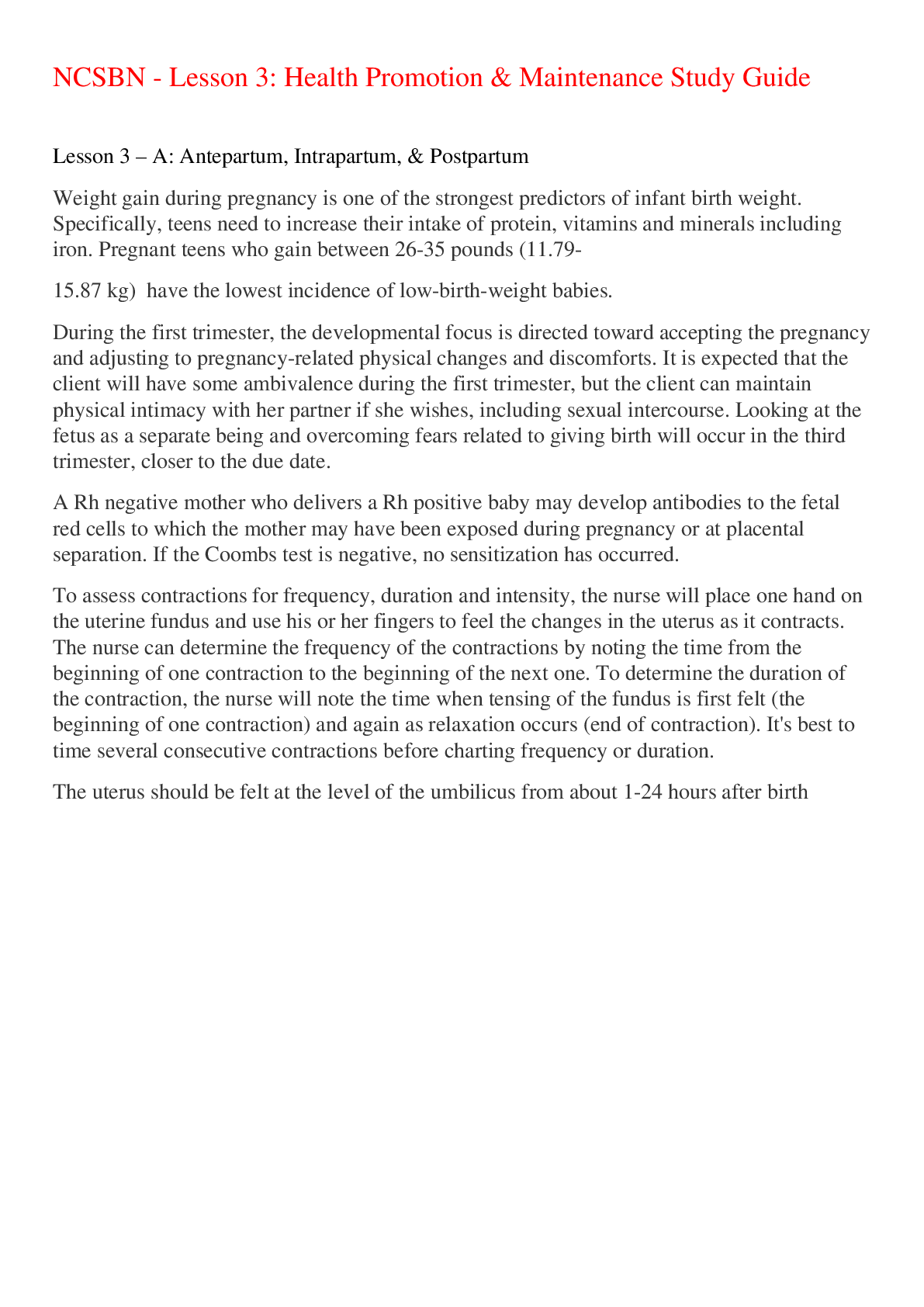
Last updated: 2 years ago

Preview 1 out of 57 pages

Buy Now

Instant download

We Accept:

Payment methods accepted on Scholarfriends (We Accept)
Preview image of NCSBN - Lesson 3: Health Promotion & Maintenance Study Guide,100% CORRECT document

Buy this document to get the full access instantly

Instant Download Access after purchase

Buy Now

Instant download

We Accept:

Payment methods accepted on Scholarfriends (We Accept)

Also available in bundle (1)

Click Below to Access Bundle(s)

NCSBN – Lesson 3- A to C: Questions with Verified Answers Study guide,100%CORRECT

NCSBN - Lesson 3: Health Promotion & Maintenance Study Guide,NCSBN Lesson 3B: Growth & Development Questions with Answers Study Guide &NCSBN – Lesson 3-C: Physical Assessment Study guide

By securegrades 2 years ago

$25.5

3  

Reviews( 0 )

$15.50

Buy Now

We Accept:

Payment methods accepted on Scholarfriends (We Accept)

Instant download

Can't find what you want? Try our AI powered Search

118
0

Document information


Connected school, study & course


About the document


Uploaded On

Jun 19, 2023

Number of pages

57

Written in

All

Seller


Profile illustration for securegrades
securegrades

Member since 5 years

118 Documents Sold

Reviews Received
24
3
3
0
5
Additional information

This document has been written for:

Uploaded

Jun 19, 2023

Downloads

 0

Views

 118

Document Keyword Tags

Recommended For You

Get more on STUDY GUIDE »

$15.50
What is Scholarfriends

Scholarfriends.com Online Platform by Browsegrades Inc. 651N South Broad St, Middletown DE. United States.

We are here to help

We're available through e-mail, Twitter, Facebook, and live chat.
 FAQ
 Questions? Leave a message!

Follow us on
 Twitter

Copyright © Scholarfriends · High quality services·