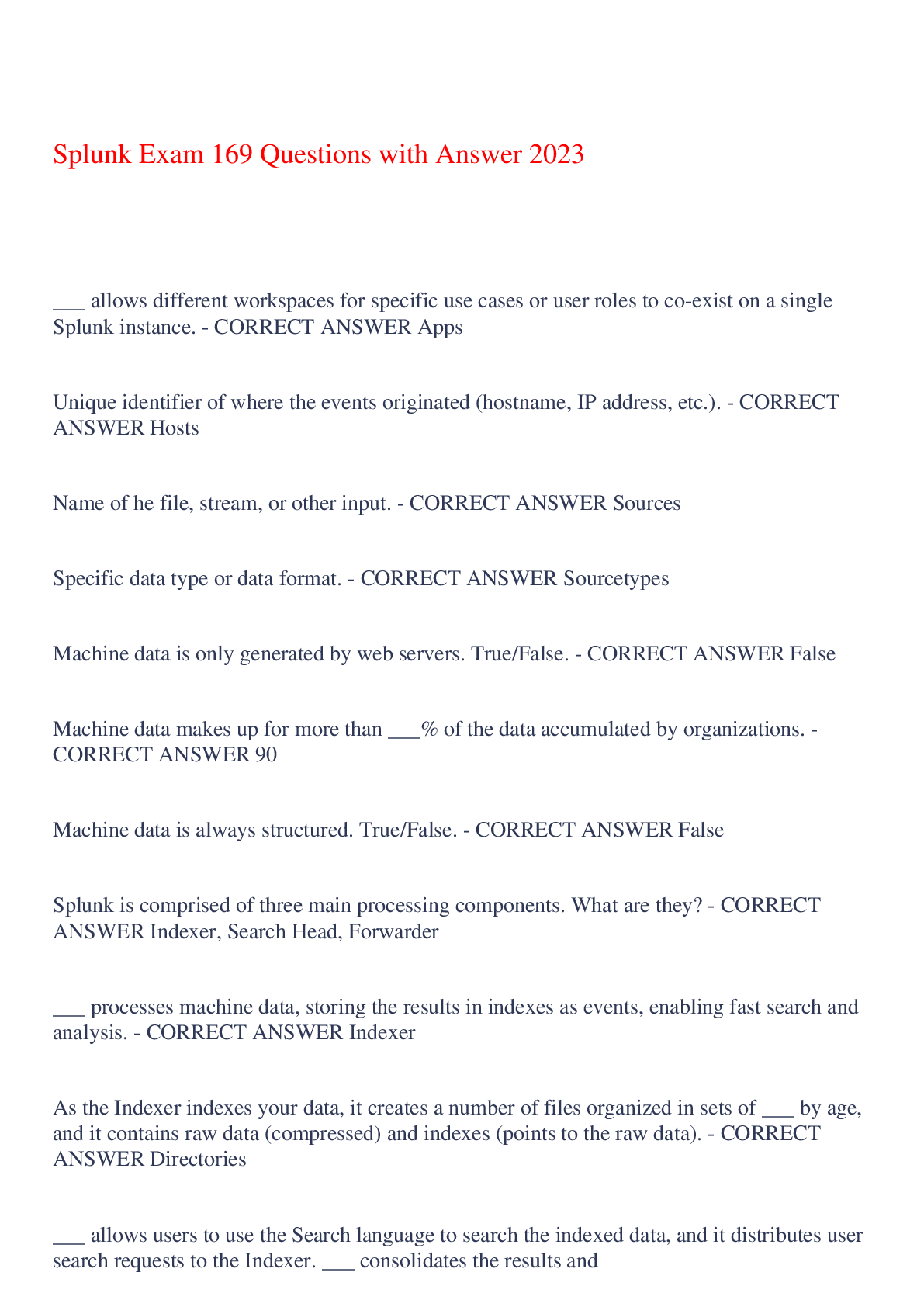
Splunk Exam 169 Questions with Answer 2023
___ allows different workspaces for specific use cases or user roles to co-exist on a single Splunk instance. - CORRECT ANSWER Apps
Unique identifier of where the eve
...
Splunk Exam 169 Questions with Answer 2023
___ allows different workspaces for specific use cases or user roles to co-exist on a single Splunk instance. - CORRECT ANSWER Apps
Unique identifier of where the events originated (hostname, IP address, etc.). - CORRECT ANSWER Hosts
Name of he file, stream, or other input. - CORRECT ANSWER Sources
Specific data type or data format. - CORRECT ANSWER Sourcetypes
Machine data is only generated by web servers. True/False. - CORRECT ANSWER False
Machine data makes up for more than ___% of the data accumulated by organizations. - CORRECT ANSWER 90
Machine data is always structured. True/False. - CORRECT ANSWER False
Splunk is comprised of three main processing components. What are they? - CORRECT ANSWER Indexer, Search Head, Forwarder
___ processes machine data, storing the results in indexes as events, enabling fast search and analysis. - CORRECT ANSWER Indexer
As the Indexer indexes your data, it creates a number of files organized in sets of ___ by age, and it contains raw data (compressed) and indexes (points to the raw data). - CORRECT ANSWER Directories
___ allows users to use the Search language to search the indexed data, and it distributes user search requests to the Indexer. ___ consolidates the results and extracts field value pairs from the events to the user. - CORRECT ANSWER Search Heads
___ on the Search Heads can be created to extract additional fields and transform the data without changing the underlying index data. - CORRECT ANSWER Knowledge Objects
___ provide tools to enhance the search experience such as reports, dashboards and visualization. - CORRECT ANSWER Search Heads
___ are instances that consume and send data to the index, and it require minimal resources and have little impact on performance. ___ typically reside on the machines where the data originates, and it is the primary way data is supplied for indexing. - CORRECT ANSWER Forwarders
In addition to the three main Splunk processing components, there are some lee-common components. What are they? - CORRECT ANSWER Deployment Server, Cluster Master, License Master
In ___ Deployment, a single server contains all functions in a single instance of Splunk for testing, proof of concept, personal user, and learning purposes. It is recommended to have at least one test/development setup at the site. - CORRECT ANSWER Standalone
In ___ Deployment, Splunk server manages the deployment of forwarder configurations. - CORRECT ANSWER Basic
In Basic Deployment, ___ collect data and send it to Splunk Servers. It installs forwarders at the data source (usually production servers). - CORRECT ANSWER Forwarders
Basic Deployment for organizations:
- Indexing less than __ GB per day
- With user __ user
- Small amount of forwarders - CORRECT ANSWER 20
__ Deployment increases indexing and searching capacity. Search management and index functions are split across multiple machines. - CORRECT ANSWER Multi-Instance
Multi-Instance Deployment for organizations:
- Indexing up to ___ GB per day
- Supports ___ users
- Supports several hundred forwarders - CORRECT ANSWER 100
Adding a ___ Cluster services more users for increased search capacity, and allows users and searches to share resources. It coordinates activities to handle search requests and distribute the requests across the set of indexers. - CORRECT ANSWER Search Head
Search Head Clusters require a minimum of ___ Search Heads. - CORRECT ANSWER three
A ___ is used to manage and distribute apps to the members of the Search Head Cluster. - CORRECT ANSWER Deployer
__ are configured to replicate data, prevent data loss, promote availability, and manage multiple indexers. - CORRECT ANSWER Traditional Index Clusters
___ offer simplified management, and don't provide availability or data recovery, - CORRECT ANSWER Non-replicating Index Clusters
Search requests are processed by the ___. - CORRECT ANSWER Indexers
Which function is a part of a single instance deployment? - CORRECT ANSWER Input, Parsing, Indexing, Searching
Which of these is a main component of Splunk? - CORRECT ANSWER Collect and index Data, Search and Investigate, Add Knowledge
In most Splunk deployments, ___ serve as the primary way data is supplied for indexing. - CORRECT ANSWER Forwarders
A single-instance deployment of Splunk Enterprise handles: - CORRECT ANSWER Input, Parsing, Indexing, Searching
After installation, Splunk starts automatically on ___, and must be manually started on ___ until boot-start is enabled. - CORRECT ANSWER Windows, *NIX
Installing Splunk Enterprise as an Indexer or Search Head is identical to installing a ___ deployment instance. - CORRECT ANSWER single
___ define what users can do in Splunk. - CORRECT ANSWER Roles
This role will only see their own knowledge objects and those that have been shared with them. - CORRECT ANSWER User
Which apps ship with Splunk Enterprise? - CORRECT ANSWER Search & Reporting, Home App
You can launch and manage apps from the home app. True/False. - CORRECT ANSWER True
What are the three main default roles in Splunk Enterprise? - CORRECT ANSWER Admin, Power, User
Splunk index time process (Data ingestion) can be broken down into three phases. What are they? - CORRECT ANSWER Input, Parsing, Indexing
After data is written to disk, it cannot be changed. True/False. - CORRECT ANSWER True
User can add data inputs with directly editing ___. - CORRECT ANSWER inputs.conf
When you index a data source, Splunk assigns ___ values. - CORRECT ANSWER metadata
Upload allows uploading local files that only get indexed ___. Useful for testing or data that is created ___ and never updated. - CORRECT ANSWER once
Add data menu provides three options depending on the source to be used. What are they? - CORRECT ANSWER Upload, Monitor, Forward
What Add Data option is the main source of input in production environments? - CORRECT ANSWER Forward
For one-time indexing (or testing); the ___ option does not create a stanza in inputs.conf. - CORRECT ANSWER Index Once
___ displays how your processed events will be indexed. - CORRECT ANSWER Data preview
When add data, by default, the default host name in ___ is used. - CORRECT ANSWER General settings
Indexed events are available for immediate search;however, it may take a ___ for Splunk to start indexing the data. - CORRECT ANSWER minute
Splunk uses ___ to categorize the type of data being indexed. - CORRECT ANSWER source type
Splunk knows where to break the event, where the time stamp is located and how to automatically create field value pairs using these. - CORRECT ANSWER source types
The monitor input option will allow you to continuously monitor files. True/False. - CORRECT ANSWER True
In most production environments, ___ will be used as the source of data input. - CORRECT ANSWER Forwarder
Files indexed using the the upload input option get indexed ___. - CORRECT ANSWER once
___ provides selections for how to complete the search string. - CORRECT ANSWER Search Assistant
Before the first ___, Search Assistant looks for matching terms. After the first ___, the Search Assistant shows a list of commands that can be entered into the search string. - CORRECT ANSWER pipe (|)
Search Assistant is enabled by default in the ___ user preferences. - CORRECT ANSWER SPL Editor
In SPL Editor, ___ is selected for Search Assistant by default. To show more information, choose Full. - CORRECT ANSWER Compact
Viewing search results displayed in reverse chronological order (newest first). True/False. - CORRECT ANSWER True
Splunk parses data into individual events, extracts time, and assigns metadata. Each event has five fields by default. What are they? - CORRECT ANSWER timestamp, host, source, sourcetype, index
___ symbol "snaps" to the time unit you specify. - CORRECT ANSWER @
To specify a beginning and an ending for a time range, use ___ and ___. - CORRECT ANSWER earliest, latest
If time specified, it must be in MM/DD/YYYY:HH:MM:SS format. True/False. - CORRECT ANSWER True
Zoom In dose not re-execute the search. True/False. - CORRECT ANSWER True
Zoom Out expands the time focus and re-executes the search. True/False. - CORRECT ANSWER True
Every search is also a job, and jobs are available for __ minutes by default. - CORRECT ANSWER 10
In Job Setting, Lifetime is ___ minutes by default, and can be extended to 7 days. - CORRECT ANSWER 10
Sharing search extends results retention to ___ days. - CORRECT ANSWER 7
Search History displays your most recent ad-hoc searches - ___ per page. - CORRECT ANSWER 5
In Search, "failed password" and "failed AND password" will return the same results. True/False. - CORRECT ANSWER True
Which following search mode toggles behavior based on the type of search being run? - CORRECT ANSWER Smart
These are booleans in the Splunk Search Language. What are they? - CORRECT ANSWER NOT, OR, AND
Shared search jobs remain active for ___ days by default. - CORRECT ANSWER 7
When zooming in on the event time line, a new search is run. True/False. - CORRECT ANSWER False
___ are searchable key/value pairs in your event data. - CORRECT ANSWER Fields
Between search terms, ___ is implied unless otherwise specified. - CORRECT ANSWER AND
Prior to search time, some fields are already stored with the event in the index. What are they in Meta fields? - CORRECT ANSWER host, source, sourcetype, index
Prior to search time, some fields are already stored with the event in the index. What are they in Internal fields? - CORRECT ANSWER _time, _raw
For the current search, Interesting Fields contains occurring events at least __ % of resulting. - CORRECT ANSWER 20
By default, the selected fields are ___, ___ and ___. - CORRECT ANSWER host, source, sourcetype
You can identify other fields as selected fields from ___ (which shows all of the discovered fields) - CORRECT ANSWER All Fields
Field names are case sensitive, but Field values are not case sensitive. True/False. - CORRECT ANSWER True
For IP fields, Splunk is subnet/CIDR aware. True/False. - CORRECT ANSWER True
Not status = 200 returns events where a status field exists and value in the field doesn't equal 200 -- and all events where the status field doesn't exist. True/False. - CORRECT ANSWER True
What is the default Search Mode? - CORRECT ANSWER Smart
Interesting Fields : Have values in at least ___ % of the events. - CORRECT ANSWER 20
What is the most efficient filer in Seach? - CORRECT ANSWER Time
Searching for "access denied" is always better than searching for "denied". True/False. - CORRECT ANSWER True
Inclusion is generally better than exclusion. Searching for "access denied" is faster than searching for NOT "access granted". True/False. - CORRECT ANSWER True
It's possible to search without an index - but that's inefficient and not recommended. True/False. - CORRECT ANSWER True
What duration is the most efficient way to filter events in Time? - CORRECT ANSWER 7 days
Searches are made up of 5 basic components. What are they? - CORRECT ANSWER Search terms, Commands, Functions, Arguments, Clauses
The __ command returns a table formed by only fields in the argument list. - CORRECT ANSWER table
To change the name of a field, use the ___ command. - CORRECT ANSWER rename
Once you rename a field, you can't access it with the original name. True/False. - CORRECT ANSWER True
___ ___ is one of the most costly parts of a search. - CORRECT ANSWER Field extraction
The ___ command allows you to include or exclude specified fields in your search or report. - CORRECT ANSWER fields
Using fields+ improves performance, and fields- doesn't affect performance. True/False. - CORRECT ANSWER True
The ___ command removes duplicates from your results. - CORRECT ANSWER dedup
The ___ command orders your result in + ascending (default) or - descending. True/False. - CORRECT ANSWER True
To limit the returned results, use the ___ option. - CORRECT ANSWER lint
Having separate indexes allows: - CORRECT ANSWER Multiple retention policies
Ability to limit access
Faster Searches
As a general practice, exclusion is better than inclusion in a Splunk search. True/False. - CORRECT ANSWER False
Time to search can only be set by the time range picker. True/False. - CORRECT ANSWER False
Excluding fields using the Fields Command will benefit performance. True/False. - CORRECT ANSWER False
The ___ command finds the most common values of a given field in the result set. - CORRECT ANSWER top
By default, the top command returns top ___ results. - CORRECT ANSWER 10
By default, the top command returns ___ and ___ columns. - CORRECT ANSWER count, percent
The limit=# returns this number of results, and limit=0 returns unlimited results. True/False. - CORRECT ANSWER True
If the showperc is not included - or it is included and set to t - a percent column is displayed. If showperc=f, then a percent column is NOT displayed. True/False. - CORRECT ANSWER True
By default, the display name of the countfield is ___, and countfield=string renames the field for display purposes. - CORRECT ANSWER count
The ___ command returns the least common field values or a given field in the result, and its options are identical to the top command. - CORRECT ANSWER rare
The ___ enables you to calculate statistics on data that matches your search criteria. - CORRECT ANSWER stats
What is the stats function to lists unique values of a given field? - CORRECT ANSWER values
What is the stats function to lists all values of a given field? - CORRECT ANSWER list
The ___ returns the number of matching events based on the current search criteria. - CORRECT ANSWER count
Adding a ___ as an argument to the count function returns the number of events where a value is present for the specified field. - CORRECT ANSWER field
The ___ clause returns a count for each value of a named field or set of fiends. - CORRECT ANSWER by
The ___ provides a count of how many unique values there are for a given field in the result set. - CORRECT ANSWER distinct_count or dc
How many results are shown by default when using a Top or Rare Command? - CORRECT ANSWER 10
To display the most common values in a specific field, what command would you use? - CORRECT ANSWER top
Which stats function would you use to find the average value of a field? - CORRECT ANSWER avg
Running a report returns fresh results each time you run it. True/False. - CORRECT ANSWER True
For alphanumeric character fields, there are only ___ available reports. - CORRECT ANSWER 3
A ___ consists of one or more panels displaying data visually in a useful way - such as events, tables, or charts. - CORRECT ANSWER dashboard
The Dashboard ID is automatically populated with a unique value used by Splunk and should not be changed. True/False. - CORRECT ANSWER True.
Why create Panels from Reports? - CORRECT ANSWER It is efficient to create most dashboard panels based on reports.
Any change to the underlying report affects every dashboard panel that utilizes that report.
The User role can not create reports. True/False. - CORRECT ANSWER False
A time range picker can be included in a report. True/False. - CORRECT ANSWER True
These roles can create reports: - CORRECT ANSWER Admin
User
Power
In a dashboard, a time range picker will only work on panels that include a(n) ___ search. - CORRECT ANSWER inline
The ___ are reports gathered together into a single pane of glass. - CORRECT ANSWER dashboards
Pivots can be saved as reports. True/False. - CORRECT ANSWER True
The ___ pivot allows you to utilize the pivot tool without a preexisting data model. - CORRECT ANSWER Instant
You can save any pivot to a new or existing dashboard. True/False. - CORRECT ANSWER True
___ ___ are knowledge objects that provide the data structure that drives Pivots. - CORRECT ANSWER Data Models
Data models are created by Admin and Power role. True/False. - CORRECT ANSWER True
The ___ help users to find data and get answers faster. - CORRECT ANSWER Datasets
The instant pivot button is displayed in the statistics and visualization tabs when a ___ search is run. - CORRECT ANSWER non-transforming
These are knowledge objects that provide the data structure for pivot. - CORRECT ANSWER Data Models
The ___ pull such data from standalone files at search time and add it to search results, and allow you to add more fields to your event. - CORRECT ANSWER Lookups
What can be used when sometimes static (or relatively unchanging) data is required for searches, but isn't available in the index? - CORRECT ANSWER Lookups
Lookup field values are case sensitive by default. True/False. - CORRECT ANSWER True
In Lookups file, the first row represents ___ names (header). - CORRECT ANSWER field
Use the ___ command to load the results from a specified static lookup. - CORRECT ANSWER inputlookup
If a lookup is not configured to run automatically, use the ___ command in your search to use the lookup fields. - CORRECT ANSWER lookup
Use ___ when you do not want to overwrite existing field. - CORRECT ANSWER OUTPUTNEW
To use an automatic lookup, specify the ___ fields in your search. - CORRECT ANSWER output
If a field in a lookup table represents a(n) ___, you can create a time-based lookup. - CORRECT ANSWER timestamp
To keep from overwriting existing fields with your Lookup you can use the ___ clause. - CORRECT ANSWER OUTPUTNEW
A lookup is categorized as a dataset. True/False. - CORRECT ANSWER True
When using a .csv file for Lookups, the first row in the file represents this. - CORRECT ANSWER Field names
Users with admin privileges can select a Schedule Priority of Default, Higher, or Highest. True/False. - CORRECT ANSWER True
Before a report can be embedded, it must be ___. - CORRECT ANSWER scheduled
___ are triggered when the results of the search meet a specific condition that you define. - CORRECT ANSWER Alerts
By default, ___ has read access and ___ has write access to the alert. - CORRECT ANSWER everyone, power
What are the two types of alerts? - CORRECT ANSWER Scheduled, Real-time
Trigger condition: ___ executes actions one time for all matching events within the scheduled time and conditions. - CORRECT ANSWER Once
The ___ options to suppress the actions for results within a specified time range. - CORRECT ANSWER Throttle
If you have administrator privileges, you can use a log event action: - CORRECT ANSWER Event, Source, Sourcetype, Host, Index
Alerts can be shared to all apps. True/False. - CORRECT ANSWER True
Alerts can send an email. True/False. - CORRECT ANSWER True
Alerts can run uploaded scripts. True/False. - CORRECT ANSWER True
An alert is an action triggered by a ___ ___. - CORRECT ANSWER Saved Search
Once an alert is created, you can no longer edit its defining search. True/False. - CORRECT ANSWER False
The password for a newly installed Splunk instance is: - CORRECT ANSWER Created when you install Splunk Enterprise.
Commands that create statistics and visualizations are called ___ commands. - CORRECT ANSWER stats
Charts can be based on numbers, time, or location. True/False. - CORRECT ANSWER True
Data models are made up of ___. - CORRECT ANSWER Datasets
[Show More]