NURS 531EXAM 1 Notes
1. More drugs metabolized by CYP3A4 greater than any other P450 enzyme = increased drug-drug interaction
2. Factors that regulate Css (serum conc), with this ADME is same to check maintenance dos
...
NURS 531EXAM 1 Notes
1. More drugs metabolized by CYP3A4 greater than any other P450 enzyme = increased drug-drug interaction
2. Factors that regulate Css (serum conc), with this ADME is same to check maintenance dose = increase drug increase Css plasma levels
3. Induction of CYP450 Enzyme >>> increased # of enzymes, increased intrinsic? activity increased rate of metabolism = increase metabolic rate >>> decrease amount of purest? drug
4. IV drug 1st order kinetic Q 3hrs. 9 hrs later Cp (plasma conc) = 3mcg/L. What was initial Cp of drug? = 9 hrs = 3 (t1/2 - half life) x 2=6; 6 x2=12 (2nd half life); 12x2=24 (1st half life)
5. Drug A 80% plasma protein bound w/ very low therapeutic index, Drug B 99% plasma protein = the risk of ADReaction will be more/increased w/ Drug A. So lower the % the higher the ADR risk
6. Basic (alkalinic) Drug Z pKa (pH) 8.0. not metabolized, undergoes renal elimination = True statement - acidification of urine will increase renal elimination/excretion of Drug Z
7. Presence of good slows reabsorption of Antibiotic Tab = a &b (decreases rate of absorption of Antibiotic; Takes longer to reach Therapeutic plasma levels of Antibiotics
8. BEST measure of Total amount of oral drug in plasma over time = AUC (area under the curve)
9. 10mg “LOWOUCH” IV for pain f=0.2, PO amount needed = 10/0.2= 50mg ****PO amt always > IV amt for same drug
10. Renal clearance of 4 days: 0.90, 0.03, 0.62, 0.18, shortest t1/2(half life) = 0.90 L/hr/kg
11.
EXAM 2 Notes
Module/Exam 2
Weeks 4-6
ANS Quiz
NURS 531 Pharm
Endocrine/Autonomics:
· stion 1
0.2 out of 0.2 points
Among the regimens listed below using various insulin preparations delivered subcutaneously by injection but not by pump, which would be the most logical?
Selected Answer: b.
Glargine to provide basal insulin coverage and aspart given before each meal.
Answers: a.
Lispro to provide basal insulin coverage and detimir given before each meal.
b.
Glargine to provide basal insulin coverage and aspart given before each meal.
c.
Detemir to provide basal insulin coverage and NPH insulin before each meal.
d.
Lispro or glargine injected every 3 hours and NPH given at bedtime.
· Question 2
0.2 out of 0.2 points
Mr. P self-medicates with an aluminum hydroxide antacid before every meal to reduce symptoms of hyperacidity. However he tends to overeat and drink. As a result, he ends up taking a couple of aspirin every day. Which of the following is likely to be TRUE with regard to Mr. P’s self-medication with these over-the-counter medications?
Selected Answer: c.
Mr. P. will experience reduced therapeutic effects from the antacid because he is not taking it at the optimal time.
Answers: a.
More aspirin will be absorbed in the presence of the antacid.
b.
Mr P. is likely to experience diarrhea.
c.
Mr. P. will experience reduced therapeutic effects from the antacid because he is not taking it at the optimal time.
d.
Mr. P. sometimes takes other types of antacids because one antacid is the same as another with regard to adverse effects.
· Question 3
0.2 out of 0.2 points
Which of the following statement(s) is/are TRUE about treatment of erectile dysfunction with a phosphodiesterase type 5 inhibitors? (Hint:You may choose more than one answer.)
b.
Phosphodiesterase type 5 inhibitors decrease the degradation of cyclicGMP.
c.
Among the phosphodiesterase type 5 inhibitors, tadalafil has the longest half-life.
d.
Use of phosphodiesterase type 5 inhibitors can result in visual disturbances and hypotension because these inhibitors are not absolutely selective for the phosphodiesterase type 5 isoform.
Answers: a.
Phosphodiesterase type 5 inhibitors stimulate nitric oxide synthase.
b.
Phosphodiesterase type 5 inhibitors decrease the degradation of cyclicGMP.
c.
Among the phosphodiesterase type 5 inhibitors, tadalafil has the longest half-life.
d.
Use of phosphodiesterase type 5 inhibitors can result in visual disturbances and hypotension because these inhibitors are not absolutely selective for the phosphodiesterase type 5 isoform.
e.
Only sildenafil can be taken with an organic nitrate.
· Question 4
0.2 out of 0.2 points
Anna is an APN is treating a 58 year-old postmenopausal patient for severe osteoporosis. Consider the following and select one answer.
e.
All of the above actions are incorrect.
Answers: a.
Anna prescribes 2 drugs. She prescribes alendronate and raloxifene because the mechanism of alendronate is anabolic and the mechanism of raloxifene is anti-resorptive.
b.
Anna suggests that her patient should eat a large meal before taking alendronate to reduce potential gastrointestinal side effects of the drug.
c.
Anna orders liver function test for 6 months and 12 months after initiating therapy to treat osteoporosis because bisphosphonates are metabolized in the liver where they form a reactive metabolite that can injure liver cells.
d.
Because bisphosphonates can cause hypercalcemia, Anna suggests that her patient should refrain from drinking milk or eating foods like yogurt and ice cream.
e.
All of the above actions are incorrect.
· Question 5
0.2 out of 0.2 points
Match the mechanism of action with the drug
o
Question Correct Match Selected Match
Glyburide e.
Stimulates insulin secretion by binding to beta-cell sulfonylurea receptor e.
Stimulates insulin secretion by binding to beta-cell sulfonylurea receptor
Pioglitazone a.
Act as a PPAR-gamma agonists to reduce insulin resistance a.
Act as a PPAR-gamma agonists to reduce insulin resistance
Metformin d.
Delays glucose absorption from gut, reduces gluconeogenesis, reduces glycogenolysis, facilitates insulin-mediated glucose utilization d.
Delays glucose absorption from gut, reduces gluconeogenesis, reduces glycogenolysis, facilitates insulin-mediated glucose utilization
Exenatide b.
Synthetic GLP-1 mimetic - enhances glucose-dependent insulin secretion, suppresses inappropriately elevated serum glucose concentrations, and delays gastric emptying b.
Synthetic GLP-1 mimetic - enhances glucose-dependent insulin secretion, suppresses inappropriately elevated serum glucose concentrations, and delays gastric emptying
Acarbose c.
Delays the absorption of glucose from the intestines by inhibiting glucosidase in the wall of the intestines c.
Delays the absorption of glucose from the intestines by inhibiting glucosidase in the wall of the intestines
o
o
All Answer Choices
a.
Act as a PPAR-gamma agonists to reduce insulin resistance
b.
Synthetic GLP-1 mimetic - enhances glucose-dependent insulin secretion, suppresses inappropriately elevated serum glucose concentrations, and delays gastric emptying
c.
Delays the absorption of glucose from the intestines by inhibiting glucosidase in the wall of the intestines
d.
Delays glucose absorption from gut, reduces gluconeogenesis, reduces glycogenolysis, facilitates insulin-mediated glucose utilization
e.
Stimulates insulin secretion by binding to beta-cell sulfonylurea receptor
· Question 6
0.2 out of 0.2 points
Which of the following statements are TRUE about histamine2-receptor antagonists in the treatment of hyperactivity and uncomplicated gastroesophageal reflux disease (GERD)?
Selected Answer: c.
For optimal response, H2 antagonists should be taken in the evening.
Answers: a.
Blocking the H2 receptor blocks the final common pathway of acid production in parietal cells.
b.
H2 receptor antagonists protect the stomach lining by increasing mucus production.
c.
For optimal response, H2 antagonists should be taken in the evening.
d.
Among the H2 antagonists, cimetidine has the least number of adverse effects.
· Question 7
0.2 out of 0.2 points
Which of the following statements is TRUE with regard the ideal anti-muscarinic drug to treating overactive bladder (OAB)?
Selected Answer: d.
The ideal anti-muscarinic drug would be highly selective for the M3 receptor and would not cross the blood brain barrier.
Answers: a.
The ideal anti-muscarinic drug would be highly selective for the M2 receptor subtype.
b.
The ideal anti-muscarinic drug would be a tertiary amine.
c.
The ideal drug already exists. Current anti-muscarinics on the market are very effective.
d.
The ideal anti-muscarinic drug would be highly selective for the M3 receptor and would not cross the blood brain barrier.
· Question 8
0.2 out of 0.2 points
Methimazole and propylthiouracil (PTU) are two drugs that are used to treat patients with Grave’s disease. What extra mechanism of action of PTU (compared to methimazole) explains the beneficial effects of PTU on patients who are experiencing severe hyperthyroidism or thyroid storm?
Selected Answer: c.
Only PTU inhibits conversion of T4 to T3 in periphery
Answers: a.
Only PTU inhibits peroxidase (oxidation of iodide to iodine)
b.
Only PTU inhibits coupling of iodine to tyrosine
c.
Only PTU inhibits conversion of T4 to T3 in periphery
· Question 9
0.2 out of 0.2 points
RANKL (receptor activator of nuclear factor KappaB ligand) is a cell-attached ligand that is important in regulating bone remodeling. Which of the following statement is TRUE about drugs used to treat osteoporosis by decreasing RANKL action?
Selected Answers: a.
Osteoblasts-associated RANKL binds to the RANK receptor on osteoclasts.
Answers: a.
Osteoblasts-associated RANKL binds to the RANK receptor on osteoclasts.
b.
Bisphosphonates act as a transcription factor to increase the expression of RANKL.
c.
r-OPG (recombinant osterprotegrin) and denosumab bind to RANK and inhibit maturation of osteoclasts and thereby inhibit degradation of bone.
d.
Based on the mechanism of action of denosumab, a predicted effect of this drug would be an increase in serum calcium
· Question 10
0.2 out of 0.2 points
Your patient is complaining that she has frequent spotting or break through bleeding since she started an oral contraceptive (OC). A common reason for this occurrence is related to:
Selected Answer:
taking an OC pill at different times.
Answers: having multiple sexual partners.
taking an OC pill at different times.
the clinical and therapeutic efficacy of the drug.
taking an OC pill with food.
ANS Quiz module 2
· ion 1
0.2 out of 0.2 points
Nerve pathways from the autonomic nervous system (ANS) normally have a preganglionic and a postganglionic fiber. Which of the following properties is characteristic of ONLY the parasympathetic nervous system (PNS) but not the sympathetic nervous system (SNS)?
Selected Answer: c.
Acetylcholine is the primary neurotransmitter at the postganglionic fiber.
Answers: a.
Acetylcholine is the neurotransmitter of the preganglionic fiber.
b.
ATP and neuropeptide Y are co-transmitters at the postganglionic fiber.
c.
Acetylcholine is the primary neurotransmitter at the postganglionic fiber.
d.
Stimulation mediates stress, fright, flight and fright.
e.
Innervation of the eye, heart and lungs.
Response Feedback: a) Acetylcholine is the neurotransmitter at the ganglion of both the PNS and SNS.
b) ATP and neuropeptide Y are co-transmitters at adrenergic nerve terminals in the SNS. Co-transmitters ofcholinergic nerves are nitric oxide and vasoactive intestinal peptide.
c) Acetylcholine is the primary neurotransmitter of PNS postganglionic fibers. Norepinephrine is the primary neurotransmitter of the ANS postganglionic fiber.
d) Stimulation of the SNS mediates stress, fright, flight and fight. PNS stimulation is usually associated with relaxing or moderating activity
e) Both the PNS and the SNS innervate the eye, heart and lungs.
· Question 2
0.2 out of 0.2 points
What would be the outcome of blocking depolarization-induced influx of calcium through calcium channels in a preganglionic nerve terminal of the parasympathetic or sympathetic nervous system?
Selected Answer: b.
Release of neurotransmitter from the nerve terminal would be inhibited.
Answers: a.
Uptake of neurotransmitter from the synapse would be inhibited.
b.
Release of neurotransmitter from the nerve terminal would be inhibited.
c.
Synthesis of neurotransmitter in the nerve terminal would be inhibited.
d.
Binding of the neurotransmitter on the target cell/organ receptor would be facilitated.
e.
Neurotransmitter would be released from the presynaptic terminal by exocytosis.
Response Feedback: a) Uptake may require ions to facilitate uptake but calcium is not one of the ions.
* Note that inhibited does not necessarily infer that a process is totally reduced to zero or ablated. It means that the process is reduced or decreased to a varying degree.
b) Release of neurotransmitter would be inhibited because depolarization induced opening of calcium channels mediates calcium influx. The influx of calcium mediates fusion of vesicles containing neurotransmitter (NT) to the cell surface membrane and exocytosis of the NT into the synapse. Without the Ca influx the NT would not be released.
c) Calcium is not involved in synthesis of neurotransmitter in these nerve terminals
d) Decreased calcium influx into the presynaptic membrane would have no effect on target organ receptor binding.
e) If the influx of calcium were interrupted exocytosis of neurotransmitter would be inhibited.
· Question 3
0.2 out of 0.2 points
Binding of acetylcholine to nicotinic receptors:
Selected Answer: e.
Results in the opening of sodium channels and the influx of sodium into the cell.
Answers: a.
Stimulates totally different signal transduction mechanisms at neuronal and skeletal muscle receptor sites
b.
Results in the inhibition of adenylate cyclase with subsequent decreased production of cAMP.
c.
Results in the activation of phospholipase C (PLC) with the subsequent production of inositol trisphosphate(IP3) and diacylglycerol (DAG).
d.
Leads to hyperpolarization of the cell membrane potential.
e.
Results in the opening of sodium channels and the influx of sodium into the cell.
Response Feedback: a) Regardless of the location of the nicotinic receptor, binding of acetylcholine results in opening of sodium channels
b) Neither activation or inhibition of adenylate cyclase is the signal transduction mechanism associated with nicotinic receptors.
c) The contribution of PLC activation to nicotinic receptor signal transduction is very minimal if at all and certainly not the rule.
d) Binding of acetylcholine to nicotinic receptors will result in depolarization of the cell membrane.
e) Binding of acetylcholine to nicotinic receptors results in opening of Na+ channels and the influx of Na+ into the cell.
· Question 4
0.2 out of 0.2 points
Which of the following statements best describes the consequence of norepinephrine (NE) binding to alpha2-adrenergic receptors (alpha2-AR) in the autonomic nervous system?
Selected Answer: d.
NE binds to presynaptic alpha2-AR, inhibits adenylase cyclase activity and diminishes the release of NE from the nerve terminal.
Answers: a.
NE binds to post-synaptic alpha2-AR, stimulates activation of adenylate cyclase and elicits a response in the target cell
b.
NE binds to post-synaptic alpha2-AR, inhibits activation of adenylate cyclase and mitigates the target cell response to other adrenergic agonists.
c.
NE binds to presynaptic alpha2-AR, stimulates adenylase cyclase activity and facilitates further release of NE from the nerve terminal.
d.
NE binds to presynaptic alpha2-AR, inhibits adenylase cyclase activity and diminishes the release of NE from the nerve terminal.
e.
NE binds to presynaptic alpha2-AR and stimulates the release of co-transmitters
Response Feedback: It is true that NE binds to alpha2-AR. However, alpha2-AR are located on the pre-synaptic nerve terminal, inhibitsadenylate cyclase and diminishes the release of NE from the nerve terminal. This is a feedback mechanism.
· Question 5
0.2 out of 0.2 points
Fill in the blanks of the following statements with either the word “increase” or “decrease”.
Blocking reuptake of NE in an adrenergic nerve terminal would (1) ___________ the response to NE. Inhibiting acetylcholinesterase activity in cholinergic nerve terminals would (2) __________ the response to acetylcholine.
Selected Answer: c.
1 = increase
2 = increase
Answers: a.
1 = increase
2 = decrease
b.
1 = decrease
2 = increase
c.
1 = increase
2 = increase
d.
1 = decrease
2 = decrease
Response Feedback: Adrenergic: The main mechanism for termination of NE neurotransmission is reuptake of the neurotransmitter into the presynaptic nerve cell (reuptake 1).
Blocking the reuptake of NE at the nerve terminal will result in a higher concentration of NE to bind to receptors. Therefore, the response to stimulation of an adrenergic neuron would be greater because more receptors would be bound in the target cell.
Cholinergic : The main mechanism by which cholinergic transmission is terminated is by degradation ofacetylcholine into acetate and choline by acetylcholinesterase that is found in the cleft.
If acetylcholinesterase were inhibited, the rate of acetylcholine degradation would be slower. Because of the slower degradation of acetylcholine, the neurotransmitter would accumulate and there would be more to bind to receptors. The greater the fraction of receptors bound the greater the response.
· Question 6
0.08 out of 0.2 points
Match the response with stimulation of the appropriate receptor. Choose the best match.
o
Question Correct Match Selected Match
Positive chronotropic effect on the heart b.
Beta1-AR b.
Beta1-AR
Endothelial cell-mediated vasodilation of healthy, intact vascular a.
Muscarinic (M3) e.
Muscarinic (M2)
Vasoconstriction of healthy, intact vasculature d.
Alpha1-AR b.
Beta1-AR
Relaxation of bronchial smooth muscle c.
Beta2-AR c.
Beta2-AR
Negative chronotropic effect on the heart e.
Muscarinic (M2) a.
Muscarinic (M3)
o
o
All Answer Choices
a.
Muscarinic (M3)
b.
Beta1-AR
c.
Beta2-AR
d.
Alpha1-AR
e.
Muscarinic (M2)
Response Feedback: It's necessary to know the location and normal physiologic anticipated response when a receptor is activated. B1 + chrontropic effect on Heart; M3 Endothelial cell-mediated vasodilation of healthy, intact vascular; Alpha1-AR Vasoconstriction of healthy, intact vasculature; Beta2-AR Relaxation of bronchial smooth muscle; M2 Negative chronotropic effect on the heart.
I want to point out that if the endothelium in an arteriole is injured or ablated then direct muscarinic stimulation of a vascular smooth muscle cell will cause contraction (vasoconstriction).
It is also important to point out that beta2-adrenergic stimulation (by epinephrine) in skeletal muscle arterioles will cause vascular smooth muscle relaxation and vasodilation.
· Question 7
0.2 out of 0.2 points
Early symptoms of nerve gas exposure include excessive salivation, lacrimation, urination, diarrhea/defecation, miosis (small pupil size), and fasciculation or tremors.
Which of the following would best explain these symptoms?
Selected Answer: b.
Inhibition of degradation of acetylcholine released from cholinergic nerve terminals.
Answers: a.
Increased release of norepinephrine (NE) from adrenergic nerve terminals.
b.
Inhibition of degradation of acetylcholine released from cholinergic nerve terminals.
c.
Decreased depolarization of postsynaptic parasympathetic nerve fibers.
d.
Decreased reuptake of NE into presynaptic adrenergic nerve terminals.
e.
Increased acetylcholinesterase activity.
Response Feedback: a) If you increase the release of NE you would be likely to observe symptoms that are the opposite of those described.
b) Inhibition of degradation of acetylcholine that has been released from cholinergic nerves would result in increased Acetylcholine levels and increased occupancy of muscarinic receptors mediating symptoms characteristic of activations of the parasympathetic nervous system similar to those described in the question. In addition there would be more acetylcholine to bind to nicotinic receptors in skeletal muscle motor end plates leading to fasciculation and/or tremors.
c) If depolarization of postsynaptic parasympathetic cholinergic nerves were decreased – less acetylcholine neurotransmitter would be released and receptors that mediate the symptoms described in the question would not be observed.
d) Decreased uptake into presynaptic adrenergic nerve terminals would result in more NE-induced stimulation of alpha- and beta-adrenergic receptors on target organs/cell. Norepinephrine does not mediate the described symptoms.
e) Increased acetylcholinesterase activity would result in increased degradation of acetylcholine and thereby less acetylcholine to bind muscarinic and nicotinic receptors (see answer b)
· Question 8
0.2 out of 0.2 points
Some target organs or cells are more influenced by either the sympathetic or parasympathetic nervous system (i.e., the target organ receives higher sympathetic or parasympathetic tone).
Given this fact, if transmission at all autonomic nervous system ganglion were blocked, what change would you expect to see on the production of saliva by salivary glands?
Selected Answer: c.
A decrease in salivation
Answers: a.
No change in salivation
b.
An increase in salivation
c.
A decrease in salivation
Response Feedback: General rationale: Most organs controlled by the autonomic nervous system have input from both the parasympathetic nervous system (PNS) and the sympathetic nervous system (SNS).Because ganglionic blockers block the PNS and the SNS, the effect of these drugs is influenced by the dominant tone in the organ system.
Salivary glands have higher parasympathetic tone (or input) than sympathetic tone. Therefore if you blocked stimulation of both divisions of the ANS, the greatest effect you will observe will be the loss of PNS stimulation. PNS stimulation mediates increased salivation. Thus you would observe this loss or a decrease in salivation or dry mouth.
· Question 9
0.2 out of 0.2 points
Binding of acetylcholine to muscarinic receptors on the adrenal gland results in the release of epinephrine into the bloodstream. Select the statement which correctly identifies a way in which epinephrine differs from norepinephrine.
Selected Answer: e.
Epinephrine has a higher affinity for the beta2-adrenergic receptor subtype than norepinephrine.
Answers: a.
Epinephrine has higher affinity for alpha1-adrenergic receptors than norepinephrine.
b.
Epinephrine is lacking a methyl group on its amine (nitrogen molecule) whereas norepinephrine has a methyl group at this position.
c.
Epinephrine is degraded by catechol-O-methyltransferase and monoamine oxidase whereas these enzymes do not degrade norepinephrine.
d.
Epinephrine crosses the blood-brain barrier whereas norepinephrine does not.
e.
Epinephrine has a higher affinity for the beta2-adrenergic receptor subtype than norepinephrine.
Response Feedback: This is essentially a true/false question. Of the 5 statements e is true.
a. Epinephrine has higher affinity for alpha 1-adrenergic receptors than norepinephrine.
b. These catecholamines are structurally similar with the exception that epinephrine has a methyl group on itsamine side (nitrogen molecule) whereas norepinephrine has a hydrogen ion at this position.
c. Epinephrine is degraded by catechol-O-methyltransferase and monoamine oxidase. The same enzymes degradenorepinephrine.
d. Epinephrine does not cross the blood-brain barrier whereas norepinephrine acts as a neurotransmitter in the brain (important at the end of the course too).
e. Epinephrine has a higher affinity for the beta2-adrenergic receptor subtype than norepinephrine. The ranked order of the drug affinity for the beta2-adrenergic receptor is Isoprotenol>Epinephrine>Norepinephrine. See the dose response curve for B2 receptor.
· Question 10
0.2 out of 0.2 points
Which of the following statements correctly describes the circulatory reflex initiated by the baroreceptors in response to an episodic elevation in blood pressure?
Selected Answer: c.
Excitation of the baroreceptors causes a drop in blood pressure because of a decrease in peripheral vascular resistance and a decrease in cardiac output.
Answers: a.
Increased sympathetic stimulation causes vasodilation bringing elevated blood pressure back to normal.
b.
Stimulating the vagal parasympathetic center in the medulla causes an increased heart rate and strength of contraction.
c.
Excitation of the baroreceptors causes a drop in blood pressure because of a decrease in peripheral vascular resistance and a decrease in cardiac output.
d.
Heart rate increases and stroke volume increases resulting in a higher cardiac output.
Response Feedback: Increased blood pressure in the carotid and aortic artery stretches the baroreceptors and initiates an increased rate of depolarization of the vagal and glossopharyngeal nerves that synapse in the cardiovascular center of the medulla. This results in activation of nerves that inhibit the vasoconstrictor center of the medulla and excite thevagal parasympathetic center.
In turn this causes: (1) vasodilation of the veins and arterioles in the periphery (2) decrease in heart rate and (3) decreased strength of contraction.
As a result arterial pressure is reduced by decreasing heart rate, stroke volume (thereby cardiac output) and peripheral resistance.
a) Increased sympathetic stimulation would cause vasoconstriction and increase blood pressure.
b) Parasympathetic stimulation decreases heart rate and strength of contraction via the vagus nerve.
c) Excitation of the baroreceptors causes a drop in blood pressure because of a decrease in peripheral vascular resistance and a decrease in cardiac output.
d) Heart rate increases and stroke volume increases resulting in a higher cardiac output. This sequence describes what happens with a drop in blood pressure.
Quiz 1 9/18/17
This is a multiple choice quiz with 10 questions. Each correct answer is worth 1 point. This is an open book quiz with forced completion (must answer all questions at one time). You may use any resources to help you answer the questions. You may take 2 attempts to take the quiz. However, you must submit your final answers before the deadline. The submission site for this quiz will close at that time. After the deadline passes, you will have no other opportunity to submit your quiz.
· Question 1
0.2 out of 0.2 points
An identical dose of medication was administered to a patient. The first time it was administered orally and the second time it was given intravenously. Plasma drug concentrations were measured at the same time intervals after administration of each drug. In the following Figure, the results were graphed as log of the plasma drug concentration (Cp) versus time after administration. AUCIV is the area under the curve when the drug was given intravenously and AUCPO is the area under the curve when the drug was given orally. What information can you obtain based on the Figure?
Selected Answer: e.
a and c
Answers: a.
oral bioavailability
b.
potency of the drug
c.
extent and rate of oral absorption the drug
d.
efficacy of the drug
e.
a and c
Response Feedback: Bioavailability is defined as the fraction of the administered dose of a drug that reaches the systemic circulation in an active form. We define the bioavailability of a drug given intravenously as 1.0 (100%), because medications given via intravenously can avoid barriers which affect absorption. However, drugs given by routes other than IV must be absorbed and might undergo hepatic first-pass metabolism. Thus, they have a bioavailability of less than 1.0. The calculation of bioavailability is based on the ratio of the area under the concentration-time curve (AUC) for the administration route being considered (oral, IM, etc.) and the AUC obtained with IV administration. In other words - in this case the bioavailability would be AUCPO divided by AUCIV. The area under the curve also defines the extent of absorption.
· Question 2
0.2 out of 0.2 points
A 55 year old female who has chronic renal failure due to a history of poorly controlled diabetes has a estimated glomerular filtration rate (eGFR) = 28 ml/min/ 1.73m2. Which of the following statement(s) describe pharmacokinetic issue(s) of special concern for this patient?
Selected Answer: e.
b and d
Answers: a.
The half-life of drugs cleared by glomerular filtration would be shorter.
b.
Plasma concentration of drugs eliminated by the kidney may be higher in this individual than those without chronic renal failure.
c.
Drugs cleared by biliary excretion will have a longer half-life.
d.
Drugs with a narrow therapeutic window that are eliminated by the kidney are more likely to cause adverse effects in this individual than in those without chronic renal failure.
e.
b and d
Response Feedback: The clearance of drugs eliminated by the kidney are likely to be lower in a person with chronic renal failure. The glomerular filtration rate is very low as indicated by her creatinine clearance value. Half-life is the time it takes for half of the drug to be cleared from the body. Therefore if a drug is eliminated by the kidney - particularly by glomerular filtration - then the half-life will be longer. If a drug has a narrow therapeutic window then decreased elimination of the drug can result in higher plasma levels for a longer period of time and a higher probability of an adverse effect. If the drug is given chronically at a given dose and maintenance interval - it is likely that the drug will accumulate in the plasma and be even more likely to result in an adverse effect.
· Question 3
0.2 out of 0.2 points
Ten (10) mg of Drug B is given to Mr. Anderson. Every hour, 0.5 mg of Drug B is eliminated. Therefore, drug B is eliminated by (1)_____order kinetics. However, if a constant proportion of Drug B were eliminated every hour, then Drug B would be eliminated by (2)_____order kinetics.
Selected Answer: a.
(1) zero; (2) first
Answers: a.
(1) zero; (2) first
b.
(1) first; (2) zero
Response Feedback: In first order kinetics, the elimination of the drug is proportional to the plasma concentration. After one half-life, 50% of the drug will be eliminated. For example, if 100 mg of a drug is given, following one half-life, 50% of the drug will be eliminated, decreasing the plasma concentation to 50 mg. If 200 mg of the same drug is given, after one half-life, 50% of the drug will be eliminated, resulting in a plasma concentration of 100 mg. Regardless of the amount of drug given, after one half-life, 50% of the drug will be eliminated.
In zero order kinetics, the amount of drug eliminated is the same and is independent of the drug concentration. For example, 0.5 mg of Drug B is eliminated every hour. If 10 mg of Drug B is given, after one hour, 9.5 mg of Drug B will remain in the body. If the dose is tripled and 30 mg of Drug B is given, the body still only eliminates 0.5 mg every hour. Therefore, after one hour, 29.5 mg of Drug B will remain in the body. You can see how this could lead to toxic drug levels since the body does not eliminate more of the drug when a larger dose is given.
· Question 4
0 out of 0.2 points
Which of the following statements are FALSE regarding P-glycoprotein?
Selected Answer: a.
P-glycoprotein reduces transport of drugs from one side of a membrane to the other.
Answers: a.
P-glycoprotein reduces transport of drugs from one side of a membrane to the other.
b.
P-glycoprotein can be found in the brain and intestines.
c.
Increasing or decreasing the expression of P-glycoprotein can affect the absorption and plasma levels of drugs.
d.
P-glycoprotein allows for increased transportation of drugs across the intestines and blood brain barrier.
Response Feedback: Recall that P-glycoproteins are efflux proteins and function as a protective barrier, which decrease transportation of drugs into intestinal cells and across blood brain barrier. They are found in multiple sites throughout the body. Changing the expression of theses transport proteins affects drugs levels.
· Question 5
0.2 out of 0.2 points
Which are TRUE about cytochrome p450 (CYP450) enzymes?
Selected Answer: e.
All of the above.
Answers: a.
They are important for phase 1 drug metabolism.
b.
There is more than one isoform (isozyme) of CYP450 metabolizing enzymes and CYP3A4 & CYP2D6 are two examples CYP450 isoforms.
c.
CYP450 enzymes are found throughout the body, but are predominantly found in the liver and small intestine.
d.
CYP450 enzymes can activate pro-drugs.
e.
All of the above.
Response Feedback: All are true statements. Pro-drugs need to be metabolized in order to be altered to their active form.
· Question 6
0.2 out of 0.2 points
If Drug X is metabolized by the CYP3A4 enzyme and Drug Y inhibits the CYP3A4 enzyme, concomitant administration of drugs X and Y would likely cause which result?
Selected Answer: a.
Increase in Drug X plasma levels.
Answers: a.
Increase in Drug X plasma levels.
b.
Decrease in Drug X plasma levels.
c.
No change in Drug X or Drug Y plasma levels.
Response Feedback: If Drug Y inhibits the enzyme required to metabolize Drug X, metabolism of Drug X will be hindered. Metabolism usually makes a drug more polar and more easily cleared from the body. If this process is inhibited the drug will be cleared more slowly resulting in an increase in plasma levels of Drug X. Importantly try to visualize that an enzyme like the CYP450 enzymes have an active site where the drug must bind to be metabolized (i.e., to be converted to a metabolite). You can think of this active site somewhat like a receptor. There are a limited number of enzymes and thereby a limited number of active sites. If there are enough enzymes to metabolize a certain amount of drug then the drug metabolism will be at a maximum rate. However, it more of that drug is in the system than there active sites, the drug can not be metabolized any faster. Or - if a drug is being metabolized at a maximum rate and then another drug is added that is metabolized by the same isoform of CYP450, then the 2 drugs will compete for the active site on the limited number of enzymes and the rate of metabolism of both drugs will be less than optimum. The affinity of the drug for the active site of the enzyme comes into play. If the second drug (Y) has a very high affinity for the active site of the enzyme, it may have a fast on rate and a very slow off rate. As a result the second drug will inhibit the ability of the first drug (X) to compete for the active site and get metabolized. Thus - the rate of metabolism of the first drug (X) will be reduced, the rate of clearance will be reduced, and the plasma levels will be elevated.
· Question 7
0.2 out of 0.2 points
Drug Z has a half-life of 2 hours. One hundred (100) mg of Drug Z is given at 9 am. At 11 am, the plasma level of Drug Z is 50 mg. At 1 pm, the plasma level of Drug Z is 25 mg. What will the plasma level of Drug Z be at 5 pm?
Selected Answer: b.
6.25 mg
Answers: a.
12.5 mg
b.
6.25 mg
c.
10 mg
d.
3.1 mg
Response Feedback: Drug Z is eliminated by first order kinetics, with a half-life of 2 hours. This means that every 2 hours, 50% of Drug Z will be eliminated from the body. If Drug Z was given at 9 am, after one half-life (2 hours), 50% of the drug would be eliminated. After the next half-life, which would be at 11 am, another 50% of Drug Z would be eliminated, and at 1 pm, another 50% eliminated. At 9 am, 100 mg of Drug Z was given, so at 11 am, 50 mg of Drug Z would be eliminated, since 50% of 100 mg is 50 mg. At 1 pm, another 50% of Drug Z would be eliminated, so 50% of 50 mg is 25 mg. At 3 pm, 50% of 25 mg would be eliminated, so 12.5 mg of Drug Z would remain in the body. At 5 pm, another 50% of Drug Z would be eliminated, so 50% of 12.5 mg is 6.25 mg. Therefore, at 5 pm, the plasma level of Drug Z would be 6.25 mg.
· Question 8
0.2 out of 0.2 points
Drug A is a substrate for P-glycoprotein. Drug B inhibits P-glycoprotein. Which of the following could happen if Drug A and Drug B are given together?
Selected Answer: e.
a and c
Answers: a.
Increased transport of Drug A into the brain.
b.
Decreased transport of Drug B into the brain.
c.
Increased transport of Drug A across the intestinal cells into the blood.
d.
Decreased transport of Drug B across the intestinal cells into the blood.
e.
a and c
Response Feedback: If Drug A is a substrate of P-glycoprotein, P-glycoprotein will transport Drug A out of the brain and intestines. If Drug B is given at the same time though, it prevents P-glycoprotein from "kicking out" Drug A from the brain and intestinal cells. With the action of P-glycoprotein (P-gp) being inhibited by Drug B, Drug A will then be able to cross into the brain (drug moves from blood to brain) and across the intestinal cells into the blood (drug does not cross into the intestinal lumen but remains in intestinal cells and moves into blood). In the gut, the P-gp action takes place on the membrane between the intestinal cells and the intestinal lumen.
· Question 9
0.2 out of 0.2 points
Sam is taking 100 mg of Drug X that is eliminated by first order kinetics, with a half-life of 3 hours. Sam is also taking 100 mg of Drug Y that is eliminated by zero order kinetics. Ten (10) mg of Drug Y is eliminated every hour. At 10 am, Sam accidentally takes 300 mg of Drug X and 300 mg of Drug Y, instead of taking 100 mg of each. Given the elimination patterns of each of these drugs, plasma levels of which drug (X or Y) will be higher at 1 pm, and could lead to a greater risk of adverse effects?
Selected Answer: b.
Drug Y
Answers: a.
Drug X
b.
Drug Y
Response Feedback: Drug X is eliminated by first order kinetics. Even though Sam tripled his dose, after one half-life, or at 1 pm, 50% of the drug will be eliminated. Therefore, at 1 pm, Sam's plasma levels of Drug X will be 150 mg. Drug Y is eliminated by zero order kinetics (same amount of drug is eliminated). Even though Sam took 300 mg of Drug Y instead of 100 mg, 10 mg of Drug Y will still be eliminated every hour. Therefore, at 1 pm, Sam's plasma levels of Drug Y will be 270 mg (290 mg at 11 am, 280 mg at 12 pm, & 270 mg at 1 pm). If Drug Y has adverse effects, the risk of adverse effects will be greatly increased, since it will take several hours to get the plasma levels down to therapeutic levels given that only 10 mg of Drug Y are eliminated every hour.
· Question 10
0 out of 0.2 points
John is a 70 kg man. He needs an oral dose of the drug kinetico. Kinetico has a bioavailability of 0.4. It has a volume of distribution (Vd) of 0.5 L/kg (liters per kilogram). He needs to take a dose of kinetico that will give him a plasma level of 2 ug/L (2 micrograms per liter). What dose of kinetico will you give him?
Selected Answer: c.
70 micrograms
Answers: a.
112 micrograms
b.
175 micrograms
c.
70 micrograms
d.
350 micrograms
Response Feedback:
If the Vd is 0.5 L/kg, John weighs 70 kg - so for every Kg of body weight there is a potential volume of 0.5 L that the drug can be distributed in.
Calculate apparent- Vd 70 kg x 0.5 L/kg = 35 L
You want the plasma concentration to be 2 ug/L, meaning you want 2 ug in each of those liters. So 2 ug/L x 35 L = 70 ug total drug
However, bioavailability of kinetico is 0.4 or 40% so for every ug of kinetico you give, only 0.4 ug will make it into the systemic circulation.
So you will have to give more drug to achieve the desired concentration. You want to know 40% of what dose (x) will give you 70 ug...
0.4 x = 70 ug or x = 70/0.4 x = 175 ug
You will have to give 175 ug
You can set this up as using the formula from the Katzung video series:
mass (dose) = plasma concentration x apparent Vd. Don't forget this is an oral dose so divide by F.
ANS QUIZ Module 2
Anti-Diabetic Drugs:
Part 1 : Insulin Therapy
Hormones of endocrine: pancreas & insulin
1. Pancreas - (alpha, Beta , Delta, F cells)
*alpha cells > glucagon
-glucagon secreated by pancreas, works in liver
-thru glycogenolysis converts glycogen to glucose in liver > released to blood.
- *****controls glucose level in the body
*****prevents blood glucose levels from dropping too low)
*Beta cells
*Delta cells:
*F cells
2. INSULIN
- secreted in Response to: *glucose *amino acids *some GI hormones
Primary Action:
● Maintains blood glucose within narrow range
● Promotes formation of:
-
Part 2: Insulin Secretagogues
Drugs to treat Diabetes
Overview Control of Plasma Glucose:
Pancreatic axix:
*Insulin
● Secreted by Beta - B cells dt High BG levels
● Suppresses glycogenolysis > increase glucose uptake into tissue
*Glucagon
● Secreted by Alpha - a cells when BG is Low
● Induces glycogenolysis > release of glucose into blood
MOA:
Indicated:
Contraindicated:
AEs:
Clinical Efficacy (ability to reduce HbA1C
Part 3: Biguanides (Metformin)
MOA:
● decrease hepatic production of GLUCOSE
● Reduce insulin resistance
● Increase insulin sensitivity
Indicated:
● T2D
● overweight,
● obese w/ insulin resistance
Contraindicated/cautions: pt w/
● Liver disease,
● Decreased GFR
● Decreased Cardiorespiratory perfusion
AEs: lactic acidosis, GI discomfort
Clinical Efficacy (ability to reduce HbA1C):
● 1 - 1.4%
*****muscle stimulates glucose utilization
*****liver decreases gluconeogenesis & glycogenolysis.
Part 4: Thiazolidinediones
MOA:
Indicated:
Contraindicated:
AEs:
Clinical Efficacy (ability to reduce HbA1C
Part 5: Incretins
Part 6: Alpha-glucosidase Inhibitors
Part 7: Sodium Glucose Co-transporters 2 inhibitors
Part 8: updates on DM drugs
Module/Exam 1
Week 1-2
Objectives
------------->Common routes of drug admin & excretion
VIDEO 2
*oral - swallowed
(max convenience, slower absorption, subject to first-pass effect = agent/med is metabolized in gut wall, portal circulation, & liver b4 it reaches systemic circulation.
*buccal/sublingual - not swallowed)
(Direct absorption into venous circulation, bypasses hepatic portal circuit & first-pass metabolism
*IV
(Instant, complete absorption,
100% bioavailability but potentially more dangerous)
*IM
(Faster & more complete, higher bioavailability than oral; if drug not irritating it can be given in large amt, first-pass metabolism avoided)
*SQ
(slower absorption than IM; first-pass metabolism avoided)
*Rectal
(Suppository; ***best for bad tasting drugs, & large amt; partial avoidance of first-pass metabolism)
2 concepts to differentiate common drug admin routes:
1. Absorption rate - **** depends on blood flow of that site
*IV>IM>SQ
*benefit of faster absorption = rapid
onset
Slow absorption = longer duration of action
******pt w/ compliance issue -”give birth control SQ than oral daily
2. First pass effect & bioavailability
*goal = eliminate DRUG A before it reaches systemic circulation
*first pass effect = occurs mostly w/
oral & rectal (partial) admin
******1st pass effect = decrease bioavailability because LIVER HAS 2 BLOOD SUPPLY
Q MATH: PCN bioavailability of 25%. Dose of 10mg given pt PO, how much drug gets in systemic circulation?
A******* (Mass/drug admin) x f = Mass(Total mass/drug absorbed)
Mass (total mass/drug admin 10mg) × f (bioavailability .25) = Mass (total mass/drug absorbed) = 2.5mg
Liver= metabolizing organ of body
Liver= first pass effect organ b4 drug reaches systemic circulation
ORAL > stomach > Intestines > portal vein > LIVER > IVC-Inferior vena cava > aorta > celiac artery > common hepatic artery > liver (cycle of metabolism) > kidney - for excretion
RECTAL > inferior rectum > space btwn IR & superior rectum (from IR 50% of drug admin skips liver > IVC; from SR 50% drug admin goes to portal vein
RECTAL admin only PARTIAL FIRST PASS EFFECT, this a higherer BIOAVAILABILITY
IV - NO FIRST PASS EFFECT has (f) = 1 or in other words 100% BIOAVAILABILITY
IM/SQ (Diffusion to capillaries) ***FIXED LAW = absorption is proportional to concentration gradient CG & surface area. So good blood flow maintains high CG, poor blood flow leads to decreased diffusion & absorption of drug. E.g. give pt insulin shot in leg & arm & pt goes running. The insulin in leg has higher diffusion/absorption rate
-------------->Define:
*Therapeutic index = space between the efficacy of a drug & its toxicity.
-drugs w/ high therapeutic index are safe over a wide range of concentration encompassing the variations caused by genetics then it's not necessary to consider polymorphisms in the context of therapeutics
-drugs w/ low therapeutic index (warfarin) it has minor variations in concentration causes by polymorphism
*half life = time to metabolize 50% of drug
*if half life of drug is 1 hour then 50% of the drug is eliminated after every 1 hour.
*If 100mg administered after 1 hour amt in body will be 50mg bcuz the rate is not constant but constant proportion of drug is eliminated after 2 hours (another 1 hour) the rate will be 25mg (see table below)
1. you will be asked to solve for it in 2 ways: Graph ( Co) or Table (½ Co) Co=concentration
2. 95% of drug always eliminated after ~4.5 half LIVES! Assuming the drug is undergoing 1st order elimination = a constant proportion of drug eliminated per unit time
3. Half life equation w/ variables
t ½ = (half life) = 0.693 x Vd (vol of dist) / CL (clearance)
**** see book notes on how to solve for half life (t ½) using *Table *Gragh *Equation
*clearance
1. Defination the vol of plasma cleared of drug per unit time (unit = Vol/Time)
*how clearance affect half life or rate of drug elimination
*****Increase CL > decrease t ½ (thus we eliminate drug quicker)
***** if half life (t ½) = 0.693 * Vd / CL (clearance)
2. Ability of how drug clears from body? By equation below:
*****CL total = CL renal + CL hepatic
*Renal clearance of drug (check GFR)
3. Clearance is the proportionality factor used to determine rate of elimination
******Rate of elimination = CL x Concernt
******CL =Rate of elimination / Concerntn (answer will always be a constant bcuz clearnce is always a constant).
Clearance has nothing to do with amount of the drug, just the rate at which drug from plasma goes out & into liver and kidneys
*****Renal clearance = drugs going into kidneys - urine (most drugs)
***** hepatic clearance = drugs going into liver - bile (some drugs)
*********************pt has kidney disease give drug that is cleared mostly by liver not by kidneys
*elimination
Elimination rate = mass or amt of drug cleared from blood per unit time
***** when solving for elimination rate we assume that we are solving for first order elimination = elimination rate is proportional to plasma drug concentration up to certain point.
---------------->Graph to show drug elimination : (see book notes)
*first order elimination *zero-order elimination
1 __Increase__ plasma drug concentration > __Increase___ rate of drug elimination ___Increase__ plasma drug concentration > __No increase_ rate of drug elimination
2 Rate of elimination is proportional to drug concentration 0 hour = 100mg, 1 hour = 50mg, 2 hours = 25mg, 3 hours = 12.5mg Rate of elimination is independent of drug concentration 0 hour = 100mg, 1 hour = 75mg, 2 hours = 50mg, 3 hours = 25mg (Rate is constant, the proportion is not constant)
3 Constant Half life Constant rate of drug elimination
4 Ex. Most drugs at most doses Ex. High doses aspirin, phenytoin & alcohol
5
------>clinical implications of changes in half life
------>Process of drug (ADME)
* absorption
* distribution
*metabolism
*excretion
------>concepts of Bioavailability & Vol of distribution
*bioavailability(f) = fraction of admin’d dose that reaches systemic circulation
f = [Mass (total Mass absorbed) = Mass (total Mass Admin)
Concentration vs Time Graph (VIDEO 3)
Concentration = plasma drug concentration
Plasma = blood w/o the cells
Blood vol = 5L
Plasma Vol = 2.5L
Q MATH: 10mg dose, drug x, 100% absorbed. What is approx plasma drug concentration shortly after admin?
M (Mass) = 10mg
V (vol) = 2.5L bcuz blood staying in plasma
C (concentration) ?
C= M/V = 10/2.5 = 4mg/L
See book note for graphs:
Pay attn to area under the curve - the larger the area the more drug absorbed
******Bioavailability route =
AUC (route)/AUC (IV)
********by definition the bioavailability of any drug given IV = 100%
Mass = dose of drug which reaches systemic circulation (units = mg) - dose that gets absorbed
Volume = plasma volume (units = L, mL)
*volume of distribution (VIDEO 4 - apparent vol of distribution)
*When the drug leaves the vascular space(plasma 2.5L) = systemic circulation & it's distributed to extravascular space (7.5L)= target tissue(heart, muscle, fat, brain…. w/ their individual vol)
* Admin 10mg drug
C (plasma concentration b4 distribution @ t=0) = 10mg/2.5L = 4mg/L
C (plasma concentration after distribution @ t=1 hour) = 10mg/2.5L+7.5L = 10mg/10mg = 1mg/L
*****C=M/V
Why is drug distribution important? Bcuz drugs don't distribute equally in the vascular space we can't assume the Vol
*****Vd (vol of dist) = M/C (M= amt of drug in the body, C in the blood/plasma concentration)
High Vd > Low C (concentration) - widely distributed, will not stay in plasma ( less in vascular space, more in extravascular space) Vd=20/2= 10)
e.g. widely distributed drugs don't stay in plasma :* lipophilic (fat), * binds to extravascular tissue (muscle), small Molecular wt (MW)
Low Vd > High C
( more in vascular space, less in extracellular space) Vd=20/18=1.1 bcuz 18 units stayed in plasma
E.g. drugs not widely distributed, stay in plasma: H2O soluble, plasma protein bound, large ME
What determines the Vol of distribution/vol you are going to solve for?
2 determinants of Vd:
1. Properties of drug
2. Size of extravascular space - size/pt’s vol estimated from pt’s wt. E.g. obese ot vs child *****Vd recorded as L/Kg ; or
****** low Vd = high degree plasma protein binding (stays in blood)
How would a very high vol of dist affect the limitation of a drug?
Takes longer to eliminate the drug bcuz of their higher vol of dist
------>relevance of Hepatic first pass effect
------>application of these principal in clinical situations
*Pharmacokinetics Dr. V
Metabolism/Biotransfornation
Def: transforming active compounds into “metabolites” (have pharmaceutical properties)
-by deactivating parent compound into excretable form or both
- occurs mostly in liver (& plasma, kidney, intestines & brain)
- liver enzymes convert lipid soluble drugs > more polar compounds w/ smaller Vd > inactive parent compound > elimination
IV drug metabolizes by moving back & forth into central & peripheral compartments. The drug is metabolized in liver.
*****Liver & kidney in Central Compartment highly vascularized.
Factors that influence metabolism:
*age - kids <1 yo & elderly have ****decreased metabolic capacity in liver
*pregnancy - here some metabolic pathways increase or decrease capacities
*liver disease - decrease metabolic capacity
*genetics - CYP enzyme some pop have variations in metabolic capacity to certain drugs e.g. *****warfarin, SSRIs
2 Types of metabolism
1. Phase I (ORH)
-oxidation
- Reduction
- hydrolysis
2. Phase II (CAAM)
- conjugation
- Alkylation
-Acetylation
-Methylation
Phase I Reactions of Metabolism
*mediated by large family group of enzymes called *****Cytochrome p450 enzymes
*******5 substrates of cytochrome p450 family that undefined Phase I biotransformation:(95% of drugs)
*1A2
*2C9
*2D6
*2E1
*3A4
*******majority of drugs are metabolized through CYP3A subfamily, followed by CYP2D6 CYP2C
Types of CYP P450 drug interactions:
*inhibition
*induction
*Inhibition = when 1 compound competes w/ the other for CYP P450 enzyme binding site (drugs drug interactions )
********most common type of pharmacokinetics drug interactions = CYP P450
********drugs w/ CYP P450 inhibition capability/most common types of pharmacokinetics drug interactions involve:
*warfarin
*HIV drugs
*Antibiotic
*Antiarrhythmics
*******CYP p450 metabolism is (or enzymes are) saturable = when all enzyme binding sites are filled, the system is saturated.
*********Drug accumulation = 2 drugs, same substrate to same enzyme are given together. 1 blocks metabolism of the other causing blocked drug to accumulate.
Diagram: Red discs = CYP2C19 enzymes, blue discs = drug
-drug binds to CYP then it's metabolized, but if enzymes are blocked the drug cannot be metabolized
Clinical application of drug-drug interaction
Q: 55 yo female Hx DVT/PE. ℅ weakness, black tarry stool. INR 9.2. On Warfarin. Completed ABT bactrim 4 UTI yesterday. What Happened?
A: Bactrim blocked absorption/metabolism of warfarin > warfarin not metabolized > warfarin accumulates > INR goes up > pt experiences bleeding.
*Induction - when some compounds increase the activity of CYP P450 enzymes > increase metabolism of meds > Tx failures dt subtherapeutic concentration of drugs
Some people w/ a genetic variant that can metabolize some drugs rapidly. So clinically it's important to consider when titrating drugs and pt is still in subtherapeutic level. Consider maybe pt is a Rapid Metabolizer- UM
Clinical application of enzyme induction
Q&A
Q: Public advisory in risk of drug interaction w/ St. John's Wort & HIV meds. What happened?
A: st. John's wort induces/increases the CYP enzymes available so the HIV drugs were rapidly metabolized > pts getting Hiv
Enzyme inhibitor + liver disease > toxicity level of drugs increase
Enzyme inducer added > Tx failure occurs
******pts should be kept at MINIMALLY EFFECTIVE CONCENTRATION level or steady state… think of therapeutics index.
*Excretion of drugs:
* occurs mainly in kidneys
* also thru urine, feces, lungs, skin, sweat, breast milk
* excreted in their active state or undergo metabolism in the liver to convert them into excretable form = more hydrophilic/more polar
Factors that influence kidneys ability to excrete drugs:
*kidney disease - decrease excretive capacity
*age - excretion capacity reduced in newborns & elders
*heart disease - dt decrease perfusion esp in pt w/ heart failure > decreases kidneys ability to excrete drugs dt impaired heart's ability to deliver fluids to kidneys
*urinary pH - plays a big role in drug excretion. Has to do with
****ionization of the drug. Manipulating urinary pH is one way to manipulate drug levels
*plasma protein binding -
**** only unbound, “free drugs” that can bind to receptors & can be excreted via kidneys
Renal physiology: 3 ways drugs can be excreted:
1. Drug is filtered > glomerulus apparatus then excreted
2. Drug goes thru glomerulus is filtered > capillaries & reabsorbed
3. Drug goes thru glomerulus to capillaries & thru circulation system & excreted thru the tubular system w/o being filtered
Renal Excretion: - estimating renal function is paramount
● Highly influenced by renal function
● Renal function is defined by *****GFR glomerular filtration rate
● *****Most clinically useful tool to estimate GFR is by calculating Creatinine Clearance = CrCi
● Most widely used CrCi estimator = Cockcroft-Gault equation then adjust meds to avoid ADRs/Events
*******Male 140 - age x ideal body wt (IBW) / serum creatinine x 72
(For female correction factor multiply male fraction above x 0.87)
******IBW female (kg) = 45.5kg + (2.3x inches > 5’ feet)
*IBW male (kg)= 50 kg + (2.3x inches > 5’)
(See more book for equation)
*Pharmacokinetics in infants & Children
- ADME factors differ across age within the Peds age category
- *****ADE-ffects in infants & children are usually similar to adults but there are some unusual or unique toxicity in this age group.
- Know dosing intervals to calculate amt of drug to admin @ each interval
- Dosing for some less frequently used drugs may be based on Age, WT, and/or BSA (Body surface Area)
Weight-based dosing:
*****Know the WT of Peds pt in Kg (1kg=2.2Lbs)
*****mg/kg/day OR mg/BSA/day
*****BSA = (are notebook)
Considerations in peds dosing:
- She, disease, pharmacokinetics differences in age group (ADME)
1. Change across the age range
2. Mediate plasma drug levels & time course of drug on the body.
******use of theophylline has increased in peds
Absorption:
*Oral absorption depends on:
- Gastric/intestinal pg
- Bike formation
- Gastric emptying time
- Intestinal motility
- bowel length & effective absorption surface
- Activity of intestinal wall drug metabolizing enzymes (CYP450) & drug protein
- GASTRIC pH varies w/ age:
- Acid labile drugs in acidic environment = increase absorption & bioavailability
- ***** basic/alkaline drugs in basic environment = increase absorption
- LIKE GOES WITH LIKE
- *****Phenobarbital (weak acid)= decreased bioavailability in neonate/infants/children
- Bile formation:
- Low bile formation low/decreased absorption of lipophilic drugs/vits
- *****incomplete absorption = when reduced gastric emptying & intestinal motility > increased time to reach Therapeutic concentration
- Variable microbial colonization of gut:
- *****gut is sterile at birth
- *****amt & type of bacteria influences intestinal metabolism of drugs
Distribution :
*depends on:
- SIze (of drug molecules esp lipid or water soluble
- Membrane permeability
- Water partitioning
- Protein binding
- Blood flow to tissue
- Physicochemical properties of drug ionized
- ***** compared to adults children have a higher Vd of water soluble drugs & lower Vd of lipid soluble drugs except at age around 1yo.
- Distribution into brain:
● *****increased permeability across BBB (blood brain barrier) bc it's not well established
● *****CNS vol is disproportionate bigger compares to rest of body for Neonates, Infants & children (NIC).
- Plasma protein binding:
- Neonates -
● Qualitatively different binding proteins which drugs may have LOW affinity to
● Higher blood concentration of bilirubin & non-esterified fatty acids - these compete w/ drugs for plasma protein binding sites
● Neonate & infants: Albumin & alpha1-acidic glycoprotein concentration are lower but reach adult values @ 1yo
● *****highly plasma protein bound drug w/ higher levels of free drugs > greater response & toxicity (e.g. PCN, phenytoin, sulfa drugs, lidocaine & propranolol)
● *****high affinity drugs for plasma protein displacement bilirubin > Kernicterus (e.g. Ceftriaxone)
● *****only free drugs can exert an effect or be metabolized
Metabolism:
-primarily hepatic - liver
-depends on: ****hepatic blood flow; amt & activity of drug metabolizing enzymes
● Up to 1 yo - reduced hepatic blood flow
● Infants/children - liver size to body WT ratio is higher than adults
● In NIC - phase 1 metabolism is generally reduced & dependent on CYP450 isoforms
● In children - phase 1 metabolism may be increased in some CYP450 enzymes
● Phase II metabolism decreased > CONJUGATION
● *****drug metabolism > more polar, water soluble metabolite that's more easily eliminated
● *****metabolism is required for activation of a prodrug
● *****some metabolites are active & potentially more active than parent drug
● *****lower drug metabolism > decreased clearance > increased accumulation > increased toxicity risk
● *****lower metabolism of prodrug > decreased active drug > decreased response
First Pass Metabolism
● Drugs can be metabolized by metabolic enzymes in the intestinal wall - esp CYP450
● In NIC - reduced CYP450 > increased BIOAVAILABILITY = less drug metabolized > more absorped
● Inpremies & neonates decreased metabolism of Midazolam by CYP3A4 > increased plasma levels > increased risk of over sedation
● Zidovudine (ARV) metabolized by glucuronidation & several CYP450 isoforms has lower first pass metabolism > lower clearance > higher plasma drug concentration
Elimination/ Total Body Clearance
● *****Renal excretion = primary route of drug elimination
- Other routes (biliary, lungs, skin, breastmilk)
- *****involves:
- * glomerular filtration
- * renal secretion
- * renal reabsorption
- *****measure of drug elimination = clearance = vol of plasma cleared of drug per unit time (ml/min)
- *****half life (t ½) = amt of time required for concentration of drug to reduce by 50%
- *****consider renal function alterations & dose modifications in pt w/ renal disease
Glandular filtration
- *****GFR measured by creatinine clearance (CrCl) which is reduced but reaches adult function at 6months - 1 year (infants)
- *****CrCl in infants is 3x that of adults (40-120)
- *****Schwartz equation = 1wk old - 18yo
CrCl =
(ml/min/1.73m2) = [Length (cm) x k] / Scr
*****Scr in mg/DL
Renal Secretion
● Rate lower but reach adult rate by 7 months
● E.g. of drugs w/ reduced renal secretion: PCN, furosemide, sulfonamides, cephalosporins
● Higher renal elimination in late infancy w/ some drugs w/ rapid tubular secretions & lower plasma protein binding (e.g. digoxin, carbamazepine, clindamycin, cimetidine, chlorpheniramine)
Renal Reabsorption
● Rates lower but reach adult rates btwn 1-3 years
● In Neonates & infant lower urinary pH > altered reabsorption rate
Implications:
*****lower rate renal elimination > slower clearance > increased plasma levels > increased drug response > higher potential for ADRs
*****with decreased clearance just decrease dose OR increase dosing intervals
*****examine each drug individually
***** follow normal pharmacokinetic principles to predict implications with differences btwn age groups.
*****CLEARANCE = parameter importance w/ kids.
Pharmacological considerations Elderly Part 1:
*eldely > 65
*older elderly >85 > 100
Reasons for concern:
● *****disproportionately higher incidence of ADRs
● More diseases, chronic conditions, polypharmacy
● Elderly severely underrepresented in clinical trials on pharmacotherapeutic response (benefits) & risks (ADRs)
● *****ACE inhibitors in those > 75 are not effective
What is ADR?
● Side effect - expect it may happen, unnecessarily unavoidable
● Toxicity - Inability to maintain steady state
● Allergic reaction
● Drug-drug interaction
● Drug-food interaction
● Sub-optimal drug treatment - drug not suitable
What is optimal drug therapy? (True for gen. pop. not just elderly)
● *****maximizing therapeutic effect while minimizing risks (ADRs)
● Drug selection for overall greatest advantage
● Selection of pharmacotherapeutic interventions whereby potential benefit outweigh potential risk
Factors influencing ADR:
● ***** impaired homeostasis (homeostatic reserve)
● *****altered Pharmacodynamics & pharmacokinetics
● *****polypharmacy
Primary reasons for ADRs in elderly:
● *****Absolute age is less important than # of diagnoses (diseases) & # of drugs consumed
● So CHRONIC COMORBIDITIES &
POLYPHARMACY
Factors contributing to polypharmacy:
● # of diseases
● Multiple Rx (ing) HCPs & multiple filling pharmacies
● Use of drugs to Tx symptoms vs underlying disease
● Tx (ing) AEs of one drug w/ another
● ***** Propensity of HCPs to Rx
● Expectations of pts to receive a Rx
● Reluctance to D/C old meds
● *****Automatic refill mechanisms
● *****multiple OTC meds
● Lack of compliance/adherence
● Borrowing meds from family/friends
● *****inadequate clinical assessment = lack of systematic eval of pharmacotherapeutic intervention
● ************studies - NPs w/ prescription authority order fewer drugs than physician & Rx were appropriate for the medical Dxs
Age-related changes that affect pharmacokinetics:
● ADME
Dose Response Relationship:
● Response to drug depends on drug concentration at receptor site (amt of drug available)
● *****concentration of drug at receptor site = steady state plasma concentration (Css) of the drug
● *****ideally Css > therapeutic level & < toxic level (within therapeutic Window)
Physiologic changes from 20-80 years:
● +35 - body fat / total body WT
● -17 - total body water
● ***** 50 - monitor GFR
● *****40 - renal & splanchnic blood flow
Age/disease/drug-related Changes in
Absorption:
● Age > decreased splanchnic blood flow, gastric acidity, motility & absorption surface
● Absorption Slows down in elderly use non oral route if you need rapid response of drug
● ***** are factors may delay absorption but overall have minimal clinical significant effect
● *****Ask about use of OCTs (antacids, laxatives, bile acid binders, drug that alter gastric emptying)
● *****drug-drug interaction & disease states can increase or decrease absorption
Alterations in Vd change Css:
Vd =
***** extent of drug distribution throughout the body
*****Related to : compartment of body water in which the drug is dissolved
*****Change in Vd (drug dist) alters t ½ & Css (are Equations for Exam 1 for Css & t ½ formula
Distribution:
Age:
● Decrease in TBM (total body mass), lean body mass, body water & *****ALBUMIN (10-20%)
● Increase or decrease of Css
● Hydrophilic drugs - decreased Vd
But Increased Css & response,
● Lipophilic drug - increase Vd, t 1/2 , duration of action > risk of toxicity
------>effects of drug binding ON volume of distribution when a drug
*stays in the plasma
*binds to plasma protein
* binds to peripheral tissue (elderly)
(See diagram in lecture Handout pg 8)
Fig A
Plasma Protein Binding: Drug D Alone
● When Drug D alone binds to plasma protein in vascular compartment > decrease its intensity & prolongs its action. So the ratio of bound-to-free drug remains constant regardless total amt of drug in the plasma. ratio represents free drug/total drug D 4/16, 3/12 , 1/4 (25% of total drug = free drug)
● *****Albumin - most abundant Cat-ion
Fig B
Plasma Protein Binding: When Drug A added to the presence of Drug D:
● When added/admin’d Drug A - which has a high plasma protein binding affinity displaces Drug D > Increase in Free Drug D = active drug
Metabolism
Age:
● Everything decreased *****(phase I metabolism -CYP450; liver mass; total metabolizing enzymes;& hepatic blood flow )
● *****with age Pt w/ liver disease, Hx of Alcoholism, decreased blood flow to liver > increased half life of drug metabolized in kidney/duration of action (drug will hang around), f, Css *****but decrease phase I metabolism & decreased first pass metabolism - so proDrug may not be best choice
Elimination:
Age
*****btwn 30-80 yo kidney mass, RBF (renal blood flow), GFR, tubular secretion decrease by 35-50%
* increase t 1/2 , duration of action & Cad
* decrease in CL - clearance dt decrease kidney function of 30% > decrease in dose of drugs elimination by kidney
Assessing kidney function in Elderly:
***** Serum creatinine is NOT reliable
*****Use Cockcroft-Gault Formula
Updates:
*****Anticholinergic meds are associated w/ AEs in elderly
Pharmacodynamical Concerns in Elderly: Part 2:
*****Receptors & Signal Transduction = cellular mechanism responsible for eliciting a response to a drug at its target site
*Age, disease, other drugs can alter:
*****physiological, homeostasis mechanism & # of receptors
Signal Transduction/Receptor-effector coupling = cascade of biochemical/biophysical events initiated by drug receptor binding > cellular response
● *****mediated through protein (& lipid) interactions > Age & disease change the expression of or modify the structures of these protein/lipid components > altered signal transduction
- It's components change w/ age & disease
- *****may be an increase or decrease response to drug compared to predicted response
Ex. of age/disease protein modifications
*****oxidative stress characterized by aging & some disease like diabetes cause AGEs (advance glycation end products), nitrosylation products, & lipo peroxidation products.
******majority drugs have downstream effects on protein expression = protein changes interrupt normal signal transduction
Decreased Homeostasis Reserve in the elderly
Homeostasis - ***** state of dynamic equilibrium of the body's internal environment maintained by physiologic checks & balances & feedback systems
*****drug elicit response > secondary homeostasis response initiated dampens the drug's effect.
Homeostatic functions affected by age & drugs:
*baroreceptor reflex - anti HTN
*local mediators - e.g. Prostaglandins (Tx for heart failure) - dependent on local changes
Non- compliance, Non-adherence: = *****pt behaviours that deviate from recommended dose regimen - intentionally or unintentionally
*****Under- medication is the most common
*****non-adherence incidences estimated 30-50% = similar to younger age group.
Characteristics of risky drugs for elderly - caution W/ DRUGS THAT ARE…
● Eliminated/excreted by kidney
● Metabolized by liver
● High hepatic excretion ratio = high first pass metabolism
Drugs w/
● Long half life
● Narrow therapeutic window
● Having actions that block/overburden homeostasis reserve
● CNS is primary site of action
Ethical consideration in Rxing meds for elderly:
*Beneficence - First DO NO HARM
● Check benefits, clinical trials, practitioners clinical judgement & observation assessment of outcomes
*Nonmaleficence -
● Check associated risk ADRs to pt
● check balance of risk-benefit ratio
*Autonomy -
● Check pt’s opinion, rights, values, preferences
● Will pt’s independence be threatened by meds
Components of pharmacotherapy assessment:
● *****establish therapeutic goal - make a CONTRACT
● *****Begin w/ low dose for high risk drugs & titrate upwards
● Consider cost
Monitoring Drug Response:
● Evaluate drug efficacy frequently
● Check any change in condition after initiating new drug or changing dose
● periodically review & “prune” regimen
● Consider de-prescribing/ drug holiday
● *****provide pt w/ portable med record for communication w/ other HCPs
Common ADRs in Elderly symtoms/syndromes:
● *****Anticholinergic syndrome - inhibiting cholinergic neurotransmission - check tachycardia, confusion, blurred vision, cognitive deficit
● Movt disorders- postural hypotension, tartive dyskinesia, Parkinsonism
*****Beer’s criteria for prescribing drugs in elderly:
- 1991, Dr. MH Beers - published criteria for determining inappropriate medication use in elderly
- 2012 - criteria reviewed, updated, published by American Geriatric Society.
Pharmacology in pregnancy and lactation:
*Goal of understanding pregnancy-induced differences in pharmacokinetics is - determine dose, dose frequency/dosing intervals & route of administration
● *****Teratogens - harmful drugs to be totally avoided in pregnancy
● Decrease or increase dose of some drugs or shorten dosing intervals
Pregnancy-induced changes in pharmacokinetics:
Absorption & Bioavailability:
Oral
● Increased gastric pH
● increased CO > rate of absorption
● N/V > incomplete drug absorption
Distribution:
● *****Expansion of plasma volume increased by 50%
● *****Steroid & placenta hormones displace bound drugs
Metabolism:
● *****increased hepatic blood flow
● *****increased activity or up-regulated
Excretion:
Renal -
● *****GFR increased by 50%, 80% I 2nd trimester then down to normal by end of 3rd trimester
● *****Progesterone can either increase or decrease elimination of certain drugs
Drugs & the fetus:
Drugs easily transported across membranes are:
● Lipophilic
● Low molecular wt
● Unionized
● Unbound
● Have long Half-Life
*****fetus greatest risk of teterogenesis uf during 1st trimester
*****teratogen = an agent (virus, drug, radiation) that can cause malformations or functional damage to an embryo/fetus
*****the fetal system affected is determined by the stage of development when the drug exposure occurred
Drugs enter the fetus:
● Via membrane btwn mother's blood - intervillous space to fetus’s blood in the villi.
● *****the fetus has lower drug clearance than adults
Drug pregnancy categories = potential of drug to cause birth defects
Category A = adequate & well-controlled studies show no fetal risk in all trimesters
Category C = animal reproduction AEs on fetus
Category D =| human trials fetal risks based on ARs - only in life-threatening situations
Category X - animal & human studies shown fetal abnormalities
Category N = FDA has not classified drug
Drugs & lactation:
*****Nearly all drugs transferred into maternal milk exposing baby
*****transfer into breast milk influenced by factors that influence drug's ability to cross membranes
****generally if infant receives <10% of drug mother received that's safe unless the drug has high inherent toxicity = cytotoxic drugs
*****calculate infants exposure to drugs in Breast milk by:
D infant (mg/kg/day) = C maternal (mg/L) x M/P AUC x V infant (L/kg/day)
Lactation categories for drug safety:
● L1 - safest
● L2 - safer
● L3 - Moderately safe
● L4 - POSSIBLY HAZARDOUS
● L5 - CONTRAINDICATED
3 sections of pregnancy labelling:
1. Fetal risk summary
2. Clinical consideration
3. Data
General guidelines for drugs in lactation:
● Motherisk hotline
● FDA reporting
● Minimize exposure
● *****avoid feeding at peak plasma concentration
● *****discard affected milk
● *****wait 4-5 half lives
● Schedule dose after feeding
*Pharmacodynamics
------->READING:
-Krau S. D. CYTOCHROME p450, Park 1: What Nurses Really Need to Know
*1st in 3 series articles
* PURSPOSE: **** help Prescribing & Admin persons understand impact of CYP family of enzymes in human drug metabolism.
-describe the cytochrome p450 (CYP)
-familiarize NPs with nomenclature
-explain basis for genetic variations in drug metabolism & drug interactions mediated by or as r/t the CYP family of enzymes
-provide bedside nurses & prescribing nurses tools to incorporate existing info about enzymes into their practice to safely achieve effective pt outcomes.
*****Because many pharmaceutical companies include info on their products, to apply this in clinical practice, NPs must understand the meaning & function of the enzyme p450 cytochrome be included when prescribing medications thus:
*NPs will be more effective prescribers
*have pts who experience fewer ADRs
*have overall faster and better pt outcomes
*can consider pts’ classifications r/t to their ability to metabolize drugs based on variants in the enzyme system & the genetic basis for the distinction
*gender & race influence effects or no effects of medication, level of efficacy and toxicity
INTRO:
Despite abundant lit & recent studies of the CYP enzyme system impact on pt pharmacokinetics & pharmacodynamics, this has not been related into clinical practice, leading to (-undermedicating pts; overmedicating pts; & treating pts w/ meds that simply don't work for these pts; clinicians prescribe meds on a trial-&-error approach hoping for desired outcome; pts become experiments; pts not experiencing therapeutic drug effects leading to harmful or lethal drug events
interindividual variation in drug response:
(at the cellular level that accounts for the disparities in drug responses): need to be understood by med admin. & prescribing persons to make the best decisions w/ regard to the most effective med regime -
*pose serious problem in management of pts who are receiving meds to treat or prevent any disease or illness.
*Bioavailability (f) of drug concentration can be >600 fold different btwn 2 individuals w/ same WT, using same drug dosage.
*genetic variants can make a difference btwn 2 different people treated w/ same meds & same dose
* individual variations in response to drug therapy > toxicity & ADRs.
*modifiable factors that account for differences in drug response:
-lifestyle choices
-cultural practices
Nonmodifiable factors:
-gender
-race
-genetic makeup
ADRs:
4th- 7th leading cause of death in US, > 2 million pts affected; ~0.3% (100,000) pt death; 2 days prolonged hospitalization
*****ADRs affected Peds same as adults w/ 4.3% Peds hosp. Admits < 2 y.o
Higher for ICU infants w/ multiple system failure
*****substantial interindividual variability occurs in clinical response to drug treatments of acute & chronic diseases
*****25-60 (50 average)% pts respond to meds as intended
Problem:
*****current medication protocols & dosing strategies based on predominant subject groups to not represent society as a whole & do little to consider genetic differences
*****using clinical trials to determine dosing strategies for all pts of all ethnic background.
*****there's a lack of current evidence based on clinical trials & the impact of meds on a variety of patients
******current med prescription paradigm is based on meager evidence that exist, then on pt DX, then on observing pt response; then meds changed numerous times until desired outcome is achieved (paradigm of trial and error based on limited info)
Solution:
*Pharmacogenetics = basis of change in the paradigm where DX based on pt’s genetics > pt is prescribed correct meds
Ethnic differences:
******though blacks have the highest CV disease risk/prevalence, clinical drug trials are ethically mis/underrepresented w/ White participants >73-93% in HTN & arrhythmias.
*Whites - EMs = 70-80%, UMs = 3-5%
*Part 4 Pharmacodynamics:
Ethnopharmacoligy - study of racial differences in drug metabolism & response
*****variance across all races
AA = warfarin, codeine, betablockers Ace inhibitors, Ca channel blockers
Asian Americans = CYP2D6 EMs; warfarin
- ck. Clinical monitoring
Contributory factors to variations in drug response:
Pharcokinetics
- Drug interactions
- Pathology disease States
Pharmacodynamics (Increase drug activity)
1. Drug interactions at receptors
● Antagonism
● Cross-talk btwn signalling pathways
● Opposing actions
● Potentiation = enhance 1 drug which has no effect by itself w/ another drug
● Supersensitivity/ UPREGULATION
● Synergy = effects of 2 drugs > Sum of the effect of each drug
2. Decreased drug activity /Down or upregulation of receptors (see notebook for REGULATION OF RECEPTOR SENSITIVITY)
● Tachyphylaxis - very rapid response dt physiological changes
● Desensitization - *****when cells are continuously exposed to Agonist they become DESENSITIZED / REFRACTORY
● DOWN REGULATION of receptor # bcuz *receptors have been destroyed by cells OR * receptors have been modified > so they respond less fully
● Tolerance
● Sensitization - cells exposed to Antagonist continuously become HYPERSENSITIVE / SUPERSENSITIVE bcuz of the synthesis of more receptors
**********Aging & multidrug interactions - decrease homeostatic reserves
Gender Differences in Drug Metabolism
*******huge gap in knowledge rt appropriate dose, dosing schedule, & treatment intervals for women especially pregnant
******Gender disparities in drug metabolism result of *endogenous hormonal influences; CYP enzymes coded by autosomal chromosomes
● Significant difference in drug response btwn men & women
● Women are @ higher risk of ADRs/ADEs
● Women overdose more than men
● Are more sensitive to meds than men pharmacodynamically
● Take more meds than men ( more drug interactions)
● physiologically differences = influence absorption
● Body composition differences = influence drug distribution
● physiologic gender differences are apparent in symptoms just as in drug metabolism
● women do not present w/ symptoms similar to men.
● women experience more Adverse Events (AEs) than men.
● 8 out of 10 meds (approved for women ) were withdrawn due to greater risks of ADRs/neg effects in women
*AERS (Adverse Event Reporting System) voluntary database of AEs.
*How enzyme is different between genders
Pharmacokinetics-Related CYP enzymes Model substrates for this enzyme CYP enzyme activity level
> males
> females
CYP1A Caffeine, nicotine, paracetamol (acetaminophen) >
CYP2D6 Dextromethorphan, deprisoquine, spartene >
CYP2E1 Chlorzoxazone >
CYP3A Midazolam, dapsone, cortisol, lidocaine, nifedipine, erythromycin >
Context of pharmacogenetics:
*Genomics= science central to all HCPs bc all diseases, disorders & conditions have a genetic or genomic component
***** to understand the genetic variants that occur with med admin HCPs must understand components & concepts from pharmacogenetics perspective
*****clarification of terms helps clarify concepts & help in common discussions among HCPs
Pharmacogenetics = study of single gene variations that result in altered drug response
-originated on 1950s as result of discovery of concepts that influence genetics on drug response (* sensitivity of primaquine, * slow isoniazid acetylation, * butyrylcholinesterase deficiency)
-subsequent studies in pharmacogenetics focus on: ********characterizing effects of variation in drug-metabolizing enzymes on pharmacokinetics - primarily TYPE A ADRs
*TYPE A ADRs = those that are DOSE-DEPENDENT, & are predictable exaggerations of KNOWN ACTIONS OF THE DRUG.
TYPE B ADRs= are typically IDIOSYNCRATIC and SHOW NO APPARENT DOSE-RESPONSE REGULATION.
*Recently ongoing efforts have been made to:
- broaden genetic variation & to sequence the entire human genome
- Id & map genomic variations through projects like HapMap Project (these projects attempt to link phenotypes w/ genetic variation in previously unknown drug targets like those responsible for TYPE B ADRs >>>>>>>>
Pharmacogenomics: study of the drug response-related polymorphisms at the genomic level.
*an extension of pharmacogenetics
Goal: personalized medicine - ID pts who should not receive certain meds & those to receive modified dosing.
Gene polymorphisms: has led to: drug metabolism, drug transport, drug interaction alterations; just like advancement in medical technology, & human genome project.
- to be clinically important the effects of the polymorphisms must be identified and separated from other factors that might cause variance in the drug effect.
Cytochrome p450 enzyme system:
*superfamily of heme-thiolate enzymes w/ > 2700 individual members
* associated w/ oxidative metabolism - large # of both endogenous & exogenous organic compounds
*absent in some species of bacteria
*found in all 5 biological kingdoms
******57 variations of CYP in homo sapiens with majority enzymes present in CYP1-CYP4 Families.
CYP:
*cellular chromophore w/ pigment that has a 450-nm spectral peak when reduced and bound to carbon monoxide.
*a family of enzymes which represent the most important phase - 1 drug-metabolizing enzymes which oxidize a large # of ENDOgenous substances - mostly therapeutic drugs & environmental compounds (eicosanoid, steroids, most xenobiotics) into hydrophilic compounds
********numbering nomenclature of these enzymes & the organization of the families & subfamilies is based on % of Amino Acid sequence identity
*enzymes w/ > or = 40% sequence identity are assigned a family designated by Arabic numerical
*enzymes that share > or = 55% identity make up subfamily ID’d by letters
E.g.
*sterol 27-hydroxylase enzyme, Vit D 24-hydroxylase enzymes are both CYP27 family bc they share > 40% sequence ID
*sterol 27-hydroxylase enzyme CYP27 becomes CYP27A subfamily, & Vit D 24-hydroxylase enzyme CYP27 becomes CYP27B bc their protein sequences are < 55% identical
*****If an additional enzyme is discovered that shares > or = to 55% IDentity w/ sterol 27-hydroxylase CYP27A, that new enzyme would be CYP27A2
********what has a profound influence on the response of humans to drugs? The variability & activities in the CYP content
CYP function:
* oxidation of > 90% human drugs
*metabolizes drugs in liver
*exogenous drug/ exogenous compounds metabolism (*environmental chemicals, *pollutants *natural plant products)
*endogenous functionality
-biosynthesis of steroid hormones, prostaglandins, fatty acids, eicosanoids & vit D3
-acts on endogenous substrates (*saturated/unsaturated fat *Vit D derivatives *sterols & steroids *Bile acids * retinoids *uroporphyrinogens)
*****CYP1, CYP2, CYP3 = metabolism of EXOgenous compounds
*****CYP4 = ENDOgenous processes
Pro of CYP:
*metabolism of foreign chemicals that lead to detoxification of an irritant
Con of CYP:
Metabolites can lead to: *increase cancer risks *birth defects *toxic effects
CYPs discussion affect NPs’ role in med prescription & all aspects of CYPs focus on pts holistic health.
% of human drug oxidation attributed to the different CYP enzymes:
(Largest to smallest)
*CYP3A4 - 50%
*CYP2D6 - 30%
*CYP2C9 - 10%
*CYP1A2 - 4%
*(CYP2A6, CYP2E1, CYPC19) - 2%
*****In humans CYP genes are highly polymorphic = they occur in different forms & have variant mutations
* these variants > drug levels that are higher, lower than anticipated > ADRs or decreased efficacy of the drug.
*these variants can also produce enzymes w/ altered, reduced, increased activity, (or no enzyme activity) in the total amt of the enzyme expressed.
*****enzymatic activity of the CYP provides the basis for the classification levels of metabolization.
Phenotypic classification of humans:
PMs - (poor metabolizers) are
-result of 2 non-functional, null alleles
- compound heterozygous 4 different alleles
- homozygous 4 an inactivating variant = may display functional enzyme deficiencies
- these people deviate dramatically from what's expected when admin’d drugs specific to that enzyme
-targeted meds are metabolized slower or not at all > increase S/Es or some being lethal
*******require lower doses of targeted meds than EMs
*whites = 5-10%, AA= 0-19%
IMs - (intermediate metabolizers)
-carry 1 functional & 1 nonfunctional allele
-but demonstrate great deal of variation in enzyme activity
-like PMs, IMs break down targeted meds at slower rate than EMs
********require lower than normal doses of target meds.
*Whites - 10-27%
EMs phenotype - (extensive metabolizers)
- result of 1 or 2 normal function alleles
-carry 2 functional gene copies
-drugs are metabolized at a normal rate
-provide basis for standard dosing
-because it is assumed that a pt is EM = the largest proportion of the population
******whites = 70-80%
UMs - (ultra rapid metabolizers)
-have extra functional e.g. Swedish whites(1-2%) & Ethiopians (16%)
-metabolize a targeted med rapidly leads to DECREASED BIOAVAILABILITY OF DRUG leading to POOR THERAPEUTIC RESPONSE causing the necessity of DOSE HIGHER THAN THE STANDARD for that med.
****UMs > EMs more likely metabolized to suffer sedation when admin codeine
E.g. UMs of codeine - due to excessive activation of enzyme CYP2D6 pt on cough med w/ codeine > life threatening opioid intoxication
E.g. UM mom on analgesic w/ codeine losses baby 13 days postpartum. Breast Milk has 4x higher than expected morphine level bcux mom had CYP2D6 gene duplication. Baby was EM. Other babies w/ UM CYP2D6 suffer CNS depression
*****variations d/t differences in person's genetics related to their alleles
*allele = 1 number of a pair of genes occupying a specific spot on a particular chromosome that determines a trait
- in humans simple traits result from interaction btwn 1 pair of alleles.
-homogenous = when that pair of alleles are the same
-heterogeneous = when they are different
-people often refer to a gene accompanied by a trait that is actually a phenotype
******* one may say they have tall genes = phenotype is Tall. But the more scientific term for genes is allele.
*ADRs/effects or lack of can occur when standard dosing is applied.
*****30% of human drug oxidation attributed to CYP2D6
*Subtrates that metabolizes lipiphilic bases:
*Antidepressants
*antipsychotics
*antiarrythmics
*B-Blockers
*opiods
*antiemetics
*CYP enzyme discovery > 30 yrs & genetic testing > 20 has failed to move into clinical practice on routine basis because
-general difficulty of introducing genetic testing into clinical settings
-several key substrates of these enzymes have been taken off market bcuz of issues w/ PMs (poor metabolizers)
-changes in meds & ever-improving pharmaceutics
- current lack of knowledge among providers about genetics & pharmacogenetics
-lack of solid clear evidence in large conclusive studies related to improvement as a result of genotyping.
*There's Increasing evidence that CYP family of enzymes are relevant to outcomes of treatments w/ commonly used medication
-
------>Katzung Board review: pg 27-28, review fig. 3.1
*“Volume of distribution”
------->REVIEW Q&As Katzung chapter 1-3 on ACCESS PHARMACY
Video 11: Practice problem
Loading dose:
Q:
53-yo male, ED ℅ VTach (ventricular tachycardia. WT 80kg. MD order IV bolus of antiarrhythmic to attain initial peak serum concentration at 2mg/L. Drug's Vd= 1L/kg. What is most appropriate loading dose of this drug for this pt (in mg)?
A:
*WT=80mg
*f (Bioavailability)= 1 (since we are giving IV)
*Cp (Desired plasma drug concerntn) =2mg
*Vd = 1 L/kg = 80kg x 1L / Kg (kg cancels kg) = 80 L ***** Vd = 80L
what's the most appropriate loading dose?
Equation #1 :
Concentration: Mass adsorbed /Vol of dist.
Cp=M / Vd
Equation #2 (goes w/ #1):
Bioavailability (f): Mass absorbed / Dose x f
***** f = 2mg/L
Equation #3 (combo of #1 & #2):
Cp = Dose x f / Vd
We are solving for Dose
divide both sides by Vd
Dose = Vd x Cp / f
Dose = (80L) (f = 2mg/L) / 1
Dose = 160mg
Maintenance Dose Part 1:
Q :
74 yo ℅ MI & severe acute cardiac arrhythmia. Tx arrhythmia w/ continous lidocaine IV 2mg/min stat at 0800
Average pharmacokinetic parameters of lidocaine: clearance = 400ml/min; half life = 1.4 hours. What is the expected steady state concentration/Css?
A) 3mg
B) 4mg
C) 5mg
D) 9mg
E) 15my
A: (also see notes in book)
***** whenever you see “continuous” in a problem = it's a maintenance dose problem
***** whenever you see “steady state concentration/Css” = Rate in = Rate out
*maintenance Dose Rate (Rate in)=
*****Rate In = Infusion Rate = 2mg/min
*****Rate Out = Rate of Elimination
*Vd = 80L
*Clearance/average clearance = 400ml/min
*Half life (T ½ ) = 1.4 hours
***** First look at units in answer. Always convert mg/L
****Rate of elimination (Rate In) = CL x Cp
****Solve for Steady State of concentration or steady state plasma drug concentration?
Rare In = CL x Cp
Multiply both sides by CL
Rate In / CL = CL x Cp / CL
CL cancels CL
Rate In / CL = Cp
Cp = (2mg/min divided by 400ml/min)
min cancels min
2mg/400ml to be converted to units on answer = mg/L
2mg/400mL x 1000mL/1 L
mL cancel mL
2000mg/400L
20mg/4L = 5mg/L answer C
Maintenance Dose Part 2:
Q:
Same pt on lidocaine 2mg/min x 8hrs. arrhythmia has suppressed but signs of toxicity appeared. Plasma drug concentration level = 10mg/L = above therapeutic Window & twice desired value (5mg/L) How would you modify the infusion rate?
A) Change to 1mg/min
B) Change to 0.5 mg/min
C) Halted for 1 half-life (1.4hr) then restate at 2mg/min
D) Halted for 1 half-life (1.4) then restate for 1mg/min
(See graph in book notes)
Cp = Rate In / CL
So Cp (10mg/L) is twice as high as expected decreasing CL maybe due to kidney or liver disease.
2 options:
A or B reduce infusion rate
*****Answer: D halt for 1.4hr to bring down plasma drug concentration then restart it at 1 mg/min
VIDEO 1
By Areo Saffarzadeh
-Intro to pharmacokinetics & pharmacodynamics
******pharmacokinetics
(Synonym: PK/******Biodisposition) Transform DRUG A to DRUG B
= what your body does to the drug thru ADME
Pharmaco = drugs
Kinetics = motion
*how drugs move thru the body
*how the drug’s concentration changes over time as the drug moves through your body
*4 phases of this movement of drug thru body (ADME)
Route of drug admin ( IV, IM, PO) > Absorption systemic circulation ( change in drug concentration over time - so concentration measured as a function of time) Distribution - takes a drug to target tissues @ the same time DRUG A is being metabolized Metabolism - using enzymes found in the LIVER to form DRUG B = reason we metabolize drugs to make them more polar to get them ready for final phase of pharmacokinetics = Elimination at the KIDNEY. So more polar drugs are more easier to eliminate at kidney.
E.g. kidney pt w/ decrease elimination takes longer time so you'll see longer graph higher concentration; pt w/ liver disease have problem w/ metabolism (synonym: *****Biotransformation)
*pharmacodynamics - what the drug does to your body - what are the effects of the drug - DRUG RECEPTOR INTERACTION
RELATED TO:
*dosing
*mechanism of action
*receptor binding
*signal transduction
Pharmaco = drug
Dynamics = power -
*how the drug exerts its effects on the body @ the target tissues, how is it powerful
*efficacy = how high of an effect we can get
*potency = at what concentration do we get the effect of the drug
VIDEO 2
See above notes on Routes of drug admin & excretion)
VIDEO 3
See above - concentration vs time graph
VIDEO 4
Apparent Volume of Distribution
VIDEO 5
Practice Qs:
1. Bioavailability
HTN pt stabilized w/ 50mg metoprolol IV to be converted to ORAL for discharge. Oral bioavailability of metoprolol is 50% (or .5). What oral dose will you prescribe so equivalent mass (M) of drug reaches plasma?
M (total mass admin) x bioavailability(f) (route) = M (total mass/drug absorbed)
M (dose PO admin) = M(dose IV absorbed)/bioavailability PO
50mg/.5= 100mg ******(PO will be 2x the IV dose)
Therefore 100mg PO= 50mg IV
If (f) was 25% (.25)
50mg/.25 = 200 *****(PO will be 4x the IV dose)
2. Volume of Distribution (Vd) VIDEO 4
Child 40kg w/ bacteria infection. You give single dose IV ABT. 10mg/L = minimum ABT plasma concentration to inhibit bacterial growth. Vd= 1L/Kg. What should IV dose be?
C= M/V
C=10mg/L
Vd=1L/kg
M= C x V
M (total mass absorbed) =
plasma C x apparent Vd
Vd= 40kg x 1L/kg = 40L (kg cancelled kg)
Vd=40L
M= 10mg/L
Plasma C x apparent Vd
10mg/L x 40 L = 400mg (L cancelled L)
Give the 40kg 400mg IV
Give PO/ Total Mass administered?
PO dose x f = 400mg
P.O. dose = 400mg/.25 = 1.6 g / 1600mg
VIDEO 6
Drug Elimination:
*1st Order
*2nd Order
VIDEO 7
Half Life ( t ½)
VIDEO 8
Clearance (CL)
VIDEO 9
Dosage regimens: continuous infusion, loading dose, maintainance dosing
*Continuous infusion - using an infusion pump to give small controlled amts of drugs over short periods of time to prevent heaves & drops of the drug in the plasma concentration as a function of time.
2400mg once a day over 24hrs (2400mg/24hrs) OR 1200mg/12hrs BID
OR 600mg/Q6hrs OR down to 100mg/1hr
Constant IV infusion (see book for Graph notes)
*Loading dose =
Helps us reach therapeutic concentration level faster
*AUC is proportional to amount of drug absorbed.
*maintainable dosing rate (see book note)
Video 10
Chapter 3: Holford, N.G. P&P: Rational Dosing & the Time Course of Drug Action
-pharmacokinetics (dose concentration)& pharmacodynamics(effect of interaction) - both clarify the dose-effect relationship
-goal of therapeutics = achieve a desired beneficial effect w/ minimal adverse effects
So clinicians must determine does closely achieve above goal.
******3 primary processes of pharmacokinetics (IDE as in ADME)
*input- drug concentration in systemic circulation (after Administration)
* distribution - drug in tissue
* elimination - drug concentration at site of action (after metabolism - drug excretion)
-----illustrates hypothesis of pharmacology = there's a relationship btwn a beneficial or toxic effect of a drug & the concentration of that drug.
----explains time course of concentration at the actual site of pharmacology effect.
******importance of p&p in pt care rests on the improvement in therapeutic benefits & reduction toxicity.
CASE STUDY:
Q: 85 yo 60kg woman w/ Afib.
Serum creatinine 1.8mg/DL
Rx Digoxin - improve rapid HR
Target concentration of digoxin to Tx Afib = 1ng/ml
Tablets available 62.5mcg & 250mcg
What maintenance dose do u recommend?
A: 67% total standard digoxin clearance is renal
Therefore standard renal clearance = 0.67x 9 L/h
Dr. K. Vuckovic Lecture (handouts/video)
Pharmacodynamics : Part 1
Pharmacodynamics - what drug does to body - system to molecular mechanisms
******Drugs do not elicit new actions in the body, they either mimic the actions of endogenous (like NE & increase Cardiac Output) or block actions of endogenous (NE & reduce CO) in a Lock-key analogy/fit. E.g. both NE from nerves, & drugs from pt both bind to receptor then elicit therapeutic effect.
Receptors:
= specific macromolecules on which a drug or endogenous signal (ligands) binds to produce a response
-it can be a *protein, or *glycoprotein (protein w/ sugar attached, *nucleic acid *lipoprotein
-has 3-dimensional complex structure/shape
Drugs:
-exogenous “signal molecules”
-exogenous = comes from outside body
-May also be a ligand = endogenous signal
********confrontational change in receptor = what happens when drug binds to receptor
-confrontational change in receptor > cascade of events > response = signal transduction
Drug-receptor binding:
- 3 dimensional fit
- binding usually reversible bc they are weak bonds: (*ionic bonds *hydrogen bonds *hydrophobic interactions)
-covalent bonding rarely irreversible
-3 dimensional fit & binding determine the AFFINITY = stickiness/attraction of drug for receptor
- ON/OFF rate activity to avoid drug-receptor complex to not come apart
********by knowing the type of receptor a drug binds to, the clinician can figure out clinical consequences
4 Types of Receptors:
1. Ligand-gated ion channels
● Membrane protein
● Rapid action/opens & show effect quickly (milliseconds)
● E.g. Neurotransmitters (Nicotine ACh receptor, glutamine, tyrosine)
● Most ligands are water soluble - circulate thru out the body, & must be lipid soluble - to pass thru or bind w/ specific transport protein to get into cell
2. G-protein-coupled receptors (metabotrophic)
● ****most common
● Big/largest, 7-transmembrane receptors coupled w/ intracellular effect system that elicit a series of reactions within the cell in seconds
● E.g. G-proteins (*Muscarinic ACh receptor *hormones * kitokinase
3. Kinase-linked receptors (act in hours)
● Large heterogeneous groups
● Involved w/ phosphorylation & cell signalling
● Intracellular domain has protein kinase
● E.g. *Insulin receptors * Growth factors
******receptors 1, 2, 3 are surface receptors = they are on the surface of the cell, not on the membrane
- this Ligands are water soluble
*******receptor 4 - phosphate lipid soluble, cannot pass thru
4. Nuclear Receptors (act in hours)
● In the nucleus
● Regulate Gene transcription
● E.g. *Glucocordicoids *Oestrogen *progesterone *insulin *steroids *Vit D *thyroid hormone receptor
Function of Kinase & Phosphatase
Kinase - cellular signaling
-phosphorylates = adds phosphate - a protein group - from APT to enzyme to inactive protein
*the converse is also true = Kinase may also be activated - to inhibit protein
Phosphatase - removes phosphate group & turns off reaction
Phosphorylation ocurs in:
*G-protein signaling
*Kinase-linked receptor (outside domain)
*kinase enzyme itself - inside enzymes
G-protein Coupled Receptor
G = Guanosine triphosphate (GTP) or GDP bound to subunit
- G1 & G2 = Target enzyme
- most common
- Once bound to receptor a ligand/G-proteins can have either:
*inhibitory effects
*stimulator effects
- Binding of drug to receptor can activate more than 1 signal cascade (e.g. B-1 activation)
- Example of G-protein receptor is Beta-adrenergic receptor
- response depends on location of receptor (E.g. B2 activation - causes dilation of veins; constriction of GI sphincters)
--------->how these concepts are applied to clinical situations:
*pKa phosphokinase A = kinase - involves signalling protein response
Also in cellular responses to hormones
*ionization
*alkalization of urine
Examples of G-protein cellular receptors
1. GPCR Adenylyl Cyclase (cascade)/ AC adenylyl cycles
- AC Adenylyl cyclase
- *****PKA phosphokinase A = a kinase involved in signaling protein response; also Cyclic AMP mediates hormone-induced cellular responses
2. GPCR Phosphoinositide Turnover Phospholipase C
● Complex
● > 1 cellular response - there are 3
● E.g. myocyte, calcium releases
● *signal *ligand *drug = initiates regular responses
● Kinase responses
● Cellular confrontational change
● ***** some drugs interrupt some kinases
3. Kinase Coupled Receptors
Tyrosine Kinases
● SH2 domain in IC binding protein
- Growth factors/hormones = circular receptor domain growth hormones binds & changes circular receptors to square shapes = confrontation change DIMERISATION of Stat = transcription factor
- SH2 domain in intracellular binding protein
Kinase-coupled receptors
- JAK/stat - interrupted by some drugs
- Stat has SH2 domain
- Ras = is a G-protein
Signal Transduction Components
- Drug & ligands signals initiated by 1st messenger bind to receptor thru AFFINITY = an ON & OFF unequal rate characteristic of drugs.
*****Binding of a ligand to a receptor is REVERSIBLE & has a characteristic ON & OFF rate end
- Protein synthesis takes time to see cellular responses
- Increase gene expression = increase or decrease protein synthesis
Pharmacodynamics Part 2:
Drug effects - cellular responses elicited by drugs:
*gene expression - embryonic development
Concepts Definition:
*affinity = stickiness/attraction of drug to receptor
*Efficacy = ability of drug, once bound for us to see an effect - elicit a response/Emax
*potency = Concentration/dose required to produce 50% of drug’s max effect
******used to compare Efficacy of drugs EC50 & KD equilibrium.
*EC50 = effective concentration required to produce 50% of drug's max effect/Emax
*KD = equilibrium dissociation constant; ON/OFF rate of drug-receptor binding
*****An inverse of affinity = ON/OFF rate of binding
*Agonist = drug w/ affinity + efficacy
*****Binds & elicit response
*Antagonist = drug w/ affinity but No efficacy= binds but No response (Full Antagonist). Competitive or noncompatative.
*Selectivity = degree to which interaction of a drug to a receptor elicit 1 response
*Specificity = degree to which a drug binds to only 1 receptor or subtype
*Intrinsic activity = ability of a receptor-bound drug to activate the receptor & initiate an event/response
*****the higher the affinity & efficacy, the smaller the dose required to elicit a response
*****clinical effect of a drug does not depend on its potency but on its Max effect/Tmax
KD (Dissociation Constant) = EC50 (Equilibrium Binding Constant)
*****The higher the KD the less drug is bounds
*****Affinity = 1/KD
*****Affinity = 1/EC50
*****Affinity is inversely related to EC50
So when EC50 is high, affinity is low
*****this is important to determine relationships btwn certain class of drugs for certain diseases bcuz within each class are different drugs to decide which to prescribe
Law of Mass Action - considered when 2 drugs bind to the same receptor
Characteristics of Drug-Receptor Complex
*Specificity *saturability *reversibility
1.specificity - certain drugs bind to only certain receptor
*Lock & Key
*stereoisomer of the drug (like how the rt & lt hands fit when clasped)
*drug manufacturers make sure drugs only bind to 1 particular subtype e.g. Histamine- an endogenous molecule/hormone can bind to H1, H2, H3. But drug manufacturers make sure it only binds to either H1 or H2 or
2. Saturability
Because there are limited # of receptors in a cell, once bound, a max possible effect or response is elicited so no matter how much more drug you give no more response from the drug, you’ve reached Emax. But if you go beyond therapeutic rate it'll only lead to toxicity.
3. Reversibility
*Association/ dissociation occurs
******what determines affinity? ON/OFF rate of a drug from a receptor
******explains competitive antagonist
******when does the effects of a drug end/terminate? When dtug
* dissociates
* diffuses away
* is metabolized
* taken up by a cell
Dose response curve
(See note book for this graph)
*Increase drug concentration = increase drug response
*Emax = where S - shape flattens on graph also known as Steady state
*To understand dose response relationship look at dose response curve
Why it's best to use logarithmic dose-response curve/graph?
*****Linear scale does not indicate phase 1 bcux dose is very low
● It's S-shaped
● has 3 phases of response:
Phase 1:
● Relatively flat curve
● threshold dose/conc;
● dose too low to elicit significant response Only min effective dose & response
Phase 2:
● Curve climbs upwards
● It's graded
● Steep in mid portion
● Significant/big response w/ bigger dose increase
Phase 3:
● Curve levels off
● has reached Maximum drug effect = Emax
● Bigger doses added are unable to elicit any further increase in response
*****EC50 = ½ max receptor occupation KD
* Concentration at which ½ of maximal response is achieved. So if max response is 85. Then 1/2 concentration/dose on curve is?
Spare receptor /Receptor Reserve
● Are important in circumstances like Reflective pain pattern or response to NT at Neuromuscular junction - where an all or nothing response is needed
● Emax dt spare receptors come from amplification steps in signal transduction
● Here EC50 is not equal ½ maximal receptor occupation KD
● ******Here EC50 < KD dt presence of spare receptors that will shift the Dose Response Curve to the left (see notebook for graph)
● # of spare receptors for any given receptor type may be different in different tissues. E.g. EC50 for response to a drug that binds to that particular receptor will be different in different tissues
Max effective dose > spare receptor > primary coupling mechanism (E.g. G-protein) > 2nd messenger (signaling) cascade > response
Clinical point of spare receptor:
*why small amount of drug can still elicit a response If it's acting within signalling cascade involves amplification dt spare receptor
*explains individual variations (& pharmacokinetics) in drug efficacy & affinity
. ..Why 1 person may respond different to a drug = spare receptors require protein synthesis; genetic & gene expression
Pharmacodynamics - Part 3:
Agonists & Antagonists
Concept of Affinity
*****Dose response curves illustrates Affinity, efficacy & potency
- Criteria to select prescription drugs bcuz most pts don't just take 1 drug.
- It monitors pts for drug interactions & effectiveness
*****Kd (Dissociation Constant)
* measures Affinity = stickiness of drug to receptor
* it is inversely proportional w/ the affinity of a drug for its receptor
* compared to drugs of lower affinities, (see diagram pg 2) those of higher affinities have lower Kd values, & they occupy a great # of drug receptors at given concentration.
CONCEPTS: Affinity & Efficacy; Agonist & Antagonist
*Affinity governs Occupation
*Efficacy governs Activation
*Drug A (agonist) > binds to receptor > forms drug-receptor complex > signal transduction > response
*has affinity & efficacy
*Drug B (Antagonist) > binds to receptor > forms drug-receptor complex > No response
CONCEPTS: Agonist & Antagonist (using #)
*Full agonist = Efficacy of 1 = elicit response; agonist-receptor complex activates cell & it turns darker
*Full Antagonist = Efficacy of 0 = no efficacy/ no response elicited; antagonist blocks receptor for agonist; & cell remains light coloured
Types: *competitive *non competitive *Allosteric agonist/antagonist
*Partial Agonist/partial Antagonist = Efficacy of <1 >0
*Allosteric Antagonist = binds to different site on receptor such as on the cell; deforms the receptor
- No antagonist-receptor complex formation
- E.g. Benzodiazepines
Allosteric = modulation
Types of Antagonists:
*competitive -
-agonist & Antagonist compete for same receptor
- EC50 of agonist appears to shift to right (higher concentration)
-enough agonist can always be added & can reach Max response
*non competitive = irreversible competition
-EC50 of agonist does not change
-cannot reach maximum possible effect of agonist
*Allosteric agonist/antagonist
Effects of non competitive antagonist on dose-response curve of agonist (see note book) =
● a, b, c curve Emax (where curve flattens) are on different levels
*****non competitive antagonist decrease the maximal response achievable
******No change in EC50 but at different levels; less response / flat line, Emax changes
Effects of competitive antagonist on the dose-response curve of an agonist (see note book):
● a, b, c curves Emax are at the same line , EC50 shifts to the right
● = competitive antagonist does not decrease the maximal response achievable with agonist instead ...
*****non competitive antagonist
*Antagonist forms very strong irreversible bond w/ Receptor
***** with more agonist added max
*****competitive Antagonist increases the amount of agonist to produce any response
= requires greater concentration of agonist to overcome the competition of the antagonist
***** enough agonist needs to be added for the effects of the antagonist to be overcome & for the max effect of the agonist drug to be achieved
*****btwn Antagonist & agonist whoever has high affinity for receptor wins
CHAPTER 5: Pharmacodynamics pp49-51
2 Theories of Drug-receptor interactions =explains *drug-response relationship
*ability of drugs to mimic or block endogenous regulatory molecules actions
1. Simple Occupancy Theory
*****Assumes that all drugs acting at a particular receptor are identical w/ respect to 1) ability to bind to the receptor = affinity
2) ability to influence that receptor once binding has taken place.
*states that:
- Intensity of response of a drug is proportional to the # of receptors occupied by that drug
- Maximal response/effect = when all available receptors are occupied (see figure 5.6)
- 2 drugs acting at the same receptor should produce same Max effect providing their dosage are high enough to produce 100% receptor occupancy (Not true - see fig 5.2A).
*****All receptors are occupied when dose-response curve levels off
-
- CONS:
- *cannot explain why 1 drug should be more potent than another
- *SOT cannot account for difference (E.g. even with 100% receptor occupancy response elicited by Pentazocin < that elicited by Meperidine.
2. Modified occupied theory.
-Ascribes to 2 qualities of drugs :
1) Affinity
2) Intrinsic activity - ability of drug to activate receptor after binding
****affinity & intrinsic activity are independent properties.
*****Affinity of a drug for a receptor is reflected in its POTENCY.
-HIGH AFFINITY DRUGS - Can bind to receptor in low concentration, thus they are effective in low doses = drug w/ high affinitt are VERY POTENT.
-LOW AFFINITY DRUGS - can Bind to receptor is present in high concentration, thus they are LESS POTENT
(*****Affinity/potency: High/high & /low low)
*****Intrinsic Activity of a drug is reflected in its MAXIMAL EFFICACY
-HIGH INTRINSIC ACTIVITY DRUGS have high maximal efficacy, thus they cause INTENSE RESPONSES & vis versa
(*****I.A./Efficacy: High/high, low/low)
*****the intensity of the response to a drug is related to # of receptors occupied, & ability of drug to activate receptors once binding has occurred.
******2 drugs can occupy same # of receptors but produce effects of different intensity - drug w/ greater I.A. will produce more intense response
Agonist, Partial Agonists, Antagonist
- When drugs bind to receptors they can do 2 things:
1. Mimic action of endogenous regulatory molecules - Agonists (& Partial agonists which mimic like agonist but produce responses of intermediate intensity
2. Block actions of endogenous regulatory molecules - Antagonists
Agonists:
● molecules that Activate/Turn on receptors function
● Drug acts as agonist by binding to receptors & mimic the actions of the body’s own regulatory molecules
● In Modified occupancy theory - an agonist = drug that has both AFFINITY & INTRINSIC ACTIVITY
● E.g. endogenous regulators like
*****Dobutamine - mimics action of NTs at receptors of the heart thus INCREASING HR & FORCE OF CONTRACTION;
*****Insulin - mimics action of endogenous insulin at receptors;
******Norethindrone - component of oral contraceptive/hormone - acts by turning on receptors for Progesterone
Above examples are agonists that mimic or make physiological processes go faster; they can also activate receptors that make processes slower
E.g. some drugs that mimic actions ACh - the body's own agonist for these heart receptors cause HR to decrease
Antagonist:
● *****Prevent receptor activation by endogenous regulatory molecules and drugs
● Have NO effect of their own receptor function
● In the Modified Occupancy Theory - an antagonist = drug w/ affinity for a receptor but NO INTRINSIC ACTIVITY thus prevent bound antagonist from causing receptor activation
● Antagonist do not cause receptor activation but produce pharmacologic effects by preventing the activation of receptors by agonists. & by blocking actions of endogenous regulatory molecules or blocking actions of drugs
● *****Response to an antagonist is determined by how much agonist is present - if there are no agonists present, admin of an antagonist will have NO OBSERVABLE EFFECTS = drug will bind to receptor but nothing will happen.
● ****however if agonists are activating a receptor & an antagonist is added, it shuts down that process & response is observed
● E.g. of receptor antagonists:
*****Antihistamines - suppress allergy symptoms by binding to histamine receptors & preventing their activation by histamines produced in response to allergens.
*****Naloxone - an antagonist used to treat drug toxicity & completely reverses OPIOID OVERDOSE - it blocks receptors for Morphine & related opioid by preventing activation of opioid receptors
Q&As
* partial agonist + full agonist @ same receptor. What happens to Emax? = Emax will decrease bcux efficacy is < 1
* Partial agonist - full agonist. What kind of response? = Some response but not as much as full agonist
*advantage of giving partial agonist vs competitive antagonist? Give when you don't want full response e.g. Beta blocker to Tx HTN in elderly pt. *****Changes in age reduce homeostasis reserves. Polypharmacy - using multiple drugs same time also change homeostatic reserves
(See diagram on pg 17 Fig 3.1 Exam 1 review answers for TARGET OF DRUG AGONISTS & ANTAGONISTS)
In Fig 3.1 the tiny balls are color
Greenish blue = ProDRUG = drug that must go through/ be metabolized thru first pass to become an active metabolite/drug
Brown = abnormal metabolite/product
Pink = Agonist/substrate
Black = Antagonist/inhibitor - normal reaction inhabited
*****on receptor antagonist have an effect but the effect is No Effect
*****Not every drug targets a receptor
Other targets of drug agonists & antagonists include:
Types of targets for drug action
1. Receptor
2. Ion channels
3. Enzymes
4. Transporters
Concepts: (see notebook for diagrams)
*Potency = EC50 of the drug
- Relative position along the drug (x) axis
*****the more potent the drug the lower the EC50 curve
*Maximal effect Emax - relative position of the highest effect (100%) along the (Y) axis of the dose response curve
Efficacy vs Potency: (see notebook for graphs )
*Efficacy or Maximal Efficacy = index of the maximal response a drug can produce
*****it is indicated by the height of the dose-response curve = the higher the height of the curve the greater the efficacy of that drug = to produce a response
***** a clinically important quality in a drug
Potency = index of how much drug must be administered to elicit a desired response
*****not a clinically important quality in a drug
Clinical Dose-Response Curves (see graph in lecture hand out pg 9)
*Cumulative Quantal dose response curves = illustrates which drug at what dose will be effective in 50% of the general population = represented in humans by ED50, in animal models by LD50
*****animals need more dose than that given to humans to elicit despise in animals - when humans reach Therapeutic effect, at that same point % animals are dead with each dose
Therapeutic index/Therapeutics window (see frequency distribution curves in notebook)
***** TI = LD50/ED50
*****Drug is more safer if LD50 is much > ED50
Css/steady state plasma concentration (see notebook for graph)
*****Drugs are admin at prescribed intervals in order to maintain Css within a therapeutic Window
*****what do you do to shorten the time interval to steady state drug levels? admin loading dose
Variations in response to drugs:
Within an individual - Response to drugs can change across the lifespan & day-to-day
Within groups/populations - Response to a drug differ from one racial/ethnic group to another
Pharmacodynamics Part 4:
Variations in Response to drugs
Pharmacodynamics factors(chronic/permanent) > variations in drug response:
Apart from age, gender, race/ethnicity….
Pharmacokinetics variations in - amount of drug at the receptor - cellular level
Pharmacodynamic variations in:
- # or properties/structure of receptor
- Signal Transduction component distal to receptor
- Components of cellular response
Idiosyncratic drug responses - usually immunological /immune mediated/genetic
- Hypersensitivity
- e.g. Siblings can have same drug reaction
Ethnopharmacology: (see above)
Changes in drug activity due to variation:
*Decreased drug activity:
- Drug-drug antagonism - at receptor
- Physiologic antagonism = opposing effects (*********histamine & NE)
- Tolerance - diminished response to the same dose of drug over time
● Desensitization (rapid
● Tachyphylaxis (very rapid) -Response dt physiological changes
-phosphorylation (beta-adrenergic receptors)
- depletion of a mediator (amphetamine) No effect if no dopamine or epinephrine around
*****DOWN REGULATION of receptor #
*Increased Drug Activity
***** UPREGULATION # of receptors =SUPERSENSITIVITY Antagonist is elicited
-Potentiation = *****enhancement of the effect of one drug which has no effect by itself with a second drug (E.g. 0+2=10 NOT 2)
-Synergism = ***** effects of 2 drugs given together is > than the sum of the effect of each drug (e.g. 2+2= 20, NOT 4)
CAUSES: desensitization/sensitization
Downregulation/upregulation
-change in receptor -phosphorylation; nitrosylation
- loss of receptor - temporary or permanent loss
- exhaustion of mediators - Response diminishes thru loss
-other
Homeostatic reserve = whatever effect a drug produces in the body the body tries to balance that effect to maintain homeostasis
******homeostasis is reduced by
* extreme age/aging
* presence of other drugs (polypharm)
*disease
Receptor desensitization (internalized)
*****Activation of seven-transmembrane (7TM)-receptor trafficking - by antagonist > dissociation of a & beta subunits.
-1 or more receptor type changes can be decentralized = mixed response
- 1 change > more changes within that change
- very complex how cells handler the tissue /organ
Selectivity & sensitivity; Toxic vs Therapeutic effects
*receptor -effector -Response - signal transduction cascade fail or benefit
*****between toxic & beneficial - easier to have selective drugs for specific response
Level of drug effect:
Molecular
Cellular
Tissue
Organ
Clinical effects / Individual level of drug effect (*****illness prevented, cured, symptoms alleviated or palliative accomplished )
------>how drugs alter the ADME process of other drugs > pharmacokinetic drug-drug interaction
[Show More]




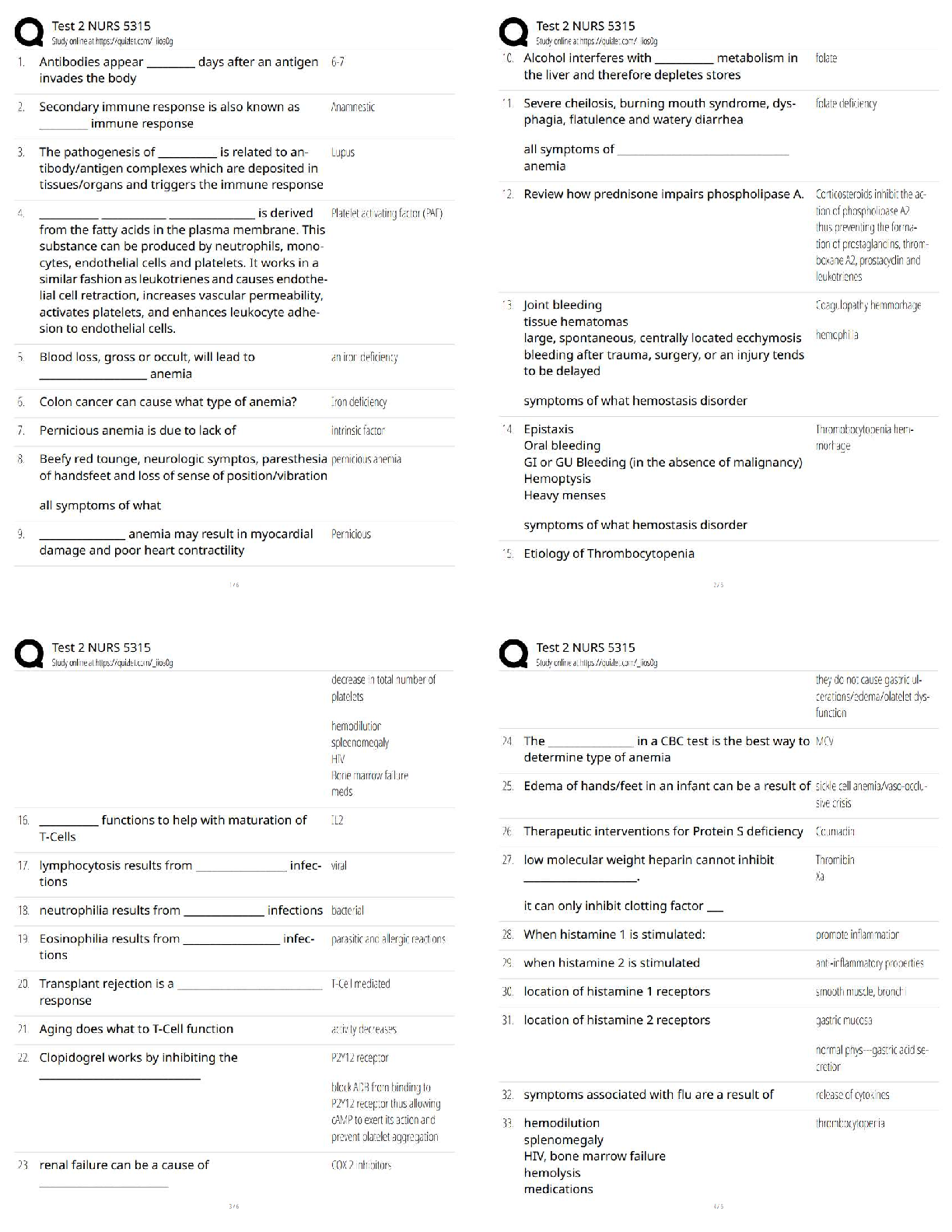
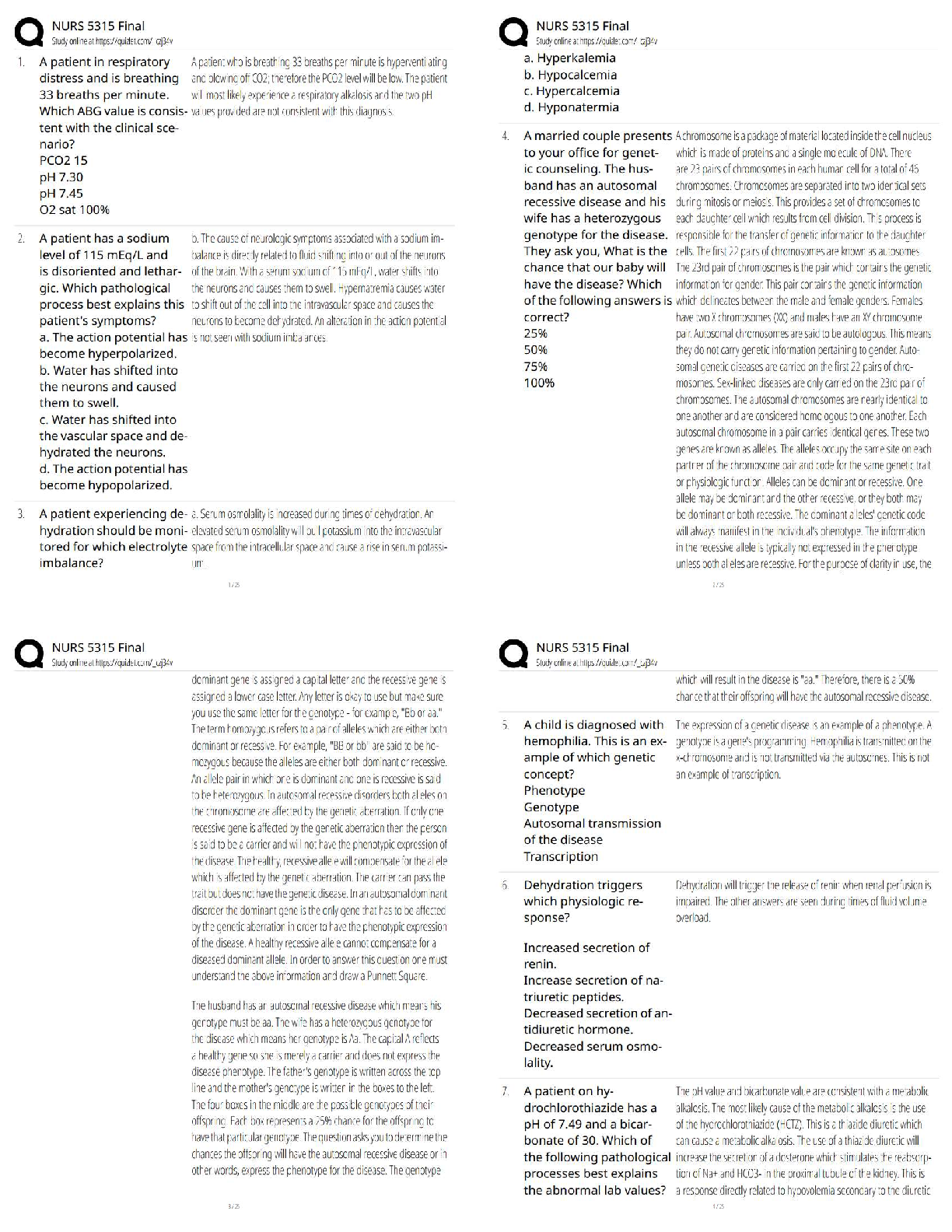
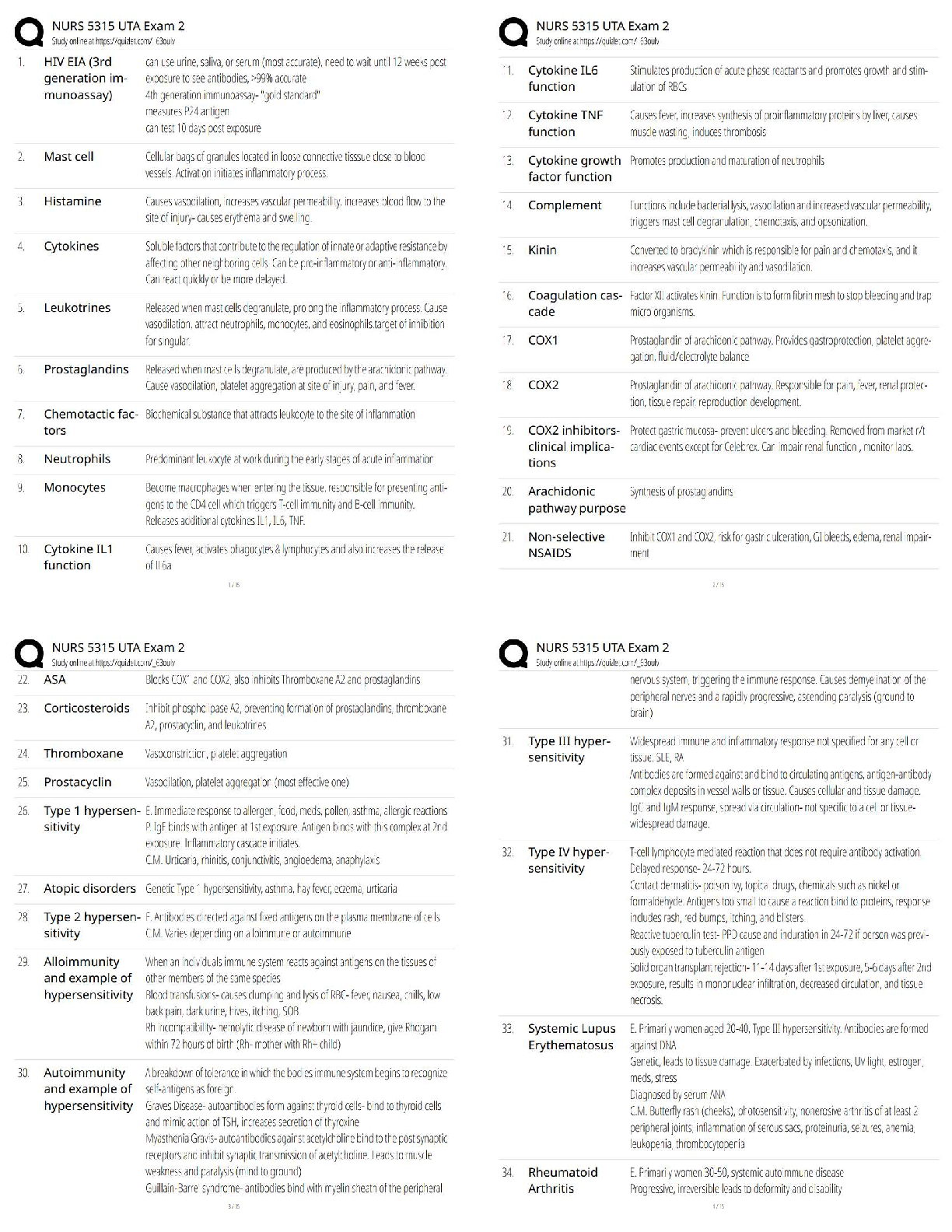

.png)