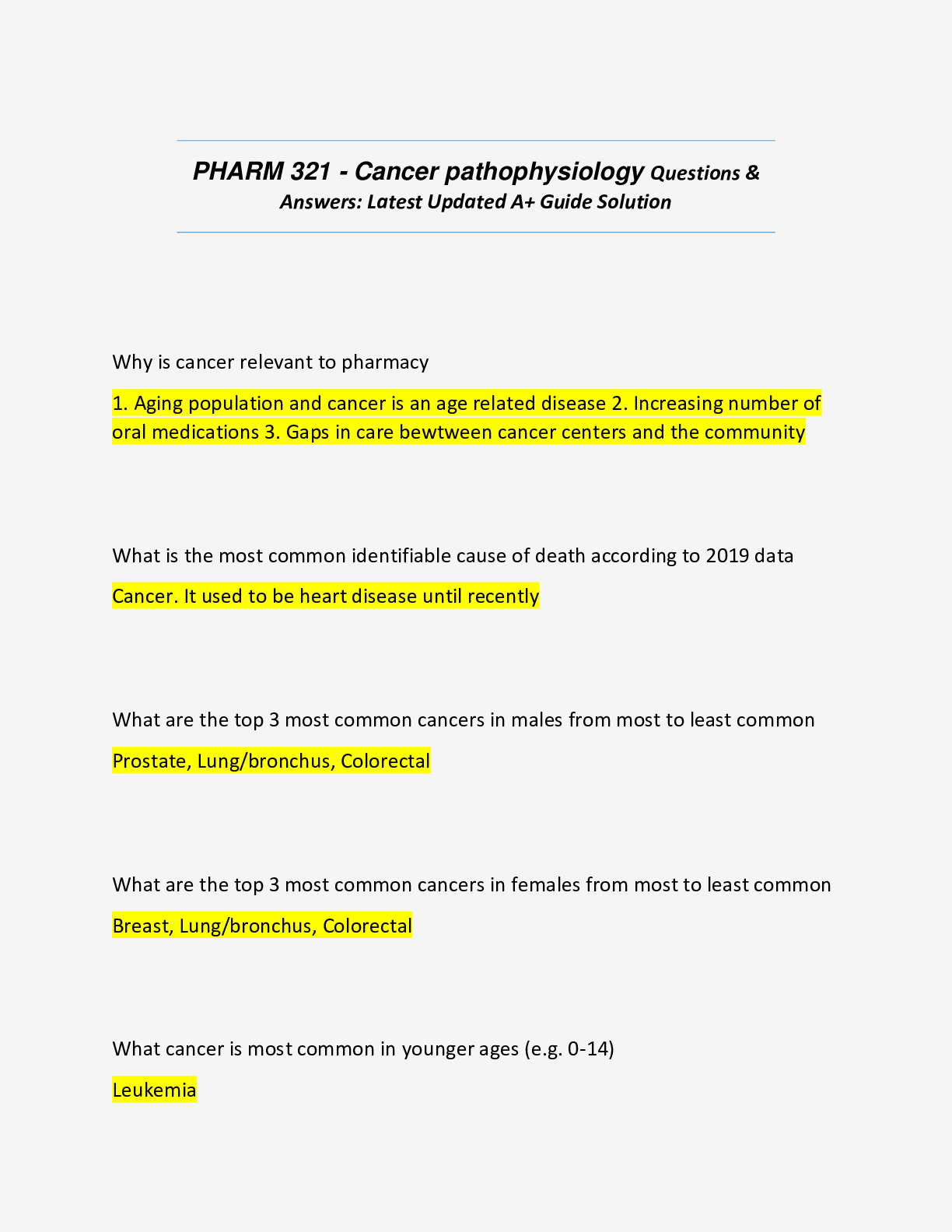
Why is cancer relevant to pharmacy
1. Aging population and cancer is an age related disease 2. Increasing number of oral medications 3. Gaps in care bewtween cancer centers and the community
What is the most common
...
Why is cancer relevant to pharmacy
1. Aging population and cancer is an age related disease 2. Increasing number of oral medications 3. Gaps in care bewtween cancer centers and the community
What is the most common identifiable cause of death according to 2019 data
Cancer. It used to be heart disease until recently
What are the top 3 most common cancers in males from most to least common
Prostate, Lung/bronchus, Colorectal
What are the top 3 most common cancers in females from most to least common
Breast, Lung/bronchus, Colorectal
What cancer is most common in younger ages (e.g. 0-14)
Leukemia
What is the most common cancer for older ages (e.g. 70+)
Lung/bronchus and colorectal
What is the most common cancer from 30-69 years old
Breast cancer
What is the probability of dying from cancer in Canada
1/4
What is the most common cancer death for males
Lung/bronchus
What is the most common cancer death for females
Lung/bronchus
What is the most common cancer death for younger ages (e.g. 0-29)
Brain/CNS or Leukemia
What is the most common cancer death for older ages (e.g. 50+)
Lung/Bronchus
What is the trend with cancer mortality and why is it trending that way
It is improving because of better screening and early detection
Which cancer has seemed to not make many improvements in mortality
Lung (for both genders) and uterus (obviously only in females)
What are the screening recommendations for breast cancer
1. Mammograms every 2 years for women 50-74 y.o has shown to reduce breast cancer mortality 2. Start at 30 for high risk patients (hereditary breast cancer syndrome) 3. Option to start at 40 for all women who wish to be screened 4. Women over 74 can still be screened by require a referral
What are the screening recommendations for colorectal cancer and what is the issue with it
A FOBT to be done every two years over the age of 50. It's not done often because patient's dont like to deal with poop.
What is used to screen for prostate cancer
DRE and PSA are evaluated
What screening is done for lung cancer
Low dose spiral CT but only for a select group of patients
What are some risk factors for cancer
Modifiable - Tobacco use, poor diet, lack of physical activity, solar radiation (including tanning beds), exposure to environmental carcinogens, infection (e.g. HPV), alcohol use ; Non-modifiable - Genetics (e.g. BRCA-1/BRCA-2 mutation), gender, age, race
What is the leading cause of preventable illness and death in Ontario and Canada
Tobacco use
What is the single most important cause of cancer
Tobacco use
What is the increase in risk of death from lung cancer with smoking
Risk of dying from lung cancer is more than 23 times greater in men and 13 times greater in women when compared to non-smokers
What percentage of lung cancer death are caused by smoking in women and men
90% for women and 80% for men
Other than lung cancer, what other cancers can tobacco cause
1. Cancers of oral cavity 2. Urinary tract cancers (bladder and kidney) 3. Cervical cancer 4. Acute myeloid leukemia 5. Some cancers of the stomach and pancreas
Which forms of tobacco cause cancer
All forms. Smoking, chewing, and second-hand tobacco smoke
What dietary considerations increase and/or decrease cancer risk
1. Intake of 5-10 servings of vegatable and fruits per day reduce cancer risk 2. Intake of +500 grams of cooked red meat per week increases cancer risk 3. Processed meats should be avoided (bacon, spam, smoked ham, or sausages) 4. Both red meat and processed meats are now listed as carcinogens by the WHO
What exercise and weight considerations increase and/or decrease cancer risk
1. Obesity (BMI>30) is a risk factor for developing cancer 2. Moderate to vigorous exercise and maintenance of a healthy body weight is recommended
What infections can increase risk of cancer. Include the associated cancer risks
1. HPV (Cervical, head and neck, vulvovaginal, anal, and penile cancers) 2. Hepatitis B & C (Hepatocellular carcinoma) 3. Epstein-Barr virus (Lymphoma) 4. Kaposi's Sarcoma associated herpesvirus 5. Merkel cell polyomavirus (Merkel cell carcinoma) 6. Helicobacter Pylori (Gastric cancer)
True or False. Light drinking does not increase the risk of some cancers
False. Even light drinking, defined as 0-12.5g alcohol/day, can increase the risk of some cancers
True or False. Most cancers can't be prevented through healthy eating, active living, regular cancer screening, and implementation of health promoting policies
False. 50% of cancers can be prevented by health lifestyle choices, regular screening, etc
How can genetic risk factors develop
1. De novo (newly mutated) 2. Inherited germline mutations
What are proto-oncogenes and some examples
Normal genes which can become oncogenic upon mutation or increased expression. These include RAS, Raf, MEK, ERK
What are some examples of tumor suppressor genes that when mutated to lose function, they may cause cancer
BRCA 1 & 2 and p53
What age group does cancer tend to be more prevalent. Provide a general age group.
Elderly
Since cancers are more common on older ages, why is this important
1. Our population is aging and thus will begin to see more cancer 2. Due to the aging popuation, it will palce enormous pressure on the healthcare system since cancer treatments are expensive
What are the 6 essential alterations in cell physiology that lead to malignancy
1. Self-sufficiency in growth signals 2. Evading apoptosis 3. Insensitivity to anti-growth signals 4. Tissue invastion and metastasis 5. Limitless replicative potential 6. Sustained angiogenesis
What are some new hallmarks of malignancy aside from the 6 essential alterations
1. Avoiding immune destruction 2. Tumor promoting inflammation 3. Genone instability and mutation 4. Deregulating cellular energetics
Does it take a single or multiple mutations before cells become malignant
Usually several mutations have to occur before it becomes malignant
What is a benign tumor
An abnormal group of cells that do not grow in an unlimited and aggressive manner and lacks the ability to metastasize and invade
True or False. Benign tumors can still cause health problems. If so, list some examples
True. They can cause compression of anatomic structures, overproduction of hormones if endocrine-derived, or have potential to become malignant
How are benign tumors usually managed
They are usually surgically removed
How is cancer diagnosed
Suspected malignancies are discovered either through screening or appearance of symptoms consistent with a diagnosis of cancer (e.g. cough, weight loss, hemoptysis in lung cancer) However, definitive diagnosis is made by pathologist upon examination of tissue sample
What can be deteremined from examing a tissue sample and why are they important
Tumor origin, histology, and grade. These are important because they guide treatment
How are cancer cells classified. Provide examples
They are classified by the type of normal cell they most resemble which is presumed to be their origin. For example, Carcinoma - Epithelial cells, Sarcoma - Connective tissue, Lymphoma & Leukemia - Hematopoetic cells, Germ-cell - Totipotent cells, Blastoma - Immature precursor cells
What is histologic grade
Determines how much the tumor cells in a neoplasm differ from the surrounding tissue. A well-differentiated cell is easy to identify. Poor differentiated tumor cells are more aggressive with poorer prognosis compared to well differentiated tumor cells
How does the grading scheme work
Grade 1 - Low grade/well-differentiated Grade 2 - Intermediated grade/moderately-differentiated Grade 3 - High grade/Poorly-differentiated
List the histologic grading schemes from most to least aggressive
3, 2, 1
Cancer spread differs based on what factor
Whether it is hematologic or solid tumor
True or False. Hematologic malignancies can metastasize
False. They dont really form metastatic deposites like solid tumors since they're already moving
What usually causes mortality in hematologic malignancies
Malignant clones preventing normal bone marrow function
What are the signs and symptoms of metastasis at different sites
Liver - Jaundice, right upper quadrant pain, nausea, asymptomatic ; Brain - headache, altered mental status, cushing's triad if severe, focal neurological signs ; Bone - Pain, fracture, hypercalcemia ; Spinal cord- Back pain, parasthesias, cauda equina syndrome & cord compression (Oncologic emergencies) ; Lung - Dyspnea, hemoptysis, cough
If a cancer metastasizes to a different area is it considered a cancer of the new location?
No it is still considered a cancer of the origin location that metasized to a new location
What does cancer staging tell us and why is it important
It tells us how far the cancer has progressed and is critical for determining prognosis
What are the different types of staging systems and their associated cancer
1. TNM staging (solid tumor) 2. Ann arbor staging (lymphoma) 3. International staging system (myeloma) 4. FAB classification (acute leukemias) 5. Rai staging/Binet classification (Chronic lymphocytic leukemia)
Describe how TNM staging of solid tumors works
T - Describes the size of the primary tumor and whether it has invaded nearby tissue ; N - Describes regional lymph nodes that are involved (Usually assigned a number from 0-2) ; M - Describes distant metastasis (Usually assigned a number 0-1)
What does the N criteria in TNM staging refer to
Areas of where the lymph nodes are involved and NOT the number of nodes
True or False. Any distant metastasize in lung cancer instantly makes it stage 4
True
How does staging affect 5-year survival rates in non-small cell lung cancer
The higher the stage the lower the survival rate
Which stages of cancer are considered early stage
Stage 1 and 2
What stage(s) of cancer is/are considered locally advanced
Stage 3
What stage(s) of cancer is/are considered metastatic/widespread
Stage 4
Why is staging important and how does it guide your treatment plan
Early stages will often adopt a curative treatment while later stages will adopt a palliative treatment. However, certain colorectal and ovarian cancers can be cured at stage 4
What is the difference between staging and grading
Staging is how advanced a patient's disease is according to it's spread. Grading is how aggressive the patient's tumor is by appearance under a microscope
What are the different types of biomarkers for cancer and their purposes
Diagnostic biomarkers - Determine whether the patient has cancer or a high risk for cancer ; Prognostic biomarkers - Determine how good/poor a patient's prognosis is independant of treatment ; Predictive biomakers - Determine how well a patient will respond to a particular targeted cancer therapy ; Resistance biomarkers - Predict for resistance to a given therapy ; Surrogate biomarkers - May correlate with real clinical endpoint but does not necessarily have a guaranteed relationship
What is the purpose of predictive biomarkers
Not all patients response to certain cancer treatments which can be expensive and expose patients to unnecessary toxicities. Predictive biomarkers can help circumvent these issues and make treatment more effective and reduce costs
What are common consequences of cancer
1. Pain 2. Weight loss 3. Cachexia 4. Fatigue 5. Loss of appetite 6. Night sweats 7. Anemia 8. Thrombosis 9. Paraneoplastic symptoms (Hypercalcemia, Cushing's, Dermatomyositis)
[Show More]