CPCE Exam 226 Questions with Verified Answer 2023
Erik Erikson's 8 stages of development - CORRECT ANSWER trust vs mistrust, autonomy vs shame, initiative vs guilt, industry vs inferiority, identity vs diffusion, inti
...
CPCE Exam 226 Questions with Verified Answer 2023
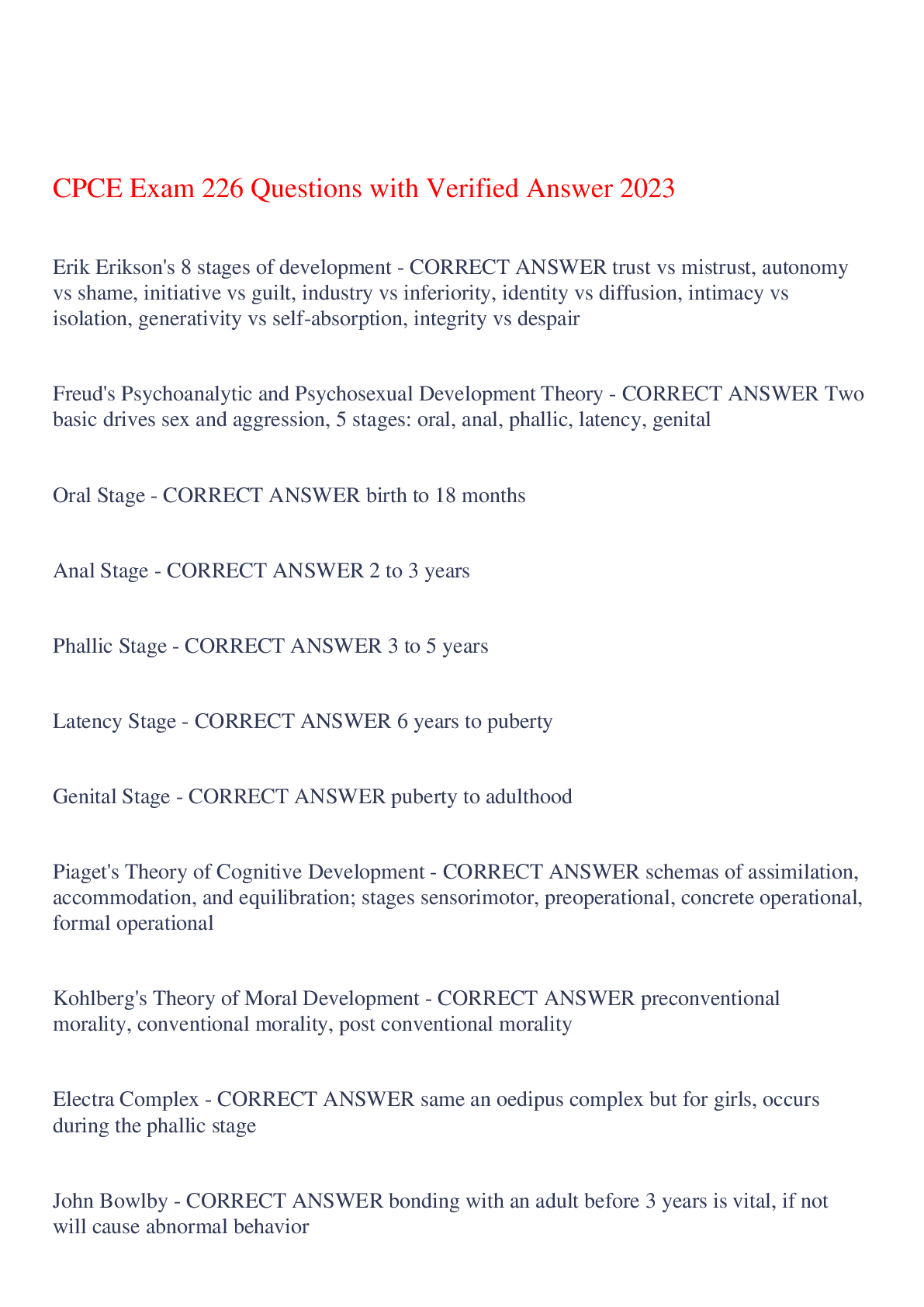
Erik Erikson's 8 stages of development - CORRECT ANSWER trust vs mistrust, autonomy vs shame, initiative vs guilt, industry vs inferiority, identity vs diffusion, intimacy vs isolation, generativity vs self-absorption, integrity vs despair
Freud's Psychoanalytic and Psychosexual Development Theory - CORRECT ANSWER Two basic drives sex and aggression, 5 stages: oral, anal, phallic, latency, genital
Oral Stage - CORRECT ANSWER birth to 18 months
Anal Stage - CORRECT ANSWER 2 to 3 years
Phallic Stage - CORRECT ANSWER 3 to 5 years
Latency Stage - CORRECT ANSWER 6 years to puberty
Genital Stage - CORRECT ANSWER puberty to adulthood
Piaget's Theory of Cognitive Development - CORRECT ANSWER schemas of assimilation, accommodation, and equilibration; stages sensorimotor, preoperational, concrete operational, formal operational
Kohlberg's Theory of Moral Development - CORRECT ANSWER preconventional morality, conventional morality, post conventional morality
Electra Complex - CORRECT ANSWER same an oedipus complex but for girls, occurs during the phallic stage
John Bowlby - CORRECT ANSWER bonding with an adult before 3 years is vital, if not will cause abnormal behavior
Harry Harlow - CORRECT ANSWER worked with monkeys on attachment and believe it was innate, isolation lead to autistic abnormal behavior
Konrad Lorenz - CORRECT ANSWER imprinting ducks will follow the first moving object the see
Critical Periods (Lorenz) - CORRECT ANSWER certain behaviors must be learned at specific stages or they will not be learned at all
Genotype - CORRECT ANSWER genetic makeup of an organism
Phenotype - CORRECT ANSWER physical or biochemical characteristics determined by genetics and the environment
Tabula Rasa - CORRECT ANSWER John Locke, a child is born with an unformed mind that develops through experience, blank slate
Plasticity - CORRECT ANSWER the smooth transition from one stage of development to the next
Human Development - CORRECT ANSWER learning, cognitive, psychoanalytic, humanistic
Levinson's The Seasons of a Man's Life - CORRECT ANSWER book about study of adult males, life into 4 periods; preadulthood to 17 years, early adulthood starting at 17 to 22, middle adulthood starting at 40 to 45, older adult starting at 60 to 65, midlife crisis
Maslow's Hierarchy of Needs - CORRECT ANSWER person must first satisfy basic needs (food/shelter) before higher needs (love/security)
Gesell's Maturationist Theory - CORRECT ANSWER development is a biological process independent from environmental influences
Behaviorism Theory of Learning - CORRECT ANSWER learning is a change of behavior caused by consequences of behaviors, Watson, Skinner, Thorndike
Law of Effect (Thorndike) - CORRECT ANSWER a behavior followed by a reward is is strengthened and more likely repeated
Rogers - CORRECT ANSWER person centered, people are eventually good, move toward self-actualization
Berne - CORRECT ANSWER transactional analysis, each person has 3 ego states, parent, adult, child
Freud - CORRECT ANSWER psychoanalysis, biological instincts and development through psychosexual stages
Ellis - CORRECT ANSWER rational emotive behavior therapy: person's instincts are rational and irrational but can be taught
Perls - CORRECT ANSWER gestalt: people are whole and complete but effect by environment. organizing experience determines learning
Glasser - CORRECT ANSWER reality therapy: people have needs of food/shelter plus the need to feel worthwhile and successful
Adler - CORRECT ANSWER individual psychology: people are essentially good, birth order determines much of behavior
Jung - CORRECT ANSWER analytic psychology: people strive for self-fulfillment
Skinner - CORRECT ANSWER behavioral/cognitive behavioral modification: people cannot make free will decisions, behavior is learned from environment and reinforcement
Frankl - CORRECT ANSWER existential: people are good/rational and have the freedom to chose behavior
Williamson (trait factor) - CORRECT ANSWER trait factor: potential for good/bad is innate
Empiricists - CORRECT ANSWER John Locke, experience is the only source of knowledge
Psychodiagnostic - CORRECT ANSWER testing that assesses how thinking and emotions affect behavior
Invivo Desensitization - CORRECT ANSWER person is gradually exposed to something he fears
Ethology - CORRECT ANSWER the study of animals in their natural environment
Psychometrics - CORRECT ANSWER the entire process of tests measuring intelligence, aptitude, and personality characteristics
Psychopharmacology - CORRECT ANSWER the study of the effects of drugs on psychological functioning
Centration - CORRECT ANSWER Piaget's preoperational stage, focusing on one feature of an object and ignoring the rest
Bibliotherapy - CORRECT ANSWER use of books and written material
Musterbation - CORRECT ANSWER absolutist thinking by the client (must/should) (Ellis)
Awfulizations - CORRECT ANSWER Looking at a situation irrationally how awful it will be (Ellis)
Nancy Chodorow - CORRECT ANSWER saw psychoanalytic theory as using gender stereotyping with male imposed standards
Jean Baker Miller - CORRECT ANSWER "care taking" is helping others to develop emotionally, intellectually, and socially. differentiates women's development from men
Harriet Lerner - CORRECT ANSWER women need to balance activities that center on others and also themselves, women need to be assertive and show independence and strength in intimate relationships
Carol Tavris - CORRECT ANSWER society judges women by how they fit into the male world
Carol Gilligan - CORRECT ANSWER women communicate with each other differently then men
Gail Sheehy - CORRECT ANSWER wrote book Passages about transitional crisis periods in a woman's life that provide opportunities for growth
Scheme of intellectual and ethical development (William Perry) - CORRECT ANSWER 4 categories: dualism, multiplicity, relativism, commitment
Piaget's definition of intelligence - CORRECT ANSWER not solely determined by genetics but also by environment, experiences, and culture
Emotional intelligence (Daniel Goleman) - CORRECT ANSWER self-motivation, self-awareness, empathy, social awareness, and persistence
Spirituality - CORRECT ANSWER effects a person's sense of self, relationships with others, perception of society, and reaction to problems
Generativity - CORRECT ANSWER in Erikson's middle adulthood stage a person's ability to care for another
Stagnation (Havinghurst) - CORRECT ANSWER a person will demonstrate self-absorption not caring for another
Universal Culture - CORRECT ANSWER contains all humans all having the same biology and basic biological needs
Ecological Culture - CORRECT ANSWER the physical location and climate of a person
Ethnic Culture - CORRECT ANSWER social subdivision of a cultural group
IDEA - CORRECT ANSWER individuals education improvement act of 2004
ADA - CORRECT ANSWER Americans with disabilities act of 1990 prohibits discrimination in employment
Alfred Adler's birth order - CORRECT ANSWER birth order creates a different psychological situation for each child, influences family dynamics
Life Cycle of a family - CORRECT ANSWER independence, coupling, parenting, launching adult children, retirement or senior years
Family systems theory (Murray Bowen) - CORRECT ANSWER differentiation of self, nuclear family, triangulation, family projection process, multigenerational transmission process, emotional cutoff, sibling position, societal emotional process
Intrinsic Motivation - CORRECT ANSWER an internal motivation for behavior such as a hobby, based on the enjoyment of the behavior
Extrinsic Motivation - CORRECT ANSWER motivation for a behavior based on expectation of a reward or punishment
Robert Carkhuff - CORRECT ANSWER conducted studies revealing that therapy doesn't always have a positive outcome, developed a 5 point scale measuring empathy, genuineness, concreteness, and respect in counseling
Restatement - CORRECT ANSWER rephrasing what the client has said with emphasis on the cognitive message
Reflection - CORRECT ANSWER rephrasing what the client has said with emphasis on the feeling part of the message
Paraphrasing - CORRECT ANSWER using different words to restate what the client has said in order to gain a better understanding
Summarizing - CORRECT ANSWER a concise statement of the main points or ideas in a session
Confrontation - CORRECT ANSWER technique where the counselor identifies discrepancies and presents them to the client
Structuring - CORRECT ANSWER defining the nature, limits, and goals of counseling, and the roles of the client and counselor
Witmer and Sweeney (healthy individuals) - CORRECT ANSWER identified 5 tasks associated with healthy individuals; spirituality, self-regulation, work, friendship, and love
Empathy - CORRECT ANSWER understanding another by identifying with their situation. Two stages include experiencing the same emotions as the person, and looking at the situation from their pov
Stages of building counselor client relationship - CORRECT ANSWER entry phase, clarification phase, structure phase, relationship phase
Stages of Positive Interaction - CORRECT ANSWER 4 stages: stage 1 exploring feelings, stage 2 consolidation, stage 3 planning, stage 4 termination of relationship
Transference - CORRECT ANSWER projecting thoughts or feelings about someone/something onto a new object/person
Attending - CORRECT ANSWER showing interest and respect for what another has to say, examples include eye contact, posture/distance, communication
Resistance - CORRECT ANSWER occurs when a client avoids seeking help when needed, can be unconscious
Critical incident stress debriefing - CORRECT ANSWER a meeting for involved professionals following a stressful event or crisis
Maslow's hierarchy of needs - CORRECT ANSWER pyramid of basic human needs: (bottom up) physiological, safety, love and belonging, self-esteem, and self-actualization
Congruence - CORRECT ANSWER the counselor's ability to maintain agreement between words and actions
Caplan's group counseling - CORRECT ANSWER primary or guidance, secondary or counseling, tertiary or therapy
Stages of a group - CORRECT ANSWER formation or trust/orientation, work/productivity or transition, closure or consolidation and termination
Gestault group theory - CORRECT ANSWER mature people determine their path in life and take responsibility for their decisions and actions, goal to make them more aware of their thoughts and emotions to become more mature
Person-centered theory - CORRECT ANSWER goal to help members better understand themselves to get closer to self-actualization
Behavioral counseling groups - CORRECT ANSWER goal is to modify problem behaviors and improve member's coping skills
Benet and IQ testing - CORRECT ANSWER developed the first intelligence test the Stanford-Binet, determined mental age as opposed to chronological age
Cattell and intelligence - CORRECT ANSWER fluid intelligence; inborn, abstract reasoning, crystallized intelligence; from acquired knowledge and skills
Appraisal - CORRECT ANSWER assessment tools used to evaluate traits and behaviors
Measure - CORRECT ANSWER a score assigned to a person's trait or behavior
Test - CORRECT ANSWER a systematic method of measuring/evaluating
Projective tests - CORRECT ANSWER unstructured tests for things like personality/feelings
Free choice test - CORRECT ANSWER short answer subjective test
Forced choice test - CORRECT ANSWER items such as true/false questions have a definite answer
Spiral test - CORRECT ANSWER easier to harder questions
Cyclical test - CORRECT ANSWER test has sections that progress in each section
Test battery - CORRECT ANSWER collection of tests given to the same group and scored the same
Horizontal test - CORRECT ANSWER covers material from different subjects
Vertical Test - CORRECT ANSWER test on one subject that is given at different levels/ages
Q-sort - CORRECT ANSWER tool for measuring self-esteem with statements like "most/least like me"
Halo effect - CORRECT ANSWER favorable evaluation of personality based on one trait
Difficulty index - CORRECT ANSWER the percentage of test takers that get an item correct
Dichotomous items - CORRECT ANSWER questions such as true/false that give the test taker opposing choices
Normative item format - CORRECT ANSWER unlinked items on a test
Normative test - CORRECT ANSWER person's test results can be compared to others, percentile can be created
Ipsative format - CORRECT ANSWER allows a person to compare 2 or more examples of their performance
Power test - CORRECT ANSWER untimed test, tests mastery level
Percentile - CORRECT ANSWER number that shows percent of data distribution
Speed test - CORRECT ANSWER timed test, difficulty is in how fast completed not content
Stanine - CORRECT ANSWER a way of scaling test scores, 9 divisions, SD 2
Transactional analysis theory in groups - CORRECT ANSWER goal to change life pattern through self-awareness and awareness of others and understanding past events
Reality theory in groups - CORRECT ANSWER goal is to improve life situation by gaining better control and more responsibility for their behavior
REBT - CORRECT ANSWER goals include changes in thought and behavior to promote greater self-acceptance and eliminate self-defeating behaviors and illogical thinking
Adlerian theory and groups - CORRECT ANSWER examine early history, roles of family, birth order, ad belief systems assess emotional problems caused by feelings of inferiority and lack of social connectedness
Risky shift phenomenon - CORRECT ANSWER a person is likely to make a riskier decision as part of a group than they would alone
T-group - CORRECT ANSWER training group
Self-help - CORRECT ANSWER support group of people sharing a common problem
Sociometry - CORRECT ANSWER a method for measuring social relationships in groups, developed by Jacob Moreno
Karpman's drama triangle: - CORRECT ANSWER in transactional analysis, a model of interactions that show roles of victim, persecutor, and rescuer
Horizontal interventions - CORRECT ANSWER counselor works with the group as a whole
Vertical interventions - CORRECT ANSWER counselor works with individuals within the group
Group work grid - CORRECT ANSWER developed by R. K. Coyne, model that shows four levels of intervention; individual, interpersonal, organization, and community population
Developmental approach to career development - CORRECT ANSWER career development occurs through stages over a period of time, includes self-concept, need, and lifespan changes (Gottfredson)
Actuarial/ trait-based approach to vocational guidance - CORRECT ANSWER developed by Frank Parsons, assumes people are capable of making intelligent vocational decisions by the careers best suited to their interests and aptitudes
Minnesota Occupational Rating Scales - CORRECT ANSWER developed by Williamson to expand on Parsons' model
Decisions approach to vocational guidance - CORRECT ANSWER believes that vocational education should be a part of all student's education, Gelatt identified two types of decisions terminal and investigative
Super's vocational development stages: - CORRECT ANSWER stages; growth (birth to 15), exploratory (15 to 24), establishment (25 to 44), maintenance (45 to 64), and decline (65+)
Super's development tasks - CORRECT ANSWER crystallization (14 to 18), specification (18 to 21), implementation (21 to 24), stabilization (24 to 35), and consolidation (35+)
Super's archway model - CORRECT ANSWER illustration of changing life roles over lifespan, includes biographical, psychological, and socioeconomic elements that influence development of career
Super's life career rainbow - CORRECT ANSWER illustration which each color represents a life role, used to help find balance of work and life suited for them
Super's life roles - CORRECT ANSWER child, student, leisurite, citizen, worker, parent, spouse, and homemaker
Holland's hexagon theory - CORRECT ANSWER illustration of personality types and six occupational environments/themes, determines what work environment will best suit personality type
Holland's personality types - CORRECT ANSWER realistic, investigative, artistic, social, enterprising, and conventional
Krumboltz's learning theory of career counseling - CORRECT ANSWER four factors in career decision making; genetic endowments, environmental conditions, instrumental and associative learning, and task approach skills
Gottfredson's circumscription and compromise theory of career development: - CORRECT ANSWER explains how vocational choice develops in children and teens, four stages include; orientation to size and power, sex roles, social valuation, internal unique self
Roe's career development theory - CORRECT ANSWER genetics, childhood experiences, and relationship with parents were contributing factors to career choice, 8 occupational fields and 6 levels of skill
Career development theory of Ginzberg, Ginsberg, Axelrad, and Herma - CORRECT ANSWER occupational choice can be divided into 3 periods; fantasy, tentative, and realistic
Cognitive information processing of career development - CORRECT ANSWER method of dealing with career problems using 5 steps; communication, analysis, synthesis, valuing, and execution
Tiedeman's career decision making model - CORRECT ANSWER believed that career decisions were made as ego related problems were solved, two phase process; anticipation/preoccupation and implementation/adjustment
Constructivism approach to career development - CORRECT ANSWER each person builds their own reality, understand the meaning of their life roles and values and beliefs
Contextualism approach to career development - CORRECT ANSWER acknowledges a close relationship between a person's inner forces and their environment, reality is drawn from person's perception of event
Social cognitive theory of career development: - CORRECT ANSWER based on self-efficacy; person's belief/knowledge about their abilities
Sociological model of career development - CORRECT ANSWER situational model, which a person chooses a career based on sociological reasons
Crites' career development theory - CORRECT ANSWER believes that diagnosis determines the outcome of counseling, 3 types of diagnosis; differential, dynamic, and decisional
Limitations of career development theories - CORRECT ANSWER most studies were done in the 50s and 60s with adult white males
Family and Medical Leave Act (FMLA) - CORRECT ANSWER requires companies to employ 50 or more people to provide for up to 12 week unpaid leave for childbirth or immediate family member illness
Glass ceiling - CORRECT ANSWER an unwritten agreement by the decision makers of a company, the highest level women and minorities can reach
Displaced homemaker - CORRECT ANSWER a woman reentering the workforce or entering for the first time after raising a family
Dislocated worker - CORRECT ANSWER a person unemployed due to job elimination/relocation
Underemployment: - CORRECT ANSWER employee whose education/experience exceeds requirements for the position
Occupational sex segregation - CORRECT ANSWER occupations commonly thought of as female jobs usually have less pay and lower status
Manifested interest - CORRECT ANSWER an interest revealed by what a person does
Tested interest - CORRECT ANSWER determination of interest through testing
Outplacement counseling - CORRECT ANSWER career counseling for employees whose jobs are ending
Test reliability - CORRECT ANSWER measurement of the consistency in which a test yields similar results in repeated uses
Test-retest reliability/stability - CORRECT ANSWER giving the same test to the same group twice no more than 2 weeks between
Equivalence - CORRECT ANSWER the correlation of the results of using different tests covering the same content with the same group of test takers
Internal consistency - CORRECT ANSWER measures the consistency of results from items in a test
Validity: - CORRECT ANSWER the degree to which a test measures what it is designed to measure
Content validity - CORRECT ANSWER the reflection of the subject matter in the content of the test
Predictive validity - CORRECT ANSWER the capability of a test to predict future behavior
Concurrent validity - CORRECT ANSWER the immediate comparison of test results with the results from other sources that measure the same factors
Construct validity - CORRECT ANSWER the extent to which a test measures an abstract psychological trait such as anxiety
Achievement tests - CORRECT ANSWER measure learning, such as the Stanford-Binet or Wechsler Adult Intelligence Scale (WAIS-III)
Aptitude tests - CORRECT ANSWER measure a person's ability to master skills or acquire knowledge
Personality tests - CORRECT ANSWER determines personality traits and may be projective, inventories, or specialized; ex Rorschach or Myers-Briggs
Interest inventories - CORRECT ANSWER measures likes and dislikes; ex Strong Interest Inventory, Career Assessment Inventory
WAIS-III: - CORRECT ANSWER Wechsler Adult Intelligence Scale measures both verbal and performance IQ, can be used as young as age 3
Galton and intelligence - CORRECT ANSWER intelligence is primarily genetic and has a normal distribution similar to height and weight
Gilford and intelligence - CORRECT ANSWER used factor analysis to find 120 factors related to intelligence, also defined convergent and divergent thinking
Convergent thinking (Gilford) - CORRECT ANSWER different thoughts and ideas combined into a single concept
Divergent thinking (Gilford) - CORRECT ANSWER the ability to create a novel idea
T-score - CORRECT ANSWER a score within a normal distribution with a mean of 50 and SD of 10
Standardized score - CORRECT ANSWER same as z score
Skew - CORRECT ANSWER the amount a score deviates from the norm
Standard deviation - CORRECT ANSWER measure of statistical dispersion
Variance - CORRECT ANSWER the square of the SD
Correlation coefficient: - CORRECT ANSWER a measurement of the linear relationship between two variables
Intrusive measurement - CORRECT ANSWER person is aware that they are being observed, questionnaire/interviews
Obtrusive measurement - CORRECT ANSWER subject is unaware of observation or investigation
Regression to the mean - CORRECT ANSWER earning a very low/very high score on a pretest means they will probably score close to the mean on the posttest
Rating scale - CORRECT ANSWER chart used to indicate the degree to which an attribute/characteristic exists
Descriptive/statistical research - CORRECT ANSWER can be used to document factors such as frequencies/averages, showing the who, what, when, where, and how of the data
Comparative research - CORRECT ANSWER compares two or more groups without changing any of the experiences of the group
Correlation coefficient - CORRECT ANSWER the degree of relationship between variables
Deductive research - CORRECT ANSWER sets out to prove/disprove a theory by collecting data and testing hypothesis
Inductive research: - CORRECT ANSWER works from known info to develop a theory by establishing relationships/patterns in the data
Qualitative research - CORRECT ANSWER in-depth investigation of the subject/group
Interactive qualitative research - CORRECT ANSWER includes case studies and ethnography
Non-interactive qualitative research - CORRECT ANSWER includes a study and analysis of the literature about a particular subject
Experimental quantitative research - CORRECT ANSWER the cause and effect relationship between variables, includes a control, and independent & dependent variable
Quasi-experimental research - CORRECT ANSWER much like experimental but may not use a control
External validity - CORRECT ANSWER the accuracy which the results of a study can be generalized to a larger population
Hawthorne effect - CORRECT ANSWER caused by the subjects knowing they are being involved in a study
Rosenthal effect/experimenter bias - CORRECT ANSWER when the subjects change their behavior due to the researcher
Internal validity: - CORRECT ANSWER the extent to which the results of an experiment can be attributed to the variable under study because extraneous variables have been controlled
Random sampling - CORRECT ANSWER choosing the subjects for a study based on chance, reduces likelihood of bias
Stratified sampling - CORRECT ANSWER divides the population into subgroups according to a certain criteria
Proportional stratified sampling - CORRECT ANSWER the selection of the number of subjects in each subgroup that corresponds to the percentage of the population
Cluster sampling - CORRECT ANSWER divides the population into subdivisions
Purposeful sampling - CORRECT ANSWER the selection of subjects for an in-depth study
Nominal measurements - CORRECT ANSWER categorical variables used to describe the demographics of the subjects
Ordinal measurements - CORRECT ANSWER used to describe variables that can be arranged in some type of ranking order
Interval measurements: - CORRECT ANSWER used to describe variables with similar/equal distances between ranks
Ratio measurements - CORRECT ANSWER variables that have equal intervals and a zero reference point
Independent variable - CORRECT ANSWER the factor in an experiment that is changed by the researcher
Dependent variable - CORRECT ANSWER what is being measured by the study and is changed in response to changes in the independent variable
Type I/alpha error - CORRECT ANSWER the null hypothesis is rejected as false when it is really true
Type II/beta error - CORRECT ANSWER the null hypothesis is not rejected when it is false
T-test - CORRECT ANSWER compares the mean of two independent data sets to determine if there is significant statistical difference between them
Null hypothesis - CORRECT ANSWER assumes no difference or no association between variables
Directional hypothesis - CORRECT ANSWER predicts how the independent variable will affect the dependent variable
Significance level: - CORRECT ANSWER indicated the probability of making a type I error in a hypothesis test
Analysis of covariance (ANCOVA) - CORRECT ANSWER used in studies where the dependent variables are controlled
One-way analysis of variance - CORRECT ANSWER a test for differences when the study involves 3 or more independent groups/levels
Factorial Analysis of variance (ANOVA) - CORRECT ANSWER used in the study of 2 or more variables
Multivariate analysis of variance (MANOVA) - CORRECT ANSWER used in studies involving several dependent variables and at least 2 independent variables
Chi-squared - CORRECT ANSWER used to determine if there are significant differences in the distribution of two data sets
Post hoc tests - CORRECT ANSWER multiple comparison tests, can be done after the data sets are determined to have similar F values
Nonparametric tests: - CORRECT ANSWER validation tests used when a study yields values that are not distributed normally or the sample variance is close to the population
Nonparametric one-way analysis of variance - CORRECT ANSWER used there are multiple values for a single variable/factor
Accountability - CORRECT ANSWER primarily concerned with effectiveness of the treatment with justification of the cost
1 - CORRECT ANSWER
[Show More]