ATI MED SURG 1:
Safety and Infection Control [2/4]
- Bacterial, viral, fungal, and parasitic infections: isolation precautions for client who has influenza
1. A nurse is caring for a client who has Haemophilus in
...
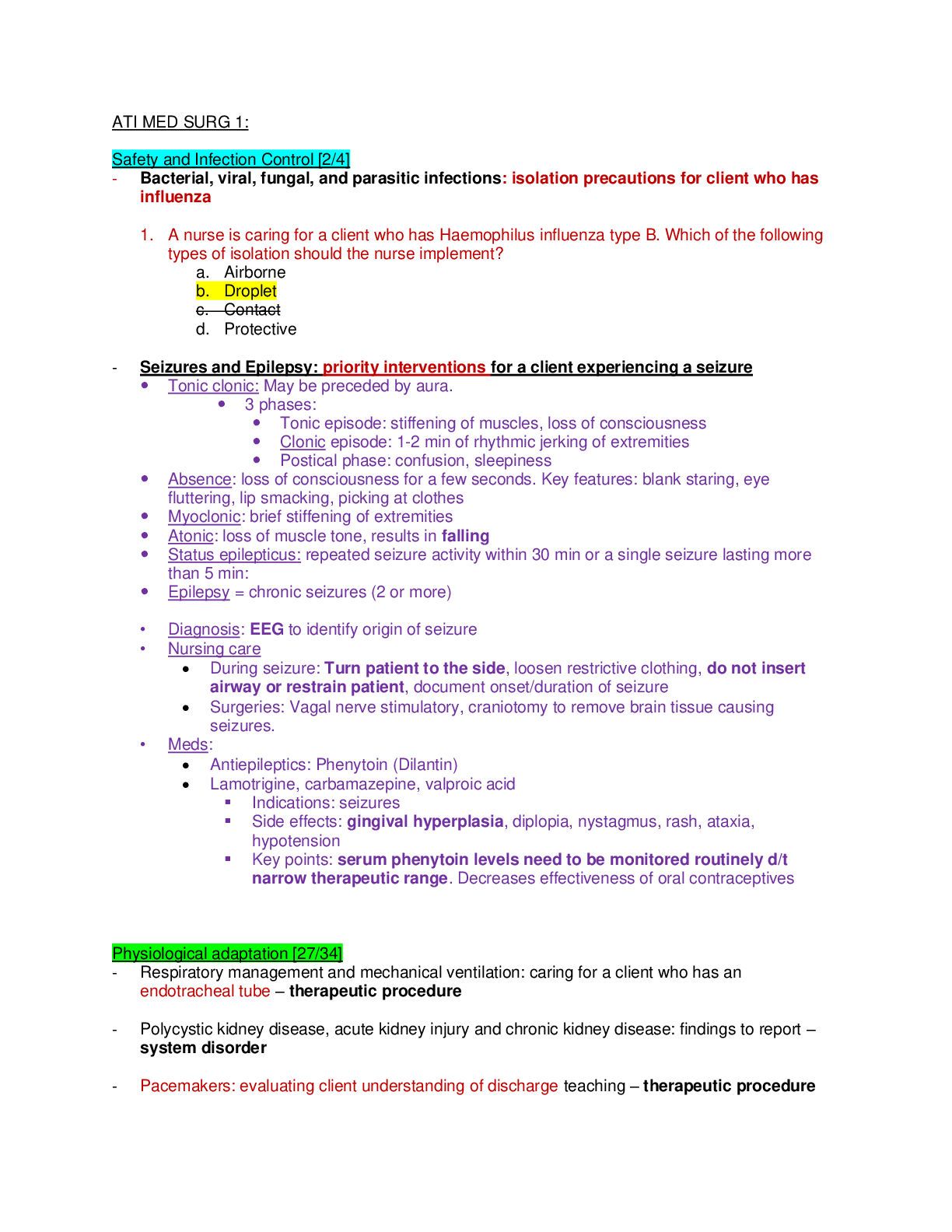
ATI MED SURG 1:
Safety and Infection Control [2/4]
- Bacterial, viral, fungal, and parasitic infections: isolation precautions for client who has influenza
1. A nurse is caring for a client who has Haemophilus influenza type B. Which of the following types of isolation should the nurse implement?
a. Airborne
b. Droplet
c. Contact
d. Protective
- Seizures and Epilepsy: priority interventions for a client experiencing a seizure
Tonic clonic: May be preceded by aura.
3 phases:
Tonic episode: stiffening of muscles, loss of consciousness
Clonic episode: 1-2 min of rhythmic jerking of extremities
Postical phase: confusion, sleepiness
Absence: loss of consciousness for a few seconds. Key features: blank staring, eye fluttering, lip smacking, picking at clothes
Myoclonic: brief stiffening of extremities
Atonic: loss of muscle tone, results in falling
Status epilepticus: repeated seizure activity within 30 min or a single seizure lasting more than 5 min:
Epilepsy = chronic seizures (2 or more)
• Diagnosis: EEG to identify origin of seizure
• Nursing care
• During seizure: Turn patient to the side, loosen restrictive clothing, do not insert airway or restrain patient, document onset/duration of seizure
• Surgeries: Vagal nerve stimulatory, craniotomy to remove brain tissue causing seizures.
• Meds:
• Antiepileptics: Phenytoin (Dilantin)
• Lamotrigine, carbamazepine, valproic acid
Indications: seizures
Side effects: gingival hyperplasia, diplopia, nystagmus, rash, ataxia, hypotension
Key points: serum phenytoin levels need to be monitored routinely d/t narrow therapeutic range. Decreases effectiveness of oral contraceptives
Physiological adaptation [27/34]
- Respiratory management and mechanical ventilation: caring for a client who has an endotracheal tube – therapeutic procedure
- Polycystic kidney disease, acute kidney injury and chronic kidney disease: findings to report – system disorder
- Pacemakers: evaluating client understanding of discharge teaching – therapeutic procedure
- Electrocardiography and dysrhythmia monitoring: identifying first-degree heart block – diagnostic procedure
- Musculoskeletal trauma: assessing for compartment syndrome – system disorder
- Emergency nursing principles and management: emergency illness management – therapeutic procedure
- Cancer treatment options: prioritizing client care – basic concept
Health promotion and maintenance [1/2]
- Immunization: recommended vaccinations for older adult clients – growth and development
Pharmacological and parenteral therapies [14/23]
- Pain management for clients who have cancer: managing breakthrough pain—system disorder
- Dosage calculations: Calculating IV infusion rate – basic concept
- Electrolyte imbalances: adequate nutritional status with TPN – therapeutic procedure
Total Parenteral Nutrition (TPN) → Indicated for malabsorption, hypermetabolic states (i.e. burns), chronic malnutrition, and prolonged NPO
a. Administration → Via central line (i.e. PICC line)
i. Do not use TPN line for other fluids or meds!!
b. Nursing considerations → Gradually increase/decrease flow rate
i. Change tubing and bag q24h and use micron filter on tubing
ii. If next TPN bag is unavailable, administer 10% dextrose in water until it arrives because it prevents a precipitous drop in the client’s blood glucose levels
iii. Monitor I&O, daily wt, electrolytes, and blood glucose (q4-6h for first 24h)
o TPN -- Indications: Malabsorption, hypermetabolic state, chronic malnutrition, prolonged NPO
▪ Administration: Through central or peripheral IV-line (Ex. PICC) Infusion pump is always used for PN
▪ Nursing care:
● Gradually increase/decrease flow rate, Change tubing and bag every 24 hours, Use micron filter on tubing, Monitor I&O, daily weights, electrolyte levels, blood glucose (every 4-6 hours for the first 24 hours),If the next TPN bag is unavailable, administer 10% dextrose in water until it arrives, Do not use TPN line for other fluids or meds! Monitor central line insertion site for s/s of infection (erythema, pain, exudate) Monitor blood glucose, VS q4hrs
- Medications affections coagulation: heparin contraindications – medication
- Heparin subcutaneously
Use an electric shaver because they are less likely to get cuts from shaving
Avoid actions that may cause bleeding such as flossing. Do not massage site after injection, firm pressure is okay. Report signs of bleeding in urine.
- Electrolyte imbalances: Manifestations of hypokalemia – medication
- Heart failure and pulmonary edema: client teaching on use of furosemide – medication
- Gastrointestinal therapeutic procedures: central venous access device care – therapeutic procedure
- Electrolyte imbalances: effective action of magnesium sulfate – medication
- Blood and blood produce transfusions: Indications of a transfusion reaction – therapeutic procedure
Basic care and comfort [5/6]
- Pressure ulcers, wounds, and wound management: methods of debridement
Reduction of risk potential [14/21]
- Cushing’s disease/ syndrome: priority action – system disorder
- Burns: Priority action during resuscitation phase – system disorder
- Alzheimer’s Disease: short term memory loss – system disorder
- Alzheimers: Non-reversible dementia, resulting in memory loss, problems with judgment and changes in personality
- Stages:
- Stage 1: No impairment
- Stage 2: Forgetfulness, no memory problems
- Stage 3: mild cognitive deficits, short term memory loss noticeable to family members
- Stage 4: Personality changes” obvious memory loss
- Stage 5: Assistance with ADL’s necessary
- Stage 6: Incontinence (fecal, urinary), wandering
- Stage 7: impaired swallowing, ataxia, no ability to speak
- Nursing care: maintain structured environment. Provide short directions, repetition. Avoid overstimulation. Use single-day calendar. Provide frequent reorientation. Maintain routine toileting schedule
- Home safety: Remove scatter rugs. Install door locks, good lighting (particularly on stairs), Mark step edges with colored tape, remove clutter
Meds:
- Donepezil (prevents breakdown of Ach, improves ability to do ADL’s, other meds to manage symptoms (anti-psychotics, antidepressants, anti-anxiety meds)
- Head injury: monitoring neurological status – system disorder
- First priority: Stabilize cervical spine
- Signs of increased ICP: irritability (early sign!), HA, decreased LOC, pupil abnormalities, abnormal breathing (Ex. Cheyne Stokes), abnormal posturing, Cushing’s triad (severe hypertension, wide pulse pressure, bradycardia)
- Interventions to decrease ICP: Reduce hypercarbia, (hyperventilate patients), avoid suctioning, maintain HOB more than 30 degrees. Teach patient to avoid coughing, blowing nose, extreme neck flexion/extension, restrictive clothing
- Medications
Mannitol: osmotic diuretic to treat cerebral edema
Phenobarbital: Induces coma, decreases metabolic demands
..............................Continued
[Show More]


 Adult Medical Surgical.png)






.png)