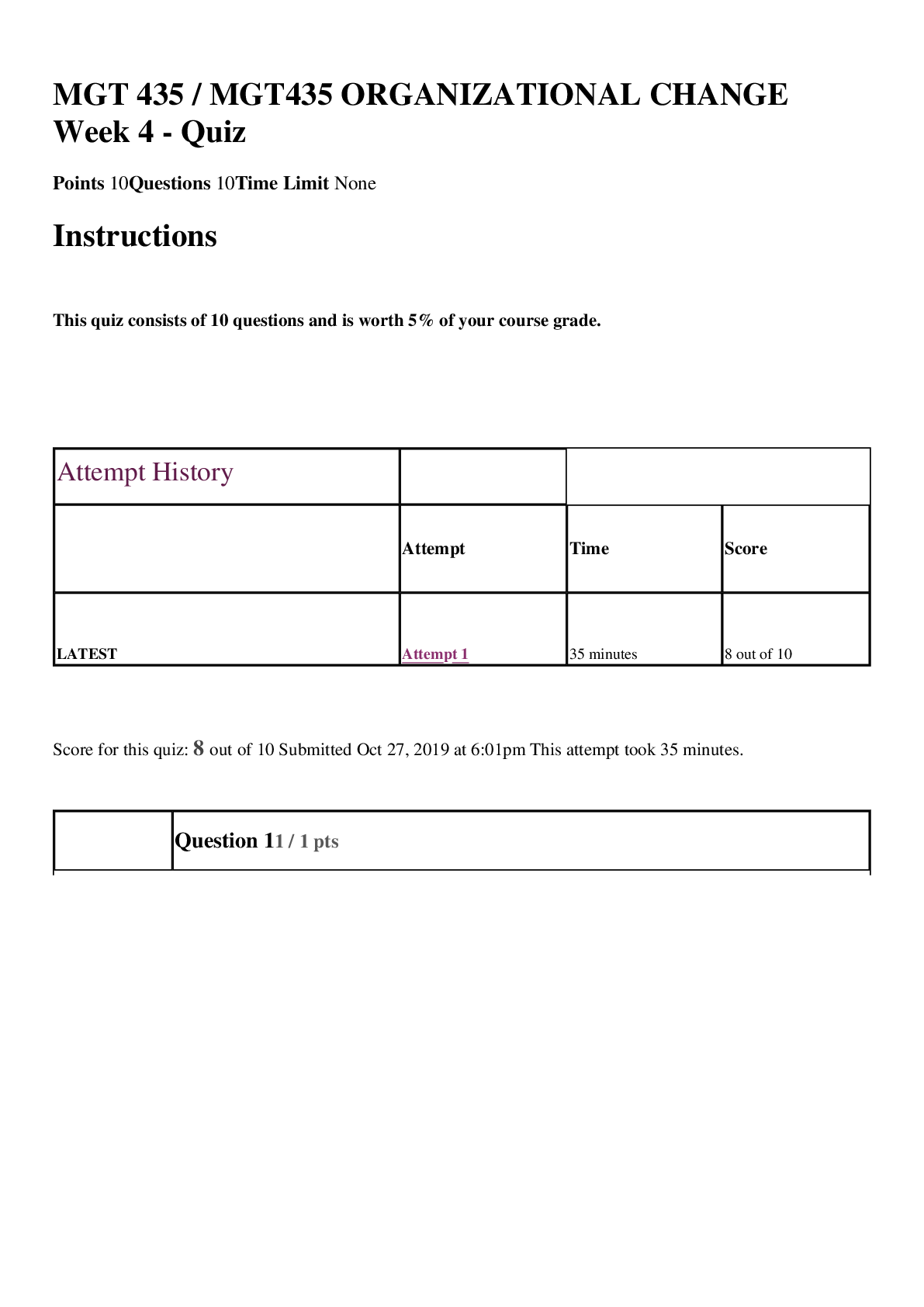
MGT 435 WEEK 2 QUIZ WITH ANSWERS
Which of the following is an especially critical factor for diagnosing, planning, and implementing organizational change?
the change model the organization selects
the ex
...
MGT 435 WEEK 2 QUIZ WITH ANSWERS
Which of the following is an especially critical factor for diagnosing, planning, and implementing organizational change?
the change model the organization selects
the expertise and experience of the organization’s leaders, managers, and change specialists
the expertise and experience of the leaders of competing organizations
the expertise and experience of the organization’s legal staff
The correct answer can be found in Section 2.1 under the heading “Diagnosing Organizations for Change” in Organizational Change, Second Edition.
Question 2
1 / 1 pts
First-order (adaptive) changes are __________.
large, sweeping, and fundamental
long term and irreversible
transformational
small scale and incremental
The correct answer can be found in Section 2.3 under the heading “Assessment Model: Determining What Changes to Make” in Organizational Change, Second Edition.
Question 3
1 / 1 pts
Which organizational change model does the history of the Apple computing company exemplify?
the systems contingency model
environment-industry-organization contingency model
the organizational life-cycle model
resource dependency theory
The correct answer can be found in Section 2.2 under the heading “Steve Jobs and Apple” in Organizational Change, Second Edition.
Question 4
1 / 1 pts
After all nine steps of the action research model are completed, to which step does the process cycle back/return to?
jointly diagnose problem/opportunity/findings with client
consult with OD/change management expert
plan action steps jointly
present feedback to client
The correct answer can be found in Section 2.5 under the heading “How to Change Using Action Research” in Organizational Change, Second Edition.
Question 5
1 / 1 pts
Large-scale change interventions in firms are typically __________.
unplanned circumstances that serve to enhance an organization’s effectiveness
unplanned circumstances that serve to inhibit an organization’s effectiveness
planned actions designed to enhance an organization’s effectiveness
planned actions designed to prevent management from laying off staff members
The correct answer can be found in Section 2.1 under the heading “Diagnosing Organizations for Change” in Organizational Change, Second Edition.
Question 6
1 / 1 pts
Under what category does “external stakeholders” fit when diagnosing types of change and level of intervention?
people
culture
strategy
structure
The correct answer can be found in Section 2.3 under the heading “Assessment Model: Determining What Changes to Make” in Organizational Change, Second Edition.
Question 7
1 / 1 pts
According to McKinsey and Kotter (1996), approximately what percentage of large organizational changes fail?
1%
10%
50%
75%
The correct answer can be found in “Introduction” in Organizational Change, Second Edition.
Question 8
1 / 1 pts
Which organizational change model stresses the importance of applying a historical analysis of changes that have occurred over the course of a company’s development?
the systems contingency model
the environment-industry-organization contingency model
the organizational life-cycle model
the resource dependency theory
The correct answer can be found in Section 2.2 under the heading “Organizational Life-Cycle Model” in Organizational Change, Second Edition.
Question 9
1 / 1 pts
Organizational inertia refers to the tendency of organizations to __________.
embrace change
employ theoretical models for directed change
standardize leadership roles
maintain the status quo
The correct answer can be found in Section 2.6 under the heading “Why People Resist Change” in Organizational Change, Second Edition.
Question 10
1 / 1 pts
Which of the following statements is true about the action research stage “collecting postimplementation data”?
Correct!
Postimplementation data should be collected from internal and external stakeholders, including from people at all position levels.
Postimplementation data should be collected from internal and external stakeholders, but not from anyone in top management.
Postimplementation data should be collected from external stakeholders only.
Postimplementation data should be collected from internal stakeholders only.
The correct answer can be found in Section 2.5 under the heading “Collect Postimplementation Data” in Organizational Change, Second Edition.
[Show More]



.png)
.png)