Module 11 NCLEX Questions
NCLEX Nursing Fundermentals Module 11 (2020)
Questions and answers – Keiser University
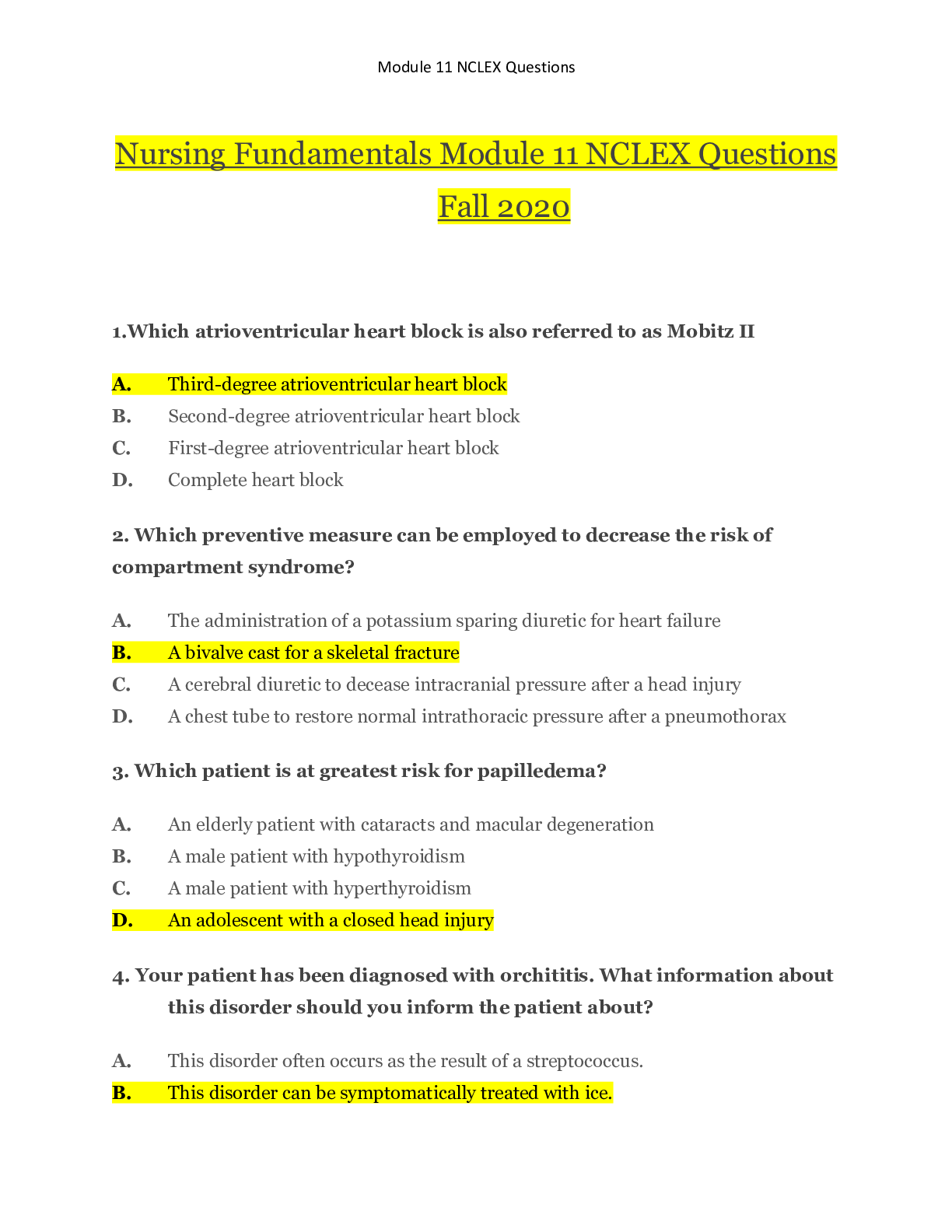
1.Which atrioventricular heart block is also referred to as Mobitz II
A. Third-degree atrioventricular
...
Module 11 NCLEX Questions
NCLEX Nursing Fundermentals Module 11 (2020)
Questions and answers – Keiser University
1.Which atrioventricular heart block is also referred to as Mobitz II
A. Third-degree atrioventricular heart block
B. Second-degree atrioventricular heart block
C. First-degree atrioventricular heart block
D. Complete heart block
2. Which preventive measure can be employed to decrease the risk of
compartment syndrome?
A. The administration of a potassium sparing diuretic for heart failure
B. A bivalve cast for a skeletal fracture
C. A cerebral diuretic to decease intracranial pressure after a head injury
D. A chest tube to restore normal intrathoracic pressure after a pneumothorax
3. Which patient is at greatest risk for papilledema?
A. An elderly patient with cataracts and macular degeneration
B. A male patient with hypothyroidism
C. A male patient with hyperthyroidism
D. An adolescent with a closed head injury
4. Your patient has been diagnosed with orchititis. What information about
this disorder should you inform the patient about?
A. This disorder often occurs as the result of a streptococcus.
B. This disorder can be symptomatically treated with ice.
C. This disorder can be symptomatically treated with heat.
D. This disorder is typically treated with surgery.Module 11 NCLEX Questions
5. Which of the following healthcare providers can legally have access to all,
or part, of a patient’s medical record because they have a “need to
know”? Select all that apply.
A. Student nurses caring for a particular patient
B. Registered nurses when they are not caring for a particular patient
C. The Vice President for Nursing who is investigating a patient fall
D. Licensed practical nurses caring for a particular patient
E. A quality assurance nurse collecting data for a performance improvement activity
6. Which cardiac arrhythmia can be either acquired or congenital and can
spontaneously disappear on its own or lead to ventricular fibrillation?
A. Wenckebach
B. Premature arterial contractions
C. Torsades de pointes
D. Premature ventricular contractions
7. Which quality assurance or performance improvement technique is used
to identify underlying process flaws?
A. Small group process
B. Root cause analysis
C. People at fault process
D. Cause and effect
8. Which legal document will most likely contain the patient’s decision to
not get cardiopulmonary resuscitation?
A. Healthcare surrogacy
B. Healthcare proxy
C. Advance directives
D. Durable power of attorneyModule 11 NCLEX Questions
9. Select the stage of a pressure ulcer that is accurately pair with its
characteristics.
A. Stage I: Only slight blanching when pressure is applied to the skin.
B. Stage II: The epidermis and part of the dermis is damaged or lost.
C. Stage III: The wound has slough and eschar.
D. Stage IV: The loss of skin usually exposes some fat.
10. You have been assigned to care for a neonate who has been diagnosed
with the Tetralogy of Fallot. The mother asks you what the Tetralogy
of Fallot is. How should you respond to this mother?
A. “The Tetralogy of Fallot is a congenital gastrointestinal disorder”
B. “The Tetralogy of Fallot is a congenital cardiac disorder”
C. “The Tetralogy of Fallot will affect the baby’s reflexes”
D. “The Tetralogy of Fallot will affect the baby’s ability to breastfeed”
11. The protrusion of an internal organ through a wound or surgical
incision is referred to as:
A. Serosanguineous.
B. Dehiscence.
C. Evisceration.
D. Exuded.
12. Which pain assessment scale is used exclusively for infants and
neonates from 32 weeks of gestation to six months of age?
A. The PEPPS pain scale
B. The FLACC pain scale
C. The Faces pain scale
D. The CRIES pain scale
13. Which of the following is a hazard of immobility?Module 11 NCLEX Questions
A. Loss of bone calcium
B. Increased vital capacity
C. Venous vasoconstriction
D. A positive nitrogen balance
14. How many daily feedings are considered normal for a newborn:
A. 8 to 10
B. 10 to 12
C. 6 to 8
D. 12 to 14
15. The hormone produces mother’s milk is:
A. Progesterone
B. Estrogen.
C. Prolactin.
D. Colostrum.
16. Which of the following is a life threatening acute complication of
diabetes mellitus?
A. Neuropathy
B. Hypoglycemia
C. Retinopathy
D. Impaired microcirculation
17. Sutures and staples are typically removed following surgery within:
A. 7 to 10 days if healing is considered adequate.
B. 10 to 14 days if healing is considered adequate.
C. 7 to 10 days if no further dressings are needed.
D. 10 to 14 days if no further dressings are needed.Module 11 NCLEX Questions
18. Which of these breath sounds is considered normal and not
adventitious?
A. Vesicular breath sounds
B. Fine rales
C. Rhonchi
D. Wheezes
19. Which type of burn leads to the greatest degree of pain?
A. A first degree burn
B. A second degree burn
C. A third degree burn
D. A fourth degree burn
20. Babies should double their birth weight by the:
A. 5th to 6th month.
B. 3rd to 4th month.
C. 4th to 5th month.
D. 5th to 7th month.
21. Which of the following is best for a client who has difficulty swallowing
and chokes frequently?
A. A liquid diet.
B. Tilting the head back when swallowing.
C. Tucking the chin in when swallowing.
D. Following each bite with a drink of water.
22. How long can women lactate for?
A. Indefinitely
B. 12 to 18 monthsModule 11 NCLEX Questions
C. 18 to 24 months
D. 30 to 36 months
23. Which anatomic malformations are associated with the Tetralogy of
Fallot?
A. A sub-aortic septal defect, an overriding aorta, left ventricular hypertrophy, and
right ventricular outflow
B. A sub-aortic septal defect, an overriding aorta, right ventricular hypertrophy, and
left ventricular outflow
C. A sub-aortic septal defect, an overriding aorta, pulmonary atresia, and right
ventricular outflow
D. A sub-aortic septal defect, an overriding aorta, right ventricular hypertrophy, and
right ventricular outflow
24. Your 32 year old female patient has erythema marginatum, Sydenham
chorea, epistaxis, abdominal pain, fever, cardiac problems and skin
nodules. What disorder would you most likely suspect based on these
signs and symptoms?
A. Leukemia
B. Histoplasmosis
C. Pneumocystis jirovec
D. Rheumatoid arthritis
25. Select the cranial nerve that is accurately paired with its name.
A. The first cranial nerve: The trochlear nerve
B. The twelfth cranial nerve: The hypoglossal nerve
C. The tenth cranial nerve: The olfactory nerveModule 11 NCLEX Questions
D. The thirteenth cranial nerve: The auditory nerve
26.Round off these numbers to the nearest hundredth. Fill in the blanks.
A. 5.5778 = _5.58
B. 1.027 = __1.03
C. 62.999 = _63 _
D. 55.123 = _55.12
E. 96.679 = _96.68
27. Label the following bones of the pelvis:
Correct Response:
A: Pelvis
B: Sacrum
C: Coccyx
D: Symphysis PubisModule 11 NCLEX Questions
28. Round off these numbers to the nearest tenth:
A. 5.5778 = _5.6
B. 1.027 = _ 1.0
C. 62.999 = _ 63
D. 55.123 = 55.1
E. 96.676 = 96.7
29. The doctor has ordered 500 mg of a medication po once a day. The
tablets on hand are labeled as 1 tablet = 30.250 mg. How many tablets
will you administer to your patient?
A. 1 Tablet
B. 2 Tablets
C. 3 Tablets
D. 4 Tablets
31. Which patient is exercising their right to autonomy in the context of
patient rights?
A. An 86 year old female who remains independent in terms of the activities of daily
living.
B. An unemancipated 16 year old who chooses to not have an intravenous line.
C. A 32 year old who does not need the help of the nurse to bathe and groom
themselves.
D. A 99 year old who wants CPR despite the fact that the nurse and doctor do not
think that it would be successful.Module 11 NCLEX Questions
32. The mnemonic “PERLA” is useful for the assessment of the eyes. What
does PERLA stand for?
A. Pupils equally reactive to light and accommodation
B. Patient eyes are equally recessed and responsive to light and acuity
C. Patient eyes are equally responsive to light and acuity
D. Pupils equally reactive to light and acuity
33. You are performing a neurological assessment of your adolescent
patient. The patient has the Moro reflex. How should you interpret
this neurological assessment finding?
A. It is normal among adolescents.
B. It indicates that the patient has an intact peripheral nervous system.
C. It indicates that the patient has an intact central nervous system.
D. It is not a normal finding.
34. Which patient is most at risk for Osgood-Schlatter disease?
A. An elderly female who is hospitalized with a hip fracture and on bedrest
B. A middle aged male patient who has been exposed to asbestos in the shipping
industry
C. An adolescent who is physically active and the captain of their soccer team
D. An infant of low birth weight and a gestational age of 28 weeks
35. Your client is adversely affected with fever, night sweats, occult
hematuria, tenderness of the spleen and Osler’s nodes. What disorder
would you most likely suspect?Module 11 NCLEX Questions
A. Tuberculosis
B. AIDS/HIV
C. Pericarditis
D. Endocarditis
36. Your pediatric weighs 15.8 kg. How many pounds does this child weigh?
A. 36 pounds
B. 33.6 pounds
C. 35 pounds
D. 34.8 pounds
37. An episiotomy is:
A. A surgical incision of the perineum to prevent tearing during delivery.
B. Releasing the red plug from the cervix just before crowning occurs.
C. An incision in the abdomen with which the baby can be delivered through.
D. The severance of the umbilical cord between mother and child.
38. How many calories per kilogram does an average full-term infant
require when the infants is around 1-2 months old?
A. 140 calories per kilogram per day
B. 120 calories per kilogram per day
C. 100 calories per kilogram per day
D. 160 calories per kilogram per day
39. What are the six levels of consciousness from the most to the least
responsive level of consciousness. Number all six using 1 as the most
conscious and 6 as the least conscious.
A. Obtunded
B. Confused
C. LethargicModule 11 NCLEX Questions
D. Comatose
E. Stuporous
F. Alert
40. Select the stage of shock that is accurately paired with its characteristic.
A. The initial stage of shock: Hyperventilation occurs and the blood pH rises.
B. The compensatory stage of shock: Hypoxia occurs and lactic acid rises.
C. The progressive stage of shock: Histamine is released; fluid and proteins leak into
surrounding tissues and the blood thickens.
D. The refractory stage of shock: Potassium ions leak out, sodium ions build up and
metabolic acidosis increases.
41. The doctor has ordered 1,000 cc of intravenous fluid every 8 hours. You
will be using intravenous tubing that delivers 20 cc/drop. At what rate
will you adjust the intravenous fluid flow? _____ gtts per minute.
A. 38 gtts/min
B. 42 gtts/min
C. 50 gtts/min
D. 40 gtts/min
42. During which stage of anesthesia is a patient most likely to experience
involuntary motor activity?
A. Stage I
B. Stage II
C. Stage III
D. Stage VI
43. Select all of the risk factors that are associated with deep vein
thrombosis.
A. The use of oral contraceptivesModule 11 NCLEX Questions
B. Type B and O blood
C. Rh negative blood
D. Obesity
E. Nulliparity
F. Leukemia
44. Most water leaves the body by way of the:
A. Lungs.
B. Intestines.
C. Skin.
D. Kidneys.
45. Which statement about glaucoma is true and accurate?
A. Acute angle-closure glaucoma is an ocular emergency.
B. Acute angle-closure glaucoma leads to the loss of peripheral vision and tunnel
vision.
C. Primary open-angle glaucoma leads to eye pain, nausea and vomiting, blurry
vision and halos.
D. Bubbles are implanted to protect the retina from the glaucoma.
46. A cavity containing pus surrounded by inflamed tissue is:
A. Cellulitis.
B. An abscess.
C. Extravasation.
D. An adhesion.Module 11 NCLEX Questions
47. The doctor has ordered 20 cc an hour of normal saline intravenously for
your pediatric patient. You will be using a pediatric intravenous
tubing that delivers 60 cc per drop. How many drops per minute will
you administer using this pediatric intravenous set? Fill in the
blank.____ drops per minute.
A. 30 drops per minute
B. 25 drops per minute
C. 20 drops per minute
D. 22 drops per minute
48. What does the mnemonic device ABCDE stand for?
A. Allergy, bleeding, chemicals, dietary, environment
B. Allergy, bleeding, cardio, diabetes, endocrine
C. Allergy, bleeding, cardio, digestive, endocrine
D. Allergy, bleeding, cortisone, diabetes, emboli
49. Which of the following assessment tools is used to determine the
patients’ level of consciousness?
A. The Snellen Scale
B. The Norton Scale
C. The Morse Scale
D. The Glasgow Scale
50. Wilms’ tumor is a form of:
A. Renal cancer.
B. Liver cancer.
C. Basal cell carcinoma.
D. Brain cancer.Module 11 NCLEX Questions
51. You will be reinforcing teaching and instructing the patient. Which basic
principle of teaching should you follow?
A. Sequence the instruction from the least complex to the most complex.
B. Assume that the patient knows little or nothing about the topic.
C. Tell the patient to call their significant other so you can instruct them.
D. Use medically oriented terms so the patient will be able to speak with the doctor.
53. Your patient has a blood potassium level of 9.2 mEq/L. What
intervention should you anticipate for this patient?
A. Intravenous potassium supplementation
B. Intravenous calcium supplementation
C. Kidney dialysis
D. Parenteral nutrition
54. Which of the following foods enhances the absorption of an iron
supplement?
A. Orange juice
B. Green beans
C. Fortified Milk
D. Baked potato
55. Select a myth or falsehood relating to pain, pain management and
addiction.
A. Addiction can be accurately predicted.
B. Withdrawal, drug tolerance and physical dependence do not indicate addiction.
C. Pain medications can be used with patients who have a substance abuse history.
D. Addiction is signaled when the client employs deception and stockpiling.Module 11 NCLEX Questions
56. What is the expected date of delivery for the woman who has had their
last menstrual period on April 20th?
A. January 20th
B. January 27th
C. January 29th
D. January 31st
57. Clumsiness, difficulty running, climbing, and riding a bicycle are some
of the earliest signs and symptoms of:
A. Duchennes’s muscular dystrophy
B. Osteomyelitis
C. Talipes or clubfoot
D. Septic joint, suppurative arthritis
58. Which statement about adjuvant medications is true and accurate?
A. Licensed practical nurses cannot administer adjuvant medications.
B. Adjuvant medications are schedule 2 narcotics.
C. Adjuvant medications are schedule 1 narcotics.
D. Adjuvant medications can be purchased over the counter.
59. Which nonpharmacological technique entails the use of electronic
monitoring equipment while the patient controls basic bodily
mechanisms?
A. Meditation
B. Visualization
C. Biofeedback
D. Chiropractic
60. Which of the following is considered normal for the neonate?Module 11 NCLEX Questions
A. Chest Circumference: 10 to 13 inches
B. Length: 16 to 22 inches
C. Weight: 1,500 to 4,000 g
D. Head Circumference: 12.6 to 14.5 inches
61. Your patient has been diagnosed with giant cell arteritis. What
medication will this patient most likely be given?
A. High doses of aspirin
B. High doses of prednisone
C. Methotrexate
D. Albuterol
62. The wound irrigation process cleanses the wound and:
A. Reduces the potential of pain in the wound region or area.
B. Stops the spread of infection by way of magnifying the “clean” area.
C. Pushes extravasated blood from a hematoma into nearby healthy tissue.
D. Allows for the introduction of medications in solution form.
63. You are caring for a four year old female patient who was severely
burned in a house fire. How would you determine the extent of this
child’s burns?
A. By using the Lund and Browder chart
B. By using the Rule of Nines
C. By using the Rule of Tens
D. By using the Parkland Formula
64. Your client has a doctor’s order that reads “advance diet as tolerated”.
This client has returned from the recovery room after an
appendectomy and he states, “I am hungry”. What would you offer
this client to consume?Module 11 NCLEX Questions
A. Cheese and crackers
B. Apple sauce
C. Chicken broth
D. A peanut butter sandwich
65. Idiopathic thrombocytopenia purpura is:
A. Highly similar to disseminated intravascular coagulation (DIC).
B. Caused by the over production of platelets.
C. A bleeding disorder that is characterized with too few platelets.
D. Treated with immune system boosting medications.
66. Select the type of skeletal fracture that is correctly paired with its
description.
A. A complete fracture: The fractured bone penetrates through the skin to the skin
surface.
B. A pathological fracture: A fracture that results from some physical trauma.
C. A greenstick fracture: This bends but does not fracture the bone.
D. An avulsion fracture: A fracture that pulls a part of the bone from the tendon or
ligament
67. Select the criteria that is accurately paired with its indication of birth
weight or gestational age.
A. Low birth weight: The neonate’s weight is less than 1,500 g at the time of
delivery.
B. Appropriate for gestational age: The neonate’s weight ranges from the 10th to the
90th percentile.
C. Large for gestational age: The neonate’s weight is above the 99th percentile.
D. Small for gestational age: The neonate’s weight is below the 20th percentile.
68. Diabetes insipidus is the result of:Module 11 NCLEX Questions
A. A diet high in sugar and carbohydrates.
B. A complicated pregnancy.
C. A disorder of the pancreas.
D. A disorder of the pituitary gland.
69. Which position will you place your patient in when they are
demonstrating the signs and symptoms of hypovolemic shock?
A. The Trendelenberg position
B. The supine position
C. The left lateral position
D. The right lateral position
70. The fine, down-like hairs on the newborn’s ears, shoulders, lower back,
and/or forehead are known as:
A. Vernix.
B. Lanugo.
C. Milia.
D. Vibrissea.
All questions came from NCLEX Saunder’s Study GuideModule 11 NCLEX Questions
[Show More]
 Questions and answers – Keiser University.png)






 Questions and answers – Keiser University.png)
 Questions and answers – Keiser University.png)
 Questions and answers – Keiser University.png)
 Questions and answers – Keiser University.png)
 Questions and answers – Keiser University.png)