Module 6 NCLEX Questions
NCLEX Nursing Fundermentals Module 6 Questions
and answers – Keiser University
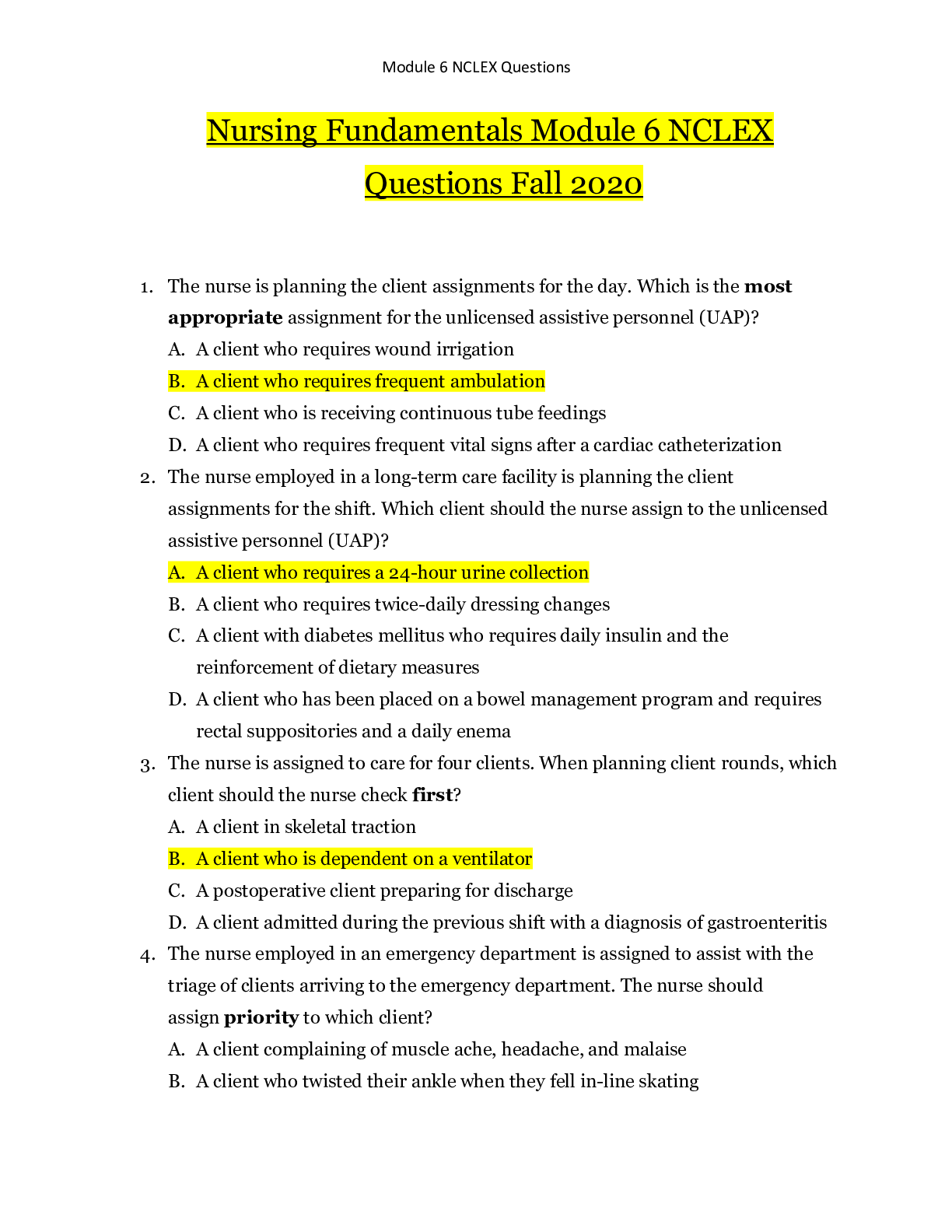
1. The nurse is planning the client assignments for the day. Which is the most
appropriate assignment for the un
...
Module 6 NCLEX Questions
NCLEX Nursing Fundermentals Module 6 Questions
and answers – Keiser University
1. The nurse is planning the client assignments for the day. Which is the most
appropriate assignment for the unlicensed assistive personnel (UAP)?
A. A client who requires wound irrigation
B. A client who requires frequent ambulation
C. A client who is receiving continuous tube feedings
D. A client who requires frequent vital signs after a cardiac catheterization
2. The nurse employed in a long-term care facility is planning the client
assignments for the shift. Which client should the nurse assign to the unlicensed
assistive personnel (UAP)?
A. A client who requires a 24-hour urine collection
B. A client who requires twice-daily dressing changes
C. A client with diabetes mellitus who requires daily insulin and the
reinforcement of dietary measures
D. A client who has been placed on a bowel management program and requires
rectal suppositories and a daily enema
3. The nurse is assigned to care for four clients. When planning client rounds, which
client should the nurse check first?
A. A client in skeletal traction
B. A client who is dependent on a ventilator
C. A postoperative client preparing for discharge
D. A client admitted during the previous shift with a diagnosis of gastroenteritis
4. The nurse employed in an emergency department is assigned to assist with the
triage of clients arriving to the emergency department. The nurse should
assign priority to which client?
A. A client complaining of muscle ache, headache, and malaise
B. A client who twisted their ankle when they fell in-line skatingModule 6 NCLEX Questions
C. A client with a minor laceration on the index finger sustained while cutting an
eggplant
D. A client with chest pain who states that they just ate pizza that was made with
a very spicy sauce
5. The nurse is assigned to care for four clients. When planning client rounds, which
client should the nurse collect data from first?
A. A client scheduled for a chest x-ray
B. A client requiring daily dressing changes
C. A postoperative client preparing for discharge
D. A client receiving oxygen who is having difficulty breathing
6. The nurse is caring for a client who is scheduled for surgery. The client states
concern about the surgical procedure. How should the nurse initially address
the clients concerns?
A. Tell the client that preoperative fear is normal.
B. Explain all nursing care and possible discomfort that may result.
C. Ask the client to discuss information known about the planned surgery.
D. Provide explanations about the procedures involved in the planned surgery.
7. The nurse is preparing to care for a dying client and several family members are
at the client's bedside. Which therapeutic techniques should the nurse use when
communicating with the family? Select all that apply.
A. Discourage reminiscing.
B. Make the decisions for the family.
C. Encourage expression of feelings, concerns, and fears.
D. Explain everything that is happening to all family members.
E. Touch and hold the client's or family member's hand if appropriate.
F. Be honest and let the client and family know that they will not be abandoned
by the nurse.
8. The nurse should plan which to encourage autonomy in the client who is a
resident in a long-term care facility?
A. Choosing meals
B. Decorating the room
C. Scheduling haircut appointmentsModule 6 NCLEX Questions
D. Allowing the client to choose social activities
9. Which client is most likely at risk to become a victim of elder abuse?
A. A 75-year-old man with moderate hypertension
B. A 68-year-old man with newly diagnosed cataracts
C. A 90-year-old woman with advanced Alzheimer's disease
D. A 70-year-old woman with early diagnosed Lyme disease
10. The nurse is assisting with caring for a postpartum client who is experiencing
uterine hemorrhage. When planning to meet the psychosocial needs of the client,
the nurse should plan which action?
A. Maintain strict bed rest.
B. Monitor the vital signs every 2 hours.
C. Perform firm fundal massage every 2 hours.
D. Keep the client and her family members informed of her progress.
11. The nurse is reinforcing measures regarding the care of the newborn with a
mother. To bathe the newborn, the mother should be taught which intervention?
A. Begin with the eyes and face.
B. Start with the dirtiest area first.
C. Begin with the feet and work upward.
D. Only wash the diaper area, because this is the only part of the baby that gets
soiled.
12. The nurse is collecting data regarding a client after a thyroidectomy and notes the
development of a hoarse and weak voice. Which nursing action is appropriate?
A. Check for signs of bleeding.
B. Administer calcium gluconate.
C. Notify the registered nurse immediately.
D. Reassure the client that this is usually a temporary condition.
13. The nurse is assisting with caring for the client immediately after insertion of a
permanent demand pacemaker via the right subclavian vein. The nurse prevents
dislodgement of the pacing catheter by implementing which intervention?
A. Limiting movement and abduction of the left arm
B. Limiting movement and abduction of the right arm
C. Assisting the client to get out of bed and ambulate with a walkerModule 6 NCLEX Questions
D. Having the physical therapist do active range of motion to the right arm
14. The nurse in the mental health unit reviews the therapeutic and nontherapeutic
communication techniques with a nursing student. Which are therapeutic
communication techniques? Select all that apply.
A. Restating
B. Listening
C. Asking the client, "Why?"
D. Maintaining neutral responses
E. Giving advice, approval, or disapproval
F. Providing acknowledgment and feedback
15. A client experiencing a severe major depressive episode is unable to address
activities of daily living. Which is the appropriate nursing intervention?
A. Feed, bathe, and dress the client as needed until the client can perform these
activities independently.
B. Offer the client choices and consequences to the failure to comply with the
expectation of maintaining activities of daily living.
C. Structure the client's day so that adequate time can be devoted to the client's
assuming responsibility for the activities of daily living.
D. Have the client's peers confront the client about how their noncompliance
with addressing activities of daily living affects the milieu.
16. The nurse is collecting data from a client, and the client's spouse reports that the
client is taking donepezil hydrochloride. Which disorder should the nurse suspect
that this client may have based on the use of this medication?
A. Dementia
B. Schizophrenia
C. Seizure Disorder
D. Obsessive-Compulsive Disorder
17. The nurse is caring for an older client who is terminally ill. Which signs indicate
to the nurse that death may be imminent?
A. Flushed and warm skin
B. Eupnea and normal body temperature
C. Irregular, noisy breathing and cold, clammy skinModule 6 NCLEX Questions
D. Presence of swallowing reflex and active bowel sounds
18. The nurse should expect to note which interventions in the plan of care for a
client with hypothyroidism? Select all that apply.
A. Provide a cool environment for the client.
B. Instruct the client to consume a high-fat diet.
C. Instruct the client about thyroid replacement therapy.
D. Encourage the client to consume fluids and high-fiber foods.
E. Inform the client that iodine preparations will be prescribed to treat the
disorder.
F. Instruct the client to contact the primary health care provider (PHCP) if
episodes of chest pain occur.
19. The home care nurse observes that an older male client is confined to his room by
his daughter-in-law. When the nurse suggests that he walk to the den and join the
family, he says, "I'm in everyone's way, and my son needs me to stay here." Which
is the best nursing intervention for this situation?
A. Say to the son, "Confining your father to his room is inhumane."
B. Say nothing; it is best for the nurse to remain neutral and to wait to be asked
for help.
C. Suggest to the client and daughter-in-law that they consider a nursing home
for the client.
D. Suggest appropriate resources such as respite care and a senior citizens'
center to the client and daughter-in-law.
20.The psychiatric nurse knows that a therapeutic nurse–client relationship includes
which specific goals and functions? Select all that apply.
A. Promoting self-care and independence
B. Acting as an intermediary between the client and family
C. Accompanying the client to all group therapy sessions
D. Facilitating communication of distressing thoughts and feelings
E. Helping clients examine self-defeating behaviors and test alternatives
F. Assisting clients with problem solving to help facilitate activities of daily livingModule 6 NCLEX Questions
21. A client in a manic state emerges from her room. She is topless and is making
sexual remarks and gestures toward staff and peers. Which is an appropriate
nursing action?
A. Approach the client in the hallway and insist that she go to her room.
B. Ask the other clients to ignore her behavior; eventually she will return to her
room.
C. Quietly approach the client, escort her to her room, and assist her in getting
dressed.
D. Confront the client on the inappropriateness of her behaviors and offer her a
time-out.
22.The mother of 6-year-old twins says to the nurse, "My mother-in-law doesn't
think our children should come to the funeral service for their grandfather. What
do you advise?" Which response made by the nurse would be most appropriate?
A. "What do you and your husband believe is the right thing for your children?"
B. "By all means have them attend. Not to do so would promote postmortem
grief."
C. "It's a difficult decision, but given their young age, perhaps omitting the wake
and just including the funeral should be best."
D. "I agree with your mother-in-law. Your mother-in-law is upset enough as it is.
Tell your children that their grandfather is in heaven."
23.The nurse in the primary health care provider's office is measuring vital signs on
a postoperative client who underwent mastectomy of her right breast 2 weeks
ago. The client tells the nurse that she is very concerned because she has
numbness in the area of the surgery and along the inner side of the arm from the
armpit to the elbow. Which statement is appropriate for the nurse to tell the
client?
A. "These sensations are signs of a complication."
B. "These sensations probably will be permanent."
C. "These sensations lessen over several months and usually are gone after 1
year."
D. "It is nothing to worry about because women who have this type of surgery
experience this problem."Module 6 NCLEX Questions
24.A stillborn was delivered in the birthing suite a few hours ago. After the birth, the
family has remained together, touching the baby. Which statement by the nurse
should further assist the family in their initial period of grief?
A. "Would you like to hold your baby?"
B. "We need to take the baby from you now so that you can get some sleep."
C. "Don't worry; there is nothing you could have done to prevent this from
happening."
D. "We will see to it that you have an early discharge so that you don't have to be
reminded of this experience."
25. The nurse is planning the client assignments. Which is the least appropriate
assignment for the unlicensed assistive personnel (UAP)?
A. Obtaining frequent oral temperatures on a client
B. Collecting a urine specimen from a client admitted 3 days ago
C. Assisting a child who is profoundly developmentally disabled to eat lunch
D. Accompanying a client being discharged to home following a bowel resection
8 days ago to their transportation
26.The nurse is instructed to complete a medication reconciliation form on a newly
admitted client. Why is it important for the nurse to ensure that this process is
completed accurately?
A. It ensures that the client does not have any medication allergies.
B. It educates the client on the reason that medications are being given.
C. It notifies the client's pharmacy about the medications the client is taking in
the hospital.
D. It helps to make sure that the primary health care provider is aware of all of
the medications the client is taking and has been taking at home.
27. The nurse is performing an environmental assessment in the home of an older
client. Which observations require immediate attention? Select all that apply.
A. Unsecured scatter rugs
B. Clear exit passageways
C. An operable smoke detector
D. A prefilled medication cassette
E. Cigarette pack and lighter on the bedside standModule 6 NCLEX Questions
28.The nurse is providing information to unlicensed assistive personnel (UAP)
regarding caring for the older adult. The nurse determines the UAP understands
the information provided if the UAP identifies which situation portrays ageism?
A. Informing the older adult of their rights
B. Allowing older adults to make decisions
C. Accepting differences among older adults
D. Advising older adults to forgo aggressive treatment
29.The nurse instructs the unlicensed assistive personnel (UAP) assigned to care for
an older adult client to place an extra blanket in the client's room. The nurse
provides this instruction because the older adult is less able to regulate hot and
cold body changes as a result of alterations in the activity of which gland?
A. Pineal gland
B. Sweat glands
C. Parotid glands
D. Thymus gland
30.The nurse is providing care for a client following a bone biopsy. Which action by
the nurse is unnecessary in the care of this client?
A. Elevating the limb for 24 hours
B. Monitoring vital signs every 4 hours
C. Administering intramuscular opioid analgesics
D. Monitoring the site for swelling, bleeding, hematoma
31. A client brought to the emergency department states that he has accidentally
been taking two times his prescribed dose of warfarin for the past week. After
noting that the client has no evidence of obvious bleeding, the nurse plans to
assist the registered nurse with which action?
A. Administering an antidote
B. Drawing a sample for type and crossmatch and transfuse the client
C. Drawing a sample for an activated partial thromboplastin time (aPTT) level
D. Drawing a sample for prothrombin time (PT) and international normalized
ratio (INR)Module 6 NCLEX Questions
32.An adult female client has a hemoglobin level of 10.8 g/dL (108 g/L). The nurse
interprets that this result is most likely caused by which condition noted in the
client's history?
A. Dehydration
B. Heart failure
C. Iron deficiency anemia
D. Chronic obstructive pulmonary disease
33.A client with a history of gastrointestinal bleeding has a platelet count of 300,000
mm3 (300 × 109/L). The nurse should take which action after seeing the
laboratory results?
A. Report the abnormally low count.
B. Report the abnormally high count.
C. Place the client on bleeding precautions.
D. Place the normal report in the client's medical record.
34.A client is having problems with blood clotting. Which food item should the nurse
encourage the client to eat?
A. Legumes
B. Citrus fruits
C. Vegetable oils
D. Green, leafy vegetables
35. A client who is receiving a blood transfusion pushes the call light for the nurse.
When entering the room, the nurse notes that the client is flushed, dyspneic, and
complaining of generalized itching. How should the nurse correctly interpret
these findings?
A. Bacteremia
B. Fluid Overload
C. Hypovolemic Shock
D. Transfusion Reaction
36.Which of these clients are most likely to develop fluid (circulatory)
overload? Select all that apply.
A. A premature infant
B. A 101-year-old manModule 6 NCLEX Questions
C. A client with heart failure
D. A client with diabetes mellitus
E. A client receiving renal dialysis
F. A 29-year-old client with pneumonia
37. The nurse is checking the insertion site of a peripheral intravenous (IV) catheter.
The nurse notes the site to be reddened, warm, painful, and slightly edematous in
the area of the vein proximal to the IV catheter. The nurse interprets that this is
likely the result of which?
A. Phlebitis of the vein
B. Infiltration of the IV line
C. Hypersensitivity to the IV solution
D. An allergic reaction to the IV catheter material
38.A client with a diagnosis of asthma is admitted to the hospital with respiratory
distress. Which signs should the nurse expect to note in the health record when
collecting data related to the respiratory system for this client?
A. Stridor and cyanotic lips
B. Diminished breath sounds and fever
C. Wheezes and use of accessory muscles
D. Pleural friction rub and inspirational chest pain
39.The nurse learns in report that a client is exhibiting Cheyne-Stokes respirations.
Based on this data, which action is most appropriate for the nurse to
take initially?
A. Listen to the client's heart sounds.
B. Determine whether the client has a pulse deficit.
C. Instruct the client to use an incentive spirometer.
D. Determine the client's ability to follow verbal commands.
40.While collecting data related to the cardiac system on a client, the nurse hears a
murmur. Which best describes the sound of a heart murmur?
A. Lub-dub sounds
B. Scratchy, leathery heart noise
C. Gentle, blowing or swooshing noise
D. Abrupt, high-pitched snapping noiseModule 6 NCLEX Questions
41. The nurse obtains the vital signs on a postoperative client who just returned to
the nursing unit. The client's blood pressure (BP) is 100/60 mm Hg, the pulse is
90 beats per minute, and the respiration rate is 20 breaths per minute. On the
basis of these findings, which actions should the nurse take? Select all that
apply.
A. Ask if the client is thirsty and assist with drinking a glass of water.
B. Ask how the client feels and inquire about any feelings of dizziness.
C. Review the client record to determine time and type of analgesia last received.
D. Review the client record to determine whether the client has voided
postoperatively.
E. Assist the client to perform leg exercises and then recheck the blood pressure
and pulse rate.
F. Review the client record to note the vital signs taken in the Post Anesthesia
Care Unit (PACU).
42.A client arrives to the surgical nursing unit after surgery. What should be
the initial nursing action after surgery?
A. Assess patency of the airway.
B. Check tubes or drains for patency.
C. Check dressing for bleeding or drainage.
D. Obtain vital signs to compare with those recorded preoperatively.
43.The nurse monitors the 3-day postoperative client who underwent abdominal
surgery. Vital signs are:temperature: 37.9° C (100.2° F), pulse 104 beats per
minute, respirations 22 breaths per minute, blood pressure 128/74 mm Hg.
Oxygen saturation is 93% on room air. The client feels tired and has a productive
cough. Fine crackles are audible in the bases of the lungs posteriorly. The nurse
considers the client has developed which postoperative problem?
A. Hypoxia
B. Atelectasis
C. Pneumonia
D. Fluid OverloadModule 6 NCLEX Questions
44.The nurse is assigned to assist with caring for a client after cardiac
catheterization performed through the left femoral artery. The nurse should plan
to maintain bed rest for this client in which position?
A. High-Fowler's position
B. Supine with no head elevation
C. Left lateral (side-lying) position
D. Supine with head elevation no greater than 30 degrees
45. A client is being prepared for a thoracentesis. The nurse reinforces instructions
with the client given by the registered nurse. Which points should be included in
the instructions? Select all that apply.
A. The client leans over a bedside table.
B. The client should sit on the edge of the bed.
C. The procedure involves obtaining a biopsy.
D. A time-out is performed before the procedure.
E. The procedure is performed during a bronchoscopy.
F. A local anesthetic is administered before the procedure.
46.The nurse is assisting with the insertion of a nasogastric tube into a client. The
nurse should place the client in which position for insertion?
A. Right Side
B. Low-Fowler’s Position
C. High-Fowler’s Position
D. Supine, with the head flat
47. A client has just returned to a nursing unit after an above-knee amputation of the
right leg. The nurse should plan to place the client in which position?
A. Prone
B. Reverse Trendelenburg’s
C. Supine, with the residual limb flat on the bed
D. Supine, with the residual limb supported with pillows
48.The nurse is providing endotracheal suctioning to a client who is mechanically
ventilated when the client becomes restless and tachycardic. Which actions
should the nurse take? Select all that apply.
A. Notify the RN.Module 6 NCLEX Questions
B. Notify the Rapid Response Team.
C. Finish the suctioning as quickly as possible.
D. Discontinue suctioning until the client is stabilized.
E. Contact the respiratory department to suction the client.
49.A licensed practical nurse (LPN) is preparing to assist a registered nurse (RN)
with removing a nasogastric (NG) tube from the client. Which interventions
should be included in the procedure? Select all that apply.
A. Remove the air from the balloon.
B. Explain the procedure to the client.
C. Ask the client to take a deep breath and hold.
D. Pull the tube out in one continuous steady motion.
E. Remove the device or tape securing the tube from the nose.
50.The nurse is assisting with monitoring the functioning of a chest-tube drainage
system in a client who just returned from the recovery room after a thoracotomy
with wedge resection. Which findings should the nurse expect to note? Select all
that apply.
A. Excessive bubbling in the water-seal chamber
B. Vigorous bubbling in the suction-control chamber
C. 50 mL of drainage in the drainage-collection chamber
D. The drainage system is maintained below the client's chest.
E. An occlusive dressing is in place over the chest-tube insertion site.
F. Fluctuation of water in the tube of the water-seal chamber during inhalation
and exhalation
51. The nurse is assigned to assist with caring for a client with esophageal varices
who had a Sengstaken-Blakemore tube inserted because other treatment
measures were unsuccessful. The nurse should check the client's room to ensure
that which priority item is at the bedside?
A. An obturator
B. A Kelly clamp
C. An irrigation set
D. A pair of scissorsModule 6 NCLEX Questions
52. The nurse is assigned to assist with caring for a client who has a chest tube. The
nurse notes fluctuations of the fluid level in the water-seal chamber. Based on
this observation, which action would be appropriate?
A. Continue to monitor.
B. Empty the drainage.
C. Encourage the client to deep breathe.
D. Encourage the client to hold his or her breath periodically.
53. The nurse is assigned to assist the primary health care provider (PHCP) with the
removal of a chest tube. Which interventions should the nurse anticipate
performing during this process? Select all that apply.
A. Reinforce instructions to breathe deeply while the tube is removed.
B. Cover the site with an occlusive dressing after the tube is removed.
C. Clamp the chest tube near the insertion site just before the removal.
D. Raise the drainage system to the level of the chest tube insertion site.
E. Have the client perform the Valsalva maneuver as the chest tube is pulled out.
54. The nurse is planning to begin a continuous tube feeding on a client with a
nasogastric (NG) tube. Which interventions should the nurse perform before
initiating the feeding? Select all that apply.
A. Explain the procedure to the client.
B. Irrigate the NG tube with saline.
C. Aspirate all stomach contents and discard.
D. Elevate the head of the bed to 45 degrees.
E. Have a pair of scissors for emergency use at the bedside.
F. Ensure that the end of the NG tube is in the esophagus.
55. The nurse is assisting in planning care for a client with a chest tube. The nurse
should suggest to include which interventions in the plan? Select all that
apply.
A. Pin the tubing to the bed linens.
B. Be sure all connections remain airtight.
C. Be sure all connections are taped and secure.
D. Monitor closely for tubing that is kinked or obstructed.
E. Empty the drainage from the drainage collection chamber daily.Module 6 NCLEX Questions
56. The nurse is assigned to care for a client who has a chest tube. The nurse is told to
monitor the client for crepitus (subcutaneous emphysema). Which method
should be used to monitor the client for crepitus?
A. Auscultating the posterior breath sounds
B. Asking the client about pain upon inspiration
C. Placing the hands over the rib area and observing expansion
D. Palpating the skin around the chest and neck for a crackling sensation
57. The nurse is told that an assigned client will have a fenestrated tracheostomy
tube inserted. The nurse plans care knowing that which facts are true with the use
of a fenestrated tracheostomy tube? Select all that apply.
A. Enables the client to speak
B. Is necessary for mechanical ventilation
C. Must have the cuff deflated when capped
D. Eliminates the need for tracheostomy care
E. Prevents air from being inhaled through the tracheostomy opening
58.The nurse is caring for a client who is in labor. The nurse rechecks the client's
blood pressure and notes that it has dropped. To decrease the incidence of supine
hypotension, the nurse should encourage the client to remain in which position?
A. Squatting
B. Side-lying
C. Tailor sitting
D. Semi-Fowler's
59. A primigravida's membranes rupture spontaneously. Which action should the
nurse take first?
A. Determine the fetal heart rate.
B. Prepare for immediate delivery.
C. Monitor the contraction pattern.
D. Note the amount, color, and odor of the amniotic fluid.
60.The nurse is assigned to assist with caring for a client who has been admitted to
the labor unit. The client is 9 cm dilated and is experiencing precipitous labor.
Which is the priority nursing action?
A. Prepare for an oxytocin infusion.Module 6 NCLEX Questions
B. Keep the client in a side-lying position.
C. Prepare the client for epidural anesthesia.
D. Encourage the client to start pushing with the contractions.
61. The client who is being prepared for a cesarean delivery is brought to the delivery
room. To maintain the optimal perfusion of oxygenated blood to the fetus, the
nurse should place the client in which position?
A. Prone position
B. Semi-Fowler's position
C. Trendelenburg's position
D. Supine position with a wedge under the right hip
62.The nurse is caring for a postpartum client with a diagnosis of thrombophlebitis.
The client suddenly complains of chest pain and dyspnea. The nurse
should initially check which item?
A. Vital signs
B. Fundal height
C. Presence of calf pain
D. Level of consciousness (LOC)
63.The nurse suspects that the client has a pulmonary embolism. Which is the most
important nursing action?
A. Monitor the vital signs.
B. Elevate the head of the bed.
C. Increase the intravenous flow rate.
D. Administer oxygen by face mask, as prescribed.
64.The nurse notes that the 4-hour postpartum client has cool, clammy skin and that
she is restless and excessively thirsty. The nurse immediately notifies the
registered nurse and then performs which action?
A. Checks the vital signs
B. Begins fundal massage
C. Encourages ambulation
D. Encourages the client to drink fluids
65. A client asks the nurse why her newborn baby needs an injection of vitamin K
(phytonadione). The nurse should make which statement to the client?Module 6 NCLEX Questions
A. "Your newborn needs vitamin K to develop immunity."
B. "The vitamin K will protect your newborn from becoming jaundiced."
C. "Newborns are deficient in vitamin K. This injection prevents your baby from
abnormal bleeding."
D. "Newborns have sterile bowels. The vitamin K will give the bowel the
necessary bacteria."
66.The nurse in the newborn nursery receives a telephone call to prepare for the
admission of a neonate born at 43 weeks' gestation with Apgar scores of 1 and 4.
When planning for the admission of this infant, which is the nurse's highest
priority?
A. Turning on the apnea and cardiorespiratory monitor
B. Connecting the resuscitation bag to the oxygen outlet
C. Setting up the intravenous line with 5% dextrose in water
D. Setting the radiant warmer control temperature at 36.5° C (97.6° F)
67. The nurse should monitor for which signs associated with respiratory distress
syndrome (RDS) in a preterm newborn?
A. Tachypnea and retractions
B. Acrocyanosis and grunting
C. Hypotension and bradycardia
D. The presence of a barrel chest with acrocyanosis
68.The nurse is monitoring a client who is receiving oxytocin to induce labor. Which
assessment findings should cause the nurse to immediately discontinue the
oxytocin infusion? Select all that apply.
A. Fatigue
B. Drowsiness
C. Uterine hyperstimulation
D. Late decelerations of the fetal heart rate
E. Early decelerations of the fetal heart rate
69.A pregnant client is receiving magnesium sulfate for the management of
preeclampsia. The nurse determines that the client is experiencing toxicity from
the medication if which findings are noted during assessment? Select all that
apply.Module 6 NCLEX Questions
A. Proteinuria of 3+
B. Respirations of 10 breaths/minute
C. Presence of deep tendon reflexes
D. Urine output of 20 mL in an hour
E. Serum magnesium level of 6 mEq/L (3 mmol/L)
70.The nurse is monitoring a client in preterm labor who is receiving intravenous
magnesium sulfate. The nurse should monitor for which adverse effects of this
medication? Select all that apply.
A. Flushing
B. Hypertension
C. Increased urine output
D. Depressed respirations
E. Extreme muscle weakness
F. Hyperactive deep tendon reflexes
All questions came from NCLEX Saunder’s Study Guide
[Show More]
 Questions and answers – Keiser University.png)

 Questions and answers – Keiser University.png)
 Questions and answers – Keiser University.png)
 Questions and answers – Keiser University.png)




 Questions and answers – Keiser University.png)
 Questions and answers – Keiser University.png)