Pearson Edexcel International GCSE In Accounting (4AC1) Paper 01 Introduction to Bookkeeping and Accounting (Summer 2019 Marking Scheme)
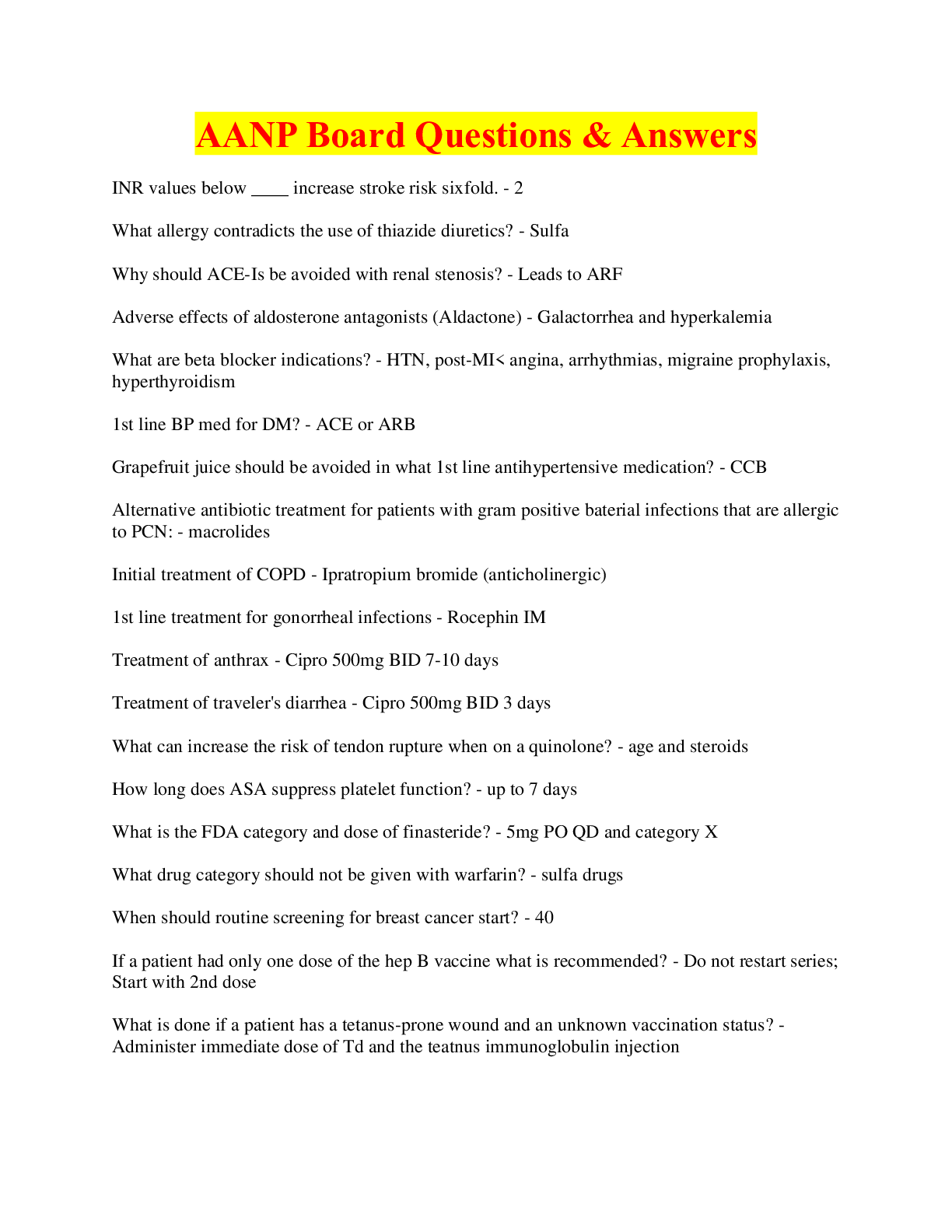
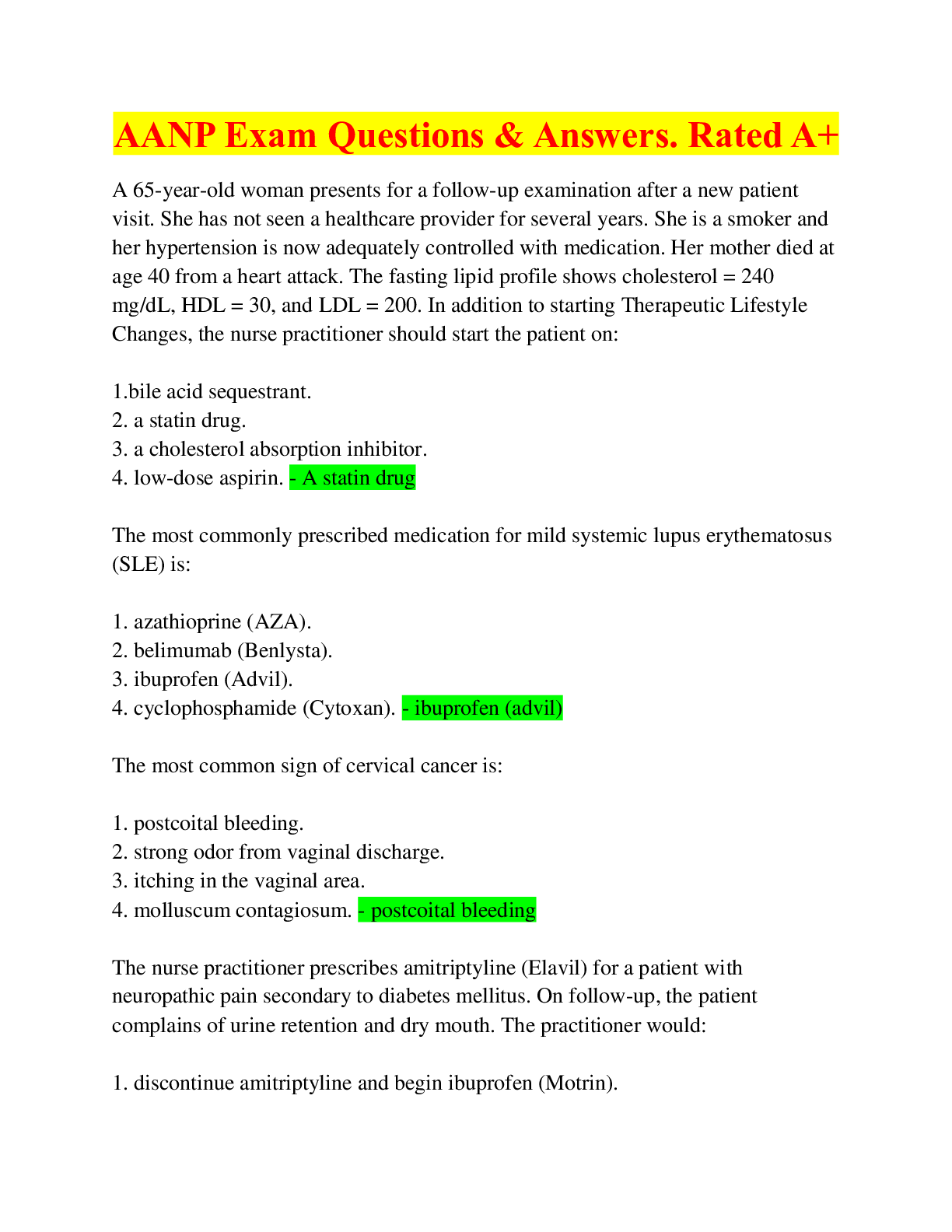
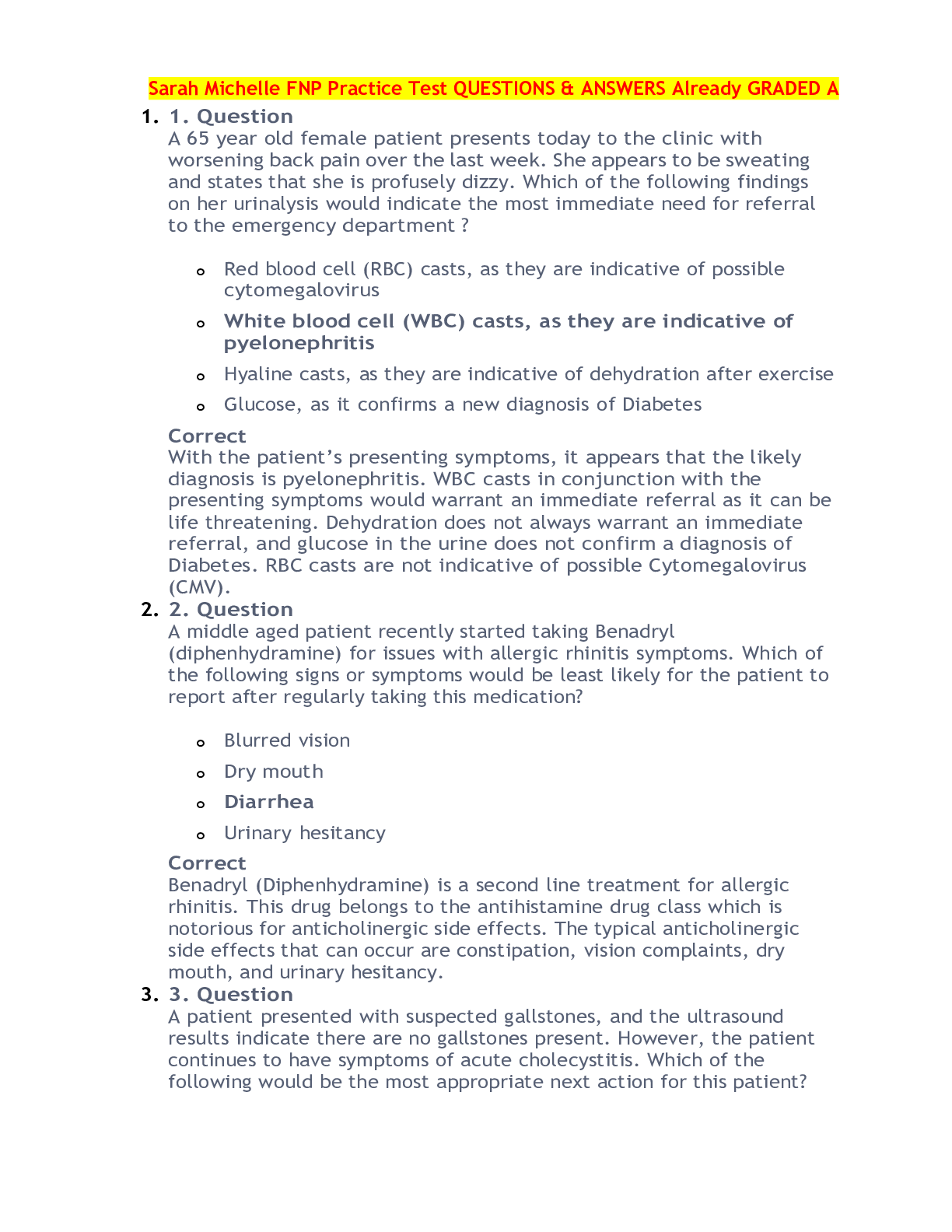
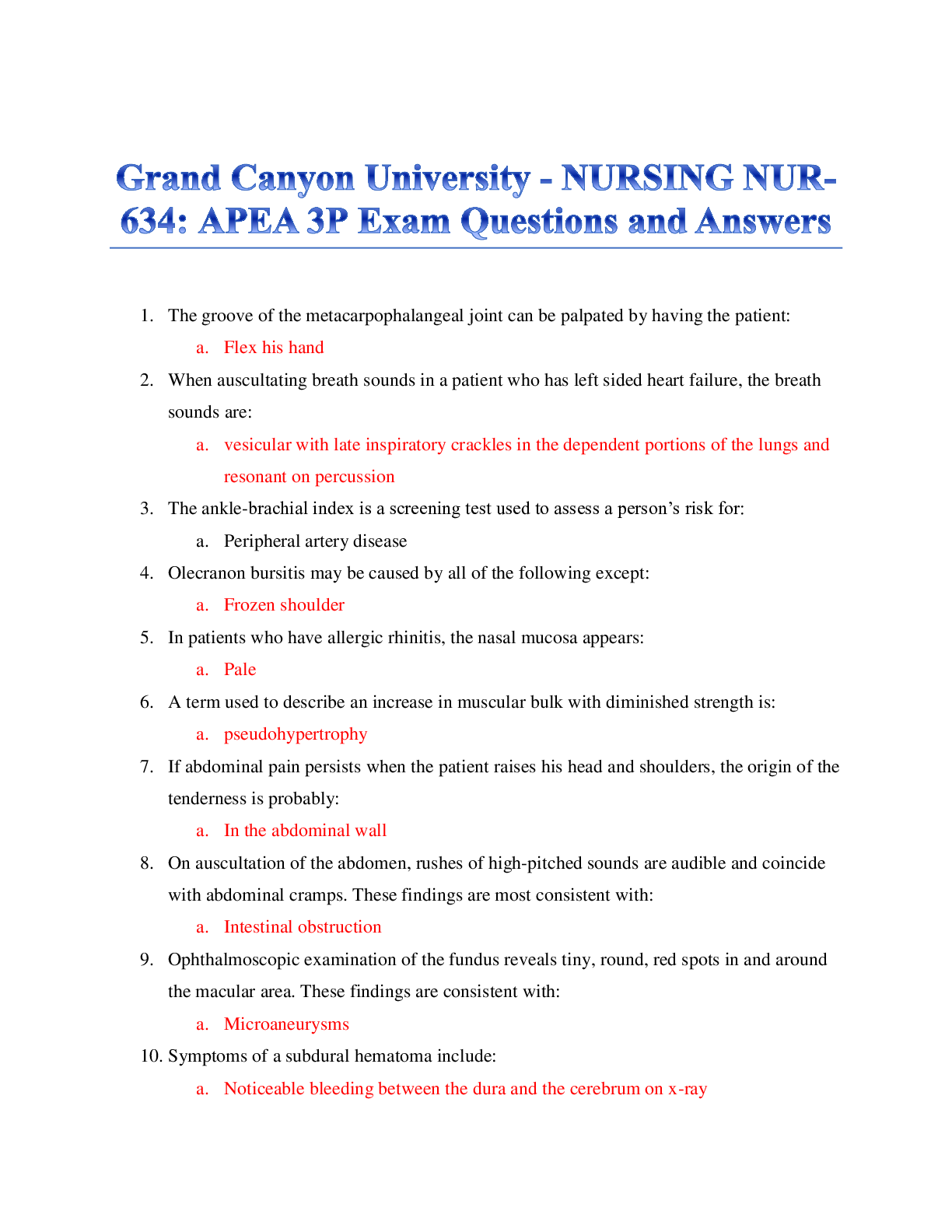
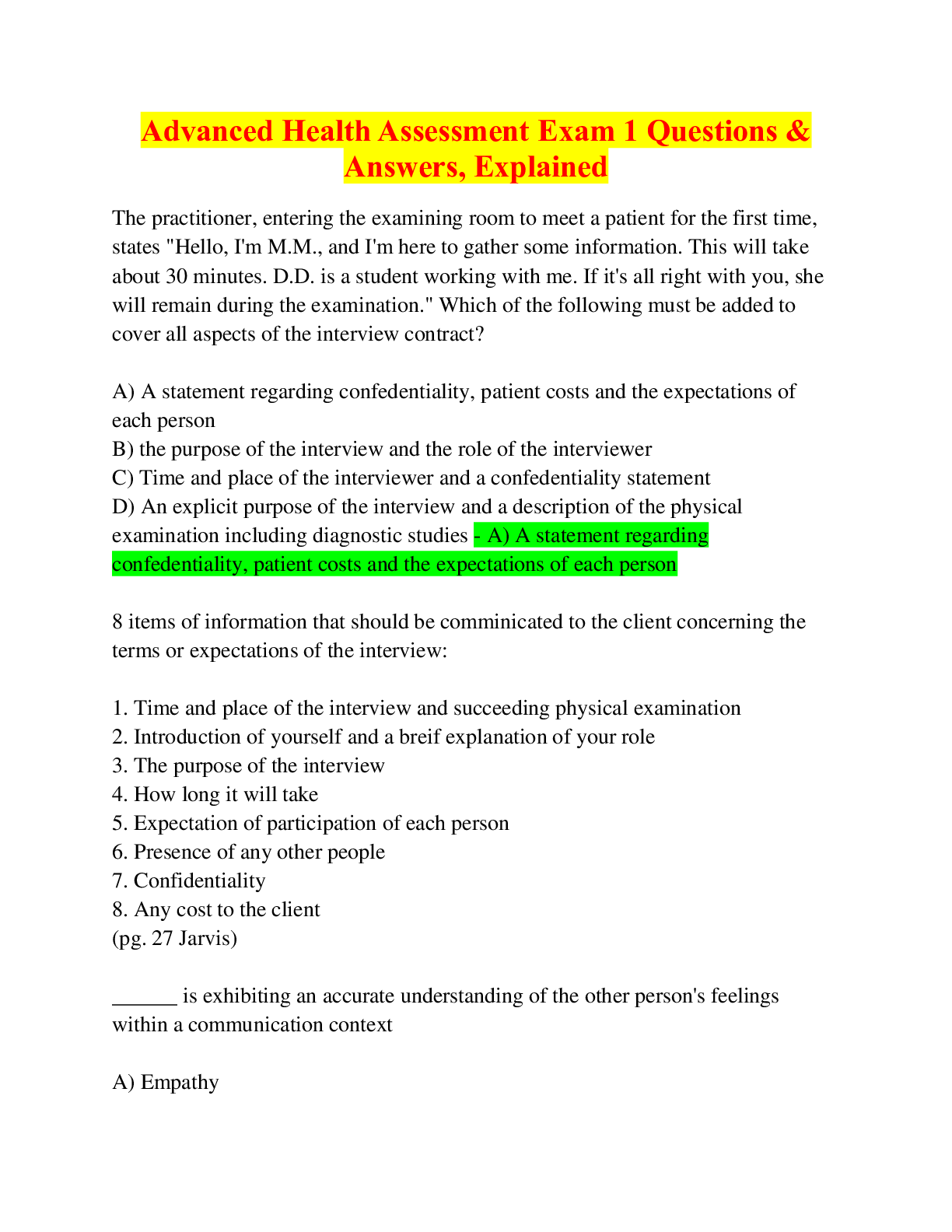
Advanced Health Assessment Exam 1 Questions & Answers, Explained-The practitioner, entering the examining room to meet a patient for the first time, states "Hello, I'm M.M., and I'm here to gather som ... e information. This will take about 30 minutes. D.D. is a student working with me. If it's all right with you, she will remain during the examination." Which of the following must be added to cover all aspects of the interview contract? A) A statement regarding confedentiality, patient costs and the expectations of each person B) the purpose of the interview and the role of the interviewer C) Time and place of the interviewer and a confedentiality statement D) An explicit purpose of the interview and a description of the physical examination including diagnostic studies - A) A statement regarding confedentiality, patient costs and the expectations of each person 8 items of information that should be comminicated to the client concerning the terms or expectations of the interview: 1. Time and place of the interview and succeeding physical examination 2. Introduction of yourself and a breif explanation of your role 3. The purpose of the interview 4. How long it will take 5. Expectation of participation of each person 6. Presence of any other people 7. Confidentiality 8. Any cost to the client (pg. 27 Jarvis) ______ is exhibiting an accurate understanding of the other person's feelings within a communication context A) Empathy B) Liking others C) Facilitation D) A Nonverbal listening technique - A) Empathy: means viewing the world from the other persons inner frame of reference while remaining you. Recognition of another persons feelings without criticism. (pg. 28 Jarvis) You conduct an admission interview. Because you are expecting a phone call, you stand near the door. Which would be a more appropriate approach? A) Arrange to have someone page you so you can sit on the side of the bed B) Have someone answer the phone so you can sit facing the patient C) Use this approach given the circumstances D) Arrange for time free of interuptions after the initial physical examination is complete - B) Have someone answer the phone so you can sit facing the patient Refuse Interruptions: Inform support staff of your interview and ask them not to interupt you during this time. Any interuption can destroy any rapport you had previously built. Sit eye level with patient and avoid barriers such as desks, and avoid standing, standing assumes superiority and takes away control from the patient. Keep a distance of 4 to 5 feet for personal space. (pg.29 Jarvis) A patient asks the nurse, "May I ask you a question?" This is an example of: A) An open-ended question B) A reflective question C) A closed question D) A double-barreled question - C) A closed question: elicits a "yes" or "no" answer or a forced choice. **Avoid Double-barreled questions are questions that ask more than one question, to where a "yes" or "no" answer would not fully satisfy the question (pg. 32 Jarvis) Which statement best describes interpretation as a communication technique? A) interpretation is the same as clarification B) interpretation is a summary of a statement made by the patient C) interpretation is used to focus on a particular aspect of what the patient has just said D) interpretation is based on the interviewer's inference from the data that have been presented - D) interpretation is based on the interviewer's inference from the data that have been presented Interpretation links events, makes associations and implies cause, not based on directly observations but instead on inference or conclusion, you interpretation may be incorrect but helps promt further discussion (pg. 33 Jarvis) Which demonstrates a good understanding of the interview process? A) the nurse stops the patient each time something is said that is not understood B) the nurse spends more time listening to the patient than talking C) the nurse is consistently thinking of his or her next response so the patient will know he or she is understood D) the nurse uses "why" questions to seek clarification of unusual symptoms or behaviors - B) the nurse spends more time listening to the patient than talking #8 on Ten Traps of Interviewing: Talking too much (pg. 34 Jarvis) [Show More]
Last updated: 11 months ago
Preview 1 out of 19 pages
Buy this document to get the full access instantly
Instant Download Access after purchase
Buy NowInstant download
We Accept:


BUNDLE: Advanced Health Assessment Exams 1,2,3,4 & FINAL EXAMS (Including Practice Questions) RATED A+
By PROF 2 years ago
$35.5
9
Can't find what you want? Try our AI powered Search
Connected school, study & course
About the document
Uploaded On
Aug 17, 2023
Number of pages
19
Written in
All
This document has been written for:
Uploaded
Aug 17, 2023
Downloads
0
Views
140
Scholarfriends.com Online Platform by Browsegrades Inc. 651N South Broad St, Middletown DE. United States.
We're available through e-mail, Twitter, Facebook, and live chat.
FAQ
Questions? Leave a message!
Copyright © Scholarfriends · High quality services·