NR 507 Week 4 Test Winter A+GRADED
1. Hypertension (high blood pressure) will have its most immediate effect on
Preload
Contractility
Afterload
None of these
2. Mature, circulating RBC’s lack endoplasmic r
...
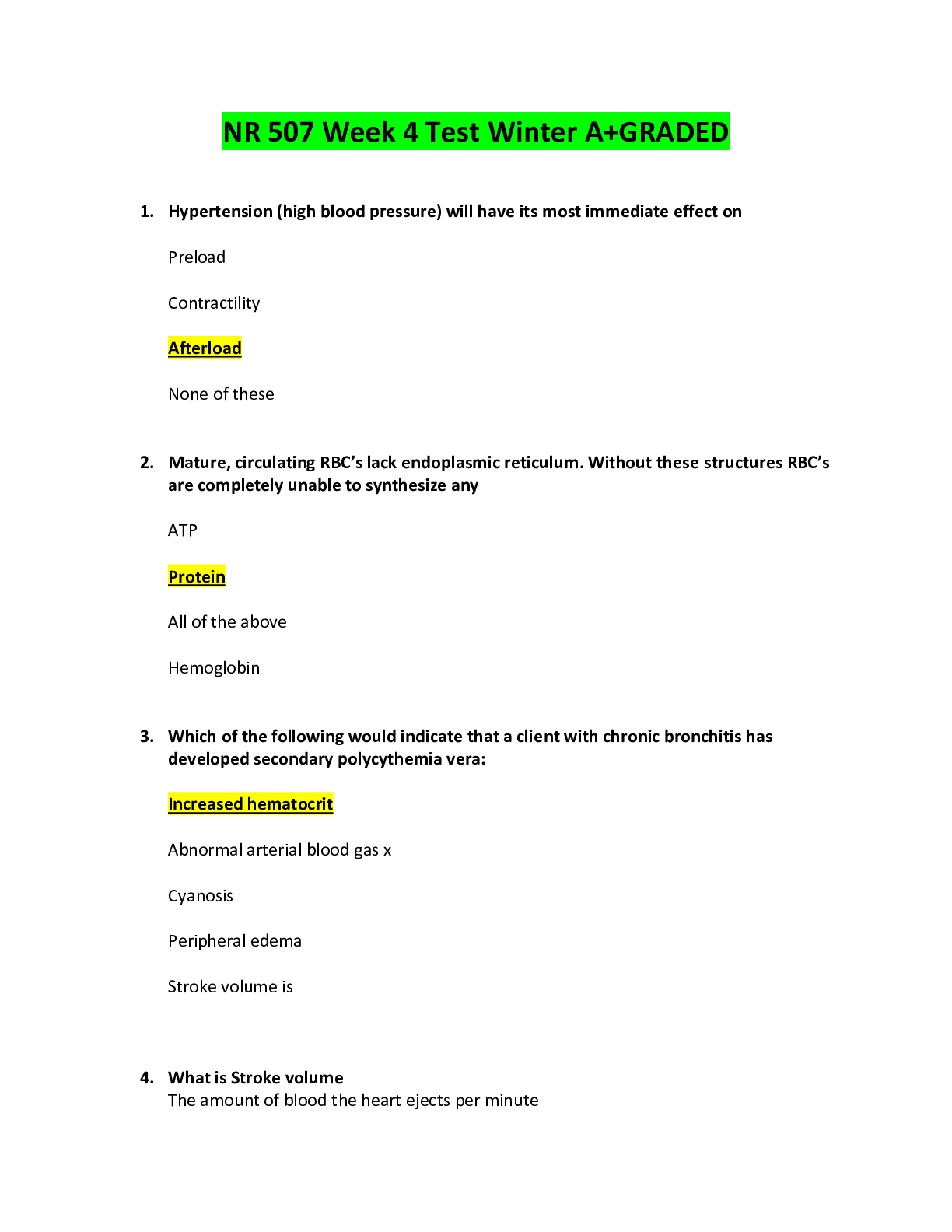
NR 507 Week 4 Test Winter A+GRADED
1. Hypertension (high blood pressure) will have its most immediate effect on
Preload
Contractility
Afterload
None of these
2. Mature, circulating RBC’s lack endoplasmic reticulum. Without these structures RBC’s are completely unable to synthesize any
ATP
Protein
All of the above
Hemoglobin
3. Which of the following would indicate that a client with chronic bronchitis has developed secondary polycythemia vera:
Increased hematocrit
Abnormal arterial blood gas x
Cyanosis
Peripheral edema
Stroke volume is
4. What is Stroke volume
The amount of blood the heart ejects per minute
The amount of blood the heart ejects per beat
Equal to the total blood volume of approximately 5 L
5. Glomerulonephritis is associated with a(n)
Elevated BUN/creat levels due to increase GFR
Decreased BUN/creat levels due to decreased GFR
Decreased bun/creat levels due to increased GFR
Elevated bun/creat level due to decreased GFR
6. Which of the following would not typically be observed in a client with asthma
Wheezing
Chest tightness
SOB
Productive cough
7. A prolonged episode of tachycardia will result in
Increased ejection fraction
No change in stroke volume
Increased stroke volume
Decreased stroke volume
8. Tubular reabsorption and tubular secretion differ in that
Secretion adds material to the filtrate, reabsorption removed material from the filtrate
Secretion occurs via passive transport, reabsorption occurs via active transport
Secretion adds material to the blood; reabsorption removes material from the blood
Reabsorption tends to increase urine volume, secretion tends to decrease urine volume
9. After erythrocytes have completed their lifespan \, they are removed by macrophages located mainly in the
Yellow bone marrow
Appendix
Spleen
Liver x
10. Alveolar hyperinflation occurs in asthma and chronic bronchitis as the result of
Thorax expansion
Increased rate of pulmonary capillary perfusion
Sustained bronchodilation
Decreased ability to exhale
11. The primary site of damage in the nephron due to ischemic conditions is the
Bowmans capsule
Loop of henle
Distal convoluted tubule
Proximal convoluted tubule
12. The movement of blood into and out of the capillary beds of the lungs to the body tissues and cells describes the process of
Metabolism
Respiration
Perfusion
Ventilation
13. A 5-year-old female presents with frequent urinary tract infections, imagine studies indicate a retrograde flow of urine from the urinary bladder into the ureters. This is indicative of
Hypospadias
Vesicoureteral reflux
Renal agenesis x
Polycystic kidney disease
14. A 30-year-old client who had a gastrectomy procedure 1 year ago is most at risk for the development of
Iron-deficiency anemia
Aplastic anemia
Hemolytic anemia
Pernicious anemia
15. A deficiency of intrinsic factor (IF) will most likely result in
Pernicious anemia
Iron-deficiency anemia x
Folate-deficiency anemia
Aplastic anemia
16. During ventricular systole
A and b
Venous blood from the systemic circulation enters the right atrium
The mitral and tricuspid valves are closed
The mitral and tricuspid valves are open
17. A deficiency of transferrin is most likely to result in
Aplastic anemia
Iron-deficiency anemia
Hemolytic anemia
Pernicious anemia
18. The primary source of erythropoietin is the
Spleen
Kidney
Liver
Bone marrow
19. Which of the following is not a condition associated with renal failure
Hypernatremia
Hyperphosphatemia
Hypokalemia
Hypocalcemia
20. A 25-year-old female presents with frequent complete calculi blockage of one ureter. This is referred to as
Postrenal disease
Hypercalcemia
Intrarenal
Prenatal disease
21. Contractility of cardia muscle is directly dependent on the level of
Calcium
Chloride
Sodium
Potassium x
22. Appropriate management of progressive renal failure typically includes
All of the above
Potassium supplementation
High protein diet
Erythropoietin administration
23. In addition to oxygen, hemoglobin also carries nitric oxide (NO) No is important for
Preventing free radical damage to RBC membranes
Promoting vasodilation
Preventing conversion of Fe +2 to fe+3
Increasing oxygen binding affinity of Hb x
24. Which equation correctly represents cardiac output (CO)
CO = heart rate x pulse rate
CO = heart rate x stroke volume
CO = heart rate x blood pressure x
CO = blood pressure x stroke volume
25. Which of the following statements correctly describes the flow of blood between the heart and lungs
Oxygenated blood is transported from the lungs to the heart via the pulmonary veins
Deoxygenated blood is transported from the left ventricle to the lungs via the pulmonary arteries
The pulmonary arteries carry oxygenated blood from the lungs to the heart
Oxygenated blood is transported from the lungs to the right atrium of the heart
26. Blood (hydrostatic) pressure is most important for the process of
Excretion
Reabsorption
Filtration
secretion
27. Preload can be decreased by all the following except
dehydration
hemorrhage
ventricular hypertrophy
cardiac tamponade
28. chronic bronchitis is characterized by
elevated IgG levels
bronchial breakdown
right ventricular hypertrophy
no answer text provided
decreased hematocrit
29. the lamina propria area of the bronchioles play a significant role in the pathogenesis of chronic bronchitis because this is where
columnar epithelia cells lose their cilia
hyperplasia of goblet cells occurs
inflammatory cell activation occurs
smooth muscle constriction occurs
30. which of the following will occur when calcium binds to troponin
troponin shifts to prevent actin and myosin interaction
troponin shifts to allow actin and myosin interaction
an action potential is stimulated
cardiac muscle cells relax
31. the average red blood cell lifespan is approximately
3-4 months
Many years
One month or less
6-12 months
32. The correct definition of afterload is
The amount of blood ejected from each ventricle x
The number of times the heart contracts
How much the ventricles can stretch to hold blood
How much pressure the heart must exert to eject blood
33. An accident victim transfused with the incorrect blood type is at most risk for development of
Hemolytic anemia
Iron-deficiency anemia
Polycythemia
Aplastic anemia
34. A client is experiencing congestive heart failure (CHF) which of the following represent the correct sequence of events that occur with CHF
Systemic hypotension increased la preload increased lv preload biventricular heart failure
Pulmonary hypertension increased RV preload, increased RA preload, pulmonary edema
Aortic valve disease, decreased LV preload, increased LA preload, peripheral edema
Systemic hypertension, increased lv preload, increased la preload, pulmonary edema
35. The condition most associated with a history of seasonal and/or chronic allergies is
Extrinsic asthma
Emphysema
Intrinsic asthma
Chronic bronchitis
36. Preload refers specifically to
How much work the heart must do to pump blood
How often the heart muscle can contract
How much blood the ventricles can hold
End-systolic volume
37. ACE (angiotensin converting enzyme)
Is made by the JG cells to activate renin
Is made by the adrenal cortex to increase NA and water reabsorption
Is made by the liver to form angiotensin II
is made by the lung to activate angiotensin I
38. Closure of the semilunar valves (SLV)
Produces the second heart sounds
Corresponds to atria contraction
Directs blood into the atria
Produces a deflection on the ECG tracing
39. A 78-year old patient is scheduled for an imaging procedure using contrast dye, although rare you know that he may be at risk for contrast induced nephropathy (CIN) because of his history of
Cystitis
Fatty liver
Kidney stones
Diabetes
40. The normal primary site of hematopoiesis in the adult is
Red bone marrow
Yellow bone marrow
Spleen
Liver
41. A 78-year-old male has been diagnosed with benign prostatic hyperplasia (BPH) the increases his risk for development of
Postrenal disease
Vesicouretral reflux
Intrarenal disease
Prerenal disease
42. After load can be increase by all the following except
Pulmonary disease
Systemic hypertension
Aortic valve damage
Hemorrhage
43. The blood disorders sickle-cell anemia and thalassemia are
Idiopathic in origin
Autosomal recessive genetic disorders
Autoimmune-mediated
Autosomal dominant genetic disorders
44. Treatment for asthma included anticholinergic drugs. The mechanism of action for the medication is to
Block acetylcholine binding to promote bronchoconstriction
Enhance acetylcholine binding to promote bronchoconstriction
Block acetylcholine binding to promote bronchodilation
Enhance acetylcholine binding to promote bronchodilation
45. A client who is 2 days post-partum is most at risk for development of
Folate deficiency anemia
Aplastic anemia
Hemolytic anemia
Iron-deficiency anemia
46. A client with chronic bronchitis is most likely to experience
Respiratory acidosis due to decreased intake of O2
Respiratory alkalosis due to decreased intake of O2
Respiratory alkalosis due to inability to exhale CO2
Respiratory acidosis due to inability to exhale CO2
47. An aortic semilunar valve stenosis would have the most immediate effect by
Increasing R atrial preload
Increasing L ventricular afterload
Decreasing L ventricular preload
Decreasing R ventricular afterload
48. In the healthy heart the response to an increase in preload is for stroke volume to
Stay the same
Decrease
Increase
All of the above
49. Decreased contractibility can be caused by all the following except
Acidosis
Ischemia
Fever
Cardiomyopathy
50. Cor pulmonale refers to
Left ventricular failure secondary to lung disease
Right ventricular failure secondary to systemic hypertension x
Left ventricular failure secondary to systemic hypertension
Right ventricular failure secondary to pulmonary hypertension
[Show More]