SOCS 325 Environmental Sociology
1. (TCO 8) What term is not associated with Amartya Sen's theory of justice?
a. Functionings
b. Capabilities
c. Pluralism
d. Utilitarianism
2. (TCO 8) The main point of John Raw
...
SOCS 325 Environmental Sociology
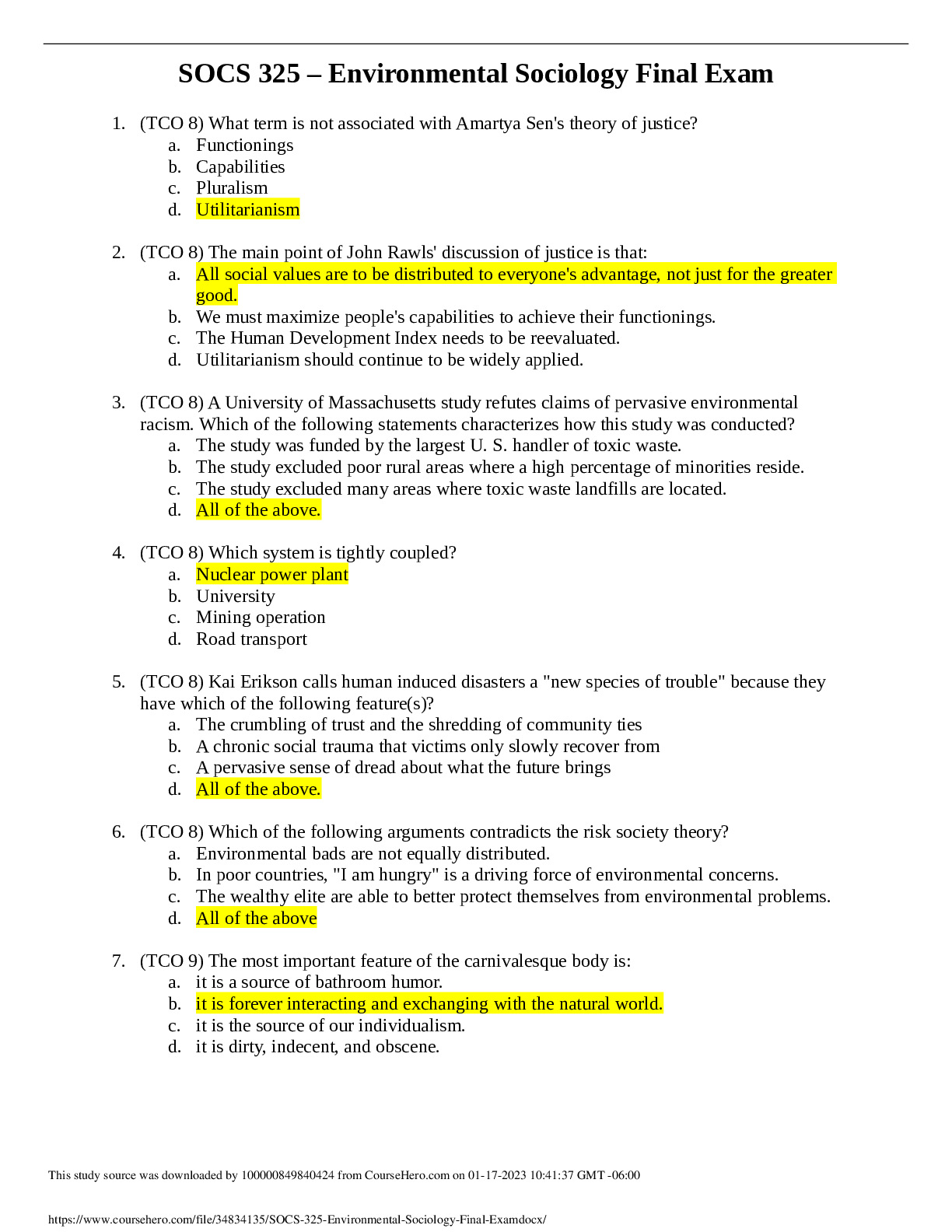
1. (TCO 8) What term is not associated with Amartya Sen's theory of justice?
a. Functionings
b. Capabilities
c. Pluralism
d. Utilitarianism
2. (TCO 8) The main point of John Rawls' discussion of justice is that:
a. All social values are to be distributed to everyone's advantage, not just for the greater good.
b. We must maximize people's capabilities to achieve their functionings.
c. The Human Development Index needs to be reevaluated.
d. Utilitarianism should continue to be widely applied.
3. (TCO 8) A University of Massachusetts study refutes claims of pervasive environmental racism. Which of the following statements characterizes how this study was conducted?
a. The study was funded by the largest U. S. handler of toxic waste.
b. The study excluded poor rural areas where a high percentage of minorities reside.
c. The study excluded many areas where toxic waste landfills are located.
d. All of the above.
4. (TCO 8) Which system is tightly coupled?
a. Nuclear power plant
b. University
c. Mining operation
d. Road transport
5. (TCO 8) Kai Erikson calls human induced disasters a "new species of trouble" because they have which of the following feature(s)?
a. The crumbling of trust and the shredding of community ties
b. A chronic social trauma that victims only slowly recover from
c. A pervasive sense of dread about what the future brings
d. All of the above.
6. (TCO 8) Which of the following arguments contradicts the risk society theory?
a. Environmental bads are not equally distributed.
b. In poor countries, "I am hungry" is a driving force of environmental concerns.
c. The wealthy elite are able to better protect themselves from environmental problems.
d. All of the above
7. (TCO 9) The most important feature of the carnivalesque body is:
a. it is a source of bathroom humor.
b. it is forever interacting and exchanging with the natural world.
c. it is the source of our individualism.
d. it is dirty, indecent, and obscene.
8. (TCO 9) An important aspect of carnivalesque humor is that it:
a. is gross and degrading.
b. is only expressed during the Pre-Lenten Festival.
c. is egalitarian in that it attempts to level inequalities and build community.
d. creates separation and hierarchy.
9. (TCO 9) Forever interacting and exchanging with the natural world is the most important feature of the:
a. Bathroom humor.
b. Carnivalesque body.
c. Individualist.
d. Dirty, indecent, and obscene.
10. (TCO 9) What proportion of those polled in a survey of 43 nations expressed approval for the environmental movement?
a. Less than 10% worldwide
b. Less than 50% worldwide
c. Less than 75% worldwide
d. More than 95% worldwide
11. (TCO 9) Which of the following statements is TRUE?
a. A) Business leaders are the most likely opponents of the environmental movement.
b. B) Whites often show lower levels of concern for the environment than minority groups.
c. Both A and B are true.
d. Neither A nor B is true.
12. (TCO 9) "Human are part of nature and need to maintain a sense of balance and limits in an interconnected world." This statement best describes which paradigm?
a. The dominant paradigm
b. The old paradigm
c. The human-exceptionalism paradigm
d. The ecological-social paradigm
13. (TCO 9) To what does Ramachandra Guha attribute the robust environmental movement in India?
a. The high population from which activists can be drawn
b. Indian democracy
c. The Chipko movement
d. The environmental sensitivity of Ghandi
14. (TCO 9) Which of the following is not "nature" or "natural" according to Aristotle?
a. A wooden bed
b. Molten lava
c. A breath of fresh air
d. A violently destructive tornado
15. (TCO 9) Stephen Jay Gould replicated the craniometry research of Samuel G. Morton and concluded:
a. the smaller stature of females explained the difference in cranial size.
b. cranial size does not indicate intelligence.
c. feet size is a better predictor of intelligence.
d. there is no significant difference between races in cranial size.
16. (TCO 10) Which of the following phrases best characterizes the tragedy of the commons?
a. The dialogue of solidarities
b. The problem of government regulation
c. The tragedy of individualism
d. The problem of common ownership
17. (TCO 10) An important aspect of building both community and a dialogue of solidarities is:
a. Self-interest.
b. Other-interest.
c. Trust.
d. All of the above.
18. (TCO 10) The "bottom-up" approach alone to creating an ecological society is flawed because:
a. it is difficult to draw boundaries to define a grassroots community.
b. a grassroots effort may not be all inclusive.
c. a grassroots community may lack resources and/or expertise needed to tackle an issue effectively.
d. All of the above.
19. (TCO 10) American pedestrians and bicyclists are killed at ________ times the rate of German pedestrians and cyclists.
a. two
b. three
c. four
d. five
20. (TCO 10) The basic idea to model new developments on the kind of traditional neighborhoods that cities routinely turn into historic districts is called:
a. New ruralism.
b. Old rualism.
c. Old urbanism.
d. New urbanism.
21. (TCO 1) Over the past 7 to 8 weeks, how has your definition of environmental sociology changed?
a. Over these past weeks, my view on environmental sociology has changed significantly. At first, I didn’t even really understand what it meant and now I know that there are a lot of factors and issues that affect the environment and society. I am glad that I had the opportunity to take this class because, I now know how to look at my environment and the society that I have around me and see a difference in how everything is interacting.
22. (TCO 2) Give a few examples of how capitalism has caused inequality in minority populations.
a. Some examples of inequality in minority populations that have been caused from capitalism. One example is work incentive, if every worker received the same wage regardless of skill and effort, then no one would want to learn a new skill or work hard at their job. Another example is monopoly power, this allows companies to pay their workers at a lower wage regardless of how productive they are. The last example is inheritance, most people who get an inheritance get them from the previous generation. This gives them the ability to get a better education and a better job. All these examples usually pertain to the top percent of the wealthy. They are usually not a minority and have never really seen a hard day’s work. Capitalism causes inequality in every aspect of its definition and actions that it has. There are very few minorities that have these chances and if they do have them, they usually have worked really hard to get where they are.
23. (TCO 3) A number of social phenomenon discussed in this course vie as the leading cause of environmental problems: overconsumption of products, the problem of collective action, the Western ethos, population growth, social inequality, and uneven development, to name a few. Which do you feel is the most important, and why? Justify your answer sociologically, using detailed facts and figures from the course readings and any outside sources. Compare and contrast how these environmental problems impacts socioeconomic status and influences goods and bads.
a. I feel that the overconsumption of products is the most important issue that we are facing today. That is because most everyone wants the newest and greatest item that is on the market. The treadmill of consumption that is discussed in the book is the best representation of this issue. Everyone is trying to keep up with the Joneses. They consume more and more just to try to keep up, when in all reality they are falling farther and farther behind. I know that I would like to be like the Joneses but know that I don’t have the means necessary to keep that lifestyle. For one, I don’t have the money to obtain all the items. And secondly, I don’t want to be like the Joneses. I am perfect the way I am, and I don’t need any item or possession to help me be better than someone else.
24. (TCO 4) What is the problem with utilitarianism and how does John Rawls' theory of justice as fairness improve upon it? Be sure to explain the difference between utilitarianism and justice as fairness.
a. The main problem with utilitarianism is that it tolerates quite a bit of inequality in the distribution of goods. It doesn’t require the greatest number to be a majority of the population, or even any more than a small minority of it, if the good applies to more than it might otherwise. John Rawls’ theory of justice as fairness improves upon utilitarianism by ensuring that the greatest number of people are treated fairly and that all values are to everyone’s advantage. A great example of the difference between the two is from the book and states, “Utilitarianism might well accept a technology that increases the risk of cancer by 1 in 1,000,000 if more happiness were created than lost in the process. But justice as fairness would not accept such a technology. Maximizing happiness isn’t its point. Maximizing fairness is.”
25. (TCO 5) The sociologist Maynard Haskins once wrote that, "The biggest environmental problem is not any of the gang of five usually pointed to--pollution, overpopulation, overconsumption, the treadmill of production, or our concepts of nature. Rather, the biggest environmental problem is social inequality, for it is ultimately responsible for all the others." Drawing on readings and lectures from this course, defend or critique Haskins' pronouncement. In your answer, be sure to discuss the role (or lack thereof) of social inequality in at least three of the "gang of five." Compare and contrast how these impact free market economics and capitalism.
a. I would have to say that I would have to agree with Haskins. Social inequality is by far a bigger environmental problem than the other five. Most people never bring this up because they believe that it isn’t really an issue. When in fact it is probably the base issue within the gang of five that are usually held accountable. You get overpopulation in areas of the world where; most of the population can’t afford to live in a less crowded area. A good example of this is Puerto Rico, most of the country is overpopulated and everyone is stacked right on top of each other. Overconsumption is another of the five that has a base of social inequality. Everyone in society is trying to be like the Joneses even if they don’t have the means necessary to be like the Joneses. They overconsume products just to get to a status that isn’t achievable to them because of their inequality. Lastly our concepts of nature have a social inequality as well. Everyone views nature in a different way and perceives how nature can either benefit or hinder them. The inequality that everyone has is a major impact to the gang of five and the biggest environmental problem that we have today.
26. (TCO 6) Why is organic food a positional good? What other ways do wealthy people have an advantage in avoiding pesticides? How does this relate to global inequality? How are organic foods produced, marketed, and sold in a capitalist society? Compare and contrast the future of green businesses, green energy, organic foods, and ecotourism.
a. Organic food is a positional good because it’s lack of availability and price for the product. Wealthy people have an advantage of avoiding pesticides by not directly working with them on a daily basis, unlike farmers and lawn care workers. These relate to the global inequality by showing that not everyone is given or has the chance to purchase organic food and avoid pesticides. Organic foods in a capitalist society are going to be produced in a way that ensures no pesticides come into contact with them, like being in a greenhouse that is controlled. They are going to be marketed and sold to the higher class of society, who have the means and money to purchase them. They won’t be sold to the lower classes of society because the capitalist of the markets is always looking for ways to make money and not lose money. If they were to sell to the lower markets, then they would have to lower the price of the products, which won’t be in their best interests.
27. (TCO 7) The author of your textbook states that, "the principle scholarly contribution of the book is the concept of ecological dialogue." Briefly explain what is meant by ecological dialogue and give an example or illustration. How can ecological dialogue be used to solve such complex issues in Environmental Sociology such as exploding population growth, degradation of our natural resources, poverty, debt, and hunger?
a. Ecological dialogue is best defined as an interplay of factors that condition and influence each other, a never-ending conversation between the material and ideal dimensions of social life. This is best reflected in the attached photo from the book. Ecological dialogue can used to help resolve a lot of issues that we currently are facing in our society. The main issue is that the people in power don’t want to talk and or listen to the ideas of the people who could make a difference. This is because it usually isn’t going to benefit them in some way, shape, or form. I believe that if you can change the mind of one or two of the larger players in the political system then they can start to influence others and help get the ball rolling to resolve these environmental issues that we have today. All it takes if for people to listen and then provide their feedback.
[Show More]



.png)










.png)