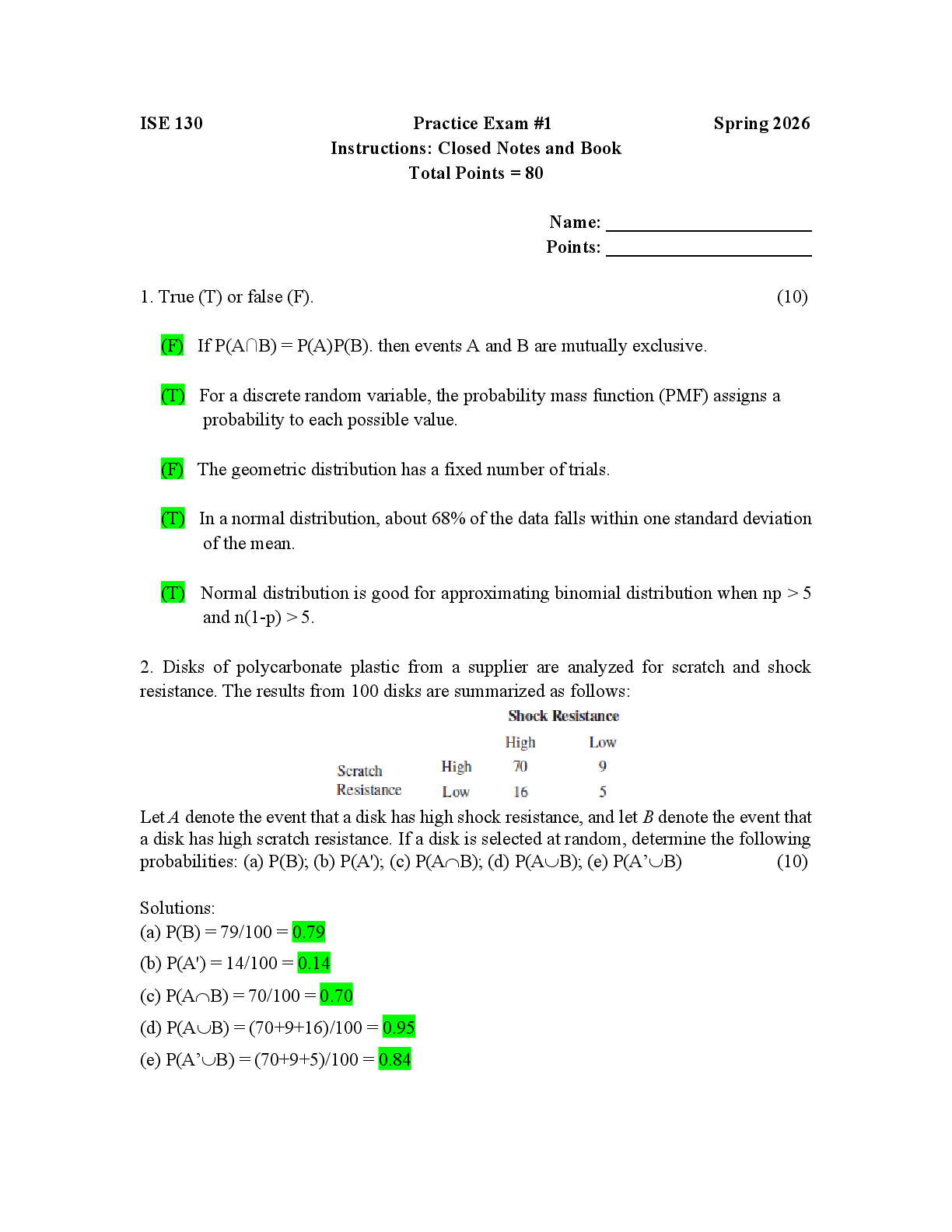
ATI MEDICAL SURGICAL EXAM - RESPIRATORY 1- A nurse is reviewing the discharge instruction for a client who is recovering from pneumonia. Which of the following statements should the nurse make? -“You should avoid crowed
...
ATI MEDICAL SURGICAL EXAM - RESPIRATORY 1- A nurse is reviewing the discharge instruction for a client who is recovering from pneumonia. Which of the following statements should the nurse make? -“You should avoid crowed areas.” 2- A nurse in an emergency department is assessing a client who has a flail chest from blunt chest trauma. Which of the following findings should the nurse expect: (SATA) -Cyanosis -Dyspnea -Paradoxical chest movement 3- A nurse is caring for an adolescent with cystic fibrosis. Which finding requires immediate intervention when caring for this client? -Chest pain with dyspnea Rational: chest pain and dyspnea are signs of pneumothorax and should be treated immediately. 4- A nurse in the emergency department is assessing a client admitted to the emergency department who has sustained crushing chest injuries in a car accident. Which of the following signs indicate a possible pneumothorax? -Diminished or absent breath sounds on the affected side 5- A client who had extensive pelvic surgery 24 hr ago becomes cyanotic, is gasping for breath, and complains of right-sided chest pain. What should the nurse do first? -Administer oxygen using a face mask 6- A client is admitted with second degree burns on face, neck, anterior chest, and hands. The nurse’s priority action would be: -Assess for dyspnea and stridor 7- A client who underwent a left lower lobectomy is forty-eight hrs post op. The client is receiving morphine sulfate via a patient-controlled analgesia (PCA) system and report having pain in the left thorax that worsens coughing. The nurse should: -Obtain a more detailed assessment of the client’s pain using a pain scale. 8- A nurse is caring for a client who is undergoing tracheostomy. The nurse understands that which of the following is a complication of this procedure? -Damage to the recurrent laryngeal nerve. 9- A nurse is assessing a client’s arterial blood results. The results are pH 7.50, bicarbonate 32mEq/L, and PaCO2 36 mmHg. Which of the following do these arterial gas results indicate? -Metabolic alkalosis 10- A nurse is caring for a client on a ventilator who has ventilator settings with a preset tidal volume. Which best describes the tidal volume (VT) in this setting: -The amount of air inhaled with each breath 11- The nurse is caring for a client who has just been intubated for respiratory failure. The physician orders the ventilator to be set SIMV mode. Which best describes SIMV? -A preset number of breaths delivered to the client at certain volume 12- A client with asthma is scheduled for treatment with methylxanthine for nocturnal wheezing. Which of the following drugs are methylxanthine drugs that are appropriate for the treatment of this client? (SATA) -Theophylline -Aminophylline 13- The nurse is administering cromolyn sodium (Intal) for client with asthma. Which of the following are true about this drug? (SATA) -It causes headache -It prevents an attack 14- A nurse caring for a client with hemothorax. The physician plans to insert a right-sided chest tube. (La pregunta pide ordenar los cuadritos en el orden correcto) -Check the physician order and gather the chest tube supplies -Assist the client to the correct position for placement. -Assist the provider with the chest tube insertion -Move the drainage system unit so that it is below the level of the chest -Administer pain medication as required -Encourage the client to cough and deep breathe. 15- A 33-year-old client is in the ICU for treatment of acute respiratory distress syndrome (ARDS). (la pregunta pide ordenar los pasos para realizar endotraqueal suctioning en orden) -Turn on the suction to 80-120 mmHg -Pre-oxygenate the client by providing 100% oxygen through the ET tube -Insert the suction catheter into the ET tube until resistance is met, taking care not to apply suction with insertion. -Apply suction while withdrawing the catheter from the ET tube -Suction the in-line catheter with saline to clear for next use. 16- The nurse is assessing a client with ARDS (acute respiratory distress syndrome). Which of the following may have caused the client’s condition? (SATA) - Heroin - Pancreatitis - Burns - Fat emboli 17- The nurse is assessing a client with extrapulmonary tuberculosis. Which of the following is true about this type of condition? (SATA) -Genitourinary system is affected -Osteomyelitis occurs 18- Which of the following devices is most appropriate for delivering a predicted oxygen concentration in a client with unstable chronic obstructive pulmonary disease (COPD)? -Venturi mask Rational: this mas allowing delivery of fixed FiO2 that depends on the flow rate and size of the entrainment port. It can delivery oxygen concentration ranging from 24-60 % and flow rates between 4-12 L/min. Used to titrate the oxygen concentration in clients with unstable COPD. 19- A nurse is assessing a client with emphysema. Which assessment findings does the nurse anticipate in this form of COPD? (SATA) -Hyperresonance on percussion of the lung area -Increased respiratory effort -Increased chest diameter when measured anteriorly and posteriorly 20- A nurse is caring for 4 new clients. When receiving reports, the nurse should prioritize assessment of which of the following? -A 70-year-old client after knee replacement complaining of sudden-onset dyspnea accompanied by chest pain 21- A charge nurse is admitting an elderly client with influenza. Which of the following precautions are necessary for preventing the transmission of influenza virus to other clients? (SATA) -The client should wear a face mas when leaving the room -The client should be assigned to a private room -Visitor contact with the client should be limited 22- A nurse is caring for a client with a tracheostomy
[Show More]

![Preview of eBook [PDF] Reinventing Babel in Medieval French 1st Edition By Dr Emma Campbell](https://browseimages.nyc3.digitaloceanspaces.com/paper-images/2024/Sep/13/MYBKTi9D2024-09-13-11-5566e3fdfc48de9.png)