Syllabus
Theoretical Foundations for Nursing Roles and Practice
Details This course examines nursing as a profession and a discipline and the individual
nurse's role as a member of the profession. The theoretical foun
...
Syllabus
Theoretical Foundations for Nursing Roles and Practice
Details This course examines nursing as a profession and a discipline and the individual
nurse's role as a member of the profession. The theoretical foundations for nursing
practice and roles are explored and applied. Emphasis is placed on developing
scholarly writing and presentation skills. Critical thinking skills are refined as
students discuss and synthesize the literature that guides nursing practice with a
special emphasis on caring, diversity, and spirituality.
Course
AddOns
Textbook1. Publication Manual of the American Psychological Association
American Psychological Association. (2009). Publication manual of the American
Psychological Association (6th ed.). Washington, DC: American Psychological
Association. ISBN-13: 9781433805615 (Available as print text only.)
2. Advanced practice nursing: Essential Knowledge for the Profession
Barker, A. M., & DeNisco, S. M. (2016). Advanced practice nursing: Essential
Knowledge for the Profession (3rd ed.). Boston, MA: Jones & Bartlett. ISBN-
13: 9781284072570 (Available as print text only.)
3. Theoretical Basis for Nursing
McEwen, M., & Wills, E. (2014). Theoretical basis for nursing (4th ed.). Philadelphia,
PA: Lippincott Williams & Wilkins. ISBN-13: 9781451190311 (Print-Text Required)
Topics
Topic 1: The Evolution of the Nursing Profession and Discipline
Objectives:
1. Identify the milestones in the development of professional nursing.
2. Describe the evolution of the discipline of nursing.
3. Compare the GCU mission, CON mission/graduate program competencies, and the AACN
Essentials of Masters' Education for Advanced Practice Nursing and the Future for Nursing
Report.
4. Examine the responsibilities of being a member of a profession.
Topic Material:
Lecture Note1. NUR-502 Lecture 1
Read Lecture 1.
NUR-502 Lecture 1
Textbook1. Advanced practice nursing: Essential Knowledge for the Profession
Read Chapters 1-3 and 18.
2. Theoretical Basis for Nursing
Read Chapter 1.
Electronic Resource1. The Essentials of Baccalaureate Education for Professional Nursing Practice
Study "The Essentials of Baccalaureate Education for Professional Nursing Practice," located on the
American Association of Colleges of Nursing website.
http://www.aacnnursing.org/Portals/42/Publications/BaccEssentials08.pdf
2. The Essentials of Master's Education for Advanced Practice Nursing
Study "The Essentials of Master's Education for Advanced Practice Nursing," located on the American
Association of Colleges of Nursing website.
http://www.aacnnursing.org/Portals/42/Publications/MastersEssentials11.pdf
3. The Future of Nursing: Leading Change, Advancing HealthRead “The Future of Nursing: Leading Change, Advocating Health,” located on the
National Academies of Sciences, Engineering, and Medicine website.
Read the IOM report “The future of nursing: Leading change, advocating health,” located on the
Institute of Medicine’s website.
http://www.nationalacademies.org/hmd/Reports/2010/The-Future-of-Nursing-Leading-ChangeAdvancing-Health.aspx
4. The APRN Consensus Model
Read “APRN Consensus Model,” located on the NCSBN website.
https://www.ncsbn.org/Consensus_Model_for_APRN_Regulation_July_2008.pdf
Website1. American Nurses Association
Explore the American Nurses Association website.
http://nursingworld.org
2. National Council of State Boards of Nursing
Explore the National Council of State Boards of Nursing website.
http://www.ncsbn.org
3. American Organization of Nurse Executives
Explore the American Organization of Nurse Executives website.
http://www.aone.org
4. National Association of Clinical Nurse Specialists
Explore the National Association of Clinical Nurse Specialists website.
http://www.nacns.org
5. American Academy of Nurse Practitioners
Explore the American Academy of Nurse Practitioners website.
http://www.aanp.org
6. National League for Nursing
Explore the National League for Nursing website.
http://www.nln.org
7. National Nursing Staff Development Organization
Explore the National Nursing Staff Development Organization website.
http://www.nnsdo.org
Additional Material1. Master's Prepared Nurse Interview Guide
Review "Master's Prepared Nurse Interview Guide."
NUR502.v10R.MastersPreparedNurseInterviewGuide_student.docx
Gradable
Items
Details Points
Possible
Assignments Master's-Prepared Nurse Interview
Refer to the "Master's Prepared Nurse Interview Guide_student" as
you prepare this assignment.
Interview a nurse who is master's-prepared in nursing and is using
this education in a present position. Preferably, select someone
who is in a position similar to your chosen specialty track. The
purpose of the interview is for you to gain insight into the
50.0interplay among education, career path, and opportunities. Be
certain to identify specific competencies that the MSN-prepared
nurse gained, and is presently using, that reflect advanced
education. Organize your interview around the topics below:
1. Overview of the master's-prepared nurse's career
2. Reason for seeking graduate education
3. Description of present position and role
4. Usefulness of graduate education for present role
5. Pearls of wisdom he/she is willing to share
In 750-1,000 words, write the interview in a narrative format. Use
the following guidelines:
1. Within the paper's introduction, explain your interview
selection.
2. Do not identify the individual by name.
3. Use centered headings to separate parts of the interview.
4. In the conclusion, identify one or more competencies from
the interview that are consistent with GCU program
competencies and/or AACN education essentials. In
addition, provide a statement that reflects what you gained
from the interview.
Prepare this assignment according to the guidelines found in the
APA Style Guide, located in the Student Success Center. An
abstract is not required.
This assignment uses a rubric. Please review the rubric prior to
beginning the assignment to become familiar with the expectations
for successful completion.
You are required to submit this assignment to Turnitin. Refer to
the directions in the Student Success Center.
Discussion
Questions
Topic 1 DQ 2
Name one recommendation from the IOM Future of Nursing
Report. What is its importance relative to Advanced Practice
Nursing? Support your answer.
5.0
Topic 1 DQ 1
What comparisons can be found between the GCU Mission and
Domains/CON Mission and Program Competencies (for your
selected specialty track, links located in the Course Materials) with
the AACN's Essentials for Master's Education for Advanced
Practice Nursing (link located in the Week 1 Topic Materials)?
Explain your rational.
https://www.gcu.edu/about-gcu/university-snapshot.php
https://www.gcu.edu/college-of-nursing-and-health-careprofessions.php
5.0Participation 30.0
Duration: 7 daysTopic 2: Professional Communication and Practice
Objectives:
1. Demonstrate professional writing skills using APA style.
2. Define cultural competence.
3. Describe the role of "codes of ethics" in the development of disciplinary knowledge.
Topic Material:
Lecture Note1. NUR-502 Lecture 2
Read Lecture 2.
NUR-502 Lecture 2
Textbook1. Publication Manual of the American Psychological Association
Read Chapters 2 and 3.
2. Advanced practice nursing: Essential Knowledge for the Profession
Read Chapters 23-27.
Electronic Resource1. Status of Cultural Competence in Nursing Education: A Literature Review
Read "Status of Cultural Competence in Nursing Education: A Literature Review," by Grant and Letzring,
from the Journal of Multicultural Nursing & Health (2003).
https://lopes.idm.oclc.org/login?url=http://search.proquest.com.lopes.idm.oclc.org/docview/2203025
43?accountid=7374
2. Purnell Model for Cultural Competence
Read "Purnell Model for Cultural Competence," by Purnell, from the Journal of Multicultural Nursing
and Health (2005).
https://lopes.idm.oclc.org/login?url=http://search.proquest.com.lopes.idm.oclc.org/docview/2203014
19?accountid=7374
3. Code of Ethics for Nurses with Interpretive Statements
Read “Code of Ethics for Nurses With Interpretive Statements,” located on the
American Nurses Association website.
http://www.nursingworld.org/MainMenuCategories/EthicsStandards/CodeofEthicsforNurses/Code-ofEthics-For-Nurses.html
4. A Nurse’s Guide to the Use of Social Media
Read “A Nurse’s Guide to the Use of Social Media,” located on the NCSBN website.
https://www.ncsbn.org/NCSBN_SocialMedia.pdf
Website1. Diversity Rx
Explore the Diversity Rx website.
http://www.DiversityRx.org
2. Cultural Profiles of Countries
Explore the "The World Factbook" website.
https://www.cia.gov/library/publications/the-world-factbook/
3. MinorityNurse.com: The Career and Education Resource for Minority Nursing Professionals, Students, and
Faculty
Explore the MinorityNurse.com: The Career and Education Resource for Minority Nursing Professionals,
Students, and Faculty website.
http://www.minoritynurse.com
4. ANA’s Social Networking Principles Toolkit
Explore the Social Networking Principles Toolkit page of the ANA website.
http://www.nursingworld.org/socialnetworkingtoolkit.aspx
e-Library Resource1. Developing Ethical Skills: From Sensitivity to ActionRead “Developing Ethical Skills: From Sensitivity to Action,” by Robichaux,
from Critical Care Nurse (2012).
https://lopes.idm.oclc.org/login?url=http://search.ebscohost.com/login.aspx?direct=true&db=a9h&AN
=74306541&site=ehost-live&scope=site
2. Moral Courage and the Nurse Leader
Read “Moral Courage and the Nurse Leader,” by Edmonson, from OJIN: The Online
Journal of Issues in Nursing (2010).
https://lopes.idm.oclc.org/login?url=http://search.ebscohost.com/login.aspx?direct=true&db=a9h&AN
=56593216&site=ehost-live&scope=site
3. Defining End of Life Care from Perspectives of Nursing Ethics
Read “Defining End of Life Care from Perspectives of Nursing Ethics,” by Izumi, Nagae,
Sakurai, and Imamura, from Nurse Ethics (2012).
https://lopes.idm.oclc.org/login?url=http://search.ebscohost.com/login.aspx?direct=true&db=a9h&AN
=82506601&site=ehost-live&scope=site
4. Interventions to Improve Cultural Competency in Healthcare: A Systematic Review of Reviews
Read "Interventions to Improve Cultural Competency in Healthcare: A Systematic Review of Reviews,"
byTruong, Paradies and Priest, from BCM Health Services Research (2014).
https://bmchealthservres.biomedcentral.com/articles/10.1186/1472-6963-14-99
5. Culture Care Theory: A Proposed Practice Theory Guide for Nurse Practitioners in Primary Care Settings
Read "Culture Care Theory: A Proposed Practice Theory Guide for Nurse Practitioners in Primary Care
Settings," by McFarland and Eipperle, fromContemporary Nurse (2008).
https://lopes.idm.oclc.org/login?url=http://search.proquest.com.lopes.idm.oclc.org/docview/2031726
54?accountid=7374
Additional Material1. Professional Communication Cultural Sensitivity Guide
Review "Professional Communication Cultural Sensitivity Guide."
NUR502.v10R.CulturalSensitivityGuide_student.docx
Gradable
Items
Details Points
Possible
Assignments Professional Communication: Cultural Sensitivity
For this assignment, consult the "Professional Communication
Cultural Sensitivity Guide."
Write a paper of 1,000-1,250 words on a specific cultural group.
Use the following guidelines:
1. Select one article from a nursing journal focused on a
cultural group.
2. In the introduction, state your reason for selecting the
cultural group.
3. Summarize the key points of the article.
4. Apply the new information to a practice situation that
demonstrates cultural sensitivity in communication,
reflecting the reading in Chapter 25.
5. Write a conclusion.
Prepare this assignment according to the guidelines found in the
APA Style Guide, located in the Student Success Center. An
100.0abstract is not required.
This assignment uses a rubric. Please review the rubric prior to
beginning the assignment to become familiar with the expectations
for successful completion.
You are required to submit this assignment to Turnitin. Refer to
the directions in the Student Success Center.
Discussion
Questions
Topic 2 DQ 2
What is the role of the Advanced Professional Nurse in creating an
ethical practice environment? Respond to this question, based on
your selected APN role.
5.0
Topic 2 DQ 1
Discuss several aspects of professional communication as it relates
to the use of language in terms of form (e.g., clarity, accuracy) and
content (culture and/or ethics). Cite the references you used to
compose your response (from required readings).
5.0
Participation 30.0
Duration: 7 daysTopic 3: Role Development in Graduate Education
Description:
Objectives:
1. Explain the usefulness of theory and research in nursing practice.
2. Explore the applications of role theory to differentiated practice between Bachelor of Science
in Nursing (BSN) and Master of Science in Nursing (MSN) prepared nurses.
Topic Material:
Lecture Note1. NUR-502 Lecture 3
Read Lecture 3.
NUR-502 Lecture 3
Textbook1. Advanced practice nursing: Essential Knowledge for the Profession
Read Chapters 18-22.
2. Theoretical Basis for Nursing
Read Chapters 1, 2, and 12.
Electronic Resource1. Notes on Nursing: What It Is, and What It Is Not
Read "Notes on Nursing: What It Is, and What It Is Not," located on the Penn Libraries website.
http://digital.library.upenn.edu/women/nightingale/nursing/nursing.html
2. Initial Course Survey
In an effort for continuous improvement, Grand Canyon University would like you to take this
opportunity to provide feedback about your experience with the university. Your participation is
appreciated. Click on the link to begin the survey.
http://survey.gcu.edu/initial_course_survey/initial_course_survey.htm?q0.a=20231713
Website1. The Nursing Theory
Explore The Nursing Theory website.
http://www.sandiego.edu/nursing/research/nursing-theory-research.php
2. Nursing Theory
Explore the Nursing Theory Link website, including the "Nursing Theories and Models" and "Nursing
Theorists" tabs.http://www.nursing-theory.org/
3. Academic Center for Evidence-Based Practice (ACE)
Explore the Academic Center for Evidence-Based Practice (ACE) website.
http://www.acestar.uthscsa.edu
e-Library Resource1. Career Pathways in Nursing: Entry Points and Academic Progression
Read “Career Pathways in Nursing: Entry Points and Academic Progression,” by Raines
and Taglaireni, from OJIN: The Online Journal of Issues in Nursing (2008).
https://lopes.idm.oclc.org/login?url=http://search.ebscohost.com/login.aspx?direct=true&db=a9h&AN
=37604851&site=ehost-live&scope=site
2. Beyond Rhetoric to Role Accountability: A Practical and Professional Model of Practice
Read “Beyond Rhetoric to Role Accountability: A Practical and Professional Model of
Practice,” by O’Rourke, from Nurse Leader (2006).
https://lopes.idm.oclc.org/login?url=http://dx.doi.org.lopes.idm.oclc.org/10.1016/j.mnl.2006.04.011
3. Development of a Professional Nursing Framework: The Journey Towards Nursing Excellence
Read “Development of a Professional Nursing Framework: The Journey Towards
Nursing Excellence,” by Mensik, Maust, Scott, and Horton, from the Journal of
Nursing Administration (2011).
https://lopes.idm.oclc.org/login?url=http://gateway.ovid.com.lopes.idm.oclc.org/ovidweb.cgi?T=JS&C
SC=Y&NEWS=N&PAGE=fulltext&AN=00005110-201106000-00007&D=ovft&PDF=y
Additional Material1. CLC Group Project Agreement
Complete "CLC Group Project Agreement."
NUR502.v10R.CLCGroupProjectAgreement_student.docx
Gradable
Items
Details Points
Possible
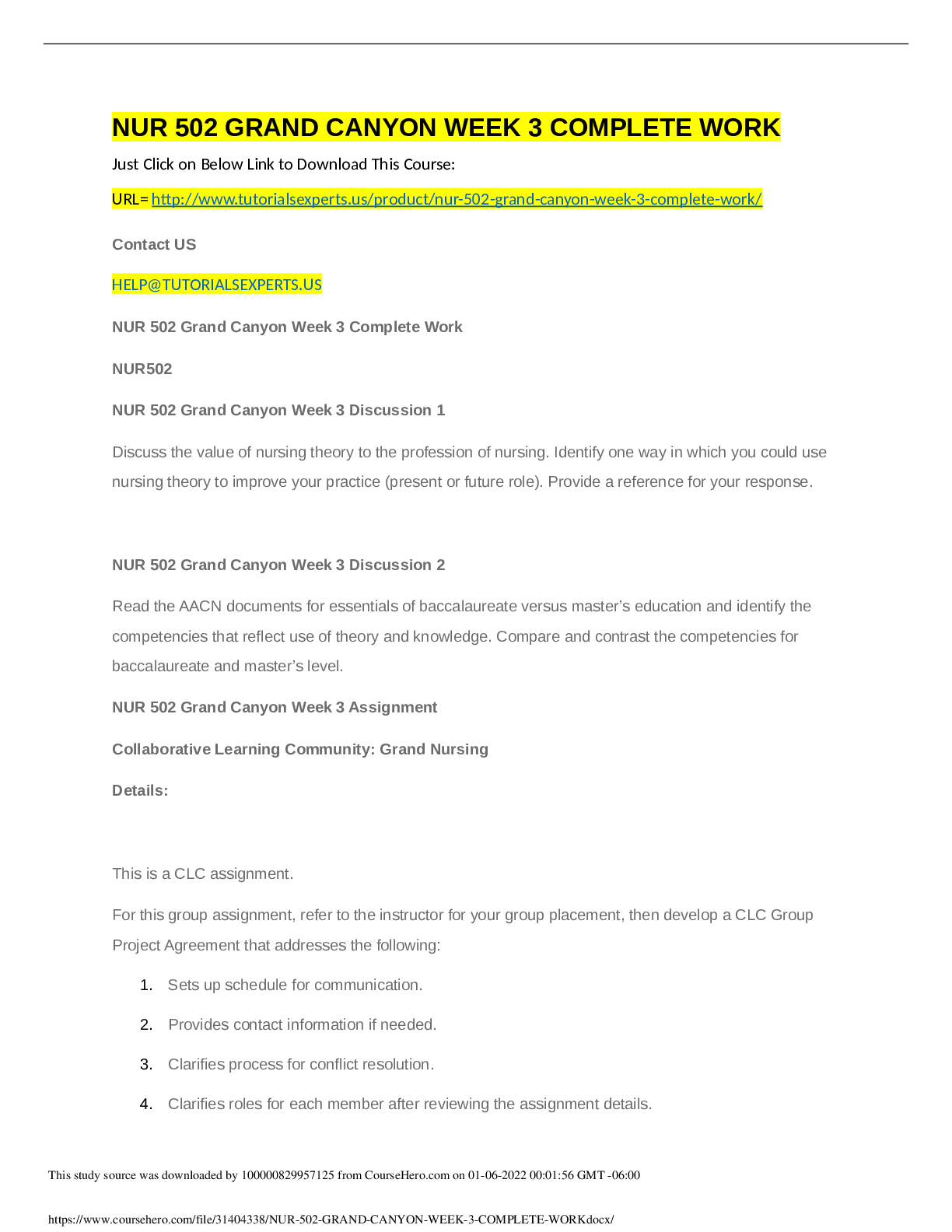
Assignments CLC - Grand Nursing Theorist Assignment: CLC Group
Project Agreement
This is a Collaborative Learning Community assignment.
For this group assignment, refer to the instructor for your group
placement, then develop a CLC Group Project Agreement that
addresses the following:
1. Sets up schedule for communication.
2. Provides contact information if needed.
3. Clarifies process for conflict resolution.
4. Clarifies roles for each member after reviewing the
assignment details.
APA format is not required, but solid academic writing is
expected.
You are not required to submit this assignment to Turnitin.
0.0
Discussion
Questions
Topic 3 DQ 1
Discuss the value of nursing theory to the profession of nursing.
Identify one way in which you could use nursing theory to
improve your practice (present or future role). Provide a reference
for your response.
5.0Topic 3 DQ 2
Read the AACN documents for essentials of baccalaureate versus
master's education and identify the competencies that reflect use of
theory and knowledge. Compare and contrast the competencies for
baccalaureate and master's level.
5.0
Participation 30.0
Duration: 7 daysTopic 4: Overview of Nursing Theory
Objectives:
1. Describe the concepts of nursing's multiple paradigms.
2. Differentiate between grand, middle-range, and practice theory.
3. Apply the analysis of a concept to nursing practice.
Topic Material:
Lecture Note1. NUR-502 Lecture 4
Read Lecture 4.
NUR-502 Lecture 4
Textbook1. Theoretical Basis for Nursing
Review Chapters 2 and 3-5.
e-Library Resource1. A Cross-Cultural Comparison of a Clinical Nurse Competency Path Model
Read "A Cross-Cultural Comparison of a Clinical Nurse Competency Path Model," by Sportsman,
Hamilton, and Schumacker, from International Journal of Nursing Education (2014).
https://lopes.idm.oclc.org/login?url=http://search.ebscohost.com/login.aspx?direct=true&db=ccm&AN
=103820896&site=ehost-live&scope=site
2. Developing and Testing a Middle-Range Theory of the Well-Being Supportive Physical Environment of HomeDwelling Elderly
Read "Developing and Testing a Middle-Range Theory of the Well-Being Supportive Physical
Environment of Home-Dwelling Elderly," by Satu, Maria, Arja, and Helvi, from the The Scieintific World
Journal (2013).
https://www.ncbi.nlm.nih.gov/pubmed/23766727
3. Complex Adaptive Systems: Concept Analysis
Read "Complex Adaptive Systems: Concept Analysis," by Holden, from the Journal of Advanced
Nursing (2005).
https://pdfs.semanticscholar.org/2a8d/746a53c232bbb490ad5e9679f7092214a913.pdf
4. From Practice to Midrange Theory and Back Again: Beck's Theory of Postpartum Depression
Read "From Practice to Midrange Theory and Back Again: Beck's Theory of Postpartum Depression," by
Lasiuk and Ferguson, from Advances in Nursing Science (2005).
https://lopes.idm.oclc.org/login?url=http://gateway.ovid.com/ovidweb.cgi?T=JS&NEWS=N&PAGE=fullt
ext&AN=00012272-200504000-00005&LSLINK=80&D=ovft
5. Enhancing Methodological Clarity: Principle-based Concept Analysis
Read "Enhancing Methodological Clarity: Principle-based Concept Analysis," by Penrod and Hupcey,
from the Journal of Advanced Nursing (2005).
https://lopes.idm.oclc.org/login?url=http://search.ebscohost.com/login.aspx?direct=true&db=a9h&AN
=16719550&site=ehost-live&scope=site
6. The Living Tree of Nursing Theories
Read "The Living Tree of Nursing Theories," by Tourville and Ingalls, from Nursing Forum (2003).
https://lopes.idm.oclc.org/login?url=https://search-proquestcom.lopes.idm.oclc.org/docview/195013387?accountid=73747. Patterns of Knowing: Review, Critique, and Update
Read "Patterns of Knowing: Review, Critique, and Update," by White, from Advances in Nursing
Science (1995).
https://lopes.idm.oclc.org/login?url=http://gateway.ovid.com.lopes.idm.oclc.org/ovidweb.cgi?T=JS&C
SC=Y&NEWS=N&PAGE=fulltext&AN=00012272-199506000-00007&LSLINK=80&D=ovft
8. Fundamental Patterns of Knowing in Nursing
Read "Fundamental Patterns of Knowing in Nursing," by Barbara Carper,
from Advances in Nursing Science (1978).
https://lopes.idm.oclc.org/login?url=http://gateway.ovid.com.lopes.idm.oclc.org/ovidweb.cgi?T=JS&C
SC=Y&NEWS=N&PAGE=fulltext&AN=00012272-201001000-00003&D=ovft&PDF=y
9. Concept Analysis of Professional Socialization in Nursing
Read "Concept Analysis of Professional Socialization in
Nursing" from Nursing Forum (2013).
https://lopes.idm.oclc.org/login?url=http://search.ebscohost.com/login.aspx?direct=true&db=ccm&AN
=2011915624&site=ehost-live&scope=site
Gradable
Items
Details Points
Possible
Assignments Benchmark Assignment - Application of Concept Analysis to
Clinical Practice
Select a peer-reviewed concept analysis article of your choice and
write a response of 1,000–1,250 words. Use the following
guidelines:
1. Include an introduction.
2. Describe the method of analysis, using the article and
Chapter 3 of Theoretical Basis for Nursing.
3. Describe the steps of process and the results for each step.
4. Apply the concept to a practice situation.
5. Include a conclusion.
Prepare this assignment according to guidelines found in the APA
Style Guide, located in the Student Success Center. An abstract is
not required.
This assignment uses a rubric. Please review the rubric prior to
beginning the assignment to become familiar with the expectations
for successful completion.
You are required to submit this assignment to Turnitin. Refer to
the directions in the Student Success Center.
100.0
Collaborative Learning Community: Grand Nursing Theorist
Assignment: Theorist Identification and Rationale
This is a CLC assignment.
The purpose of this assignment is to have a clear understanding of
the elements of a theory and to apply a theory to practice. The
CLC group must use a grand theory or a high-level mid-range
40.0theory.
The group will create a report for a practice committee at a health
care institution. The objective is to convince your peers of the
value of using a specific theory to guide practice and evaluate care.
Since the text does not provide adequate information on any one
theory for the purpose of this assignment, further research through
nursing theory websites (general and specific), as well as theory
texts specific to individual theories, will be required.
Begin the assignment by identifying a theorist and providing the
rationale for the group's selection.
Prepare this assignment according to the guidelines found in the
GCU APA Style Guide, located in the Student Success Center. An
abstract is not required.
You are required to submit this assignment to Turnitin. Refer to
the directions in the Student Success Center.
Discussion
Questions
Topic 4 DQ 2
Select one of the grand or middle-range nursing theories. How
does the theory demonstrate evidence of the utilization of social,
behavioral, or bioscience theories?
5.0
Topic 4 DQ 1
Explain, in your own words, the difference between the three
paradigms: human needs, interactive, and unitary process. Which
of these best fits your philosophy of nursing?
5.0
Participation 30.0
Duration: 7 daysTopic 5: Overview of Grand Nursing Theories
Description:
Objectives:
1. Differentiate the grand nursing theories based on human needs, interactive process, and
unitary process.
2. Explore the application of grand nursing theories to practice and research.
Topic Material:
Lecture Note1. NUR-502 Lecture 5
Read Lecture 5.
NUR-502 Lecture 5
Textbook1. Theoretical Basis for Nursing
Read Chapters 6-9 and 17-18.
Electronic Resource1. A Multidimensional Analysis of the Epistemic Origins of Nursing Theories, Models, and
Frameworks
Read "A Multidimensional Analysis of the Epistemic Origins of Nursing Theories, Models, and
Frameworks," by Beckstead and Beckstead, from the International Journal of Nursing Studies (2006).
https://lopes.idm.oclc.org/login?url=http://dx.doi.org.lopes.idm.oclc.org/10.1016/j.ijnurstu.2004.09.
021
e-Library Resource1. Toward a North-South Dialogue: Revisiting Nursing Theory (From the South)Read "Toward a North-South Dialogue: Revisiting Nursing Theory (From the South)," by Salas,
from Advances in Nursing Science (2005).
https://lopes.idm.oclc.org/login?url=http://gateway.ovid.com/ovidweb.cgi?T=JS&NEWS=N&PAGE=fullt
ext&AN=00012272-200501000-00003&LSLINK=80&D=ovft
2. Evolution of the Science of Unitary Human Beings: The Conceptual System, Theory Development, and
Research and Practice Methodologies
Read "Evolution of the Science of Unitary Human Beings: The Conceptual System, Theory Development,
and Research and Practice Methodologies," by Fawcett, from the Visions: THe Journal of Rogerian
Nursing Science (2015).
https://lopes.idm.oclc.org/login?url=http://search.ebscohost.com/login.aspx?direct=true&db=ccm&AN
=111299017&site=ehost-live&scope=site
3. The Evaluation of Nursing Theory: A Method for Our Madness
Read "The Evaluation of Nursing Theory: A Method for Our Madness," by Dudley-Brown, from
the International Journal of Nursing Studies (1997).
https://lopes.idm.oclc.org/login?url=http://dx.doi.org/10.1016/S0020-7489(96)00024-7
Additional Material1. Identify Practice Problem Grading Criteria
Review "Identify Practice Problem Grading Criteria."
NUR502.v10.2R.IdentifyPracticeProblemGradingCriteria_student.docx
Gradable
Items
Details Points
Possible
Assignments Applying Theory to a Practice Problem: Part 1: Introduction
and Problem of Practice
PURPOSE:
It is important to understand how research can help you in your
everyday environment as a nurse. In this assignment, you will
identify a practical problem that emerges from the evidence in the
extant literature or professional practice.
DIRECTIONS:
Chose a problem that you are encountering in your practice or
about which you have read in the current literature.
Write a paper (250 to 500 words) that describes a practical
problem that emerges from the evidence in the extant literature or
professional practice. The paper should do the following:
1. Clearly describe the problem.
2. Provide a rationale for the significance of this problem.
The rationale must be supported by the current or seminal
literature.
Prepare this assignment according to the guidelines found in the
APA Style Guide, located in the Student Success Center. An
abstract is not required.
This assignment uses a rubric. Please review the rubric prior to
beginning the assignment to become familiar with the expectations
for successful completion.
You are not required to submit this assignment to Turnitin.
40.0Discussion
Questions
Topic 5 DQ 2
Select three theories and compare the definition of person/human
being. Comment regarding which definition best fits with your
own thinking.
5.0
Topic 5 DQ 1
All nursing theories are developed in space and time, and are not
value free. Select one nursing theorist and explain the factors that
influenced development of the theory (history, scientific paradigm,
and personal experiences--mentoring, education, practice, other).
Provide reference(s) for your response.
5.0
Participation 30.0
Duration: 7 daysTopic 6: Middle-Range Nursing Theory
Description:
Objectives:
1. Explain the purposes of middle-range theory.
2. Apply middle-range theory to specific practice.
Topic Material:
Lecture Note1. NUR-502 Lecture 6
Read Lecture 6.
NUR-502 Lecture 6
Textbook1. Theoretical Basis for Nursing
Read Chapters 10 and 11.
e-Library Resource1. Using Symptom Management Theory to Explain How Nurse Practitioners Care for
Children with Asthma
Read “Using Symptom Management Theory to Explain how Nurse Practitioners Care for
Children with Asthma,” by Newcomb, from the Journal of Theory Construction &
Testing (2010).
https://lopes.idm.oclc.org/login?url=http://search.ebscohost.com/login.aspx?direct=true&db=ccm&AN
=2011017880&site=ehost-live&scope=site
2. The Relationship of Nursing Students’ Spiritual Care Perspectives to Their Expressions of Spiritual Empathy
Read “The Relationship of Nursing Students’ Spiritual Care Perspectives to Their
Expressions of Spiritual Empathy,” by Chism, from the Journal of Nursing
Education (2009).
https://lopes.idm.oclc.org/login?url=http://search.ebscohost.com/login.aspx?direct=true&db=ccm&AN
=2010466955&site=ehost-live&scope=site
3. Experiencing Transitions: An Emerging Middle-Range Theory
Read "Experiencing Transitions: An Emerging Middle-Range Theory," by Meleis, Sawyer, Im, Hilfinger
Messias, and Schumacher, from Advances in Nursing Science (2000).
https://lopes.idm.oclc.org/login?url=http://gateway.ovid.com/ovidweb.cgi?T=JS&NEWS=N&PAGE=fullt
ext&AN=00012272-200009000-00006&LSLINK=80&D=ovft
4. Comparison Between Two Nursing Theories: Rogers and Leddy
Read "Comparison Between Two Nursing Theories: Rogers and Leddy," by Rahim, from Journal on
Nursing (2016).https://lopes.idm.oclc.org/login?url=http://search.ebscohost.com/login.aspx?direct=true&db=ccm&AN
=116359098&site=ehost-live&scope=site
5. Integrating the Synergy Model for Patient Care at Children’s Hospital of Wisconsin
Read “Integrating the Synergy Model for Patient Care at Children’s Hospital of
Wisconsin,” by Gralton and Brett, from the Journal of Pediatric Nursing (2012).
https://www-sciencedirect-com.lopes.idm.oclc.org/science/article/pii/S0882596311004854
Additional Material1. Apply Middle-Range Nursing Theory Grading Criteria
Review "Apply Middle-Range Nursing Theory Grading Criteria."
NUR502.v10R.ApplyNursingTheoryGradingCriteria_student.docx
Gradable
Items
Details Points
Possible
Assignments Applying Theory to a Practice Problem: Part 2: Application of
Middle-Range Theory to Problem
PURPOSE:
It is important to understand how middle-range theory can help
you in your everyday environment as a nurse. In the previous
assignment, you identified a practical problem that emerged from
the evidence in the extant literature or professional practice. In this
assignment, you will explore and apply middle-range theory to
solve the specific problem that you identified in the previous
assignment.
DIRECTIONS:
Consider the problem that you described in the previous
assignment and the instructor feedback about that assignment.
Write a paper (1,000 to 1,500 words) that describes how middlerange theory can be applied to the identified problem. The paper
should include the following:
1. A brief summary of the problem.
2. A description of a middle-range theory that could be
applied to the problem. Is this middle-range theory
appropriate to your identified problem?
3. A brief discussion of the middle-range theory's origins.
4. A discussion of how the middle-range theory has been
previously applied.
5. A discussion of the application of the middle-range theory
to the identified problem. How would your practice change
by incorporating this theory?
Prepare this assignment according to guidelines found in the APA
Style Guide, located in the Student Success Center. An abstract is
not required.
This assignment uses a rubric. Please review the rubric prior to
beginning the assignment to become familiar with the expectations
for successful completion.
You are required to submit this assignment to Turnitin. Please
refer to the directions in the Student Success Center.
50.0Discussion
Questions
Topic 6 DQ 1
Choose one of the middle-range theories. How could you use this
theory to direct care in a nursing unit if you were the manager?
Share your results
5.0
Topic 6 DQ 2
Choose one of the middle-range theories. What impact would this
theory most likely have on your individual practice? Give specific
examples.
5.0
Participation 30.0
Duration: 7 daysTopic 7: Borrowed Theories
Description:
Objectives:
1. Describe borrowed theories relevant to nursing practice (basic and advanced).
2. Apply borrowed theories to nursing practice (basic and advanced).
Topic Material:
Lecture Note1. NUR-502 Lecture 7
Read Lecture 7.
NUR-502 Lecture 7
Textbook1. Theoretical Basis for Nursing
Read Chapters 12 - 20.
Electronic Resource1. What Is Systems Theory?
Read "What Is Systems Theory?" by Heylighen and Joslyn, located on the Principia Cybernetica website.
http://pespmc1.vub.ac.be/SYSTHEOR.html
2. A Syndrome Produced by Diverse Nocuous Agents
Read "A Syndrome Produced by Diverse Nocuous Agents," by Selye, from Nature (1936), located on the
Psychiatry Online website.
http://neuro.psychiatryonline.org/doi/full/10.1176/jnp.10.2.230a
3. Motivation to Learn: An Overview
Read "Motivation to Learn: An Overview," located on the Educational Psychology Interactive website.
http://www.edpsycinteractive.org/topics/motivation/motivate.html
4. Kurt Lewin: Groups, Experiential Learning and Action Research
Study the Kurt Lewin: Groups, Experiential Learning and Action Research page of the Infed website.
http://www.infed.org/thinkers/et-lewin.htm
5. Theories of Pain: From Specificity to Gate Control
Read “Theories of Pain: From Specificity to Gate Control,” by Moayedi from the Journal of
Neurophysiology (2013).
http://jn.physiology.org/content/jn/109/1/5.full.pdf
6. Learning Theories
Explore the Learning Theories page on the Instructional Design website.
http://www.instructionaldesign.org/theories/
7. TQM/CQI Quality Links
Explore the TQM/CQI Quality Links website.
http://www.mytapestry.com/qlinks.htmlWebsite1. Society for Chaos Theory in Psychology & Life Sciences
Explore the Society for Chaos Theory in Psychology & Life Sciences website.
http://www.societyforchaostheory.org/
2. Chaos at UMD
Explore the Chaos at UMD (University of Maryland) website.
http://www.chaos.umd.edu
3. Feminist Theory: Center for Digital Discourse and Culture
Explore the Feminist Theory page on the Center for Digital Discourse and Culture website.
http://www.cddc.vt.edu/feminism/index.html
4. Six Sigma -- What is Six Sigma?
Explore the Six Sigma -- What is Six Sigma? website.
http://www.isixsigma.com/sixsigma/six_sigma.asp
5. Learning-Theories.com
Explore the Learning-Theories.com website.
http://www.learning-theories.com/
e-Library Resource1. The Nursing Contribution to Ethical Decision Making
Read "The Nursing Contribution to Ethical Decision Making" by Dinten-Schmid, Stoffel, Staudacher,
McDougall, Baumann-Hölzle, and Spirig, from International Practice Development Journal (2016).
https://lopes.idm.oclc.org/login?url=http://search.ebscohost.com/login.aspx?direct=true&db=ccm&AN
=119684257&site=ehost-live&scope=site
2. Linking Nursing Theory and Practice: A Critical-Feminist Approach
Read "Linking Nursing Theory and Practice: A Critical-Feminist Approach," by Georges, from Advances in
Nursing Science (2005).
https://lopes.idm.oclc.org/login?url=http://gateway.ovid.com/ovidweb.cgi?T=JS&NEWS=N&PAGE=fullt
ext&AN=00012272-200501000-00006&LSLINK=80&D=ovft
3. Covering Content and Teaching Thinking: Deconstructing the Additive Curriculum
Read "'Covering Content and Teaching Thinking: Deconstructing the Additive Curriculum," by Ironside,
from the Journal of Nursing Education (2004).
https://lopes.idm.oclc.org/login?url=http://search.ebscohost.com/login.aspx?direct=true&db=ccm&AN
=2004037207&site=ehost-live&scope=site
4. Evolution of Leadership in Nursing
Read "Evolution of Leadership in Nursing," by Moiden, from Nursing Management (2002).
https://lopes.idm.oclc.org/login?url=http://search.ebscohost.com/login.aspx?direct=true&db=a9h&AN
=7717041&site=ehost-live&scope=site
5. Matching Theory to Practice
Read "Matching Theory to Practice," by Welford, from Nursing Management (2002).
https://lopes.idm.oclc.org/login?url=http://search.ebscohost.com/login.aspx?direct=true&db=a9h&AN
=6921576&site=ehost-live&scope=site
Gradable
Items
Details Points
Possible
Assignments CLC - Grand Nursing Theorist Assignment: Grand Theorist
Report
This is a Collaborative Learning Community assignment.
In your group, write a report on the chosen theorist/theory that
150.0includes the following:
1. Introduction: Identify the theorist and rationale for the
selection.
2. Describe the theorist (short biography and major influences
on the theorist).
3. Indicate the category under which the theorist falls (can use
McEwen & Wills classification or other source).
4. Incorporate assumptions underlying the theory (including
how metaparadigm concepts are defined).
5. Include major concepts of the theory.
6. Include major propositions of the theory.
7. Provide examples from the literature of how the theory has
been used.
8. Describe how the theory will be integrated into practice at
your institution (or how it will be used as a foundation,
framework, etc.). This is an action plan.
9. Give concrete examples of how theory would be integrated
(e.g., assessment guide) and what patient outcomes could
be measured as a result of implementing the theory.
10. Conclusion: Contrast present practice with what would
take place if the theory were guiding the practice.
Prepare this assignment according to the guidelines found in the
GCU APA Style Guide, located in the Student Success Center. An
abstract is not required.
This assignment uses a rubric. Please review the rubric prior to
beginning the assignment to become familiar with the expectations
for successful completion.
Have one member of the CLC post the Grand Theorist Report in
the Module 8 Discussion Forum.
You are not required to submit this assignment to Turnitin.
Discussion
Questions
Topic 7 DQ 2
Which among the learning theories provided you with new
information? How would you apply this in your practice?
5.0
Topic 7 DQ 1
The influence of consequential ethics as an ethical framework (the
greatest good for the greatest number) opposes the ethical
principle of deontology (i.e., the rightness of an act itself
determines what is right). Both of these impact the nursing
profession. Modern social exchange theories are based on the
principle of utility. Read the assumptions of social exchange
theory and consider how these would affect the nurse-patient
relationship, compared to how these impact the nurse within the
5.0health care environment. To what extent are all theories ethical? Is
social exchange theory compatible with the values of the nursing
profession?
Participation 30.0
Duration: 7 daysTopic 8: Expert Practice
Description:
Objectives:
1. Analyze advanced professional practice from Benner's Novice to Expert model.
2. Develop a professional action plan.
Topic Material:
Lecture Note1. NUR-502 Lecture 8
Read Lecture 8.
NUR-502 Lecture 8
Textbook1. Advanced practice nursing: Essential Knowledge for the Profession
Read Chapters 28 and 29.
2. Theoretical Basis for Nursing
Read Chapters 21 and 22.
Electronic Resource1. Economism, Efficiency, and the Moral Ecology of Good Nursing Practice
Read "Economism, Efficiency, and the Moral Ecology of Good Nursing Practice," by Weiss, Malone,
Merighi, and Benner, from the Canadian Journal of Nursing Research (2002), located on the McGill
website.
http://digital.library.mcgill.ca/cjnr/pdfs/CJNR_Vol_34_Issue_02_Art_08.pdf
e-Library Resource1. Individual, Practice, and System Causes of Errors in Nursing: A Taxonomy
Read "Individual, Practice, and System Causes of Errors in Nursing: A Taxonomy," by Benner, Sheets,
Uris, Malloch, Schwed, and Jamison, from JONA: The Journal of Nursing Administration (2002).
https://lopes.idm.oclc.org/login?url=http://gateway.ovid.com/ovidweb.cgi?T=JS&NEWS=N&PAGE=fullt
ext&AN=00005110-200210000-00006&LSLINK=80&D=ovft
Additional Material1. Apply Middle-Range Nursing Theory Grading Criteria.
Review "Apply Middle-Range Nursing Theory Grading Criteria."
NUR502.v10R.ApplyNursingTheoryGradingCriteria_student.docx
Gradable
Items
Details Points
Possible
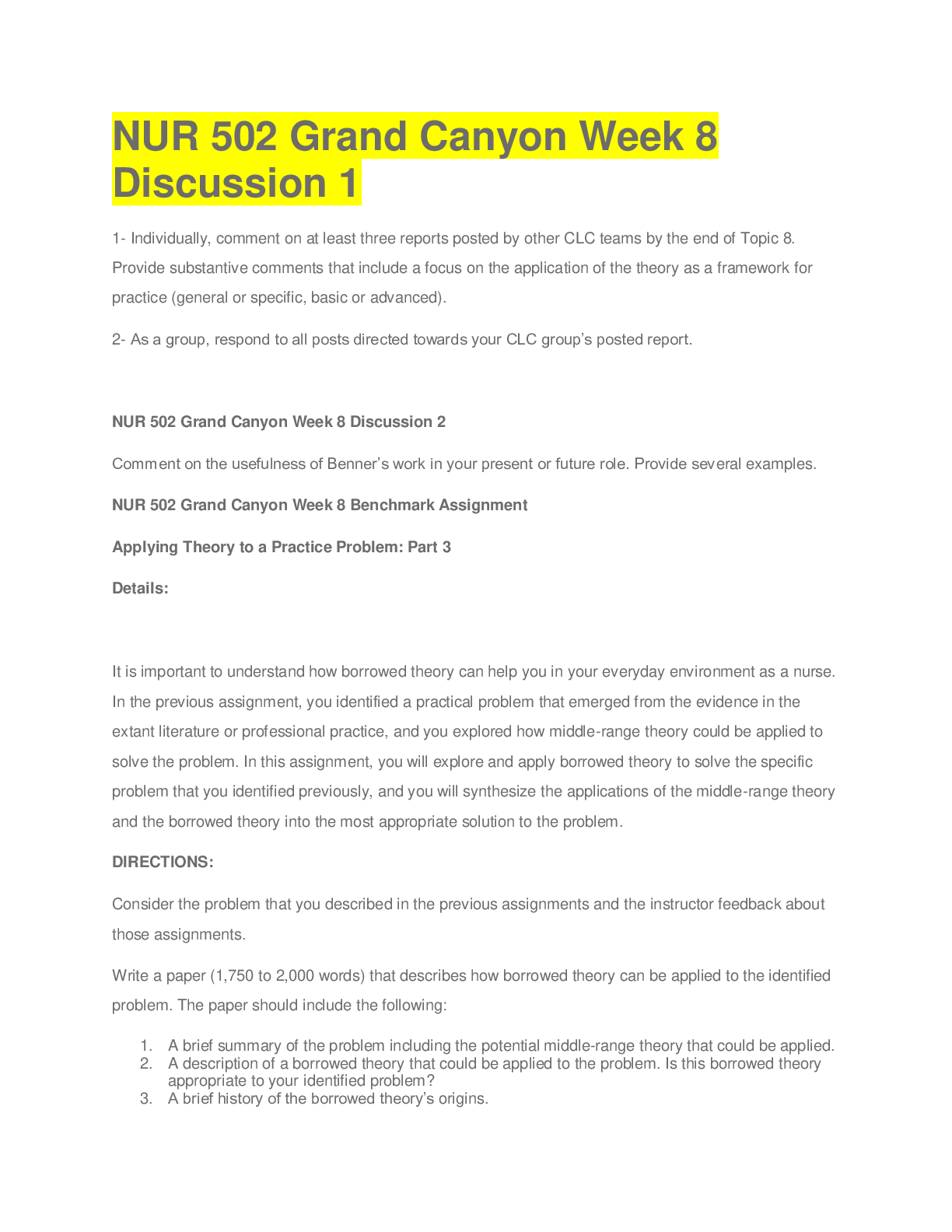
Assignments Benchmark Assignment: Applying Theory to a Practice
Problem: Part 3: Application of Borrowed Theory to Problem
and Conclusion
PURPOSE:
It is important to understand how borrowed theory can help you in
your everyday environment as a nurse. In the previous assignment,
you identified a practical problem that emerged from the evidence
in the extant literature or professional practice, and you explored
how middle-range theory could be applied to solve the problem. In
this assignment, you will explore and apply borrowed theory to
solve the specific problem that you identified previously, and you
will synthesize the applications of the middle-range theory and the
borrowed theory into the most appropriate solution to the problem.
DIRECTIONS:
150.0Consider the problem that you described in the previous
assignments and the instructor feedback about those assignments.
Write a paper (1,750 to 2,000 words) that describes how borrowed
theory can be applied to the identified problem. The paper should
include the following:
1. A brief summary of the problem including the potential
middle-range theory that could be applied.
2. A description of a borrowed theory that could be applied to
the problem. Is this borrowed theory appropriate to your
identified problem?
3. A brief history of the borrowed theory's origins.
4. A discussion of how the borrowed theory has been
previously applied.
5. A discussion of the application of the borrowed theory to
the identified problem. How would your practice change
by incorporating this theory?
6. A discussion of how application of both the borrowed
theory and the middle-range theory can be integrated to
create the most appropriate solution to the identified
problem.
Prepare this assignment according to the guidelines found in the
APA Style Guide, located in the Student Success Center. An
abstract is not required.
This assignment uses a rubric. Please review the rubric prior to
beginning the assignment to become familiar with the expectations
for successful completion.
You are required to submit this assignment to Turnitin.
Discussion
Questions
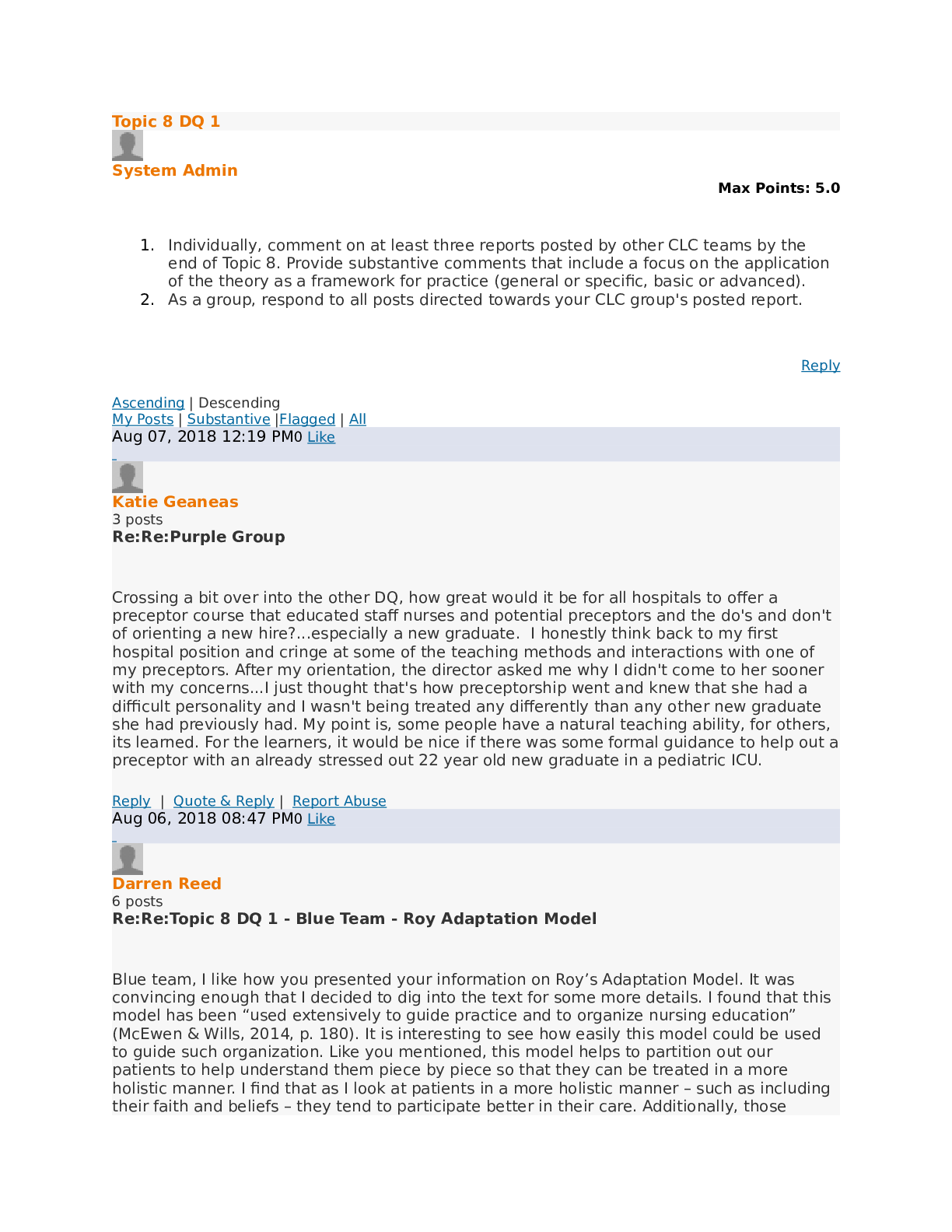
Topic 8 DQ 1
1. Individually, comment on at least three reports posted by
other CLC teams by the end of Topic 8. Provide
substantive comments that include a focus on the
application of the theory as a framework for practice
(general or specific, basic or advanced).
2. As a group, respond to all posts directed towards your CLC
group's posted report.
5.0
Topic 8 DQ 2
Comment on the usefulness of Benner's work in your present or
future role. Provide several examples.
5.0
Participation 30.0
Grade ScaleLetter Grade GPA Value Minimum Maximum Interpretation of Level of
Performance
A 4.0 97.0 100.0 Superior; outstanding scholarship
A- 3.7 93.0 6.99 Superior; outstanding scholarship
B+ 3.3 89.0 92.99 Above average; good work
B 3.0 85.0 8.99 Average standard performance
B- 2.7 81.0 4.99 -
C+ 2.3 78.0 80.99 Below Standard
C 2.0 76.0 7.99 Below Standard
F 0.0 75.99 Failure
I 0.0 Course work is incomplete
W 0.0 Authorized withdrawal; no credit
- 0.0 NA
- 0.0 NA
Policies
For student policies, please refer to your University Policy Handbook.
[Show More]




.png)

.png)
x.png)


![Preview of NUR2488 / NUR 2488 Exam 2 Study Guide [In Class Review] : Mental Health Nursing - Rasmuss](https://scholarfriends.com/storage/Mental Health Exam 2 Study Guide [In class review] MY21.png)

.png)
.png)


