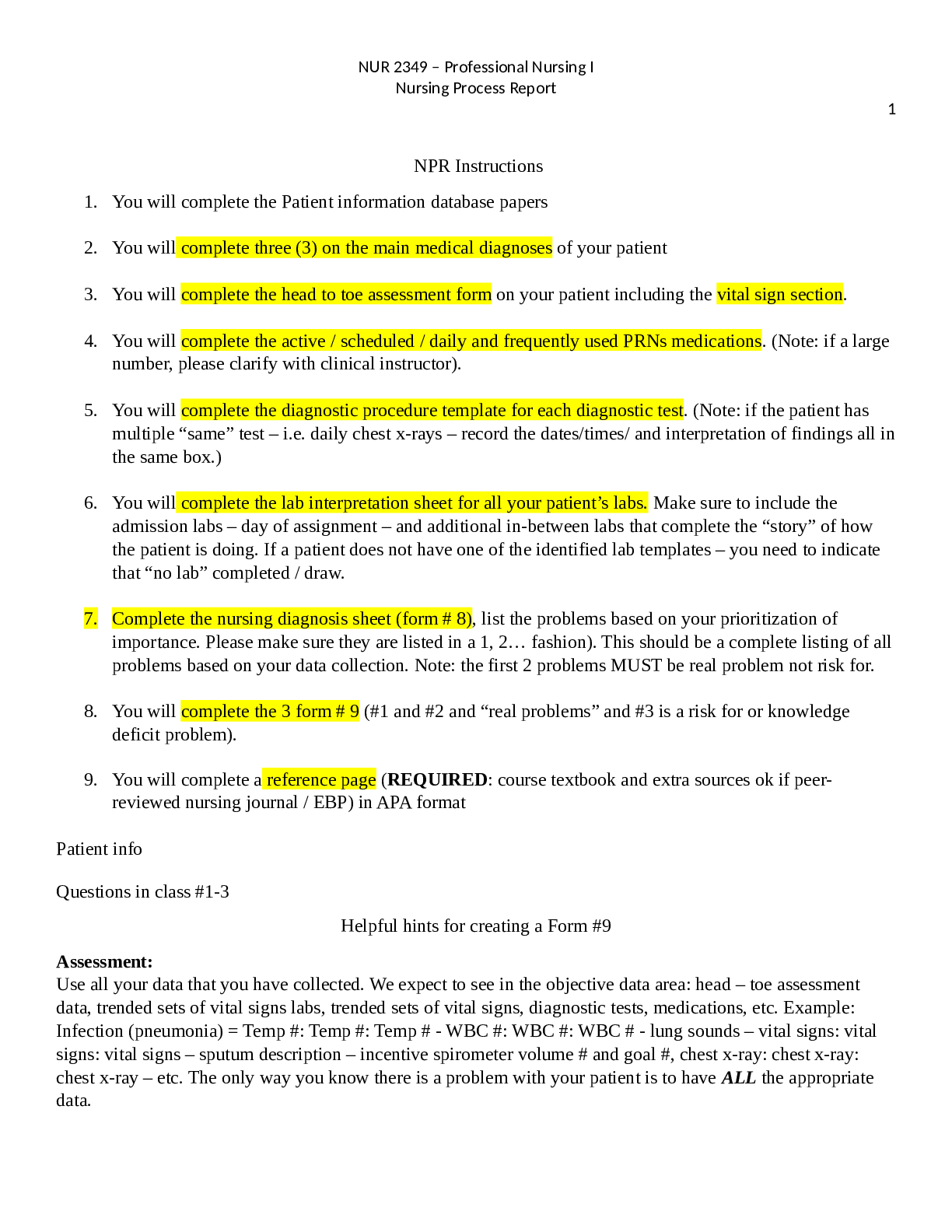
NPR Instructions
1. You will complete the Patient information database papers
2. You will complete three (3) on the main medical diagnoses of your patient
3. You will complete the head to toe assessment form on yo
...
NPR Instructions
1. You will complete the Patient information database papers
2. You will complete three (3) on the main medical diagnoses of your patient
3. You will complete the head to toe assessment form on your patient including the vital sign section.
4. You will complete the active / scheduled / daily and frequently used PRNs medications. (Note: if a large number, please clarify with clinical instructor).
5. You will complete the diagnostic procedure template for each diagnostic test. (Note: if the patient has multiple “same” test – i.e. daily chest x-rays – record the dates/times/ and interpretation of findings all in the same box.)
6. You will complete the lab interpretation sheet for all your patient’s labs. Make sure to include the admission labs – day of assignment – and additional in-between labs that complete the “story” of how the patient is doing. If a patient does not have one of the identified lab templates – you need to indicate that “no lab” completed / draw.
7. Complete the nursing diagnosis sheet (form # 8), list the problems based on your prioritization of importance. Please make sure they are listed in a 1, 2… fashion). This should be a complete listing of all problems based on your data collection. Note: the first 2 problems MUST be real problem not risk for.
8. You will complete the 3 form # 9 (#1 and #2 and “real problems” and #3 is a risk for or knowledge deficit problem).
9. You will complete a reference page (REQUIRED: course textbook and extra sources ok if peer-reviewed nursing journal / EBP) in APA format
Patient info
Questions in class #1-3
Helpful hints for creating a Form #9
Assessment:
Use all your data that you have collected. We expect to see in the objective data area: head – toe assessment data, trended sets of vital signs labs, trended sets of vital signs, diagnostic tests, medications, etc. Example: Infection (pneumonia) = Temp #: Temp #: Temp # - WBC #: WBC #: WBC # - lung sounds – vital signs: vital signs: vital signs – sputum description – incentive spirometer volume # and goal #, chest x-ray: chest x-ray: chest x-ray – etc. The only way you know there is a problem with your patient is to have ALL the appropriate data.
Interventions:
When creating interventions there are certain verbs that indicate which category the intervention is placed into (categories: assessment – decreased stressor / strengthen lines of defense – teaching / counseling / referral). So, as you use your resources to help you create “patient specific interventions” the following verbs are to be used within the designated categories.
Assessment Decreased stressor / strengthen lines of defense Teaching / Counseling / Referral
Assess Administer Educate
Monitor Apply Teach
Observe Provide (care) Provide (education material)
Inquire Encourage Reinforce
Check Perform Consult
Evaluate Attend Inform
Determine Instruct
Discuss
manage
Goals:
Remember the techniques of SMART - - specific measurable achievable realistic and time sensitive goals. In the acute care setting your short-term goals need to be within the first 24 – 48 hours (this obviously is relevant to the length of stay of your patient) and the long-term goals need to be by day of discharge.
Reassessment statement:
In this section you are to complete another focused nursing narrative assessment on the body system/ assessment data reflected in your problem. Example: impaired gas exchange = a reassessment of the respiratory system, appropriate vital signs, etc.
Nursing Process Report (NPR)Supportive Documents POINTS SCORE
Client Medical History 1
Comprehensive Assessment and Narrative Note 1
Pathophysiology 2
Diagnostic Procedures 1
Lab Interpretations 1
Medications 2
Nursing Diagnoses
-Is appropriate to the individual client
-Is properly stated (Actual-used P r/t A.E.B. format; Risk for-used P r/t format) using the NANDA list
-Reflects a situation which the nurse can order interventions to treat or prevent 1
Form 9: NURSING PROCESS REPORT (NPR) FORM
Assessment-Data (Subjective and Objective)
-Data is properly classified under these headings:
SUBJECTIVE DATA, OBJECTIVE DATA
-Data includes cues (no inferences)
-Data is appropriate to validate the nursing diagnosis
-Data reflects a complete assessment of the client for the nursing diagnosis 1
Client Goal
-Is a client goal
-Is realistic and attainable
-Is measurable
-Is properly stated (Includes subject, action verb, performance criteria and target time; special condition is optional)
-Does not interfere with other client therapies
-Considers client’s level of growth and development, and individuality
-Has a realistic time frame for achievement 1
Nursing Interventions
-Are properly classified under these headings:
ASSESSMENT
DECREASE STRESSORS AND/OR STRENGTHEN LINES OF DEFENSE
TEACHING/COUNSELING AND/OR REFERRAL
-Concise and includes: an action verb, a descriptive phrase-how, what, where to perform the action, and a time frame-exactly (when, how often, how long)
-Clearly stated so other personnel can carry out the orders
without question or confusion
-Appropriate to the nursing diagnosis and client
-Consistent with the medical plan of care
-Adequate to achieve the client goal
-Are numbered consecutively 1
Scientific Rationale
-Are clear, complete and support the use of the nursing orders
-Source for each rationale is properly documented (Author’s last name, year, p. or pp.)
-Are numbered consecutively to match each nursing order 1
Evaluation/Client Goal
-Evaluative statement includes whether the goal was met,
partially met or not met using criteria stated in the client
goal statement
-Evaluative statement includes the client’s behavior which
indicates the goal was met, partially met or not met; and
date/time
-Includes a Reassessment statement 1
Reference List
-Completed according to APA format 1
TOTAL POSSIBLE POINTS 15
Patient Healthcare Record – Database information
I. General / Current database information
Date of Admission: 07/31/2019
Dates of care: 07/31/2019 - 08/02/2019
M / F: Male
Age: 70
DOB: 05/16/1949
Race: White
Weight: 125 kg 275 lb.
Height: 173 cm 5’ 8’’ ft/in
Allergies (all): Penicillin and ACE inhibitors
Attending Physician / Team: Dr. Celia Smith
Consults: Respiratory therapy
Primary diagnosis: COPD exacerbation
Past Medical History: Type 2 Diabetes Mellitus - diagnosed in 1994, COPD - emphysema - diagnosed in 1994, Myocardial Infarction - began in 1994, Hypertension 1994
Surgeries / Procedures: No previous surgeries
History of present illness: COPD flare up caused client to seek medical attention and reports difficulty breathing and confusion upon inhaling Advair.
II. Background information
Major Support system: Patient’s wife is at bedside. Patient has 3 children out of state.
Immunizations: Influenza immunization administered 09/16/18, MMR, VAR TDap all up to date
Home medications: Advair, Aspirin, Lopressor, Atrovent, DuoNeb, Valerian root at night, fish oil, saw palmetto, multivitamin
Family History: Parental hx of T2DM and HTN. Paternal hx of HTN.
Social History: Smoker for the last 25 years, smoke 1-2 ppd, drinks alcoholic beverages 1-2 beers per day.
Assessment of the Adult, Elderly
KEY: THE STAGES
Approximate Age Virtues Psychosocial Crisis Significant Relationship Existential Question Examples
0-2 years Hopes Basic Trust vs. Mistrust Mother Can I Trust the World? Feeding, Abandonment
2-4 years Will Autonomy vs. Shame and Doubt Parents Is It Ok to Be Me? Toilet Training, Clothing Themselves
4-5 years Purpose Initiative vs. Guilt Family Is It Ok for Me to Do, Move and Act? Exploring, Using Tools or Making Art
5-12 years Competence Industry vs. Inferiority Neighbors, School Can I Make It in The World of People and Things? School, Sports
13-19 years Fidelity Identity vs. Role Confusion Peers, Role Model Who Am I? What Can I Be? Social Relationships
20-24 years Love Intimacy vs. Isolation Friends, Partners Can I Love? Romantic Relationships
25-64 years Care Generativity vs. Stagnation Household, Workmates Can I Make My Life Count? Work, Parenthood
65-death Wisdom Ego Integrity vs. Despair Mankind, My Kind Is It Ok to Have Been Me? Reflection on Life
Age range: 65-death (pt age 70)
What development stage should the patient be at according their identified age range? Ego Integrity vs. Despair
Using your supportive assessment data below, construct a couple of sentences identifying what stage the patient is presently at? (Remember – you must pick one side of the stage – can’t be both. Clearly identify which side).
Supportive data:
Subjective Objective
Pt states he has enjoyed all his years of life and looks forward to watching his grandchildren grow up. has an overall sense of pride and accomplishment in his life
Pt states I am ready to go with the Lord whenever he sees fit. I have lived my life. Looking back on life and coming into terms with end of life with no feelings of regret or despair
Pt states I can’t wait to feel better so I can go out and play soccer with my grandchild. Every Monday I pick him up and go to the park to practice kicking the ball around. Has found role in family and feels fulfillment and a sense of need from grandchild
Pt states his motivation for a better recovery is so he can attend his grandchild’s soccer game Pt has had many family members come and visit during admission
Pt has been telling his wife to bring in pictures of their grandchildren to show staff
Pt has shared memories in his past of travel and experiences
Pt has been active in church for the past 10 years
Pt has appeared cheerful and hopeful
Pt states he has been married for 30 years
Pt has been praying at bedside
Cultural sensitivities and implications identified that might interfere with medical, nursing treatment:
Religion: Christianity
Ethnicity: White
Cultural Habits: None
III. CURRENT STATUS
Code Status: Full code
Activity Level: bedridden
Diet (If NPO, why?): Low sodium, low carb diet.
Nutritional Support / Supplements: Multivitamin, ensure
Total intake and Total output (over 24-hour period): 2000ml/1500ml
Do your I/O totals balance? (If no, why?): Yes
Fluid Restrictions (If yes, why?): no
Dialysis (schedule – type – type of access): no
Neuro Checks (If yes, why?): yes, since pt came in confused, A&Ox1
Isolation (If yes, why?): no
Fall Score (what precautions were instituted based on #): 50. Precautions: orient pt to surroundings, hourly rounding to provide and assist pt with change in position, toileting, offer fluids and ensure that patient is warm and dry. Provide personal belongings within reach.
Braden Score (what precautions were instituted based on #): 15-high risk. Precautions: regular turning schedule, protect bony prominence, manage moisture friction, and shear
Collaborative Therapy (PT – OT – ST)
Oxygen Therapy: Venturi mask at 40%
Incentive Spirometry (Q _1-2_ hours) and (current volume and goal volume): Current volume: 500 Goal: 750
Dressings and Wound Care (be detailed): None
Drains/Catheter/Tubes (make sure to include IV access): IV line on LRA, Foley catheter 14 French
Discharge Plan (discharge starts on admission): Increase intake of fluids, implement nutritious meals, glucose maintenance, medication adherence
Other important data about the client:
Head to Toe Assessment
Date / Time Date / Time Date / Time Date / Time Date / Time
7/31/19 @ 0845 Admission 7/31/19 @1220 7/31/19 @1500 7/31/19 @1900 8/01/19 @0015
Temp 36.9 C 36.7 C 36.9 C 36.2 C 37.1 C
BP 165/95 136/82 151/87 148/88 139/84
HR 105 87 98 98 96
RR 26 20 22 20 20
Pain scale #/# 0/10 0/10 2/10 2/10 1/10
O2 % 85% RA 90% on VM 30% 92% on RA 93% on RA 93% on RA
(Make sure you have filled in all sections – minimum of 5 sets day of admission and day of care must be included).
Narrative note (complete head to toe):
70-year-old white male brought in by ambulance presents with shortness of breath, pallor, cool and clammy skin, 3+ pitting edema, wheezing, elevated heart rate, pulse and blood pressure.
Pt is A&O x1, no lesions or masses found on head or body, pt denies any falls or head injury, pupils are equal, round, reactive and accommodation. Pt has wheezing bilaterally in lungs; patient is using accessory muscles and has labored breathing. S1 and S2 heart sounds heard, lymph nodes were nonpalpable and non-tender. Pulses felt 2+ in all areas bilaterally, strong reflexes, negative Babinski test results. Capillary refill was 3 seconds, pt has clubbing on all fingers. Pt has weakness muscle weakness in all limbs. No CVA tenderness noted. Pt spine is straight, no signs of kyphosis, scoliosis, or lordosis. Pt’s stomach was round, soft and normoactive bowel sounds heard in all 4 quadrants, pt states last bowel movement was day before with no unusual smells, was brown in color and formed. Pt states he urinated within the past 2 hours, no pain, hesitation, burning and color was yellow.
Left pt with charge nurse who is awaiting provider’s orders, call bell in hand and pt at high fowler’s position, awake.
K. McAuley, RNS
Pathophysiology
1. Medical Diagnosis: COPD exacerbation
(Make sure you put the definition (“patho”) of what your diagnosis is here
(make sure to use a nursing source and cite in APA).
Chronic Obstructive Pulmonary Disease (COPD) is a progressive lung disease including emphysema, chronic bronchitis, and refractory (non-reversible) asthma. This disease is characterized by increasing breathlessness (Meg Gulanick, 2011).
Assessment Medications Diagnosis/Imaging Interventions Nursing Dx.
(just the problem) D/C teaching
Subjective Objective ----------------- Labs ------------------ --------------- --------------
Difficulty Breathing
Chest tightness
(Meg Gulanick, 2011)
Wheezing
Change in resp depth and/or rate
persistent cough for months
ineffective cough
excess secretions
altered blood gasses and oxygen saturation
(Meg Gulanick, 2011)
DuoNeb
Methylprednisolone
Advair
Oxygen
(Meg Gulanick, 2011)
ABG
BPM
PFT
CBC
AST
ALT
BG
(Meg Gulanick, 2011)
CXR
(Meg Gulanick, 2011) 1.monitor O2 sats
2. assess skin turgor, temperature, and color
3. assess for changes in breath sounds, resp depth or rate
4. assess for s/s of cyanosis
(Meg Gulanick, 2011)
Ineffective airway clearance
(Meg Gulanick, 2011) 1.Educate the pt on smoking cessation
2.instruct pt to do deep breathing and use his incentive spirometer
3.Instruct pt to get up slowly and wait a few minutes before standing up
4.No grapefruit juice and instruct pt to stay away from anyone they know is sick and to monitor BG levels regularly
(Meg Gulanick, 2011)
[Show More]