NURSING 301 quiz two_ LATEST
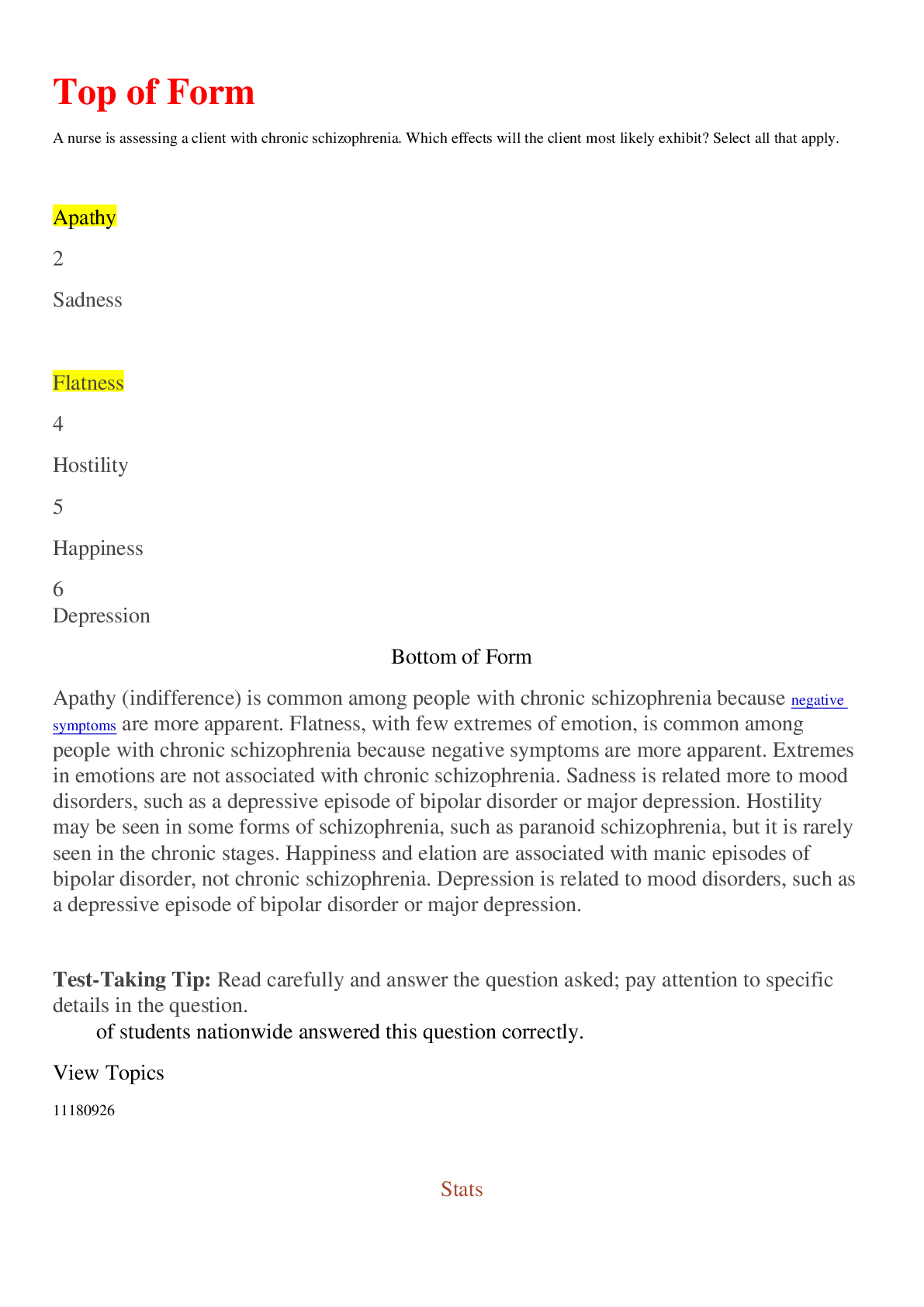
1. A nurse is assessing a client with chronic schizophrenia. Which effects will the client most likely exhibit? Select all that apply.
Correct1
Apathy
2
Sadness
Correct3
Flatne
...
NURSING 301 quiz two_ LATEST
1. A nurse is assessing a client with chronic schizophrenia. Which effects will the client most likely exhibit? Select all that apply.
Correct1
Apathy
2
Sadness
Correct3
Flatness
4
Hostility
5
Happiness
6
Depression
Apathy (indifference) is common among people with chronic schizophrenia because negative symptoms are more apparent. Flatness, with few extremes of emotion, is common among people with chronic schizophrenia because negative symptoms are more apparent. Extremes in emotions are not associated with chronic schizophrenia. Sadness is related more to mood disorders, such as a depressive episode of bipolar disorder or major depression. Hostility may be seen in some forms of schizophrenia, such as paranoid schizophrenia, but it is rarely seen in the chronic stages. Happiness and elation are associated with manic episodes of bipolar disorder, not chronic schizophrenia. Depression is related to mood disorders, such as a depressive episode of bipolar disorder or major depression.
Test-Taking Tip: Read carefully and answer the question asked; pay attention to specific details in the question.
13%of students nationwide answered this question correctly.
View Topics
2. 11180926
Confidence: Pretty sure
Stats
Issue with this question?
2.
2. Which client characteristic is an initial concern for the nurse when caring for a client with the diagnosis of paranoid schizophrenia?
1
Continual pacing
Correct2
Suspicious feelings
3
Inability to socialize with others
4
Disturbed relationship with the family
The nurse must consider the client's suspicious feelings and establish basic trust to promote a therapeutic milieu. Continual pacing is not a problem because the nurse can walk back and forth with the client. Inability to socialize with others and disturbed relationship with the family may be of long-range importance but have little influence on the nurse-client relationship at this time.
67%of students nationwide answered this question correctly.
View Topics
3. 11177389
Confidence: Pretty sure
Stats
Issue with this question?
3.
3. A client has a diagnosis of schizoid personality disorder. During the assessment the nurse should expect the client's behavior to be:
1
Rigid and controlling
2
Dependent and submissive
Correct3
Detached and socially distant
4
Superstitious and socially anxious
Clients with the diagnosis of schizoid personality disorder neither desire nor enjoy close relationships, prefer solitary activities, and demonstrate emotional coldness, detachment, and a flattened affect. Rigid and controlling behavior is typical of clients with the diagnosis of obsessive-compulsive personality disorder. Dependent and submissive behavior is typical of clients with the diagnosis of dependent personality disorder. Superstitious and socially anxious behavior is typical of clients with the diagnosis of schizotypal personality disorder.
61%of students nationwide answered this question correctly.
View Topics
4. 11172455
Confidence: Pretty sure
Stats
Issue with this question?
4.
4. A health care provider prescribes aripiprazole (Abilify) 15 mg by mouth once a day for a client with the diagnosis of schizophrenia. The hospital pharmacy sends aripiprazole 5 mg/tablet. How many tablets should the nurse administer? Record your answer using a whole number. ___3_ tablets
Solve the problem using ratio and proportion.
95%of students nationwide answered this question correctly.
View Topics
5. 11180952
Confidence: Pretty sure
Stats
Issue with this question?
5.
5. The night nurse reports that a young client with paranoid schizophrenia has been awake for several nights. The day nurse reviews the client's record and finds that this client did not have an interrupted sleep pattern disorder before transfer from a private room to a four-bed room 3 days ago. What factor should the nurse identify as most likely related to the client's sleeplessness?
Correct1
Fear of the other clients
2
Concern about family at home
3
Watching for an opportunity to escape
4
Trying to work out emotional problems
Because the client has paranoid feelings that other people are out to do harm, assignment to a four-bed room may be threatening. Concern about family at home seems unlikely because the disruption appears to have started with the transfer to a four-bed room. Watching for an opportunity to escape is possible but unlikely; planning an escape is usually not part of a schizophrenic pattern of behavior. Trying to work out emotional problems is possible but not likely; clients with schizophrenia have difficulty solving problems.
94%of students nationwide answered this question correctly.
View Topics
6. 11181668
Confidence: Pretty sure
Stats
Issue with this question?
6.
6. When speaking with a client who has schizophrenia, the nurse notes that the client keeps interjecting sentences that have nothing to do with the main thoughts being expressed. The client asks whether the nurse understands. How should the nurse reply?
1
"You aren't making any sense; let's talk about something else."
2
"Why don't you take a rest? We can talk again later this afternoon."
3
"I'd like to understand what you're saying, but you're too confused now."
Correct4
"I'd like to understand what you're saying, but I'm having trouble following you."
"I'd like to understand what you're saying, but I'm having trouble following you" lets the client know that the nurse is trying to understand; it increases the client's feeling of self-esteem and points out reality. Clients with schizophrenia have problems with associative links, and these same problems will occur regardless of the topic. The statement "Why don't you take a rest? We can talk again later this afternoon" cuts off communication and tells the client that the nurse will speak only if the client's communication makes sense to the listener. "I'd like to understand what you're saying, but you're too confused now" cuts off communication and tells the client that the nurse will speak only if the client's communication makes sense to the listener.
92%of students nationwide answered this question correctly.
View Topics
7. 11181696
Confidence: Pretty sure
Stats
Issue with this question?
7.
7. A client with the diagnosis of schizophrenia is given one of the antipsychotic drugs. The nurse understands that antipsychotic drugs can cause extrapyramidal side effects. Which effect is cause for the greatest concern?
1
Akathisia
Correct2
Tardive dyskinesia
3
Parkinsonian syndrome
4
Acute dystonic reaction
Tardive dyskinesia, an extrapyramidal response characterized by vermicular movements and protrusion of the tongue, chewing and puckering movements of the mouth, and puffing of the cheeks, is often irreversible, even when the antipsychotic medication is withdrawn. Akathisia, motor restlessness, usually can be treated with antiparkinsonian or anticholinergic drugs while the antipsychotic medication is continued. Parkinsonian syndrome (a disorder featuring signs and symptoms of Parkinson disease such as resting tremors, muscle weakness, reduced movement, and festinating gait) can usually be treated with antiparkinsonian or anticholinergic drugs while the antipsychotic medication is continued. Dystonia, impairment of muscle tonus, can usually be treated with antiparkinsonian or anticholinergic drugs while the antipsychotic medication is continued.
67%of students nationwide answered this question correctly.
View Topics
8. 11171783
Confidence: Pretty sure
Stats
Issue with this question?
8.
8. A client with the diagnosis of schizophrenia refuses to eat meals. Which nursing action is most beneficial for this client?
1
Directing the client repeatedly to eat the food
2
Explaining to the client the importance of eating
3
Waiting and allowing the client to eat whenever the client is ready
Correct4
Having a staff member sit with the client in a quiet area during mealtimes
By sitting with the client during mealtimes the nurse can evaluate how much the client is eating; this encourages the client to eat and begins the construction of a trusting relationship. Fewer distractions may help the client focus on eating. The client will not follow directions to eat because of the nature of the illness. Explaining the importance of eating and allowing the client to eat when ready are both unrealistic and will not ensure adequate intake.
50%of students nationwide answered this question correctly.
View Topics
9. 11171776
Confidence: Pretty sure
Stats
Issue with this question?
9.
9. A client is admitted to a psychiatric hospital with the diagnosis of schizoid personality disorder. Which initial nursing intervention is a priority for this client?
1
Helping the client enter into group recreational activities
2
Convincing the client that the hospital staff is trying to help
Correct3
Helping the client learn to trust the staff through selected experiences
4
Arranging the client's contact with others so it is limited while she is in the hospital
Demonstrating that the staff can be trusted is a vital initial step in the therapy program. The client is not ready to enter group activities yet and will not be until trust is established. Even proof will not convince the client with a schizoid personality that feelings of distrust are false. Arranging the client's contact with others is not realistic even if it is possible; limiting contact with other clients will not enhance trust.
76%of students nationwide answered this question correctly.
View Topics
10. 11171769
Confidence: Pretty sure
Stats
Issue with this question?
10.
10. A client with paranoid schizophrenia tells the nurse, "My neighbors are spying on me because they want to rob me and take money." While hospitalized, the client complains of being poisoned by the food and of being given the wrong medication. The nurse evaluates the client's response to medications and therapy. Which assessment finding leads the nurse to conclude that the client's reality testing has improved?
Correct1
The client eats the food provided on the hospital tray.
2
The client discusses his discharge plans with the staff.
3
The client questions each medication when it is administered.
4
The client asks permission to make phone calls to the hospital administration.
Because the client was admitted while complaining that the food was poisoned, eating the food on the tray indicates that the client feels safe. Discussing discharge plans with the staff does not provide adequate behavioral assessment with which the nurse can evaluate reality testing. Questioning each medication when it is administered indicates that the client still does not completely trust the staff. Asking permission to make phone calls to the hospital administration seems to indicate that the client still does not trust the staff and is attempting to intimidate the staff by calling the administration.
85%of students nationwide answered thi
11.
11.
11. What should the nurse identify as the foremost basis for the development of schizophrenia?
1
Seasonal perspective
Correct2
Biological perspective
3
Immunological perspective
4
Psychoanalytical perspective
The biological factors, including genetics, neuroanatomy, and abnormal neurotransmitter-endocrine interactions, prevail as the origin of schizophrenia as a result of studies conducted during the twentieth century. Psychoanalytic perspective no longer is thought of as the primary basis for schizophrenia. A seasonal or immunological perspective is not the primary basis for schizophrenia.
59%of students nationwide answered this question correctly.
View Topics
12. 11170224
Confidence: Pretty sure
Stats
Issue with this question?
12.
12. An adult with the diagnosis of schizophrenia is admitted to the psychiatric hospital. The client is ungroomed, appears to be hearing voices, is withdrawn, and has not spoken to anyone for several days. What should the nurse do during the first few hospital days?
1
See that the client bathes and changes clothes daily.
2
Wait and see whether the client approaches the staff.
3
Conduct an admission assessment interview with the client.
Correct4
Seek out the client frequently to spend short periods of time together.
Seeking out the client frequently to spend short periods of time together will help the nurse establish trust without unduly increasing anxiety. Seeing that the client bathes and changes clothes daily is not the priority unless the client is extremely dirty; this client is ungroomed, not dirty. A withdrawn client will usually not approach anyone. The client's history reveals a failure to speak.
54%of students nationwide answered this question correctly.
View Topics
13. 11167524
Confidence: Pretty sure
Stats
Issue with this question?
13.
13. A client with catatonic schizophrenia who is in a vegetative state is admitted to the psychiatric hospital. The nurse identifies short- and long-term outcomes in the client's clinical pathway. What is the priority short-term outcome of care that the client should be able to attain?
1
Talking with peers
2
Performing her own activities of daily living
3
Completing unit activities and assignments
Correct4
Ingesting adequate fluid and food with assistance
A client in a vegetative state may not eat or drink without assistance; fluids and foods are basic physiologic needs that are necessary to prevent malnutrition and starvation; therefore the intake of adequate fluid and food is a priority short-term goal. The client is in total withdrawal; talking with peers, performing activities of daily living, and completing activities and assignments are not priority outcomes at this time.
81%of students nationwide answered this question correctly.
View Topics
14. 11163241
Confidence: Pretty sure
Stats
Issue with this question?
14.
14. A 56-year-old man is admitted to the inpatient unit after family members report that he seems to be experiencing auditory hallucinations. The man has a history of schizophrenia and has had several previous admissions. Which statement indicates to the nurse that the client is experiencing auditory hallucinations?
1
"Get these horrible snakes out of my room!"
Correct2
"I am not the devil! Stop calling me those names!"
3
"The food on this plate has poison in it, so take it away—I won't eat it."
4
"I did see an alien spaceship last night outside in my yard, and I've felt worse ever since."
The client is responding to messages that he is hearing, which are auditory hallucinations. The responses regarding the snakes and the spaceship are examples ofvisual hallucinations because they describe what the client sees. The accusation of poisoning is the statement of a client who is suspicious and paranoid but not hallucinating.
95%of students nationwide answered this question correctly.
View Topics
15. 11161642
Confidence: Pretty sure
Stats
Issue with this question?
15.
15. A client has a diagnosis of schizoid personality disorder. During the assessment the nurse should expect the client's behavior to be:
1
Rigid and controlling
2
Dependent and submissive
Correct3
Detached and socially distant
4
Superstitious and socially anxious
Clients with the diagnosis of schizoid personality disorder neither desire nor enjoy close relationships, prefer solitary activities, and demonstrate emotional coldness, detachment, and a flattened affect. Rigid and controlling behavior is typical of clients with the diagnosis of obsessive-compulsive personality disorder. Dependent and submissive behavior is typical of clients with the diagnosis of dependent personality disorder. Superstitious and socially anxious behavior is typical of clients with the diagnosis of schizotypal personality disorder.
62%of students nationwide answered this question correctly.
View Topics
16. 11159410
Confidence: Pretty sure
Stats
Issue with this question?
16.
16. A client with schizophrenia is demonstrating waxy flexibility. Which intervention is the best way to manage the possible outcome of this behavior?
1
Providing thickened liquids to minimize the risk of aspiration
2
Documenting intake and output each shift to monitor hydration
3
Reinforcing appropriate social boundaries through staff role modeling
Correct4
Passive range-of-motion exercises three times a day for effective joint health
Waxy flexibility is an excessive and extended maintenance of posture that can lead to a variety of problems, including joint trauma. Passive range-of-motion exercises focus on the effective management of joint mechanics. Although aspiration precautions, documentation of intake and output, and staff role modeling may address issues experienced by a client with schizophrenia, passive range-of-motion exercises address waxy flexibility.
68%of students nationwide answered this question correctly.
View Topics
17. 11157156
Confidence: Pretty sure
Stats
Issue with this question?
17.
17. A young client is admitted to the hospital with a diagnosis of acute schizophrenia. The family reports that one day the client looked at a linen sheet on a clothesline and thought it was a ghost. What is the most appropriate conclusion to make about what the client was experiencing?
Correct1
Illusion
2
Delusion
3
Hallucination
4
Confabulation
An illusion is a misinterpretation of an actual sensory stimulus. A delusion is a false, fixed belief. A hallucination is a false sensory perception that occurs with no stimulus. Confabulation is a filling in of blanks in memory.
51%of students nationwide answered this question correctly.
View Topics
19. 11156382
Confidence: Pretty sure
Stats
Issue with this question?
19.
19. What defense mechanism should the nurse anticipate that a client with the diagnosis of schizophrenia, undifferentiated type, will most often exhibit?
1
Projection
Correct2
Regression
3
Repression
4
Rationalization
Regression is the defense mechanism that is commonly used by clients with schizophrenia, undifferentiated type, to reduce anxiety by returning to earlier behavior. Projection is an organized defense used by clients with schizophrenia, paranoid type, in which the delusional system is well systematized. Repression, or unconscious forgetting, is not a major defense used by clients with schizophrenia; if it were, they would not need to break with reality. Rationalization, in which the individual blames others for problems and attempts to justify actions, is seldom used by clients with schizophrenia.
32%of students nationwide answered this question correctly.
View Topics
20. 11156373
Confidence: Pretty sure
Stats
Issue with this question?
20.
20. On the afternoon of admission to a psychiatric unit, an adolescent boy with the diagnosis of schizophrenia exposes his genitals to a female nurse. What should the nurse's immediate therapeutic response be?
1
Ignoring the client at this time
Correct2
Stating that this behavior is unacceptable
3
Moving him to his room for a short time-out
4
Telling the client to come to the office later to discuss the behavior
When clients enter a new milieu, limits should be set on unacceptable behavior and acceptable behavior should be reinforced. Neither clients nor unacceptable behavior should ever be ignored. Moving the client to his room for a short time-out is punishment. Unacceptable attention-getting behavior must be addressed immediately; also, the focus should be on appropriate behavior.
83%of students nationwide answered this question correctly.
View Topics
21. 11156357
Confidence: Pretty sure
Stats
Issue with this question?
21.
21. As a nurse is assisting a client with the diagnosis of schizophrenia with morning care, the client suddenly throws off the covers and starts shouting, "My body is disintegrating! I'm being pinched." What term best describes the client's behavior?
Correct1
Somatic delusion
2
Paranoid ideation
3
Loose association
4
Ideas of reference
A somatic delusion is a false feeling about the physical self that is caused by a loss of reality testing. Paranoid ideations are beliefs that the individual is being singled out for unfair treatment. Loose associations are verbalizations that are difficult to understand because the links between thoughts are not apparent. Ideas of reference are false beliefs that the words and actions of others are concerned with or are directed toward the individual.
74%of students nationwide answered this question correctly.
22. What should the nurse do when a client with the diagnosis of schizophrenia talks about being controlled by others?
1
Express disbelief about the client's delusion.
2
Divert the client's attention to unit activities.
Correct3
React to the feeling tone of the client's delusion.
4
Respond to the verbal content of the client's delusion.
Reacting to the feeling tone of the client's delusion helps the client explore underlying feelings and allows the client to see the message that his verbalizations are communicating. Expressing disbelief about the client's delusion denies the client's feelings rather than accepting and working with them. Attempting to divert the client rather than accepting and working with him denies the client's feelings. Responding to the verbal content of the client's delusion focuses on the delusion itself rather than on the feeling that is causing the delusion.
26%of students nationwide answered this question correctly.
View Topics
23. 11156329
Confidence: Pretty sure
Stats
Issue with this question?
23.
23. A nurse is monitoring a client with the diagnosis of schizophrenia who is experiencing opposing emotions simultaneously. When providing a change-of-shift report, how should the nurse refer to this emotional experience of the client?
1
Double bind
Correct2
Ambivalence
3
Loose association
4
Inappropriate affect
Ambivalence is the existence of two conflicting emotions, impulses, or desires. Double bind is two conflicting messages, not emotions, in a single communication. Loose associations are not two conflicting emotions but instead the loosening of connections between thoughts. Inappropriate affect is not two conflicting emotions but instead the inappropriate expression of emotions.
38%of students nationwide answered this question correctly.
View Topics
25. 11150494
Confidence: Pretty sure
Stats
Issue with this question?
25.
25. A client with schizophrenia who was admitted involuntarily to a psychiatric facility runs away. The nurse's first action is to notify the:
1
Client's family that the client has left the hospital
Correct2
Law enforcement officers of the client's elopement
3
Client's psychiatrist after discovering that the client has gone
4
Practitioner who certified the client's need for hospitalization
Legally it is the responsibility of the staff to notify law enforcement officers so the client can be found and returned. The staff should notify the family, but this is not the first intervention. Although the client's psychiatrist will be notified, it is not the priority at this time. Although the practitioner may appreciate being notified, it is not the priority.
75%of students nationwide answered this question correctly.
View Topics
26. 11148894
Confidence: Pretty sure
Stats
Issue with this question?
26.
26. A client has been prescribed chlorpromazine (Thorazine) for the management of positive symptoms of schizophrenia. When the client reports difficulty sustaining an erection, the nurse:
1
Reassures him this side effect will resolve in a few weeks
Correct2
Consults with his provider regarding alternative medication therapies
3
Explains that all conventional antipsychotic medications cause impotence
4
Provides additional medication education to explain the medication's side effects in detail
Although erectile dysfunction can result from conventional antipsychotic medication therapy, the provider is often able to prescribe an alternative medication that will help manage the symptoms but is less likely to cause the dysfunction. Education regarding side effects is certainly appropriate, but such information will only confirm that the side effect is not likely to subside with time.
51%of students nationwide answered this question correctly.
View Topics
27. 11148847
Confidence: Pretty sure
Stats
Issue with this question?
27.
27. When a nurse enters a room to administer an oral medication to an agitated and angry client with schizophrenia, paranoid type, the client shouts, "Get out of here!" What is the most therapeutic response?
1
Stating, "You must take your medicine now."
Correct2
Saying, "I'll be back in a few minutes so we can talk."
3
Explaining why it is necessary to take the medication
4
Withholding the medication before notifying the primary care practitioner
Saying, "I'll be back in a few minutes so we can talk," allows the angry client time to regain self-control; announcing a plan to return will ease fears of abandonment or retribution. Staying and insisting that the client take the medication may provoke increased anger and further loss of control. Clients will not accept logical explanations when angry. Alternative nursing interventions should be attempted before withholding the medication and notifying the practitioner may become necessary.
Test-Taking Tip: Survey the test before you start answering the questions. Plan how to complete the exam in the time allowed. Read the directions carefully and answer the questions you know for sure first.
62%of students nationwide answered this question correctly.
View Topics
28. 11148293
Confidence: Pretty sure
Stats
Issue with this question?
28.
28. A nurse begins a therapeutic relationship with a client with the diagnosis of schizotypal personality disorder. What is the best initial nursing action?
1
Setting limits on manipulative behavior
2
Encouraging participation in group therapy
Correct3
Respecting the client's need for social isolation
4
Recognizing that seductive behavior is expected
These clients are withdrawn, aloof, and socially distant; allowing distance and providing support may foster the eventual development of a therapeutic alliance. Manipulative behavior is typical of clients with the diagnosis of antisocial personality disorder or borderline personality disorder. Group therapy will increase this client's anxiety; cognitive or behavioral therapy is more appropriate. Seductive behavior is associated with clients with the diagnosis of histrionic personality disorder.
29%of students nationwide answered this question correctly.
View Topics
29. 11148286
Confidence: Pretty sure
Stats
Issue with this question?
29.
29. An adult is found to have schizotypal personality disorder. How should a nurse describe the client's behavior?
1
Rigid and controlling
2
Submissive and immature
3
Arrogant and attention-seeking
Correct4
Introverted and emotionally withdrawn
These clients usually display social inadequacy and lack of emotional contact with others. Rigid and controlling behaviors reflect an obsessive-compulsive personality disorder. Submissive and immature behaviors reflect a dependent personality disorder. Arrogant and attention-seeking behaviors probably reflect a narcissistic personality disorder.
60%of students nationwide answered this question correctly.
View Topics
30. 11143876
Confidence: Pretty sure
Stats
Issue with this question?
30.
30. A client with schizophrenia, paranoid type, is delusional, withdrawn, and negativistic. The nurse should plan to:
Correct1
Invite the client to play a game of cards or board game.
2
Explain to the client the benefits of joining a group activity.
3
Encourage the client to become involved in group activities.
4
Mention to the client that the psychiatrist has ordered increased activity.
Activities that require limited interpersonal contact are less threatening. Individuals with schizophrenia, paranoid type, usually do not respond to an authoritarian approach because they do not trust others, particularly those who act in an aggressive manner. Group activities require interaction with other people, which is threatening to individuals with paranoid feelings.
53%of students nationwide answered this question correctly.
View Topics
31. 11143854
Confidence: Pretty sure
Stats
Issue with this question?
31.
31. A nurse is caring for a client with the diagnosis of schizophrenia, paranoid type. How should the nurse plan for the client's initial care?
1
By discussing important life events
Correct2
By providing a nonthreatening environment
3
By concentrating on the content of delusions
4
By limiting topics for discussion to recent situations
These clients are hypersensitive to external stimuli and respond with less anxiety to a minimally threatening environment. Discussing prominent life events is too threatening an approach and interferes with the goals of therapy. Focusing on delusional material will reinforce the delusional system. Limiting topics for discussion to recent situations is not therapeutic; it may trigger suspiciousness and hostile outbursts.
92%of students nationwide answered this question correctly.
View Topics
32. 11143832
Confidence: Pretty sure
Stats
Issue with this question?
32.
32. During a one-to-one interaction with a client with schizophrenia, paranoid type, the client says to the nurse, "I figured out how foreign agents have infiltrated the news media. They want to shut me up before I spill the beans." How should the nurse describe this statement?
1
Nihilistic delusion
Correct2
Delusion of grandeur
3
Auditory hallucination
4
Overvaluation of the self
Thoughts of being pursued by some powerful agent or agents because of one's special attributes or powers are fixed false beliefs and referred to as delusions of grandeur. There is no evidence to indicate that a delusion of total or partial nonexistence is being used. There is no evidence to indicate that a sensory-perceptual disturbance is present. Delusions of grandeur are usually used to deny unconscious feelings of low self-esteem.
57%of students nationwide answered this question correctly.
33.
A client with schizophrenia tells the nurse, "There are foreign agents conspiring against me; they're out to get me at every turn." How should the nurse respond?
1
"It must be scary to believe that people are out to trick you at every opportunity."
2
"Those people you call foreign agents are out to do you in. What else is happening?"
3
"What's happened to make you believe that these people you call foreign agents are after you?"
Correct4
"I can understand how frightening your thoughts are to you, but there are not foreign agents out to get you."
Noting how frightening the client's thoughts must seem to him but also telling the client that his thoughts do not seem factual acknowledges the client's feelings and points out reality. Although "It must be scary to believe that people are out to trick you at every opportunity" is an empathic response, it does not point out reality; the word "trick" does not have the same connotation as "do me in." The response "Those people you call foreign agents are out to do you in. What else is happening?" reinforces the client's delusional system. The response "What's happened to make you believe these people you call foreign agents are after you?" does not focus on feelings and places the client on the defensive.
54%of students nationwide answered this question correctly.
View Topics
34. 11142828
Confidence: Pretty sure
Stats
Issue with this question?
34.
A client with schizophrenia who has auditory hallucinations is withdrawn and apathetic. What should the nurse say to involve this client in an activity?
1
"You'll get a reward if you go to the gym."
Correct2
"Would you like to participate in the group walk today?"
3
"Those voices you hear would like it if you did a little exercise."
4
"There's a positive relationship between exercise and good mental health."
"Would you like to participate in the group walk today?" is a declarative statement invites the client to walk, and the client can comply without making a verbal decision. A client with schizophrenia is often ambivalent, rendering decision-making difficult. A withdrawn, apathetic clients probably will not internalize or appreciate rationales for interventions. Saying that the voices want the client to exercise supports the client's hallucinations.
54%of students nationwide answered this question correctly.
View Topics
35. 11142815
Confidence: Pretty sure
Stats
Issue with this question?
35.
One morning a client tells the nurse, "My legs are turning to rubber because I have an incurable disease called schizophrenia." The nurse identifies that this as an example of:
1
Hallucinations
2
Paranoid thinking
Correct3
Depersonalization
4
Autistic verbalization
The state in which the client feels unreal or believes that parts of the body are distorted is known as depersonalization or loss of personal identity. This is not an example of a hallucination; a hallucination is a sensory experience for which there is no external stimulus. The client's statement does not indicate any feelings that others are out to do harm, are responsible for what is happening, or are in control of the situation. The statement is not an example of autistic verbalization.
35%of students nationwide answered this question correctly.
View Topics
36. 11142187
Confidence: Pretty sure
Stats
Issue with this question?
36.
A young client with schizophrenia says, "I'm starting to hear voices." What is the nurse's most therapeutic response?
1
"How do you feel about the voices, and what do they mean to you?"
2
"You're the only one hearing the voices. Are you sure you hear them?"
3
"The health team members will observe your behavior. We won't leave you alone."
Correct4
"I understand that you're hearing voices talking to you and that the voices are very real to you. What are the voices saying to you?"
Acknowledging that client is hearing voices talking to him and that the voices are very real to him validates the presence of the client's hallucinations without agreeing with them, which communicates acceptance and can form a foundation for trust; it may help the client return to reality. The nurse also needs to assess the content of the voices to determine the risk of self injury or violence against others. The client's contact with reality is too tenuous to explore what they mean. Saying that the client is the only one hearing the voices and asking whether he is sure that he is hearing demeans the client, which blocks the development of a trusting relationship and future communication. Telling the client that the health team members will observe his behavior and that he won't be left alone is condescending and may impair future communication.
86%of students nationwide answered this question correctly.
View Topics
37. 11142176
Confidence: Pretty sure
Stats
Issue with this question?
37.
A nurse is caring for a client with the diagnosis of schizophrenia. What should the nurse plan to do to increase the self-esteem of this client?
Correct1
Reward healthy behaviors.
2
Explain the treatment plan.
3
Identify various means of coping.
4
Encourage participation in community meetings.
By realistically rewarding the healthy behaviors, the nurse provides secondary gains and encourages the continued use of healthy behaviors. Explaining the treatment plan, identifying various means of coping, and encouraging participation in community meetings are important but will do little to increase the client's self-esteem.
61%of students nationwide answered this question correctly.
View Topics
38. 11142166
Confidence: Pretty sure
Stats
Issue with this question?
38.
The nurse is planning a group session for three chronically ill clients who have the diagnosis of schizophrenia. In light of the symptoms and general characteristics of schizophrenia and long-term mental illness, one of the most helpful topics for this group is:
1
Relaxation techniques
2
Rational behavior therapy
3
Assertiveness in relationships
Correct4
Social skills in the group setting
Chronically ill clients with schizophrenia usually have a lack of social skills, so this topic is appropriate for this group. Relaxation techniques can be helpful for anyone; however, this is not the most therapeutic focus for this group. Rational behavior therapy is helpful for clients coping with depression. Many chronically mentally ill clients have difficulty applying the concepts associated with being assertive.
45%of students nationwide answered this question correctly.
View Topics
39. 11142102
Confidence: Pretty sure
Stats
Issue with this question?
39.
A client with the diagnosis of schizophrenia watches the nurse pour juice for the morning medication from an almost-empty pitcher and screams, "That juice is no good! It's poisoned." What is the most therapeutic response by the nurse?
1
Assure the client, "The juice is not poisoned."
2
Pour the client a glass of juice from a full pitcher.
3
Take a drink of the juice to show the client that it is safe.
Correct4
Say, "You sound frightened. Is there something else I can give you to take your medication with?"
The response "You sound frightened" reflects the client's feelings and avoids focusing on the delusion; following up with "Is there something else I can give you to take your medication with?" encourages the client to take the medication. The response "The juice is not poisoned" will not change the client's feelings because the belief is real to the client. Pouring the client a glass of juice from a full pitcher will not change the client's feelings because the other pitcher also may be perceived as poisoned. Taking a drink of the juice to show the client that it is safe will not change the client's feelings; the client will believe that the nurse was not really drinking the juice.
74%of students nationwide answered this question correctly.
View Topics
40. 11141692
Confidence: Pretty sure
Stats
Issue with this question?
40.
At mealtime a client with schizophrenia moves to the counter to choose food but is unable to decide what to do next. The nurse, recognizing the client's ambivalence, assists by using:
1
Nonverbal communication
Correct2
Simple declarative statements
3
Basic questions requiring simple choices
4
Rewards for each of the food items chosen
Ambivalence makes decision-making difficult, if not impossible; simple, easy-to-follow declarative statements limit the choices available for the indecisive client. The client will be unable to interpret nonverbal communication and will experience increased confusion and indecision. Asking basic questions to elicit simple choices or giving a reward for each item chosen is inappropriate because the pressure to make choices may increase the client's ambivalence and discomfort.
33%of students nationwide answered this question correctly.
View Topics
41. 11141684
Confidence: Pretty sure
Stats
Issue with this question?
41.
A 22-year-old male client with the diagnosis of schizophrenia has been in a mental health facility for approximately 2 weeks. After his parents visit he is seen pacing in the hall, talking loudly to himself. What should the nurse's initial intervention be?
1
Obtaining a prescription for a tranquilizer
Correct2
Asking the client about the events of his day
3
Calling the parents to find out what happened
4
Assigning a nursing assistant to remain with the client
A broad opening encourages communication that may elicit the client's perception of the day's events. Obtaining a prescription for a tranquilizer is premature. What is most important is the client's, not the parents', perception of what has occurred. Assigning a nursing assistant to remain with the client is premature; there are no data to indicate that the client may harm himself or others.
81%of students nationwide answered this question correctly.
View Topics
43. 11141624
Confidence: Pretty sure
Stats
Issue with this question?
43.
A newly admitted male client with schizophrenia appears to be responding to internal stimuli when laughing and talking to himself. What is thebest initial response by the nurse?
Correct1
Asking the client whether he is hearing voices
2
Encouraging the client to engage in unit activities
3
Telling the client that the voices he is hearing are not real
4
Giving the client his prescribed PRN antipsychotic medication
Because the client is newly admitted, the nurse needs to conduct a thorough assessment before intervening. Encouraging the client to engage in unit activities may eventually be done but is not the priority. Telling the client that the voices he is hearing are not real assumes that the client is hallucinating. The client's behavior does not indicate the need for extra medication at this time. Some clients with schizophrenia have hallucinations throughout their lives.
44.
What should a nurse do first when managing interpersonal relationships with a client who has schizophrenia?
1
Allow the client to be alone when desired but provide quiet activities.
2
Insist that the client join group meetings and activities with other clients.
Correct3
Establish a one-on-one relationship and then bring the client into group activities.
4
Encourage dependence by the client initially but set limits on the extent of this behavior.
To improve social function in clients with schizophrenia, the nurse must first work to develop a trusting one-on-one relationship. Clients with schizophrenia will build trust through one-on-one interactions. Clients need interaction to increase trust; they will not seek interactions without encouragement. If forced, these individuals will be too fearful of the group to function in it or benefit by it. Dependency is not encouraged for any capable clients.
76%of students nationwide answered this question correctly.
View Topics
45. 11140886
Confidence: Pretty sure
Stats
Issue with this question?
45.
A female client with schizophrenia is going to occupational therapy for the first time. She tells the nurse that she doesn't want to go. What is themost therapeutic initial response by the nurse?
1
"It's only for an hour, and then you'll be back."
2
"Try it once. If you don't like it, you don't have to go back."
Correct3
"Tell me what concerns you about going to occupational therapy."
4
"The doctor prescribed it as part of your treatment. You should go."
"Tell me what concerns you about going to occupational therapy" is an open-ended statement that allows the nurse to explore the patient's concerns. If the patient would feel more comfortable having the nurse go with her to the first session, this idea may be explored next. The statement "It's only for an hour, and then you'll be back" will do nothing to allay the client's anxiety about facing a new situation. Telling the client to try it once because she won't have to go back if she doesn't like it is not true; even if the client does not like the therapy, she should be encouraged to go as part of the overall therapy program. Telling her that the provider has prescribed the therapy as part of her treatment and that she should go will do nothing to allay the client's anxiety about facing a new situation.
96%of students nationwide answered this question correctly.
View Topics
46. 11140884
Confidence: Pretty sure
Stats
Issue with this question?
46.
A client with schizophrenia is taking benztropine (Cogentin) in conjunction with an antipsychotic. The client tells a nurse, "Sometimes I forget to take the Cogentin." What should the nurse teach the client to do if this happens again?
1
Take 2 pills at the next regularly scheduled dose.
2
Notify the health care provider about the missed dose immediately.
Correct3
Take a dose as soon as possible, up to 2 hours before the next dose.
4
Skip the dose, then take the next regularly scheduled dose 2 hours early.
Taking a dose as soon as possible is the advised intervention when a dose is missed; interruption of the medication may precipitate signs of withdrawal such as anxiety and tachycardia. Taking 2 pills at the next regularly scheduled dose will provide an excessive amount of the medication at one time. Notifying the health care provider about the missed dose immediately is unnecessary. Skipping a dose is not advised if the next regularly scheduled dose is due within 2 hours.
61%of students nationwide answered this question correctly.
View Topics
47. 11140873
Confidence: Pretty sure
Stats
Issue with this question?
47.
A client with schizophrenia says to the nurse, "I've been here 5 days. There are five players on a basketball team. I like to play the piano." How should the nurse document this cognitive disorder?
1
Word salad
Correct2
Loose association
3
Thought blocking
4
Delusional thinking
These ideas are not well connected and there is no clear train of thought. This is an example of loose association. Word salad is incoherent expressions containing jumbled words. This client's thoughts are coherent but not connected. Thought blocking occurs when the client loses the train of thinking and ideas are not completed. Each of the client's thoughts is complete but not linked to the next thought. These statements are reality based and not reflective of delusional thinking.
72%of students nationwide answered this question correctly.
View Topics
48. 11140845
Confidence: Pretty sure
Stats
Issue with this question?
48.
A client with schizophrenia is actively psychotic, and a new medication regimen is prescribed. A student nurse asks the primary nurse, "Which of the medications will be the most helpful against the psychotic signs and symptoms?" What response should the nurse give?
1
Citalopram (Celexa)
Correct2
Ziprasidone (Geodon)
3
Benztropine (Cogentin)
4
Acetaminophen with hydrocodone (Lortab)
Ziprasidone (Geodon) is a neuroleptic, which will reduce psychosis by affecting the action of both dopamine and serotonin. Citalopram (Celexa) is a selective serotonin reuptake inhibitor antidepressant. Benztropine (Cogentin) is an anticholinergic. Acetaminophen with hydrocodone (Lortab) is an analgesic/opioid.
49%of students nationwide answered this question correctly.
View Topics
49. 11140830
Confidence: Pretty sure
Stats
Issue with this question?
49.
Schizophrenia is associated with negative symptoms. In the assessment of a client with schizophrenia, which symptoms are classified as negative symptoms? Select all that apply.
Correct1
Lack of energy
Correct2
Poor grooming
3
Illogical speech
4
Ideas of reference
5
Agitated behavior
A lack of energy (anergy) is a negative symptom associated with schizophrenia. Inadequate grooming results from apathy and lack of energy and is a negative symptom associated with schizophrenia. Illogical speech that reflects disorganized thinking is a positive symptom of schizophrenia type 1. Ideas of reference, a thought process in which a person believes he or she is the object of environmental attention, is a positive symptom of schizophrenia. Agitated, hostile, angry, and violent behaviors are positive symptoms of schizophrenia.
38%of students nationwide answered this question correctly.
View Topics
50. 11181635
Confidence: Pretty sure
Stats
Issue with this question?
50.
At times a client's anxiety level is so high that it blocks attempts at communication and the nurse is unsure of what is being said. To clarify understanding, the nurse says, "Let's see whether we mean the same thing." What communication technique is being used by the nurse?
1
Reflecting feelings
2
Making observations
Correct3
Seeking consensual validation
4
Attempting to place events in sequence
Seeking consensual validation is a technique that prevents misunderstanding so that both the client and the nurse can work toward a common goal in the therapeutic relationship. Reflection of feelings is used to increase client awareness but should not be used when the nurse is unsure of what the client is saying. Making observations refers more to nonverbal than to verbal communication. Placing events in a sequence helps organize content, but ideas should be clarified first by means of validation if the nurse is unsure of the meaning of what is being said.
72%of students nationwide answered this question correctly.
View Topics
51. 11172408
Confidence: Just a guess
Stats
Issue with this question?
51.
A client has been on the psychiatric unit for several days. The client arouses anxiety and frustration in the staff and manipulates them so well that staff members are afraid to approach the client. One morning the client shouts at the nurse, "You've worked it so I can't go for a walk with the group today. You're as cunning as a fox. I hate you! Get out, or I'll hit you!" What is the best response by the nurse?
1
"Tell me what I did to upset you."
2
"Go ahead and try to hit me if you need to."
Correct3
"I don't like hearing your threats, but tell me more about your feelings."
4
"You're being rude and your behavior is stopping me from wanting to be with you."
The response "I don't like to hear your threats, but tell me more about your feelings" shows acceptance for the client and may promote expression of feelings, yet it sets firm limits on the behavior. The response "Tell me what I did to upset you" is not therapeutic because it puts the focus on the nurse rather than on what is behind the outburst. The nurse should not accept physical abuse from the client; limits must be set. Although the statement "You are being rude and your behavior is stopping me from wanting to be with you" rejects the behavior, it also rejects the client.
56%of students nationwide answered this question correctly.
View Topics
52. 11170281
Confidence: Pretty sure
Stats
Issue with this question?
52.
A client is admitted to the psychiatric hospital with a diagnosis of obsessive-compulsive disorder. The client's anxiety level is approaching a panic level, and the client's ritual is interfering with work and daily living. Which selective serotonin reuptake inhibitor (SSRI) should the nurse anticipate that the health care provider may prescribe?
1
Haloperidol (Haldol)
Correct2
Fluvoxamine (Luvox)
3
Imipramine (Tofranil)
4
Benztropine (Cogentin)
Fluvoxamine (Luvox) inhibits central nervous system neuron uptake of serotonin but not of norepinephrine. Haloperidol (Haldol) is not an SSRI; it is an antipsychotic that blocks neurotransmission produced by dopamine at synapses. Imipramine (Tofranil) is a tricyclic antidepressant, not an SSRI. Benztropine (Cogentin) is an antiparkinsonian agent, not an SSRI.
47%of students nationwide answered this question correctly.
View Topics
53. 11168827
Confidence: Pretty sure
Stats
Issue with this question?
53.
A client who was involved in a near-fatal automobile collision arrives at the mental health clinic with complaints of insomnia, anxiety, and flashbacks. The nurse determines that the client is experiencing symptoms of crisis. What is the nurse's initial intervention?
Correct1
Focusing on the present
2
Identifying past stressors
3
Discussing a referral for psychotherapy
4
Exploring the client's history of mental health problems
Crisis intervention deals with the here and now; the past is not important except in building on client strengths. The client is anxious and uncomfortable because of the current situation; the focus is on the present, not the past. Psychotherapy is not appropriate for crisis intervention; psychotherapy focuses on the causes of current feelings and behavior and may be provided long term. Exploring the client's history of mental health problems is not significant to crisis intervention.
57%of students nationwide answered this question correctly.
View Topics
54.
The nurse plans to teach a client to use healthier coping behaviors that can consciously be used to reduce anxiety. These include:
1
Eating, dissociation, fantasy
2
Sublimation, fantasy, rationalization
Correct3
Exercise, talking to friends, suppression
4
Repression, intellectualization, smoking
Exercise, talking to friends, and suppression are positive coping behaviors that can be used consciously to promote mental health. Eating, dissociation, and fantasy; sublimation, fantasy, and rationalization; and repression, intellectualization, and smoking are not healthy coping behaviors, and their frequent use can lead to distortions of reality. Also, they are usually not under conscious control.
86%of students nationwide answered this question correctly.
View Topics
56. 11159419
Confidence: Pretty sure
Stats
Issue with this question?
56.
A client is admitted to the hospital with the diagnosis of severe anxiety. The nurse's plan of care for a client with an anxiety disorder should include:
1
Promoting the suppression of anger by the client
Correct2
Supporting the verbalization of feelings by the client
3
Encouraging the client to limit anxiety-related behaviors
4
Restricting the involvement of the client's family during the acute phase
Freedom to ventilate feelings serves as a safety valve to reduce anxiety. The suppression of anger may increase the client's anxiety. Encouraging the client to limit anxiety-related behaviors is not therapeutic; it may increase the anxiety that the client is feeling. Restricting the involvement of the client's family during the acute phase may or may not be helpful; the client's family may provide support to the client.
78%of students nationwide answered this question correctly.
View Topics
57. 11158899
Confidence: Just a guess
Stats
Issue with this question?
57.
A client who is to begin a physical therapy regimen after orthopedic surgery expresses anxiety about starting this new therapy. The nurse responds that some of this apprehension can be an asset because it will:
1
Slow physiological function.
Correct2
Increase alertness to the environment.
3
Mobilize automatic behavioral responses.
4
Promote the use of ego defense mechanisms.
Mild and moderate levels of anxiety can be beneficial because they focus attention on the environment by attempting to ward off additional anxiety. Initially anxiety amplifies physiological function; function decreases after prolonged anxiety because of exhaustion. Automatic behavioral responses and ego defense mechanisms may hinder, rather than increase, an individual's awareness.
64%of students nationwide answered this question correctly.
View Topics
58. 11158869
Confidence: Just a guess
Stats
Issue with this question?
58.
A client with a generalized anxiety disorder is hospitalized. The nurse determines that an environment conducive to reducing emotional stress and providing psychological safety for this client is one in which:
1
Needs are met.
Correct2
Realistic limits and controls are set.
3
The client's requests are met promptly.
4
The client's environment is kept neat and orderly.
Setting realistic limits and controls makes the environment as emotionally nonthreatening as is realistically possible. All needs cannot be met; the person must learn how to cope with delaying gratification. It is not possible or realistic to meet all of a person's requests. Order in the environment is of less importance; providing a nonthreatening environment is the priority action.
50%of students nationwide answered this question correctly.
View Topics
59. 11158846
Confidence: Just a guess
Stats
Issue with this question?
59.
Many clients who call a crisis hotline are extremely anxious. The nurse answering the hotline phone considers that the characteristic distinguishing posttraumatic stress disorders from other anxiety disorders is:
1
Lack of interest in family and others
Correct2
Reexperiencing the trauma in dreams and flashbacks
3
Avoidance of situations and activities that resemble the stress
4
Depression and a blunted affect when discussing the traumatic situation
Experiencing the actual trauma in dreams or flashbacks is the major symptom that distinguishes posttraumatic stress disorders from other anxiety disorders. Lack of interest in family and others is usually not associated with anxiety disorders. Avoidance of situations and activities that resemble the stress is more common with phobic disorders. Although depression may be generated by discussion of the traumatic situation, the affect is usually exaggerated, not blunted.
89%of students nationwide answered this question correctly.
View Topics
61. 11154140
Confidence: Pretty sure
Stats
Issue with this question?
61.
The nurse can identify the most commonly demonstrated comorbid disorders associated with generalized anxiety disorder (GAD) by assessing the client for which of the following? Select all that apply.
1
Obesity
Correct2
Signs of alcohol withdrawal
Correct3
Phobias
4
Impaired cognitive function
Correct5
Suicidal ideations
The most frequent comorbid conditions associated with GAD include alcohol abuse, simple phobias, and major depression. Obesity and impaired cognitive function generally are not identified as being comorbid conditions associated with GAD.
12%of students nationwide answered this question correctly.
View Topics
62. 11154126
Confidence: Pretty sure
Stats
Issue with this question?
62.
What is the nurse's ultimate goal when managing the care of a client diagnosed with generalized anxiety disorder (GAD)?
1
Creating an anxiety-free environment for the client
Correct2
Assisting the client with the development of healthy, adaptive coping mechanisms
3
Identifying the triggers that produce anxiety in the client
4
Providing reinforcement that the client's anxiety issues can be eliminated
GAD is characterized by the maladaptive use of worrying as a coping mechanism. The ultimate goal is for the nurse to help the client replace the ineffective worrying with effective, healthy coping mechanisms. It is not possible or even desirable to create an anxiety free environment; the goal is to help the client learn to deal with anxiety in a healthy manner. While identifying triggers is an appropriate goal, it is not the ultimate/definite goal for this diagnosis. It is not appropriate to eliminate all of the client's anxiety issues, because all individuals experience anxiety.
Test-Taking Tip: Anxiety leading to an exam is normal. Reduce your stress by studying often, not long. Spend at least 15 minutes every day reviewing the “old” material. This action alone will greatly reduce anxiety. The more time you devote to reviewing past material, the more confident you will feel about your knowledge of the topics. Start this review process on the first day of the semester. Don’t wait until the middle to end of the semester to try to cram information.
66%of students nationwide answered this question correctly.
View Topics
63. 11153368
Confidence: Pretty sure
Stats
Issue with this question?
63.
Which nursing intervention is indicated for a client with an anxiety disorder?
1
Encouraging suppression of anger by the client
Correct2
Promoting verbalization of feelings by the client
3
Limiting involvement of the client's family during the acute phase
4
Explaining why the client should accept the psychological factors that are precipitating the anxiety
Freedom to express feelings serves as a safety valve to reduce anxiety. Suppression of anger or hostility may add to the client's anxiety. Limiting involvement of the client's family during the acute phase may or may not be helpful; the client's family members may provide support. Explaining why the client should accept the psychological factors that are precipitating the anxiety is not therapeutic; accepting current situational stresses may not be possible.
Test-Taking Tip: Anxiety leading to an exam is normal. Reduce your stress by studying often, not long. Spend at least 15 minutes every day reviewing the “old” material. This action alone will greatly reduce anxiety. The more time you devote to reviewing past material, the more confident you will feel about your knowledge of the topics. Start this review process on the first day of the semester. Don’t wait until the middle to end of the semester to try to cram information.
92%of students nationwide answered this question correctly.
View Topics
64. 11153347
Confidence: Pretty sure
Stats
Issue with this question?
64.
A student is anxious about an upcoming examination but is able to study intently and does not become distracted by a roommate's talking and loud music. What level of anxiety is demonstrated by the student's ability to shut out the distractions?
Correct1
Mild
2
Panic
3
Severe
4
Moderate
A person with mild anxiety has a broad perceptual field and increased problem-solving abilities. A moderately anxious person shuts out peripheral events and focuses on central concerns but has a decreased ability to problem solve. Panic is characterized by a completely disruptive perceptual field. With severe anxiety, the perceptual field is reduced, as is the ability to focus on details.
80%of students nationwide answered this question correctly.
View Topics
65. 11153340
Confidence: Pretty sure
Stats
Issue with this question?
65.
A nurse is accompanying a client with a diagnosis of anxiety disorder who is pacing the halls and crying. When the client's pacing and crying worsen, the nurse suddenly feels uncomfortable and experiences a strong desire to leave. What is the most likely reason for what the nurse is experiencing?
Correct1
An empathic communication of anxiety
2
A fear of the client's becoming assaultive
3
A desire to go off duty after a busy workday
4
An inability to tolerate any more bizarre behavior
Because anxiety can be an interpersonal experience, it is contagious; the nurse then has a strong urge to get away. A fear of the client's becoming assaultive is possible but not probable; the client is exhibiting anxiety, not hostility, at this time. The desire to go off duty should not suddenly make the nurse uncomfortable. There is no indication that this or any other behavior encountered has been bizarre.
54%of students nationwide answered this question correctly.
View Topics
66.
A client who was hospitalized with severe anxiety is ready to be discharged. What priority outcome has been met?
1
Follows rules of the milieu
Correct2
Maintains anxiety at a manageable level
3
Verbalizes positive aspects about the self
4
Recognizes that hallucinations can be controlled
Maintenance of anxiety at a manageable level results from teaching the client to recognize situations that provoke anxiety and how to institute measures to control its development. Following the rules of the milieu and verbalizing positive aspects about himself are not priorities; the client has probably had little difficulty in these areas. No evidence was presented to indicate that the client is hallucinating.
88%of students nationwide answered this question correctly.
View Topics
68. 11148868
Confidence: Just a guess
Stats
Issue with this question?
68.
When a client is expressing severe anxiety by sobbing in the fetal position on her bed, the nurse's priority is:
Correct1
Ensuring a safe therapeutic milieu
2
Monitoring and documenting vital signs
3
Eliminating the cause of the client's anxiety
4
Ensuring that the client's physical needs are met
Client safety is the nurse's first priority, and because the client is has not experienced any physical injuries and is not at risk, attention should be directed toward psychiatric risk, in this case crisis control. The severely stressed individual is likely to experience increased vital signs and will continue to have physiological needs such as food and water; however, these issues do not take the priority over a psychiatric crisis. The client will not be able to concentrate on therapy related to identifying the source of the anxiety until the crisis has been managed.
57%of students nationwide answered this question correctly.
View Topics
69. 11145198
Confidence: Pretty sure
Stats
Issue with this question?
69.
An extremely depressed client signed the consent for electroconvulsive therapy (ECT) but continues to express anxiety about the procedure. What is most important for a nurse to emphasize when discussing ECT with the client?
1
"The procedure may cause a headache."
2
"The procedure will make you feel better."
Correct3
"You won't be left alone during the procedure."
4
"You will have periods of amnesia after the procedure."
The staff's presence provides continued emotional support and helps relieve anxiety. Although the client should be aware that headache may occur, it is not the priority information that should be discussed with the client. Also, a mild analgesic will be prescribed if a headache occurs. The treatments may not make the client feel better; this is false reassurance. Not all clients experience amnesia, and the amnesia is temporary; placing emphasis on amnesia will increase fear.
66%of students nationwide answered this question correctly.
View Topics
70. 11142133
Confidence: Pretty sure
Stats
Issue with this question?
70.
Amitriptyline (Elavil) is an antidepressant medication used to treat anxiety disorders. Which class of antidepressant medications does it belong to?
Correct1
Tricyclics
2
Monoamine oxidase inhibitors (MAOIs)
3
Selective serotonin reuptake inhibitors (SSRIs)
4
Serotonin-norepinephrine reuptake inhibitors (SNRIs)
Amitriptyline (Elavil) is one of several tricyclic antidepressants used to treat anxiety disorders. It is not an MAOI (e.g., isocarboxazid [Marplan], phenelzine [Nardil], tranylcypromine [Parnate), SSRI (e.g., citalopram [Celexa], fluoxetine [Prozac], paroxetine [Paxil]), or SNRI (e.g., venlafaxine [Effexor], duloxetine [Cymbalta], norepinephrine).
61%of students nationwide answered this question correctly.
View Topics
71. 11142105
Confidence: Pretty sure
Stats
Issue with this question?
71.
A nurse is planning care for a group of hospitalized children. Which age group does the nurse anticipate will have the most problem with separation anxiety?
1
5 to 11 years
2
12 to 18 years
Correct3
6 to 30 months
4
36 to 59 months
Infants and toddlers ages 6 to 30 months experience separation anxiety; it is this age group's major life stressor and is most traumatic to the child and parent. Adolescents are often ambivalent about whether they want their parents with them when hospitalized. Peer group separation may pose more anxiety for the adolescent. The school-aged child is more accustomed to periods of separation from parents. Separation anxiety occurs in preschool and young school-aged children, but it is less obvious and less serious than it is in the toddler.
60%of students nationwide answered this question correctly.
View Topics
73. 11136328
Confidence: Just a guess
Stats
Issue with this question?
73.
A nurse interviewing a client being admitted for acute anxiety asks, "What brought you to the emergency department tonight?" Which responsebest demonstrates that the client's cognitive abilities have been affected by the anxiety?
1
"It's obvious why I came to the emergency department."
Correct2
"The ambulance brought me to the emergency department."
3
"Why do you want to know why I came to the emergency department?"
4
"What do you mean by 'What brought you to the emergency department'?"
Cognitive impairment is a common response to acute anxiety. Such impairment is often observed as an inability to appropriately interpret abstract questions. The response is generally very concrete, as seen in the client's response to the nurse's question. "It's obvious why I came to the emergency department" demonstrates agitation rather than cognitive impairment. "Why do you want to know why I came to the emergency department?" demonstrates paranoia rather than cognitive impairment. "What do you mean by 'What brought you to the emergency department?" demonstrates a fairly high degree of cognitive processing because the client is asking for clarification.
38%of students nationwide answered this question correctly.
View Topics
74. 11135622
Confidence: Pretty sure
Stats
Issue with this question?
74.
Before discharge of an anxious client, the nurse should teach the family that anxiety can be recognized as:
1
A totally unique feeling
2
Fears specifically related to the total environment
3
Consciously motivated actions, thoughts, and wishes
Correct4
A pattern of emotional and behavioral responses to stress
Anxiety is a human response consisting of both physical and emotional changes that everyone experiences when faced with stressful situations. Anxiety is experienced to a greater or lesser degree by every person. The fear may be related to a specific aspect of the environment rather than the total environment. Anxiety does not operate from the conscious level.
86%of students nationwide answered this question correctly.
View Topics
75. 11135099
Confidence: Pretty sure
Stats
Issue with this question?
75.
A nurse is planning to teach a client about self-care. What level of anxiety will best enhance the client's learning abilities?
Correct1
Mild
2
Panic
3
Severe
4
Moderate
Mild anxiety motivates one to action, such as learning or making changes. Higher levels of anxiety tend to blur the individual's perceptions and interfere with functioning. Attention is severely reduced by panic. The perceptual field is greatly reduced with severe anxiety and narrowed with moderate anxiety.
88%of students nationwide answered this question correctly.
View Topics
78. 11112041
Confidence: Pretty sure
Stats
Issue with this question?
78.
The only survivor of a motor vehicle collision is found to have posttraumatic stress disorder. The client verbalizes that one long-term goal is to have a sense of control over personal feelings related to the trauma. What should the nurse include in the client's plan of care?
1
Working on self-forgiveness
2
Exploring specific feelings related to survivor guilt
Correct3
Discussing life situations that the client is able to manage
4
Focusing on the client's inability to limit escalating anxiety
Focusing on situations that are manageable will enable the client to experience a sense of personal power. Working on self-forgiveness relates to feelings of self-blame and depression. Talking about survivor guilt will not allow the development of a sense of control over the trauma; instead, the client may focus on being a survivor through luck or chance. Focusing on negative responses will not help the client gain a sense of personal control over the feelings related to the trauma.
26%of students nationwide answered this question correctly.
View Topics
80. 11164609
Confidence: Pretty sure
Stats
Issue with this question?
80.
An older woman comes to the mental health clinic and reports, "I've not been feeling right and haven't been able to sleep or eat since my husband died 8 months ago." The nurse determines that the client is experiencing grief associated with the loss of the husband. What supports this conclusion?
1
Inability to talk about her loss
2
Difficulty in expressing her loss
Correct3
Lack of sleep and the presence of symptoms of depression
4
Prolonged period of grief and mourning after her husband's death
Insomnia, depressed mood, anxiety, and anorexia are common responses associated with loss, especially the death of a spouse. Eight months does not constitute a prolonged period of mourning, and therefore her grieving is not impaired. The client is communicating information about not "feeling right" since her husband's death.
65%of students nationwide answered this question correctly.
View Topics
81.
hospice nurse is caring for a dying client while several family members are in the room. When the client dies, the initial nursing intervention during the shock phase of a grief reaction is focused on:
Correct1
Staying with the individuals involved
2
Directing the individuals' activities at this time
3
Mobilizing the support systems of the individuals
4
Presenting the full reality of the loss to the individuals
Staying with the individuals involved provides support until the individuals' coping mechanisms and personal support systems can be mobilized. Directing the individuals' activities at this time is not the role of the nurse. The individuals, not the nurse, must mobilize their support systems. The individuals need time before the full reality of the loss can be accepted.
71%of students nationwide answered this question correctly.
View Topics
83. 11144550
Confidence: Pretty sure
Stats
Issue with this question?
83.
A teenager recently committed suicide, and grief counselors have been working with his fellow students. What behaviors indicate to the school nurse that another student may be considering suicide? Select all that apply.
Correct1
Withdrawing from friends
Correct2
Giving away prized possessions
3
Memorializing the dead teenager
4
Talking excessively about the event
5
Becoming involved in student activities
Some people considering suicide exhibit withdrawal, apathy, immobility, and intensified irritability. Giving away prized possessions indicates that the student is planning no future. It is typical to pay tribute to dead friends. Talking about the event helps resolve the conflict that it provokes. Becoming involved in school activities demonstrates a return to usual life patterns.
37%of students nationwide answered this question correctly.
View Topics
84. 11127644
Confidence: Pretty sure
Stats
Issue with this question?
84.
A nurse is assessing the grief response of a family member whose relative has died. What must the nurse consider first about the family to conduct an effective assessment?
1
Personality traits
2
Educational level
3
Socioeconomic class
Correct4
Cultural background
The degree of anguish experienced or expressed is most often set or imposed by the cultural background of the individual, so cultural background must be assessed before care is planned. Although personality traits do enter into the grief process, they are not as important in the developing awareness stage as is cultural background. Educational level has no relationship to the grieving process; nor does socioeconomic class.
89%of students nationwide answered this question correctly.
View Topics
86. 11115296
Confidence: Pretty sure
Stats
Issue with this question?
86.
A nurse facilitating a support group of widows and widowers recalls that research indicates that the probability of a spouse having a pathological or morbid grief response will be greater if:
1
The couple had an ambivalent relationship.
Correct2
The cause of the spouse's death was suicide.
3
The relationship between the spouses was satisfying.
4
There was a long preparatory grief period before a spouse's death.
The survivors of a suicide feel more guilt and bitterness and go through a longer grieving process, and therefore the chances of a pathological grief response are increased. An ambivalent relationship between the spouses may result in a difficult grief response because of guilty feelings but should not cause a morbid grief response. Research documents that the more satisfying the relationship, the more likely that the mourner will establish a new relationship. With a preparatory grief period a person may have the opportunity to work through a part of the grief process before the death and have a shorter mourning period after the death.
62%of students nationwide answered this question correctly.
View Topics
87. 11109775
Confidence: Pretty sure
Stats
Issue with this question?
87.
A hospice nurse is caring for a dying client and the client's family members during the developing awareness stage of grief. What is the most important thing about the family that the nurse should assess before providing care?
1
Cohesiveness
2
Educational level
Correct3
Cultural background
4
Socioeconomic status
During the developing awareness stage of grief the degree of anguish experienced or expressed is influenced by the cultural background of the individual and family. Although cohesiveness does enter into the grief process, it is not as important in the developing awareness stage as cultural background is. Educational level has no relationship to the grieving process. Socioeconomic status is not a defining factor in how a family will respond to the loss of a loved one.
80%of students nationwide answered this question correctly.
View Topics
89. 11181609
Confidence: Pretty sure
Stats
Issue with this question?
89.
A health care provider prescribes antipsychotic medication, and the nurse teaches the client about the possible side effects of the drug. The nurse concludes that the client needs further teaching about these side effects when he states that he should call the clinic if he experiences:
1
Tremors
2
Constipation
3
Blurred vision
Correct4
Ringing in the ears
Ototoxicity is not a side effect of antipsychotics; this side effect occurs with aspirin. Signs of pseudoparkinsonism (e.g., tremors, rigidity, and bradykinesia) are common side effects of antipsychotics. The anticholinergic effect of antipsychotic medications can cause constipation, and it is a common gastrointestinal side effect. Vision changes and photosensitivity are common side effects of antipsychotic medications.
24%of students nationwide answered this question correctly.
View Topics
90. 11148208
Confidence: Pretty sure
Stats
Issue with this question?
90.
A client with a diagnosis of bipolar I disorder, manic episode, is started on a regimen of an antipsychotic agent and lithium carbonate. The nurse explains to the client that the rationale behind this regimen is that the antipsychotic:
1
Potentiates the action of lithium for more effective results
2
Interacts with lithium to prevent progression to the depressive phase
3
Helps decrease the risk of lithium toxicity in the first week of therapy
Correct4
Acts to quiet the client while allowing time for the lithium to reach a therapeutic level
Antipsychotics usually are prescribed to calm agitated clients during the 3-week period it takes for the lithium to become effective. Antipsychotic drugs have a different, not a potentiating, mechanism of action. The drugs are used to control symptoms of mania, not to prevent depression. The neuroleptic drug has no effect on lithium toxicity.
44%of students nationwide answered this question correctly.
View Topics
91. 11147369
Confidence: Pretty sure
Stats
Issue with this question?
91.
A client is to take an antipsychotic drug twice a day. Two thirds of the daily dose is given in the evening and one third in the morning. What should the nurse tell the client is the rationale for this schedule?
1
To facilitate dreaming
2
To maintain the daily sleep rhythm
Correct3
To reduce sedation during the daytime
4
To decrease assaultiveness in the evening
Antipsychotic drugs tend to make the client listless or drowsy and can interfere with the ability to participate in the therapeutic regimen. Antipsychotic drugs do not induce rapid eye movement sleep, which is when most dreams occur. Antipsychotic drugs do not appreciably affect diurnal rhythms. Assaultiveness is associated with increased anxiety and is unrelated to the time of day.
81%of students nationwide answered this question correctly.
View Topics
92. 11140875
Confidence: Pretty sure
Stats
Issue with this question?
92.
Antipsychotic drugs can cause extrapyramidal side effects. Which responses should the nurse document as indicating pseudoparkinsonism? Select all that apply.
Correct1
Rigidity
Correct2
Tremors
3
Mydriasis
4
Photophobia
Correct5
Bradykinesia
Rigidity, tremors, and bradykinesia may occur because of the effect of the antipsychotic on the postsynaptic dopamine receptors in the brain. Mydriasis and photophobia are side effects of anticholinergic, not antipsychotic, drugs.
60%of students nationwide answered this question correctly.
View Topics
93. 11141607
Confidence: Pretty sure
Stats
Issue with this question?
93.
Neuroleptic malignant syndrome is a potentially fatal reaction to antipsychotic therapy. What signs and symptoms of this syndrome should the nurse identify? Select all that apply.
1
Jaundice
Correct2
Diaphoresis
Correct3
Hyperrigidity
Correct4
Hyperthermia
5
Photosensitivity
Diaphoresis, hyperrigidity, and hyperthermia occur with neuroleptic malignant syndrome as a result of dopamine blockade in the hypothalamus. Jaundice and photosensitivity are not associated with neuroleptic malignant syndrome.
44%of students nationwide answered this question correctly.
View Topics
94.
A client with chronic undifferentiated schizophrenia is receiving an antipsychotic medication. For which potentially irreversible extrapyramidal side effect should a nurse monitor the client?
1
Torticollis
2
Oculogyric crisis
Correct3
Tardive dyskinesia
4
Pseudoparkinsonism
Tardive dyskinesia occurs as a late and persistent extrapyramidal complication of long-term antipsychotic therapy. It is most often manifested by abnormal movements of the lips, tongue, and mouth. The other side effects are reversible with administration of an anticholinergic (e.g., benztropine [Cogentin]) or an antihistamine (e.g., diphenhydramine [Benadryl]) or cessation of the medication.
77%of students nationwide answered this question correctly.
View Topics
95. 11140062
Confidence: Pretty sure
Stats
Issue with this question?
95.
A primary nurse notes that a client has become jaundiced after 2 weeks of antipsychotic drug therapy. The nurse continues to administer the antipsychotic until the health care provider can be consulted. What does the nurse manager conclude about this situation?
Correct1
Jaundice is sufficient reason to discontinue the antipsychotic.
2
Jaundice is a benign side effect of antipsychotic agents that has little significance.
3
The blood level of an antipsychotic drug must be maintained once it has been established.
4
The prescribed dosage for the antipsychotic agent should have been reduced by the nurse.
Liver damage is a well-documented toxic side effect of antipsychotics. In continuing to administer the drug, the nurse failed to use professional knowledge in the performance of responsibilities as outlined in the state nurse practice act. The blood level must be reduced when signs of liver damage are present. Dosing of the antipsychotic should be stopped, not reduced.
60%of students nationwide answered this question correctly.
View Topics
96. 11138663
Confidence: Pretty sure
Stats
Issue with this question?
96.
A nurse administers an antipsychotic medication to a client. For which common manageable side effect should the nurse assess the client?
1
Jaundice
2
Melanocytosis
3
Drooping eyelids
Correct4
Unintentional tremor
Unintentional tremor is one of the extrapyramidal side effects of the antipsychotic medications; it is considered common and manageable. Jaundice is a severe but not a common occurrence; periodic liver function tests should be performed. An excessive number of melanocytes is not a side effect of antipsychotics. Drooping of the eyelids is not a common side effect.
76%of students nationwide answered this question correctly.
View Topics
97. 11135670
Confidence: Pretty sure
Stats
Issue with this question?
97.
An older client has been prescribed an atypical antipsychotic medication. Which nursing interventions demonstrate that the nurse has determined the client's risk for injury? Select all that apply.
Correct1
Monitoring the pulse for an irregular rhythm
2
Sitting with the client during meals to encourage eating
3
Offering a favorite beverage between meals to maintain hydration
Correct4
Assessing the temperature to determine the possibility of an infection
5
Teaching the client about the importance of taking an anticholinergic medication
Older clients prescribed atypical antipsychotic medications are at increased risk for death as a result of cardiovascular dysfunction and infection and should be monitored closely for such situations. This client is at risk for death related to complications of atypical antipsychotic medication therapy, but the risk is not related to poor nutrition, dehydration, or any condition that could be managed with anticholinergic therapy.
15%of students nationwide answered this question correctly.
View Topics
98. 11120966
Confidence: Pretty sure
Stats
Issue with this question?
98.
A client with schizophrenia is started on an antipsychotic/neuroleptic medication. The nurse explains to a family member that this drug primarily is used to:
1
Keep the client quiet and relaxed.
2
Control the client's behavior and reduce stress.
3
Reduce the client's need for physical restraints.
Correct4
Make the client more receptive to psychotherapy.
Antipsychotic/neuroleptic medications help control anxiety, improve cognition, and decrease acting-out behavior, rendering the client better able to participate in therapy. Although the medication may keep the client quiet and relaxed, control the client's behavior and reduce stress, or prevent the need for restraints, none of these is the primary purpose of administration.
22%of students nationwide answered this question correctly.
View Topics
99. 11120902
Confidence: Pretty sure
Stats
Issue with this question?
99.
On the first day of the month a practitioner prescribes an antipsychotic medication for a client with schizophrenia. The initial dosage is 25 mg once a day, to be titrated in increments of 25 mg every other day to a desired dosage of 175 mg daily. On what day of the month will the client reach the desired daily dose of 175 mg?
1
Day 7
2
Day 9
Correct3
Day 13
4
Day 15
The client will reach the desired dosage of 175 mg on the 13th day of the month; on the first day it is 25 mg, on the third day it is 50 mg, on the fifth day it is 75 mg, on the seventh day it is 100 mg, on the ninth day it is 125 mg, on the 11th day it is 150 mg, and on the 13th day it is 175 mg.
55%of students nationwide answered this question correctly.
View Topics
100. 11118798
Confidence: Pretty sure
Stats
Issue with this question?
100.
An antipsychotic has been prescribed to be taken three times a day by a client who was admitted to the psychiatric service because of delusions and physical and verbal abuse of others. What client behavior demonstrates a therapeutic response to the medication?
1
Exhibits enthusiasm about the food in the hospital
Correct2
Becomes aware of the behavior and its consequences
3
Begins to get involved with the activities of others on the unit
4
Remains preoccupied with the delusions but is less verbally abusive
As the therapeutic level is reached and maintained, the client's psychotic symptoms decrease and insight increases. Exhibiting enthusiasm about the food or beginning to get involved with the activities of others on the unit does not indicate that the client is responding therapeutically to the medication. Remaining preoccupied with the delusions but is less verbally abusive is an indication that the client is not responding to the medication.
66%of students nationwide answered this question correctly.
View Topics
101. 11117387
Confidence: Just a guess
Stats
Issue with this question?
101.
A nurse teaches a client about the side effects and precautions associated with the antipsychotic haloperidol (Haldol). The nurse concludes that the teaching has been understood when the client states:
1
"I'll call my doctor right away if I have any diarrhea or vomiting."
2
"I won't eat anything containing tyramine while I'm taking this drug."
Correct3
"I'll avoid direct sunlight and make sure to use sunscreen when I go outside."
4
"I'll be sure to drink enough fluids because the drug may make me urinate more than usual."
Photosensitivity is a side effect of many antipsychotic medications. Diarrhea and vomiting are side effects of lithium, not Haldol. Avoiding tyramine-containing foods is a precaution associated with monoamine oxidase inhibitors, not Haldol. Adequate fluid intake is a precaution associated with lithium, not Haldol.
48%of students nationwide answered this question correctly.
View Topics
102. 11111210
Confidence: Pretty sure
Stats
Issue with this question?
102.
Clozapine (Clozaril) is an atypical antipsychotic used to treat psychotic conditions. It is important for clients taking this medication to have their blood checked frequently for:
1
Anemia
2
Hemophilia
Correct3
Agranulocytosis
4
Thrombocytopenia
Although the complication is rare, clients taking clozapine (Clozaril) are at increased risk of agranulocytosis, a marked decrease in granulated white blood cells. All clients taking clozapine require frequent blood testing during the therapy and for as long as 4 weeks after the medication is discontinued. Clozapine does not cause anemia or thrombocytopenia. Hemophilia is a genetic deficiency of certain proteins needed to help blood to clot.
71%of students nationwide answered this question correctly.
View Topics
103. 11110684
Confidence: Pretty sure
Stats
Issue with this question?
103.
A nurse enters the room of an agitated, angry client to administer the prescribed antipsychotic medication. The client shouts, "Get out of here!" The nurse's best approach is to:
Correct1
Say, "I'll be back in 15 minutes, and then we can talk."
2
Get assistance and give the medication by way of injection.
3
Explain why it is necessary to comply with the practitioner's order.
4
Tell the client, "You have to take the medicine that's been prescribed for you."
Saying, "I'll be back in 15 minutes, and then we can talk" allows the agitated, angry client time to regain self-control; telling the client that the nurse will return will decrease possible guilt feelings and implies to the client that the nurse cares enough to come back. Getting assistance and giving the medication by way of injection does not respect the client's feelings; it may decrease trust and increase feelings of anger, helplessness, and hopelessness. An agitated, angry client will not be able to accept a logical explanation. Continued insistence may provoke increased anger and further loss of control.
64%of students nationwide answered this question correctly.
View Topics
105.
A man is found to have paranoid schizophrenia, and the practitioner prescribes a typical antipsychotic medication. After taking the medication for 1 month the client comes to the clinic and says, "I feel stiff, my hands shake, and I started drooling." The picture illustrates the client's physical status observed by the nurse in the clinic. What extrapyramidal side effect does the nurse conclude has developed?
1
Dystonia
2
Akathisia
3
Tardive dyskinesia
Correct4
Pseudoparkinsonism
Pseudoparkinsonism has adaptations similar to those of Parkinson disease (e.g., shuffling gait, tremors, rigidity, bradykinesia). Pseudoparkinsonism, an extrapyramidal side effect of typical antipsychotics, can occur any time after initiation of therapy. Dystonia is muscle spasms of the face, tongue, head, neck, jaw, and back, usually causing exaggerated posturing of the head. Akathisia is exhibited by motor restlessness. Tardive dyskinesia is exhibited by facial, ocular, oral/buccal, lingual/masticatory, and systemic movements.
50%of students nationwide answered this question correctly.
View Topics
106. 11100719
Confidence: Just a guess
Stats
Issue with this question?
106.
A client is found to have paranoid schizophrenia, and the practitioner prescribes a typical antipsychotic medication. After a 1-month hospitalization the client is discharged home with instructions to continue the antipsychotic and a referral for weekly mental health counseling. This picture illustrates the client's physical status as observed by the nurse on the client's first visit to the community mental health clinic. What extrapyramidal side effect has developed?
1
Dystonia
Correct2
Akathisia
3
Tardive dyskinesia
4
Pseudoparkinsonism
Akathisia, an extrapyramidal side effect of typical antipsychotics, is motor restlessness. The client is unable to sit or stand still and feels the need to move, pace, rock, swing the legs, or tap the feet. The condition occurs within 5 to 90 days of the initiation of therapy. Dystonia is muscle spasms of the face, tongue, head, neck, jaw, or back, usually resulting in exaggerated posturing. This extrapyramidal side effect of typical antipsychotics occurs within 1 hour to 1 week of the initiation of therapy. Tardive dyskinesia is facial, ocular, oral/buccal, lingual/masticatory, and systemic movements. This extrapyramidal side effect of typical antipsychotics may occur 6 months or more after the initiation of therapy. Pseudoparkinsonism has characteristics similar to those of Parkinson's disease (e.g., shuffling gait, tremors, rigidity, bradykinesia). This extrapyramidal side effect of typical antipsychotics may occur anytime after the initiation of therapy.
35%of students nationwide answered this question correctly.
View Topics
107. 11094605
Confidence: Pretty sure
Stats
Issue with this question?
107.
A client who has been taking a conventional antipsychotic for several days comes to the clinic complaining of neck spasms. The figure illustrates the client's physical status observed by the nurse. What extrapyramidal side effect has the client developed?
Correct1
Torticollis
2
Tardive dyskinesia
3
Pseudoparkinsonism
4
Neuroleptic malignant syndrome
Torticollis is an acute dystonia that involves muscle spasms of the head and neck. Torticollis develops within 1 to 5 days after beginning therapy with a conventional antipsychotic. Tardive dyskinesia is involuntary repetitious tonic muscular spasms that involve the face, tongue, lips, limbs, and trunk. Tardive dyskinesia takes several months to years to develop after the start of therapy with a conventional antipsychotic. Pseudoparkinsonism is an extrapyramidal tract response that includes masklike facies, shuffling gait, pill-rolling tremors, stooped posture, and drooling. Pseudoparkinsonism develops within several days to 1 month after the start of therapy with a conventional antipsychotic. Neuroleptic malignant syndrome is a severe, potentially fatal (10%) response to conventional antipsychotics. It is believed to be caused by an acute reduction in brain dopamine activity, precipitating hyperthermia, tachycardia, tachypnea, unstable blood pressure, hypertonicity, dyskinesia, incontinence, decreased level of consciousness, and pulmonary congestion. Neuroleptic malignant syndrome can occur during the first week of therapy but often occurs later during therapy.
38%of students nationwide answered this question correctly.
View Topics
108. 11093291
Confidence: Pretty sure
Stats
Issue with this question?
108.
A client is receiving an antipsychotic medication. When assessing the client for signs and symptoms of pseudoparkinsonism, the nurse should be alert for:
1
Drooling
2
Blurred vision
Correct3
Muscle tremors
4
Photosensitivity
Drug-induced parkinsonism presents with the classic triad of adaptations associated with Parkinson's disease: rigidity, slowed movement (bradykinesia), and tremors. The anticholinergic effects of antipsychotic medication cause dry mouth, not drooling. Neither dry mouth nor drooling is related to pseudoparkinsonism. Blurred vision and photosensitivity are side effects of anticholinergic, not antipsychotic, medications.
82%of students nationwide answered this question correctly.
View Topics
109. 11092750
Confidence: Just a guess
Stats
Issue with this question?
109.
A nurse on a mental health unit administers a variety of antipsychotic medications. The nurse concludes that olanzapine (Zyprexa, Zydis) has a distinct advantage over other antipsychotics because:
1
Extrapyramidal symptoms do not occur.
2
Drug effects last for weeks after administration.
3
Dopamine is increased at receptor sites, decreasing psychotic behavior.
Correct4
Tablets disintegrate immediately in the mouth, preventing tablet "cheeking."
Olanzapine (Zyprexa, Zydis) is an oral disintegrating tablet that dissolves on contact with moisture. Extrapyramidal effects are possible side effects of this medication. This medication must be administered daily. Olanzapine's action is unknown; it is believed to be a dopamine and serotonin type 2 antagonist. Increased dopamine at receptor sites increases psychotic behavior.
27%of students nationwide answered this question correctly.
View Topics
110. 11092703
Confidence: Pretty sure
Stats
Issue with this question?
110.
A client with schizophrenia who is receiving an antipsychotic medication begins to exhibit a shuffling gait and tremors. The practitioner prescribes the anticholinergic medication benztropine (Cogentin) 2 mg daily. What should the nurse assess the client for daily when administering these medications together?
Correct1
Constipation
2
Hypertension
3
Increased salivation
4
Excessive perspiration
The anticholinergic activity of each drug is magnified, and adverse effects such as paralytic ileus may occur. Hypotension, not hypertension, occurs with anticholinergic medications. Dryness of the mouth, not increased salivation, occurs with anticholinergic medications. Decreased, not increased, perspiration occurs with anticholinergic medications.
45%of students nationwide answered this question correctly.
View Topics
112. 11091957
Confidence: Pretty sure
Stats
Issue with this question?
112.
A nurse recalls that the blockage of dopamine by antipsychotic drugs can cause extrapyramidal side effects such as akathisia. Which client behaviors reflect the presence of akathisia?
1
Acute muscle spasms and torticollis
2
Bizarre facial and tongue movements
Correct3
Motor restlessness, foot tapping, and pacing
4
Tremor, shuffling gait, drooling, and rigidity
Motor restlessness, foot tapping, and pacing are signs of akathisia, which is an involuntary movement disorder characterized by an inability to sit still. Muscle spasms and pulling of the head to the side by the neck muscles (torticollis) are related to acute dystonia. Bizarre facial and tongue movements are associated with tardive dyskinesia. Tremor, shuffling gait, drooling, and rigidity are signs of pseudoparkinsonism.
60%of students nationwide answered this question correctly.
View Topics
113. 11091367
Confidence: Pretty sure
Stats
Issue with this question?
113.
A client with schizophrenia, undifferentiated type, is receiving a typical antipsychotic/neuroleptic. For which extrapyramidal effects should the nurse be alert?
Correct1
Shuffling gait, tremors, and restlessness
2
Nausea, vomiting, and muscle cramps
3
Drowsiness, disorientation, and slurred speech
4
Tachycardia, urine retention, and constipation
Shuffling gait, tremors, and restlessness are common extrapyramidal signs (pseudoparkinsonism) that occur as side effects of neuroleptics; they are usually controlled with antiparkinsonian drugs. Nausea, vomiting, and muscle cramps are signs of lithium toxicity. Drowsiness, disorientation, and slurred speech are common side effects that occur with central nervous system depressants. Tachycardia, urine retention, and constipation are common side effects that occur with antidepressants.
69%of students nationwide answered this question correctly.
View Topics
114. 11091337
Confidence: Pretty sure
Stats
Issue with this question?
114.
A client with schizophrenia is given an antipsychotic drug. The nurse recalls that of all the extrapyramidal effects associated with this type of medication, the one that requires discontinuation of the drug is:
1
Akathisia
Correct2
Tardive dyskinesia
3
Parkinsonian syndrome
4
Acute dystonic reaction
Tardive dyskinesia is characterized by protrusion and vermicular movements of the tongue, chewing and puckering movements of the mouth, and a puffing of the cheeks. These adverse effects may or may not be reversible when the antipsychotic medication is withdrawn. Motor restlessness (akathisia) can be treated with an antiparkinsonian or anticholinergic drug while the antipsychotic medication is continued. Parkinsonian symptoms can be treated with antiparkinsonian or anticholinergic drugs while the antipsychotic medication is continued. An acute dystonic reaction can be treated with antiparkinsonian or anticholinergic drugs while the antipsychotic medication is continued.
59%of students nationwide answered this question correctly.
View Topics
115. 11170217
Confidence: Just a guess
Stats
Issue with this question?
115.
A nurse is conducting the sixth and final session of crisis intervention with a client in a community health center. Evaluation demonstrates that the client has not yet resolved her crisis issues. What is the most acceptable intervention by the nurse?
1
Discharging the client on time whether or not the crisis has been fully resolved
2
Agreeing to continue the treatment until the client feels that the crisis has been resolved
Correct3
Providing the client with additional information and referral regarding other community resources
4
Focusing on the client's underlying personality conflicts in preparation for referral to long-term therapy
The client needs continued assistance to facilitate resolution of unresolved conflicts and problems. Discharging the client on time whether or not the crisis has been fully resolved is unethical; referral for ongoing therapy is warranted in this situation. If immediate issues have not been resolved during crisis intervention, further therapy is an appropriate option. Focusing on underlying personality conflicts is not the objective of crisis intervention and should be left to the therapist who undertakes long-term therapy with the client.
42%of students nationwide answered this question correctly.
View Topics
116.
A pregnant single client who is attending a crisis intervention group has finally decided to go through with the pregnancy and keep the baby. What is the crisis intervention nurse's primaryresponsibility at this time?
1
Confirming that this really is what the client wants to do
2
Exploring other problems that the client may be experiencing
3
Selecting a health care provider that the client can visit for prenatal care
Correct4
Providing information about resources from which the client may receive assistance
After the client has made a decision, the nurse's main responsibility is to assist the client in using the problem-solving process to explore other agencies, facilities, and services. It is not appropriate to question the decision after it has been made. Exploring other problems that the client may be experiencing is not part of the immediate goal during the crisis; the client may be encouraged to seek help later for other problems. The client must take primary responsibility for selecting a health care provider for prenatal care.
55%of students nationwide answered this question correctly.
View Topics
117. 11161660
Confidence: Pretty sure
Stats
Issue with this question?
117.
The parents of an 11-month-old infant with failure to thrive are referred to the crisis intervention clinic. What is the primary crisis intervention that the nurse should use?
Correct1
Problem-solving
2
Prescriptive work
3
Analytical therapy
4
Exploratory therapy
The parents must be involved in developing alternative methods to cope with the current crisis; this involves problem-solving techniques. Analytical therapy is aimed at insight and subsequent changes in behavior and is not focused specifically on one problem. Prescriptive work dictates to the parents rather than adding to their self-esteem by having them contribute to the solution. The parents' feelings may be explored, but this is supplemental to the work of problem-solving.
37%of students nationwide answered this question correctly.
View Topics
118. 11161610
Confidence: Pretty sure
Stats
Issue with this question?
118.
An unmarried pregnant adolescent who is attending a crisis intervention group has decided to continue the pregnancy and keep the baby. Now the crisis intervention nurse's primary responsibility is to:
1
Praise the client for making a wise decision.
2
Explore other problems that the client is experiencing.
3
Make an appointment for the client to visit a prenatal clinic.
Correct4
Provide information about where the client will be able to get assistance.
The crisis center nurse's main responsibility is to assist the client in using the problem-solving process; the client should be helped to explore alternative solutions and be given information regarding other agencies, facilities, and services. Although the client's decision should be supported, praising the client is a judgmental response. Exploring other problems that the client may be experiencing is not part of the immediate intervention during the crisis; the client may be encouraged to seek help later for other problems. Making an appointment for the client to visit a prenatal clinic is an option for which the client must take primary responsibility.
51%of students nationwide answered this question correctly.
View Topics
120. 11158828
Confidence: Pretty sure
Stats
Issue with this question?
120.
A nurse works in a crisis intervention center. A woman who has experienced sexual abuse comes in and says, "I've got to talk to someone or I'll go crazy. I shouldn't have dated him." What ismost important for the nurse to identify after initially assessing the client's physical condition?
Correct1
Support system
2
Sexual background
3
Ability to relate the facts
4
Knowledge of sexual assault terminology
Identification of a client's support system and relationships is a priority if the victim is to be helped after the immediate crisis is over. Sexual background and ability to relate the facts may eventually be of value, but at this time they are irrelevant in the assessment of the client's current condition and needs. Knowledge of sexual assault terminology is not necessary for care to be provided.
65%of students nationwide answered this question correctly.
View Topics
121. 11169516
Confidence: Just a guess
Stats
Issue with this question?
121.
A client is admitted to the psychiatric unit during the first episode of an acute psychotic disorder. The plan of care calls for psychiatric, medical, and neurological evaluation. What essentialintervention should be included in the plan?
1
Assessing the symptoms and teaching the client about the disorder
2
Encouraging participation in cognitive and social skills enhancement
3
Maintaining a daily routine and instituting family and group therapies
Correct4
Instituting psychopharmacologic prescriptions and supportive communication
Antipsychotic medications reduce or alleviate the signs and symptoms associated with psychoses; conventional or typical antipsychotics block the activity of dopamine; unconventional or atypical antipsychotics block both serotonin and dopamine. The reduction in psychosis will enable the client to participate more in therapy and educational programs. Although assessing signs and symptoms is an appropriate intervention during the entire hospitalization, teaching regarding this disorder is premature at this time. Participation in activities to enhance cognitive and social skills is premature at this time; these activities may become appropriate after the acute psychotic episode has passed. Although a daily routine is encouraged because it provides structure, it is more beneficial to initiate individual therapy rather than family or group therapy.
31%of students nationwide answered this question correctly.
View Topics
122. 11169504
Confidence: Pretty sure
Stats
Issue with this question?
122.
A nonviolent client on the psychiatric unit suddenly refuses to take the prescribed antipsychotic medication. What should the nurse do?
Correct1
Honor the client's decision and document the behavior and all interventions.
2
Use an authoritarian approach to induce the client to take the prescribed medication.
3
Call the health care provider and request that the client be discharged against medical advice.
4
Start proceedings to have the client declared incompetent and seek a court order permitting medication.
A client has the right to refuse treatment and should not be forcibly medicated unless he is deemed dangerous to himself or others. An authoritarian approach is not therapeutic and may compromise the nurse-client relationship. Calling the health care provider is premature; first the nurse should attempt therapeutic interventions to meet the client's needs. Starting proceedings to have the client declared incompetent is appropriate for a client who is considered to be dangerous to himself or others or incompetent to evaluate necessary treatment.
88%of students nationwide answered this question correctly.
View Topics
123. 11168185
Confidence: Pretty sure
Stats
Issue with this question?
123.
A psychiatric nurse has been working with a client who is experiencing a relapse of psychotic symptoms. Command hallucinations are ruled out, and the content of the auditory messages has been determined. What should the nurse's next planned intervention be?
1
Teaching the client how to prevent relapses
2
Instructing the client to eliminate dietary stimulants
3
Helping the client learn strategies for disregarding the voices
Correct4
Assisting the client in recognizing hallucinations when they occur
After issues related to the safety of the client and others have been addressed, it is important to determine the frequency of the hallucinations; this is the first step toward enabling the client to gain insight, which is an essential step in outcome thought control. Although the client will eventually be taught how to prevent relapses, it is not the priority at this time. Instructing the client to eliminate dietary stimulants is appropriate for clients who are agitated; no data indicate that this client is agitated. The client should be taught strategies for disregarding the voices after the frequency has been determined and acknowledged by the client.
43%of students nationwide answered this question correctly.
View Topics
124. 11143859
Confidence: Pretty sure
Stats
Issue with this question?
124.
A client with major depression that includes psychotic features tells the nurse, "All of my relatives have been killed because I've been sinful and need to be punished." What is the primary focus of nursing interventions?
Correct1
Protecting the client against any suicidal impulses
2
Supporting the client's interest in the outside world
3
Helping the client manage the concern for family members
4
Reassuring the client that past behaviors are not being punished
Suicidal impulses take priority, and the client must be stopped from acting on them while treatment is in progress; the client's safety is the focus of nursing interventions. Supporting the client's interest in the outside world is of very low priority. The client is focusing on the current personal situation, not the outside world. Helping the client manage the concern for family members is a secondary concern. Reassurance will not change the client's belief.
75%of students nationwide answered this question correctly.
View Topics
125. 11142118
Confidence: Pretty sure
Stats
Issue with this question?
125.
When a psychotic, acting-out female client's condition improves, the practitioner suggests discharge to a halfway house. The client's family is worried that she will continue to act out at the halfway house. What is the nurse's best intervention at this time?
1
Having the social worker talk with the family
2
Canceling the discharge plans until the family is reassured
3
Having the client promise the nurse and family that she will not act out
Correct4
Discussing the concern at a meeting with both the client and the family present
Discussing the concern at a meeting with both the client and the family present gives the client and family an opportunity to discuss their feelings together and clarifies their expectations. Talking with the family is the nurse's responsibility and should not be passed to someone else such as a social worker. Canceling the discharge plans until the family is reassured is not the nurse's role; the family may never be reassured. Having the client promise the nurse and family that acting out will not occur will do little to reassure the family.
83%of students nationwide answered this question correctly.
View Topics
126. 11129888
Confidence: Pretty sure
Stats
Issue with this question?
126.
What is an important aspect of nursing care for a client exhibiting psychotic patterns of thinking and behavior?
Correct1
Helping keep the client oriented to reality
2
Involving the client in activities throughout the day
3
Helping the client understand that it is harmful to withdraw from situations
4
Encouraging the client to discuss why interacting with other people is being avoided
Keeping the withdrawn client oriented to reality prevents further withdrawal into a private world. A gradual involvement in selected activities is best. Helping the client understand that it is harmful to withdraw from situations is futile at this time. The psychotic client is unable to tell anyone why he is avoiding interaction with others.
76%of students nationwide answered this question correctly.
View Topics
127.
A nurse is planning to teach a class of nursing assistants how to compare the behaviors of psychotic clients and people who function acceptably in society. What type of behavior is considered acceptable?
1
When defense mechanisms are rarely employed
2
If feelings and thoughts are expressed accurately
Correct3
When it reflects the standards accepted by one's society
4
If methods used enhance achievement of short- and long-term goals
An accepted practice in some parts of the world may be considered unacceptable behavior in others (e.g., pica). Every person needs relief from tension from time to time and makes use of defense mechanisms to accomplish this. If the behavior is aggressive or destructive, although it might accurately reflect the individual's thoughts and feelings, it is not considered acceptable. If the behavior is aggressive or destructive, even if it helped reach a goal, it is not considered acceptable.
47%of students nationwide answered this question correctly.
View Topics
128. 11140054
Confidence: Pretty sure
Stats
Issue with this question?
128.
A nurse is caring for a client with the diagnosis of schizophrenia. What is a common problem for clients with this diagnosis?
1
Chronic confusion
Correct2
Disordered thinking
3
Rigid personal boundaries
4
Violence directed toward others
The schizophrenic individual has neurobiological changes that cause disorders in thought process and perceiving reality. Chronic confusion and disorientation are not usually associated with this disorder. Illogical thinking and impaired judgment are associated with schizophrenia. Individuals with the diagnosis of schizophrenia often have personal boundary difficulties. They lack a sense of where their bodies end in relation to where others begin. Loss of ego boundaries can result in depersonalization and derealization. Most clients with schizophrenic disorders are not violent.
83%of students nationwide answered this question correctly.
View Topics
129. 11140040
Confidence: Pretty sure
Stats
Issue with this question?
129.
A nurse is educating a client who is taking clozapine (Clozaril) for paranoid schizophrenia. What should the nurse emphasize about the side effects of clozapine?
1
Risk for falls
2
Inability to sit still
Correct3
Increase in temperature
4
Dizziness upon standing
Clozapine (Clozaril) may cause agranulocytosis, which can result in the development of infection. Risk for falls is more common with typical antipsychotic medications because they may cause orthostatic hypotension and extrapyramidal side effects. Inability to sit still (akathisia) and dizziness upon standing (orthostatic hypotension) are more common with typical antipsychotics because they may cause extrapyramidal side effects.
22%of students nationwide answered this question correctly.
View Topics
130. 11140031
Confidence: Pretty sure
Stats
Issue with this question?
130.
By identifying behaviors commonly exhibited by the client who has a diagnosis of schizophrenia, the nurse can anticipate:
1
Disorientation, forgetfulness, and anxiety
2
Grandiosity, arrogance, and distractibility
Correct3
Withdrawal, regressed behavior, and lack of social skills
4
Slumped posture, pessimistic outlook, and flight of ideas
Withdrawal, regressed behavior, and lack of social skills are classic behaviors exhibited by clients with a diagnosis of schizophrenia. Disorientation, forgetfulness, and anxiety are more commonly associated with dementia. Grandiosity, arrogance, and distractibility are more commonly associated with bipolar disorder, manic phase. Slumped posture, pessimistic outlook, and flight of ideas are more commonly associated with depression.
46%of students nationwide answered this question correctly.
View Topics
131. 11139493
Confidence: Pretty sure
Stats
Issue with this question?
131.
Breaks with reality such as those experienced by clients with schizophrenia require the nurse to understand that:
1
Extended institutional care is necessary.
Correct2
Clients believe that what they feel that they are experiencing is real.
3
Electroconvulsive therapy produces remission in most clients with schizophrenia.
4
The clients' families must cooperate in the maintenance of the psychotherapeutic plan.
Failure to accept the client and the client's fears is a barrier to effective communication. Today mental health therapy is directed toward returning the client to the community as rapidly as possible. Electroconvulsive therapy is not the treatment of choice for clients with schizophrenia. Family cooperation is helpful but not an absolute necessity.
92%of students nationwide answered this question correctly.
View Topics
132. 11139479
Confidence: Pretty sure
Stats
Issue with this question?
132.
A female client with acute schizophrenia tells the nurse, "Everyone hates me." What is the best response by the nurse?
Correct1
"Tell me more about this."
2
"Everyone does not hate you."
3
"That feeling is part of your illness."
4
"You may be promoting this feeling yourself."
The response "Tell me more about this" explores more fully the client's ideas, experiences, or relationships; this response promotes communication. Arguing about delusions increases anxiety and diminishes trust. The response "That feeling is part of your illness" denies the client's feelings and implies that the client is wrong; it may cause her to defend her feelings further. The response "You may be promoting this feeling yourself" puts the blame on the client and implies that the feelings are based on reality.
90%of students nationwide answered this question correctly.
View Topics
133. 11139465
Confidence: Pretty sure
Stats
Issue with this question?
133.
A client who has been hospitalized with schizophrenia tells the nurse, "My heart has stopped and my veins have turned to glass!" What should the nurse conclude that the client is experiencing?
1
Echolalia
2
Hypochondriasis
Correct3
Somatic delusion
4
Depersonalization
A somatic delusion is a fixed false belief about one's body. Echolalia is the automatic and meaningless repetition of another's words or phrases. Hypochondriasis is a severe, morbid preoccupation with an unrealistic interpretation of real or imagined physical symptoms. Depersonalization is a feeling of unreality and alienation from one's self.
85%of students nationwide answered this question correctly.
View Topics
135. 11139435
Confidence: Just a guess
Stats
Issue with this question?
135.
After 2 days on the unit a female client with the diagnosis of schizophrenia refuses to take a shower. What is the most appropriate intervention by the nurse?
1
Having the staff give the client a shower
2
Simply stating that she must shower now
3
Gently point out that her appearance is upsetting the other clients
Correct4
Gently asking the client whether she would wash her hands and face if given a basin of water
The client needs to feel comfortable in the environment before establishing enough trust to undress for showering; the nurse's statement allows the client to make the decision. Stating that she must shower now or having the staff give the client a shower may add to the client's anxiety and feelings of loss of control; it may also worsen any delusional thoughts the client is having. Gently pointing out that her appearance is upsetting the other clients will not help the client's self-image, and it does not matter what other clients think.
80%of students nationwide answered this question correctly.
View Topics
136. 11139428
Confidence: Pretty sure
Stats
Issue with this question?
136.
A client with a diagnosis of schizophrenia is discharged from the hospital. At home the client forgets to take the medication, is unable to function, and must be rehospitalized. What medication may be prescribed that can be administered on an outpatient basis every 2 to 3 weeks?
1
Lithium
2
Diazepam
3
Fluvoxamine
Correct4
Fluphenazine
Fluphenazine can be given intramuscularly every 2 to 3 weeks to clients who are unreliable about taking oral medications; it allows them to live in the community while keeping the disorder under control. Lithium is a mood-stabilizing medication that is given to clients with bipolar disorder. This drug is not given for schizophrenia. Diazepam (Valium) is an antianxiety/anticonvulsant/skeletal muscle relaxant that is not given for schizophrenia. Fluvoxamine (Luvox) is a selective serotonin reuptake inhibitor; it is administered for depression, not schizophrenia.
43%of students nationwide answered this question correctly.
View Topics
137. 11139417
Confidence: Pretty sure
Stats
Issue with this question?
137.
A client with schizophrenia who has type II (negative) symptoms is prescribed risperidone (Risperdal). Which outcomes indicate that the medication has minimized these symptoms? Select all that apply.
1
There is less agitation.
2
There are fewer delusions.
Correct3
More interest is shown in unit activities.
4
The client reports that the hallucinations have stopped.
Correct5
The client performs activities of daily living independently.
Apathy is a common type II (negative) symptom; flat affect and lack of socialization are also common. A lack of interest in performing daily self-care activities is a common type II (negative) symptom. More interest in unit activities is a type I (positive) symptom. Fewer delusions is a type I (positive) symptom. The disappearance of hallucinations is a type I (positive) symptom.
29%of students nationwide answered this question correctly.
View Topics
138.
A client with a diagnosis of paranoid schizophrenia throws a chair across the room and starts screaming at the other clients. Several of these clients have frightened expressions, one starts to cry, and another begins to pace. A nurse removes the agitated client from the room. What should the nurse remaining in the room do next?
1
Continue the unit's activities as if nothing has happened.
Correct2
Arrange a unit meeting to discuss what has just happened.
3
Refocus clients' negative comments to more positive topics.
4
Have a private talk with the clients who cried and started to pace.
Arranging a unit meeting to discuss what has just happened provides an opportunity for the other clients to voice and share feelings and to identify and separate real from imaginary fears; an open expression of feelings allows the nurse to address clients' fears and provide reassurance. Ignoring the situation denies reality and may precipitate or reinforce feelings of vulnerability and fear in the other clients. Refocusing clients' negative comments to more positive topics denies clients' concerns and could increase their anxiety and fear. Having a private talk with the clients who cried or started to pace may meet the needs of these two clients but ignores the needs of the other clients.
39%of students nationwide answered this question correctly.
View Topics
139. 11138645
Confidence: Pretty sure
Stats
Issue with this question?
139.
A newly admitted client is apathetic and exhibits an inappropriate affect. A diagnosis of schizophrenia is made. In light of the diagnosis, one symptom the nurse expects to identify in the client's communication or behavior is:
1
Logical deductions
2
Suicidal preoccupation
3
Absence of self-criticism
Correct4
Response to internal stimulation
These clients have increased levels of dopamine, which produces hallucinations. The most common are auditory hallucinations. The loosening of associative links that occurs in schizophrenia makes this impossible. Clients with severe depression, not schizophrenia, may be preoccupied with suicidal thoughts. Clients with schizophrenia have low self-esteem and usually have feelings of guilt and self-blame.
58%of students nationwide answered this question correctly.
View Topics
140. 11138659
Confidence: Pretty sure
Stats
Issue with this question?
140.
A female graduate student who has become increasingly withdrawn and neglectful of her studies and personal hygiene is brought to the psychiatric hospital by her roommate. After a detailed assessment, a diagnosis of schizophrenia is made. Which characteristic is unlikely to be demonstrated by this client?
1
Neologisms
2
Low self-esteem
3
Concrete thinking
Correct4
Organized speech and thoughts
A person with this disorder will not always have organized speech or thought process. Neologisms, words that have meaning only to the patient, are associated with schizophrenia. Low self-esteem is associated with schizophrenia because these people often experience internal stimulation, such as auditory hallucinations, that can be demeaning, as well as distortions of reality. Concrete thinking is symptomatic of schizophrenia.
55%of students nationwide answered this question correctly.
View Topics
141. 11138669
Confidence: Pretty sure
Stats
Issue with this question?
141.
A client who has been admitted with a diagnosis of schizophrenia says to the nurse, "Yes, it's March. March is Little Women. That's literal, you know." These statements illustrate:
1
Echolalia
2
Neologisms
3
Flight of ideas
Correct4
Loosening of associations
Loose associations are thoughts that are presented without the logical connections that are usually necessary for the listener to interpret the message. Echolalia is the purposeless repetition of words spoken by others or repetition of overheard sounds. Neologisms are new meaningless words coined by the client or new, unique meanings given to old words. Flight of ideas is the rapid skipping from one thought to another; these thoughts usually have only superficial or chance relationships.
54%of students nationwide answered this question correctly.
View Topics
142. 11138687
Confidence: Just a guess
Stats
Issue with this question?
142.
The nurse is caring for a client with newly diagnosed schizophrenia. What factor in the client's history indicates a greater potential for recovery?
Correct1
Vague prepsychotic symptoms
2
Brain abnormalities on PET scan
3
Insidious onset of the client's illness
4
A relative who also has schizophrenia
The presence of vague prepsychotic symptoms is associated with decreased morbidity related to schizophrenia. Brain abnormalities on PET scan, insidious onset of the client's illness, and a relative who also has schizophrenia tend to contribute to a poor prognosis.
45%of students nationwide answered this question correctly.
View Topics
143. 11138696
Confidence: Pretty sure
Stats
Issue with this question?
143.
The nurse is interviewing the family about the onset of problems in a young client with the diagnosis of schizophrenia. In what stage of development does the nurse expect that the client's difficulties with reality testing began?
1
Puberty
Correct2
Adolescence
3
Late childhood
4
Early childhood
The usual age of onset of schizophrenia is adolescence or early adulthood. Signs and symptoms usually do not appear earlier in life.
52%of students nationwide answered this question correctly.
View Topics
144. 11135698
Confidence: Just a guess
Stats
Issue with this question?
144.
A nurse is managing the care of a client with recently diagnosed schizophrenia. Effective therapeutic communication will directly affect which client-focused outcomes? Select all that apply.
1
The client will become capable of part-time employment.
Correct2
The client will effectively express emotional and physical needs.
3
The client will demonstrate wellness reflective of physical potential.
Correct4
The client will demonstrate an understanding of the mental health disorder.
Correct5
The client will recognize the issues most important to managing this disorder.
Therapeutic communication facilitates the exchange of information between the nurse and the client that focuses on the client's attaining health and wellness. This information can be directed towards the client's health needs such as the effective expression of the client's physical and emotional needs, the understanding of the cause and prognosis of the current mental health problem, and the recognition of issues important to the management of the client's health issues. The client's ability to maintain part-time employment and the client's physical health potential are minimally affected by therapeutic communication.
49%of students nationwide answered this question correctly.
View Topics
145. 11123965
Confidence: Pretty sure
Stats
Issue with this question?
145.
A client with schizophrenia who has been taking clozapine (Clozaril) is to be started on 10 mg of olanzapine (Zyprexa) instead. The nurse explains to the client, in terms that can be understood, that olanzapine is being substituted for clozapine because it does not produce the side effect of:
1
Hypotension
2
Gastric upset
Correct3
Agranulocytosis
4
Metabolic syndrome
Although neutropenia may occur, agranulocytosis does not occur as a side effect of olanzapine. Cardiovascular responses, such as hypotension, are side effects of both medications. Dyspepsia, nausea, vomiting, anorexia, and other gastrointestinal disturbances occur with both medications. Metabolic syndrome may occur with olanzapine. Metabolic syndrome is a cluster of conditions including weight gain, increased cholesterol and triglyceride levels, hyperglycemia, and diabetic ketoacidosis.
57%of students nationwide answered this question correctly.
View Topics
146. 11119413
Confidence: Pretty sure
Stats
Issue with this question?
146.
A young adult client with schizophrenia is prescribed haloperidol (Haldol). When the nurse administers the medication, the client asks, "What's this for?" The nurse responds that the medication:
Correct1
Will help him relax and think more clearly
2
Fights 'the blues' and helps keeps thoughts together
3
Maintains an even mood and will control his temper
4
Will raise his seizure threshold by letting him think more clearly
Stating that the medication will help him to relax and think more clearly is an accurate and concise explanation of the effects of haloperidol (Haldol); it blocks postsynaptic dopamine receptors in the brain. Haloperidol lowers, not increases, the seizure threshold. Haloperidol is a neuroleptic; it does not alter mood.
54%of students nationwide answered this question correctly.
View Topics
147. 11118085
Confidence: Pretty sure
Stats
Issue with this question?
147.
o Chart/Exhibit 1
A client with the diagnosis of schizophrenia and type I diabetes has recently been receiving haloperidol (Haldol) as part of the treatment plan. The nurse identifies a sudden change in the client's health status. The nurse reviews the client's medical history and laboratory results, obtains the client's current vital signs, and performs a physical assessment. What medical emergency does the nurse conclude that the client is experiencing?
1
Oculogyric crisis
2
Serotonin syndrome
3
Diabetic ketoacidosis
Correct4
Neuroleptic malignant syndrome
The data presented are indicative of neuroleptic malignant syndrome, a rare and life-threatening complication of antipsychotic medications such as haloperidol (Haldol). The medication should be discontinued and supportive care provided. An oculogyric crisis is an extrapyramidal side effect of neuroleptic (not antipsychotic) medications in which there is uncontrolled rolling back of the eyes. This should be treated quickly with an antiparkisonian agent. Although many of the adaptations presented are associated with serotonin syndrome, the client is not taking a selective serotonin reuptake inhibitor antidepressant or other drugs that increase the serotonin level. Although diabetic ketoacidosis is a form of metabolic acidosis that can cause increased respiratory and heart rates, it causes dry skin, not diaphoresis. With this condition the client's creatine phosphokinase will not be increased and muscle rigidity will not be present.
50%of students nationwide answered this question correctly.
View Topics
148.
A client with schizophrenia is receiving intramuscular injections of fluphenazinedecanoate (ProlixinDecanoate). After therapy is initiated, dystonia develops. What clinical manifestations does the nurse document during the assessment? Select all that apply.
1
Akathisia
Correct2
Torticollis
3
Shuffling gait
4
Masklike facies
Correct5
Oculogyric crisis
Impaired or distorted muscle tone (dystonia) is a side effect of fluphenazinedecanoate (ProlixinDecanoate); spasms of the neck that pull the head to the side (torticollis) are typical of dystonia. Deviation and fixation of the eyes (oculogyric crisis) are typical of dystonia. The feeling of restlessness and an urgent need for movement (akathisia) is not related to dystonia. Shuffling gait is a symptom of pseudoparkinsonism. A masklike facies is also found in pseudoparkinsonism.
9%of students nationwide answered this question correctly.
View Topics
149. 11091991
Confidence: Pretty sure
Stats
Issue with this question?
149.
A nurse is caring for a client with the diagnosis of schizophrenia who is started on fluphenazinedecanoate (ProlixinDecanoate). What is the primary advantage of this medication?
1
There are no side effects.
Correct2
It has a long-lasting effect.
3
It is safe to use during pregnancy.
4
There is less need for laboratory monitoring.
This medication may be taken every 2 weeks instead of every day. The side effects are the same as those of most other antipsychotic drugs. The action of this drug during pregnancy is uncertain; animal studies have demonstrated an adverse effect on the fetus. The side effects and the routine monitoring of the client's laboratory results are the same as for most other antipsychotic drugs.
63%of students nationwide answered this question correctly.
View Topics
150. 11091351
Confidence: Pretty sure
Stats
Issue with this question?
150.
A client with the diagnosis of schizophrenia, paranoid type, has been receiving a phenothiazine drug. The daycare center is planning a fishing trip. It is important that the nurse:
Correct1
Provide the client with sunscreen.
2
Caution the client to limit exertion during the trip.
3
Give the client an extra dose of medication to take after lunch.
4
Take the client's blood pressure before allowing him to participate in the outing.
Phenothiazines frequently cause a photosensitivity that can be controlled with sunscreen. Limiting activity is not a necessary precaution when phenothiazines are prescribed. The medication must be administered as prescribed. Participating in the outing should not negatively affect the client's blood pressure.
72%of students nationwide answered this question correctly.
View Topics
82.
Kübler-Ross has identified the five stages of dying/grief. Place the following nursing statements, reflecting the five stages, in the correct order.
Correct
1.
“You do understand that your child experienced fatal head trauma in the automobile accident?”
Correct
2.
“Being angry at your partner for dying and leaving you alone is a natural grief reaction.”
Incorrect
3.
“Can we talk about the benefits of agreeing to take an antidepressant medication?”
Incorrect
4.
“Have you discussed with your oncologist how long radiation therapy might prolong your life?”
Correct
5.
“I’ve collected the information you requested concerning end-of- life planning.”
Denial is the first stage; this statement addresses possible denial of the severity of the child's injury. Anger is the second stage; this statement acknowledges the presence of anger. Bargaining is the third stage; negotiating for more time is common. Depression is the fourth stage; discussing the management of depression is now appropriate. Acceptance is the fifth and final stage; planning for one's death is characteristic of acceptance.
36%of students nationwide answered this question correctly.
View Topics
85. 11118770
Confidence: Pretty sure
Stats
Issue with this question?
85.
In an effort to foster a healthy grief response to the birth of a stillborn child, the nurse responds to the mother's questions about the cause by saying:
Incorrect1
"This often happens when something is wrong with the baby."
2
"It's God's will; we have to have faith that it was for the best."
3
"You're young, and you'll have other children—wait and see."
Correct4
"You may be wondering whether something you did caused this."
The mother must be helped to identify her feelings. Telling her that she is young and will have other children" is false reassurance; it does not encourage the client to explore her feelings. Many stillborn children are apparently free of any defects. Telling the woman that it was God's will and that we have to have faith that it was for the best is based on the nurse's religious beliefs; there is no indication that the client has the same beliefs, so this closes off communication.
81%of students nationwide answered this question correctly.
View Topics
88. 11105261
Confidence: Just a guess
Stats
Issue with this question?
88.
A nurse in a hospice program cares for clients and family members who are coping with imminent loss. What is the most important factor in predicting a person's potential reaction to grief?
1
Family interactions
Incorrect2
Social support system
3
Emotional relationships
Correct4
Earlier experiences with grief
How a person has handled grief in the past provides clues to how he or she will cope with grief in the present. Although family interactions, social support system, and emotional relationships are all important, none is the paramount predictor of a client's reaction to grief.
51%of students nationwide answered this question correctly.
View Topics
104. 11110671
Confidence: Just a guess
Stats
Issue with this question?
104.
Neuroleptic malignant syndrome develops in a client who is taking a conventional antipsychotic medication . What signs and symptoms does the nurse expect? Select all that apply.
Correct1
Hyperpyrexia
Incorrect2
Blurred vision
Correct3
Increased muscle tone
Correct4
Respiratory depression
5
Buccolingual lip-smacking
Neuroleptic malignant syndrome is caused by dopamine blockade in the hypothalamus, precipitated by antipsychotic medications. The hypothalamus activates, controls, and integrates many of the involuntary functions necessary for living. Signs and symptoms of a problem in this area include increased body temperature (hyperpyrexia), increased muscle tone, and respiratory depression is caused by dopamine blockage precipitated by antipsychotic medications. Blurred vision is a side effect of anticholinergics. Lip-smacking is associated with tardive dyskinesia.
10%of students nationwide answered this question correctly.
View Topics
111. 11091974
Confidence: Just a guess
Stats
Issue with this question?
111.
A client who has schizophrenia is receiving a phenothiazine antipsychotic medication. Which serious client responses to the medication should the nurse immediately report to the practitioner?Select all that apply.
Incorrect1
Akathisia
Incorrect2
Shuffling gait
Correct3
Yellow sclerae
4
Photosensitivity
Correct5
Involuntary tongue movements
Yellow sclerae are a sign of toxicity that has damaged the liver and necessitates withholding the drug. Abnormal movements of involuntary muscle groups, particularly of the face, mouth, tongue, fingers, and toes, can occur after a prolonged period of dopamine blockade. Conversion to an atypical antipsychotic is warranted. Akathisia is a common side effect that usually is alleviated by antiparkinsonian agents. A shuffling gait is a common side effect that usually is alleviated by antiparkinsonian agents. Photosensitivity is an expected side effect of the drug; the medication does not have to be withheld.
8%of students nationwide answered this question correctly.
View Topics
119. 11160194
Confidence: Just a guess
Stats
Issue with this question?
119.
An adolescent client seeks help at a crisis intervention clinic. The client says, "I dropped out of college because the instructors were dumb. I tried waiting on tables but got fired. The boss said I was nasty to the customers. They were the nasty ones. If people were nicer, I wouldn't be in this mess." With the application of crisis theory, this client's stressful events can be seen as:
1
Experiential
Incorrect2
Age-related and frequent
3
Usually non–crisis producing
Correct4
Situational and maturational
The data presented indicate developmentally related struggles and specific situations that are extremely stressful, resulting in the adolescent's use of projection as a defense. Multiple stresses can produce a crisis situation for the individual when past coping mechanisms are ineffective. It is not the experience but the individual's response to the experience that determines a crisis. A crisis is not an age-related problem; a crisis results when the individual's past coping mechanisms are no longer effective for managing a present stressful situation. The individual's inability to cope indicates a crisis.
72%of students nationwide answered this question correctly.
View Topics
134. 11139448
Confidence: Just a guess
Stats
Issue with this question?
134.
A client is admitted to a psychiatric unit with the diagnosis of schizophrenia, undifferentiated type. When assessing the client, the nurse identifies the presence of the characteristics related to this disorder. Select all that apply.
Correct1
Bizarre behavior
2
Extreme negativism
Correct3
Disorganized speech
4
Persecutory delusions
Correct5
Auditory hallucinations
Bizarre behavior is associated with undifferentiated schizophrenia. Disorganized speech is associated with undifferentiated schizophrenia. Auditory hallucinations are associated with undifferentiated schizophrenia. Extreme negativism is associated with catatonic schizophrenia. Persecutory delusions are associated with paranoid schizophrenia.
20%of students nationwide answered this question correctly.
18.
A client with schizophrenia who is being admitted to a psychiatric hospital for evaluation refuses to remove dirty clothing. What should the nurse do to best meet the client's needs?
Correct1
Allow the client to undress when ready to help maintain identity.
Incorrect2
Provide two outfits and help the client decide which one to wear.
3
Explain that clean clothes will look more attractive and increase self-esteem.
4
Get assistance and remove the clothing to meet the client's basic hygiene needs.
Any approach other than allowing the client to undress when ready will probably be seen as threatening, increase anxiety, and result in a physical confrontation. Providing two outfits and helping the client make a simple decision will increase anxiety, not foster decision-making. Explaining that clean clothes will look more attractive and increase self-esteem will increase anxiety, not increase self-esteem. Getting assistance and remove the clothing to meet the client's basic hygiene needs will increase the client's anxiety and will probably result in a physical confrontation.
40%of students nationwide answered this question correctly.
View Topics
24. 11152914
Confidence: Pretty sure
Stats
Issue with this question?
24.
A client with schizophrenia is observed sitting alone quietly talking to herself. She appears sad and is tearful. Place the following nursing assessment questions in the appropriate order to best ensure client safety.
Incorrect
1.
“Are you thinking about hurting yourself or someone else?”
Incorrect
2.
“Are you hearing voices?”
Incorrect
3.
“What are the voices telling you?”
Correct
4.
“What do you usually do to make the voices stop?”
Confirming that the client is experiencing verbal hallucinations is the priority. Determination of the nature of the message that the voices are delivering takes place next. The risk for injury to the client and others occurs is assessed after the focus of the hallucination is identified. Finally the nurse will assist the client in managing her reaction to the hallucination.
31%of students nationwide answered this question correctly.
View Topics
42. 11141663
Confidence: Pretty sure
Stats
Issue with this question?
42.
What should a nurse do when a client with the diagnosis of schizophrenia talks about being controlled by others?
1
Express disbelief about the delusion.
Incorrect2
Acknowledge the feeling tone of the delusion.
Correct3
Determine the content of the delusions of control.
4
Institute an activity that will compete with the delusion.
Determining the content of delusions and hallucinations is essential for safety reasons. Expressing disbelief about the delusion denies the client's feelings rather than accepting and working with them. Responding to the verbal content of the client's delusion focuses on the delusion itself rather than the feeling causing the delusion. Attempting to divert the client denies feelings rather than accepting and working with them.
47%of students nationwide answered this question correctly.
View Topics
55. 11159444
Confidence: Pretty sure
Stats
Issue with this question?
55.
A client is pacing the floor and appears extremely anxious. The nurse approaches in an attempt to alleviate the client's anxiety. The most therapeutic initial question by the nurse is:
1
"What's made you so upset?"
Correct2
"Where would you like to walk with me?"
Incorrect3
"Shall we sit down to talk about your feelings?"
4
"How would you like to go to the gym to work out?"
The nurse's presence may provide the client with support and a feeling of control. The client is too upset to respond; asking what has upset the client may lead to more anxiety. The client is too distraught to sit; to be therapeutic the nurse should walk with the client, thereby demonstrating concern. The client is in a panic; anger is not the primary emotion and there is no need to work off aggression.
46%of students nationwide answered this question correctly.
View Topics
60. 11154182
Confidence: Just a guess
Stats
Issue with this question?
60.
All of the following are appropriate crisis interventions. Place the interventions in the order the nurse would implement them for a client experiencing escalating levels of anxiety.
Incorrect
1.
Provide firm but kind directions.
Correct
2.
Encourage deep breathing and relaxation techniques.
Incorrect
3.
Attempt to identify the source of the anxiety.
Correct
4.
Place the client in restraints if deemed dangerous.
Mild anxiety is addressed best with attempts to identify the source so it can be eliminated or coping mechanisms can be initiated. Moderate anxiety requires refocusing that can include deep breathing and relaxation techniques. In severe anxiety the client begins to lose control and benefits from firm but kind direction. Panic level anxiety results in the client having a strong need to escape the discomfort, so they can become a danger to themselves or to others. Restraints would be considered and implemented only as a last option to assure the client's safety and that of the milieu.
30%of students nationwide answered this question correctly.
View Topics
67. 11148892
Confidence: Just a guess
Stats
Issue with this question?
67.
A client is found to have an adjustment disorder with mixed anxiety and depression. What should the nurse anticipate as the client's primary problem?
Correct1
Low self-esteem
2
Deficient memory
Incorrect3
Intolerance of activity
4
Disturbed personal identity
When a client has an adjustment disorder, anxiety may be related to a disturbance in self-esteem and depression may be related to impaired social interaction. Problems with memory are not specifically related to an adjustment disorder. Activity intolerance, which is related to oxygenation problems, is not associated with adjustment disorders. A client with an adjustment disorder does not experience a disturbance in personal identity.
60%of students nationwide answered this question correctly.
View Topics
72. 11140095
Confidence: Pretty sure
Stats
Issue with this question?
72.
A 25-year-old male client is being treated for an anxiety disorder and issues related to impaired social interaction. The client accuses the health care providers of being homosexuals. This behavior indicates that the client is most likely:
1
Attempting to keep the focus off his problems
Correct2
Having difficulty handling unacceptable feelings about himself
Incorrect3
Exploring emotionally charged reactions to threatening situations
4
Trying to embarrass those people he perceives as authority figures
By using the defense mechanism of projection, the client is attributing to others those personal feelings that are objectionable to himself. No evidence is given to indicate that redirection is being used. The client is not exploring emotionally charged reactions. There is no evidence to indicate that the client is trying to embarrass those people he perceives as authority figures.
36%of students nationwide answered this question correctly.
View Topics
76. 11152376
Confidence: Just a guess
Stats
Issue with this question?
76.
A client with posttraumatic stress disorder is admitted for depression and medication management. On the second night of hospitalization, the client awakens from a nightmare and begins threatening to strangle his roommate for "coming at me with that knife you've got hidden." Place the following nursing interventions in the appropriate order to best ensure client and milieu safety.
Correct
1.
Remove roommate from the room
Incorrect
2.
Arrange for antianxiety medication to be administered as prescribed
Incorrect
3.
Remain with the client until the agitation is under control
Correct
4.
Arrange for a private room the near nurses' station
Correct
5.
Institute homicide precautions at night
Addressing the roommate's safety is the priority. For the client's safety he should not be left alone until the crisis has been managed. The extreme agitation will generally require both pharmaceutical and nonpharmaceutical measures. Once the crisis has been managed, the long-term safety of the client and milieu should be addressed. Instituting homicide precautions at night is appropriate in preparation for future nights.
26%of students nationwide answered this question correctly.
View Topics
77. 11131320
Confidence: Just a guess
Stats
Issue with this question?
77.
The parents of an adolescent who is experiencing posttraumatic stress disorder have decided to care for their child at home. What is the priority intervention that the home health nurse must include in the plan of care?
1
Encouraging the parents to keep their child in the home environment
Incorrect2
Helping the parents identify the things that cause the child to be fearful
Correct3
Helping the parents understand that their child may avoid emotional attachments
4
Discussing with the parents their feelings of ambivalence about what their child is enduring
The client will tend to avoid emotional attachment to significant others because this is a common way to protect the self from the experience of potential future losses. The priority at this time is to have family members develop an understanding of what is happening to the client. Although it is important to keep the client safe and secure when in the home, the family should not restrict the client to the home environment. Although issues concerning the client's problems need to be resolved, this is not the priority. Although a discussion of the parents' feelings of ambivalence may be necessary, it is not the priority.
16%of students nationwide answered this question correctly.
View Topics
79. 11164674
Confidence: Just a guess
Stats
Issue with this question?
79.
Why should the nurse question a prescription for a benzodiazepine for an individual experiencing acute grief?
1
The depression is magnified and the risk of suicide increases.
2
Brain activity is suppressed and the risk of depression increases.
Incorrect3
Lethargy results, and it prevents the return to interpersonal activity.
Correct4
The period of denial is extended and the grieving process is suppressed.
With this sedating medication, the individual does not face the reality of the loss and merely delays the onset of the pain associated with it. Because most support is available at the time of the death and the funeral, a benzodiazepine at this time denies the individual the opportunity to use this assistance. This class of drugs does not magnify the risk of suicide or cause or prevent depression. Although sedation and muscle relaxation may initially occur with these drugs, these are not the reasons that they are not ordered.
24%of students nationwide answered this question correctly.
View Topics
[Show More]