Page 1
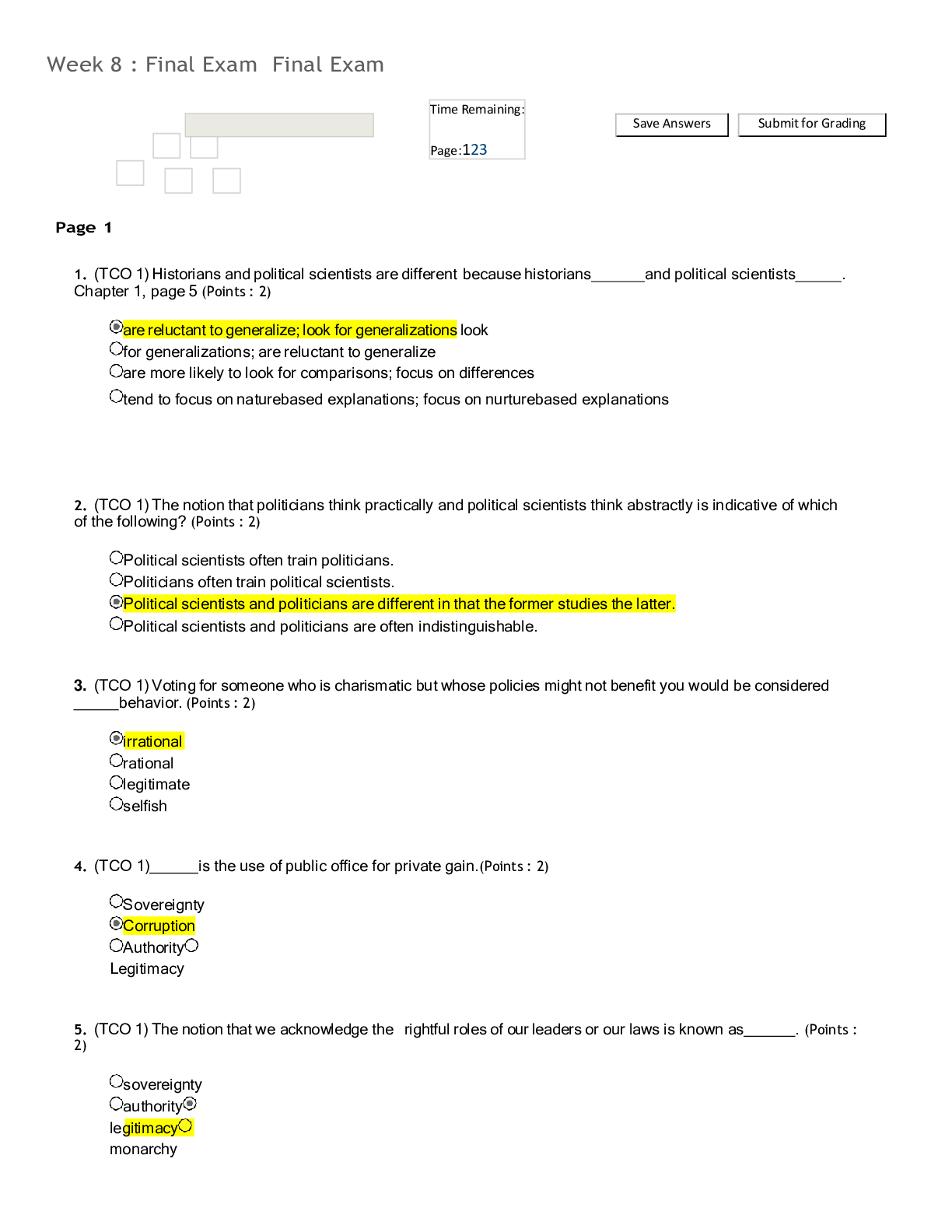
1. (TCO 1) Historians and political scientists are different because historians and political scientists .
Chapter 1, page 5 (Points : 2)
are reluctant to generalize; look for generalizations look
for generali
...
Page 1
1. (TCO 1) Historians and political scientists are different because historians and political scientists .
Chapter 1, page 5 (Points : 2)
are reluctant to generalize; look for generalizations look
for generalizations; are reluctant to generalize
are more likely to look for comparisons; focus on differences
tend to focus on naturebased explanations; focus on nurturebased explanations
2. (TCO 1) The notion that politicians think practically and political scientists think abstractly is indicative of which of
the following? (Points : 2)
Political scientists often train politicians.
Politicians often train political scientists.
Political scientists and politicians are different in that the former studies the latter.
Political scientists and politicians are often indistinguishable.
3. (TCO 1) Voting for someone who is charismatic but whose policies might not benefit you would be considered
behavior. (Points : 2)
irrational
rational
legitimate
selfish
4. (TCO 1) is the use of public office for private gain.(Points : 2)
Sovereignty
Corruption
Authority
Legitimacy
5. (TCO 1) The notion that we acknowledge the rightful roles of our leaders or our laws is known as . (Points :
2)
sovereignty
authority
legitimacy
monarchy
6. (TCO 1) Relating concepts in a way that connects them in an empirical manner is the basis of building (Point . 2)
POLI 330N Week 8 Final Exam (Version 2
- Essay & MCQs).
scholarship
theory power
culture
7. (TCO 1) The term for measuring with numbers is . (Points : 2)
quantifying
hypothesis
qualifying
empirical
8. (TCO 4) The English common law stressed the rights of free and equal men and was developed on the basis of
precedent set by earlier judges, known today as . (Points : 2)
judge-made law
judicial precedent
example by trial court
generated
9. (TCO 4) Which of the following issues is a civil concern? (Points : 2)
Extortion
Theft Divorce
Trafficking
10. (TCO 4) The concept of judicial review falls under which article of the U.S. Constitution?(Points : 2)
Article I: The Legislative Branch
Article III: The Judicial Branch Article
VI: Debts, Supremacy, Oaths
Judicial review is not mentioned in the U.S. Constitution.
11. (TCO 4) Who nominates and approves federal judges in the U.S. court system? (Points : 2)
The president and the Senate
The Senate and the House
The president and Speaker of the House
The Senate and the Secretary of State
12. (TCO 4) Which of the following was an argument against granting the U.S. Supreme Court the power of judicial
review? (Points : 2)
Many feared that such a power would give the court a double check and compromise its neutrality. Some
thought that such power would create untrustworthy judges.
The founders argued that judicial review would lead to undue indictments by the court. Drafters
of the Constitution feared that few laws would ever be set in stone.
13. (TCO 4) Examine the ideal role of American judges. (Points : 2)
Judges should intervene frequently, interpreting the law according to their expertise and ensuring a fair trial.
Save Answers Submit for Grading
Judges should act as umpires, passively watching the legal drama and ruling only on disputed points of
procedure.
Judges should not intervene unless attorneys object, at which point they may either overrule or sustain the objection.
Judges should take an active role, questioning witnesses, eliciting evidence, and commenting on procedure.
14. (TCO 4) In Lombard v. Louisiana (1963), the Warren Court supported , ruling that blacks who had refused
to leave a segregated lunch counter could not be prosecuted. (Points : 2)
boycotts
sit-ins picket
lines
protests
15. (TCO 5) Why do the responsibilities of legislative and executive powers often overlap?(Points : 2)
Separation of powers is rarely clear-cut.
Separation of powers is rare among industrialized nations. Separation
of powers is absolute.
Separation of powers grants obtuse levels of power to the executive branch.
16. (TCO 5) How often does the cabinet change in a parliamentary system? (Points : 2)
Every 4 years
Every 6 years
Every 8 years
When the cabinet is voted out or resigns
17. (TCO 5) Because of the separation of powers inherent in a presidential system, some scholars think that
executive-legislative is common in systems like that used in the United States. (Points : 2)
cooperation
stagnation
deadlock
insolvency
18. (TCO 5) Who directly calls forth the leader of the largest party to take office with a cabinet and become the
prime minister? (Points : 2)
The voters
Parliament The
monarch
The House of Commons
Week 8 : Final Exam - Final Exam
Page 2
1. (TCO 5) When it comes to electing officials, which factor matters the most to voters in both presidential and
parliamentary elections? (Points : 2)
Party affiliation
Political ideologies
Money invested in campaign
Personality
2. (TCO 5) Who receives the most attention in both parliamentary and presidential systems? (Points : 2)
Head of state
Chief executive
The legislature
Voting citizens
3. (TCO 5) Describe how the United States expands its cabinet. (Points : 2)
The president can create a new department at his or her will.
Congress must agree on the new department and provisions for its funds must be made.
In order for a new department to be developed, a former one must be deleted.
New departments are no longer developed.
4. (TCO 7) Radicals use the term political economy instead of to describe their critique of capitalism and the
inequitable distribution of wealth among nations. (Points : 2)
Marxism
laissez-faire
public choice
Keynesian
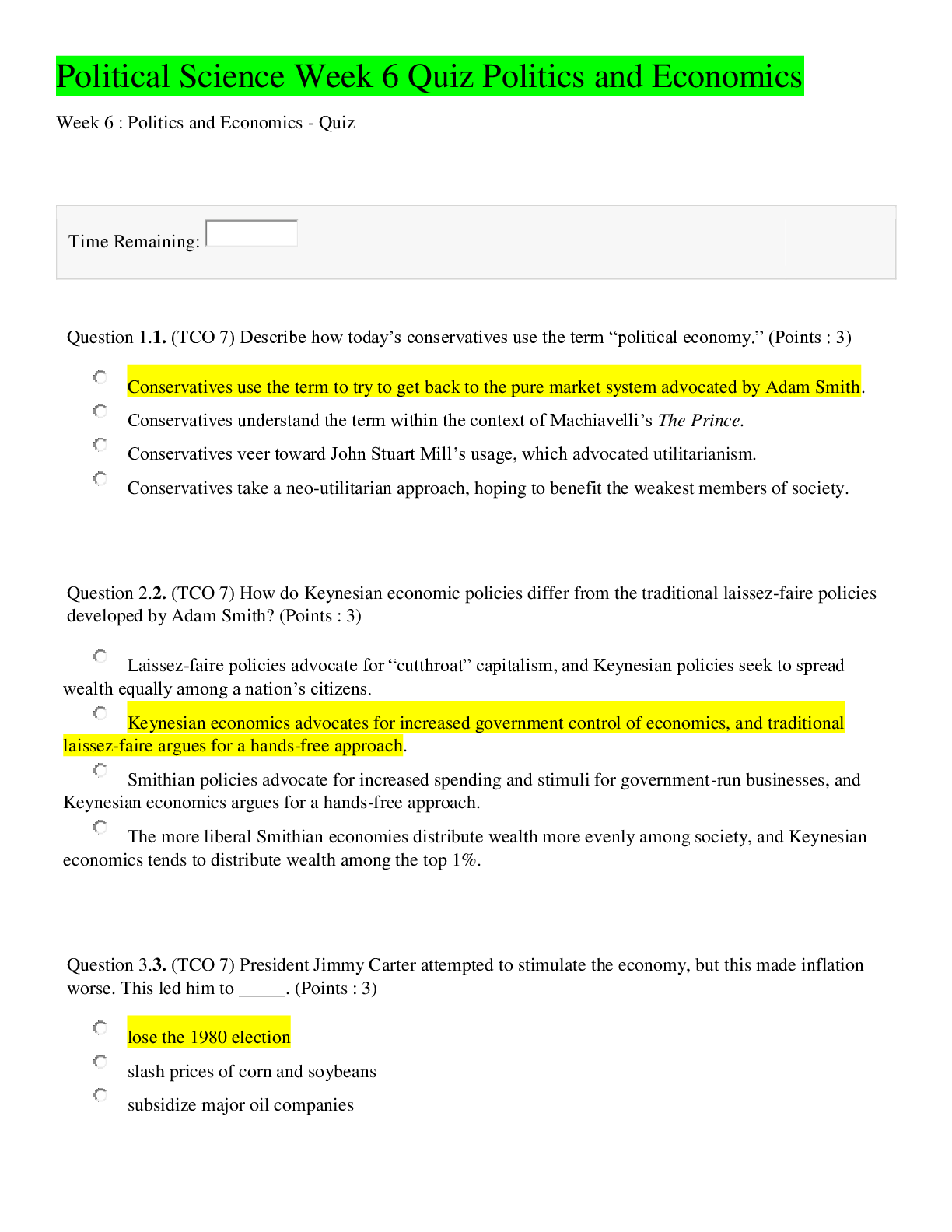
5. (TCO 7) How do Keynesian economic policies differ from the traditional laissez-faire policies developed by Adam
Smith? (Points : 2)
Laissez-faire advocates for “cutthroat” capitalism, and Keynesian policies seek to spread wealth equally
among a nation’s citizens.
Keynesian economics advocate for increased government control of economics, and traditional laissez-faire
argues for a hands-free approach.
Smithian policies advocate for increased spending and stimuli for government-run businesses, and Keynesian
economics argues for a hands-free approach.
The more liberal Smithian economies distribute wealth more evenly among society, and Keynesian economics
tends to distribute wealth among the top 1%.
Time Remaining:
Page: 1 2 3
6. (TCO 7) What event is largely considered responsible for deterring Johnson’s War on Poverty? (Points : 2)
Great Society
Vietnam War
Middle-class entitlements
Tax expenditures
7. (TCO 7) Which of the following is an increasing financial concern of the Medicare program? (Points : 2)
The proportion of older people in American society is increasing steadily.
Every American citizen on reaching 65 obtains Medicare, regardless of class.
Economic inequality renders Medicare more necessary for some than for others.
Wealthy Americans are taking advantage of the Medicare system.
8. (TCO 7) Why are many politicians wary about limiting Social Security and Medicare expenses? (Points : 2)
Many would be left without enough to support them.
Caps to these programs would undermine the welfare state.
It can cost them votes.
Both are primary social safety nets.
9. (TCO 7) How does the American welfare state compare to those of other industrialized nations? (Points : 2)
Much less is allocated to welfare in the United States.
Other nations allocate less to welfare than the United States.
The United States allocates about the same to welfare.
Few nations besides the United States maintain funds for welfare.
10. (TCO 7) Theoretically, what are the consequences if the government assumes the burden of bad loans? (Points
: 2)
Citizens will default on their mortgages.
Banks will learn from their mistakes and pay back the burden with interest.
Ultimately, the government will profit.
Firms will be encouraged to continue their risky behavior.
11. (TCO 9) What is the most common response to serious domestic unrest? (Points : 2)
Revolution
Coup d’état
Military takeover
UN diplomatic action
12. (TCO 9) Riots triggered by police beating youths, protests against globalization, and labor strikes against
austerity are all examples of . (Points : 2)
purely traditional violence
issue-oriented violence
violence carried out by civilian institutions of government
coups
13. (TCO 9) What is likely to happen if the people are unhappy and there is no organization to focus their
discontent? (Points : 2)
They will almost surely turn to violence.
Not much will happen.
The people will organize themselves, regardless.
They will eventually find other means of achieving contentedness.
14. (TCO 9) What about U.S. agencies such as the Department of Homeland Security, the FBI, and the CIA make
them so ill prepared to fight terrorism? (Points : 2)
They have extremely different missions when it comes to
terrorism. They are poorly funded.
They have a great deal of red tape to get through in order to be able to communicate.
They are often unwilling to communicate with each other.
15. (TCO 9) According to Hannah Arendt, the American struggle was indeed a revolution, perhaps history’s only
complete revolution, .(Points : 2)
because it alone ended with democratic
institutions. because it became an example for
other nations.
because it managed to route what was then the great world power.
because it alone ended with a new foundation of liberty instead of the tyranny that came after other
revolutions.
16. (TCO 9) Does terrorism work? (Points : 2)
Rarely, and seldom without political and/or economic
pressure Rarely, but primarily when brought against
democratic nations Often, and without much need for political
pressure to aid it
Often, but only with the assistance of economic and/or political pressure
17. (TCO 9) Hannah Arendt pointed out that rage is the fuel of revolution, but what is now the greatest cause of
rage?(Points : 2)
The low level of education in developing nations
The enormous economic mismanagement in industrialized nations
The extreme violence utilized by industrialized nations against developing nations
The massive corruption now found in developing lands
1. (TCO 2) What types of states are most likely to become authoritarian? Why? Along the same lines, what authoritarian
states have been most likely to democratize? Under what circumstances does this democratization occur and why?
Based on previous findings, describe one country you think is likely to democratize in the near future. (Points : 40)
States that suffers from frequent wars and political pressure is most likely to have an authoritarian government. A good
example in current times is the case of Burundi and Syria. The most likely governance to calm down the situation involves
authoritarianism. Besides that, states that suffer from economic turmoil also have a higher likely chance of suffering from
authoritarianism. A good example of authoritarianism resulting from economic pressure occurred in Germany in 1919. In
this case, allies of Germany respond to the situation by preventing the nation from recovering. This led to Germany being
an authoritarian state. A nation with strong nationalism ideology also has a higher chance of turning out to be an
authoritarian state. During the reign of Hitler, the core concept was a nationalism that made Germany community feels
they are superior to other nation, particularly Jewish community.
Egypt and Libya are a most recent nation that considered democratizing. The possible reason for such move is to fight
for equity, improve governance and enjoy political freedom.
Uganda is a nation located in East Africa, and President Yoweri Museveni rules it. Museveni uses the authoritarian concept
to rule which is subjected to frequent threats and mistreatment of opposition. However, the citizen is pressuring for the
need for freedom and democracy in that state for equity and betterment of services. Besides that, in February 2016 there
will be an election and change might occur since different organization and group are encouraging the people to exercise
their right that for a long time have been violated.
2. (TCO 3) Compare and contrast interest groups and political parties. In your response, be sure to provide examples their
similarities and differences. In addition, please assess what advantages interest groups offer that political parties don’t
and then what advantages d political parties offer that interest groups don’t. (Points : 40)
The way of association of vested parties varies from that of political gatherings. As it were, the association of vested
parties is to some degree free. They are a gathering of individuals working for a shared objective. That does not as a
matter of course imply that they ought to have a constitution thus on for their work.
The contrast between political gatherings and vested parties comes from the reasons for each. Political gatherings stand
in the races and attempt to win the votes cast by the general population and speak to them in the chambers, parliament,
or some other representing body of the state or nation. Then again, intrigue bunches don't remain in the races. They don't
try for the votes from the general population as well. This is the primary distinction between political gatherings and
vested parties. There are some other fascinating actualities additionally about each of these gatherings that we will
examine in this article before we go to the contrasts between political gatherings and vested parties.
A political gathering more often than not has an appropriate constitution that clarifies why they have met up, the
elements of their gathering, parts of the individuals, and so forth. They are extremely composed.
With regards to regular great, political gatherings tend to work a great deal more as one than the vested parties who
appear to work for particular interests as their name recommends.
3. (TCO 6) Since the end of WWII, international relations have been framed by the conflict between liberal governments
and communist ideals. Compare and contrast the features of these systems and assess their continued impact on the
global community. Please be certain to explain classical and modern liberalism, socialism, and communism within your
responses and provide examples to support your points. (Points : 40)
Communism in about the majority of its notable and current signs has conveyed what needs be as solid, incorporated
dictator control of the economy, business, managing an account, the political framework, allotment of assets, and the
engaging of the common laborers with the point of a "raunchy" society. Further, property of assorted types is held in like
manner (by means of the state), as opposed to separated as private and open property. Marx had a substantially more
vote based perspective of how such a general public would work and advance after some time (see his dialog of the Paris
Commune, for instance), however Stalin, Mao and others utilized socialist standards as a revitalizing cry to take single
gathering control of government (and whatever is left of society), wrestling it from the decision first class (and laborers
committees and assemblages) in unfathomably fierce ways. I'm sure Marx and Engels would have been frightened by what
these "progressives" did, yet there you have it. Regardless, what separates socialism by and by from different types of
communism are these components of tyrannical ideological unbending nature, compelling nonappearance of vote based
system, and state responsibility for about everything. Obviously, on the grounds that comrade states needed to exist
inside globalized private enterprise, they basically have worked by means of an especially vindictive type of state free
enterprise, and never achieved the "destitute" social orders at first imagined.
Modern non-comrade types of communism are distinctive in that they look to architect square with access to
circumstances and assets for all nationals, as gave by unified and/or appropriated equitable components for overseeing
creation, as opposed to tyrant state control and foundations. In like manner, there is about dependably procurement
made for both private and open property, and albeit a few commercial ventures might be "associated" to convey square
with baselines of fundamental staples and administrations to everybody in that society, the impulse to control all
undertaking through the state is truant. In spite of the fact that there have been numerous types of communism proposed,
the most widely recognized by and by is some type of law based communism, where other political and financial
philosophies exist together with communist ones. Truly, communism flourishes in pretty much every present day society,
including the U.S., where the military, the postal administration, national parks, interstate expressways, medicare and a
large group of different establishments speak to an "associated" model for aggregate advantage. In this sense, it is
somewhat funny that a few Americans rail against "those communist elitists" in Europe, and so on., since Europe and the
U.S. simply actualize communism to somewhat changing degrees. Likewise with socialism, be that as it may, almost all
communism on the planet works inside the system of true state private enterprise.
Despite befuddling talk from the right-wingers, progressiveness has no immediate connections with communism,
socialism or radicalism. Rather, progressives are worried with propelling society for the advantage of everybody in the
most even minded and inventive ways that could be available. This implies a dynamic supporters progresses in everything:
innovation, well-being and prosperity, more impartial laws and social liberties, a more extensive use of science in cutting
edge basic leadership in all levels of society, and frequently more libertarian access to assets and opportunity (i.e. social,
political and financial force). It's this last thing - populist access - that gets them in a bad position with "hostile to
communists," since communism has demonstrated itself an exceptionally successful method for accomplishing that end
for specific things. In any case, a dedicated dynamic would not waver to drop communism like a hot potato if something
better - that is, something all the more logically compelling in raising the personal satisfaction, social standing and open
door for everybody - tagged along. What's more, since private enterprise, when unregulated, has had a tendency to make
more disparity and classicism in the public eye, and has likewise tended to endeavor individuals and regular assets instead
of shield these from misuse, progressives are for the most part very wary of traditionalist cases with respect to automatic
free undertaking and stream down advantages for poor people.
Liberalism presents us with some extremely cloudy and evolving waters, and most likely merits significantly more
exchange than a minor section here. Since radicalism champions the standards of freedom and fairness, it conveys what
needs be in various courses relying upon how somebody trusts freedom and equity can be accomplished. So while the
neoliberal supporters liberated free endeavor and exchange, and a seriously decreased part and power in focal
government, a "social liberal" may trust government is fundamental to upholding individual and aggregate flexibility (social
liberties), and that social equity (as upheld by the standard of law) is basic to keeping up individual freedoms. Social
liberals additionally have a tendency to trust that entrepreneur endeavor and markets oblige control to secure laborers
and customers. Libertarianism, is doubtful that the State plays something besides a severe part with respect to freedom.
As anybody watching American governmental issues in the course of recent decades can confirm, these different types of
progressiveness can be at incredible chances with each other. At the end of the day, however, both closures of the
radicalism range work inside the structure of true state free enterprise.
4. (TCO 8) Today’s world seems to be moving beyond sovereignty and toward supranational leadership to cooperate on
issues of global importance. What are some of these issues? How might they be solved through supranational
cooperation? Does such cooperation impede the sovereignty of independent nations? Please sure to include specific
examples in supporting your points. (Points : 40)
The sovereign obligation emergency and the euro emergency have incited heads of state and government in Europe to
heighten supranational collaboration. Be that as it may, some political pioneers and arrangement producers go for
additional. They propose the presentation of a typical European monetary government that would keep Europe from
encountering further financial dangers and settle national spending plans and financial markets, and the euro. The
consequences of a review among well informed individuals infer a fairly undecided state of mind towards this endeavor.
While a thin dominant part supports the general thought of incorporated monetary administration in Europe, or in the
Euro zone, the solid thoughts for the configuration of such a legislature are not famous among the respondents.
A unified macroeconomic approach, a typical spending plan that is set midway and utilizing Euro-bonds as a typical
method for obligation financing in the Euro zone all get restricted endorsement. In this way, on the off chance that they
are going for more supranational collaboration, open and corporate approach producers need to make obvious strides
that offer substantial benefits that influence general feelings favorably.
[Show More]


-Graded 100%.png)