ATI Fundamentals 1, Exam Quiz, Answered With Rationales. Rated A+, To use the NURSING PROCESS correctly, the nurse must FIRST
A. Identify the goals for the client's care
B. Obtain information about the client
C.
...
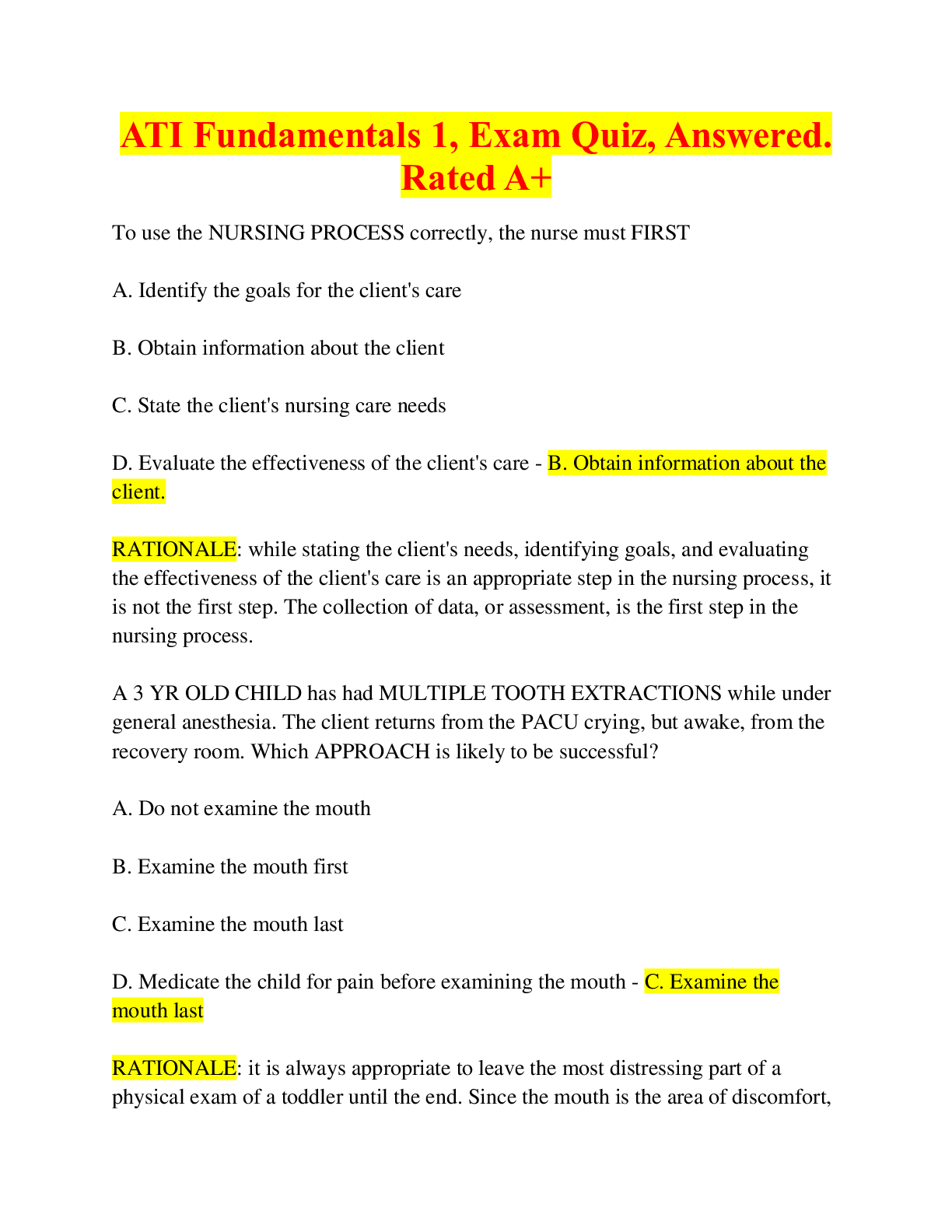
ATI Fundamentals 1, Exam Quiz, Answered With Rationales. Rated A+, To use the NURSING PROCESS correctly, the nurse must FIRST
A. Identify the goals for the client's care
B. Obtain information about the client
C. State the client's nursing care needs
D. Evaluate the effectiveness of the client's care - B. Obtain information about the client.
RATIONALE: while stating the client's needs, identifying goals, and evaluating the effectiveness of the client's care is an appropriate step in the nursing process, it is not the first step. The collection of data, or assessment, is the first step in the nursing process.
A 3 YR OLD CHILD has had MULTIPLE TOOTH EXTRACTIONS while under general anesthesia. The client returns from the PACU crying, but awake, from the recovery room. Which APPROACH is likely to be successful?
A. Do not examine the mouth
B. Examine the mouth first
C. Examine the mouth last
D. Medicate the child for pain before examining the mouth - C. Examine the mouth last
RATIONALE: it is always appropriate to leave the most distressing part of a physical exam of a toddler until the end. Since the mouth is the area of discomfort, examining it is likely to cause more crying and uncooperative behavior for the remainder of the assessment.
The child just had oral surgery and is at risk for hemorrhage and swelling. It is imperative that the mouth be examined. The child must be assessed for pain before pain medication can be administered.
A nurse is performing an ABDOMINAL ASSESSMENT of an adult client. Identify the correct sequence of steps used for this assessment.
Auscultation
Inspection
Palpation
Percussion - Inspection
Auscultation
Percussion
Palpation
RATIONALE: this sequence prevents altering the bowel sounds during an abdominal assessment. The appropriate sequence for any other assessment of an adult client is inspection, palpation, percussion, and auscultation.
A nurse is teaching a client who has cardiovascular disease how to reduce his intake of sodium and cholesterol. The nurse understands that the MOST SIGNIFICANT factor in PLANNING DIETARY CHANGES for this client is the
A. Involvement of the client in planning the change
B. Emphasis the provider places on the dietary changes
C. Financial ability of the client to make the dietary changes
D. Extent of the dietary changes planned for the client - A. Involvement of the client in planning the change
RATIONALE: a client who is actively involved in planning dietary changes is more receptive to the changes and is more likely to adhere to them.
The provider's approach and the extent of change is important when planning dietary changes but is not the highest priority in this situation. If finances are an obstacle, the nurse can advocate for the client by referring him to the appropriate social service agencies.
While starting an IV for a client, the nurse notices that her GLOVED HANDS get SPOTTED WITH BLOOD. The client has not been diagnosed with any infection transmitted via the bloodstream. Which of the following should the nurse do as soon as the task is completed?
A. Wash the gloved hands and then throw the gloves away
B. Prepare an incident report so that this occurrence will be documented
C. Remove the gloves carefully and follow with hand hygiene
D. Ask the provider to order a blood culture to determine risk - C. Remove the gloves carefully and follow with hand hygiene
RATIONALE: standard precautions require the use of gloves and hand hygiene in the care of all clients. Unless there is a break in the nurse's skin, there is no need for an incident report or further investigation. Washing the hands while still gloved is unnecessary.
A nurse's neighbor is scheduled for ELECTIVE SURGERY. The neighbor's provider indicated that a moderate amount of blood loss is expected during the surgery, and the neighbor is anxious about acquiring an INFECTION from a BLOOD TRANSFUSION. Which of the following is appropriate for the nurse to suggest?
A. Asking the provider about taking (epoetin) Epogen before the surgery
B. Taking iron supplements prior to the surgery
C. Requesting that a family member donate blood
D. Donating autologous blood before the surgery - D. Donating autologous blood before the surgery
RATIONALE: autologous blood transfusion is the collection and re-infusion of the client's own blood. With pre-op autologous blood donation, the blood is drawn from the client 3-5 weeks before an ELECTIVE surgery and stored for transfusion at the time of surgery. While blood bank tests greatly reduce the risks of acquiring certain infectious diseases, these risks can not be eliminated entirely. Autologous blood is the safest form of blood transfusion; while taking Epogen prior to surgery may boost the client's hematocrit levels, it is inappropriate if the client already has an adequate hematocrit. In addition, this action may not eliminate the need and its related risks. While taking an iron supplement prior to surgery may boost the client's hemoglobin levels, it is inappropriate if the client already has an adequate hemoglobin level and intake of iron from dietary sources. In addition, this action may not eliminate the need for a transfusion and its related risks. The directed blood donation from a family member does not eliminate the risk of acquiring an infection.
An assistive personnel tells the nur
[Show More]