https://www.stuvia.com/user/quizbit07
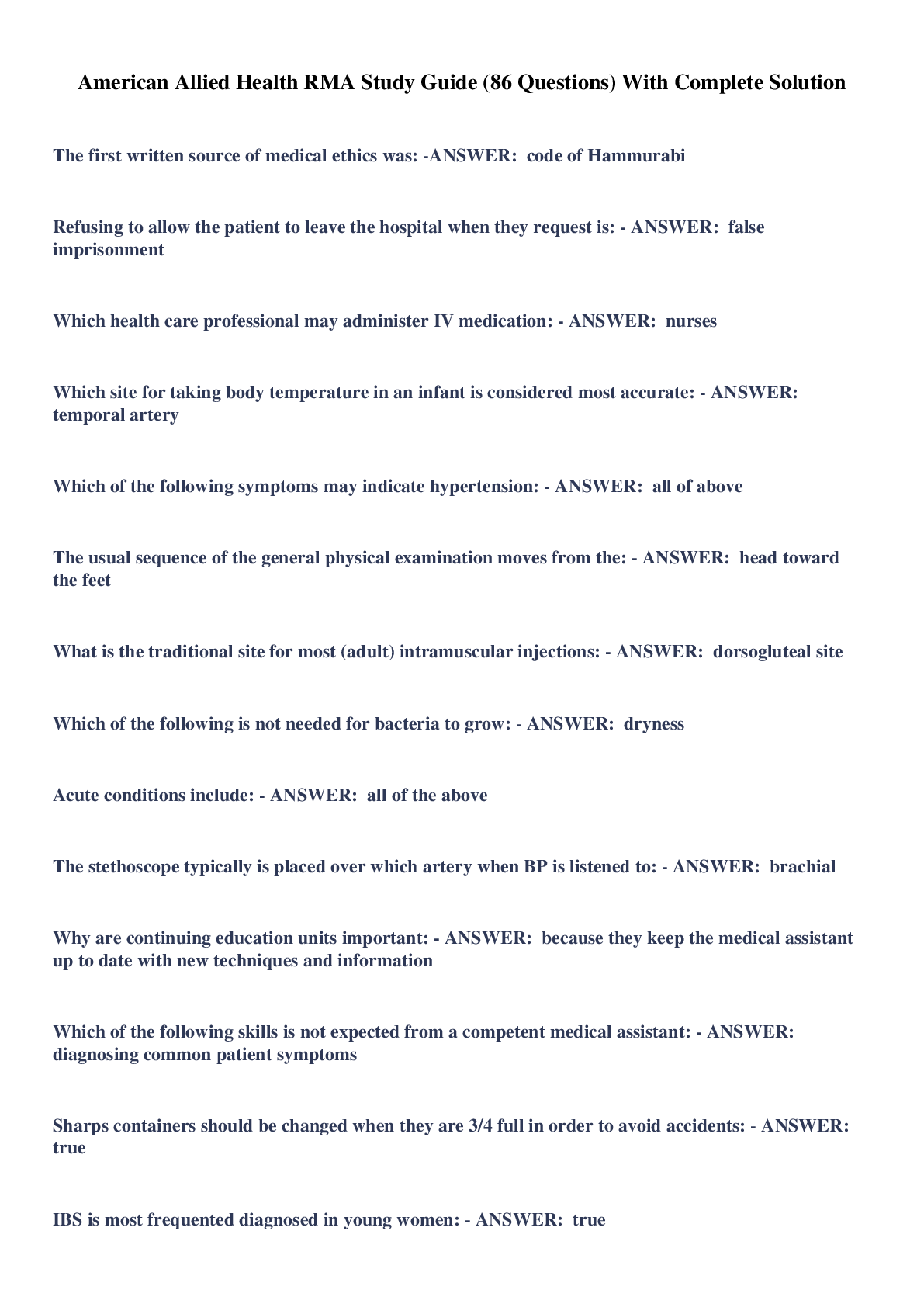
American Allied Health Practice Exam |
Comprehensive Certification Examination |
Verified Questions & Answers | 2026/2027 Update - 100% Correct Solutions
Q: A sitz bath is
...
https://www.stuvia.com/user/quizbit07
American Allied Health Practice Exam |
Comprehensive Certification Examination |
Verified Questions & Answers | 2026/2027 Update - 100% Correct Solutions
Q: A sitz bath is applied to the _____________.
Choose one:
shoulder
knee
perineum
lower back
Answer
perineum
Q: All of the following can be reported as objective information except:
Choose one:
vital signs
bleeding
edema
headache
Answer
headache
Q: Equipment used to collect a specimen for a throat culture would include all of the following
except:
Choose one:
pen light
applicator
https://www.stuvia.com/user/quizbit07
syringe
tongue blade
Answer
syringe
Q: The suffix "-rrhagia" means:
Choose one:
Pain
Excessive flow
Inside
Small
Answer
excessive flow
Q: The suffix "-lysis" means:
Choose one:
Disease
Around
Excessive flow
Destruction of
Answer
destruction of
Q: The suffix "-pathy" means:
Choose one:
Discharge
Away from
https://www.stuvia.com/user/quizbit07
Disease
Study of
Answer
disease
Q: Which of the following are side effects of chemotherapy?
Choose one:
Emesis and anorexia
Alopecia
Anemia and fatigue
All are chemotherapy side effects
Answer
All are chemotherapy side effects
Q: The suffix "-itis" means:
Choose one:
Excessive flow
Inflammation
Breathing
Discharge
Answer
Inflammation
Q: The suffix "cyan" means:
Choose one:
yellow
blue
https://www.stuvia.com/user/quizbit07
green
red
Answer
blue
Q: The root word "hemo" means:
Choose one:
Blood
Heart
Vessel
Artery
Answer
blood
Q: The abbreviation OU means:
Choose one:
Left ear
Right ear
Both eyes
Both ears
Answer
Both eyes
Q: An AED is used only when the patient is:
Choose one:
https://www.stuvia.com/user/quizbit07
Unresponsive
Without a pulse
Not breathing
All are reasons to use an AED
Answer
All are reasons to use an AED
Q: The abbreviation OS means:
Choose one:
right eye
left eye
both eyes
left ear
Answer
left eye
Q: Which of the following is true when an IV infiltrates?
Choose one:
Needle pierces the vein
IV fluid flows into surrounding tissue
Patient will experience pain and swelling
All the above are true with IV infiltration
Answer
All the above are true with IV infiltration
https://www.stuvia.com/user/quizbit07
Q: Constipation can be relieved by administering a(n) _____________.
Choose one:
Rectal suppository
Enema
Heat pad to the lower abdomen
Both a and b are methods of relieving constipation
Answer
Both a and b are methods of relieving constipation
Q: The suffix "-emia" means:
Choose one:
inflammation
blood
enlargement
small
Answer
blood
Q: The suffix "-uria" means:
Choose one:
Condition of urine
Excessive flow
Study of
Growth
Answer
Condition of urine
https://www.stuvia.com/user/quizbit07
Q: The suffix "-rrhea" means:
Choose one:
Dark
Breathing
Blood
Discharge
Answer
Discharge
The suffix "-logy" means:
Choose one:
Blood
Destruction of
Dark
Study of
Answer
Study of
A crash cart contains which of the following?
Choose one:
Defibrillator with cardiac monitor
Emergency drugs, needles, and syringes
Equipment for ventilation and chest compression
All of the above
Answer
All of the above
https://www.stuvia.com/user/quizbit07
In an adult, the normal pulse rate is __________ beats per minute and normal respiratory
rate is ___________ breaths per minute.
Choose one:
20-30, 60-100
60-100, 18-20
100-60, 30-20
30-20, 90-60
Answer
60-100, 18-20
A pressure ulcer with death to the tissue and damage to the muscle and bone is:
Choose one:
Stage I
Stage II
Stage III
Stage IV
Answer
Stage IV
The prefix "hypo" means:
Choose one:
Low
Pain
High
Water
Low
A single lumen, indwelling catheter is inserted into all of the following except:
Choose one:
https://www.stuvia.com/user/quizbit07
Jugular vein
Subclavian vein
Basilic vein
Superior vena cava
Superior vena cava
A nephrostomy tube is inserted directly into the:
Choose one:
Nephron
Kidney
Urinary bladder
Colon
Kidney
Which pulse is commonly palpated in CPR?
Choose one:
Radial
Carotid
Femoral
Brachial
Carotid
The suffix "-algia" means:
Choose one:
Pain
Condition of
Difficult
Blood
Pain
https://www.stuvia.com/user/quizbit07
The suffix "-ectomy" means:
Choose one:
Condition of urine
Discharge
Surgical removal
Procedure
Surgical removal
Which of the following will affect a wound's ability to heal?
Choose one:
Pain
Infection
Vomiting
Nausea
Infection
When performing a 12-lead ECG, V-1 is placed at the:
Choose one:
Fifth intercostal space, right of the sternum
Fifth intercostal space left of the sternum
Fourth intercostal space, right of the sternum
Fourth intercostal space left of the sternum
Fourth intercostal space, right of the sternum
Which piece of equipment would be used to check an oxygen level on a patient with COPD?
Choose one:
Nasal cannula
https://www.stuvia.com/user/quizbit07
Pulse oximeter
CXR
Respirator
Pulse oximeter
A hydrocolloid film is used:
Choose one:
In treatment of hives and rashes
In taking an x-ray
In treatment of pressure ulcers
None of the above are common uses
In treatment of pressure ulcers
Which blood type is considered to be the universal donor?
Choose one:
A
B
O
AB
O
The most common vein used in venipuncture:
Choose one:
basilic
cephalic
median cubital
femoral
median cubital
https://www.stuvia.com/user/quizbit07
A medical interpreter will only tell the patient what the physician tells the patient.
Choose one:
true
false
true
The suffix "-megaly" means:
Choose one:
Enlargement
Inflammation
Condition of urine
Breathing
Enlargement
The root word "adeno" means:
Choose one:
Vessel
Bladder
Gland
Joint
Gland
An opening into the airway is called a ____________.
Choose one:
trachelectomy
tracheomalacia
tracheotomy
tracheoscopy
https://www.stuvia.com/user/quizbit07
tracheotomy
Which technique is used for an invasive procedure?
Choose one:
Clean
Sterile
Autoclave
Micro-clean
Sterile
The suffix "-pnea" means:
Choose one:
Before
Enlargement
Breathing
Pain
Breathing
The brachial artery is located in the __________.
Choose one:
Side of the neck
Behind the knee
Sole of the foot
Top side of the elbow
Top side of the elbow
Which of the following are routine test for a patient with diabetes?
Choose one:
https://www.stuvia.com/user/quizbit07
HgA1C
UA
FBS
all are tests commonly done for diabetics
all are tests commonly done for diabetics
The prefix "dys-" means:
Choose one:
against
unfavorable
backward
difficult
difficult
An ostomy may be performed because of:
Choose one:
Cancer
Blockage
Trauma
All are reasons an ostomy may be performed
All are reasons an ostomy may be performed
An infection that affects the entire body is __________.
Choose one:
Systemic
Local
Trauma
Edema
Systemic
https://www.stuvia.com/user/quizbit07
The CDC recommends which of the following for hand hygiene?
Choose one:
Hand washing
Autoclaving
Alcohol based hand rubs
Both a and c are CDC recommended
Both a and c are CDC recommended
What is "epi-"?
Choose one:
on top
upon
below
sub
on top
TID means:
Choose one:
once a day
three times a day
two times a day
four times a day
three times a day
When charting on a patient's condition include:
Choose one:
Your thoughts on the patient's condition
https://www.stuvia.com/user/quizbit07
subjective and objective information
what you think the treatment should be
all should be included when charting
subjective and objective information
Tact is best defined as:
Choose one:
saying or doing the right thing at the right time
complete task quickly
not being judgmental
giving good advice
not being judgmental
An HAI infection, also known as a nosocomial infection is:
Choose one:
a hospital acquired infection
contact by an infected patient
someone who came into the hospital with the infection
contact with treatment nurse who did not follow protocol
a hospital acquired infection
The prefix "intra-" means:
Choose one:
toward
inside, within
around
away from
inside, within
https://www.stuvia.com/user/quizbit07
The prefix "peri-" means:
Choose one:
many
around
without
under
around
The prefix sub- means:
Choose one:
above
toward
across
under
under
When removing a dressing:
Choose one:
pull the tape away from the wound
pull the tape toward the wound
use an adhesive remover
cover with a new dressing
pull the tape toward the wound
A supra-pubic catheter enters the urinary bladder through-
Choose one:
abdominal pelvic wall
ureters
https://www.stuvia.com/user/quizbit07
urethra
vagina
urethra
The root word "myo-" means:
Choose one:
arm
liver
nose
muscle
muscle
The root word "rhino-" means:
Choose one:
nose
muscle
joint
spine
nose
Which layer of the skin contains adipose tissue?
Choose one:
epidermis
dermis
subcutaneous
all layers contain adipose tissue
subcutaneous
https://www.stuvia.com/user/quizbit07
Arteries carry:
Choose one:
oxygen to the cells
nutrients to the cells
deoxygenated blood
both A and B
both A and B
The strongest bone in the human body:
Choose one:
humerus
femur
tibia
skull
femur
The small intestines absorb:
Choose one:
nutrients
vitamins
water
all of the above
all of the above
Which of the following is the term for the upper portions of the heart?
Choose one:
arteries
atria
ventricles
https://www.stuvia.com/user/quizbit07
aorta
atria
Which of the following is the pacemaker of the heart?
Choose one:
AV node
QT node
SA node
All are pacemakers of the heart
SA node
Digestion begins in the:
Choose one:
stomach
spleen
intestines
mouth
stomach
Knowing right and wrong is called:
Choose one:
morals
ethics
substand care for a patient
malpractice
ethics
Not caring for a patient in the right way is called:
https://www.stuvia.com/user/quizbit07
Choose one:
negligence
forgetting to do the treatment
malpractice
ethics
negligence
concentrate on patient's concern
Listening is a skill
they have anxiety and fear
In dealing with people
speak clearly, get interpreter, also give written instructions
verbal instructions
stress for all, erroneous results, and irrational patient behavior
bad communication leads to
contract
patient and doctor enters into a
standard of care
doctor agrees to
https://www.stuvia.com/user/quizbit07
contract; skills to treat patient
patient agrees to pay _________ based on the fact that doctor has necessary ____________
you are personally liable
you make a mistake....
healthcare professional and the patient
breach of confidentiality... applies to information gained between the __________________
and the ___________.
assault
an unwanted, declined attempt to draw my blood is ______.
negligence
failure to perform duties Standard of Care
permission given; is happening
consent based on __________ and patient knows what ___________________.
malpractice
____________-improper or unskilled care of the Health Care Team
Hippocratic oath
____________- do no harm; do only what you have been trained to do
https://www.stuvia.com/user/quizbit07
Ethics
______________ is the principle of right and wrong conduct
Negligence
___________ - HCP should have known what would cause harm to patient
bedtime
HS
vein carrying oxygenated blood
pulmonary vein
hemoglobin
___________ is responsible for RBC color
towards the side
lateral
10 years
statue limitation professional negligence
aorta
largest artery
https://www.stuvia.com/user/quizbit07
veins
_____ always carry blood back to the heart
2 hours after meal
2hr PC
basophils; clotting factor
_________ is not a cell.
plasma
liquid portion of blood
myocardial infarction
MI
death of tissue in heart
myocardial infarction
capillaries
________=microscopic blood vessel
red
erythr
https://www.stuvia.com/user/quizbit07
vein
phleb
inflammation
itis
loosen, freed, destruction
lysis
oxygen
respiratory=body system to get
bile, stores vitamins, glucose
liver produces ________, _______, ______.
a bleeding condition; blood doesn't clot
hemophiliac
12
pair of ribs
without/lacking
a/an
https://www.stuvia.com/user/quizbit07
centimeter
c
granulocytes
basophils
histamine and heparin
Basophils secrete ____ and ____.
released during an inflammatory response
histamine
prevents coagulation
heparin
coagulation
platelets work in
BP, TPR
customary vital signs are...
temperature, pulse, respiration
tpr
https://www.stuvia.com/user/quizbit07
production of or loss of heat
temperature
the body process of chemical and physical change
metabolism
pulse
_______ = heart pushing blood out the aorta
60-100
normal pulse
inhalation
_________ - exchange of oxygen for carbon dioxide
mm Hg; millimetres of mercury
BP measured in ____________
blood pressure
_________ = pressure of blood against arterial walls
60-90/100-140
Normal adult blood pressure
https://www.stuvia.com/user/quizbit07
levels
BP taken _________ w/ heart
contraction
systolic
occurs when the ventricles are relaxed; the lowest pressure against the walls of an artery
diastolic
25 mm/sec
EKG speed
never go deeper than 2.4 inches deep on heels
osteomyelitis
blood in urine
hematuria
bile salts
key tones
case that holds x-ray film
cassette
https://www.stuvia.com/user/quizbit07
film of the kidneys, ureter, and bladder
KUB x-ray
cancer
over exposure to x-rays could cause
what the walls are lined with in an x-ray room
lead
another name for x-ray
fluoroscope
take portion off for testing
aliquot
to assign a number
accession
put yourself in their shoes and be kind
empathetic
hemorrhoids and infarction
how to spell HEM and I?
https://www.stuvia.com/user/quizbit07
you must wash your hands and put on gloves
In dealing with a patient with AIDS
could cause dilution of blood
Edema
inadequate blood flow to the heart muscle
heart pain
mature and form antibodies
lymphocytes
muscular organ
heart
separates left and right
septum
rapid heart beat
tachycardia
generates heart beat
SA node
https://www.stuvia.com/user/quizbit07
fainting
syncope = _____
happens when heart beats too slow
syncope
picture of heart
a lead
instrument used to do EKG
electrocardiograph
tracing of EKG
electrocardiogram
chest leads
pericardial leads
AVF, AVR, AVL
augmented leads
left leg
Lead AVF goes where?
https://www.stuvia.com/user/quizbit07
portion of specimen taken for testing
take an aliquot
sound of faulty action when the valves close
heart murmur
abnormally low blood pressure
hypotension
voice box
larynx
virus caused by steptoccocus a; can affect heart valves
rheumatic fever
abnormally low blood pressure
hypotension
voice box
The T Wave represents
ventricular re-polarization
https://www.stuvia.com/user/quizbit07
If the heart is in a state of asystole
There is no contraction
What are the bipolar leads
I, II, and III
The most common type of supraventricular Tachycardia is
AV nodal Reentrant tachycardia (AVNRT)
In 2:1 AV block, the PR interval
Lengthens
In sinus arrhythmia, a gradual decreasing of the heart rate is usually associated with:
Expiration
When the cardiac muscle cell is stimulated, the cell is said to:
Depolarize
Leads, II,III AVF view which portion of the heart
Inferior
A regular rhythm with a rate of 100-250 beats per minute would most likely be
Atrial Tachycardia
https://www.stuvia.com/user/quizbit07
Artifact can be cause by
Alternating currents, Patient movements, poorly applied or dirty sensors
When you have more than one premature beat that are of a different kind they are called
Multifocal
What is the rate range for junctional tachycardia?
100-180
Another name for the S-A node is
Pacemaker
Wolff-Parkinson-White Syndrome is associated with
Short P-R interval, delta wave, wide QRS complex
How are frequent PAC's usually managed?
Correcting the underlying cause
The term for three or more PVC's occurring in a row at a rate of more than 100 beats per min is?
A run of ventricular Tachycardia
How do you determine whether the atrial rhythm on an ECG tracing is regular or Irregular ?
Compare to P to P Intervals
https://www.stuvia.com/user/quizbit07
Tall, Peaked T waves observed on the ECG are most commonly seen in patients with.
Hyperkalemia
Leads V3 and V4 view which portion of the heart?
Anterior
A normal rhythm with a normal rate is a
Normal Sinus Rhythm
Defibrillation is a
Shock to the heart to stop the heart and shock to the heart to change rhythms
Which of the following small waves sometimes appears between the T wave and P wave?
U wave
What structure maintains the control of the control of blood flowing through the heart?
Valves
Sinus rhythm at a rate of 48 would be considered
Bradycardia
The function of the AV node is to
Delay the electrical signal to the Purkinje Fibers
https://www.stuvia.com/user/quizbit07
The inherent rate for the AV Junction is
40-60 bpm
The term for three or more PVC's occurring in a row at a rate of more than 100 beats
A run of ventricular tachycardia
The usual rate of nonparoxymal junction tachycardia is
101-140 bpm
When the cardiac muscle cell is simulated , the cell is said to
Depolarize
Leads V1 and V2 view which portion of the heart?
Septal
In atrial Tachycardia, the atrial rate can be as low as
100-150
A QRS measurement of less than ________ seconds indicates a supraventricular
0.12
A straight line on the ECG strip produced by the stylus when the EKG isn't connected to a
patient is called
Isoelectric line
https://www.stuvia.com/user/quizbit07
The atrial rate in atrial fibrillation is
More than 350 bpm
Normally a complete ECG consists of __________ leads
12
The anterior surface of the heart consists primarily of the :
Right ventricle
The ________ supplies the right atrium and ventricle with blood
Right coronary Artery
The inherent rate of the AV Junction is
40-60 bpm
The segment representing the time fro the end of the P wave to the onset of the QRS complex is
the
P-R segment
Impulses from the AV node go through the ____________ tot the right an left branches
Bundle of His
The single most important thing you can do to prevent the spread of infection is
Wash your hands
https://www.stuvia.com/user/quizbit07
When the atria and ventricles are seen to be beating independently is called
Third- degree heart block
Wenckebach is characterized by increasingly PRI's followed _________a P wave
Blocked
A rhythm with regular P-P and R-R intervals, a normal P wave before each QRS complex, and a
rate below 60 beats premature would most likely be
Sinus Bradycardia
When you have more than one premature beat that appears identical, they are called
Unifocal
The atrial rate in atrial fibrillation is
More than 350 bpm
The QRS measurement for a PAC should be
Less than 0.12 seconds
When a site speeds up/takes over as the pacemaker it is referred to as?
Ectopic pacemaker
A sinus rhythm at a rate of 48 would considered
https://www.stuvia.com/user/quizbit07
Bradycardia
U wave are thought to represent
Repolarization of the Purkinje Fibers
Which of the following are chest leads
V1, V2,V3, V4, V5, V6
Sodium
NA+ 136-142 Essential in electrical activin electrical activity of neurons and muscle cells
Calcium
4.Ca++ 4.6-5.5 excitability of neurons and muscles cells cation
Potassium
K 3.5-5.0 The essential activity of neurons in a muscle cell
Myocardium infraction or MI
Heart attack; signs include chest discomfort, shortness of breath, nausea
CHF (congestive heart failure)
condition in which the heart cannot pump enough blood to the rest of the body
Bradycardia
https://www.stuvia.com/user/quizbit07
slow heartbeat
Arrythmia
Abnormal heart rhythm
Atrial flutter
irregular beating of the atria; often described as "a-flutter with 2 to 1 block or 3 to 1 block"
coronary circulation
circulation of blood through the coronary blood vessels to deliver oxygen and nutrients to the
heart muscle tissue
2nd degree block/Wenchebach
A disease process when there is a progressive prolongation of the PRI culminating in a non
conducted p Wave missing a QRS Complex. The PRI longest immediately before the dropped
QRS
Premature Junctional Contraction (PJC) - R-R irregular - P wave may be inverted or absent - Normal QRS
Premature Atrial Contraction (PAC)
irregular heart rhythm characterized by atrial contractions occurring before the expected time
Dual Paced Rhythm
https://www.stuvia.com/user/quizbit07
Spike before the P wave and a spike before the QRS
Ventricles
the two lower chambers of the heart, and they pump blood out to the lungs and body.
atrium (atria)
The upper chamber of half the heart
Who invented the EKG?
Willem Einthoven 1895
Ventricle Pacemaker
Spike before the QRS
Atrial Pace
Spike before the P Wave
cyanosis
a bluish discoloration of the skin resulting from poor circulation or inadequate oxygenation of
the blood.
plaque
A deposit of fatty material on the inner lining of an arterial wall
https://www.stuvia.com/user/quizbit07
Arterioles
small vessels that receive blood from the arteries
epicardium
outer layer of the heart
Q-T interval
beginning of ventricular depolarization through ventricular repolarization
syncope
"Passing out", loss of consciousness or fainting
Sclerosis
abnormal hardening
mitral valve
valve between the left atrium and the left ventricle; bicuspid valve
ST segment
the time during which ventricles are contracting and emptying
Venules
small vessels that gather blood from the capillaries into the veins
https://www.stuvia.com/user/quizbit07
Capillaries
any of the fine branching blood vessels that form a network between the arterioles and venules.
aneurysm
an excessive localized enlargement of an artery caused by a weakening of the artery wall.
AIVR
Accelerated Idioventricular Rhythm
Pulmonary Circulation
flow of blood from the heart to the lungs and back to the heart
Pericardium
Double-layered membrane surrounding the heart.
Atrial Tachycardia
150 bpm
systemic circulation
flow of blood from body tissue to the heart and then from the heart back to body tissues
Veins
Blood vessels that carry blood back to the heart
https://www.stuvia.com/user/quizbit07
Aorta
The large arterial trunk that carries blood from the heart to be distributed by branch arteries
through the body.
3rd degree AV block
P wave independent of QRS
Ventricular Flutter
250-350 - smooth sine-waves w/ similar amp - can lead to deadly arryth
goes right into vfib
VT
ventricular tachycardia
tricuspid valve
A valve that is situated at the opening of the right atrium of the heart into the right ventricle and
that resembles the mitral valve in structure but consists of three triangular membranous flaps.
Ateries
Blood vessels that carry blood away from the heart
P-R interval
beginning of atrial excitation to beginning of ventricular excitation
https://www.stuvia.com/user/quizbit07
R-R interval
Peak of R wave to peak of next R wave
Tachycardia
fast heart rate
Normal Sinus Rhythm
heart rhythm originating in the sinoatrial node with a rate in patients at rest of 60 to 100 beats
per minute
PR segment
AV nodal delay
Myocardium
muscular, middle layer of the heart
endocardium
Inner layer of the heart
2nd degree block type 2
Intermittently non conducted P Waves not preceded by a PR prolongation and not followed by
PR shortening. The PRI remains constant in length. There a more P waves than QRS's
IVR
https://www.stuvia.com/user/quizbit07
idioventricular rhythm
Hypertension
high blood pressure
hypotension
low blood pressure
Trigeminal PVC
every third beat is a PVC
Bigeminal PVCs
every other beat is a PVC
septum
Divides the right and left chambers of the heart
CVA
cerebrovascular accident (stroke)
Junctional Tachycardia
A rhythm that begins in the AV bundle with a ventricular rate of more than 100 beats/min.
Accelerated Junctional Rhythm
https://www.stuvia.com/user/quizbit07
regular rhythm, rate 60-100, p waves inverted or occur before during or after QRS, PRI
measured if p before QRS <0.12
Atril Fibrillation
Rapid, random ineffective contractions of the atrium
bicuspid valve
between left atrium and left ventricle
P-P interval
represents the amount of time between atrial depolarization cycles (between P waves). The P-P
interval is measured from the beginning of one P wave to the beginning of the next P wave.
T wave
ventricular repolarization
defibrillation
application of an electric shock to the myocardium through the chest wall to restore normal
cardiac rhythm
multifocal
pertaining to or arising from many locations
QRS complex
depolarization of the ventricles
https://www.stuvia.com/user/quizbit07
P wave
atrial depolarization
Unifocal PVC's
Originate from a single site
PVC (Premature Ventricular Contraction)
Early contraction in the ventricles
DVT (deep vein thrombosis)
blood clot in the extremities
cardiac tamponade
acute compression of the heart caused by fluid accumulation in the pericardial cavity
Father of Medicine
Hippocrates (460-377 BC)
HIPAA Privacy Rule
Law that regulates the use and disclosure of patients' protected health information (PHI).
hand hygiene
washing hands with either plain or antiseptic soap and water and using alcohol-based hand rubs
https://www.stuvia.com/user/quizbit07
electrical impulses
nerves that stimulate the myocardium of the chambers of the heart
inferior vena cava
A vein that is the largest vein in the human body and returns blood to the right atrium of the
heart from bodily parts below the diaphragm.
superior vena cava
A vein that is the second largest vein in the human body and returns blood to the right atrium of
the heart from the upper half of the body.
Quadrigeminy
every 4th beat is a PVC
1st Degree Block
A P=R interval longer than 0.2sec's on EKG is called?
V fib
ventricular fibrillation
Hyperkalemia
excessive potassium in the blood
Hypokalemia
https://www.stuvia.com/user/quizbit07
low potassium
Hypercalcemia
excessive calcium in the blood
Hypocalcemia
deficient calcium in the blood
Hypermagnesium
too much magnesium
Hypomagnesium
too little magnesium
Another name for the SA node is
pacemaker
normally a complete ECG consists of ____ leads:
12
The PR interval of a first degree AV block
Is constant and greater than 0.20 second in duration.
Wolf Parkinson white syndrome is associated with
short PR interval, delta waves, wide QRS complex
https://www.stuvia.com/user/quizbit07
The term for three more PVCs occurring in a row at a rate of more than 100 bpm is
A run a ventricular tachycardia
The inherit rate for the AV junction is
40 - 60 bpm
if you are is measurement of less than ___ sec Indicate a supraventricular pacemaker
.12
A straight line on the ECG strip produced by the stylus when the EKG isn't connected to the
patient is called
Isoelectric line
when you have more than one premature beat that are a different kind they are called
multifocal
The atrial rate in atrial fabulation is
more than 350 bpm
it junctional tachycardia is
regular
when a site speeds up And takes over as a pacemaker, it is referred to as
https://www.stuvia.com/user/quizbit07
Ectopic pacemaker
What structures maintain control of blood flowing through the heart
valves
sinus sinus rhythm at a rate of 48 would be considered
bradycardia
when the cardiac muscles are stimulated
None of the above
The epicardium is
The outer most layer of the heart
in sinus arrhythmia , A gradual decreasing of the heart rate is usually associated with
Expiration
which of the following are chest leads
Leads V1, V2, V3, V4, V5, and V6
in atrial tachycardia the actual rate can be as low as
100 - 150 bpm
Irregular rhythm with a normal heart rate is
https://www.stuvia.com/user/quizbit07
normal sinus rhythm
when the atria and ventricles are seen to be beating independently it is also called
Third-degree heart block
When you have more than one premature beat that appears identical, they're cold
Unifocal
A rhythm that is normal in every aspect with the rate of 101 - 180 bpm is called
sinus tachycardia
what is the rate for junctional tachycardia
100-180 bpm
impulses from the AV node go through the ______ to the right and left bundle branches
bundle of HIS
U waves are thought to represent
Repolarization of the Purkinje fibers
in 2:1 AV block, the PR interval
lengthens
When the cardiac muscle cells stimulated, the cell is said to
https://www.stuvia.com/user/quizbit07
Depolarize
The QRS measurement for a PAC should be
less than .12 seconds
The anterior surface of the heart consist primarily of the
right ventricle
Which of the following leads are bipolar leads
l, ll, lll
Tall, peaked T waves observed on the ECG are most commonly seen impatient with
Hyperkalemia
leads V1 and V2 view which portion of your heart?
sepal
wenckeback is characterized by increasingly long PRI's followed by a ____ p wave
blocked
_____ Cells are specialize cells of the electrical conduction system responsible for the
spontaneous generation in conduction of electrical impulse
pacemaker
https://www.stuvia.com/user/quizbit07
The function of the AV node is to
Delay the electrical signal to the Purkinje fibers
The basic contract all unit of amyofibril is the
sarcomere
how are frequent PAC's managed
correcting underlying underlying cause
A rhythm with regular P-P and R-R intervals, a normal P wave before each QRS complex, and a
rate below 60 bpm would most likely be
sinus bradycardia
The most common type of supraventricular tachycardia is
AV nodal reentrant tachycardia (AVNRT)
A regular rhythm with a rate of 100-250 Beats per minute would most likely be
atrial tachycardia
The usual rate of nonparoxysmal junctional tachycardia is
101-140 bpm
leads V3 and V4 view which portion of the heart
anterior
[Show More]






.png)