ACAMS Certification Exam 115 Questions with Verified Answers
ABC Bank was served with a search warrant.
What next steps should the Bank consider? - CORRECT ANSWER 1. Call the financial institution's in‐house or outsi
...
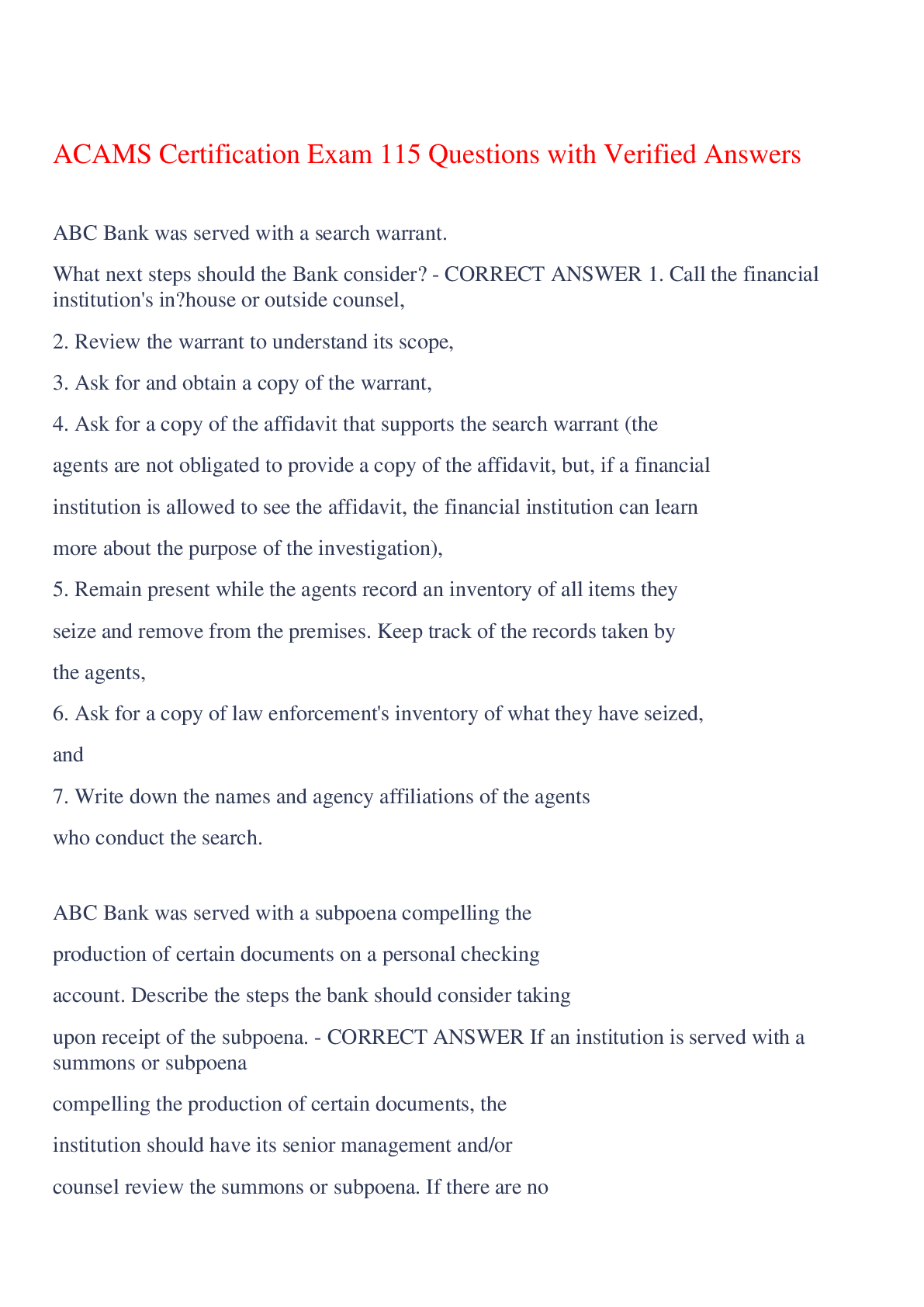
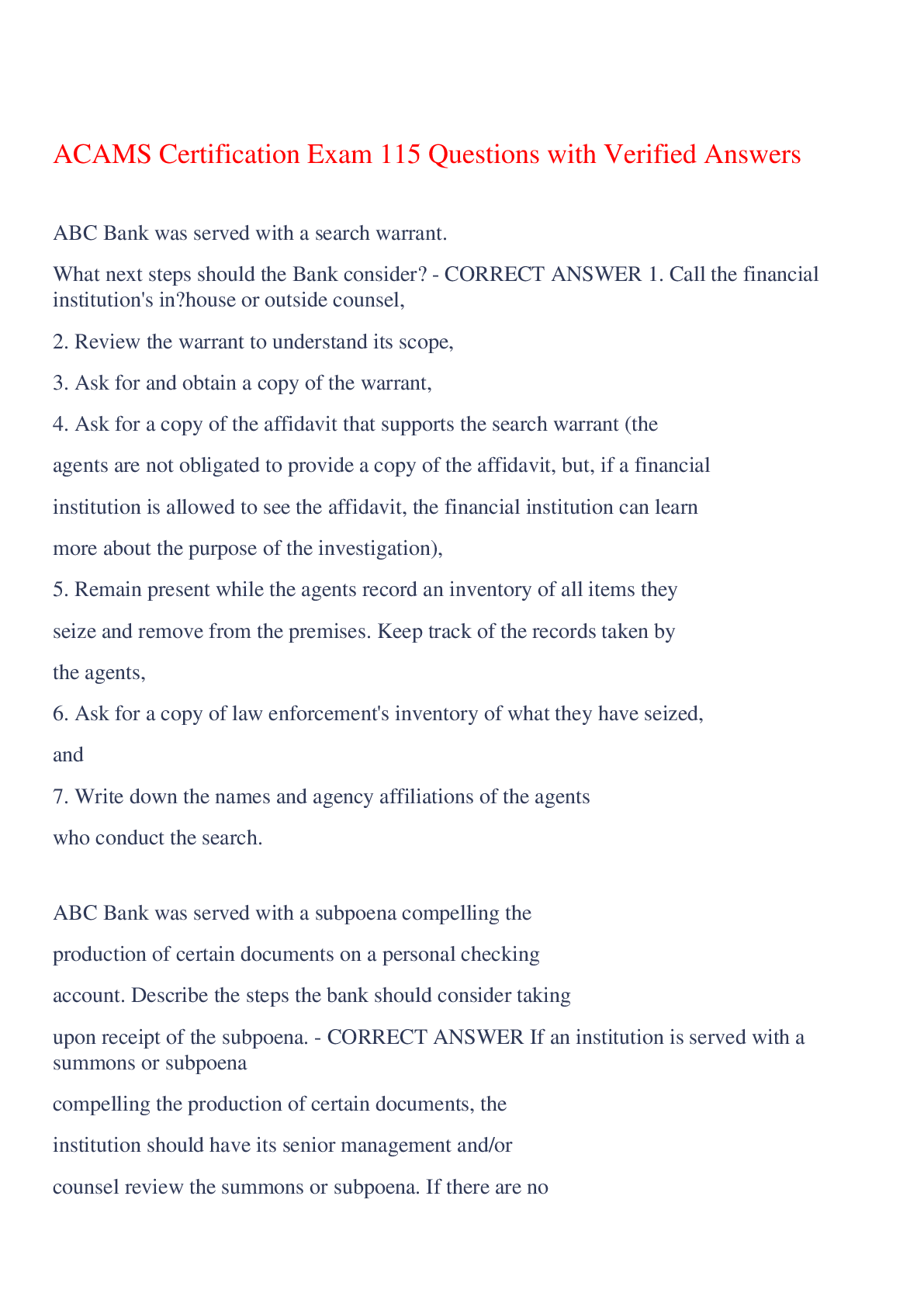
ACAMS Certification Exam 115 Questions with Verified Answers
ABC Bank was served with a search warrant.
What next steps should the Bank consider? - CORRECT ANSWER 1. Call the financial institution's in‐house or outside counsel,
2. Review the warrant to understand its scope,
3. Ask for and obtain a copy of the warrant,
4. Ask for a copy of the affidavit that supports the search warrant (the
agents are not obligated to provide a copy of the affidavit, but, if a financial
institution is allowed to see the affidavit, the financial institution can learn
more about the purpose of the investigation),
5. Remain present while the agents record an inventory of all items they
seize and remove from the premises. Keep track of the records taken by
the agents,
6. Ask for a copy of law enforcement's inventory of what they have seized,
and
7. Write down the names and agency affiliations of the agents
who conduct the search.
ABC Bank was served with a subpoena compelling the
production of certain documents on a personal checking
account. Describe the steps the bank should consider taking
upon receipt of the subpoena. - CORRECT ANSWER If an institution is served with a summons or subpoena
compelling the production of certain documents, the
institution should have its senior management and/or
counsel review the summons or subpoena. If there are no
grounds for contesting the summons or subpoena, the
institution should take all appropriate measures to comply
with the summons or subpoena on a timely and complete
basis. Failure to do so can result in adverse action and
penalties for the institution. Also, the financial institution
should not notify the customer who is being investigated. If
the government asks the bank to keep certain accounts open,
such a request should be obtained in writing under proper
letterhead and authority from the government.
According to a 2001 report, "Money Laundering in Canada:
An Analysis of RCMP Cases," what are the four related
reasons to establish or control a shell company for money
laundering purposes? - CORRECT ANSWER • Shell companies accomplish the objective of converting the
cash proceeds of crime into alternative assets,
• Through the use of shell companies, the launderer can
create the perception that illicit funds have been generated
from a legitimate source,
• Once a shell company is established, a wide range of
legitimate and/or bogus business transactions can be used to
further the laundering process, and
• Shell companies can also be effective in concealing criminal
ownership. Nominees can be used as owners, directors,
officers or shareholders.
According to FATF, what three circumstances should
be kept in mind when dealing with possible cuckoo smurfing
activity? - CORRECT ANSWER • The existence of these deposits is not necessarily grounds to
reconsider the relationship with a customer.
• It could be the indicator of laundering, therefore it should be
examined carefully.
• Law enforcement will need information on the depositor, so
banks should seek to identify cash deposits made by third parties
and should retain surveillance footage.
According to FATF's paper called "Money Laundering and
Terrorist Financing Vulnerabilities of Commercial Websites
and Internet Payment Systems," what are the different
classes/types of commercial websites? - CORRECT ANSWER • Mediated customer‐to‐customer, sites that allow private
individuals to sell to one another via an online marketplace,
• Mediated business‐to‐customer, sites that allow multiple
merchants to sell to consumers via an online marketplace,
• Non‐mediated customer‐to‐customer (i.e. Bulletin board services
and online classifieds), sites that only allow customers to advertise
goods they want to sell,
• Direct business‐to‐customer, merchants that sell goods to
consumers via their own websites, and
• Direct business‐to‐business websites,
merchants selling to merchants.
According to FATF's paper called "Risk‐Based Approach
Guidance for Casinos," what are the potential transaction
risks for land‐based and internet casinos? - CORRECT ANSWER According to FATF's paper called "Risk‐Based Approach Guidance
for Casinos,"casinos should consider operational aspects (i.e.
products, services, games, and accounts/account activities) that can
be used to facilitate money laundering and terrorist financing
activities. In addition, land‐based and Internet casinos have the
following potential transaction risks:
• Proceeds of crime,
• Cash,
• Transfers between customers,
• Loan sharking,
• Use of casino deposit accounts, and
• Redemption of chips, tickets, or tokens for currency.
According to FATF's Recommendations (2012), what are the
designated thresholds for transactions under
Recommendations 10, 22, and 23? - CORRECT ANSWER FATF also designated specific thresholds that trigger AML
scrutiny. For example, the threshold that financial institutions
should monitor for occasional customers is €15,000
[Recommendation 10]; for casinos, including Internet casinos,
it is €3,000 [Recommendation 22]; and
for dealers in precious metals, when engaged in any
cash transaction, it is €15,000 [Recommendation 22‐23].
According to Section 312 of the USA Patriot Act, the due
diligence program for correspondent and private banking
accounts must address what three measures? - CORRECT ANSWER The due diligence program for foreign correspondent and private
banking accounts for non‐U.S. persons must include "appropriate,
specific and risk‐based," and, where necessary, enhanced policies,
procedures and controls reasonably designed to identify and report
suspected money laundering in a correspondent account
maintained in the United States. This due diligence program must
also be included in the institution's anti‐money laundering program.
The due diligence program must address three measures:
• Determining whether enhanced due diligence is necessary,
• Assessing the money laundering risk presented by the
correspondent account,
• Applying risk‐based procedures and controls reasonably designed
to detect and report suspected money laundering.
According to statements by the U.S. Treasury and Internal
Revenue Service (IRS), what are some patterns
financial institutions can look for as they investigate possible
money laundering? - CORRECT ANSWER • Unusually high monthly balances in comparison to known sources
of income,
• Unusually large deposits, deposits in round numbers or deposits
in repeated amounts that are not attributable to legitimate sources
of income,
• Multiple deposits made under reportable thresholds,
• The timing of deposits. This is particularly important when dates
of illegal payments are known,
• Checks written for unusually large amounts (in relation to the
suspect's known practices), or
• A lack of account activity. This might indicate transactions in
currency or the existence of other unknown bank accounts.
According to the 1999 U.S. Customs "trade advisory" titled
"The Black Market Peso Exchange," what are the three
red flags as indicators of BMPE? - CORRECT ANSWER • Payment made in cash by a third party with no connection
to the underlying transaction,
• Payment made by wire transfers from third parties
unconnected to the underlying transaction, and
• Payment made with checks, bank drafts or money
orders not drawn on the account of the purchaser.
According to the Basel Committee on Banking Supervision's
paper entitled "Compliance and the compliance
function in banks," what are the responsibilities
of the board of directors for compliance? - CORRECT ANSWER According to the Basel Committee on Banking Supervision's
paper entitled "Compliance and the compliance function in
banks," the bank's board of directors is responsible for
overseeing the management of the bank's compliance risk.
The board should approve the bank's compliance policy,
including a formal document establishing a permanent and
effective compliance function. At least once a year,
the board or a committee of the board should assess the
extent to which the bank is managing its compliance
risk effectively.
According to the Basel Committee on Banking Supervision's
paper entitled "Customer Due Diligence for Banks," how are
sound KYC procedures relevant to the safety and soundness
of banks? - CORRECT ANSWER • They help to protect banks' reputation and the integrity of
banking systems by reducing the likelihood of banks
becoming a vehicle for or a victim of financial crime and
suffering consequential reputational damage, and
• They constitute an essential part of sound risk management
(e.g. by providing the basis for identifying, limiting and
controlling risk exposures in assets and liabilities, including
assets under management).
According to the Egmont Group, what is the definition
of a Financial Intelligence Unit (FIU)? - CORRECT ANSWER In 1996, based on the work of its Legal Working Group,
Egmont approved a definition of an FIU. It was amended in
2004 to reflect the FIUs' role in combating terrorism financing
as follows: (a) A central, national agency responsible for
receiving (and, as permitted, requesting), analyzing and
disseminating to the competent authorities, disclosures of
financial information, (b) Concerning suspected proceeds of
crime and potential financing of terrorism, and (c) Required
by national legislation or regulation, in order to combat
money laundering and terrorism financing.
According to the Egmont Group's "Principles for Information
Exchange Between Financial Intelligence Units for Money
Laundering and Terrorism Financing Cases," what are the
permitted uses of information? - CORRECT ANSWER • Information exchanged between FIUs may be used only for
the specific purpose for which the information was sought or
provided.
• The requesting FIU may not transfer information shared by
a disclosing FIU to a third party, nor make use of the
information in an administrative, investigative, prosecutorial,
or judicial purpose without the prior consent of the FIU that
disclosed the information.
According to the FATF 40 Recommendations, the complete
set of countermeasures against money laundering and
terrorist financing covers what 5 elements? - CORRECT ANSWER • The identification of risks and development of appropriate
policies,
• The criminal justice system and law enforcement,
• The financial system and its regulation,
• The transparency of legal persons and arrangements, and
• International cooperation.
According to the Wolfsberg Anti‐Money Laundering Principles
for Private Banking (2000), what are situations for private
banking that require further due diligence? - CORRECT ANSWER • Public officials, including individuals holding, or having held,
positions of public trust, as well as their families and close
associates,
• High‐risk countries, including countries "identified by
credible sources as having inadequate anti‐money laundering
standards or representing high‐risk for crime and
corruption, " and
• High‐risk activities, involving clients and beneficial owners
whose source of wealth "emanates from activities known to
be susceptible to money laundering.
According to the Wolfsberg Statement on AML Screening,
Monitoring, and Searching (2009), what are the most
appropriate and effective overall monitoring frameworks? - CORRECT ANSWER The Wolfsberg Group believes that a risk‐based approach enhances the
effectiveness of monitoring for unusual and potentially suspicious
activity, to the extent that such activity is distinguishable from
legitimate activity. It is for this reason that the Wolfsberg Group
supports the introduction of risk‐based monitoring models and
frameworks that are sufficiently flexible to meet the needs and nature
of individual financial institutions. The most appropriate and effective
overall monitoring framework may contain one or more of the
following elements:
• A dedicated automated transaction monitoring system,
• System‐generated exception reports,
• Manual "line of business" incident reports,
• Scheduled periodic reviews/sampling, and
• Event‐driven reviews (e.g., following issuance of new typologies).
Are the costs of non‐compliance with anti‐money laundering
laws and regulations limited to fines and penalties levied by
regulators? - CORRECT ANSWER The cost of the fines and penalties levied by regulators
due to non‐compliance with anti‐money laundering laws and
regulations is only part of the overall expense. Significant
additional costs include legal bills, potential
loss of business due to reputational damage, extensive
compliance review charges, consulting fees, costs for system
and other compliance program enhancements, as well as the
opportunity costs as the compliance staff and others will be
spending the bulk of their time addressing the consent order.
Define a red flag. - CORRECT ANSWER A warning signal that should bring attention to a potentially
suspicious situation, transaction or activity.
Define a search warrant and describe how it is issued. - CORRECT ANSWER A search warrant is a grant of permission from a court for
a law enforcement agency to search certain designated
premises and to seize specific categories of items or
documents. Generally, the requesting agency is required
to establish that probable cause exists to believe that
evidence of a crime will be located. The warrant is authorized
based on information contained in an
affidavit submitted by a law enforcement officer.
Define physical cross‐border transportation of currency. - CORRECT ANSWER The physical cross‐border transportation of currency is
defined as any in‐bound or out‐bound transportation of
currency or bearer negotiable instruments from one country
to another. The term includes: (1) physical transportation by
a natural person, or in that person's accompanying luggage or
vehicle; (2) shipment of
currency through cargo containers; and (3) the mailing
of currency or bearer negotiable instruments.
Define smurfing. - CORRECT ANSWER A commonly used money laundering method, smurfing
involves the use of multiple individuals and/or multiple
transactions for making cash deposits, buying monetary
instruments or bank drafts in amounts under
the reporting threshold.
Describe a cross‐border transfer. - CORRECT ANSWER A cross‐border transfer is any wire transfer in which the
originator and beneficiary institutions are located in different
jurisdictions. A cross‐border transfer also
refers to any chain of wire transfers that has at least
one cross‐border element.
Describe a Financial Intelligence Unit (FIU). - CORRECT ANSWER A central governmental office that obtains information from
financial reports, processes it and then discloses
it to an appropriate government authority in support of a
national anti‐money laundering effort. The activities
performed by an FIU include receiving, analyzing and
disseminating information and, sometimes,
investigating violations and prosecuting
individuals indicated in the disclosures.
Describe a lockbox. - CORRECT ANSWER A service offered by banks to companies in which the
company receives payments by mail to a post office box and
the bank picks up the payments several times a day, deposits
them into the company's account, and notifies the company
of the deposits. The service enables the company to put the
money to work as soon as it is received, but the amounts
must be large in order for the value obtained to exceed the
cost of the service. In the insurance industry there is also
widespread use of "lock boxes" for payment
of life insurance and annuities products.
Describe a nostro account. - CORRECT ANSWER Nostro and vostro accounts are mirror correspondent
accounts maintained by two banks in different jurisdictions to
facilitate transactions in each other's local
currency—essentially, clearing accounts that balance foreign
currency transactions between the two institutions. For
example, Bank X from Brazil might open a U.S.‐dollar account
at Bank Y in the U.S., called a "nostro"
(literally "our") account; Bank Y might open a mirror account
in Brazilian reals with Bank X in Brazil—a "vostro" ("your")
account. Financial regulators have expressed concern over
the transparency of nostro and vostro account relationships,
especially when there are multiple layers of accounts within
primary relationships.
Describe a Patriot Act certification. - CORRECT ANSWER A certification is a formal assertion in writing which,
under the USA Patriot Act, is used by U.S. regulators in
different contexts, including a written statement by a
respondent bank signed by its duly authorized representative
certifying that the bank does not do business with shell banks
(under Section 313 of the USA Patriot Act). It can also be a
written representation provided by a U.S. federal agent
stating that the matter for which he or she is seeking
information from financial institutions under Sec. 314(a) of
the USA Patriot Act regulations is linked to money
laundering or terrorist financing.
Describe a Ponzi Scheme. - CORRECT ANSWER A money laundering system named after Charles Ponzi, an Italian
immigrant who spent 10 years in jail in the U.S. for a scheme that
defrauded 40,000 people out of $15,000,000. Ponzi's name became
synonymous with the use of new investors' money to pay off prior
investors. Ponzi schemes involve fake, non‐existent investment
schemes in which the investors are tricked into investing on the
promise of unusually attractive returns. The operator of the scheme
can keep the operation going by paying off early investors with the
money from new investors until the scheme collapses under its own
weight and/or the promoter vanishes with the remaining money.
The scheme recently engaged in by Bernie Madoff is an example of
a Ponzi scheme. The prime bank guaranty, roll program, bank
debenture program and high yield promises are frequently used to
entice investors into participating in Ponzi schemes.
Describe a sound Know Your Employee program. - CORRECT ANSWER A Know Your Employee (KYE) program means that
the institution has a program in place that allows it to
understand an employee's background, conflicts of interest
and susceptibility to money laundering complicity.
Policies, procedures, internal controls, job descriptions, code
of conduct/ethics, levels of authority, compliance with
personnel laws and regulations, accountability, monitoring,
dual control, and other deterrents should
be firmly in place.
Describe a tax haven. - CORRECT ANSWER Countries that offer special tax incentives or tax
avoidance to foreign investors and depositors.
Describe a trustee. - CORRECT ANSWER A trustee may be a paid professional or company or unpaid
person that holds the assets in a trust fund separate from the
trustee's own assets. The trustee invests and disposes of the
assets in accordance with the settlor's trust deed, taking into
consideration any letter of wishes.
Describe a typical suspicious or unusual transaction reporting
process within a financial institution. - CORRECT ANSWER While reporting procedures vary from country to country,
a typical suspicious or unusual transaction reporting process
within a financial institution includes:
• Procedures to identify potential suspicious transactions or
activity,
• A formal evaluation of each instance, and continuation,
of unusual transactions or activity,
• Documentation of the suspicious transaction reporting decision,
whether or not filed with the authorities,
• Procedures to periodically notify senior management or the board
of directors of suspicious transaction filings, and
• Employee training on detecting suspicious transactions or
activities.
Describe an intermediary financial institution. - CORRECT ANSWER An intermediary financial institution receives funds from a
wire transfer transmitter's financial institution and relays or
transmits the order of payment to the recipient's financial
institution. In an international funds transmission,
intermediary financial institutions are usually
located in different countries.
Describe FATF's Recommendation 1 (2012)
on the risk‐based approach. - CORRECT ANSWER Countries should start by identifying, assessing and
understanding the money laundering and terrorist
financing risks they face. Then they should take appropriate
measures to mitigate the identified risks.
The risk‐based approach allows countries to target their
limited resources in a targeted manner to their own
particular circumstances, thereby increasing the
efficiency of the preventative measures. Financial institutions
should also use the risk‐based approach
to identify and mitigate the risks they face.
Describe FATF's Recommendation 15 (2012) on new
technologies. - CORRECT ANSWER Countries and financial institutions should assess the risks
associated with developments of new products, business
practices, delivery mechanisms and technology. Financial
institutions should assess these risks prior to launching new
products; they should also take appropriate
measures to mitigate the risks identified.
Describe FATF's Recommendations 20‐21 (2012) on
suspicious transaction reporting and liability. - CORRECT ANSWER The Recommendations say that financial institutions must
report to the Financial Intelligence Unit where they suspect
or have reasonable grounds to suspect that funds are the
proceeds of a criminal activity or are related to terrorist
financing. The financial institutions and the employees
reporting such suspicions should be protected from liability
for reporting and should be prohibited from disclosing
that they have reported such activity.
Describe four types of risk associated with
money laundering faced by a financial institution. - CORRECT ANSWER • Reputational risk is described as the potential that adverse publicity
regarding an organization's business practices and associations, whether
accurate or not, will cause a loss of public confidence in the integrity of the
organization.
• Operational risk is described as the potential for loss resulting from
inadequate internal processes, personnel or systems or from external
events.
• Legal risk is the potential for lawsuits, adverse judgments, unenforceable
contracts, fines and penalties generating losses, increased expenses for an
organization, or even the closure
of the organization.
• Concentration risk is the potential for loss resulting from
too much credit or loan exposure to one borrower or
group of borrowers.
Describe how the independent audit should review
Suspicious Transaction Reporting (STR) systems. - CORRECT ANSWER The independent audit should review Suspicious Transaction
Reporting (STR) systems, which should include an evaluation
of the research and referral of unusual transactions. Testing
should include a review of policies, procedures and processes
for referring unusual or suspicious activity from all business
lines (e.g., legal, private banking, foreign correspondent
banking) to the personnel or department responsible for
evaluating unusual activity.
Describe Know Your Customer (KYC). - CORRECT ANSWER Know Your Customer (KYC) refers to anti‐money laundering
policies and procedures used to determine the true identity
of a customer and the type of activity that is "normal and
expected," and to detect activity that is "unusual" for a
particular customer. Many experts believe that a sound KYC
program is one of the best tools in an effective anti‐money
laundering program.
Describe microstructuring. - CORRECT ANSWER Designing a transaction to evade triggering a reporting or
recordkeeping requirement is called "structuring."
Microstructuring is essentially the same as structuring, except that
it is done at a much smaller level. Instead of taking $18,000 and
breaking it into two deposits, the microstructurer might break it
into 20 deposits of approximately $900 each. This level of
structuring makes it extremely difficult to detect.
Describe several ways commodity futures and options
accounts may be susceptible to money laundering. - CORRECT ANSWER There are several ways commodity and futures accounts are susceptible to money
laundering, including:
• Withdrawal of assets through transfers to unrelated accounts or to
high‐risk countries,
• Frequent additions to or withdrawals from accounts,
• Checks drawn on, or wire transfers from, accounts of third parties
with no relation to the client,
• Clients who request custodial arrangements that allow them
to remain anonymous,
• Transfers of funds to the adviser for management followed by transfers to
accounts at other institutions in a layering scheme,
• Investing illegal proceeds for a client, and
• Movement of funds to disguise their origin.
Describe the elements that should be addressed in a
global approach to KYC identified in the Basel
Committee's October 2004 paper called
"Consolidated KYC Risk Management." - CORRECT ANSWER The Basel Committee's October 2004 paper called
"Consolidated KYC Risk Management" addresses the need for
banks to adopt a global approach and to apply the elements
necessary for a sound KYC program to both the parent bank
or head office and all of its branches and subsidiaries. These
elements consist of:
• Risk management,
• Customer acceptance and identification policies, and
• Ongoing monitoring of higher‐risk accounts.
Describe the three phases of money laundering. - CORRECT ANSWER • Placement is the physical disposal of cash or other assets derived
from criminal activity.
• Layering is the separation of illicit proceeds from their source by
layers of financial transactions intended to conceal the origin of the
proceeds.
• Integration is supplying apparent legitimacy to illicit wealth
through the re‐entry of the funds into the economy in what appears
to be normal business or personal transactions.
Describe the type of services to third parties that
any person or business provides on a professional basis
to participate in the creation, administration, or management
of corporate vehicles. - CORRECT ANSWER Trust and company service providers (TCSP) include those persons and
entities that, on a professional basis, participate in the creation,
administration or management of corporate vehicles. They refer to
any person or business that provides any of the following services
to third parties:
• Acting as a formation agent of legal persons,
• Acting as (or arranging for another person to act as) a director or
secretary of a company, a partner of a partnership, or a similar position in
relation to other legal persons,
• Providing a registered office, business address or correspondence for a
company, a partnership or any other legal person or arrangement,
• Acting as (or arranging for another person to act as) a trustee of an
express trust, and
• Acting as (or arranging for another person to act as) a nominee
shareholder for another person.
Describe willful blindness. - CORRECT ANSWER A legal principle that operates in money laundering cases
in the U.S. and is defined by courts as the "deliberate
avoidance of knowledge of the facts" or "purposeful
indifference." Courts have held that willful blindness is the
equivalent of actual knowledge of the illegal source of funds
or of the intentions of a customer in a money laundering
transaction.
How can art and antiques dealers and auctioneers
mitigate their money laundering risks? - CORRECT ANSWER • Require all art vendors to provide names and addresses. Ask that
they sign and date a form that states that the item was not stolen
and that they are authorized to sell it.
• Verify the identities and addresses of new vendors and
customers.
• If there is reason to believe an item might be stolen, immediately
contact the Art Loss Register (www. artloss.com), the world's
largest private database of stolen art.
• Look critically when a customer asks to pay in cash.
• Be aware of money laundering regulations.
• Appoint a senior staff member to whom employees can
report suspicious activities.
How can senior management show its commitment
to compliance with anti‐money laundering laws
and regulations? - CORRECT ANSWER • Establishing a strong compliance plan that is approved by
the board of directors and is fully implemented,
• Insisting that it be kept informed of compliance efforts,
audit reports and any compliance failures, with corrective
measures instituted,
• Communicating compliance expectations to the institution
personnel,
• Including regulatory compliance within the job descriptions
and job performance evaluations of institution personnel,
• Implementing procedures, processes and controls to ensure
compliance with the AML program, and
• Conditioning employment on regulatory compliance.
How can the early redemption method on insurance policies
be used to launder money? - CORRECT ANSWER One indicator of possible money laundering is when a potential
policyholder is more interested in the cancellation terms of a policy
than the benefits of the policy. The launderer buys a policy with
illicit money and then tells the insurance company that he has
changed his mind and does not need the policy. After paying a
penalty, the launderer redeems the policy and receives a clean
check from a respected insurer.
How can the free‐look period be used to launder money? - CORRECT ANSWER A free‐look period is a feature that allows investors, for a short
period of time after the policy is signed and the premium paid, to
back out of a policy without penalty. This process allows the money
launderer to get an insurance check, which represents cleaned
funds. However, as more insurance companies are subject to AML
program requirements, this type of money laundering is more
readily detected and reported.
How did the European Union's Second Directive on
Prevention on the Use of the Financial System for the
Purpose of Money Laundering (2001) expand the
scope of the First Directive? - CORRECT ANSWER The European Union's Second Directive on Preventation on
the Use of the Financial System for the Purpose of Money
Laundering (2001) extended the scope of the First Directive
beyond drug‐related crimes. The definition of "criminal
activity" was expanded to cover not just drug trafficking, but
all serious crimes, including corruption and fraud against the
financial interests of the European Community.
How does having a lawyer as a trustee on an account
at a financial institution create vulnerabilities to
money laundering at an institution? - CORRECT ANSWER Lawyers often serve as trustees by holding money or
assets "in trust" for clients. This enables lawyers to
conduct transactions and to administer the affairs of a client.
Sometimes, the illicit money is placed in a law firm's general
trust account in a file set up in the name of the client, a
nominee, or a company controlled by the client.
How does the Caribbean Financial Action Task Force (CFATF)
monitor member's implementation of the
anti‐money laundering recommendations? - CORRECT ANSWER The CFATF monitors members' implementation of the
anti‐money laundering recommendations identified in the
Kingston Declaration through the following activities:
• Self‐assessment of the implementation of the
recommendations,
• An ongoing program of mutual evaluation of members,
• Coordination of, and participation in, training and technical
assistance programs,
• Biennial plenary meetings for technical representatives, and
• Annual ministerial meetings.
How does the scope of the European Union's Third Money
Laundering Directive differ from the Second Money
Laundering Directive? - CORRECT ANSWER • It specifically includes the category of trust and company
service providers,
• It covers all dealers trading in goods who trade in cash over
15,000 Euros, and
• The definition of financial institution includes certain
insurance intermediaries.
How is a private banking account defined under
Section 312 of the USA Patriot Act? - CORRECT ANSWER Under Section 312 of the USA Patriot Act, a private banking
account is defined as an account with a minimum aggregate
deposit of $1 million for one or more non‐U.S. persons and
which is assigned to a bank employee acting as a liaison with
the non‐U.S. person.
• Private banking,
• Offshore international activity,
• Deposit‐taking facilities,
• Wire transfer and cash‐management functions,
• Transactions in which the primary beneficiary is undisclosed,
• Loan guarantee schemes,
• Travelers checks,
• Official bank checks,
• Money orders,
• Foreign exchange transactions,
• Trade‐financing transactions with unusual pricing features, and
• Payable
How should a financial institution monitor the receipt of a
subpoena, summons, or other government request? - CORRECT ANSWER When an institution receives a subpoena, summons or other
government request, the institution should do more than just
produce the records or information being sought. Financial
institutions should ensure that all grand jury subpoenas, as well as
other information requests from government agencies, are
reviewed by senior management, an investigations group or
counsel to determine how best to respond to the inquiry and to
determine if the inquiry or the underlying activity might pose a risk
to the institution. In addition, the institution should maintain a
centralized control over all requests and responses in order to
ensure that the requests are responded to on a complete and
timely basis and to establish a complete record of what is provided.
This centralized record will also assist with regard to the
institution's own internal investigation.
Identify and describe the three sections of the USA Patriot
Act concerning due diligence U.S. financial institutions need
to perform for relationships with foreign correspondent
banking customers. - CORRECT ANSWER Section 312 requires institutions must set up risk based due
diligence to mitigate the money laundering risks posed by foreign
financial institutions.
Section 313, which prohibits U.S. financial institutions from opening
or maintaining correspondent accounts for foreign shell banks and
requires them to take "reasonable steps" to ensure that a
correspondent account of a foreign bank is not being used indirectly
to provide banking services to a shell bank.
Section 319, which requires U.S. financial institutions to maintain
records with the names and address of the owners of foreign banks
for which they maintain correspondent accounts.
Identify several situations that may require a financial
institution to initiate an internal investigation? - CORRECT ANSWER • A report of examination from the regulators,
• Information from third parties, such as customers,
• Information derived from surveillance or monitoring systems,
• Information from employees or a company hotline,
• Receipt of a governmental subpoena or search warrant,
• Learning that government investigators are asking questions of
institution employees, business associates, customers or even
competitors, and
• The filing of a civil lawsuit against the institution or a
customer of the institution.
Identify several types of internal reports financial institutions
may use to discover money laundering
and terrorist financing. - CORRECT ANSWER • Daily cash activity in excess of the country's reporting threshold,
• Daily cash activity just below the country's reporting threshold
(to identify possible structuring),
• Cash activity aggregated over a period of time (e.g., individual
transactions over a certain amount, or totaling more than a certain
amount over a 30‐day period) to identify possible structuring,
• Wire transfer reports/logs (with filters using amount
and geographical factors),
• Monetary instrument logs/reports,
• Check kiting/drawing on uncollected funds
(significant debit/credit flows),
• Significant change reports, and
• New account activity reports.
Identify the basic elements behind the development of
an effective anti‐money laundering compliance
training program. - CORRECT ANSWER • Who to train,
• What to train on,
• How to train,
• When to train, and
• Where to train.
Identify the factors a prosecutor many consider when
determining whether or not to bring a case against an
institution involving money laundering‐related charges. - CORRECT ANSWER • The institution has a criminal history,
• The institution has cooperated with the investigation,
• The institution discovered and self‐reported the
money laundering‐related issues,
• The institution has had a comprehensive and effective AML
program,
• The institution has taken timely and effective remedial
action,
• There are civil remedies available that can serve as
punishment, or
• Deterring wrongdoing by others is needed and will be
served by a prosecution.
Identify the four ways that good technology can
equip organizations with improved defenses
in the fight against financial crime. - CORRECT ANSWER • Transaction monitoring: scanning and analyzing data
for potential money laundering activity,
• Watch list filtering: screening new accounts,
existing customers, beneficiaries and transaction
counterparties against terrorist, criminal and other blockedpersons
watch lists,
• Automation of regulatory reporting: filing suspicious
transaction reports (STRs), currency transaction
reports (CTRs), or other regulatory reports
with the government, and
• A detailed audit trail: demonstrates compliance
efforts to regulators.
Identify the responsibilities of the anti‐money
laundering compliance officer. - CORRECT ANSWER A person should be designated as the anti‐money laundering
compliance officer. This individual should be responsible for
designing and implementing the program, making necessary
changes and disseminating information about the program's
successes and failures to key staff members, constructing
anti‐money laundering‐related content for staff training
programs and staying current on legal and regulatory
developments in the field.
Identify the seven specific customer identification issues
as identified in the Basel Committee's October 2001
paper called "Customer Due Diligence for Banks." - CORRECT ANSWER • Trust, nominee and fiduciary accounts,
• Corporate vehicles, particularly companies with nominee shareholders or
entities with shares in bearer form,
• Introduced businesses,
• Client accounts opened by professional intermediaries, such as "pooled"
accounts managed by professional intermediaries on behalf of entities such
as mutual funds, pension funds and money funds,
• Politically exposed persons,
• Non‐face‐to‐face customers, i.e., customers who do not present
themselves for a personal interview, and
• Correspondent banking.
Identify the seven topics of international standards
incorporated into the FATF 40 Recommendations (2012). - CORRECT ANSWER • AML/CFT policies and procedures [Recommendations 1‐2],
• Money laundering and confiscation [Recommendations 3‐4],
•Terrorist financing and financing of proliferation
[Recommendations 5‐8],
• Financial and non‐financial institution preventative measures
[Recommendations 9‐23],
• Transparency and beneficial ownership of legal persons and
arrangements [Recommendations 24‐25],
• Powers and responsibilities of competent authorities and other
institutional measures [Recommendations 26‐35], and
• International cooperation [Recommendations 36‐40].
Identify the three gateways that assist with the
AML cooperation between countries. - CORRECT ANSWER • Mutual Legal Assistance Treaties,
• Financial Intelligence Units, and
• The Supervisory Channel.
Identify the three important tasks that FATF focuses on. - CORRECT ANSWER • Spreading the anti‐money laundering
message worldwide,
• Monitoring implementation of the FATF Recommendations
among FATF members, and
• Reviewing money laundering trends and countermeasures.
Identify three ways money laundering can occur
through vehicle sellers. - CORRECT ANSWER The industry defined as "vehicle sellers" includes sellers and brokers of new
vehicles, such as automobiles, trucks, and motorcycles; new aircraft,
including fixed wing airplanes and helicopters; new boats and ships, and
used vehicles. Laundering risks and ways laundering can occur through
vehicle sellers include:
• Structuring cash deposits below the reporting threshold, or purchasing
vehicles with sequentially numbered checks or money orders,
• Trading in vehicles and conducting successive transactions of buying and
selling new and used vehicles to produce complex layers of transactions,
• Accepting third‐party payments, particularly from jurisdictions with
ineffective money laundering controls.
The significance of a trust account — whether onshore or
offshore — in the context of money laundering cannot be
understated: It can be used as part of the first step in
converting illicit cash into less suspicious assets; it can help
hide criminal ownership of funds or other assets; and it is
often an essential link between different money laundering
vehicles and techniques, such as real estate, shell and active
companies, nominees and the deposit and transfer of
criminal proceeds.
There are several ways commodity and futures accounts are susceptible to money
Identify, in general, who should approve
policies and procedures. - CORRECT ANSWER Policies and procedures should be in writing, and must be
approved by appropriate levels of management. In general,
institution‐level policies should be approved by the board,
while business unit procedures can be approved by business
unit management.
If a bank is under investigation by a government agency for
possible money laundering, what steps should the
Bank have for its employees follow? - CORRECT ANSWER With regard to investigations conducted by the government,
employees should be informed of the investigation and
should be instructed not to produce corporate documents
directly, but, rather, should inform senior management or
counsel of all requests for documentation and should provide
the documents to them for production. In that way, the
institution will know what is being requested and what has
been produced. In addition, the institution can determine
what, if any, requests should be contested. The same
procedure should be followed with regard to
requests for employee interviews.
If an institution decides to file an STR,
what should they do as soon as possible? - CORRECT ANSWER Notify the investigators or prosecutors.
In 2009, FATF began to publicly identify
high risk jurisdictions. What made the named
jurisdictions high risk? - CORRECT ANSWER The named countries had strategic deficiencies in their
AML/CFT regimes.
Recommendations 36‐40 from FATF's 40 Recommendations
pertain specifically to the international aspects of money
laundering and terrorist financing investigations. What are
Recommendations 36‐40? - CORRECT ANSWER Recommendations 36‐40 deal with mutual legal assistance
treaties, extradition, confiscation of assets and mechanisms
to exchange information internationally.
The checking account for XYZ Trading LTD, a company
registered in the British Virgin Islands, was identified on a
government subpoena issued to International Bank. The
Bank has initiated an internal investigation on the account
and its beneficial owners. What factors should the Bank
consider on whether to close the account? - CORRECT ANSWER Based on its internal investigation, the institution should make an
independent determination as to whether to close the account in
issue. Some of the factors that the institution should
consider are as follows:
• The legal basis for closing an account,
• The institution's stated policies and procedures
for closing an account,
• How serious is the underlying conduct. If the conduct is serious
and rises to the level where the account would ordinarily be closed,
then the institution should consider closing the account, or
• As stated above, if law enforcement requests the institution to
keep the account open, the institution should request that
the investigator or prosecutor make that request in writing
on proper government agency letterhead with the
appropriate authorized signature.
What are bearer negotiable instruments? - CORRECT ANSWER Bearer negotiable instruments Include monetary instruments
in bearer form such as: negotiable instruments (including
checks, promissory notes and money orders) that are either
in bearer form, are endorsed without restriction, are made
out to a fictitious payee, or are otherwise in such form
that title there to passes upon delivery.
What are remittance services? - CORRECT ANSWER Remittance services are also referred to as giro houses or
casas de cambio. Remittance services are businesses that
receive cash or other funds that they transfer through the
banking system to another account. The account is held by
an associated company in a foreign jurisdiction where the
money is made available to the ultimate recipient.
What are six principles set forth in the Basel Committee's
Statement of Principles called "Prevention of Criminal Use of
the Banking System for the Purpose of Money Laundering"? - CORRECT ANSWER In 1988, the Basel Committee issued a Statement of Principles called
"Prevention of Criminal Use of the Banking System for the Purpose of
Money Laundering" in recognition of the vulnerability of the financial
sector to misuse by criminals. This was a step toward preventing the use of
the banking sector for money laundering, and it set out principles with
respect to:
• Customer identification,
• Compliance with laws,
• Conformity with high ethical standards and local laws and regulations,
• Full cooperation with national law enforcement to the extent permitted
without breaching customer confidentiality,
• Staff training, and
• Record keeping and audits.
What are some characteristics of a successful
anti‐money laundering compliance training program? - CORRECT ANSWER Regulations and laws require financial institutions to have
formal, written AML compliance programs that include
"training for appropriate personnel." A successful training
program not only should meet the standards set out in the
laws and regulations that apply to an institution, but should
also satisfy internal policies and procedures and should
mitigate the risk of getting caught up in a money laundering
scandal. Training is one of the most important ways to stress
the importance of anti‐money laundering efforts, as well as
educating employees about what to do if they encounter
potential money laundering.
What are the basic elements of financial institution's
anti‐money laundering program? - CORRECT ANSWER • A system of internal policies, procedures and controls,
• A designated compliance officer with day‐to‐day oversight
over the AML program,
• An ongoing employee training program, and
• An independent audit function to test the AML program.
What are the economic effects of money laundering? - CORRECT ANSWER • Loss of control of, or mistakes in, decisions regarding economic
policy,
• Economic distortion and instability,
• Loss of tax revenue,
• Risks to privatization efforts,
• Reputation risk for the country, and
• Social costs.
What are the four key elements of Know Your Customer (KYC)
as identified in the Basel Committee's October 2001 paper
called "Customer Due Diligence for Banks?" - CORRECT ANSWER • Customer identification,
• Risk management,
• Customer acceptance, and
• Monitoring.
What are the seven elements of a sound customer due
diligence (CDD) program? - CORRECT ANSWER • Full identification of customer and business entities, including source
of funds and wealth when appropriate,
• Development of transaction and activity profiles of each customer's
anticipated activity,
• Definition and acceptance of the customer in the context of specific
products and services,
• Assessment and grading of risks that the customer or the account
present,
• Account and transaction monitoring based on the risks presented,
• Investigation and examination of unusual customer or account
activity, and
• Documentation of findings.
What are the steps commonly taken to obtain
mutual legal assistance? - CORRECT ANSWER 1. The central authority of the requesting country sends a "commission
rogatoire" (letter rogatory, or letter of request) to the central authority
of the other country. The letter includes the information sought, the
nature of the request, the criminal charges in the requesting country
and the legal provision under which the request is made,
2. The central authority that receives the request sends it to a local
financial investigator to find out if the information is available,
3. An investigator from the requesting country then visits the country
where the information is sought, and accompanies the local
investigator during visits or when statements are taken,
4. The investigator asks the central authority for permission to
remove the evidence to the requesting country,
5. The central authority sends the evidence to the requesting central
authority, thereby satisfying the request for mutual legal assistance,
and
6. Local witnesses may need to attend court hearings in the
requesting country.
What are the two main reasons correspondent
banking is vulnerable to money laundering? - CORRECT ANSWER • By their nature, correspondent banking relationships create a
situation in which a financial institution carries out financial
transactions on behalf of customers of another institution. This
indirect relationship means that the correspondent bank provides
services for individuals or entities for which it has neither verified
the identities nor obtained any first‐hand knowledge, and
• The amount of money that flows through correspondent accounts
can pose a significant threat to financial institutions, as they process
large volumes of transactions for their customers' customers. This
makes it more difficult to identify the suspect transactions, as the
financial institution generally does not have the information on the
actual parties conducting the transaction to know whether they are
unusual.
What banking functions or products are considered
high‐risk? - CORRECT ANSWER • Private banking,
• Offshore international activity,
• Deposit‐taking facilities,
• Wire transfer and cash‐management functions,
• Transactions in which the primary beneficiary is undisclosed,
• Loan guarantee schemes,
• Travelers checks,
• Official bank checks,
• Money orders,
• Foreign exchange transactions,
• Trade‐financing transactions with unusual pricing features, and
• Payable Through Accounts (PTAs).
What characteristics of charities or non‐profit organizations
make them particularly vulnerable to misuse for terrorist
financing? - CORRECT ANSWER • Enjoying the public trust,
• Having access to considerable sources of funds,
• Being cash‐intensive,
• Frequently having a global presence, often in or next to
those areas that are exposed to terrorist activity, and
• Often being subject to little or no regulation and/or having
few obstacles to their creation.
What factors may contribute to the vulnerabilities of private
banking with regard to money laundering? - CORRECT ANSWER • Perceived high profitability,
• Intense competition,
• Powerful clientele,
• The high level of confidentiality associated with private banking,
• The close relationship of trust developed between relationship
managers and their clients,
• Commission‐based compensation for relationship managers,
• A culture of secrecy and discretion developed by the relationship
managers for their clients, and
• The relationship managers becoming client advocates to protect their
clients.
What general characteristics of terrorist financing can
a financial institution look at to avoid becoming
conduits for terrorist financing? - CORRECT ANSWER FATF's report entitled "Guidance for Financial Institutions in
Detecting Terrorist Financing" published April 24, 2002
describes general characteristics of terrorist financing that a
financial institution can look at to avoid becoming conduits
for terrorist financing, including: (a) Use of an account as a
front for a person with suspected terrorist links, (b)
Appearance of an accountholder's name on a list of
suspected terrorists, (c) Frequent large cash deposits in
accounts of non‐profit organizations, (d) High volume of
transactions in the account, and (e) Lack of a clear
relationship between the banking activity and the
nature of the accountholder's business.
What is a commission rogatoire? - CORRECT ANSWER Also known as letter rogatory, commission rogatoire is a
written request for legal or judicial assistance sent by the
central authority of one country to the central authority of
another when seeking evidence from the foreign jurisdiction.
The letter typically specifies the nature of the request, the
relevant criminal charges in the requesting country, the legal
provision under which the request is made, and the
information sought.
What is a concentration account? - CORRECT ANSWER Concentration accounts are internal accounts established to
facilitate the processing and settlement of multiple or individual
customer transactions within the bank, usually on the same day.
These accounts are also known as special‐use, omnibus, settlement,
suspense, intraday, sweep or collection accounts. Concentration
accounts are frequently used to facilitate transactions for private
banking, trust and custody accounts, funds transfers and
international affiliates.
What is a country's extraterritorial reach? - CORRECT ANSWER The extension of one country's policies and laws to the
citizens and institutions of another. U.S. money laundering
laws contain several provisions that extend its prohibitions
and sanctions into other countries. For example, the
"extraterritorial jurisdiction" of the principal U.S.
anti‐money laundering law can apply to a non‐U.S. citizen
if the "conduct" occurs "in part" in the U.S.
(Title 18, USC Sec. 1956(f)).
What is a front company? - CORRECT ANSWER A business that commingles illicit funds with revenue
generated from the sale of legitimate products or services.
Criminals use front companies to launder illicit money by
giving the funds the appearance of legitimate origin.
Organized crime has used pizza parlors to mask proceeds
from heroin trafficking. Front companies may have access to
substantial illicit funds, allowing them to subsidize front
company products and services at levels well below market
rates or even below manufacturing costs. Front companies
have a competitive advantage over legitimate firms that must
borrow from financial markets, making it difficult for
legitimate businesses to compete with front companies.
What is a Memorandum of Understanding (MOU)? - CORRECT ANSWER An agreement between two parties establishing a set of
principles that govern their relationship on a particular matter.
An MOU is often used by countries to govern their sharing of
assets in international asset‐forfeiture cases or to set out their
respective duties in anti‐money laundering initiatives. Financial
Intelligence Units (FIUs), with the task of receiving and analyzing
suspicious transaction reports on an ongoing basis and
maintaining close links with police and customs authorities,
share information among themselves informally in the context
of investigations, usually on the basis of an MOU. The Egmont
Group of FIUs has established a model for such MOUs. Unlike
the Mutual Legal Assistance Treaty (see below), this gateway is
ordinarily used not for obtaining evidence, but for obtaining
intelligence that might lead to evidence.
What is a Mutual Legal Assistance Treaty (MLAT)? - CORRECT ANSWER An agreement among countries allowing for mutual
assistance in legal proceedings and access to documents and
witnesses and other legal and judicial resources in the
respective countries, in private and public sectors, for use in
official investigations and prosecutions.
What is a nominee company? - CORRECT ANSWER A corporation that is formed for the express purpose of
holding securities and other assets in its name on behalf
of others, or providing nominee directors and/or officers on
behalf of clients.
What is a safe harbor for reporting suspicious activity? - CORRECT ANSWER Safe harbor is defined as legal protection for financial
institutions, their directors, officers and employees from
criminal and civil liability for breach of any restriction on
disclosing information imposed by contract or by any
legislative, regulatory or administrative prohibition, if they
report their suspicions in good faith to the Financial
Investigation Unit (FIU), even if they did not know precisely
what the underlying criminal activity was, and regardless
of whether illegal activity actually occurred.
What is an exempt account? - CORRECT ANSWER In some countries, a distinction is granted to certain
customers of a financial institution permitting the institution
to waive its responsibility to report certain transactions that
are otherwise required. Exempt accounts must be
documented and the financial institutions that secure the
exemptions must still monitor their transactions.
What is an International Business Company (IBC)? - CORRECT ANSWER A variety of offshore corporate structures, alternately called
"exempt companies," which are dedicated to business use
outside the incorporating jurisdiction, rapid formation,
secrecy, broad powers, low cost, low to zero taxation, and
minimal filing and reporting requirements.
What is hawala? - CORRECT ANSWER A funds exchange system in Indian and Chinese civilizations used to
facilitate the secure and convenient cross‐border movement of funds.
Hawala was born centuries before Western financial systems.
Merchant traders wishing to send funds to their homelands would
deposit them with a hawala broker or hawaladar who normally owned
a trading business. For a small fee, the banker would arrange for the
funds to be available for withdrawal from another banker, normally
also a trader, in another country. The two bankers would settle
accounts through the normal process of trade. Today, the technique
works much the same, with businesspersons in various parts of the
world using their corporate accounts to move money internationally for
third parties. Deposits and withdrawals are made through hawaladars,
rather than traditional financial institutions. The practice is vulnerable
to terrorist financing and money laundering—funds do not actually
cross borders, and transactions tend to be confidential, as records are
not stringently kept. In Pakistan, the system is called hundi. See
Alternative Remittance System.
What is one of the most important aspects of
due diligence for a bank when establishing a
relationship with a money remitter? - CORRECT ANSWER Ensuring the money remitter is properly licensed.
What is the broad objective of the UNODC model legislation
on money laundering and financing of terrorism? - CORRECT ANSWER The broad objective of the Global Programme is to
strengthen the ability of Member States to implement
measures against money‐laundering and the financing of
terrorism and to assist them in detecting, seizing and
confiscating illicit proceeds, as required pursuant to United
Nations instruments and other globally accepted standards,
by providing relevant and appropriate technical assistance
upon request.
What is the difference in the money trail between
terrorist financing and money laundering? - CORRECT ANSWER The money trail for money laundering is circular with money
eventually ending up with the person who generated it. On
the other hand, the money trail for terrorist financing is linear
with the money generated
being used to propagate terrorist groups and activities.
What is the most basic difference between terrorist
financing and money laundering? - CORRECT ANSWER The most basic difference between terrorist financing and
money laundering involves the origin of the funds. Terrorist
financing uses funds for an illegal political purpose, but the
money is not necessarily derived from illicit proceeds. On the
other hand, money laundering always involves the proceeds
of illegal activity. The purpose of laundering is to enable the
money to be used legally.
What is the purpose of conducting
an internal investigation? - CORRECT ANSWER The purpose of the investigation will be to learn the nature
and extent of any potential wrongdoing, to develop
information sufficient to report ‐ when necessary ‐ to the
authorities, to enable the institution to minimize its liability,
and to stop any potential money laundering.
What is the significance of a trust account, whether offshore
or onshore, in the context of money laundering? - CORRECT ANSWER The significance of a trust account — whether onshore or
offshore — in the context of money laundering cannot be
understated: It can be used as part of the first step in
converting illicit cash into less suspicious assets; it can help
hide criminal ownership of funds or other assets; and it is
often an essential link between different money laundering
vehicles and techniques, such as real estate, shell and active
companies, nominees and the deposit and transfer of
criminal proceeds.
What is tipping off? - CORRECT ANSWER The improper or illegal act of notifying a suspect that he or
she is the subject of a Suspicious Transaction Report or is
otherwise being investigated or pursued by the authorities.
What steps should the independent audit take to evaluate
the bank's ability to identify unusual activity? - CORRECT ANSWER • Reviewing policies, procedures, and processes for
suspicious activity monitoring,
• Evaluating the system's methodology for establishing and
analyzing expected activity or filtering criteria,
• Evaluating the system's ability to generate monitoring
reports, and
• Determining whether the system's filtering criteria
are reasonable.
What steps should the institution take to ensure a
written report on the internal investigation retains
the attorney‐client privilege? - CORRECT ANSWER If counsel for the institution prepares a written report of an
investigation, the institution should take steps to not
inadvertently waive the attorney‐client privilege by
distributing the report to persons who should not receive it.
Every page of the report should contain a statement that it is
confidential and is subject to the attorney‐client privilege and
work‐product privilege. Copies of the report should be
numbered, and a list of persons who are given copies to read
should be maintained. After a set period of time, all copies
should be returned. Persons obtaining the report should be
instructed not to make notes on their copies. All copies
should be maintained in a file separate from regular
institution files in a further effort to maintain the highest
level of protection.
What type of documents would a financial institution
have that could assist a financial investigator in tracking
money movements? - CORRECT ANSWER A financial investigator's main objective is to track the
movement of money, whether through a bank, broker‐dealer,
money services business or casino. For example, banks
maintain signature cards, which are collected at the opening
of an account, account statements, deposit tickets, checks
and withdrawal items and credit and debit memorandums.
Banks also keep records on loans, cashier's checks, certified
checks, traveler's checks and money orders. They exchange
currency, cash third‐party checks, and conduct wire transfers,
as do most money services businesses. Banks also keep safedeposit
boxes and issue credit cards.
What types of customers might be considered
high‐risk for money laundering? - CORRECT ANSWER • Casinos,
• Offshore corporations and banks located in tax/banking havens,
• Leather goods stores,
• Currency exchange houses, money remitters, check cashers,
• Car, boat and plane dealerships,
• Used‐car and truck‐dealers and machine parts manufacturers,
• Travel agencies,
• Brokers/dealers in securities,
• Jewel, gem and precious metals dealers,
• Import/ export companies, and
• Cash‐intensive businesses (restaurants, retail stores, parking).
When categorizing risks, what are the four
general levels of risk? - CORRECT ANSWER • Prohibited — The company will not tolerate any dealings of any kind
given the risk. Countries subject to economic sanctions or designated as
state sponsors of terrorism, such as Sudan or Iran, are prime candidates for
prohibited transactions. Prohibited customers would include shell banks,
• High‐Risk - The risks here are significant, but are not necessarily
prohibited. To mitigate the heightened risk presented, the firm should
apply more stringent controls to reduce the risk, such as conducting
enhanced due diligence and more rigorous transaction monitoring.
Countries that are noted for corruption or drug trafficking are generally
deemed high risk. High‐risk customers may include PEPs; high‐risk products
and services may include correspondent banking and private banking,
• Medium‐Risk — Medium risks are more than a low‐ or standard‐risk of
money laundering, and merit additional scrutiny, but do not rise to the
level of high‐risk, and
• Low‐ or Standard‐Risk — This represents the baseline risk of money
laundering; normal business rules apply. FATF member countries and
domestic retail customers are frequently, but not always, considered to be
standard‐ or low‐risk.
Where does the ultimate responsibility for the
AML compliance program rest with? - CORRECT ANSWER The ultimate responsibility for the AML compliance program
rests with the board of directors. Members must set the tone
from the top by openly voicing their commitment to the
program, ensuring that their commitment flows through all
service areas and lines of business, and holding responsible
parties accountable for compliance.
Why are bearer bonds and bearer stock certificates
prime vehicles for money laundering? - CORRECT ANSWER Bearer bonds and bearer stock certificates, or "bearer
shares," are prime money laundering vehicles because they
belong, on the surface, to the "bearer." When bearer
securities are transferred, because there is no registry of
owners, the transfer takes place by physically handing over
the bonds or share certificates. Bearer shares offer lots of
opportunities to disguise their legitimate ownership.
Why are hawalas attractive to terrorist financiers? - CORRECT ANSWER Hawalas are attractive to terrorist financiers because they,
unlike formal financial institutions, are not subject to formal
government oversight and do not keep detailed records in a
standard form. Although some hawaladars do keep ledgers,
their records are often written in idiosyncratic shorthand and
are maintained only briefly.
Why is it important to interview knowledgeable
employees as soon as practical? - CORRECT ANSWER When performing an internal investigation,
it is important to secure and review all relevant
documentation and to interview all knowledgeable
employees. It is important to interview these employees as
soon as practicable so that their memories are the freshest
and so that they can direct management or counsel to
relevant documents and people on a timely basis.
Why is the risk‐based approach more preferable than a
prescriptive approach in the area of anti‐money laundering
and counter‐terrorist financing? - CORRECT ANSWER • Flexible — as money laundering and terrorist financing risks
vary across jurisdictions, customers, products and delivery
channels, and over time,
• Effective — as companies are better equipped than
legislators to effectively assess and mitigate the particular
money laundering and terrorist financing risks they face, and
• Proportionate — because a risk‐based approach promotes a
common sense and intelligent approach to fighting money
laundering and terrorist financing as opposed to a "check the
box" approach. It also allows firms to minimize the adverse
impact of anti‐money laundering procedures on their
low‐risk customers.
[Show More]