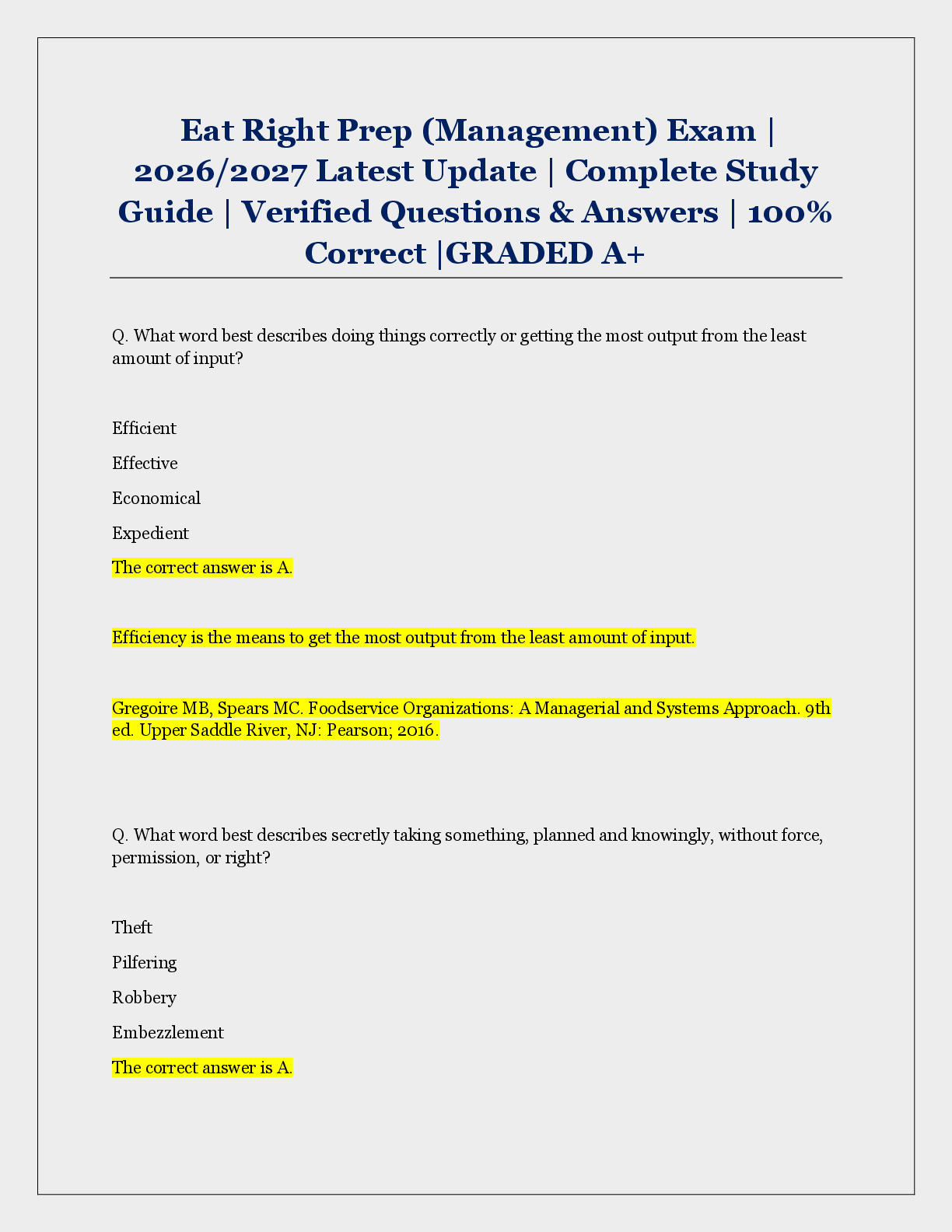
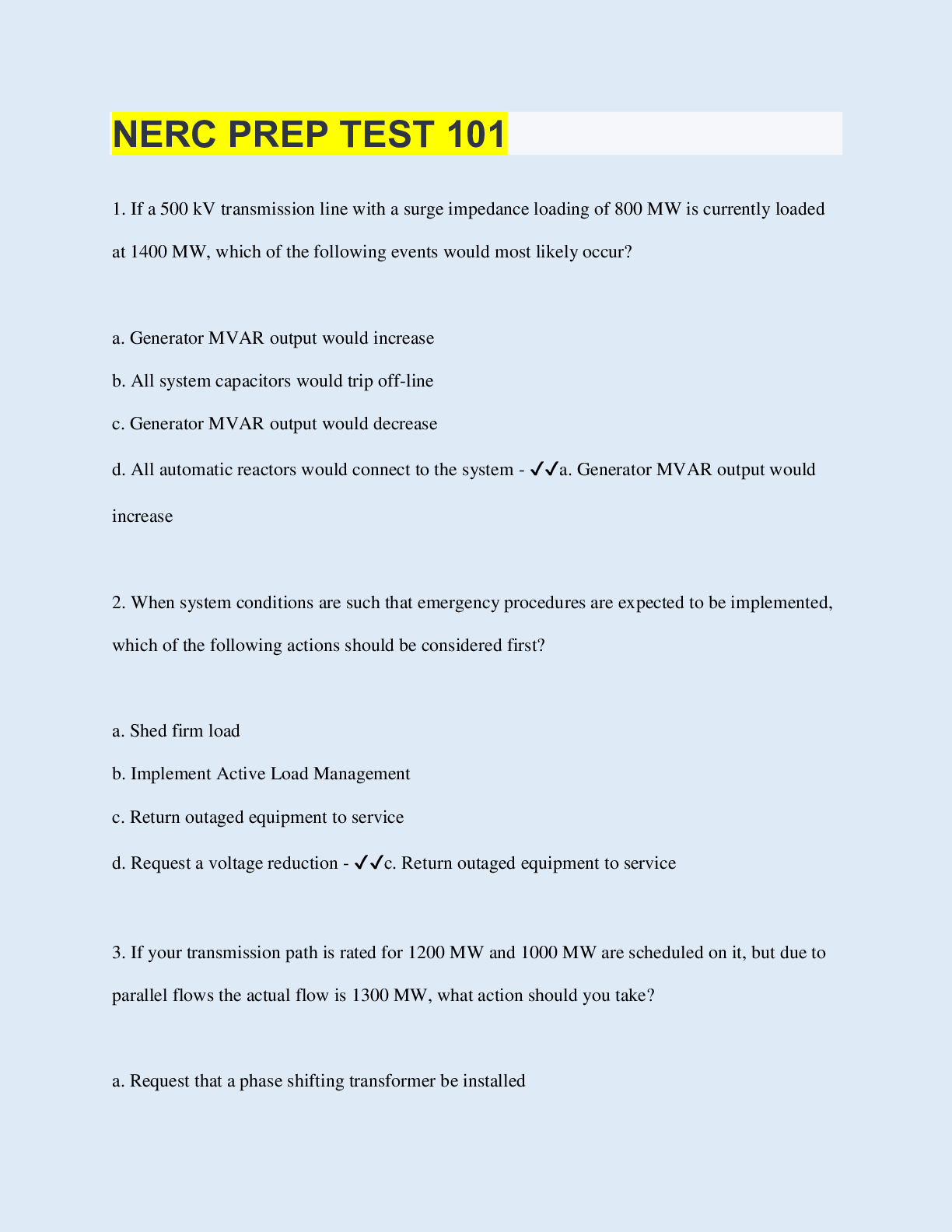
1. If a 500 kV transmission line with a surge impedance loading of 800 MW is currently loaded at 1400 MW, which of the following events would most likely occur?
a. Generator MVAR output would increase
b. All system c
...
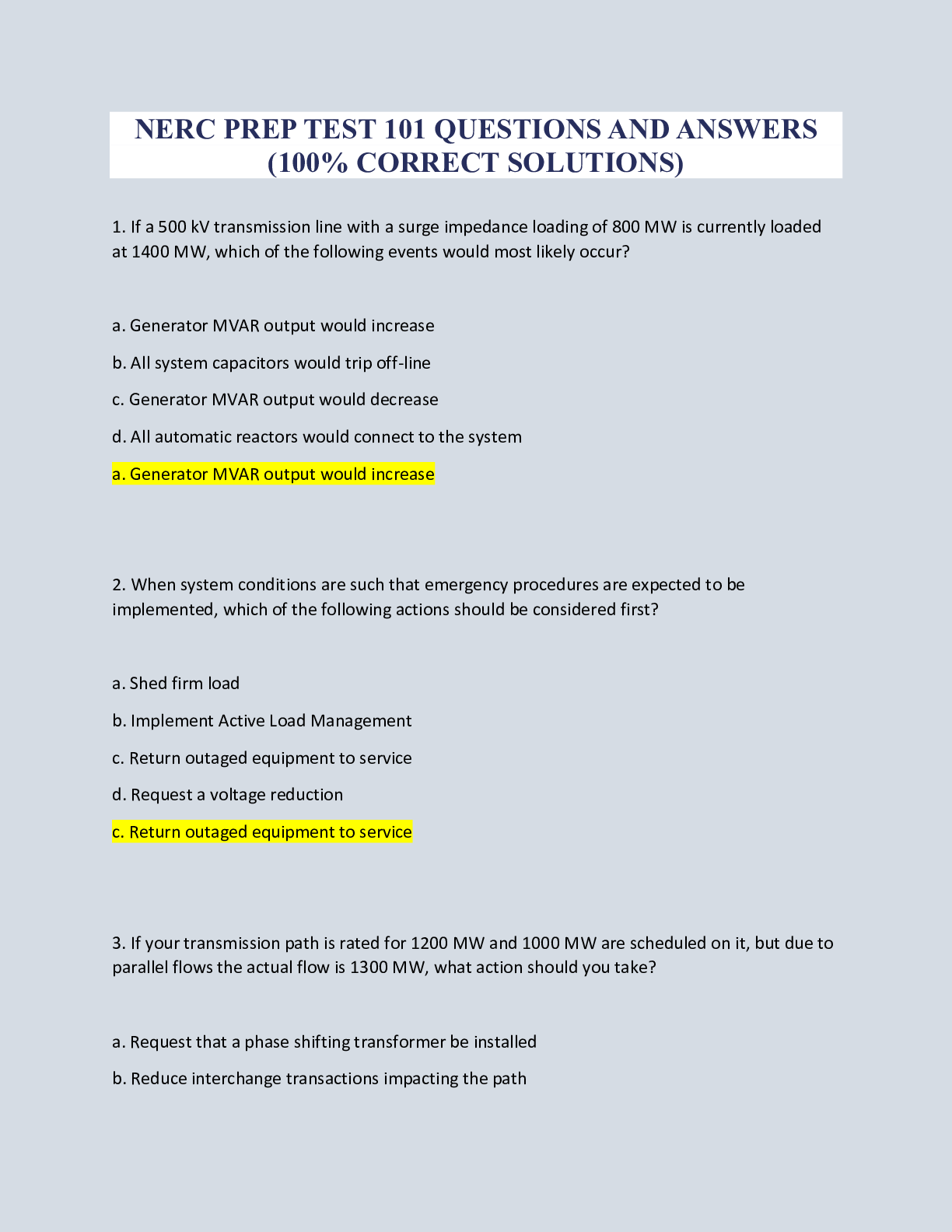
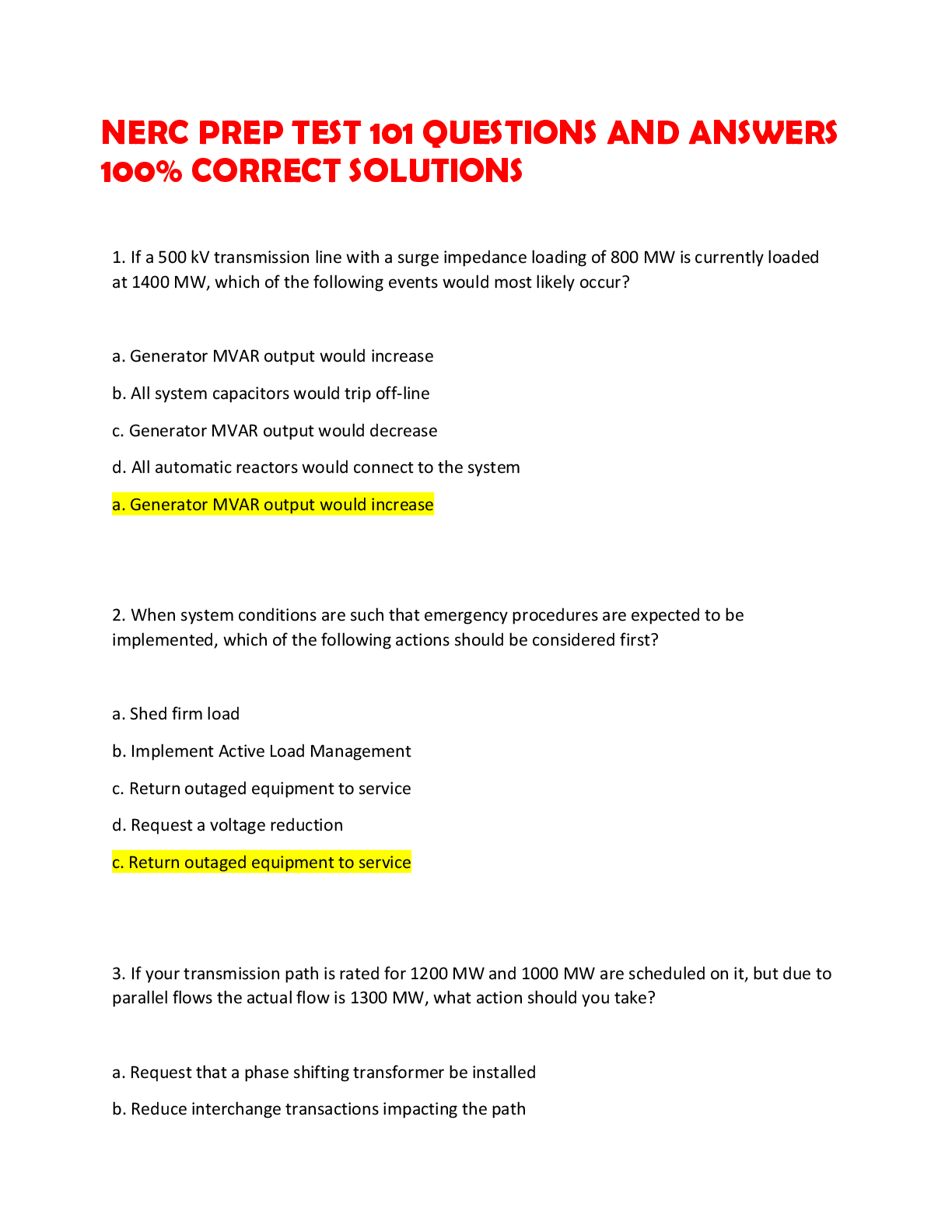
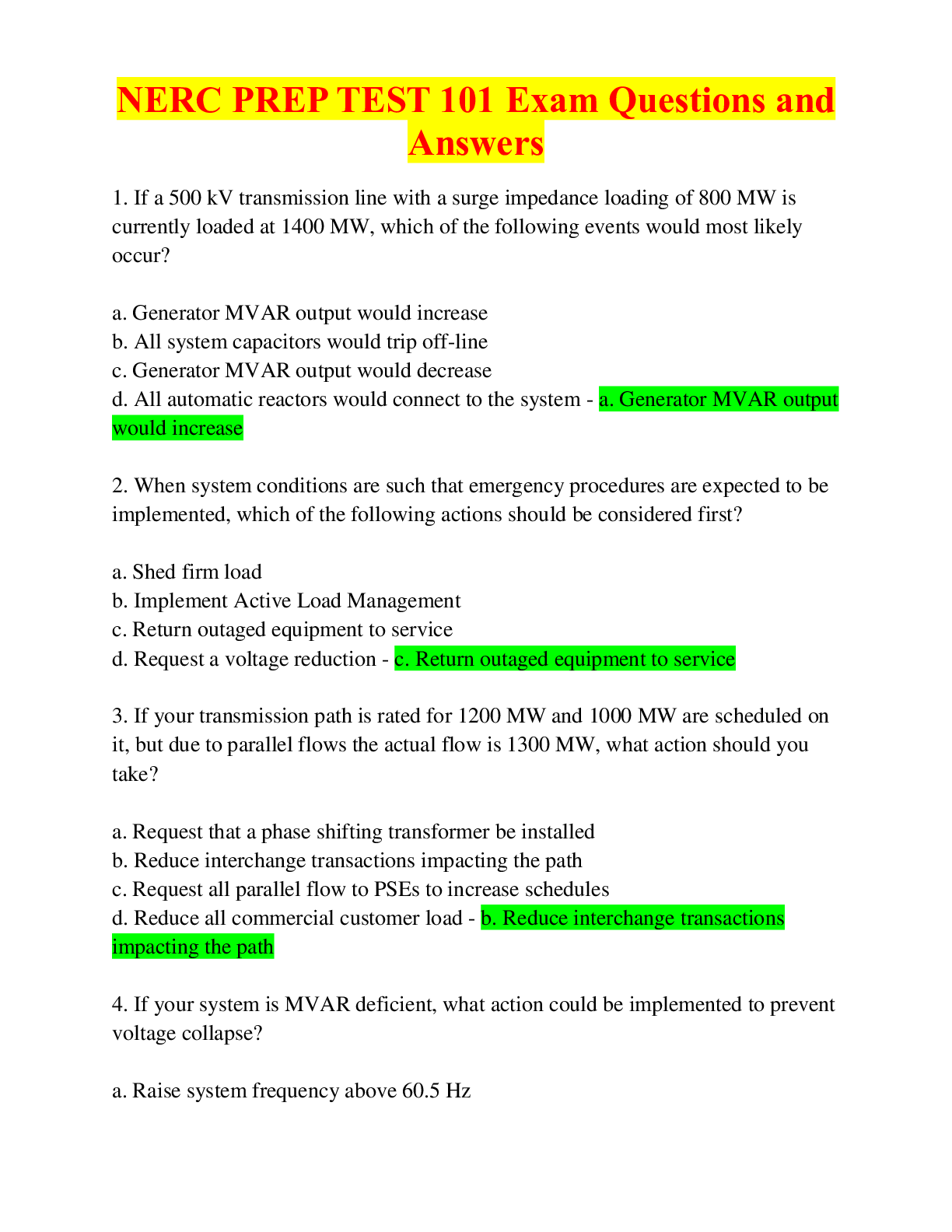
1. If a 500 kV transmission line with a surge impedance loading of 800 MW is currently loaded at 1400 MW, which of the following events would most likely occur?
a. Generator MVAR output would increase
b. All system capacitors would trip off-line
c. Generator MVAR output would decrease
d. All automatic reactors would connect to the system
a. Generator MVAR output would increase
2. When system conditions are such that emergency procedures are expected to be implemented, which of the following actions should be considered first?
a. Shed firm load
b. Implement Active Load Management
c. Return outaged equipment to service
d. Request a voltage reduction
c. Return outaged equipment to service
3. If your transmission path is rated for 1200 MW and 1000 MW are scheduled on it, but due to parallel flows the actual flow is 1300 MW, what action should you take?
a. Request that a phase shifting transformer be installed
b. Reduce interchange transactions impacting the path
c. Request all parallel flow to PSEs to increase schedules
d. Reduce all commercial customer load
b. Reduce interchange transactions impacting the path
4. If your system is MVAR deficient, what action could be implemented to prevent voltage collapse?
a. Raise system frequency above 60.5 Hz
b. Shed firm load in the deficient area
c. Separate from the Interconnection
d. Lower transmission voltages
b. Shed firm load in the deficient area
5. Which of the following actions can a system operator take in order to maintain stability on the system?
a. Request generators to absorb maximum MVAR
b. Place all operating limits on dynamic calculation
c. Raise system voltages as high as possible, but within their operating parameters
d. Reduce voltages on the transmission system
c. Raise system voltages as high as possible, but within their operating parameters
6. Which of the following actions should you take if an outage on a neighboring system has caused a violation on your system?
a. Open all tie-lines to your neighbor
b. Ask the Reliability Coordinator for assistance
c. Shed load to mitigate the violation
d. Wait for the neighboring system to contact you
b. Ask the Reliability Coordinator for assistance
7. If a SOL or IROL violation occurs due to transfers across the system and it is determined that parallel flows are contributing to the violation, what should the system operator do?
a. Place all system capacitors in service
b. Reduce system load
c. Inform the Reliability Coordinator
d. Dump firm load
c. Inform the Reliability Coordinator
8. While performing a pre-outage study, you identify that the transmission outage will cause a thermal violation on a parallel path, which of the following actions would be the first one you would implement?
a. Shed load to mitigate the concern
b. Allow the outage to occur and see what happens
c. Reschedule the outage if possible
d. Allow the outage to take place as long as no load is lost
c. Reschedule the outage if possible
9. Which of the following actions should the system operator implement first if transmission line limits exceed the facilities emergency limits based on a contingency that has not yet occurred, but their protocols are to respond on a pre-contingency basis?
a. Reduce voltages in the area of the violation
b. Remove the facility from service
c. Curtail any interchange transactions that are curtailable
d. Only implement actions if the contingency occurs
c. Curtail any interchange transactions that are curtailable
10. If a Reliability Coordinator had to implement any type of line loading relief procedures, which of the following entities would they be coordinated with? Pick two.
a. Purchasing Selling Entities
b. Balancing Authorities
c. Transmission Operators
d. Load Serving Entities
b. Balancing Authorities
c. Transmission Operators
11. If a generator is lost in a neighboring Balancing Area, what would the impact be on the BAs transmission tie lines?
a. Nothing
b. A net increase of MW would come into your BAs system
c. A net increase of MW would go out of your BAs system
d. They would exceed their emergency limits
c. A net increase of MW would go out of your BAs system
12. According to the NERC Glossary, a constrained facility is defined as a transmission facility that is approaching, is at, or is beyond its?
a. SOL or IROL
b. Normal voltage parameters
c. Available Transfer Capability
d. Economic operating point
a. SOL or IROL
13. How should a Transmission Operator that is affected by or contributing to transmission SOL or IROL limit violations respond to the situation?
a. When time permits
b. In coordination with other impacted entities
c. Independent of all other parties
d. Only at the direction of the Reliability Coordinator
b. In coordination with other impacted entities
14. If a transmission operator is experiencing a SOL or IROL violation, how long does the entity have to correct the problem?
a. 10 minutes
b. 20 minutes
c. 30 minutes
d. 60 minutes
c. 30 minutes
15. If your system is experiencing high system loads, high system imports, and transmission facilities loaded to 100%, which of the following situations would make the situation worse?
a. Loss of a distribution station
b. An internal generator tripping
c. A bulk capacitor connecting to the system
d. A 500 kV transmission line returned to service
b. An internal generator tripping
16. If a transmission line has a flow of 500 MW and the LODF for a parallel line due to the loss of this line is .25, how many MW will shift to this line if the line relays out of service?
a. 50 MW
b. 125 MW
c. 250 MW
d. 500 MW
b. 125 MW
17. If a transmission path is congested and it is determined that all curtailable transactions have a 15% affect on the path, how many MW of transactions must be curtailed if 30 MW of relief is needed?
a. 15 MW
b. 30 MW
c. 100 MW
d. 200 MW
d. 200 MW
18. If a transmission line is violating its emergency thermal limit due to the tripping of a parallel line which of the following is NOT an appropriate action to implement?
a. Shift generation
b. Implement ALM
c. Shed load
d. Adjust the thermal ratings
d. Adjust the thermal ratings
19. According to NERC standards, disturbances that are not identified until sometime after the occur must be reported to NERC
a. Immediately
b. Within 12 hours
c. Within 24 hours
d. Within 30 days
c. Within 24 hours
20. According to NERC Standards, Transmission Operators and Balancing Authorities must provide their operating personnel with a minimum of how much training annually?
a. 2 days
b. 5 days
c. 10 days
d. 14 days
b. 5 days
21. If a major transmission facility were to relay out of service, who is the system operator to inform?
a. Only local management
b. All entities in the Interconnection
c. Any impacted system
d. NERC
c. Any impacted system
22. How is the reactive output of the generator increased?
a. By raising the power factor
b. By adjusting the governor control manually
c. By adjusting the generator excitation
d. By changing the speed of the turbine
c. By adjusting the generator excitation
23. Which of the following would NOT be considered voltage regulation equipment?
a. Reactors
b. Capacitors
c. Generator governors
d. Generator AVRs
c. Generator governors
24. An open-ended transmission line exhibits the properties of which of the following devices?
a. Generator
b. Reactor
c. Capacitor
d. Insulator
c. Capacitor
25. Which of the following is NOT considered a MVAR resource?
a. Shunt reactors
b. Synchronous condenser
c. Generator
d. Capacitors
a. Shunt reactors
26. You report for work on a peak summer day with expected high temperatures and load. What can you do to maintain an adequate system profile?
a. Switch reactors in service to remove the peak
b. Request all generators to reserve MVAR for the peak
c. Switch all capacitors in service without regard to voltage levels
d. Get under the voltage by placing capacitors in service while maintaining operating limits
d. Get under the voltage by placing capacitors in service while maintaining operating limits
27. What will be the reactive power output of a 200 MVAR shunt capacitor energized at 90% of its nominal voltage?
a. 120 MVAR
b. 150 MVAR
c. 162 MVAR
d. 180 MVAR
c. 162 MVAR
28. When system conditions have caused the depletion of the system reactive reserves, when should the reserves be restored?
a. When the system load is shed
b. Only after a P-V curve has been developed
c. As soon as possible
d. When the RC has given permission to do so
c. As soon as possible
29. What is the purpose of the generator reactive capability curve?
a. Determine the generator excitation time restrictions
b. Identify the turbine loading temperatures
c. Determine how fast the unit can be loaded
d. Identify MVAR operating limits
d. Identify MVAR operating limits
30. Which of the following in conjunction with switched capacitors can be used to maintain system voltage levels within desired limits?
a. Interchange schedules
b. Static Var Compensators
c. Current transformer
d. Potential transformer
b. Static Var Compensators
31. If it is desired to have a generator operate in the LEAD, what must the Generator Operator do to the generator?
a. Increase the excitation
b. Increase the hydrogen pressure
c. Decrease the excitation
d. Decrease the hydrogen temperature
c. Decrease the excitation
32. Which of the following reactive devices would be considered to be a dynamic reactive resource?
a. Transformer
b. Shunt reactor
c. Shunt capacitor
d. Generator
d. Generator
33. If the applied voltage of a capacitor experiences a 10% reduction from the rated voltage, what will be the impact on the capacitor output?
a. It will be increased by 10%
b. It will remain unchanged
c. It will be reduced by 10%
d. It will be reduced by more than 10%
d. It will be reduced by more than 10%
34. According to NERC Standards, each Transmission Operator is expected to coordinate protection systems on major transmission lines and interconnections with all of the following neighboring entities EXCEPT?
a. Generator Operators
b. Transmission Operators
c. Balancing Authorities
d. Transmission Service Providers
d. Transmission Service Providers
35. Which type of relay operates on the premise of comparing the flow in and out of the area of protection?
a. Out-of-phase relays
b. Directional relay
c. Differential relay
d. Overspeed trip relay
c. Differential relay
36. Which of the following would be a means for the system operator to verify that a transmission system relay has operated after receiving an alarm?
a. Have the alarm re-calibrated
b. Request the relay group to provide a detailed print of the scheme
c. Have someone check the relay targets
d. Check the station instruction manual
c. Have someone check the relay targets
37. Which of the following is NOT a parameter that is used for automatic load shedding schemes?
a. Frequency
b. Rate of frequency decay
c. Rate of voltage decay
d. Rate of generation ramping
d. Rate of generation ramping
38. You receive indication through your SCADA system that a substation's main bus circuit breakers have operated open, what would you expect to see as the primary relay target at the station?
a. Synch-check relay
b. Zone 3 distance relay
c. Bus differential relay
d. Out-of -step relay
c. Bus differential relay
39. If your system experienced a relay equipment misoperation, why is it important to report this information to appropriate personnel?
a. To complete the NERC Relay Survey appropriately
b. To ensure that testing and repairs are initiated
c. To initiate re-calibration of all differential relays
d. To initiate high speed re-closing
b. To ensure that testing and repairs are initiated
40. What type of relay looks at roughly 90% of a transmission line?
a. Zone 1
b. Zone 2
c. Zone 3
d. Differential
a. Zone 1
41. If a major transmission facility were to relay out of service, who is the system operator supposed to inform?
a. Only local management
b. All entities in the Interconnection
c. Any impacted system
d. NERC
c. Any impacted system
42. You have an alarm from a substation and you send a serviceman to the substation. He reports the Circuit Switcher on the high side of the bank is open and all CB's in substation are open. Of the relays listed below, which is the most likely?
a. 50G over current
b. 21-1 impedance zone 1
c. 87T differential
d. 27 under voltage
c. 87T differential
43. Underfrequency load shedding is set-up so that which of the following does NOT occur?
a. Over voltage conditions
b. Interruption of interchange
c. Uncontrolled separation
d. Voltage criteria violated
c. Uncontrolled separation
44. What would be the expected impact on voltage when a capacitor is placed in service?
a. Increase
b. Remain the same
c. Suddenly drop but return to the same voltage
d. Decrease
a. Increase
45. If more MVAR is desired from a generator, what must the Generator Operator do to the generator?
a. Increase the excitation
b. Increase the hydrogen pressure
c. Decrease the excitation
d. Decrease the hydrogen temperature
a. Increase the excitation
46. Which of the following actions would help to lower voltages on the transmission system? Pick two.
a. Remove a capacitor from service
b. Remove a reactor from service
c. Lower the excitation on a generator
d. Switch a capacitor in service
a. Remove a capacitor from service
c. Lower the excitation on a generator
47. If the voltage on the northern part of your system is 138 kV and a capacitor were removed from service, what would be the determining factor in how the voltage would respond?
a. MVAR rating of the capacitor
b. Rated voltage of the capacitor
c. MVAR output of the capacitor
d. Distance from the capacitor to the load
c. MVAR output of the capacitor
48. A 115 kV capacitor has a rated output of 100 MVAR for a nominal voltage of 115 kV, what would be the expected reduction in the output of the capacitor if the actual voltage were reduced by 10%?
a. 10 MVAR
b. 19 MVAR
c. 81 MVAR
d. 90 MVAR
b. 19 MVAR
49. If a generator raises its VAR output, how should the system operator expect the system voltage to respond?
a. Remain the same
b. Increase
c. Decrease
d. Decrease exponentially
b. Increase
50. Which of the following would a lightly loaded transmission line exhibit the characteristics of?
a. A reactor
b. A generator in the lead
c. A shunt capacitor
d. A blackstart CT
c. A shunt capacitor
51. Which of the following would be an appropriate action for a system operator to implement in trying to maintain a safe and reliable system?
a. Maintain system voltage as high as possible, but within limits
b. Reduce spinning reserves to zero
c. Reduce system voltages below 93% of nominal
d. Request all generator AVRs be placed in manual
a. Maintain system voltage as high as possible, but within limits
52. To maintain system voltage levels within acceptable limits, capacitors and which of the following should be used?
a. Potential transformers
b. Interchange schedules
c. Current transformers
d. Rotating VAR sources
d. Rotating VAR sources
53. Which of the following actions would NOT help increase system voltages?
a. Increase generator MVAR output
b. Remove a reactor from service
c. Reduce imports across the system
d. Increase MW reserves
d. Increase MW reserves
54. If an EHV transmission line is lightly loaded and system voltages are high, what should be done with the line?
a. Completely unloaded
b. Removed from service immediately
c. Removed from service after loading to it SIL
d. Removed from service only after determining that reliability will not be affected
d. Removed from service only after determining that reliability will not be affected
55. Which of the following are considered to be reactive resources? Pick two.
a. Shunt reactors
b. Generators
c. Synchronous condensers
d. Transformers
b. Generators
c. Synchronous condensers
56. A transmission constraint is a limitation on one or more transmission elements that may be reached during
a. Normal conditions only
b. Emergency conditions only
c. Normal or contingency system operations
d. Restoration operations
c. Normal or contingency system operations
57. Which of the following is responsible to resolve any outage scheduling of potential reliability conflicts?
a. Balancing Authority
b. Reliability Coordinator
c. Transmission Operator
d. NERC
b. Reliability Coordinator
58. Which of the following is responsible to arrange for either self-providing or purchasing reactive resources to satisfy its reactive requirements identified by its Transmission Service Provider?
a. Transmission Operator
b. Purchasing-Selling Entity
c. Generator Operator
d. Balancing Authority
b. Purchasing-Selling Entity
59. Which of the following functions shall have the ability to operate or direct the operation of devices necessary to regulate transmission voltage and reactive flow?
a. Balancing Authority
b. Reliability Coordinator
c. Generator Operator
d. Transmission Operator
d. Transmission Operator
60. Which of the following situations would most benefit from the system operator monitoring frequency from various locations within a Balancing Area?
a. System separation points
b. Time error accumulations
c. Under frequency relay protection
d. Inadvertent accumulations
a. System separation points
61. Which of the following would provide an operator with an indication of how the Balancing Area and the Interconnection are performing?
a. ACE for the Balancing Area and Frequency for the Interconnection
b. Frequency for the Balancing Area and ACE for the Interconnection
c. Frequency for the Balancing Area and Inadvertent Interchange for the Interconnection
d. Voltages for the Balancing Area and Frequency for the Interconnection
a. ACE for the Balancing Area and Frequency for the Interconnection
62. If a system operator is faced with a situation where a transmission line has exceeded its emergency rating, which of the following actions is NOT acceptable?
a. Implement a generation re-dispatch
b. Switch the transmission line out of service
c. Shed enough load to reduce the line loading
d. Increase the emergency rating of the line
d. Increase the emergency rating of the line
63. If a system operator is required to control its transmission facilities on a pre-contingency basis, which of the following actions would be appropriate if a system study indicated a potential emergency limit violation?
a. Reduce all interchange transaction to 0 regardless of their impact on the violation
b. Shift generation to eliminate the concern
c. Reduce system frequency in order to reduce system load
d. Request and EEA 3 from the Reliability Coordinator
b. Shift generation to eliminate the concern
64. Which of the following would be an appropriate action for a system operator to implement in trying to maintain a safe and reliable system?
a. Reduce system voltages below 95% of nominal
b. Request all generator AVRs be placed in manual
c. Maintain system voltages as high as possible, but within limits
d. Reduce spinning reserves to zero
c. Maintain system voltages as high as possible, but within limits
65. If a transmission tie-line has a conductor rating 95 MVA with a current transformer rated 85 MVA on you end and a current transformer rated at 90 MVA on the other end, what is the limit that would be used for the operation of the line?
a. 85 MVA
b. 90 MVA
c. 95 MVA
d. 175 MVA
a. 85 MVA
66. Which of the following is ultimately the cause of system voltage collapse?
a. Reactive resource deficiency
b. Low spinning reserves
c. Too many capacitors on line
d. Not enough reactors on the system
a. Reactive resource deficiency
67. If system conditions are such that all reactive resources have been exhausted, what action should the operator consider to prevent voltage collapse?
a. Increase MW reserves
b. Increase transfer across your system to the load
c. Reduction of load in the appropriate area
d. Place reactors in service
c. Reduction of load in the appropriate area
68. Which mode of operation is most desirable for operating the Balancing Area AGC system?
a. Flat or constant frequency
b. Manual
c. Tie-line frequency bias
d. Flat or constant tie-line
c. Tie-line frequency bias
69. If the system operator determines that it is necessary to implement a firm load reduction to prevent a system voltage collapse, what is the best place to reduce load?
a. Across the entire system
b. In the load area that is generation deficient
c. At the same location as under frequency protected load
d. Wherever non-critical customers are located
b. In the load area that is generation deficient
70. If the system operator observes a decline in system frequency, in addition to an increase in their system exports, which of the following is the most likely event?
a. The Balancing Area experienced a loss of load
b. A generator tripped internal to the Balancing Area
c. A generator tripped external to the Balancing Area
d. There was a loss of load external to the Balancing Area
c. A generator tripped external to the Balancing Area
71. What is a major reason for identifying the transfer capabilities of the transmission system?
a. To identify all bottled generators
b. To mitigate transmission constraints in real-time
c. To proactively avoid system problems
d. To maximize the income of the transmission owners
c. To proactively avoid system problems
72. According to the FERC Standards of conduct, a Transmission Operator can share transmission related information with all of the following EXCEPT?
a. Other Transmission Operators
b. Reliability Coordinators
c. System Planners
d. Affiliated Marketing Groups
d. Affiliated Marketing Groups
73. Each Transmission Operator and Balancing Authority shall have emergency plans that will enable it to?
a. Cover all possible contingencies without violating any limits
b. Mitigate operating emergencies
c. Restore the system to normal within 10 minutes
d. Prevent any emergency condition from occurring
b. Mitigate operating emergencies
74. If studies were being performed to evaluate next-day system conditions, which of the following information would be the LEAST useful?
a. Projected Transmission outages
b. Generation schedule
c. Load forecast
d. Current day weather forecast
d. Current day weather forecast
75. According to NERC Standards Transmission Operators, Balancing Authorities, Generator Operators, Transmission Service Providers, Load-Serving Entities, and Purchasing-Selling Entities are required to comply with Reliability Coordinator directives unless such actions would?
a. Be contrary the companies operating philosophy
b. Cause additional financial obligations
c. Violate safety, equipment, or regulatory requirements
d. Require additional workload on the companies personnel
c. Violate safety, equipment, or regulatory requirements
76. If transmission line XYZ is carrying 300 MW and a transaction is started for 100 MW in the same direction that has a distribution factor of .3 on XYZ, what will the flow be on XYZ after the transaction is ramped?
a. 270 MW
b. 300 MW
c. 330 MW
d. 400 MW
c. 330 MW
77. Which of the following is responsible to arrange for either by self-providing or purchasing reactive resources to satisfy it reactive requirements identified by its Transmission Service Provider?
a. Transmission Operator
b. Purchasing-Selling Entity
c. Generator Operator
d. Balancing Authority
b. Purchasing-Selling Entity
78. Which of the following functions shall have the ability to operate or direct the operation of devices necessary to regulate transmission voltage and reactive flow?
a. Balancing Authority
b. Reliability Coordinator
c. Generator Operator
d. Transmission Operator
d. Transmission Operator
79. If a system operator is required to control its transmission facilities on a pre-contingency basis, which of the following actions would be appropriate if a system study indicated a potential emergency limit violation?
a. Reduce all interchange transactions to 0 regardless of their impact on the violation
b. Shift generation to eliminate the concern
c. Reduce system frequency in order to reduce system load
d. Request an EEA 3 from the Reliability Coordinator
b. Shift generation to eliminate the concern
80. If a system operator is faced with a situation where a transmission line has exceeded its emergency rating, which of the following actions is NOT acceptable?
a. Implement a generation re-dispatch
b. Switch the transmission line out of service
c. Shed enough load to reduce the line loading
d. Increase the emergency rating of the line
d. Increase the emergency rating of the line
81. When forecasting the daily load estimate, which of the following would NOT be a strong consideration for influencing final forecast?
a. Wind
b. Temperature
c. Day of week
d. Last year's peak load
d. Last year's peak load
82. Your system planning group has determined that the Total Transfer Capability is 575 MW, but the posted Available Transfer Capability is 525 MW. If current transmission reservations total 475 MW, how much capacity is left available for reserving?
a. 50 MW
b. 100 MW
c. 475 MW
d. 575 MW
a. 50 MW
83. Which of the following would be controllable if your system were considered to be voltage-stable?
a. Surge impedance loadings
b. Thermal limits
c. Voltage levels
d. Transformer stationary taps
c. Voltage levels
84. Which of the following may be given the details of an interchange transaction?
a. All PSEs registered with NERC
b. All PSEs within the Transmission Operators purview
c. Any PSE that requests the information in writing
d. Only PSEs that are party to the transaction
d. Only PSEs that are party to the transaction
85. Following a transmission system disturbance, which of the following pieces of information would be the most helpful in performing a post-disturbance analysis?
a. Phase shift transformer tap settings
b. Distance fault recorder data
c. Area control error
d. Synch-check relay locations
b. Distance fault recorder data
86. Which of the following types of communications would be considered critical for operation of the systems? Pick two.
a. SCADA
b. Voice
c. Demand meters
d. Fax machines
a. SCADA
b. Voice
87. Who is responsible to make sure that the operation of voltage control equipment is coordinated with other impacted entities?
a. Transmission Operator
b. Transmission Service Provider
c. Reliability Coordinator
d. Transmission Switchmen
a. Transmission Operator
88. If a transmission line is loaded below its surge impedance loading, it displays the characteristics of a?
a. A capacitor
b. A reactor
c. A transformer
d. A generator
a. A capacitor
89. If the voltage on the southern part of your system is 138 kV, which of the following voltages would be indicative of the impacts of removing a capacitor from service?
a. 138 kV
b. 140 kV
c. 142 kV
d. 135 kV
d. 135 kV
90. A 230 kV capacitor has a rated output of 100 MVAR for a nominal voltage of 230 kV, what would the expected output of the capacitor be if the actual voltage were 207 kV.
a. 100 MVAR
b. 90 MVAR
c. 81 MVAR
d. 50 MVAR
c. 81 MVAR
91. What should a system operator expect to see if the generator decreases its excitation?
a. An increase in MVAR output
b. A decrease in MVAR output
c. An increase in voltage
d. An increase in MW output
b. A decrease in MVAR output
92. Which of the following is NOT a means of lowering system voltage on a transmission system?
a. Take capacitors off line
b. Take lines out of service
c. Remove reactors from service
d. Reduce MVAR output of generation
c. Remove reactors from service
93. Under which of the following types of conditions should automatic reclosing be prevented?
a. Out-of-Step conditions
b. Peak Load period
c. Cold weather conditions
d. N-1 criteria event conditions
a. Out-of-Step conditions
94. What would be the impact on a transmission line's operating limit for the next day if the forecasted temperature is 150F higher than the current temperature of 78?
a. The limit would increase
b. The limit would decrease
c. The limit would double
d. The limit would not change
b. The limit would decrease
95. A transmission line is out for minor maintenance connecting Station A to Station B with a 30 minutes emergency return time. Flow on the remaining parallel lines is flowing from A to B. A generator at Station B tripped off-line causing excessive flows on the remaining parallel lines and quick-start generation in the area of Station B is insufficient to prevent overloads on the path. What is the next step that the system operator should take?
a. Shed firm load at Station B
b. Implement load curtailments at Station A
c. Request that the line on maintenance be returned to service
d. Request a public appeal for the entire area
c. Request that the line on maintenance be returned to service
96. Your system has 3 - 230 kV parallel lines tying station A to station B. If one of the three lines trips, each of the remaining two lines will experience an increase in flow of 50% of the MW that were flowing on the tripped facility. What will be the total MW flowing on the two remaining lines if each of the lines is carrying 150 MW prior to the tripping?
a. 150 MW
b. 225 MW
c. 300 MW
d. 450 MW
d. 450 MW
97. If the estimated charging incurred from switching a 500 kV line in service is 1.7 MVAR per mile, what would be incurred if a 100 mile long 500 kV line were switched into service?
a. 65 MVAR
b. 170 MVAR
c. 850 MVAR
d. It cannot be calculated with the information provided
b. 170 MVAR
98. If a transmission tie-line between Balancing Area A and Balancing Area B becomes heavily loaded due to a loss of generation within Balancing Area A, which of the following actions would help to get the transmission facility back within limits?
a. Reduce load in Balancing Area B
b. Reduce load in Balancing Area A
c. Raise generation in Balancing Area B
d. Raise generation equally in Balancing Areas A and B
b. Reduce load in Balancing Area A
99. What action should a system operator take after discovering that due to the combination of forced and planned outages, thermal overloads are experienced in the northern part of the system?
a. Request emergency assistance from the Reliability Coordinator
b. Shed load in the northern area
c. Increase generation output in the northern area
d. Cancel all scheduled outages on the system
c. Increase generation output in the northern area
100. What is the purpose of coordinating planned transmission outages?
a. To mitigate real-time contingency analysis failures
b. To create tasks for the Reliability Coordinator
c. To ensure transmission system security
d. To reduce outage times
c. To ensure transmission system security
101. According to NERC Standards, a Transmission Operator is required to have which of the following to address the loss of communication facilities?
a. Written operating instructions
b. Satellite phone
c. Cell phones
d. Radio systems
a. Written operating instructions
102. How does MVAR flow typically occur on the system?
a. Downhill based on power angle
b. Uphill based on power angle
c. Downhill based on voltage
d. Uphill based on voltage
c. Downhill based on voltage
103. If a transmission line is loaded below its surge impedance loading (SIL) level, it will do which of the following?
a. Increase inductance
b. Absorbs MVAR
c. Supply MVAR
d. Reduce voltage
c. Supply MVAR
104. Two parallel transmission lines are both rated for 450 MVA and are currently loaded at 320 MVA each. If one of the lines trip, it will cause the other line to be loaded above its rating by more than 150 MVA. What should you do if you receive notification that due to a system emergency one of the lines must come out of service?
a. Delay the outage until generation can be started
b. Re-dispatch available generation and remove the line from service
c. Take the line out and dump 150 MVA of load
d. Wait until the line trips out of service
b. Re-dispatch available generation and remove the line from service
105. Your system is operating on a hot summer day with near record loads when you receive a report of impending thunderstorms and heavy rain. What is the expected impact on the system load?
a. System MVAR load would drop
b. System load should not change
c. System load should increase
d. System load should decrease
d. System load should decrease
106. If a transmission line is carrying 200 MW and a transaction is started for 150 MW in the same direction that has a distribution factor of .5 on the line, what will the flow be on the line after the transaction is ramped?
a. 200 MW
b. 250 MW
c. 275 MW
d. 350 MW
c. 275 MW
107. What is the advantage of coordinating transmission outages?
a. Increase IROL limits
b. Keeping information away from marketers
c. Prevents telling anyone about them
d. Ensures system reliability
d. Ensures system reliability
108. Which of the following is the most important element related to forecasting the daily load?
a. Resource outages
b. Scheduled interchange
c. Weather
d. Wind generation forecast
c. Weather
109. A transmission constraint is a limitation on one or more transmission elements that may be reached during...
a. Normal conditions only
b. Emergency conditions only
c. Normal or contingency system operations
d. Restoration operations
c. Normal or contingency system operations
110. The details of interchange transactions may be given to all of the following entities EXCEPT:
a. All PSEs in the area
b. Only PSEs who are party to the transaction
c. The Reliability Coordinator
d. Other transmission operating personnel in your control center
a. All PSEs in the area
111. If the transmission system is operated such that it is considered to be voltage-stable, which of the following would you be able to control?
a. Power flow
b. Thermal limits
c. Line impedances
d. Conductor ratings
a. Power flow
112. Which of the following would probably NOT be considered critical communications?
a. SCADA
b. Voice
c. Demand meters
d. AGC
c. Demand meters
113. From a transmission operation perspective, which of the following would be the LEAST helpful in analyzing the system following a disturbance?
a. Distance Fault Recorder
b. Area Control Error
c. Relay targets
d. Oscillograph readings
b. Area Control Error
114. If a transmission line is loaded above its surge impedance loading, it displays the characteristics of a?
a. A capacitor
b. A reactor
c. A transformer
d. A generator
b. A reactor
115. If voltage control equipment is to be operated, who should it be coordinated with?
a. All Reliability Coordinators in the Interconnection
b. Impacted Transmission Operators
c. All TSPs reserving transmission
d. All market participants
b. Impacted Transmission Operators
116. What would be the expected impact on voltage when a capacitor is removed from service?
a. Increase
b. Remain the same
c. Suddenly drop but return to the same voltage
d. Decrease
d. Decrease
117. If a capacitor experiences a reduction of 10% on its applied voltage, what would you expect the impact to be on its output?
a. Unchanged
b. Reduced by 10%
c. Reduced by more than 10%
d. Increased by 10%
c. Reduced by more than 10%
117. If a capacitor experiences a reduction of 10% on its applied voltage, what would you expect the impact to be on its output?
a. Unchanged
b. Reduced by 10%
c. Reduced by more than 10%
d. Increased by 10%
a. Unchanged
119. An abnormally high voltage situation on a system can be corrected by
a. Reducing load
b. Removing capacitors
c. Ordering generation to increase VAR output
d. Decreasing transfers
b. Removing capacitors
120. What would be the expected impact on a line's operating capacity for the next day if the current temperature is 830F and the forecasted temperature is 980F?
a. The capacity would increase
b. The capacity would decrease
c. The capacity would double
d. The capacity would not change
d. The capacity would not change
121. Which of the following types of data are Balancing Areas expected to provide and Reliability Coordinators expected to share, as soon as the information is available?
a. Market clearing price
b. Employee transfers to marketing groups
c. Telecommunications channel swaps
d. Generator MW and MVAR capability
d. Generator MW and MVAR capability
122. You have 3 - 115 kV parallel lines connecting station A to station B. All three of the lines have a Line Outage Distribution Factor (LODF) of .40 for the loss of anyone of the other 2 lines with the remaining 20% flowing on the 69 kV system. If all three lines are carrying 180 MVA and one of the lines trip, what is the expected flow on each of the remaining 115kV lines?
a. 216 MVA
b. 252 MVA
c. 270 MVA
d. 540 MVA
b. 252 MVA
123. If thunderstorms are moving through your system and have caused several trips and reclosers on the transmission lines. What should you do?
a. Issue clearances on all tripped facilities
b. Call in repair personnel
c. Recalculate ATC
d. Notify affected neighboring areas
d. Notify affected neighboring areas
124. A transmission tie-line between adjacent Balancing Area becomes heavily loaded due to a loss of generation within one of the Balancing Areas. The Reliability Coordinator should direct the deficient Balancing Area to take which of the following actions to get the transmission facility back within limits?
a. Recalculate TTC
b. Load generation
c. Adjust the limits on the tie-lines
d. Submit an EIA-417
b. Load generation
125. Your system contains two 230 kV transmissions lines that have identical construction, but are different in the length of the line. If Line 1 is twice the length of Line 2, which of the following is true if the lines are loaded at less than 20 MVA?
a. Line 1 is providing more MVAR than Line 2
b. Line 1 is absorbing more MVAR than Line 2
c. Line 2 is providing more MVAR than Line 1
d. Line 2 is absorbing more MVAR than Line 1
a. Line 1 is providing more MVAR than Line 2
126. What action should a system operator take after discovering that due to a forced outage, the planned outage of another transmission line will cause low voltages in the eastern part of the system?
a. Request the Reliability Coordinator to issue emergency warnings
b. Prepare to shed load in the area
c. Increase MW reserves for the duration of the outage
d. Cancel or defer the scheduled outage.
d. Cancel or defer the scheduled outage.
127. It is determined that as a result scheduled outage in progress, contingency analysis indicates that a single contingency may threaten system reliability. Which actions should the system operator implement?
a. Cancel the scheduled outage and return equipment to service
b. Schedule emergency power from neighboring BAs
c. Ask BA to schedule additional exports
d. Request engineering to change operating limits
a. Cancel the scheduled outage and return equipment to service
128. Which way will the MVAR normally flow if Station A has a voltage of 348 kV and Station B has a voltage of 343 kV?
a. From Station A to Station B
b. From Station B to Station A
c. Downhill on power angle
d. Voltages are too close for MVAR to flow
a. From Station A to Station B
129. According to NERC, communication channels between adjacent systems are required to be
a. Part of the RC hotline system
b. Connected to the satellite system
c. Leased telephone lines
d. Exclusive channels
d. Exclusive channels
130. An indication that a transmission line is loaded above its surge impedance loading level is that it
a. Increases capacitance
b. Absorbs VARs
c. Generates VARS
d. Raises voltage
b. Absorbs VARs
131. According to NERC Standards, an emergency interchange transaction can be exempt from tagging if it is less than how many long?
a. 60 minutes
b. 90 minutes
c. 2 hours
d. 12 hours
a. 60 minutes
132. Which of the following situations would warrant the suspension of the Standards of Conduct?
a. ACE is not on zero
b. System voltages are above 103%
c. System reliability is jeopardized
d. CPS standard is not met
c. System reliability is jeopardized
133. Which of the following situations would warrant the Reliability Coordinator to initiate a NERC hotline conference call?
a. Energy Emergency Alert 3
b. Code of Conduct violation
c. Interchange transaction error
d. 115 kV capacitor tripping
a. Energy Emergency Alert 3
134. Who is responsible to disseminate GMD information?
a. Balancing Authority
b. Reliability Coordinators
c. Transmission Operators
d. Regional Reliability Organization
b. Reliability Coordinators
135. Reliability Coordinators, Transmission Operators, and Balancing Authorities are required to have written instructions for the loss of telecommunication facilities. These instructions are supposed to
a. Be updated monthly
b. Enable continued operation of system
c. Be approved by the Regional Reliability Organization
d. Provide a step-by-step procedure for implementing
b. Enable continued operation of system
136. If a Balancing Authority has identified that it will have insufficient reserves due to high loads and unexpected generation outages and they have been unable to obtain any assistance from their neighbors, what should the Balancing Authority do next?
a. Request the LSE to shed load
b. Seek assistance from the Reliability Coordinator
c. Notify NERC that compliance to DCS could be impacted
d. Ask the Transmission Operator to reduce generator MVAR output
b. Seek assistance from the Reliability Coordinator
137. When the situation involves the mitigation of emergency system conditions, who has the ultimate authority to issue directives?
a. The Reliability Coordinator
b. The deficient Balancing Authority
c. The Transmission Operator experiencing the emergency
d. NERC
a. The Reliability Coordinator
138. What are the two components that a system operator should be aware of for controlling frequency during a system restoration if they are in an islanded situation? Pick two
a. Load
b. Generation
c. Imports
d. Voltages
a. Load
b. Generation
139. What is a major concern for a System Operator during emergency conditions?
a. All transmission facilities are loaded below 90%
b. System remains connected to the Interconnection
c. All generation is at its economic operating point
d. Load is shed on residential customers only
b. System remains connected to the Interconnection
140. If your system is experiencing a capacity emergency, which of the following is NOT an acceptable action to utilize?
a. Public appeal to conserve energy
b. Shed load
c. Voltage reduction
d. Lean on tie-lines
d. Lean on tie-lines
141. According to NERC's Restoration Training document, if synchronization is required during a system restoration, the synchronization should occur at
a. Any bus on the system
b. Preplanned locations
c. Generating stations only
d. Transmission facilities only
b. Preplanned locations
142. Which of the following systems was put in place to provide RCs with a mechanism to handle energy deficiencies?
a. Maximum Generation Alerts
b. Energy Emergency Alerts
c. DOE Reporting Requirements
d. NERC Threat cons
b. Energy Emergency Alerts
143. According to EOP-005, the restoration plan should consider all of the following EXCEPT
a. Restoration cannot be completed as planned
b. Relationship and responsibility of personnel
c. Back-up generators in transmission stations
d. Identification of critical loads
c. Back-up generators in transmission stations
144. If your system is islanded during restoration, what would be the impact on a generator that is providing MVAR to the island, if a 500 kV transmission line were connected to the island that had little or no load flowing on it?
a. Generator MVAR output would increase
b. Generator would trip off-line due to a low voltage condition
c. Generator MVAR output would decrease
d. The transmission line connection would have no impact on the generator
c. Generator MVAR output would decrease
145. If a minor system event caused a generator to separate from the system due to an out-of-step condition, which of the following could be the most likely cause? Pick two.
a. Out-of-Step relay scheme
b. Ferranti-rise
c. System instability
d. Operator error
a. Out-of-Step relay scheme
c. System instability
146. If your system has experienced a disturbance that has caused your system to become islanded, which of the following would you most likely expect to experience?
a. Increased tie-line flows
b. Frequency fluctuations
c. Tie-lines at minimal flow
d. High system voltages
b. Frequency fluctuations
147. If your system experiences a disturbance that has caused some islanding, what would be the most likely system condition if you are observing different frequency at different locations around your system?
a. Some system indication is incorrect
b. The area has broken into more than one island
c. The generators on the system are swinging
d. A tie-line to the outside has not cleared
b. The area has broken into more than one island
148. If your system experiences the loss of 2000 MW of generation that has caused the frequency to decline and you have shed 300 MW of load to stop the frequency from declining, what should you do if the frequency will not come above 59.94 Hz?
a. Restore the load and wait for RC direction
b. Implement additional corrective actions to restore frequency
c. Wait until the system load drops off and monitor the system frequency
d. Request that the Region perform a frequency decay analysis
b. Implement additional corrective actions to restore frequency
149. If system conditions require the system operator to implement a voltage reduction, which of the following facilities would be utilized to implement it?
a. 230 kV/115 kV tap change
b. Distribution bus
c. 500 kV/230 kV transformer
d. Generator AVR
b. Distribution bus
150. Which of the following situations would warrant the use of manual load shedding?
a. High voltage across the system
b. Continuous decline in frequency
c. High dynamic reactive reserves
d. Increasingly high frequency
b. Continuous decline in frequency
151. If your system has lost a large amount of customer load due to a system disturbance, but has remained connected to all of your neighbors, what is the best solution to consider?
a. Request a NERC waiver
b. Coordinate with the neighbors
c. Immediately restore the entire load
d. Island the area and begin restoration
b. Coordinate with the neighbors
152. If the system conditions cause the initiation of your under frequency load shed relays, but your BAs ACE still indicates under generation and no additional generation is available to load, what should you do?
a. Ask the BA to reduce the generation equally across your system
b. Work with the BA to reduce load to return ACE to within operating parameters
c. Notify NERC and request that all neighboring system reduce their native load
d. Have the BA request EEA 0
b. Work with the BA to reduce load to return ACE to within operating parameters
153. If a Reliability Coordinator has issued an EEA2, all of the following actions should be implemented by the energy deficient area prior to requesting that an EEA3 be issued EXCEPT?
a. Start all available generation
b. Recall all non-firm exports
c. Schedule emergency assistance
d. Shed load
d. Shed load
154. Why is it important that events that result in a relay scheme misoperation be reported promptly?
a. To initiate repairs
b. To reduce maintenance costs
c. To reduce relay technician involvement
d. To avoid a NERC investigation
a. To initiate repairs
155. If the NERC Restoration Reference document indicates that a 6-10% reduction in system load would realize a 1 Hz increase in frequency, how much load should be shed to restore frequency to 60.00 Hz if it is currently 58.50 and your system load is 5000 MW?
a. 450 MW to 750 MW
b. 300 MW to 500 MW
c. 150 MW to 250 MW
d. 75 MW to 125 MW
a. 450 MW to 750 MW
156. What would be an appropriate situation for the system operator to shed load?
a. System frequency is 59.98 Hz and a 50 MW interchange transaction is cancelled
b. Transmission facility is loaded at 130% of its emergency limit, voltages are decaying rapidly, and no other actions are available
c. Balancing Area is under generating by 50 MW and the only generation that is available to correct the problem is high cost facilities
d. Underfrequency load shed relays have activated and frequency is currently 60.04 Hz
b. Transmission facility is loaded at 130% of its emergency limit, voltages are decaying rapidly, and no other actions are available
157. If the Reliability Coordinator issues you a directive to implement, when should it be implemented?
a. Whenever you can get it done
b. Without delay but less than 30 minutes
c. As soon as additional personnel can be scheduled
d. When local management provides approval
b. Without delay but less than 30 minutes
158. If a Balancing Area is going into 3% voltage reduction and is unable to purchase any emergency capacity. The Balancing Authority needs to
a. Raise voltage
b. Notify other systems
c. Call local marketers
d. Call local marketers
e. Check inadvertent
b. Notify other systems
159. Which of the following plans should address the needs of critical loads essential to the health, safety, and welfare of the community?
a. Load curtailment
b. Adequate Fuel Supply and Inventory
c. Transfer Capability
d. Control Center Evacuation
a. Load curtailment
160. Automatic load shedding steps are arranged to prevent which of the following?
a. Transmission overloads and transaction cancellation
b. Uncontrolled separation and loss of generation
c. Over frequency or over voltage relay action
d. Violation of single contingency criteria
b. Uncontrolled separation and loss of generation
161. In order to decide if load shedding is required during a system emergency, the system operator should examine all of the following EXCEPT system
a. Frequency
b. Voltage
c. AGC
d. ACE
c. AGC
162. Cold load pick-up is experienced when de-energized equipment is initially energized, but can involve inrush currents that are
a. The same as normal currents
b. 10 or more times normal
c. Less than normal currents
d. No greater than five times normal
b. 10 or more times normal
163. What is the purpose of automatic underfrequency load shedding?
a. To maintain 60.00 Hz
b. To arrest frequency decline
c. To balance load
d. To restore 60.00 Hz
b. To arrest frequency decline
164. Frequency, rate of frequency decay, voltage level, rate of voltage decay, and power flow levels are parameters which individually or in combination are used to trigger which of the following?
a. Generator rejection schemes
b. System islanding
c. Automatic load shedding
d. Out-of-step relay schemes
c. Automatic load shedding
165. What are load shed steps designed to prevent?
a. Increased production costs and exposure
b. Emergency assistance and public appeals
c. Generation loss and system shutdown
d. Transmission line overloads and voltage swings
c. Generation loss and system shutdown
166. What is the first thing that a system operator should do following a disturbance in which one or more portions of a balancing area become isolated?
a. Assess the condition of the system
b. Provide RRO with initial report
c. Evaluate if all SPSs operated correctly
d. Determine the implications to meeting DCS criteria
a. Assess the condition of the system
167. If a widespread disturbance is experienced throughout the Interconnection that has caused a system to be separated from the Interconnection and frequency remains at 59.58 Hz after UFLS has activated, what is the next step that the System Operator should take?
a. Request emergency assistance from the RC
b. Shed additional load to restore frequency to 60.00 Hz
c. Implement a public appeal
d. Ask all Distribution Providers to implement a voltage reduction
b. Shed additional load to restore frequency to 60.00 Hz
168. The underfrequency protection of generating units is intended to protect which of the following plant elements?
a. Turbine
b. Hotwell
c. Boiler
d. Heat cycle
a. Turbine
169. By reducing distribution voltage, which of the following would be increased?
a. System load
b. Capacitor losses
c. Transmission voltage
d. Transmission line impedance
c. Transmission voltage
170. System restoration plans should consider all of the following conditions EXCEPT
a. Auxiliary start-up power for generating plants
b. Backup power for transformer tap changers
c. Transmission corridors required for generating plants
d. Circuit breakers that failed to open
b. Backup power for transformer tap changers
171. If current weather reports indicate that severe weather could or is moving into the area, which of the following should NOT be considered?
a. Defer transmission equipment maintenance and testing
b. Communicate with neighboring systems along the path
c. Notify generator that could be affected
d. Inform marketing entities of condition
d. Inform marketing entities of condition
172. Which of the following would be indicative that there is a loss of generation external to a Balancing Authority's area?
a. Frequency stable and ACE on zero
b. Decline in frequency and ACE on zero
c. Frequency stable and ACE under generating
d. Increase in frequency and ACE over generating
b. Decline in frequency and ACE on zero
173. If system separation occurs, why is the frequency less stable in the portions of the system that are separated from the Interconnection?
a. More load oscillations
b. MVAR are deficient
c. Fewer synchronized generators
d. Less frequency sources
c. Fewer synchronized generators
174. To allow system operating personnel to identify conditions of system separation, frequency information should be provided at which of the following?
a. Multiple locations across the system
b. High side of all step-up transformers
c. At all BA boundaries
d. All generators greater than 50 MW
a. Multiple locations across the system
175. During restoration, the bulk power system should be operated so that voltage profiles are maintained between
a. 80% to 110%
b. 85% to 115%
c. 90% to 110%
d. 95% to 115%
c. 90% to 110%
176. In accordance with NERC Restoration Reference document guidelines, if you are experiencing a decline in your frequency during islanded operations, what percent of synchronized load should be shed to restore the frequency of the island by 1.0 Hz?
a. 5%
b. 6 to 10%
c. 15%
d. 20 to 25%
b. 6 to 10%
177. What would be the two most important pieces of information that a system operator should know during restoration for maintaining frequency?
a. System outages and damage
b. Imports and exports
c. Underfrequency and undervoltage relay settings
d. Load and generation
d. Load and generation
178. In accordance with NERC guidelines, when restoring load in islanded conditions, load pick-ups should be limited to what percent of synchronized capacity?
a. 3%
b. 5%
c. 10%
d. 20%
b. 5%
179. What is the purpose of running periodic Black start restoration drills?
a. To train field personnel on the concepts of command and control
b. To test the back-up diesel generators
c. To allow management to observe the activity
d. To assure personnel are familiar with the plan
d. To assure personnel are familiar with the plan
180. According to NERC Standards, each Reliability Coordinator must be aware of the restoration plan for which of the following entities in its Reliability Coordinator Area?
a. Transmission Operators
b. Balancing Authorities
c. Transmission Service Providers
d. Distribution Operators
a. Transmission Operators
181. If your system experiences a partial or total system shutdown, which of the following is one of the first things that a system operator should do?
a. Restore all customer load that was lost
b. Adjust all transformer LTCs to neutral
c. Arrange for generator start-up power
d. Recalculate reserve requirements
c. Arrange for generator start-up power
182. Which of the following is an advantage of having high speed trip and reclose relays on your system?
a. SCADA systems can control the system automatically
b. Reduce instability from system transients
c. Operators don't have to monitor as much
d. Limit the number of breaker operations
b. Reduce instability from system transients
183. If the system frequency has dropped to 59.75 and appears to be declining, which of the following actions would NOT be appropriate for the system operator to implement?
a. Purchase emergency power from external sources
b. Wait for underfrequency relays to activate
c. Shed an appropriate amount of load to stop the frequency decline
d. Load spinning reserves or activate RSG
b. Wait for underfrequency relays to activate
184. If a major concern during restoration is the high voltages that will be experienced, what two elements should a system operator monitor prior to and after energizing high voltage transmission lines? Pick two.
a. MW
b. Phase Angle
c. MVAR
d. Voltage
c. MVAR
d. Voltage
185. Why is it important for the system operator to monitor and address violations of transmission line thermal limits?
a. In order to inform the RC of the problem
b. To prevent the LMP from changing
c. So actions can be implemented as soon as possible
d. To recalculate ATC appropriately
c. So actions can be implemented as soon as possible
186. Which of the following conditions would require a system operator to shed firm load on a radial transmission line?
a. Line overload
b. TLR
c. High voltage
d. Reduction in load
a. Line overload
187. If system frequency drops but remains above the under frequency relay settings, what would be the impact on system load?
a. There is no impact
b. Load would also drop
c. Load would probably increase
d. Load would oscillate
b. Load would also drop
188. If a generator were lost on an adjacent system, what impact would a system operator see in their control room?
a. ACE would decrease and frequency would decline
b. ACE would remain unchanged and frequency would decline
c. ACE would increase and frequency would increase
d. ACE would remain unchanged and frequency would increase
b. ACE would remain unchanged and frequency would decline
189. Why are drastic frequency variations expected in the early stages of restoration?
a. Lack of load
b. Less generation operating for control
c. System voltages are too high
d. Underfrequency relays are disabled
b. Less generation operating for control
190. Following a minor system disturbance, the system operator observes fluctuating frequency in one particular area of the system, what is the most likely situation that has occurred?
a. Area of the system has islanded
b. Generator governor is pulsing
c. Transmission facility has tripped and reclosed
d. Generator has tripped off line
a. Area of the system has islanded
191. Which of the following would have the highest priority during system restoration?
a. Provide auxiliary power to units off-line
b. Restore all critical customer loads
c. Reclose all tie-lines
d. Implement a voltage reduction
a. Provide auxiliary power to units off-line
192. If a turbine governor control is set to provide full movement of turbine valves for a 3 Hz change in frequency, what is the droop setting on the governor?
a. 0%
b. 3%
c. 5%
d. 10%
c. 5%
193. Which of the following is the most accurate with regards to the purpose of underfrequency relay schemes?
a. Maintain generation/load balance
b. Restore frequency to 60 Hz
c. Keep frequency at 60 Hz
d. Arrest system frequency decline
d. Arrest system frequency decline
194. What is the purpose of automatic load shedding schemes?
a. Prevent uncontrolled system separation
b. Increase spinning reserves
c. Maintain normal balance in the Balancing Area
d. Reduce the need to build additional generation
a. Prevent uncontrolled system separation
195. Which of the following is NOT a consideration for designing automatic load shedding schemes?
a. Frequency
b. Rate of frequency decay
c. Rate of voltage decay
d. MVAR reserve levels
d. MVAR reserve levels
196. According to NERC Restoration Training Document, load should be restored in small blocks that do not exceed what percentage of synchronized generating capacity?
a. 2%
b. 3%
c. 5%
d. 7%
c. 5%
197. Which of the following is NOT a typical parameter that is used for automatic load shedding schemes?
a. Rate of load increase
b. Frequency
c. Rate of voltage decay
d. Rate of frequency decline
a. Rate of load increase
198. During any type of system emergency, the system operator's primary consideration should be which of the following?
a. Remain connected to the Interconnection
b. Make governmental notifications
c. Man all substations
d. Place all generation resources on Red Alert
a. Remain connected to the Interconnection
199. If a Balancing Authority would require a voltage reduction to maintain area balance, they would make the request of the Transmission Operator to reduce the voltage on which of the following?
a. Sub-transmission system
b. Distribution system
c. Generator auxiliary busses
d. Transmission system
b. Distribution system
200. Under what conditions would arranging for generating unit start-up power be the first thing the System Operator should do?
a. A loss of a major distribution substation
b. A substantial decrease is system load
c. A partial or total system shut-down occurred
d. A major transmission line tripping
c. A partial or total system shut-down occurred
[Show More]




 – St.png)


.png)