Education > EXAM > ABCTE- PTK (Assessment & Writing) 98 Questions with Verified Answers,100% CORRECT (All)
ABCTE- PTK (Assessment & Writing) 98 Questions with Verified Answers,100% CORRECT
Document Content and Description Below
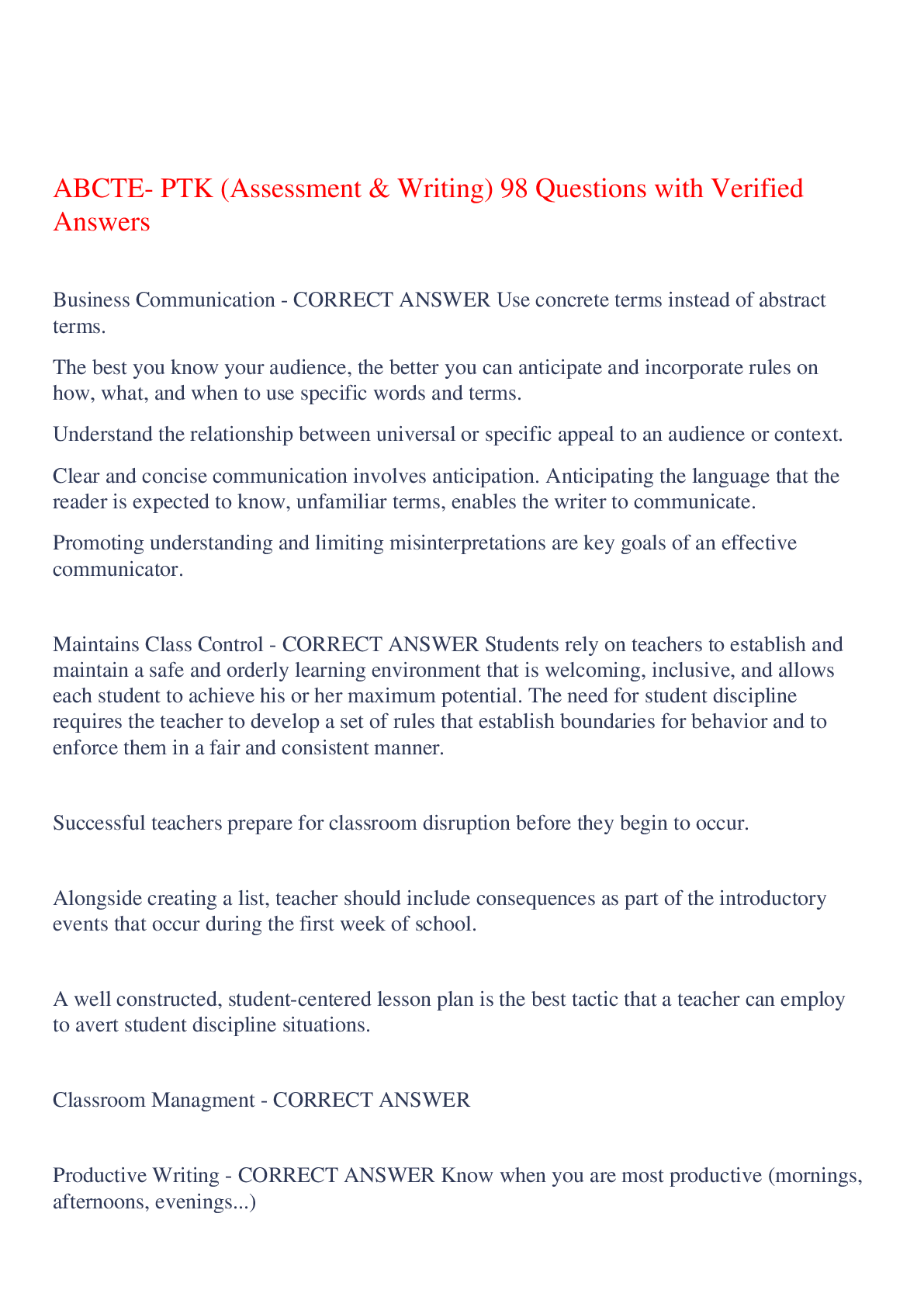
ABCTE- PTK (Assessment & Writing) 98 Questions with Verified Answers Business Communication - CORRECT ANSWER Use concrete terms instead of abstract terms. The best you know your audience, the bet ... ter you can anticipate and incorporate rules on how, what, and when to use specific words and terms. Understand the relationship between universal or specific appeal to an audience or context. Clear and concise communication involves anticipation. Anticipating the language that the reader is expected to know, unfamiliar terms, enables the writer to communicate. Promoting understanding and limiting misinterpretations are key goals of an effective communicator. Maintains Class Control - CORRECT ANSWER Students rely on teachers to establish and maintain a safe and orderly learning environment that is welcoming, inclusive, and allows each student to achieve his or her maximum potential. The need for student discipline requires the teacher to develop a set of rules that establish boundaries for behavior and to enforce them in a fair and consistent manner. Successful teachers prepare for classroom disruption before they begin to occur. Alongside creating a list, teacher should include consequences as part of the introductory events that occur during the first week of school. A well constructed, student-centered lesson plan is the best tactic that a teacher can employ to avert student discipline situations. Classroom Managment - CORRECT ANSWER Productive Writing - CORRECT ANSWER Know when you are most productive (mornings, afternoons, evenings...) If you cannot choose your timing, then dedication and perseverance is required. To be productive: 1. You need to be alert. 2. Ready to work 3. Accomplish task with relative ease. 4. Write everyday 5. Develop an habit of concentrating while you write. 6. Critical thinking self-directed, self-disciplined, self-monitored, and self-corrective thinking (attention to detail). 7. Have a positive attitude about writing in general. Reading and writing from an audience-centered view means acknowledging your confirmation bias and moving beyond it to consider multiple frames of references, points of view, perspectives as you read, research, and write. Break down writing in small manageable steps, that in turn, will provide you with a platform for success. Your rough draft as a purpose but its not your final product. Let go of fear of failure. Your desire for perfection should come in place when it comes to polishing your finished product. To eliminate fear of writing, make the unknown known. If we take out the mystery out of the product and and process, we can see it for its essential components. We see how our finished product should look. Examine successful papers to get a better feel for what you have to produce. Planning Checklist - CORRECT ANSWER 1. Determine your general purpose: are you trying to inform, persuade, entertain, facilitate interaction, or motivate a reader? (who, what, when, how, and why(optional)) Identifying "why" something happened or why a certain decision is advantageous will be the essence of the communication. 2. Determine your specific purpose: the desired outcome. 3. Credibility, Timing, and Audience Which question below is MOST likely to generate the widest range of answers and discussions among students? - CORRECT ANSWER A: Why would the author have ended the book this way? This question allows for both a wide range of answers and discussion of those answers. The discussion is likely to be interesting because there are so many possible answers to the question. Why questions tend to be the most open-ended. Why should a teacher always spend time explaining classroom rules during the first few days of class? - CORRECT ANSWER A: To establish clear expectations for performance and behavior. Students benefit from clear, firm guidelines from the outset. The rules should be changed only when necessary, not casually or according to students demands. Which of the methods below will BEST hold students accountable for their full participation in cooperative learning groups? - CORRECT ANSWER A: Assign each student in the group a specific role in accomplishing the objectives of the activity. If each student has a role in meeting the objectives and the activity is well structured, then all students will be drawn into participating because they all have something to do. Grading students' work individually can be appropriate during cooperative learning activities. Students evaluating each other should be generally avoided. When teachers share standardized test results with parents, there is a large amount of information in the score report to be discussed. Which information will be of MOST use to a typical parent? - CORRECT ANSWER A: Parents will generally benefit most rom specific information about how to help their children succeed. When parents know their child's weaknesses, they can emphasize working to improve them. Parents may want to know how their child had done in comparison to other students locally and nationally, but the information does not help their child improve. Knowledge: Recall and remember information - CORRECT ANSWER Defines Describes Identifies Knows Labels Lists Matches Names Outlines Recalls Recognize Reproduce Selects States Memorize Tells Repeats Stem: How many of the following ...? Comprehension: Understanding the meaning, translation, interpolation, and intepretation - CORRECT ANSWER Comprehends Converts Paraphrase Restate Illustrate Confirm Match Explains Predicts Defends Generalizes Compare Distinguishes Estimates Extends Gives examples Rewrites Translates Infer Summerizes Transforms Characterizes Differentiates Classifies Stem: Describe in your own words... Application: Use a concept in a new situation. - CORRECT ANSWER Typically requires the ability to transfer learning into a new situation. In turn, the act of transferring requires operating with the relationships between situations. Applies Changes Draw Solve Model Choose Discover Collect Classify Report Show Produce Prepare Make Paint Sketch Computes Constructs Demonstrates Manipulates Modifies Experiments Stem: How is ____ related to ____ ? Analysis: Separates materials or concepts into parts so that it's organizational structure may be understood. is - CORRECT ANSWER Analyze Survey Examine Research Investigate Compare/Contrast Take apart Subdivide Point out Differentiates Selects Distinguishes Classify Breaks down Diagrams Deconstructs Discriminate Observes Examines Outlines Relates Separates Identifies Illustrates Infers Stem: What are the main features of ...? How does this illustrates...? Synthesize: Highest order thinking skills. Builds a structure or patterns from diverse elements. Put parts together to form a whole, with emphasis on creating a new meaning or structure. - CORRECT ANSWER To form by combining parts or elements Combines Role-play Construct Originate Creates Organizes Develop Produce What if Hypothesize Plan Show Prepare Categorizes Reorganizes Relates Revises Rewrites Concludes Imagines Invents Reconstructs Plans Rearranges Stem: What ideas can you add to ___ ? Evaluation: Judging Outcome - CORRECT ANSWER Judge Compares Assess Criticizes Critiques Solve Summarize Relate Appraise Weigh Consider Interprets Justify Support Contrasts Describes Discriminates Measures Accepts/Rejects Values Evaluates Explains Consults Decides Stem: What would you suggest for ...? Do you agree that ____? What supports the opinion _____? Suppose your objective is "The student will demonstrate an ability to differentiate among igneous, sedimentary, and metamorphic rocks." Which is the BEST activity for introducing students to the attributes of each type of rock? - CORRECT ANSWER A: Students examine rocks belonging to each group and identify the similarities and differences. The activity is followed by a group discussion in which the teacher brings out the important characteristics of each type. Students learn best when they are actively involved. Field Trip - CORRECT ANSWER Students take a field trip followed by having the students make bulletin boards of academic concept is a good follow-up or assessment activity after an introduction. A group of students wants to produce an electronic magazine that publishes original student writing and art. Their adviser is planning a unit to train them to use a word-processing application to create pages that include features such as images, multi-column layouts, sidebars, headers, footers, links, and page backgrounds. Which of the following would be the BEST culminating activity for this portion of the training? - CORRECT ANSWER A: Small teams producing a document under proctored conditions, using specified features, and within a time limit. The purpose of the training is to prepare students to apply what they learn. The team and time limit conditions make the performance more realistic; the whole activity promotes retaining and transferring what has been learned. Written test are not ideal for gaining student mastery of a process. Since students will be working in groups to produce the magazine, testing their solo performance is also unhelpful. Which of the following is MOST likely to promote effective transfer of knowledge to students? - CORRECT ANSWER A: Having students work on their own with specific information related to a topic before giving an organizing lecture. Studies indicate that topics need to be organized and connected in order to promote transfer of knowledge, but that a large number of topics covered quickly will hinder student transfer because students have too little time to connect and organize the information. Students are about to take a paper and pencil test. If there is time for only one of the following activities, which would BEST prepare the students for the test? - CORRECT ANSWER A: Organizational structures help students to connect and remember. Leaving students to go over their notes and homework assignment is most suited for advanced students. Playing a teacher developed game, and working on individually test type questions could be helpful but does not give much support as an organizational structure. Which of the following learning objectives uses a higher order thinking skill? - CORRECT ANSWER A: The student will create a metaphor to describe an emotion. It requires synthesis in order to complete the task. Which of the following would provide the BEST introduction for a lesson on writing bibliography references? - CORRECT ANSWER A: Demonstrate to students the specific procedure and order expected. Writing bibliography references is a procedure, and procedures are best taught through demonstration. The teacher need to specify the important elements. Which of the following phrases BEST completes the following sentence? - CORRECT ANSWER Vocabulary should be taught... A: in every subject area in order for students to master the subject matter. Rather than expecting students to memorize vocabulary, it is more effective to help "hook" the words to vocabulary words students already know and to use those words in context both in class and in homework. Vocabulary study need to have context to be retained. A social studies teacher wants students to consider the role of geography in population patterns. She asks her class, "What role did geography play in the growth of Chicago as a major U.S. city?" What should she do next? - CORRECT ANSWER A: Students need various amounts of time to think through an answer to a question, particularly for complicated questions. Allowing students to answer right away can stop the thinking process for the other students. Calling on a student allows the rest of the class to stop thinking about the problem, too, and puts the student in an embarrassing position. Listing some possible answers on the blackboard and asking students which they think are the best is an option if the discussion gets stalled, but students should be given plenty of time to come up with their own ideas before the teacher starts prompting them. I. According to our textbook, what does the public welfare system do to solve the problems of poverty? II: What are some ways our country might solve the problems of poverty? Which of the following best describes the differences between these questions? - CORRECT ANSWER A: II invites more divergent thinking than I. The question is a matter of relative convergence and divergence. Question I converges on the textbook; that is, good answers will stick to what the textbook says. Question II allows for answers that may draw on sources other than the textbook. Both questions are open-ended. How should a teacher generally begin almost every class? - CORRECT ANSWER A: By telling students what they will be covering that day. Telling students what they will be covering helps focus students' attention. A teacher should remind students to pay attention if she notices that their attention is wandering, but she need not start every class with this reminder. Reviewing skills is helpful on occasion, but in every class. Casual conversation with students builds rapport but should be reserved for before or after class. What activities would BEST help students in a middle school social studies class understand why the different Native American tribes had different trading practices? - CORRECT ANSWER A: Assign a tribe to each group of students and give each group handouts that identify needs and oversupply for a particular tribe. Then stage trading activities among groups and have students identify important aspects. Students engaged in active participation are more likely to learn and understand complex interconnections. A struggling student comes to pick up a paper at your desk during class time. You have determined that this student needs extra help. Which of the following would be BEST to say to the student? - CORRECT ANSWER A: "I'd like to talk to you about this paper in a little more detail. Let's set up a time when we can talk in private." It is important to protect student privacy and avoid embarrassment. The vital issue is not to share lack of success with the rest of the students. Consider the following question asked by a first grade teacher: "What do the three stories we have read by Tomie de Paola have in common? What is the main instructional value of asking a question like this? - CORRECT ANSWER A: Analysis of the separate stories and comparison between them. Question focuses on the 4th level of Bloom's Taxonomy. The teacher is looking to see which students are able to think of all three stories at the same time and make comparisons between them. If a school wanted to compare how its students were doing with respect to students in other school, what kind of assessment would be MOST appropriate? - CORRECT ANSWER A: A norm-referenced test is designed to give a percentile score that places each student on a continuum of 1 to 99+. Suppose you want students to learn to distinguish between the words imply and infer. Which of the following sequences would be MOST effective? - CORRECT ANSWER A: Explain the distinction, then have students apply the terms to their own examples. Students cannot work independently until a skill is learned. In order to use an inductive sequence for teaching about World War II, which of the following would be the BEST way for a class to work? - CORRECT ANSWER A: Examine events leading up to the war and develop a general model of world war in the process. Induction is the process of building a general model. Inductive instruction makes use of student "noticing". Instead of explaining a given concept and following this explanation with examples, the teacher presents students with many examples showing how the concept is used. Which of the following statements BEST illustrates a proven technique for encouraging student effort? - CORRECT ANSWER A: "You're exactly right here and her. Now check this." Teacher should give a student specific feedback about successful learning or performance and also points ahead to even better performance. A student usually well-behaved, is being disruptive at the moment. Which of the following techniques is an effective first intervention? - CORRECT ANSWER A: Move closer to the student. Moving closer is a good nonverbal cue that the teacher has recognized something that needs attention, yet gives the student a chance to correct things on the spot. Given the following set of scores on a standardized test, which choice most closely approximates the difference between the mean and median of the set? 89,65,77,93,80,87,79 - CORRECT ANSWER A: The mean of the data is 81.43 and the median is 80. The difference is 1.43 which is closer to 1. Token Economy - CORRECT ANSWER Students given a reward for achieving a goal. Negative Reinforcement - CORRECT ANSWER Negative reinforcement involves attaching an undesirable consequence to undesirable behavior (i.e., like missing recess for calling someone a bad name). Partial Reinforcement - CORRECT ANSWER Partial reinforcement is a term psychologist use to describe a sort of conditioning in which a certain behavior is only sometimes reinforced. Inquiry or Discovery Learning - CORRECT ANSWER Students use the materials themselves to discover a concept in a structured lesson. Direct Instruction or Active Teaching - CORRECT ANSWER The teacher presents the concepts directly to students. Retain Information - CORRECT ANSWER Students retain information better when they use it, especially in analytical ways. By comparing and contrasting each new topic to the earlier ones they have studied, the student will access previously taught information and think about the new information they are learning. Assessing the students tell the teacher what the students have retained, but, by itself, does not help students retain information. A fifth-grade student has just finished a three-week unit on the American Revolution in social studies. Which strategy would be BEST to use to culminate the unit? - CORRECT ANSWER A: Give a free-response test on the "big ideas" of the unit and have students choose a project from a list of eight projects. In order to know whether the learning objectives of the unit have been met, the objectives must be measured. A test on the major concepts of the American Revolution achieves the goal. The project, from a limited number of choices that relate to the objectives, gives students another way to show what they have learned. Having the students design a project that shows what they learned is too free-form. It doesn't show that they have met the learning objectives. A student comes to you and says, "I just can't do math. My dad can't either. I don't have that kind of brain. I just don't get it." Which of the following is the BEST response to this situation? - CORRECT ANSWER A: Offer additional help and explain that you will pinpoint the areas that are causing problems and work through them. All students should be accountable. It insults students when the teacher assumes they cannot learn and gives them an excuse to avoid a challenge. Which of the following language arts activities requires the highest order of thinking skills? - CORRECT ANSWER A: Imagining and writing a new ending to a story is an example of the synthesis level of thinking on Bloom's Taxonomy. Two student work together to prepare visual aids that illustrate the major waves of immigration in the United States. The activity satisfies which of the following learning objectives? - CORRECT ANSWER A: Communicating suitable ways. Preparing visual aids necessarily engages students in thinking about what's suitable for the content, purpose, and audience. Their content may or may not require analyzing for cause and effect, for making claims, or making inferences (a conclusion reached on the basis of evidence and reasoning). Curriculum planning is a major aspect of a teacher's job. Which teaching practice listed below will BEST help students to achieve grade-level outcomes? - CORRECT ANSWER A: A teacher should have a plan for the school year before the year begins, so that he or she is sure to teach the required learning objectives. The units of study can then be constructed around objectives, rather than the reverse. A nine-year old student with ADD is in a regular education classroom. He has average ability in math. Which strategy below will MOST effectively help him memorize his multiplication facts? - CORRECT ANSWER A: Have him spend 15 minutes per day using a computer program that practices multiplication facts. A multiplication fact program on the computer will probably hold his interest for more time than any of the other strategies, which means he will practice more. Working with another student may be a chance to goof off, rather than focus on practicing. When planning how students will practice correct spelling of the words "there," "their," and "they're," which of the following is the BEST pattern? - CORRECT ANSWER A: Practice frequently at first, spread out practice after that. Frequent initial practice helps people acquire a skill and develop frequency with it. Further practice aids retention. A teaching unit should be designed so that key skill are... - CORRECT ANSWER A: practiced frequently until students retain them. Frequent practice distributed across the available time period helps students develop fluency. In most cases, smaller chunks work better than big ones. A teacher is planning how to explain classroom assessment practices to a group of parents. Which of the following could be used as an example of formative assessment? - CORRECT ANSWER A: Evaluating whether teaching practices need to be changed based on student self-evaluation. Formative assessment are those that give indications of what needs to be adjusted, correct, or otherwise improved based on feedback. They guide instruction that is taking place. Comparing student performance on a post-test compared to a pretest and analyzing standardized test scores to show how students in one school compare to those in other school are examples of summative assessment. A student is returning to school after being hospitalized for three months. Which accommodations should a teacher consider? - CORRECT ANSWER A: Giving additional time to complete assigned work. Time to complete work is typically the most important accommodation needed after a long absence. Most students who have been absent realize they will have adjustments to make and their classmates realize this as well. Lowering expectations for in-class behavior or performance does not help the student progress. Assigning another student to help only slows the students recovery and is unnecessary if extra time is granted for completion of assignment. Of the following verbs or verb phrases, which one is most fitting for an objective concerned with students' ability to generalize? - CORRECT ANSWER A: Find and explain additional cases of... Generalizing is the process of extending what has been learned. In its most precise sense, it calls for finding identical cases or uses of what has been learned. At the very least, it calls for finding very similar cases or uses. List/describe and Define/explain are asking for students to recall information. A teacher thinks a student is under a great stress, perhaps because of a bad relationship with a parent and step-parent. Among the following choices, which is the first thing that the teacher should do? - CORRECT ANSWER A: Refer the student to a professional help provider. In such a case, the first order of business is getting the best available help for the student. The teacher may be valuable during or after another professional is engaged. A conference with the parent or step-parent is premature. It is better for teacher to stick to educational rather than therapeutic goals. A professional might advise the teacher on what behaviors to look for as time goes along. Which activity below would give second-grade students the best practice discriminating between mammals and non-mammals? - CORRECT ANSWER A: Bring cut-out pictures of mammals and non-mammals to class, and have students sort them into "mammal" and "non-mammal" piles one at at time. Since the objective is for the students to practice discriminating between mammals and non-mammals, they need to look at many animals and decide in which category they belong. This answer, provides exposure to a large number of "practice problems." Which of the following statements will require students to analyze what they are working on? - CORRECT ANSWER A: "What are the main features of..." The answer requires students to divide something into its constituents, the heart of analysis. When students cannot transfer a concept from the classroom to other settings the most common reason is - CORRECT ANSWER A: insufficient practice with transferring it. According to researchers, most people do not transfer what they learn unless they are encouraged or required to do so. What would be the MOST expedient way for a teacher to find out whether students know specific facts about whales? - CORRECT ANSWER A: Students take a multiple-choice pretest about whales. If a teacher needs to know whether students know certain facts, a multiple-choice is a fast way to find out. Making webs in small groups would allow students the time to share everything they know about whales and build on each others' knowledge, and may give the teacher an idea of what they know, but it will not give her all the answers she needs quickly. The class brainstorming generate similar information as the webs but is less effective for the teacher. Which of the following sets of verbs is best suited to assessment of how well students can evaluate a body of content? A. Interpret, justify, support. B. Categorize, sort, subdivide C. Match, define, identify D. Show, prepare, produce - CORRECT ANSWER A: Interpret, justify, support While observing an experienced teacher you notice that every time a student answers a question correctly, the teacher asks the entire class a new question, frequently related to the previous one, but sometimes pushing the students in a different direction. Which of the following is the MOST compelling reason a teacher might do this? A. There is a lot to cover, and no time to waste. B. Maintaining momentum is an important key to facilitating group attention. C. The students need to be pushed. D. A teacher asks questions to facilitate student thinking. - CORRECT ANSWER B; Maintaining momentum is an important key to facilitating group attention. Pacing and momentum are very important when teaching groups. The teacher wants to make sure that ll students are engaged while also making sure to cover the necessary content. After grading a test, a teacher notices that the scores are significantly below the students' usual scores. The teacher decides that he did not communicate the material effectively. Rather than discard the test scores or unfairly penalize the students, the teacher decides to grade on a curve. Which of the following distributions will BEST describe the data once it has been adjusted? A. Bernoulli distribution B. Continuous probability distribution C. Normal distribution D. Poisson distribution - CORRECT ANSWER C; Normal distribution Grading on a curve fits the set of test scores along a bell curve, or normal distribution, in which the majority of students score near the mean-few students score significantly higher or lower than the mean. How should a teacher reinforce the "Be prepared and ready to work on time" rule in class? - CORRECT ANSWER A; stand outside the classroom with the door open for the students. A few seconds before the second bell rings, rush into class with a backpack and make a big show of being late. Afterwards, talk to the students about the rule for being ready on time. By showing the students how disruptive their tardy behavior is, and following the example with a discussion of why the rule is important, a teacher is most likely to change their behavior. Journal writing may be effective if it is combined with a discussion about the problem, but it must be linked to the behavior that the teacher wants to change. Consequences in this case is not appropriate. Curriculum planning is a major aspect of a teacher's job. Which teaching practice listed below will BEST help students to achieve grade-level outcomes? A. Consulting the state curriculum on a frequent basis. B. Planning units of study that are interesting and then consulting the state curriculum to be sure that the standards are incorporated into the lessons. C.Using the state curriculum at the beginning of the school year to determine the learning obj for the year, which are then incorporated into units of study. D. Using the textbooks and materials mandated by the school district because they have been chosen to meet the standards for each grade level - CORRECT ANSWER : C A teacher should have a plan for the school year before the year begins, so that he/she is sure to teach the required learning objectives. A teacher is asking a class a series of questions to review key points and warp up a lesson on Pearl Harbor. Which one of the following is the BEST way for the teacher to indicate that a student has given a correct response? A. Ask a clarifying question. B. Look to other students to see if they agree. C. Move on to the next question. D. Nod and say, "Excellent!" - CORRECT ANSWER D; Nod and say "Excellent!" Teachers should indicate approval when students give correct responses. Asking a clarifying question is appropriate if a student has given a correct response but seems unsure about the answer. Choice B and C does not indicate approval to the student. A ninth-grade student correctly stated the dates of the Cold War. Which one of the following is the BEST teacher response? A. "Good, We will move on to a discussion on Russia and its post-cold war leadership." B. "Great answer! You are well prepared for our upcoming test next Wednesday>" C. "Share with the rest of the class why you think that is the correct answer." D. "That is correct. Who can tell us what precipitating event ended the Cold War? - CORRECT ANSWER D; "That is correct. Who can tell us what precipitating event ended the Cold War?" The teacher follows the correct response with a new question to maintain momentum. Provide feedback of value to the student. Moving the question to another topic is only appropriate if the question-and-answer period was a review of previously covered material. An English teacher is assigning a persuasive essay. How can the teacher BEST help students be successful with this assignment? A. Give students a rubric for how the essay will be graded. B. Hand out several example essays from previous classes. C. Allow students to choose an essay topic they find interesting. D. Grade papers according to the effort students exhibit in class. - CORRECT ANSWER Features of field trip: 1 - CORRECT ANSWER 1. Facilitate the learning of abstract concepts. Taking students on a field trip makes learning more effective as they will be able to gain vast ideas on the topic. Features of field trip: 2 - CORRECT ANSWER 2. Motivate students through increased interest and curiosity. Field trips can add variety to the regular classroom instructional program and they tend to be special and enjoyable learning experiences. As a result, students will develop positive attitudes in students toward related classroom activities. Features of field trip: 3 - CORRECT ANSWER 3. Increases student-student and student-teacher social interaction. Field trips provide an opportunity to involve students, parents, and the teachers in the instructional program. Students can select the place to be visited, developing questions to ask, writing reports or thank you letters after the trip, or evaluating the experiences. Since parents must give their permission, a letter sent home with the permission form explaining purpose of the trip is a good way to arouse their curiosity and encourage them to ask the student or teacher about the trip. The parent guides their child in order to make sure that they do not come to any harm. This role allows the parent and teacher to establish a much closer relationship. The interaction between students within themselves will also be increased when they work in groups. Moreover, the interaction between the students and teacher will enhance as the students will have to discuss to the teachers when they have doubts. Features of field trip: 4 - CORRECT ANSWER 4. Develops social awareness. Field trips make students aware of learning activities in everyday life. For instance, visits to supermarkets or shopping malls are typical field experiences, which teachers may fail to notice. A well-organized trip to a "normal" place is an excellent method of teaching students to observe, ask questions, and learn in the large classroom. Purpose of Field Trip: 1 - CORRECT ANSWER 1. It enhances the curriculum. Field trips are rich in educational possibilities as students learn from actual hands-on experiences, rather than by simply reading or hearing about something. Involvement in a real world experience makes learning more meaningful and memorable comparing to regular classroom instructional programs. Purpose of Field Trip: 2 - CORRECT ANSWER 2. Give students experiential learning experiences. Involvement in a real world experience makes learning more meaningful and memorable. As a result the students will have more concept of the topic as they have learnt through their hand-on experiences. Purpose of Field Trip: 3 - CORRECT ANSWER 3. Concrete skills such as note taking. Students have to develop questions to be asked, write reports or thank you letters after the trip, or evaluate their experiences. By doing such activities, students will develop various skills such as note taking skills, speaking skills, writing skills will enhance. Purpose of Field Trip: 4 - CORRECT ANSWER 4. Involvement in a real world experience makes learning more meaningful and memorable. Purpose of Field Trip: 5 - CORRECT ANSWER 5. Field trips can add variety to the regular instructional program; they tend to be special and enjoyable learning experiences, ones which develop positive attitudes in students toward related classroom activities. Field trips are rich in educational possibilities because students learn from actual firsthand experiences, rather than by simply reading or hearing about something Purpose of Field Trip: 6 - CORRECT ANSWER 6. Field trips help the students appreciate the relevance and importance of what they learn in the classroom. For e.g. determining blood type is a skill, which can be learned in a school laboratory setting, but students may not learn the importance of this skill until they observe what goes on in a real hospital where life and death of real patients may depend on this skill. Step involved in conducting field trip. - CORRECT ANSWER 1. Trip Selection. • Identify objectives and plan of evaluation for the field trip. • Select site to be visited and arrange date and time. • Conduct pre-visit to familiarize yourself with the major features of the field and obtain address, directions, contact person and mobile numbers. Step involved in conducting field trip. 2 - CORRECT ANSWER 2. Logistics Planning • Apply for administrative approval and file requisition for transportation. • Make arrangement for meals and develop schedule for the day. • Arrange special equipments like cameras and collect money for admission fees if the site demands. • Inform parents about the trips. • Create a list of student names and home phone number for emergency Step involved in conducting field trip. 3 - CORRECT ANSWER 3. Field Trip Preparation/Pre-trip discussion • Discuss the purpose of the field trip. • Show photographs or posters of the site. • Set a standard conduct and discuss money usage, lunch plans, dress code and other necessary things. • Discuss how to ask good questions and make a list of open-ended observation questions to gather information. • Overview the field trip schedule. Step involved in conducting field trip. 4 - CORRECT ANSWER 4. The Field Trip • Let students to sketch if it is necessary. • Ask prepared questions and note the answers. • Do things that you have planned. Step involved in conducting field trip. 5 - CORRECT ANSWER 5. Post-field Trip • Let student to share their observations and reactions to field trip experiences. • Create classroom bulletin board displaying materials collected while on field trip. • Let class to compose thank-you letter to those who helped during the field trip. Include special information learned. Step involved in conducting field trip. 6 - CORRECT ANSWER 6. Evaluating Field trip • What was the unique educational value in this trip? • Did students meet the objectives? • Was there adequate time? • Was there adequate staff and adult supervision? • What might be done differently to be better? • What points to be emphasized next time? • What problems should be addressed in the future? Advantages of field trip. - CORRECT ANSWER Real-world experience. It allows students to have a real-world experience. For example, a textbook lesson on the domestic animals can be enhanced by a trip to a local farm where the students can clearly see the domestic animals. Increase in quality of education. For example, a biology field trip could take kids on a hunt for bugs or certain types of flowers. In this case students can learn more. Hence it improves the quality of education. Disadvantages of field trip - CORRECT ANSWER Time considerations. Difficultly in preparation (getting approval from various head of administration) and fitting the trip as per the school timetable which takes more time. Lack of support from school administrations for field trips. It means school can't afford the materials and sometime can't provide financial also where student have to search their own ways. Poor student behavior and attitudes. Means loss over students like sometime some students they don't listen to the teacher showing their ego attitudes and doing the things on their own ways which cause trip to be unsuccessful where it affects the other students and the relation between teacher and students because of the bad attitude. Shortage of resources and choice of venue. Means sometimes school can't provide the materials and teacher also can't have the correct materials for the trip which causes shortage of resources. And some time student can't have the choice to pick their own place and they have to agree with the teacher choice which shows student doesn't have the choice to select the venue. Medical risk. For example like while travelling via vehicle some children gets motion sickness. Planning a Field Trip - CORRECT ANSWER Good planning must precede field trips. Careful attention should be given to trip selection, pre-visit preparation, the trip itself, appropriate follow up, and evaluation. When considering a field trip, teachers are advised to first consult with their administrator regarding existing school policies and follow those recommended procedures in planning a field trip. 1. Trip Selection Identify the rationale, objectives and plan of evaluation for the field trip. Select the site to be visited. Contact the educational coordinator for the site and arrange the date and time. Obtain the pre-trip information package if one is available. Record addresses, directions, contact persons, phone numbers, email addresses, etc. Conduct a pre-visit to familiarize yourself with the major features of the field trip. Purchase postcards and posters. Take photographs to share with students prior to the visit. Explore the exhibition(s) you plan to visit to get ideas for pre field trip activities. Planning a Field Trip : 2 - CORRECT ANSWER 2. Logistics Planning a. Apply for administrative approval from the head of the school. b. File requisition for bus transportation if the school has any or seek administrative support for arranging transportation if the school does not have the facility c. Make arrangements for meal or sack (pack) lunch if needed d. Develop schedule for the day e. Arrange for special equipment -supplies, film, video camera, digital camera if needed f. Collect money for admission fees if the visit site demands g. Inform the parents (in case of day school) about the following things: • Date and location of field trip and transportation arrangements • Educational purpose of field trip • Provision for special needs students • Cost • Clothing for the trip • Lunch arrangements • Money needed • Trip schedule • Whether a child will need prescribed medication administered h. Provide alternative arrangements for pupils who will not be going on the trip. i. Submit a list of students who will be attending the field trip to other teachers if their schedules will be affected. j. Create a list of all student names and home phone numbers for use in an emergency. Planning a Field Trip : 3 - CORRECT ANSWER 3. Preparing Students before the Trip / Field Trip Preparation/Pre-trip discussion Discuss the purpose of the field trip and how it relates to the current unit of study. Introduce vocabulary words that will be used by field people during the tour. Show photographs or posters of the field trip site or related to exhibits that will be viewed. Assign students "specialists" roles in one aspect of the topic that they will be studying during the field trip. Students could be grouped in different subject areas related to the field trip topic to research (e.g., history, art, religion, science, environment, etc). As a class brainstorm a set of standards of conduct for the trip and discuss suggested spending money, lunch plans, appropriate clothing to wear for the trip including gear for rainy weather. Discuss with students how to ask good questions and brainstorm a list of open-ended observation questions to gather information during the visit. Record questions on chart paper or in student field trip journals. Planning a Field Trip : 4 - CORRECT ANSWER 4. Final Planning / the field trip Check all permission slips the day before the field trip. Activities that will occur during the Field Trip Plan activities that allow students to work alone, in pairs or small groups. Activities might include: Sketch pages with partial drawings of objects found in the exhibits for students to complete the drawings based on their observations Peepholes in construction paper - cut different sized round holes in construction paper and have students view a part of the exhibition through the peepholes. Ask them to describe what they see, what they notice now that they missed before, and how their perspective changes with each new view Field notebooks for recording answers to prepared questions based on clues Hand drawn postcards to write near the end of the tour that will summarize the field trip visit Provide time for students to observe, ask questions, and record key words, ideas and phrases as journal entries in their Field book after viewing each exhibit Ask follow-up questions as students make observations and listen to presentations. How are these two objects different from one another? What clues does this artifact provide about the topic? In what ways do these two objects relate to one another? If you could change one thing in this exhibit, what would it be? Pretend you are an archaeologist in the future who is observing this object. What would you be able to conclude about the culture of the past? Describe the setting in which you might have found this object. Which object will be of greatest value in a hundred years? Why? Which object took the most time and effort to produce? Pretend you are a character in this exhibit. Tell us as much as you can about your life. What does this object tell us about the person's attitude toward...? Schedule a particular segment of the field trip for a scavenger hunt where students look for particular objects and record them in their Field book or on an observation sheet. Provide time for students to work in their Field Book writing questions, describing favorite displays or making sketches of artifacts, structures, scenery, etc. If they cannot complete their sketches, encourage them to label them for future completion as to color, detail, etc. Planning a Field Trip : 5 - CORRECT ANSWER 5. Post-Field Trip Activities Just as quality pre-planning is essential to the success of a field trip, planning for appropriate follow-up activities will facilitate student learning and multiply the value of hands-on experiences outside the classroom. The following activities provide a general guide when planning for post-field trip classroom experiences. Provide time for students to share general observations and reactions to field trip experiences Share specific assignments students completed while on the field trip. Create a classroom bulletin board displaying materials developed or collected while on the field trip. Develop a classroom museum that replicates and extends displays students observed on the field trip. For example, if the field trip involved an art museum, develop a classroom art museum containing student artwork. Link field trip activities to multiple curricular areas. For example, students can develop vocabulary lists based on field trip observations; record field trip observations in a classroom journal; complete math problems related to actual field trip budget planning; etc. Share and evaluate student assignments/activities from the Field Book. Have the class compose and send thank-you letters to the field trip site host, school administrators and other persons that supported the field trip. Include favorite objects or special information learned during the field trip. Create a short news report about what happened on the field trip. Publicize the trip via an article in your local newspaper, school bulletin board, trip presentation for parent's night, or school web page. Planning a Field Trip : 6 - CORRECT ANSWER 6. Evaluating the Trip Complete a "Teacher Journal" regarding the field trip. This will provide a good reference for future field trips. What was of unique educational value on this field trip? Did the students meet the objectives/expectations? Was there adequate time? Was there adequate staff and adult supervision? What might be done differently to make this an even better experience in the future? What special points should be emphasized next time? What special problems should be addressed in the future? What would improve a visit to this site in the future? Cultivating a positive classroom: Core Ideas - CORRECT ANSWER What is a positive classroom environment? A number of factors contribute to a positive learning environment for your students. Three of the most important ones are: Core Ideals Each teacher will have different standards and values in the classroom, but the only universally important element is that these remain consistent so that students know what to expect and what is expected of them. It is important that your students know that theirs is an inclusive, respectful, community-oriented environment. To build community and an inclusive atmosphere in the classroom, one idea is to involve students in taking attendance, using photos of each student as a supplement to the boring old 'HERE' style of attendance-taking - check out the following link for a bit more detail and put your own twist on it: http://www.atozteacherstuff.com/pages/578.shtml It is also important to remember that, more than anything else, students will emulate your actions in the classroom. Therefore, it is very important to work well within your community - with your partner teachers as well as other members of the staff. Cultivating a positive classroom: Ambience (the mood, character, quality, tone, atmosphere) - CORRECT ANSWER This is an extremely important - and fun - part of creating a positive learning environment. Your classroom should be a dynamic and engaging place to be for your students. What would you think if you walked into an elementary classroom with nothing on the walls? Weird.... So have fun, but keep your décor related to both your particular students and to the topic being taught. In an ESL classroom, keeping it related to the subject matter is pretty easy, since almost anything in English counts, but keeping it related to your students requires that you know a bit about them. If you are afforded your own classroom, this is much easier than if you have to go from class to class - although it's still possible. In your own classroom, reserve a portion of the wall for each class that you teach. This allows them to feel that they belong in the classroom. You can also use the walls to re-enforce your core ideals, such as community, by posting photos of students, group photos and student work. If you have to move from room to room, have a portable poster for each group you teach, and this will establish a similar sense of belonging. Keep their past projects so that they know that their work is valued. Another aspect of ambience in the classroom is how it is physically set up. Again, this should reflect your core ideals. Desks arranged in rows does not allow for a very communal atmosphere, so you may want to come in just before your class and rearrange the desks in a circle, groups or pairs. Don't forget to move them back when you're finished in the room! Cultivating a positive classroom: Expectations - CORRECT ANSWER If you establish your expectations for student behaviour early and keep them consistent, you may be able to avoid many classroom management issues. Laying down the ground rules early in your relationship with a class is quintessential to your success as a teacher. Involve your students in this to be sure that they are aware of the rules and the consequences. This is another great way to add to the ambience of your classroom - post the ground rules and always lean towards positive, rather than negative, re-enforcement of them. Posting something on the wall when a student doesn't follow the rules will likely affect the entire class in a negative way, but posting something for each student that did adhere to the rules will do the opposite. Cultivating a positive classroom: Relativity - CORRECT ANSWER The role of the teacher goes both ways - you are responsible for imparting knowledge to your students, but you will be a more successful teacher if you also allow yourself to learn from them as well. This is particularly true when you are teaching ESL in a foreign country. Your students can teach you multitudes about their culture. Learning about your students will allow you to keep the material and classroom activities relative to their interests. I taught in South Korea during the World Cup, so an easy - and usually accurate - default for me was soccer. Teaching a difficult concept with a topic that your students are interested in will result in a higher rate of retention. Cultivating a positive classroom: The Wrap Up - CORRECT ANSWER Putting together a classroom with the above ideas in mind will create an environment where your students will thrive. They will feel involved and responsible for their own learning as well as be comfortable enough to actively participate in individual and group activities. Your positive re-enforcement will allow them to build self-esteem and be more successful students, which of course, makes you a successful teacher! The importance of lesson planning. - CORRECT ANSWER Why Plan? Lesson planning is a vital component of the teaching-learning process. Proper classroom planning will keep teachers organized and on track while teaching, thus allowing them to teach more, help students reach objectives more easily and manage less. The better prepared the teacher is, the more likely she/he will be able to handle whatever unexpectedly happens in the lesson. Lesson planning: - provides a coherent framework for smooth efficient teaching. - helps the teacher to be more organized. - gives a sense of direction in relation to the syllabus. - helps the teacher to be more confident when delivering the lesson. - provides a useful basis for future planning. - helps the teacher to plan lessons which cater for different students. - Is a proof that the teacher has taken a considerable amount of effort in his/her teaching. A teacher plans to have an open class discussion to culminate the study of a novel. The BEST seating arrangement for this type of instruction is ... - CORRECT ANSWER A; U-shape or circular formations ensure that all students can see and hear anyone else who speaks. For this instructional purpose, when students are participating in an open-class discussion, students should be able to clearly see and hear Strategies for communicating with parents - CORRECT ANSWER * As we teachers strive to establish partnerships with parents to support student learning, communicating is fundamental to his partnership. Creates a caring and welcoming learning environment - CORRECT ANSWER Students realize when a teacher cares about them as a person. Likewise, they are aware when a teacher is indifferent. Successful teachers know that teaching is a personal event that is based on the connection between the teacher and the student. This one-on-one connection occurs regardless of how many students are present in the class. Create a student-centered learning environment where all students are challenged to reach their full potential and are not inhibited by teacher -made obstacles. Successful teachers construct a variety of learning environment that include all students and appeal to their desire for advancement. To implement this goal, 1. establish a positive climate. (supporting statement): students who feel accepted as a full member of the class are more likely to perform well and less likely to cause trouble than those who feel left out or unappreciated. 2. Create a sense of team membership within the class by providing team building activities. (ss); the purpose is to have all of the members act cooperatively to focus on a goal. It is critical point for teachers to ensure that activities are within reach of students' abilities. Example activity could be name recognition. [Show More]
Last updated: 2 years ago
Preview 1 out of 33 pages
Buy this document to get the full access instantly
Instant Download Access after purchase
Buy NowInstant download
We Accept:

Also available in bundle (1)
Click Below to Access Bundle(s)

ALL ABCTE PTK Practice Exam(25 Sets ) Questions with Verified Answers,100% CORRECT
PTK Practice ABCTE Exam 65 Questions with Verified Answers,ABCTE PTK Exam Study 391 Questions with Verified Answers,ABCTE PTK Practice Exam 42 Questions with Verified Answers,ABCTE - Special Education...
By securegrades 2 years ago
$32.5
25
Reviews( 0 )
$10.00
Can't find what you want? Try our AI powered Search
Document information
Connected school, study & course
About the document
Uploaded On
Oct 15, 2023
Number of pages
33
Written in
All

Additional information
This document has been written for:
Uploaded
Oct 15, 2023
Downloads
0
Views
134