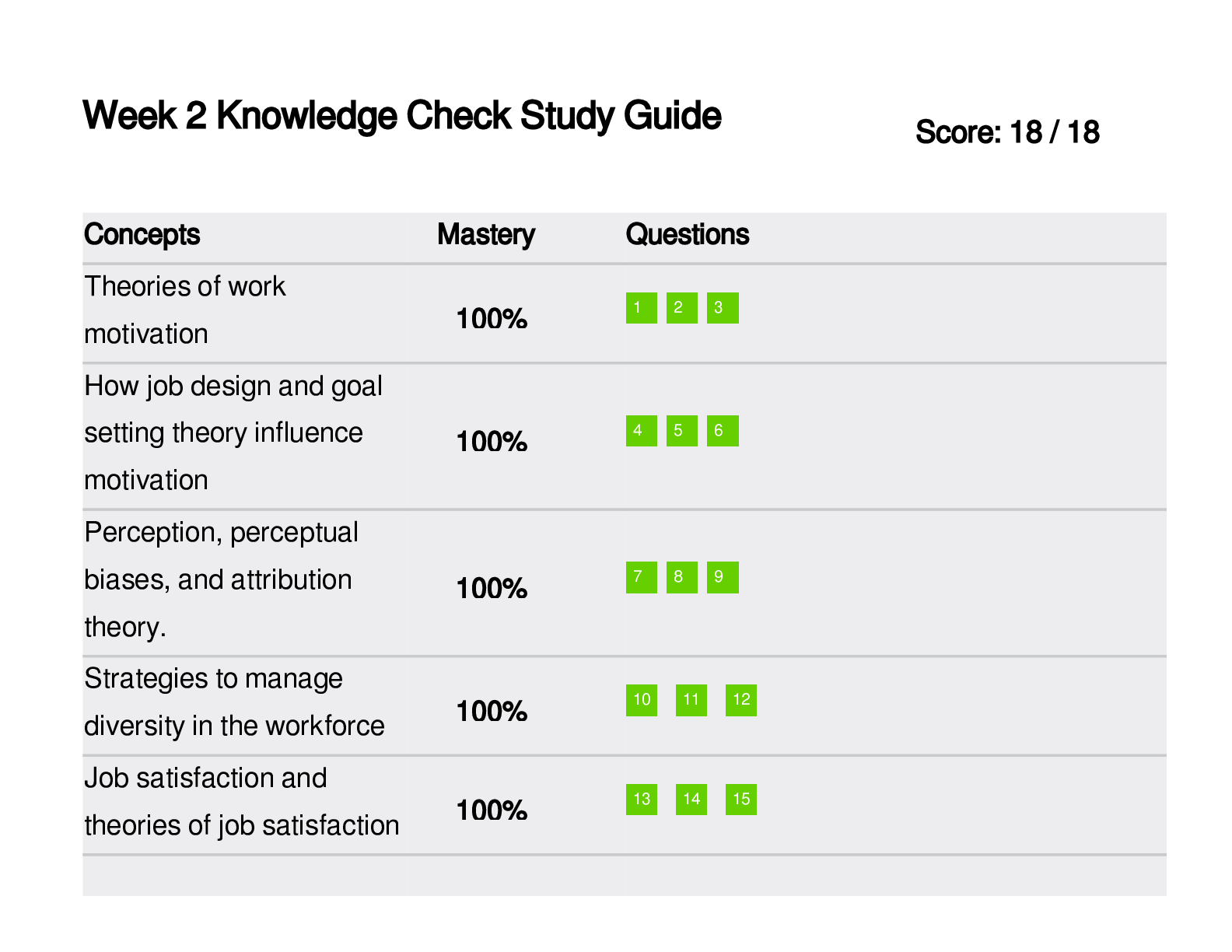
Week 2 Knowledge Check Study Guide Score: 18 / 18
Concepts Mastery Questions
Theories of work
motivation 100% 1 2 3
How job design and goal
setting theory influence
motivation
100% 4 5 6
Perception, perceptual
b
...
Week 2 Knowledge Check Study Guide Score: 18 / 18
Concepts Mastery Questions
Theories of work
motivation 100% 1 2 3
How job design and goal
setting theory influence
motivation
100% 4 5 6
Perception, perceptual
biases, and attribution
theory.
100% 7 8 9
Strategies to manage
diversity in the workforce 100% 10 11 12
Job satisfaction and
theories of job satisfaction 100% 13 14 15
Consequences of job
satisfaction
100%
16 17 18
Concept: Theories of work motivation
Mastery 100% Questions 1 2 3
1.
Emily is an ambitious worker whose performance has suffered since she joined her new
company. Emily feels that even though she enjoys the work, feels safe, and enjoys the
office's facilities, such as the cafeteria and the pool table, she has not been able to reach
out to the others in the office. She has no friends and feels isolated. According to
Maslow's hierarchy of needs, which of Emily's needs is most likely not being satisfied at
her new job?
A. Existence needs
B. Belongingness needs
Correct:
The Correct Answer is: B.
According to Maslow's hierarchy of needs, Emily's belongingness needs are most
likely not being satisfied. Belongingness needs refer to the need for social
interaction, friendship, affection, and love.
C. Safety needs
D. Physiological needs
2.
According to the expectancy theory of motivation, identify an accurate statement about
instrumentality.
A. It is always positive.
B. It is always negative.
C. It should be low so that it enhances motivation.
Correct:
The Correct Answer is: D.
According to the expectancy theory of motivation, an accurate statement about
instrumentality is that it should be high so that it enhances motivation. Instrumentality
refers to an employee’s perception of how certain levels of behavior will lead to
certain outcomes.
D. It should be high so that it enhances motivation.
3.
Sameer perceives underpayment equity when he compares his outcome-input ratio to
Lamar's. Sameer believes that he is putting in more effort and should therefore receive a
larger hike in salary. To avoid this lack of equity, Sameer decides that he need not
compare his outcome-input ratio to Lamar's; instead he should compare it to Adrian's.
According to the equity theory of motivation, how is Sameer restoring equity?
A. By changing his inputs or outputs
Correct:
The Correct Answer is: C.
Sameer is changing his referent to restore equity. A referent is a person chosen by
an individual for the purpose of comparing his or her outcome-input ratio.
B. By changing his referent's input or outputs
C. By changing his referent
D. By changing his organization
Concept: How job design and goal setting theory influence motivation
Mastery 100% Questions 4 5 6
4.
Mia and Tanya are artists at Black and White Inc, an art gallery. Both Mia and Tanya are
equally skilled and receive feedback from customers for their work. Mia creates her art
[Show More]