Chap 12 Palliative Care Exam 28 Questions with Verified Answers
Hospice - CORRECT ANSWER -interprofessional approach to EOL care
-aggressive pain and symptom control
-spiritual and psychological care
-patient an
...
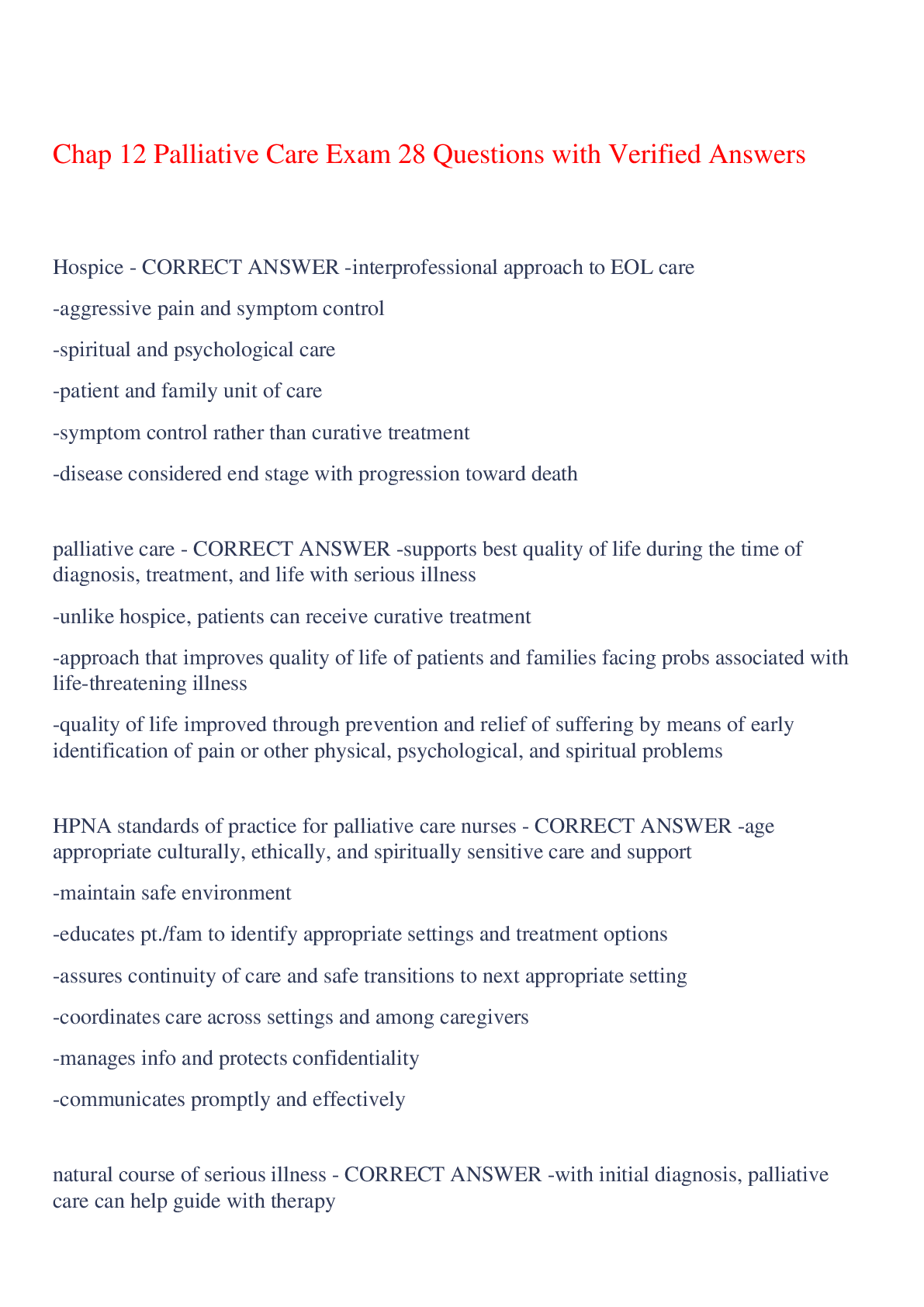
Chap 12 Palliative Care Exam 28 Questions with Verified Answers
Hospice - CORRECT ANSWER -interprofessional approach to EOL care
-aggressive pain and symptom control
-spiritual and psychological care
-patient and family unit of care
-symptom control rather than curative treatment
-disease considered end stage with progression toward death
palliative care - CORRECT ANSWER -supports best quality of life during the time of diagnosis, treatment, and life with serious illness
-unlike hospice, patients can receive curative treatment
-approach that improves quality of life of patients and families facing probs associated with life-threatening illness
-quality of life improved through prevention and relief of suffering by means of early identification of pain or other physical, psychological, and spiritual problems
HPNA standards of practice for palliative care nurses - CORRECT ANSWER -age appropriate culturally, ethically, and spiritually sensitive care and support
-maintain safe environment
-educates pt./fam to identify appropriate settings and treatment options
-assures continuity of care and safe transitions to next appropriate setting
-coordinates care across settings and among caregivers
-manages info and protects confidentiality
-communicates promptly and effectively
natural course of serious illness - CORRECT ANSWER -with initial diagnosis, palliative care can help guide with therapy
-with disease progression to an end stage condition, hospice is option of care
-as aggressive therapies are no longer effective and comfort of care increases, hospice care and bereavement services can be introduced
prognostication tools - CORRECT ANSWER -palliative performance scale (PPS): identifies functional decline and scores it
-karnosky scale: appropriate for pts. with cancer
prognostication - CORRECT ANSWER -based on lab findings and diagnostic test results
-after gathering data, meeting with pt. and fam imperative
hope - CORRECT ANSWER -for cure
-for more time
-for no pain
-for good death
two roads to death - CORRECT ANSWER -peaceful: pt. begins sleeping more and being less responsive
-difficult: pt. restless with increased confusion and hallucinations
triggers for palliative care consult - CORRECT ANSWER -asking surprise question: "would i be surprised if pt. died within 6mo-yr?" and getting positive response would be trigger
-pts with multifaceted care (ventilator, feedings, assistance with ADLs)
-pts. place of residence is long-term care facility (nursing home)
-age
-cognitive impairment
-metastatic cancer
-current or past enrollment in hospice
-pt. without advance care plan
end of life nursing education consortium (ELNEC) core curriculum - CORRECT ANSWER -care at end of life
-pain management
-symptom "
-ethical/legal issues
-cultural considerations
-communication
-loss/grief/ bereavement
-final hours
national consensus project (NCP) - CORRECT ANSWER -task force of organizations striving to improve palliative care
-american academy of hospice and palliative care medicine (AAHPM)
-center to advance palliative care (CAPC)
-hospice and palliative care nurses association (HPNA)
-national hospice and palliative care organization (NHPCO)
NCP practice domains - CORRECT ANSWER 1. structure and processes
2. addresses physical aspects of care
3. psychological and psychiatric aspects
4. social aspects
5. spiritual, religious, existential
6. cultural
7. care of pt. at end of life
8. ethical and legal aspects
palliative care model - CORRECT ANSWER -family unit of care and pt defines fam
-role of nurse as advocate vital to care
-culture honored
-palliative care further carries important focus to special populations (vulnerable prisoner, substance abuser)
-serious illness impacts all systems of care, where there are pts there are pts suffering needlessly
-sensitivity to reality of financial issues
-not confined to cancer and aids but to all life-threatening issues
-interprofessional are of pt/fam is integral to high quality palliative care
unrelieved pain - CORRECT ANSWER -provokes or exacerbate distress
-disturbs coping and adjustment
-augments sense of vulnerability
-interferes with ability to eat, sleep, think, interact
-correlated with fatigue in cancer pts.
Which of the following questions would be appropriate for a palliative care nurse to ask a patient?
A."Is your pain interfering with your ability to sleep?"
B."Why do you insist on being pain free?"
C."Why do you ask for pain medication so frequently?"
D."Do you understand how experiencing pain improves your ability to cope?" - CORRECT ANSWER -A is correct because it is illegal for potential employers to ask questions concerning religious beliefs and other criteria that include but are not limited to race, age, and marital status, which may lead to discrimination.
-B is incorrect because this question allows potential employers to determine the applicant's ability to work with others and possibly to learn whether leaving the current or former employer was voluntary.
-C is incorrect because this question allows the candidate to express his/her professional view of nursing.
-D is appropriate because this question allows the recruiter to determine how the candidate views his/her role in the organization.
benefits of palliative care - CORRECT ANSWER -relief of suffering
-optimization of function
-promotion of healing and comfort
-fostering appropriate hope
-genuine coordination of care at times of transitions between health care providers
-if anticipated, pt. and family are given opportunity and assistance in exploring and preparing for hospice
suffering - CORRECT ANSWER -state of severe distress associated with events that threaten the intactness of a person
-experience of a person
-relief of suffering is central to work of palliative care
strategies for family care givers - CORRECT ANSWER -set realistic goals
-have difficult discussions
-find help
-negotiate expectations
barriers to palliative care - CORRECT ANSWER -lack of general understanding by health care professionals as well as the consumers of the role and nature of palliative care
-limited #s of palliative care trained professionals
-payment for services
-communication
challenges - CORRECT ANSWER -barriers r/t pt safety and independence
-treating pt. for familys sake
-withholding or withdrawing food and fluids
areas of expertise for hospice and palliative care nurses - CORRECT ANSWER -clinical judgement
-advocacy and ethics
-professionalism
-collaboration
-systems thinking
-cultural competence
-facilitator of learning
-communication
certification - CORRECT ANSWER -generalist level is CHPN: certified hospice palliative nurse
-hospice/ palliative administrator is CHPA
-advanced level is ACHPN
institutional certification - CORRECT ANSWER -voluntary
-recognition for high quality palliative care
-available through joint commission
national hospice and palliative care organization (NHPCO) - CORRECT ANSWER committed to improvement of areas:
-patient centered measures r/t management of pain within 48hrs administration
-avoiding unwanted hospitalizations
-avoiding unwanted CPR
-pt. safety
center to advance palliative care (CAPC) - CORRECT ANSWER -nations leading resource for palliative care program development
barriers to research - CORRECT ANSWER -relatively new subspecialty
-numerous ethical issues
-lack of funding
-lack of staff
-lack of trained researchers
-obtaining subjects
ethical concerns - CORRECT ANSWER -advance planning
-double effect
-palliative sedation
-medically futile care
legal concerns - CORRECT ANSWER -right to refuse treatment
-landmark cases: karen ann quinlan and nancy cruzan
[Show More]