ACHPN Review course Exam 44 Questions with Verified Answer
65 M hx of CHF, COPD and NSLC II. comes with SOB and left shoulder pain. your initial focus should be on
a) complaint of SOB
b) complaint of pain
c) gathe
...
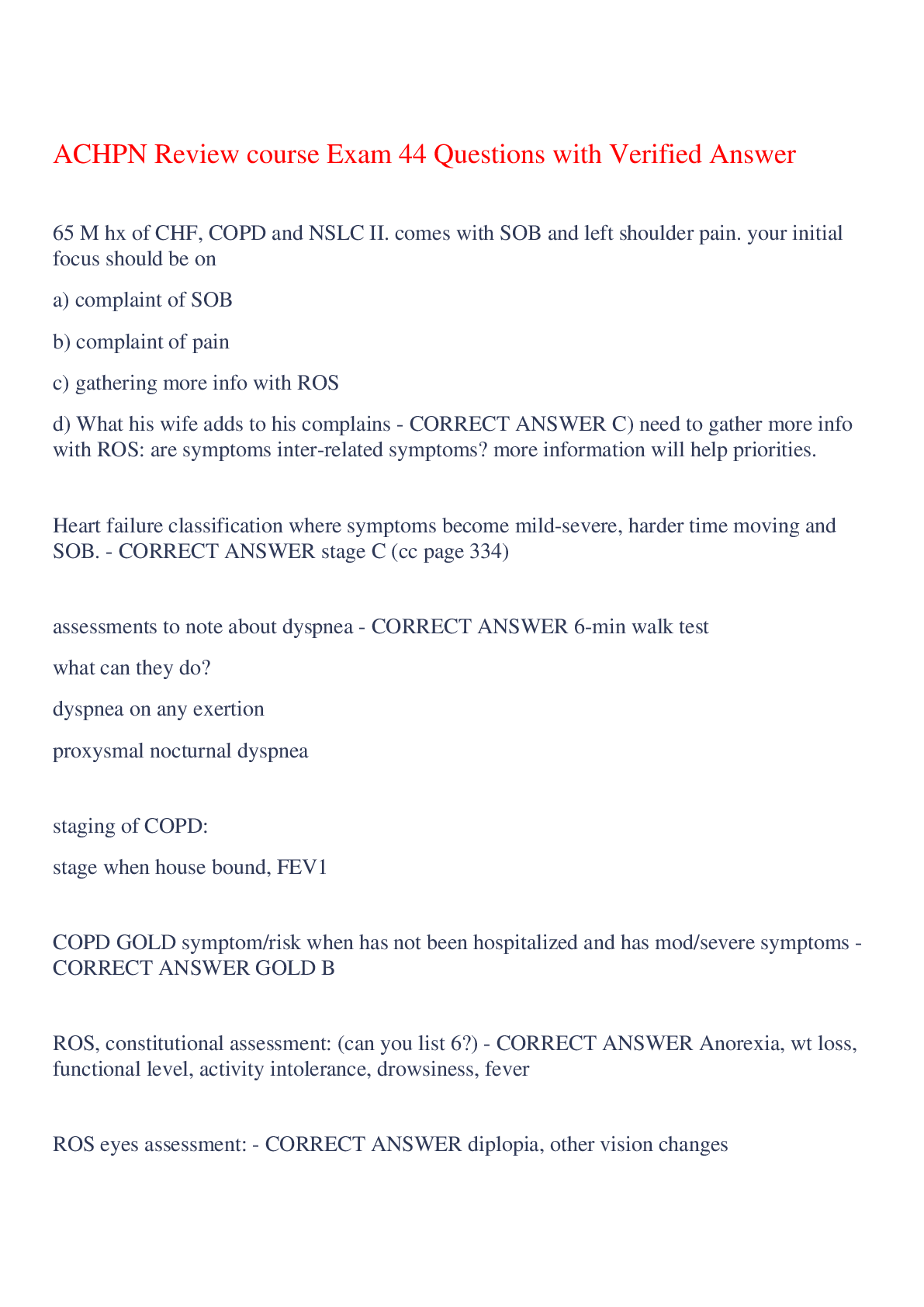
ACHPN Review course Exam 44 Questions with Verified Answer
65 M hx of CHF, COPD and NSLC II. comes with SOB and left shoulder pain. your initial focus should be on
a) complaint of SOB
b) complaint of pain
c) gathering more info with ROS
d) What his wife adds to his complains - CORRECT ANSWER C) need to gather more info with ROS: are symptoms inter-related symptoms? more information will help priorities.
Heart failure classification where symptoms become mild-severe, harder time moving and SOB. - CORRECT ANSWER stage C (cc page 334)
assessments to note about dyspnea - CORRECT ANSWER 6-min walk test
what can they do?
dyspnea on any exertion
proxysmal nocturnal dyspnea
staging of COPD:
stage when house bound, FEV1 <30 - CORRECT ANSWER GOLD 4
COPD GOLD symptom/risk when has not been hospitalized and has mod/severe symptoms - CORRECT ANSWER GOLD B
ROS, constitutional assessment: (can you list 6?) - CORRECT ANSWER Anorexia, wt loss, functional level, activity intolerance, drowsiness, fever
ROS eyes assessment: - CORRECT ANSWER diplopia, other vision changes
ROS ENTT assessment: (can you list 6?) - CORRECT ANSWER secretions, xerostomia, mucositis, thrush, dysphagia, taste alterations
ROS cardiac assessment: (can you list 6?) - CORRECT ANSWER chest pain, LE swelling, paroxysmal nocturnal dyspnea, orthopnea, lymphedema
ROS GI assessment: (can you list 5?) - CORRECT ANSWER Nausea/vomiting, abdominal pain, constipation, diarrhea, dyspepsia
ROS respiratory assessment: - CORRECT ANSWER dyspnea/cough
ROS GU assessment: (can you list 3?) - CORRECT ANSWER urinary retention, urinary incontinence, dysuria
ROS musk assessment (can you list 6?) - CORRECT ANSWER bone pain, joint pain, muscle pain, weakness, stiffness
ROS skin (can you list 5) - CORRECT ANSWER Puritus, decubitus ulcers, dry skin, rash, bruising
neuro ROS assessment (can you list 5?) - CORRECT ANSWER delirium, agitation, sedation, balance or gait issues, cognitive issues
ROS psychiatric assessment (list 4) - CORRECT ANSWER anxiety, depressed mood, hallucinations, insomnia, coping
ROS endocrine assessment - CORRECT ANSWER steroid side effects, cold/heat intolerance
ROS allergic/immunologic assessment - CORRECT ANSWER immunosuppression, neutropenia
ROS assessment heme/lymph (can you list 5?) - CORRECT ANSWER bruising, bleeding, anemia, lymphedema, lymphadenopathy
36 F ALS. Losing wt. In the morning she consistently wakes up with headaches and confusion. After discussing symptom management, what would be an appropriate next step?
A) talking to her spiritual counselor
B) Reffering her to a psychologist
C) Referring her to a psychiatrist
D) Initiating advanced care planning - CORRECT ANSWER D) Initiating advanced care planning
-> anticipate that symptoms may be progression of disease, priority is knowing goals, who decision maker is and then making plan and involving IDT.
60 M with early dementia admitted for chest pain and dyspnea. Work up reveals CAD and PH. After more education about condition, he and family want to discuss the future. On which issue should the APRN first focus this discussion?
A) The APRN's comfort and experience with end-of-life care
B) His eligibility for the Medicare Hospice Benefit
C) His and his family's understanding of his illnesses
D) In hospital do not resuscitate orders and out of hospital order for life sustaining treatments. - CORRECT ANSWER C) His and his family's understanding of illnesses
- eliminate answers that don't even apply, D is important but would need to know his understanding to discuss
cc. page 391 review dementia (stage 7 hospice elegible)
p. 394 pain/symptoms in those with dementia
You are asked to talk with 56 F new dx of brain tumor after she experienced a seizure. She tells you she does not want her family told. Your response is:
A) Tell her you will talk to the family privately to relieve her of that burden.
B) Explore her thoughts and feelings about family involvement.
C) Refer her to the psychologist since she may be incompetent to make these decisions.
D) Bring the family in when you meet with her the first time to identify the "elephant in the room." - CORRECT ANSWER B) Explore her thoughts and feelings about family involvement.
Pt has history of heart failure. Which of the following symptoms would suggest worsening of his heart failure?
A) Fever, productive cough, chest pain
B) Constipation, dysgeusia, fatigue
C) Bradypnea, agitation, fever
D) Orthopnea, tachypnea, dyspnea - CORRECT ANSWER D) Orthopnea, tachypnea, dyspnea
All are dyspnea
HF symptoms: dyspnea, chest pain, fatigue (p.314-315)
68 F presents with forgetfulness and declining executive function. What finding on a diagnostic brain CT as a part of her evaluation would most clearly suggest a diagnosis of dementia?
A) brain swelling
B) Brain injury
C) Brain atrophy
D) Brain infections - CORRECT ANSWER C) Brain atrophy
Initial diagnostic tests to determine the etiology of altered mental status changes would include:
A) Urine cultures, serum electrolytes, and brain MRI
B) Mini-Mental status exam and EEG
C) CBC, serum electrolytes, TSH, B12, and folate
D) Blood cultures, blood gases, and brain CT scan - CORRECT ANSWER C) CBC, serum electrolytes, TSH, B12, and folate
-> easiest to do 1st/least invasive...MME and EEG would not point to etiology
55 year old F admitted to your hospice from home with NSCLC with bony mets. She was discharged 2 weeks ago on Morphine ER 30mg BID and Morphine IR 15mg Q 4hr PRN. She has runny nose, tremors, goose flesh, irritability, diarrhea and insomnia. Based on these symptoms, you would immediately assess for:
A) fever and history of contact with people with flu
B) Patterns of opioid escalation and frequent requests for drug renewal
C) Patterns of opioid under use while at home and other signs of withdra - CORRECT ANSWER C) Patterns of opioid under use while at home and other signs of withdrawal
Addiction characterized by 1 or more behaviors: List - CORRECT ANSWER imparied control, compulsive use, continuing use despite harm and cravings.
nociceptive pain divided into two type: - CORRECT ANSWER Visceral:poorly localized "deep, squeezing pressure, cramping" (organ dysfunction, infiltration, distention (can be associated with N/V&diaphoresis or referred pain associated
and Somatic: well localized (skin, MSK/joint)
(term) A state of increased sensitivity of central pain-signaling neurons; an important mechanism is thought to be the glutamate activation of NMDA receptors. - CORRECT ANSWER Central Sensitization
(term) pain perceived in response to non-toxic stimuli - CORRECT ANSWER Allodynia
(term) any painful paresthesia - CORRECT ANSWER Dysesthesia
Chronic pain features - CORRECT ANSWER >3 months, lack of physiologic s/sx. if poorly controlled: fatigue, anxiety, insomnia, despire.
what is assessed on ORT? - CORRECT ANSWER opioid risk:
family history of substance abuse (ETOH, recreational, rx(4)), personal hx of substance abuse (ETOH, recre, rx(5)), age 16-45 (1) , hx of pre-adolecent sexual abuse (female only 3+if pos), psychological disease (ADD, anxiety, bipol, psychizo, OCD (2) depression=(1)) low score=3or less
opioid dose associated with addiction - CORRECT ANSWER >100 OME /day
Modified WHO analgesic ladder (can you name 4 levels) - CORRECT ANSWER -Non-opioid analgesics, NSAIDS, steroids.
- Weak opioids +/- analgesics above
- Strong opioids, methadone, oral or transdermal +/- above
- opioids titrated to pain relief +/- interventional or surgical approaches (nerve block, epidural, PCA pump, spine stim) +/- non opioid
Non-opioid medications: (mechanisms, risks, doses) - CORRECT ANSWER APA: centrally acting, max 4g/day, liver, 325mg-600mg
NSAIDS: block prostaglandin by inhibiting COX, bleeding,/ulcer, renal ischemia/failure, sodium retention Ibuprofen: 600mg TID, Naproxen 250-500 Q12hr
Naproxen sodium 275-550mg
Steroids mechanism - CORRECT ANSWER reduce pain intensity and mediate symptoms by inhibiting prostaglandin synthesis and reducing vascular permeability.
steroid adverse effects - CORRECT ANSWER potassium loss
sodium retention
=water retention
adrenal suppression=>no long term or need to taper
dosage and admin Ketamine for reducing opioid requirements - CORRECT ANSWER Bolus 0.1mg/kg (may repeat in 5min if no response)
Infuse 1mcg/kg/min, can increase Q1hr. Max 6mcg/kg/min. Can give SQ. irritating, may need to rotate Q24h site.
Oral: mix in juice. reduce opiate dose 25-50%, ?start 10mg Q6 (may increase 10mg/Q6) every 24hrs.
ESLD pruritus 1st line - CORRECT ANSWER Cholestyramine 4gm 4xDay
ESLD pruritus agents 1st and down - CORRECT ANSWER Cholesyramine
Rifampin- check LFTs for toxicity
Naltrexone 12.5-50mg
topicals: for cooling, doxepin TCA,
Hospice criteria for ESLD - CORRECT ANSWER -Both: PT >5sec or INR >1.5 &Albumin <2.5,
- at least 1: refract ascites, bowel perf, SBP, HRS, encephalop refract, recurrent varaceal bleed
WITH documentation of: malnutrition, muscle wasting, low endurance, active alcoholism, HCC, Hep B pos, or Hep C refractory
Hospice and Liver transplant listed - CORRECT ANSWER can be enrolled in hospice but have to dischaged if notified of organ
1st line drug for ESRD W/ depression - CORRECT ANSWER Sertraline 25mg (up to 100mg)
[Show More]