GRE Psychology- Personality and Abnormal Psychology
popular meanings of personality generally fall into one of two categories: - >>the social skills and the
salient impression one leaves on others
who defined physica
...
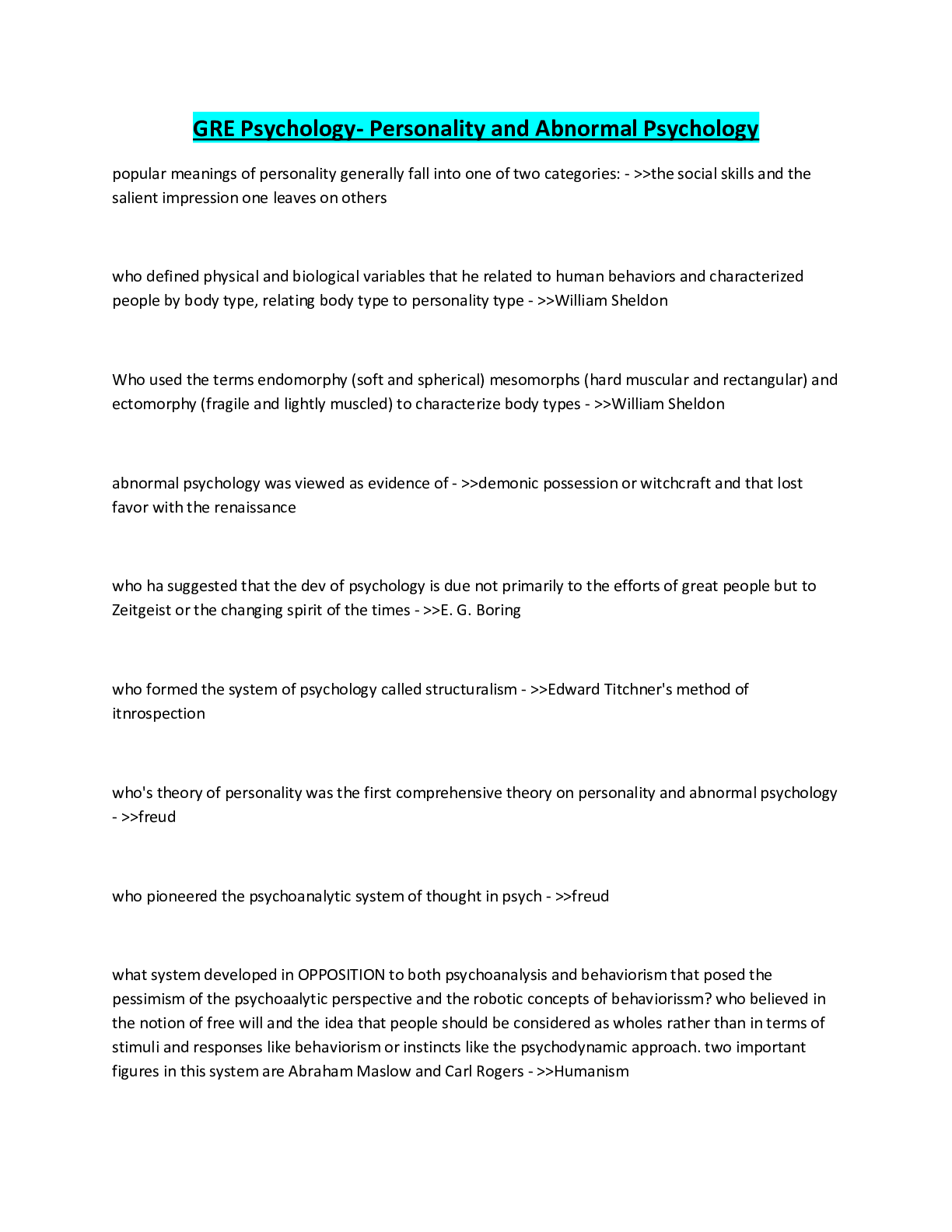
GRE Psychology- Personality and Abnormal Psychology
popular meanings of personality generally fall into one of two categories: - >>the social skills and the
salient impression one leaves on others
who defined physical and biological variables that he related to human behaviors and characterized
people by body type, relating body type to personality type - >>William Sheldon
Who used the terms endomorphy (soft and spherical) mesomorphs (hard muscular and rectangular) and
ectomorphy (fragile and lightly muscled) to characterize body types - >>William Sheldon
abnormal psychology was viewed as evidence of - >>demonic possession or witchcraft and that lost
favor with the renaissance
who ha suggested that the dev of psychology is due not primarily to the efforts of great people but to
Zeitgeist or the changing spirit of the times - >>E. G. Boring
who formed the system of psychology called structuralism - >>Edward Titchner's method of
itnrospection
who's theory of personality was the first comprehensive theory on personality and abnormal psychology
- >>freud
who pioneered the psychoanalytic system of thought in psych - >>freud
what system developed in OPPOSITION to both psychoanalysis and behaviorism that posed the
pessimism of the psychoaalytic perspective and the robotic concepts of behaviorissm? who believed in
the notion of free will and the idea that people should be considered as wholes rather than in terms of
stimuli and responses like behaviorism or instincts like the psychodynamic approach. two important
figures in this system are Abraham Maslow and Carl Rogers - >>Humanism
what were early asylums like in the 1500s - >>really bad conditions cells were dark dungeons with no
heat in the winter and they were chained and slept on staw and forced to sit in their filth
Phillipe Pinel - >>was in charge of an asylum i n paris and he believed that the people with mental health
should be treated with consideration and kindness and removed the shackles allowed them to go
outside and gas them beds. these reforms spread to other asylums
who was an important reformer in the US asylum systems who was an advocate for the treating the
hospitalized mentally ill in a humane way who had an instrumental effect on improving the lives of the
mentally ill in the US - >>Dorothea Dix
who's classification system of mental disorders was the precursor to the Diagnostic and Statistical Menal
of Mental Disorders (DSM) - >>Emil Kraeplin's textbook
general paresis what is it and what did we learn from it - >>was a disorder with delusions of gradeur,
mental deterioration, paralysis, and death- later was found that it was because of brain deterioration
from syphilis. the idea that physiological factors could underlie mental disorders was an important
advance in our understanding of abnormal psych
What researchers introduced the use of the electroshock for the artificial production of convulsive
seizures in psychiatric patients that believed epileptic like convulsions could cure schizophrenia (they
were wrong.) the convulsions were so violent atet patients were in danger of fracturing vertebrae and
other bones - >>Cerletti and Bini
what was a typical treatment for schizophrenia from 1935 to 1955 that we now know to be non
effectiev - >>Prefrontal Lobotomies
what is a prefrontal lobotomy and what was it used to treat? - >>it was used to treat people with
schizophrenia and it was a surgical treatment where the frontal lobes of the brain were severed from
the brain tissue = it destroyed a lot of the frontal lobe which makes us distinctly human. it dint cure
schizophrenia it just made the patient easier to handle since the patient usually became calm and
showed an absence of feeling
what made surgeons stop performing lobotomies and electroshock for schizophrenia - >>antipsychotic
drugs in the 1950s
the theories under the ____________ theory postulate the existence of unconscious internal states that
motivate the overt actions of individuals and determine personlity - >>Psychodynamic or psychoanalytic
theory
Sigmund Freud's model of personality was the structural dynamic model and involved which 3 major
systems - >>id, ego, and superego
what is the id in the structural dynamic model of signmund freuds model of personality - >>reservoir for
all psychic energy and consists of everything psychological that is present at birth. functions according to
the pleasure principle who's aim is to relieve tension or energy buildup. PRIMARY PROCESS is the id 's
response to frustration under obtain satisfaction now not later. if your hungry and theres no food the
primary process would be to think of an image of food and that image of the food is called WISH
FULFILLMENT
what is the ego in the structural dynamic model of freuds model of personality - >>since the mental
image of the food that the ID thought up isnt enough o cease the hunger the SECONDARY PROCESS of
the ego comes along which operates according to the REALITY PRINCIPLE taking into account objectivity
that limits the id's pleasure principle. ego is the organizer of the id- it is not independent of the id
what is the superego in the structural dynamic model of freuds model of personality - >>similar to the id
in that it is not directly in contact with reality and strives for the ideal vs the real. it is the moral branch
of personlality striving for perfection. made up fo the CONSCIENCE and the EGO IDEAL. the conscience
provides rules and norms about what is bad. ego ideal provides rules for good appropriate behavior until
a system of right and wrong is created usually for parental punish and reward in a child's mind
instinct - >>innate psychological representation or wish of a bodily or biological excitation or need.
instincts are the propelling aspects of Freud's dynamic theory of personality...
[Show More]








.png)

.png)