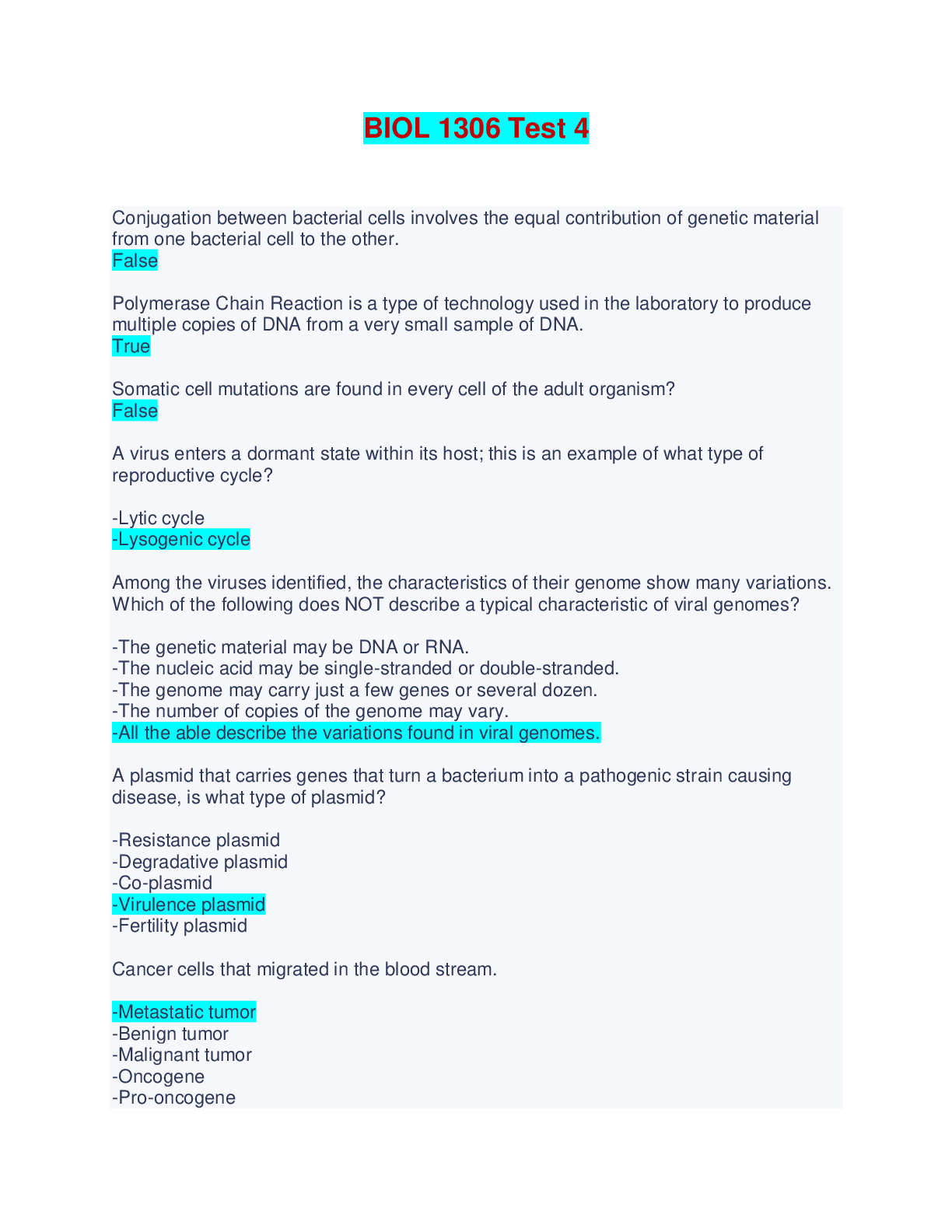
BIOL 1306 Test 4 - Questions and Answers Conjugation between bacterial cells involves the equal contribution of genetic material from one bacterial cell to the other. False Polymerase Chain Reaction is a type of techno
...
BIOL 1306 Test 4 - Questions and Answers Conjugation between bacterial cells involves the equal contribution of genetic material from one bacterial cell to the other. False Polymerase Chain Reaction is a type of technology used in the laboratory to produce multiple copies of DNA from a very small sample of DNA. True Somatic cell mutations are found in every cell of the adult organism? False A virus enters a dormant state within its host; this is an example of what type of reproductive cycle? -Lytic cycle -Lysogenic cycle Among the viruses identified, the characteristics of their genome show many variations. Which of the following does NOT describe a typical characteristic of viral genomes? -The genetic material may be DNA or RNA. -The nucleic acid may be single-stranded or double-stranded. -The genome may carry just a few genes or several dozen. -The number of copies of the genome may vary. -All the able describe the variations found in viral genomes. A plasmid that carries genes that turn a bacterium into a pathogenic strain causing disease, is what type of plasmid? -Resistance plasmid -Degradative plasmid -Co-plasmid -Virulence plasmid -Fertility plasmid Cancer cells that migrated in the blood stream. -Metastatic tumor -Benign tumor -Malignant tumor -Oncogene -Pro-oncogene Tumor cells that have not invaded adjacent tissues. -Metastatic tumor -Benign tumor -Malignant tumor -Oncogene -Pro-oncogene A normal gene that can be altered by a mutation. -Metastatic tumor -Benign tumor -Malignant tumor -Oncogene -Pro-oncogene Which viral reproductive cycle immediately kills its host? -Lytic cycle -Lysogenic cycle Germline mutations are mutations that can be passed down to offspring. True All the following statements are true regarding mutations EXCEPT -Mutations can be harmful. -Mutations are spontaneous. -Mutations are random. -Mutations can be neutral. -All the above are true regarding mutations. A nonliving particle that must be taken up by a living cell to replicate. -Virus -Prion -Viroid Tumor cells that have invaded healthy tissue. -Metastatic tumor -Benign tumor -Malignant tumor -Oncogene -Pro-oncogene
[Show More]