Chapter 1:
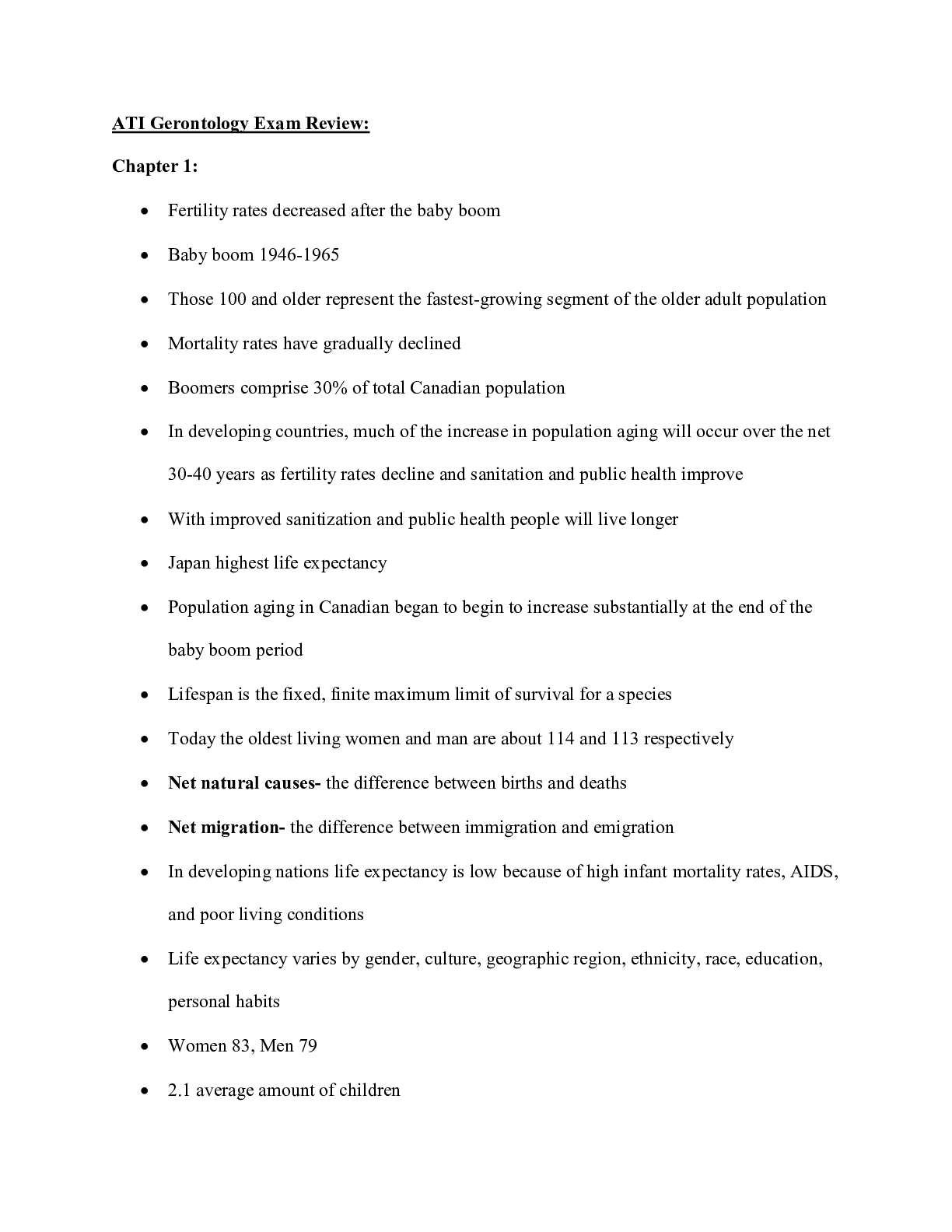
Fertility rates decreased after the baby boom
Baby boom 1946-1965
Those 100 and older represent the fastest-growing segment of the older adult population
Mortality rates have gradually declined
...
Chapter 1:
Fertility rates decreased after the baby boom
Baby boom 1946-1965
Those 100 and older represent the fastest-growing segment of the older adult population
Mortality rates have gradually declined
Boomers comprise 30% of total Canadian population
In developing countries, much of the increase in population aging will occur over the net
30-40 years as fertility rates decline and sanitation and public health improve
With improved sanitization and public health people will live longer
Japan highest life expectancy
Population aging in Canadian began to begin to increase substantially at the end of the
baby boom period
Lifespan is the fixed, finite maximum limit of survival for a species
Today the oldest living women and man are about 114 and 113 respectively
Net natural causes- the difference between births and deaths
Net migration- the difference between immigration and emigration
In developing nations life expectancy is low because of high infant mortality rates, AIDS,
and poor living conditions
Life expectancy varies by gender, culture, geographic region, ethnicity, race, education,
personal habits
Women 83, Men 79
2.1 average amount of children
Labelling of older people as a burden to society has been called “apocalyptic”
Individual aging is viewed as the interaction of interrelated biological, clinical, psycho-
social and societal factors that affect aging over the course
Life course perspective examines the interplay among individual life stories, our social
system and institutions, and environments and also looks at the effect of specific
historical events at particular times in the life course of individuals or age cohorts
Life course perspective enables us to observe and analyze how different individual or
societal events create variations in the aging process within and between cohorts and
individuals
The past, current social conditions and life histories can have an impact on different age
cohorts
[Show More]