Unit 1
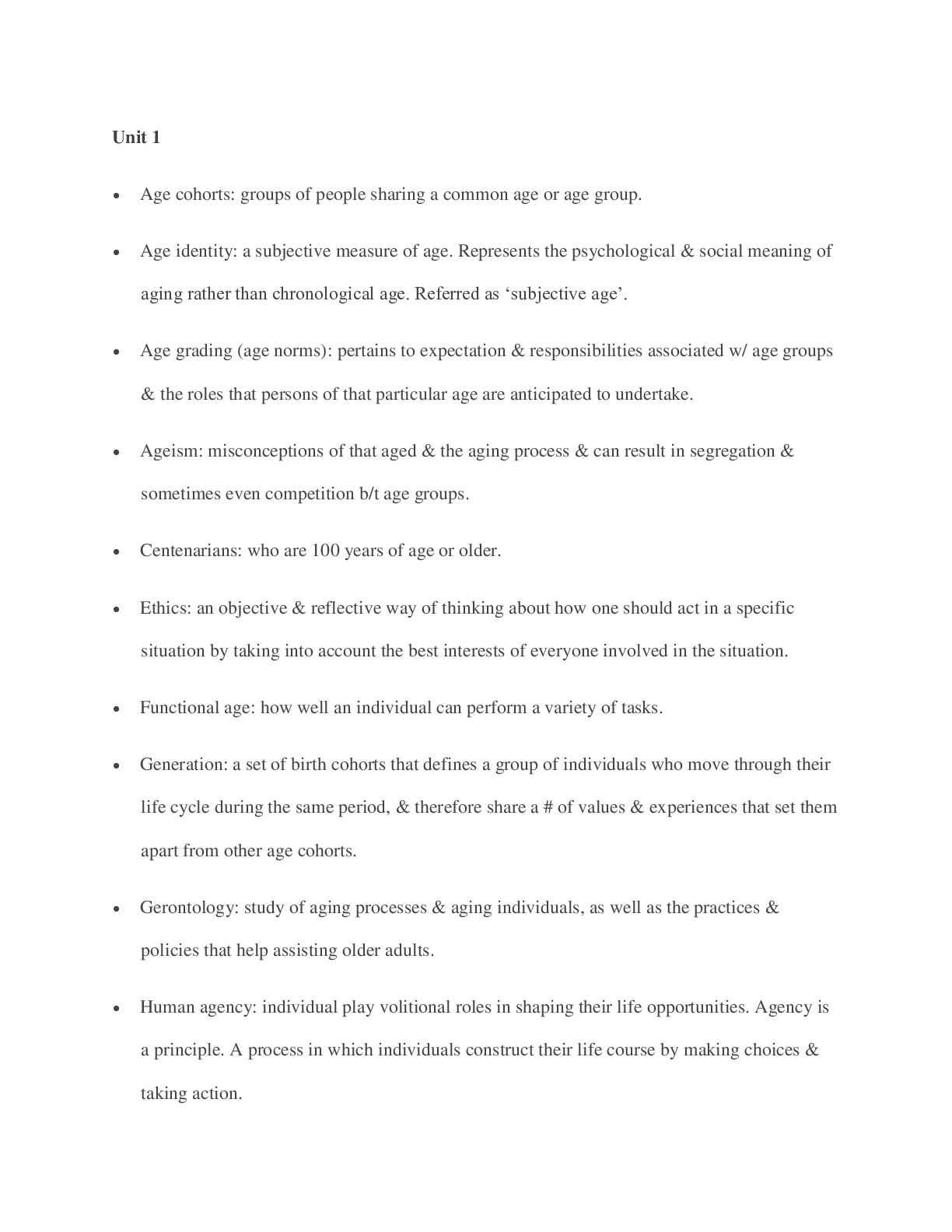
Age cohorts: groups of people sharing a common age or age group.
Age identity: a subjective measure of age. Represents the psychological & social meaning of
aging rather than chronological age. Referred a
...
Unit 1
Age cohorts: groups of people sharing a common age or age group.
Age identity: a subjective measure of age. Represents the psychological & social meaning of
aging rather than chronological age. Referred as ‘subjective age’.
Age grading (age norms): pertains to expectation & responsibilities associated w/ age groups
& the roles that persons of that particular age are anticipated to undertake.
Ageism: misconceptions of that aged & the aging process & can result in segregation &
sometimes even competition b/t age groups.
Centenarians: who are 100 years of age or older.
Ethics: an objective & reflective way of thinking about how one should act in a specific
situation by taking into account the best interests of everyone involved in the situation.
Functional age: how well an individual can perform a variety of tasks.
Generation: a set of birth cohorts that defines a group of individuals who move through their
life cycle during the same period, & therefore share a # of values & experiences that set them
apart from other age cohorts.
Gerontology: study of aging processes & aging individuals, as well as the practices &
policies that help assisting older adults.
Human agency: individual play volitional roles in shaping their life opportunities. Agency is
a principle. A process in which individuals construct their life course by making choices &
taking action.
Individual aging: biological, physiological, psychological, & social changes in the individual
that affect life chances & lifestyles across the life cycle.
Life course: a social construct in which our personal experiences interact w/ social &
historical factors in the larger society.
Life course perspective: examines the interplay among individual life stories, our social
structures & environment, & the unique impact of specific historical events at particular
times in the life of individuals or age cohorts. Allows us to study how earlier life experiences
occurring at particular ages may shape later life outcomes.
Life span: fixed, finite maximum limit of survival for a species. The maximum for human is
unlikely to increase in great extent.
[Show More]