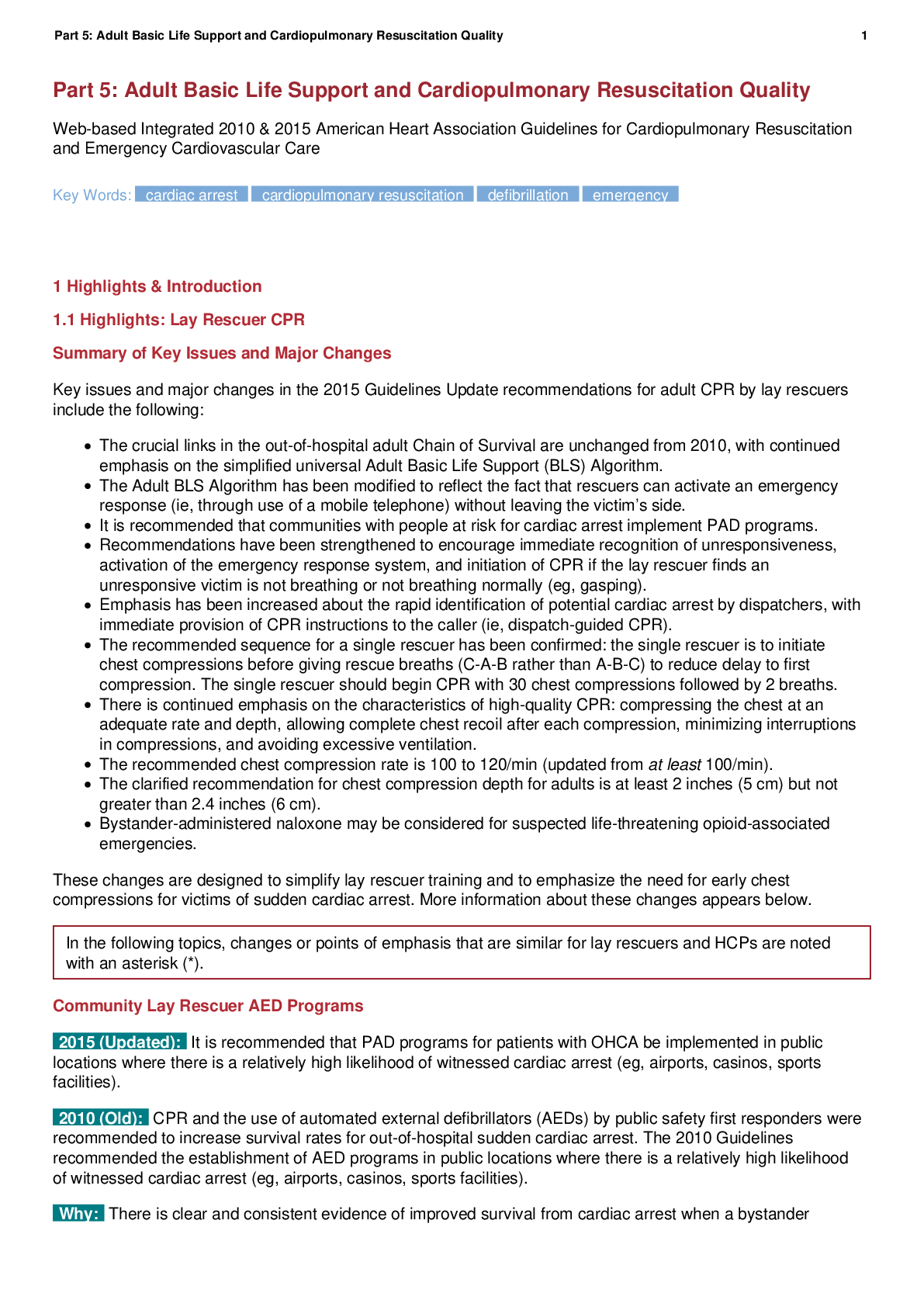
Key issues and major changes in the 2015 Guidelines Update recommendations for adult CPR by lay rescuers
include the following:
The crucial links in the out-of-hospital adult Chain of Survival are unchanged from 2010,
...
Key issues and major changes in the 2015 Guidelines Update recommendations for adult CPR by lay rescuers
include the following:
The crucial links in the out-of-hospital adult Chain of Survival are unchanged from 2010, with continued
emphasis on the simplified universal Adult Basic Life Support (BLS) Algorithm.
The Adult BLS Algorithm has been modified to reflect the fact that rescuers can activate an emergency
response (ie, through use of a mobile telephone) without leaving the victim’s side.
It is recommended that communities with people at risk for cardiac arrest implement PAD programs.
Recommendations have been strengthened to encourage immediate recognition of unresponsiveness,
activation of the emergency response system, and initiation of CPR if the lay rescuer finds an
unresponsive victim is not breathing or not breathing normally (eg, gasping).
Emphasis has been increased about the rapid identification of potential cardiac arrest by dispatchers, with
immediate provision of CPR instructions to the caller (ie, dispatch-guided CPR).
The recommended sequence for a single rescuer has been confirmed: the single rescuer is to initiate
chest compressions before giving rescue breaths (C-A-B rather than A-B-C) to reduce delay to first
compression. The single rescuer should begin CPR with 30 chest compressions followed by 2 breaths.
There is continued emphasis on the characteristics of high-quality CPR: compressing the chest at an
adequate rate and depth, allowing complete chest recoil after each compression, minimizing interruptions
in compressions, and avoiding excessive ventilation.
The recommended chest compression rate is 100 to 120/min (updated from at least 100/min).
The clarified recommendation for chest compression depth for adults is at least 2 inches (5 cm) but not
greater than 2.4 inches (6 cm).
Bystander-administered naloxone may be considered for suspected life-threatening opioid-associated
emergencies.
These changes are designed to simplify lay rescuer training and to emphasize the need for early chest
compressions for victims of sudden cardiac arrest. More information about these changes appears below.
In the following topics, changes or points of emphasis that are similar for lay rescuers and HCPs are noted
with an asterisk (*).
Community Lay Rescuer AED Programs
2015 (Updated): It is recommended that PAD programs for patients with OHCA be implemented in public
locations where there is a relatively high likelihood of witnessed cardiac arrest (eg, airports, casinos, sports
facilities).
2010 (Old): CPR and the use of automated external defibrillators (AEDs) by public safety first responders were
recommended to increase survival rates for out-of-hospital sudden cardiac arrest. The 2010 Guidelines
recommended the establishment of AED programs in public locations where there is a relatively high likelihood
of witnessed cardiac arrest (eg, airports, casinos, sports facilities).
Why: There is clear and consistent evidence of improved survival from cardiac arrest when a bystander
Key Words: cardiac arrest cardiopulmonary resuscitation defibrillation emergency
Part 5: Adult Basic Life Support and Cardiopulmonary Resuscitation Quality 1
performs CPR and rapidly uses an AED. Thus, immediate access to a defibrillator is a primary component of the
system of care. The implementation of a PAD program requires 4 essential components: (1) a planned and
practiced response, which ideally includes identification of locations and neighborhoods where there is high risk
of cardiac arrest, placement of AEDs in those areas and ensuring that bystanders are aware of the location of
the AEDs, and, typically, oversight by an HCP; (2) training of anticipated rescuers in CPR and use of the AED;
(3) an integrated link with the local EMS system; and (4) a program of ongoing quality improvement.
[Show More]