PEDS HESI Exam Practice - Questions with Verified Answers A female teenager is taking oral tetracycline HCL (Achromycin V) for acne vulgaris. What is the most important instruction for the nurse to include in this clie
...
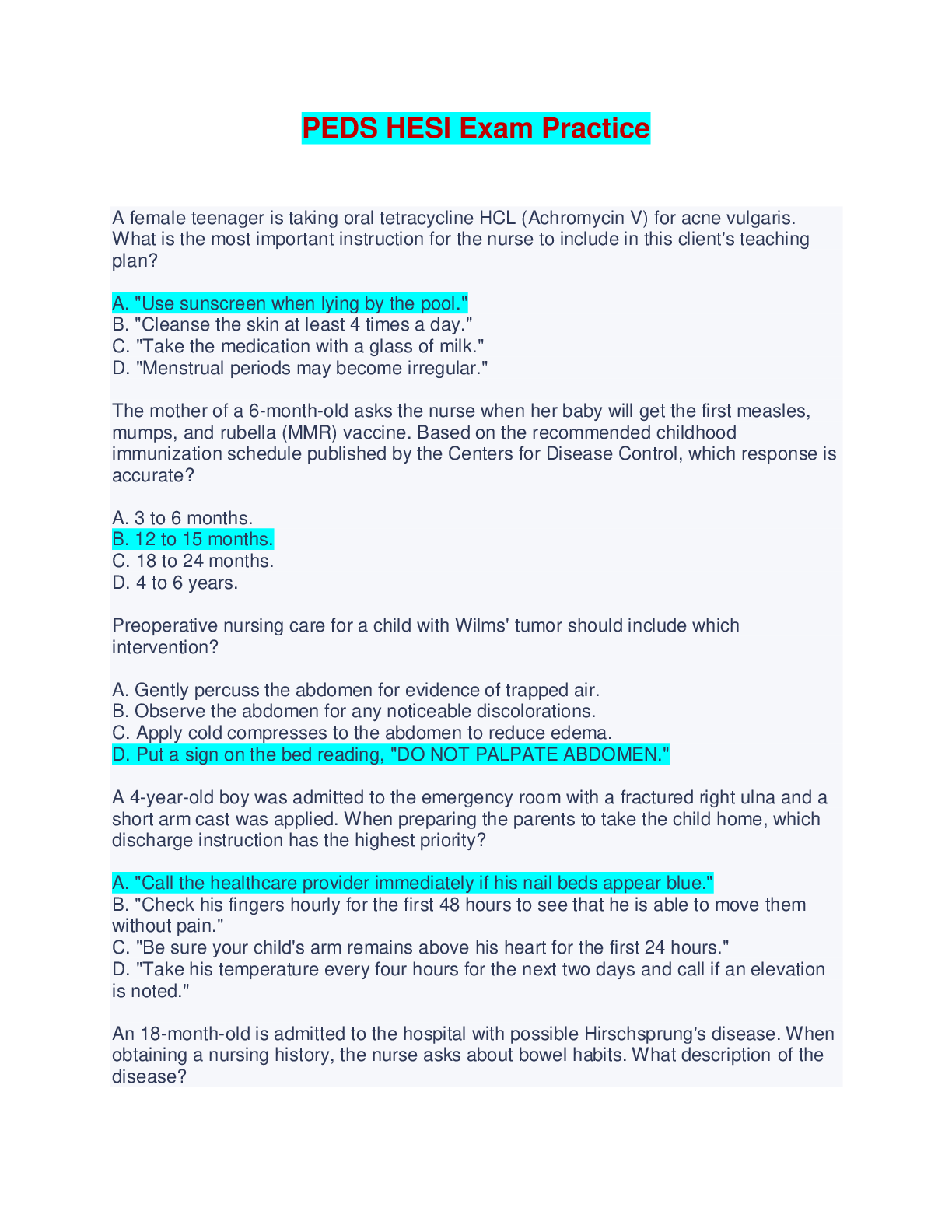
PEDS HESI Exam Practice - Questions with Verified Answers A female teenager is taking oral tetracycline HCL (Achromycin V) for acne vulgaris. What is the most important instruction for the nurse to include in this client's teaching plan? A. "Use sunscreen when lying by the pool." B. "Cleanse the skin at least 4 times a day." C. "Take the medication with a glass of milk." D. "Menstrual periods may become irregular." The mother of a 6-month-old asks the nurse when her baby will get the first measles, mumps, and rubella (MMR) vaccine. Based on the recommended childhood immunization schedule published by the Centers for Disease Control, which response is accurate? A. 3 to 6 months. B. 12 to 15 months. C. 18 to 24 months. D. 4 to 6 years. Preoperative nursing care for a child with Wilms' tumor should include which intervention? A. Gently percuss the abdomen for evidence of trapped air. B. Observe the abdomen for any noticeable discolorations. C. Apply cold compresses to the abdomen to reduce edema. D. Put a sign on the bed reading, "DO NOT PALPATE ABDOMEN." A 4-year-old boy was admitted to the emergency room with a fractured right ulna and a short arm cast was applied. When preparing the parents to take the child home, which discharge instruction has the highest priority? A. "Call the healthcare provider immediately if his nail beds appear blue." B. "Check his fingers hourly for the first 48 hours to see that he is able to move them without pain." C. "Be sure your child's arm remains above his heart for the first 24 hours." D. "Take his temperature every four hours for the next two days and call if an elevation is noted." An 18-month-old is admitted to the hospital with possible Hirschsprung's disease. When obtaining a nursing history, the nurse asks about bowel habits. What description of the disease? A. Foul-smelling and fatty. B. Bile-colored and watery. C. Semi-solid and yellow. D. Ribbon-like and brown. The nurse must prevent a 2-year-old with severe eczema on the face, neck, and scalp from scratching the affected areas. Which nursing intervention is most effective in preventing further excoriation due to the pruritis? A. Obtain gloves for the child's hands. B. Apply finger cots on the child's fingers. C. Place elbow restraints on the child's arms. D. Apply soft restraints to the child's wrists. The nurse assigning care for a 5-year-old child with otitis media is concerned about the child's increasing temperature over the past 24 hours. Which statement is accurate and should be considered when planning care for the remainder of the shift? A. An RN should be assigned to take temperatures frequently. B. Tympanic and oral temperatures are equally accurate. C. The PN should take rectal temperatures on this child. D. The pediatrician should decide how to assess the temperature. A 3-year-old boy is brought to the emergency room because he swallowed an entire bottle of children's vitamin pills. Which intervention should the nurse implement first? A. Insert N/G tube for gastric lavage. B. Determine the child's pulse and respirations. C. Assess the child's level of consciousness. D. Administer an IV D5/0.25 NS as prescribed. A 2-year-old child with gastro-esophageal reflux has developed a fear of eating. What instruction should the nurse include in the parents' teaching plan? A. Invite other children home to share meals. B. Accept that he will eat when he is hungry. C. Reward the child with a nap after eating. D. Consistently follow a set mealtime routine. A 6-month-old boy and his mother are at the healthcare provider's office for a well-baby check-up and routine immunizations. The healthcare provider recommends to the mother that the child receive an influenza vaccine. What medications should the nurse plan to administer today? A. The routine immunizations and schedule another appointment to administer the influenza vaccine. B. All the immunizations with the influenza vaccine given at a separate site from any other injection. C. The influenza vaccine and schedule another appointment to administer the immunizations. D. The influenza vaccine and the polio vaccine and schedule another appointment to administer the remaining immunizations. The nurse is assessing a 13-year-old girl with suspected hyperthyroidism. Which question is most important for the nurse to ask her during the admission interview? A. "Have you lost any weight in the last month?" B. "Are you experiencing any type of nervousness?" C. "When was the last time you took your synthroid?" D. "Are you having any problems with your vision?" The nurse is planning care for school-aged children at a community care center. Which activity is best for the children? A. Building model airplanes. B. Playing follow-the-leader. C. Stringing large and small beads. D. Playing with Playdough and clay. Surgery is being delayed for an infant with undescended testes. In collaboration with the healthcare provider and the family, which prescription should the nurse anticipate? A. A trial of adrenocorticotrophic hormone injections. B. Frequent stimulation of the cremasteric reflex. C. A trial of human chorionic gonadotrophic hormone. D. Frequent warm baths to gently dilate the scrotal area. A 3-year-old client with sickle cell anemia is admitted to the Emergency Department with abdominal pain. The nurse palpates an enlarged liver, an x-ray reveals an enlarged spleen, and a CBC reveals anemia. These findings indicate which type of crisis? A. Aplastic. B. Sequestration. C. Hyperhemolytic. D. Vaso-occlusive. To assess the effectiveness of an analgesic administered to a 4-year-old, what intervention is best for the nurse to implement? A. Use a happy-face/sad-face pain scale. B. Ask the mother if she thinks the analgesic is working.
[Show More]