*NURSING > EXAM > Telemetry Interpretation and Dysrhythmias Exam 26 Questions with Verified Answers,100% CORRECT (All)
Telemetry Interpretation and Dysrhythmias Exam 26 Questions with Verified Answers,100% CORRECT
Document Content and Description Below
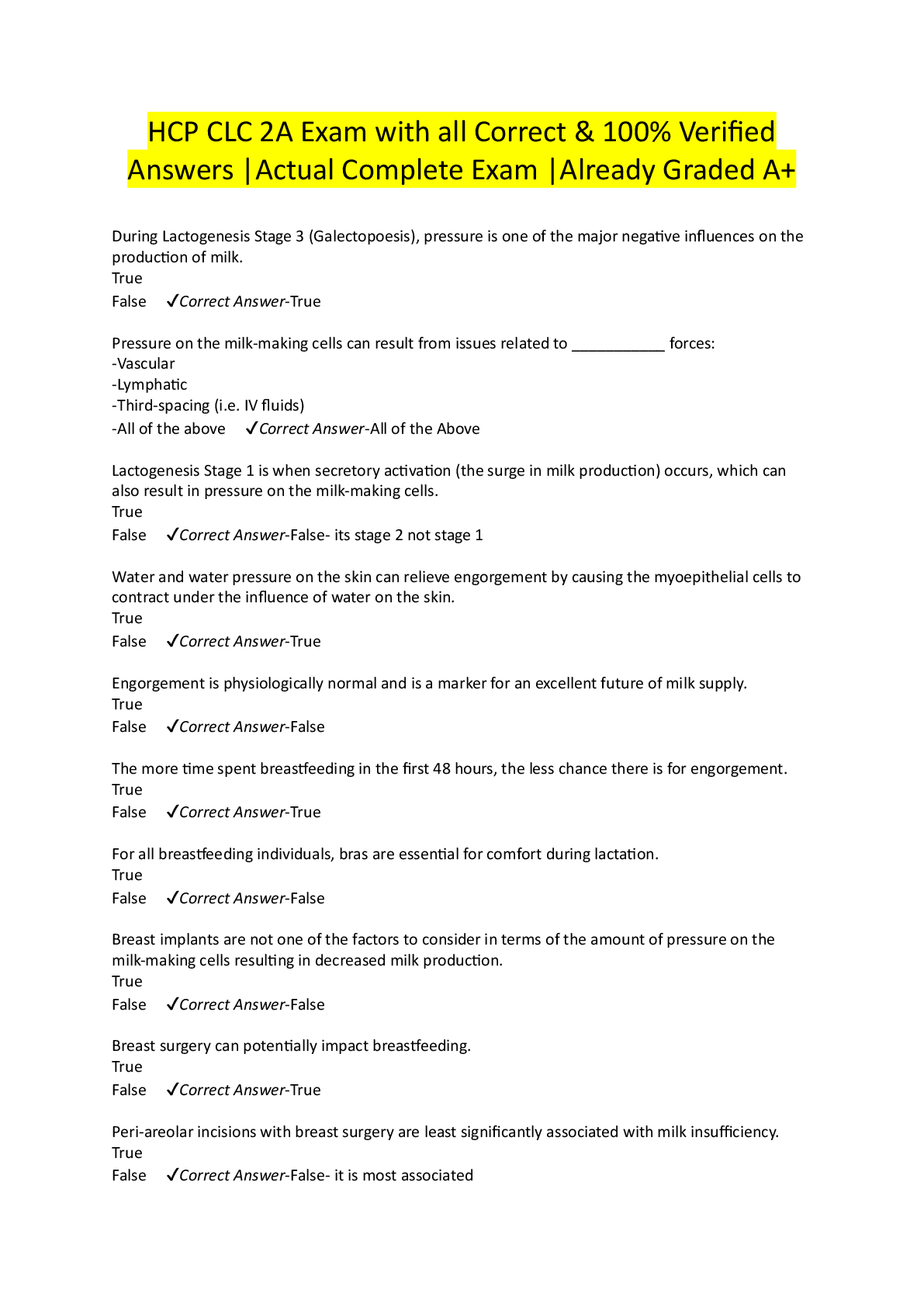
Telemetry Interpretation and Dysrhythmias Exam 26 Questions with Verified Answers ECG/EKG - CORRECT ANSWER *P Wave* - Impulse coming from the SA node - Normal electrical impulses 60-100 beats/min ... *QRS* - Indicates ventricles are contracting *T-Wave* - Resting/repolarization period of the heart Intervals - CORRECT ANSWER *PR Interval* - Represents the time between atrial firing and ventricular firing - *If this is longer than normal there is an electrical block somewhere between the atria and ventricles* *ST Segment* - not measured, usually flat and level with the baseline - Vertical change or *ST elevation of 1 mm or more* is correlated with *acute myocardial infarction or pericarditis* - *ST depression more than 1mm represents injury: no cell death to the tissue - injury can be reversed* *QT Interval* - Represents the amount of time it takes for the ventricles to fire and recover or reload - Will be elongated with overdoses Hyperkalemia - CORRECT ANSWER * >4.5 mEq = tall peaked T waves* * >8 mEq/L = wide QRS* - High K+ slows the firing ability of the ventricles and increases the reloading ability *Treatment* - Kayexelate - Lasix - Insulin via IV push *Complications* - V-tach - V-fib Hypokalemia - CORRECT ANSWER * <3.5 mEq/L often a result of diuretic therapy* - Prolongs the reloading of the ventricles - Elongates the T wave or U wave may show up *Treatment* - Replace K+ AV Blocks - CORRECT ANSWER *Differentiated by their PR interval* *First Degree* - All sinus impulses eventually reach ventricles - *Long PR interval* *Second Degree* - Some sinus impulses reach the ventricles, others do not - Irregular rhythm - *PR interval can eventually skip a QRS interval* - *One beat will be skipped* *Third-Degree* - No sinus impulses between P and QRS - No coordination between P and QRS - *Very low heart rate* - Pacemaker candidate - can lead to cardiac arrest *Treatment* - Pacemaker - Cardioversion First Degree AV Block - CORRECT ANSWER Second Degree AV Block - CORRECT ANSWER Third Degree AV Block - CORRECT ANSWER Pacemakers - CORRECT ANSWER Electronic devices that can be used to initiate a heartbeat when the internal system is malfunctioning *Abnormalities* - *Failure to capture*: ventricles fail to respond to the pacemaker impulses. On the EKG tracing, the pacemaker spike will appear but it will not be followed by a QRS complex - *Failure to pace*: occurs when the pacemaker does not generate and electrical impulse. On and EKG tracing, pacemaker spikes will be missing *Temporary Pacing* - Can place atria, ventricles, or both. Often needed as supportive treatment after a drug toxicity, MI, and/or other electrolyte imbalances *Permanent Pacing* - Bradycardia, failing SA node, ect. *Permanent Pacemaker* - Implantable cardioverter defibrillator - Identify and treat dysrhythmias - Indications: bradycardia, failing SA node Failure to Capture - CORRECT ANSWER Failure to Pace - CORRECT ANSWER Cardioversion - CORRECT ANSWER Synchronized, low energy shock *Common Indications* - Unstable A-fib - Atrial flutter - Supraventricular tachycardia *Utilized if medications fail to convert abnormal rhythm* - Amiodarone - Adenosine - Cardizem - Diltiazem *Shock with or just after the peak of the R Wave* - Can precipitate ventricular fibrillation if shock occurs on the T-wave - Make sure to put the synch button on Cardioversion: Procedure - CORRECT ANSWER *Preprocedure* - Prepare sedation: Versed - Ensure emergency equipment is at bedside - Shave chest hair if necessary *Intraprocedure* - Place pads - Infuse sedative - Ensure the SYNC button is engaged - Ensure the R wave is accurately marked by the machine - Deliver shock and assess rhythm - Frequently assess cardiac and respiratory status 5 Steps to ECG Rhythm Analysis - CORRECT ANSWER *1. Determine the speed of heart rate* - Calculate the rate - Slow, normal, fast *2. Determine heart rhythm* - Regular or irregular *3. Is it preceded by a P wave?* - Yes or no *4. Determine Complex* - Narrow or wide *5. Do all complexes look the same?* - Yes or no Step 1: Calculating Rate - CORRECT ANSWER 6 second strip (5 lg blocks = 1 second of time) - Count the number of R was and multiply x10 - 6 waves x10 = rate of 60 Step 2: Determining the Heart Rhythm - CORRECT ANSWER Look for extra beats or abnormal rhythms that would indicate abnormalities Step 3: Is it preceded by a P wave? - CORRECT ANSWER - P waves prior to the QRS complex indicates a normal conduction pathway - If the P wave is absent it could mean an abnormality in this pathway Steps 4&5: Complex - CORRECT ANSWER - Look for wide complexes that may indicate conduction abnormalities - Are each complex along this strip the same? - If they are not, it could indicate abnormalities along the pathway Normal Sinus Rhythm - CORRECT ANSWER Rate 60-100 - Regular rhythm - P wave present - Complexes normal and similar Sinus Tachycardia - CORRECT ANSWER > 100 bpm - Regular rhythm - P wave present - Complexes normal and similar *Treatment* - Correct electrolytes - Treat infection - Treat anxiety Sinus Bradycardia - CORRECT ANSWER <60 bpm - Regular rhythm - P wave present - Complexes normal and similar *Treatment* - Atropine - Epinephrine - Pacemaker - Treat underlying cause Supraventricular Tachycardia (SVT) - CORRECT ANSWER 140-250 bpm - Regular rhythm - *P wave often not present* - Complexes normal and similar *Manifestations* - Palpitations - Racing HR - Anxiety - Dizziness - Fatigue *Treatment* - Vagal maneuvers - Adenosine - Beta blockers - Verapamil - Cardioversion Atrial Fibrillation - CORRECT ANSWER *Hard to count so rate can vary* - Irregular rhythm - Chaotic electrical signals - Complexes normal and similar *Manifestatons* - Decreased cardiac output - Hypotension - Fatigue - Angina *Medications* - Cardioversion - Amiodarone - Treat underlying cause - Anticoagulants - Digoxin Atrial Flutter - CORRECT ANSWER Rate can vary - Regular rhythm - AV conduction problem - Complexes normal and similar *Manifestations* - Digoxin - Amiodarone - Cardioversion Ventricular Tachycardia - CORRECT ANSWER Often a rate of 170 or more - Regular rhythm - *P wave absent* - Complexes wide but similar *Manifestations* - Flutter sensation - Palpitations - SOB - Severe hypotension *Causes* - MI - Ischemia *Treatment* - Lidocaine - Amiodarone - Cardioversion - Correct electrolytes - Treat underlying cause Ventricular Fibrillation - CORRECT ANSWER - Rapid and disorganized - Irregular rhythm - *P wave absent* - Complexes wide and chaotic with each one different *Manifestations* - CARDIAC ARREST - No pulse - LOC - No breathing *Causes* - Severe MI - Dig toxicity - Potassium imbalance - Metabolic acidosis *Treatment* - Defibrillation & CPR - Epinephrine - Lidocaine [Show More]
Last updated: 2 years ago
Preview 1 out of 10 pages
Buy this document to get the full access instantly
Instant Download Access after purchase
Buy NowInstant download
We Accept:

Also available in bundle (1)
Click Below to Access Bundle(s)

Telemetry Exam ( 33 Sets) Questions with Verified Answers,100% CORRECT
Telemetry Exam 68 Questions with Verified Answers,Telemetry Exam 39 Questions with Verified Answers,Cardiac- Telemetry Exam 72 Questions with Verified Answers,Telemetry Exam 60 Questions with Verified...
By securegrades 2 years ago
$30
34
Reviews( 0 )
$7.50
Can't find what you want? Try our AI powered Search
Document information
Connected school, study & course
About the document
Uploaded On
Dec 08, 2023
Number of pages
10
Written in
All

Additional information
This document has been written for:
Uploaded
Dec 08, 2023
Downloads
0
Views
96