Telemetry Exam 54 Questions with Verified Answers,100% CORRECT
Document Content and Description Below
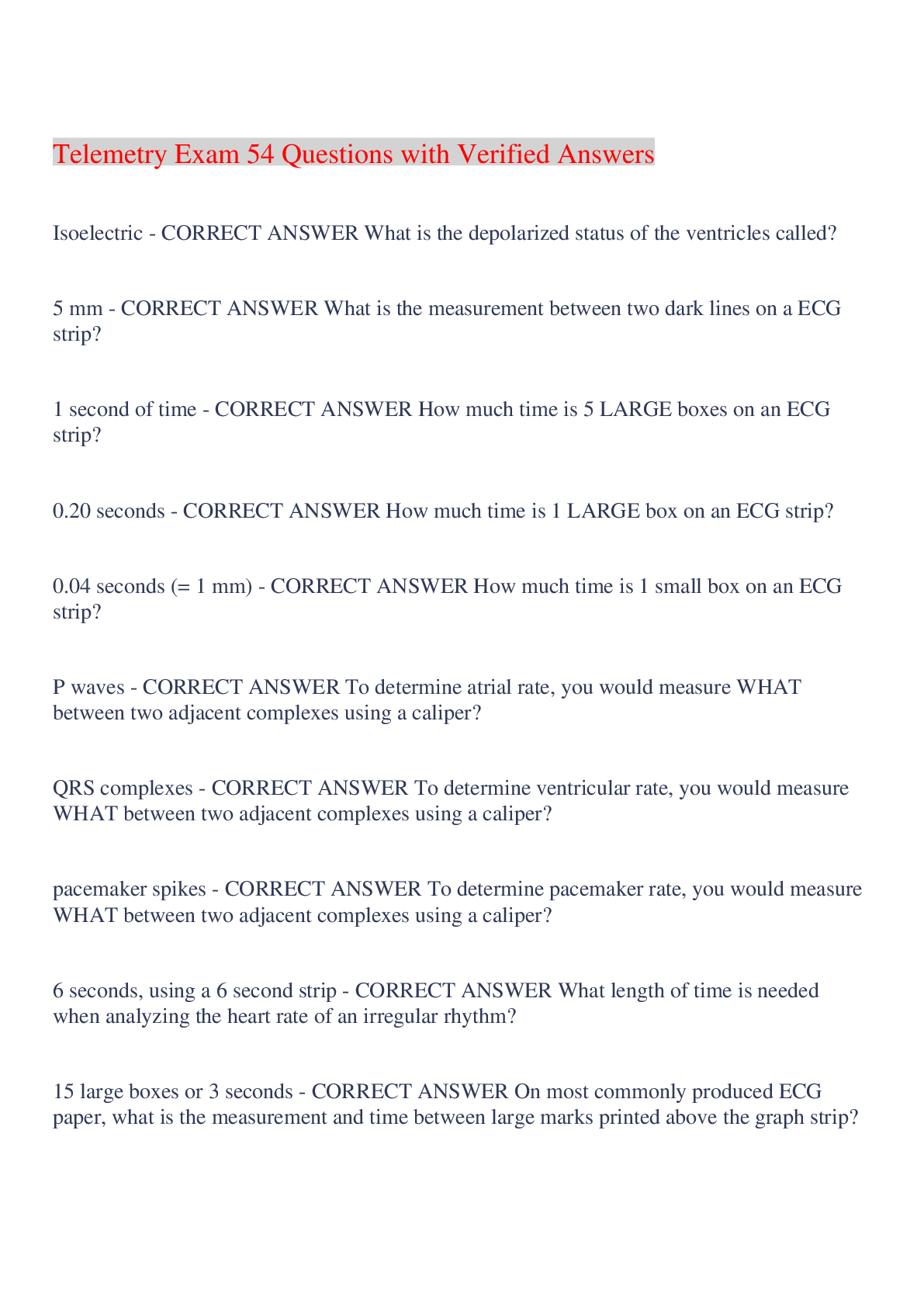
Telemetry Exam 54 Questions with Verified Answers Isoelectric - CORRECT ANSWER What is the depolarized status of the ventricles called? 5 mm - CORRECT ANSWER What is the measurement between two ... dark lines on a ECG strip? 1 second of time - CORRECT ANSWER How much time is 5 LARGE boxes on an ECG strip? 0.20 seconds - CORRECT ANSWER How much time is 1 LARGE box on an ECG strip? 0.04 seconds (= 1 mm) - CORRECT ANSWER How much time is 1 small box on an ECG strip? P waves - CORRECT ANSWER To determine atrial rate, you would measure WHAT between two adjacent complexes using a caliper? QRS complexes - CORRECT ANSWER To determine ventricular rate, you would measure WHAT between two adjacent complexes using a caliper? pacemaker spikes - CORRECT ANSWER To determine pacemaker rate, you would measure WHAT between two adjacent complexes using a caliper? 6 seconds, using a 6 second strip - CORRECT ANSWER What length of time is needed when analyzing the heart rate of an irregular rhythm? 15 large boxes or 3 seconds - CORRECT ANSWER On most commonly produced ECG paper, what is the measurement and time between large marks printed above the graph strip? Using the 6 second strip method, count the number of complexes in 6 seconds and multiply by 10 to get BPM. - CORRECT ANSWER What is the easiest way to determine heart rate of a dysrhythmic ECG? < 0.11 seconds (not quite 3 small boxes) - CORRECT ANSWER What is the normal length of a P wave? 0.12 - 0.20 seconds (3 - 5 small boxes) - CORRECT ANSWER What is the normal length of a PR interval? < 0.10 seconds (<2.5 small boxes) - CORRECT ANSWER What is the normal length of a QRS interval (from baseline to baseline)? Definitely a concern, could be an indication of ischemic heart disease, pericarditis, or other conditions. - CORRECT ANSWER Is a shift up or down from the baseline in the QT segment normal or a concern? Use the pre-calculated chart or the specific formula for .determining the corrected QTC - CORRECT ANSWER How do you determine the corrected QT interval to determine if a given strip is normal or abnormal? Term for number of small boxes (0.04 seconds) between two complexes. - CORRECT ANSWER In a corrected QT chart, what is the "Cycle Time" A.) What is the atrial rhythm? (Look for P waves) B.) What is the ventricular rhythm? (Look at the QRS complexes. C.) Is AV conduction normal? (What is the relationship between the P waves and the QRS complexes?) D.) Are there any unsual complexes? (Are there early complexes, late complexes, or complexes of unusual contour? E.) Is the rhythm dangerous? - CORRECT ANSWER What is are the 5 major questions to ask when determining diagnosis of an ECG? They are occurring at the same time as a QRS complex or T wave, and being much smaller are hidden. - CORRECT ANSWER Why are P waves sometimes not seen on a ECG strip? Yes, using a caliper, march the P waves across the strip, and notice any deformations of the QRS complex or T wave which indicates the "hidden" P wave. - CORRECT ANSWER Can you ever find the hidden P waves? Lead II, or aVF and V1 - CORRECT ANSWER Which lead is the best angle to use when identifying P waves on an ECG? Normal Sinus Rhythm w/ rate of 60 - 100 BPM - CORRECT ANSWER Regular and upright P waves indicate what? sinus tachycardia - CORRECT ANSWER A heart rate of over 100 BPM is what (with normal P waves)? sinus bradycardia - CORRECT ANSWER A heart rate of under 60 BPM is what (with normal P waves)? physiological response to exercise, fever, pain, fear, or other stresses; or could indicate occult congestive heart failure or other cardiac decompensation. - CORRECT ANSWER What can cause sinus tachycardia? increased vagal or parasympathetic tone; or could indicate an acute stage of myocardial infarction (especially diaphragmatic infarction). - CORRECT ANSWER What can cause sinus bradycardia? sinus arrhythmia - CORRECT ANSWER If the longest PP or RR interval exceeds the shortest such interval by 0.16 (4 small boxes) then what is the diagnosis (given that all P waves are identical and normal)? normal sinus rhythm (NSR) rhythm P wave, PR interval, QRS, QT, bpm - CORRECT ANSWER p wave: uniform and before QRS PR int: .12-.2 QRS: .06-.1 QT: .36-.44 60-100 bpm Sinus Tachycardia bpm, rhythm, P waves, PR int, QRS - CORRECT ANSWER 100-150 bpm p waves: uniform and before QRS, can be hidden PR int: .12-.2 QRS: .06-.1 Sinus tachycardia causes and intervention - CORRECT ANSWER causes: pain, fever, caffeine, exercise, anxiety intervention: assess patient, notify MD sinus bradycardia bpm, rhythm, P waves, PT int, QRS - CORRECT ANSWER 40-60 bpm regular rhythm P waves: upright, before QRS PR int: .12-.2 QRS: .06-.1 sinus bradycardia causes and intervention - CORRECT ANSWER causes: sleep, hyperkalemia, hypothermia, hypoxia, normal in athletes intervention: assess pt, call RRT if symptomatic, notify MD sinus arrhythmia rate, rhythm, PR int, QRS, p waves - CORRECT ANSWER rate varies irregular rhythm PR int: .12-.2 P waves are normal QRS: normal, .06-.1 sinus arrhythmia causes and intervention - CORRECT ANSWER causes: changes in vagal tone during diff phases of respiration intervention: assess pt, identify and document rhythm premature atrial contraction (PAC) rhythm, PR int, QRS, P wave - CORRECT ANSWER irregular rhythm, occurs before regular beat PR interval: .12-.2 QRS: normal P wave: upright, but abnormal shape Supraventricular Tachycardia (SVT) rhythm, QRS, p waves, PR interval, bpm - CORRECT ANSWER 150-250 bpm regular rhythm QRS is normal P waves are usually not visible PR interval may not be seen Atrial flutter PR interval, ventricular rhythm, QRS, P waves, general shape - CORRECT ANSWER no P waves PR interval is not measurable ventricular rhythm: 60-150 QRS is normal sawtooth shaped atria beat regularly atrial fibrillation (A fib) Ventricular rate, P waves, PR int, rhythm, QRS, shape - CORRECT ANSWER ventricular rate 60-100 bpm no P waves PR interval is not measurable QRS is normal atria beat irregularly jagged, zigzag premature junction contraction (PJC) rate, rhythm, p waves, PR int, QRS - CORRECT ANSWER rate= basic rate + # of PJC's reg rhythm except PJCs P waves are inverted or absent QRS is normal PR interval less than .12 Junctional Rhythm bpm, rhythm, PR interval, QRS, P waves - CORRECT ANSWER 40-60 bpm regular rhythm PR is less than .12 QRS is normal P waves are inverted or not visible like PJC but consistent and regular junctional rhythm bpm accelerated junctional tachycardia bpm junctional tachycardia bpm - CORRECT ANSWER junc rhythm: 40-60 bpm accelerated junc tachy: 60-100 junc tachy: 100-220 PAC vs PJC vs PVC - CORRECT ANSWER PAC p waves: upright and before QRS, just occur before supposed to PJC: p wave is inverted or absent, or after QRS PVC: no p wave, wide V/QRS, abnormal QRS shape asystole - CORRECT ANSWER 0 bpm may see P waves no QRS no PR interval no ventricular activity Idioventricular Rhythm - CORRECT ANSWER rate 20-40 bpm looks like vtach but is slow no P waves regular rhythm no PR interval wide QRS interval (>.12) ventricular fibrillation rate, rhythm, shape, p waves, pr interval - CORRECT ANSWER not able to determine rate irregular rhythm no p waves no PR interval coarse/fine waves ventricular tachycardia (polymorphic) torsades de pointes rhythm, bpm, p waves, pr interval, QRS - CORRECT ANSWER irregular rhythm 100-250 bpm no p waves, no pr interval QRS >.12, with alternating shape (neg and pos deflection) ventricular tachycardia (monomorphic) rhythm, bpm, p waves, pr interval, QRS - CORRECT ANSWER regular rhythm 100-250 bpm no p waves, no pr interval QRS >.12, relatively same shape premature ventricular contraction (PVC) rate, rhythm, pr interval, p wave, QRS - CORRECT ANSWER early ventricular contraction QRS is wide and abnormal shape rate determined by basic rate + PVC's no p wave, no pr interval 1st degree AV block rate, rhythm, p waves, QRS, PR interval, characteristic - CORRECT ANSWER normal rate regular rhythm normal P waves PR interval is PROLONGED but consistent QRS is normal 2nd degree AV block type 1 rhythm, QRS, p waves, pr interval, characteristic - CORRECT ANSWER irregular rhythm QRS is normal P waves have normal shape but more than QRS PR interval becomes increasingly longer until QRS is dropped 2nd degree AV block type 2 rhythm, rate, PR interval, P waves, QRS - CORRECT ANSWER ventricular rate is slow irregular d/t missed QRS, otherwise regular PR interval is normal and constant P waves are regular, but not all conduct QRS QRS are usually normal, but can be wide 3rd degree AV block (complete heart block) rate (vent and atrial), rhythm, QRS, p waves, pr interval - CORRECT ANSWER vent rate: 30-40 atrial rate: 60-100 regular rhythm QRS: normal or wide more P waves than QRS PR interval: no relationship between P waves and QRS, highly variable 2:1 AV block - CORRECT ANSWER regular 2 P waves to every QRS form of second degree bundle branch block (BBB) qrs, s wave - CORRECT ANSWER QRS >.12 prominent, wide S wave or abnormal QRS [Show More]
Last updated: 2 years ago
Preview 1 out of 9 pages
Buy this document to get the full access instantly
Instant Download Access after purchase
Buy NowInstant download
We Accept:

Also available in bundle (1)
Click Below to Access Bundle(s)

Telemetry Exam ( 33 Sets) Questions with Verified Answers,100% CORRECT
Telemetry Exam 68 Questions with Verified Answers,Telemetry Exam 39 Questions with Verified Answers,Cardiac- Telemetry Exam 72 Questions with Verified Answers,Telemetry Exam 60 Questions with Verified...
By securegrades 2 years ago
$30
34
Reviews( 0 )
$8.00
Can't find what you want? Try our AI powered Search
Document information
Connected school, study & course
About the document
Uploaded On
Dec 08, 2023
Number of pages
9
Written in
All

Additional information
This document has been written for:
Uploaded
Dec 08, 2023
Downloads
0
Views
76