The setting below shows that management is related with administration in an organizational environment. Management pertains to the utilization of available resources in an organization while administration refers to the
...
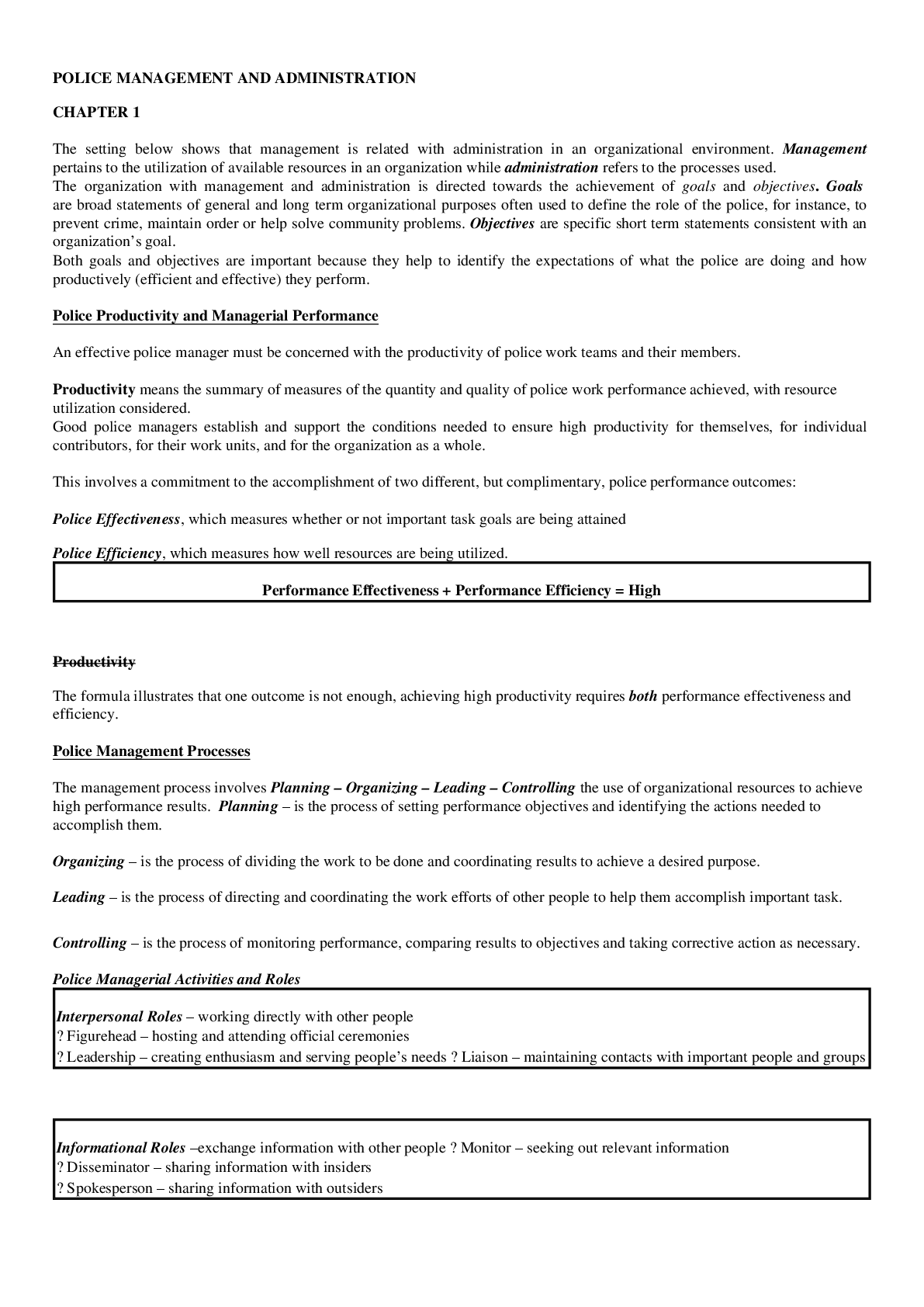
The setting below shows that management is related with administration in an organizational environment. Management pertains to the utilization of available resources in an organization while administration refers to the processes used.
The organization with management and administration is directed towards the achievement of goals and objectives. Goals are broad statements of general and long term organizational purposes often used to define the role of the police, for instance, to prevent crime, maintain order or help solve community problems. Objectives are specific short term statements consistent with an organization’s goal.
Both goals and objectives are important because they help to identify the expectations of what the police are doing and how productively (efficient and effective) they perform.
Police Productivity and Managerial Performance
An effective police manager must be concerned with the productivity of police work teams and their members.
Productivity means the summary of measures of the quantity and quality of police work performance achieved, with resource utilization considered.
Good police managers establish and support the conditions needed to ensure high productivity for themselves, for individual contributors, for their work units, and for the organization as a whole.
This involves a commitment to the accomplishment of two different, but complimentary, police performance outcomes:
Police Effectiveness, which measures whether or not important task goals are being attained
Police Efficiency, which measures how well resources are being utilized.
Performance Effectiveness + Performance Efficiency = High
Productivity
The formula illustrates that one outcome is not enough, achieving high productivity requires both performance effectiveness and efficiency.
Police Management Processes
The management process involves Planning – Organizing – Leading – Controlling the use of organizational resources to achieve high performance results. Planning – is the process of setting performance objectives and identifying the actions needed to accomplish them.
Organizing – is the process of dividing the work to be done and coordinating results to achieve a desired purpose.
Leading – is the process of directing and coordinating the work efforts of other people to help them accomplish important task.
Controlling – is the process of monitoring performance, comparing results to objectives and taking corrective action as necessary.
Police Managerial Activities and Roles
Interpersonal Roles – working directly with other people
∙ Figurehead – hosting and attending official ceremonies
∙ Leadership – creating enthusiasm and serving people’s needs ∙ Liaison – maintaining contacts with important people and groups
Informational Roles –exchange information with other people ∙ Monitor – seeking out relevant information
∙ Disseminator – sharing information with insiders
∙ Spokesperson – sharing information with outsiders
Decisional Roles – make decisions that affect other people
∙ Entrepreneur – seeking problems to solve and opportunities to explore ∙ Disturbance handler – helping to resolve conflicts
∙ Resource Allocator – allocating resources to various uses
∙ Negotiator – negotiating with other parties
The Traditional & Contemporary
Foundations of Police Organization and Management
The Classical Approach
The three primary areas in the development of the classical approach are:
1. Scientific Management
(Frederick Taylor, 1856-1915)
Scientific Management sought to discover the best method of performing specific task. Based on his studies, Taylor believed that if workers were taught the best procedures, with pay tied to output, they would produce the maximum amount of work.
With respect to this philosophy, the role of management changed abruptly from the earlier use of the “rule of the thumb” to a more scientific approach, including scientifically selecting, training, and developing workers, and ensuring that all the work would be done in accordance with scientific principles, thus scientific management strongly adhered to the formal organization structure and its rules.
2. Bureaucratic Management
(Max Weber, 1864-1920)
The concept of Bureaucracy is generally associated with the work of Max Weber, who was the major contributor to modern sociology.
He studied the effect of social change in Europe at the end of the 19th Century and coined the term BUREAUCRACY to identify the complex organizations that operated on a rational basis.
Weber believed that such an approach was a means of lessening the cruelty, nepotism, and subjective managerial practices common in the early stages of the Industrial Revolution. (for example, it was a standard practice to hire relatives regardless of their competence and to allow only individuals of aristocratic birth to attain high-level positions within government and industry)
Characteristics of Bureaucratic Organization
1. Division of labor based on a specified sphere of competence 2. Hierarchy of authority where its lower office is under the control and supervision of a higher one.
3. Specified set of rules applied uniformly throughout the organization
4. Maintenance of interpersonal relationships, because rational decisions can only be made objectively and without
emotions
5. Selection and promotion based on competence, not on
[Show More]

.png)
.png)






.png)
.png)


![Preview of Fundamentals of Planning Buildings and Facilities of Animal and Poultry production[ARABIC]](https://browseimages.nyc3.digitaloceanspaces.com/paper-images/2023/Nov/17/1QvD0aZg2023-11-17-07-376556edf4bbbb3.png)