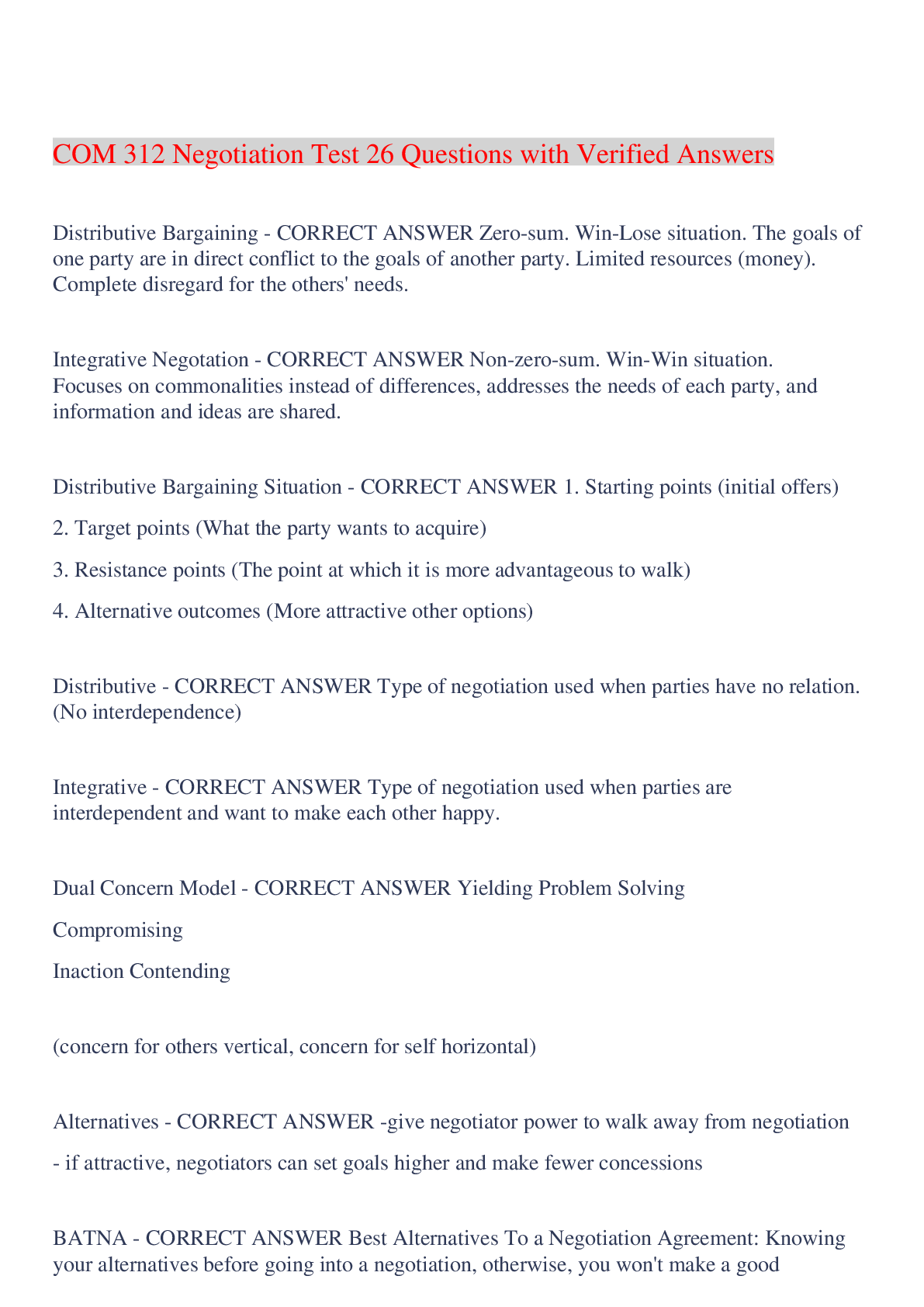
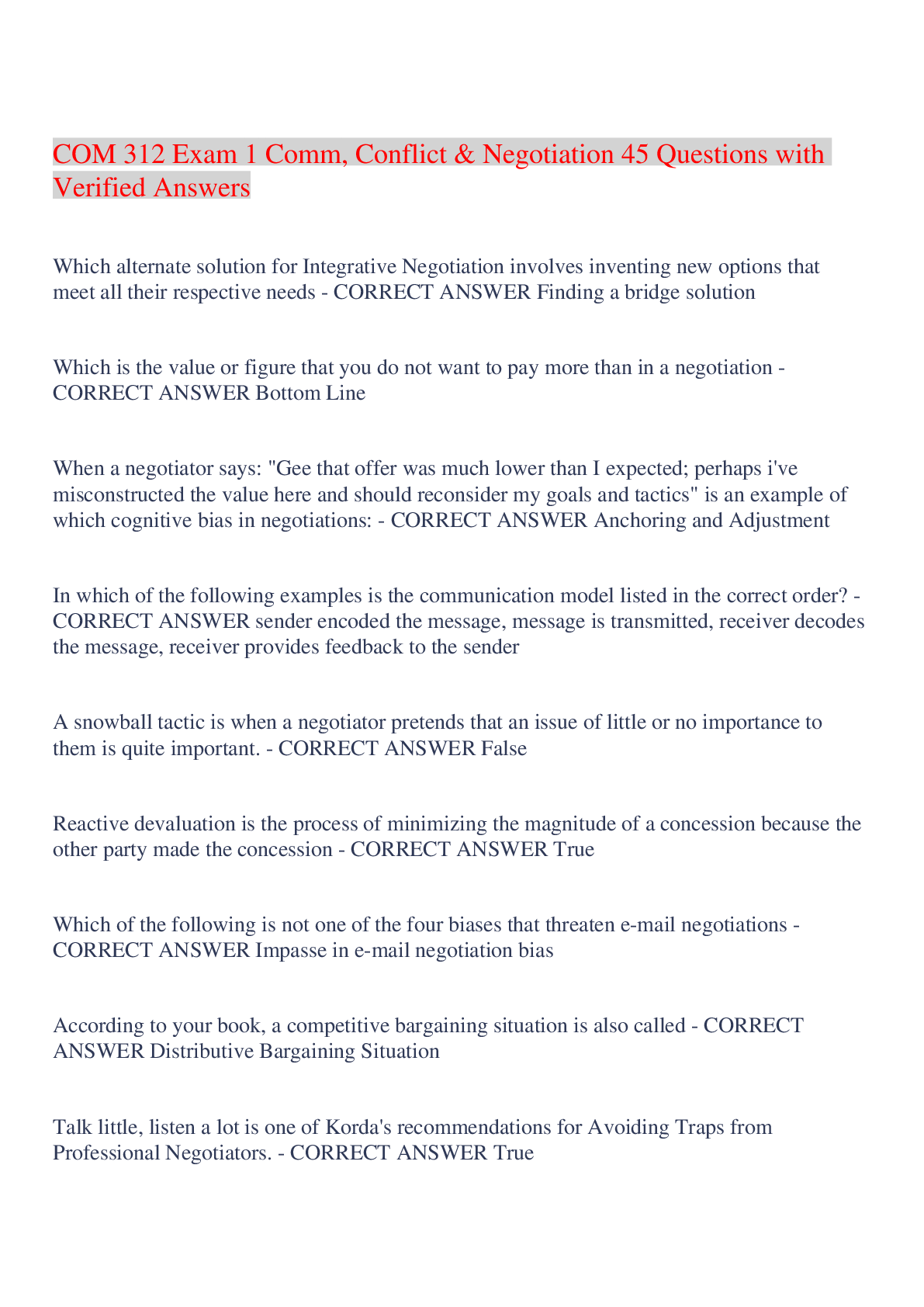
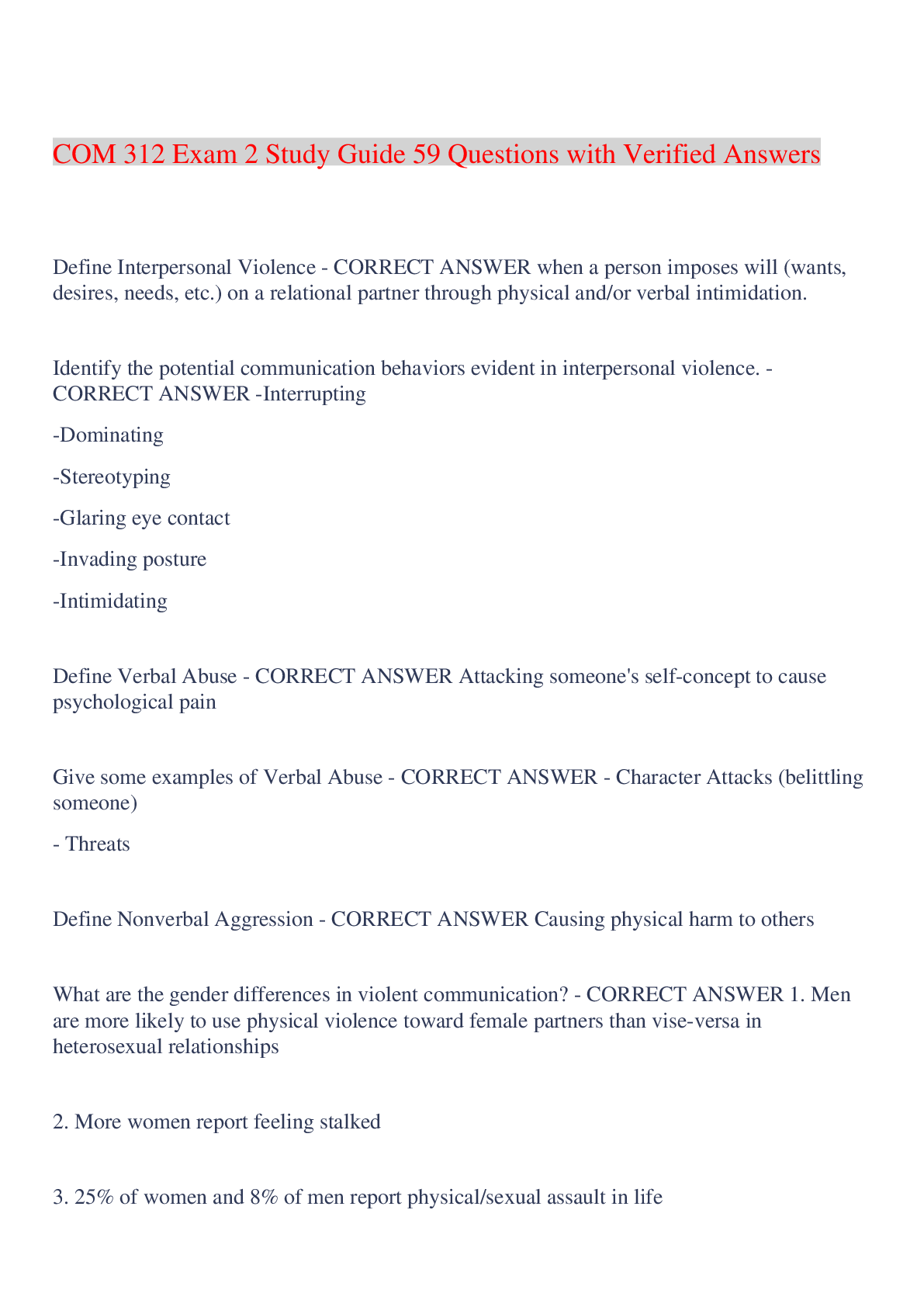
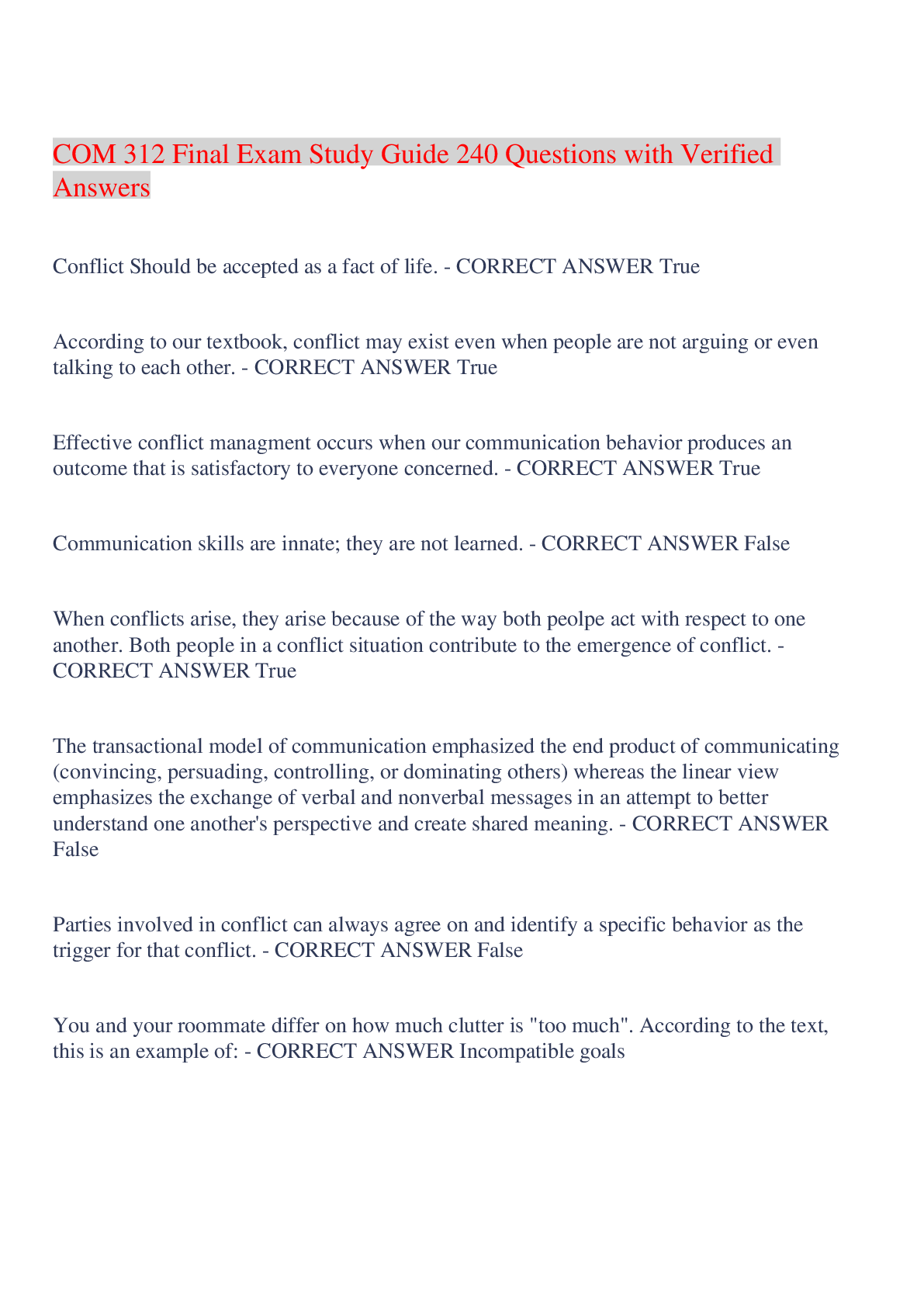
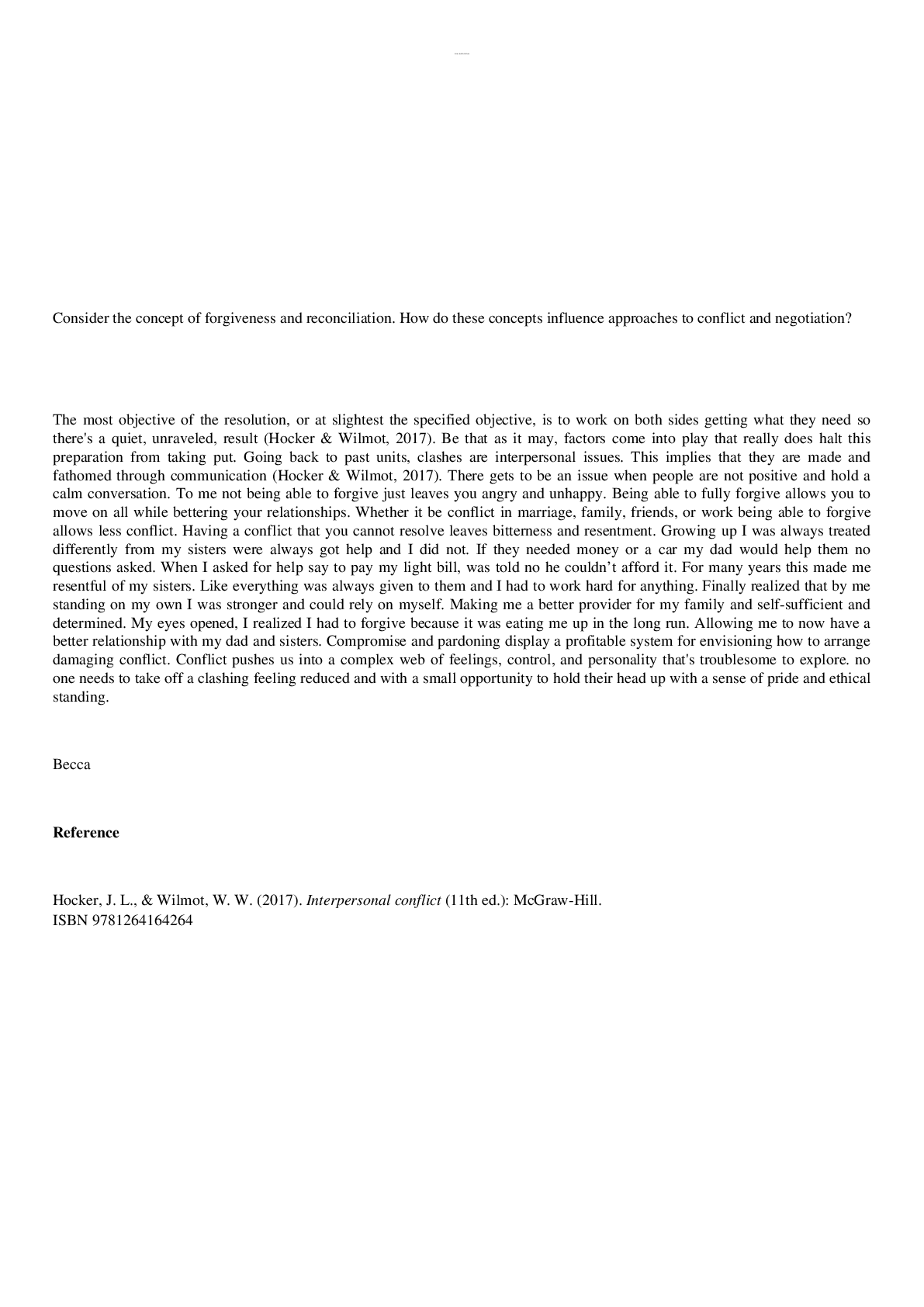
COM 312-EXAM 1|86 Questions with Verified Answers Level 1 of Conflict - CORRECT ANSWER specific behavior (e.g. what to watch, where to eat, etc.) Level 2 of Conflict - CORRECT ANSWER Relational ... norms and roles (e.g. who cooks/who cleans, friend's with benefits rules, etc.) Level 3 of Conflict - CORRECT ANSWER Personal character (e.g. personal faults, motives, tendencies) Parallel Conflict - CORRECT ANSWER Perceived exactly the same by both parties Latent Conflict - CORRECT ANSWER Should be occurring but is not False Conflict - CORRECT ANSWER Is occurring but should not (misunderstand) Displaced Conflict - CORRECT ANSWER Conflict is about 'A' but person is mad about 'B' Misattributed Conflict - CORRECT ANSWER Mad about person 'A' but mad at person 'B' Incompatible Goals - CORRECT ANSWER Seeking different outcomes, different expectancies (e.g. different sports fans) Incompatible Means - CORRECT ANSWER Same goal, different strategy (e.g. "I hate Joe Girardi") Conflict Management - CORRECT ANSWER The communication behavior enaced based on our analysis of conflict situation "Meta-Conflict" perspective - CORRECT ANSWER Super skill; analyze previous conflicts you've had; make corrections and learn form mistakes Linear - CORRECT ANSWER sender, receiver, channel, noise; accuracy (rec. same meaning as sent) Transnactional - CORRECT ANSWER Emphasized managing, coordinating, exchange; parties create meaning together (doesn't always match) Destructive Communication Processes - CORRECT ANSWER Thinking of something as unchanging (i.e. "He was annoying in high school, he's going to be annoying in college") Ignoring/forgetting our histories - CORRECT ANSWER "I don't understand why she's being so mean, that happened like forever ago" Process View of Communication - CORRECT ANSWER Realizing that our lives consists of events which influence subsequent events Prelude to conflict - CORRECT ANSWER Variables emerge that make conflict possible Four Key Variables - CORRECT ANSWER 1. Who is in the conflict? 2. What type of relationship do they share? 3. Who else is involved (bystanders)? 4. The context/environment that conflict occurs in Triggering Event - CORRECT ANSWER The thing that happens that both parties point to as the focal point; parties can disagree on the triggering event Initiation Phase - CORRECT ANSWER When the conflict becomes overt/expressed; conflict episode cannot proceed without initiation Differentiation phase - CORRECT ANSWER Strategies and tactics used; conflict becoems obvious to parties and maybe others; sides of the story presented; escalation and de-escalation; perspectives and desired outcomes explained Resolution Phase - CORRECT ANSWER Parties accept an outcome to the conflict; management and resolution affect future conflicts between parties (cycle) Destructive Conflict - CORRECT ANSWER Parties do not manage conflict ina awy that is mutually satisfactory and harms their relationship (i.e. los sight of original goals, hostility is normal, becomes regular part of communication) Productive Conflict - CORRECT ANSWER Kept to issue and those involved in it; no escalation and loss of control (i.e. reduces costs and negative feelings to part, helping other person, awareness of options, flexibilities, believe other parties can achieve their goals) Negative view of conflict - CORRECT ANSWER Seeing opportunity to resolve problems and improve relationship in conflict situations Tangible Conflict Issues - CORRECT ANSWER Over things that can be measured (i.e. gas in car) Intangible Conflict issues - CORRECT ANSWER Gut feelings, love, respect, self-esteem, power, cooperation, attention, caring; usually not limited resources but perceived to be Behavioral issue conflicts - CORRECT ANSWER Specific, observable actions; emphaiss on HOW or WHAT one has done (i.e. money, time, space, etc.); one time behaviors; most closely relation to tangible conflicts-level 1 Relational Issue Conflicts - CORRECT ANSWER Rules, norms, boundaries agreed upon by partners ("Just friends", loalty, commitment, time, favors, expecations, etc,); level 2 conflict Personality Issue Conflicts - CORRECT ANSWER Consistent attitudes or characteristics (i.e. "why do you always..." "what is it with you and..." "It drives me crazy when you..."); this is the most serious form of conflict- level 3 Scripts - CORRECT ANSWER Routine events we do without deviating or thinking much; scripts exist for every walk of life; can be dangerous in conflict scenarios (repeating the cycle) Undesired Repetitive Patter (URP) - CORRECT ANSWER Feeling trapped in circumstances beyond your control; automatic responses to people and events Dysfunctional Conflict Style- Avoiding/Accommodating - CORRECT ANSWER Withdrawing, leaving the scene, steering away from discussion, silence; can lead to Gunny-Sacking Dysfunctional Conflict Style- Avoidance - CORRECT ANSWER Anything it takes to not partake in the conflict episode Dysfunctional Conflict Style- Accommodating - CORRECT ANSWER Obliging others, quick to give in, harmony at all costs; relationship and comfort valued over personal needs and interests Gunny-Sacking - CORRECT ANSWER Issues build up and anxiety hurts conflict interaction; can destroy a relationship Schismogenesis - CORRECT ANSWER Escalation of conflict because behavior of one person intensity the behaviors of another Symmetrical Competition - CORRECT ANSWER Outdoing others' behavior (revenge) Passive-Aggressive Communication - CORRECT ANSWER Behavior that appears to avoid or accommodate, but in actuality are designed to inflict harm Theory - CORRECT ANSWER A means of explaining how something works Psycho dynamic Theory - CORRECT ANSWER People explain conflict due to internal tension within them Anxiety - CORRECT ANSWER Tension that occurs when we perceive danger Repression - CORRECT ANSWER Tension that occurs when we refuse to think about a situation Displacement - CORRECT ANSWER Tension that occurs when we attribute conflict toward the wrong person, avoiding the actual person of interest Attribution Theory - CORRECT ANSWER People make inferences about others based on behavior Internal Attributions - CORRECT ANSWER Behaviors are enacted due to person characteristics (i.e. wants, needs, beliefs) External Attributions - CORRECT ANSWER Behaviors influenced by an exteranl factor (i.e. luck, chance, a 3rd part) Fundamental Attribution Error - CORRECT ANSWER Occurs when we falsely make attribution to ourselves or others Uncertainty Theory - CORRECT ANSWER Conflict occurs because we have insufficient info about the other person Social Exchange Theory-Costs vs Rewards - CORRECT ANSWER Effort put into relationship vs what you receive from relationship Comparison Level (CL) - CORRECT ANSWER how satisfactory our relationship is compared to our expectancy of what we feel we deserve Comparision Level for Alternatives (CL-ALT) - CORRECT ANSWER Comparing current relationships against alternative relationships Rewards-Costs= - CORRECT ANSWER Outcomes Outcomes-CL= - CORRECT ANSWER Satisfaction Outcomes-CLALT= - CORRECT ANSWER Comittment Homeostasis - CORRECT ANSWER the system maintains itself in pursuit of its goals Systems Theory - CORRECT ANSWER Human relationships exist across a continuum of communication; conflict is both inevitable and continuous; conflict encourages adaptation of system Excitation Transfer Theory Assumptions - CORRECT ANSWER 1. Arousal, once evoked, requires a period of time to decay 2. Arousal, experienced for w/e reason, heightens the response to subsequently experience stimuli Arousal - CORRECT ANSWER Decreased cognitive control Emotions and Conflict: Appriasal theories of Emotion Assumptions - CORRECT ANSWER People monitor the environment to assess whether conditions help or hinder their goals; the judgements are called appraisals Anger - CORRECT ANSWER An injustice is interfering with a desired and obtainable goal Sadness - CORRECT ANSWER Something of value has been lost and can't be recovered Happiness - CORRECT ANSWER The situation allows a desired goal to be met Fear - CORRECT ANSWER An unpleasant outcome is possible but not certain Shame - CORRECT ANSWER I have behaved in a way that violates my moral ideals Embarrassment - CORRECT ANSWER I have behaved in a way that makes me look inept to others Self-perceptions - CORRECT ANSWER Our awareness of how we feel Physiological Changes - CORRECT ANSWER Heart rate, sweating, pupil dilation Nonverbal Markers - CORRECT ANSWER Body language, gestures, use of adaptors, manipulators Action Tendencies - CORRECT ANSWER The behaviors that our emotions compel us to perform Implications for conflict - CORRECT ANSWER 1. The appraisals likely to be relevant to conflict lead to negative emotions 2. The action tendencies associated with those emotions are typically constructive 3. People are hard-wired by evolutionary processes to manage conflict poorly 4. Partners affect each other through emotional contagion Mood and Conflict: the Affect-Infusion Model Assumptions - CORRECT ANSWER 1. Affect- infusion occurs when mood influences the selection of info that subsequently shapes behavior or cognitive processes 2. The effect of mood is greater when judgments or behavior require an open info search and constructive thinking Stop: take a time out - CORRECT ANSWER exit temp.; create a set time of seperation; change topic for a bit; stopping does not mean stonewalling Think: consider cause and outcomes of your actions - CORRECT ANSWER What is the topic of conflict; think about the relationship; think about your goals Goals to consider - CORRECT ANSWER 1. Instrumental-what is the task at hand 2. Relational- how will it change 3. Identity- how conflict parties view each other 4. Process- how is each party managing the conflict Listening: focus attention on other person's story - CORRECT ANSWER Do not only consider your side; reduce our own and others' defensiveness Communicating - CORRECT ANSWER Collaborating; reciprocating; basic communication rights; be assertive 6 Step Confrontation Process - CORRECT ANSWER 1. Preparation- identify your problems/needs/issues 2. Arrange to meet/talk 3. Interpersonal Confrontation- talk about your problem 4. Consider Partner's POV 5. Manage the problem 6. Follow up on solution-set time up for reevaluation Trained Incapacitates - CORRECT ANSWER Abilities, talents, habits that limit thinking and creativity Task oriented-ness - CORRECT ANSWER Efficient but neglect the relationship Critical Thinking - CORRECT ANSWER Normally good; can stifle new ideas by focusing on one Cooperation - CORRECT ANSWER Wanting the best for both parties Competition - CORRECT ANSWER Wanting the best for yourself and the worst for the other party Individualism - CORRECT ANSWER Wanting the best for yourself and not caring about the other party The Dual Concern Model- Predicts 5 Outcomes - CORRECT ANSWER 1. Accommodating 2. Problem solving 3. Compromising 4. Avoiding 5. Forcing [Show More]
Last updated: 2 years ago
Preview 1 out of 8 pages
Buy this document to get the full access instantly
Instant Download Access after purchase
Buy NowInstant download
We Accept:
Can't find what you want? Try our AI powered Search
Connected school, study & course
About the document
Uploaded On
Dec 12, 2023
Number of pages
8
Written in
All
This document has been written for:
Uploaded
Dec 12, 2023
Downloads
0
Views
65
Scholarfriends.com Online Platform by Browsegrades Inc. 651N South Broad St, Middletown DE. United States.
We're available through e-mail, Twitter, Facebook, and live chat.
FAQ
Questions? Leave a message!
Copyright © Scholarfriends · High quality services·