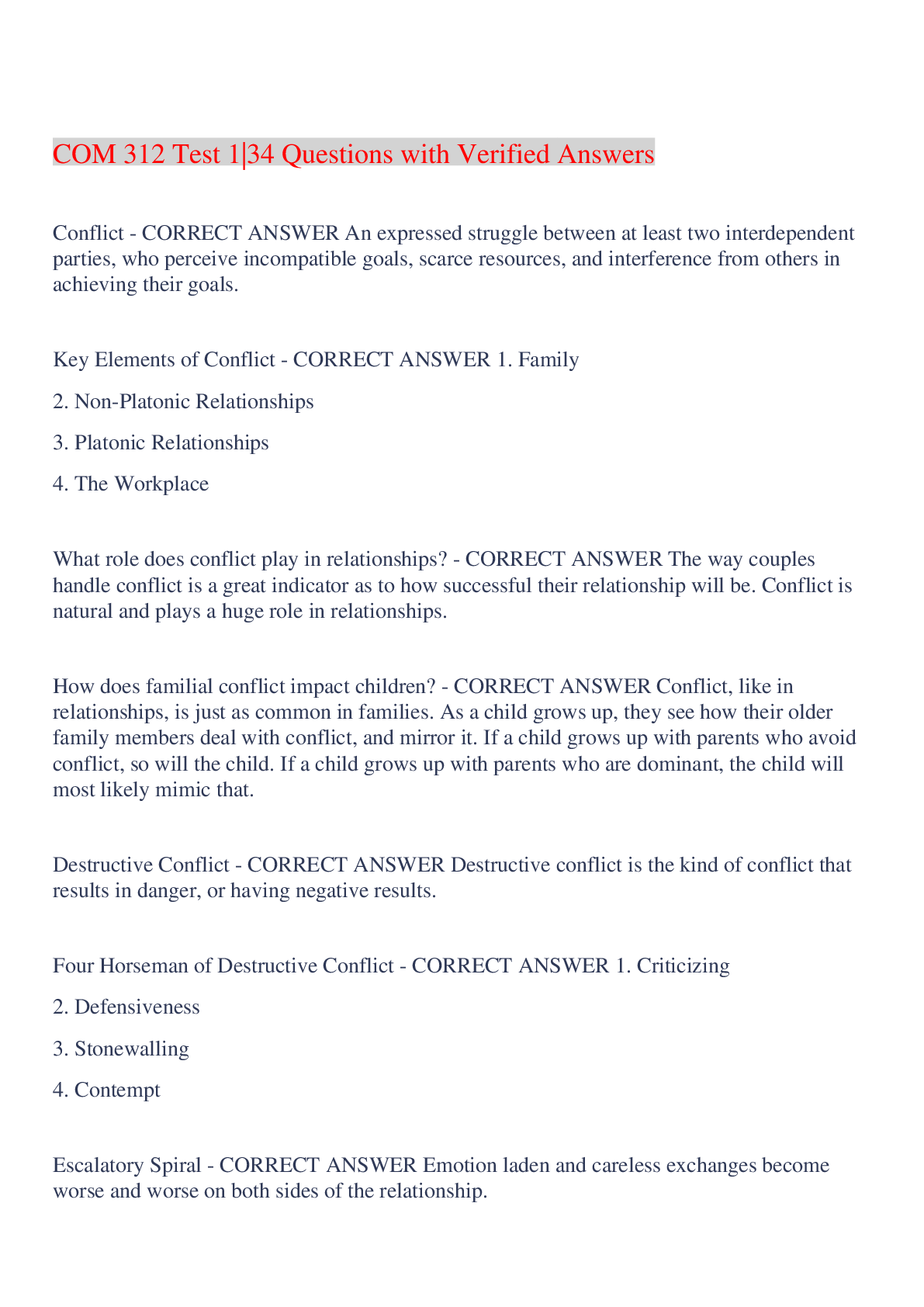
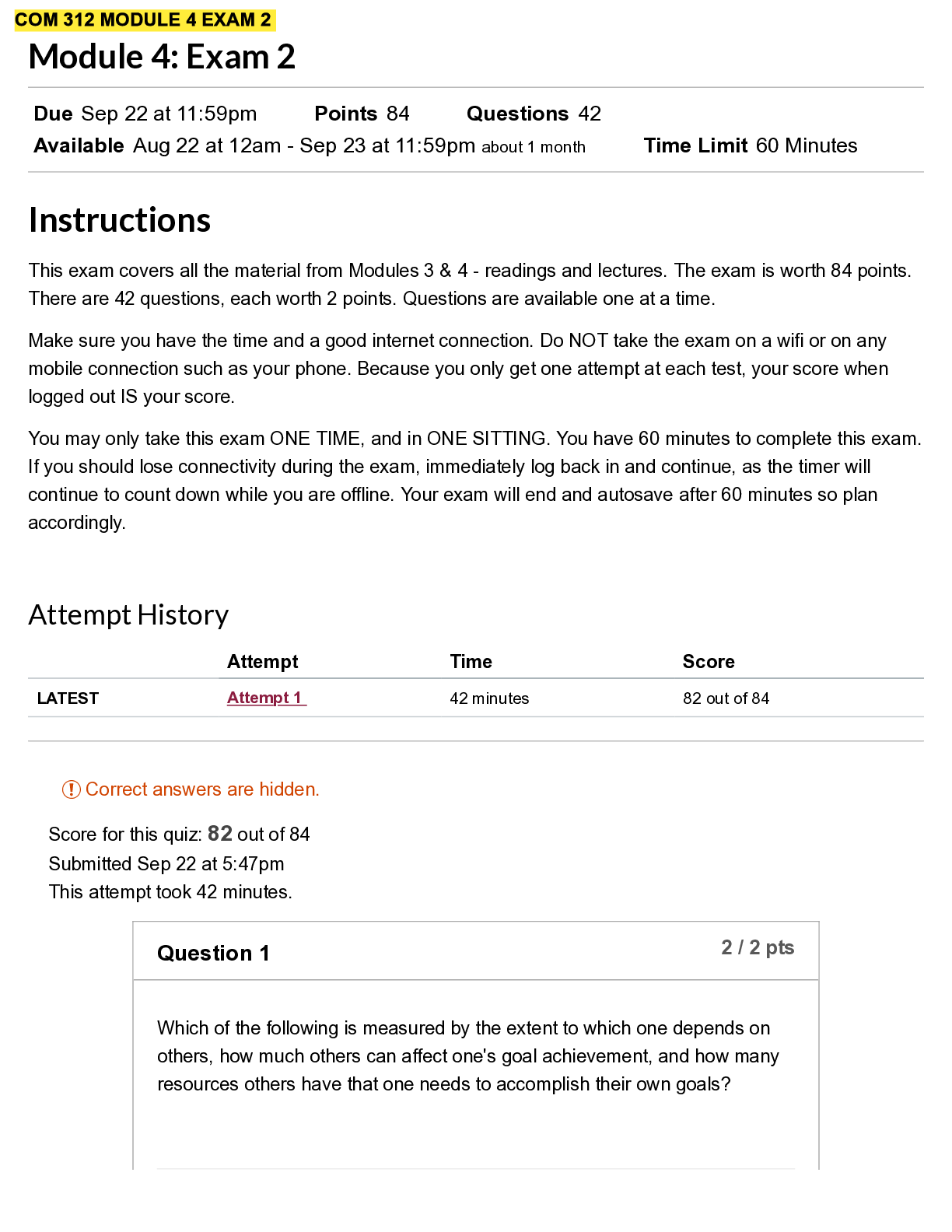
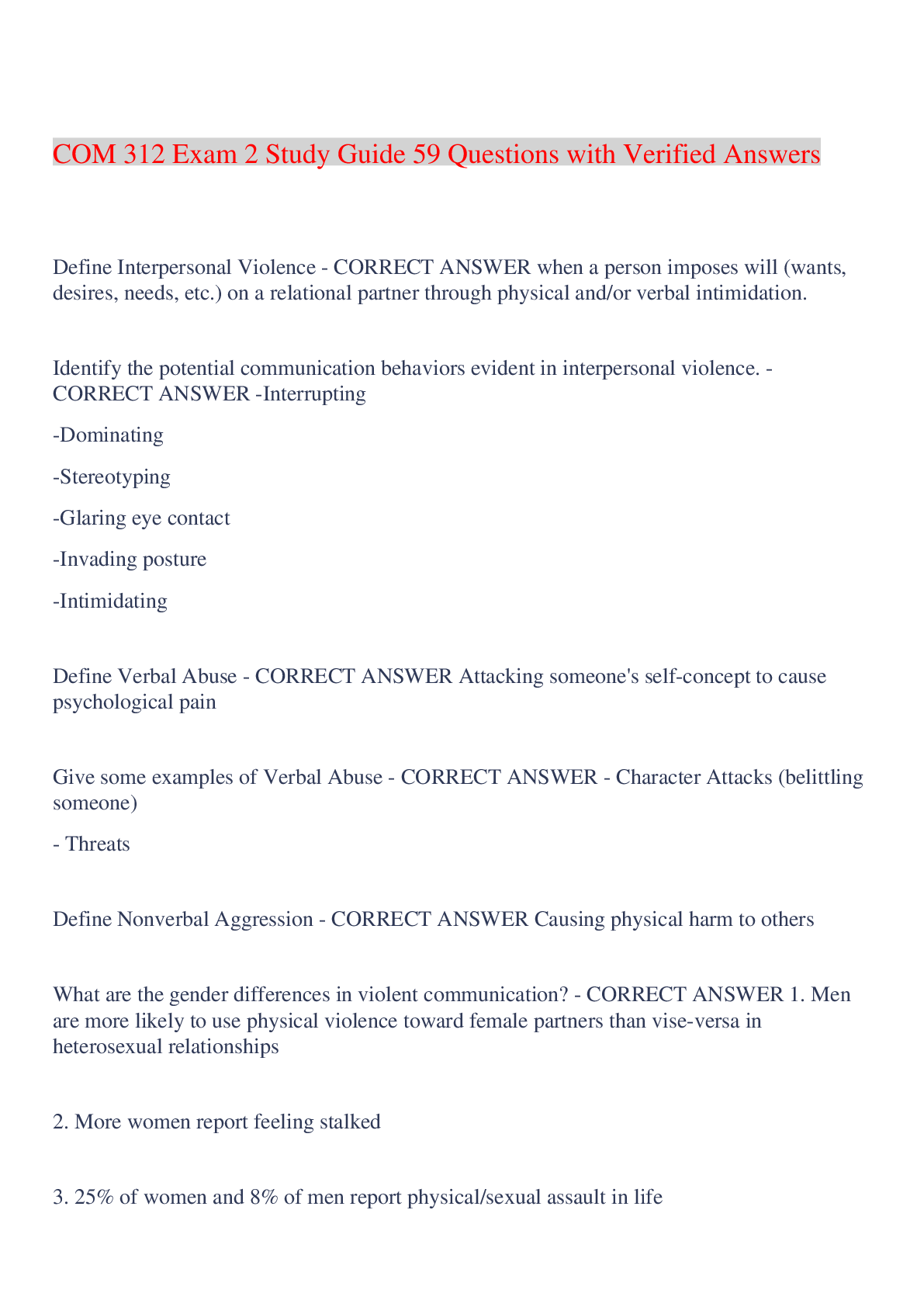
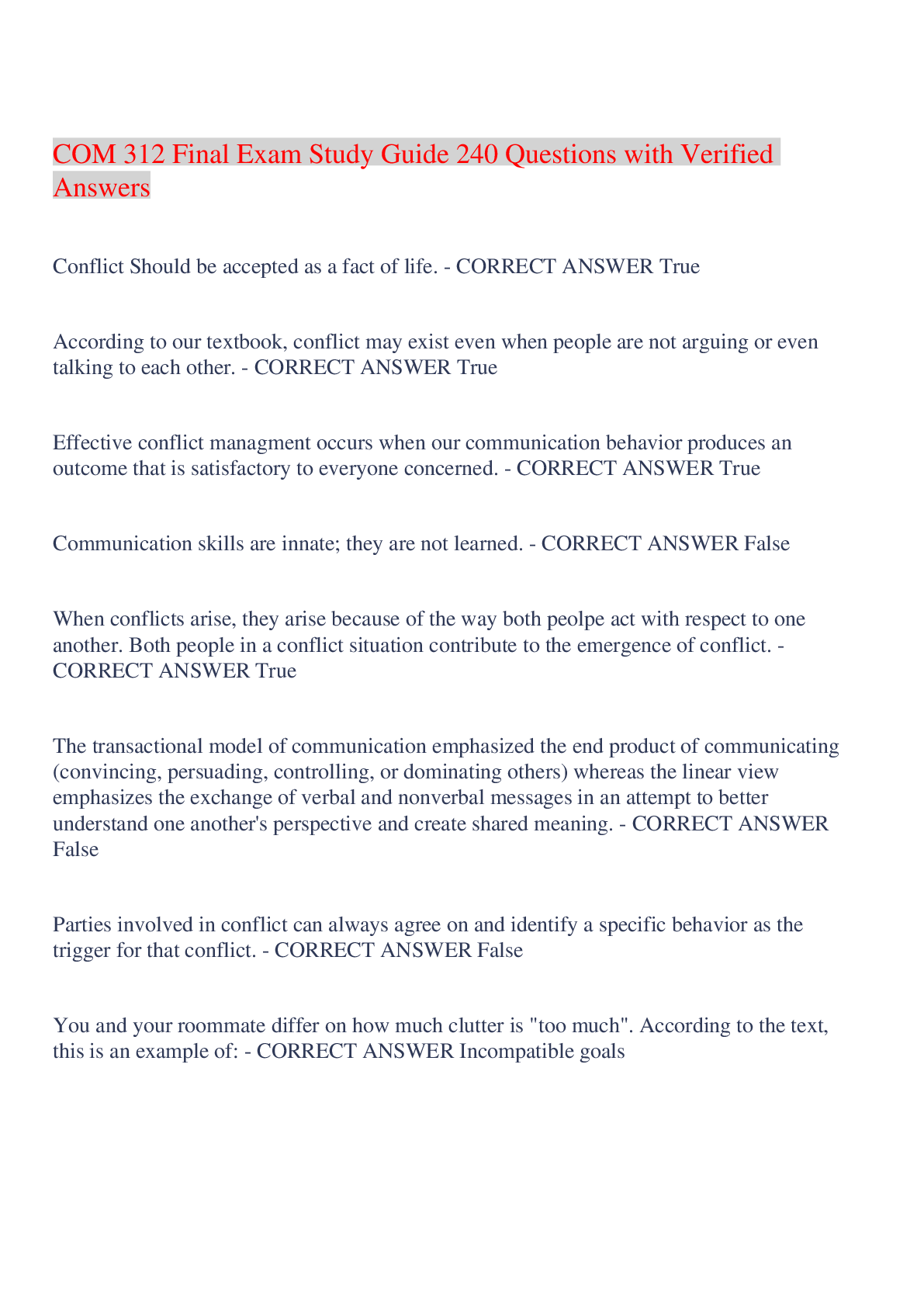
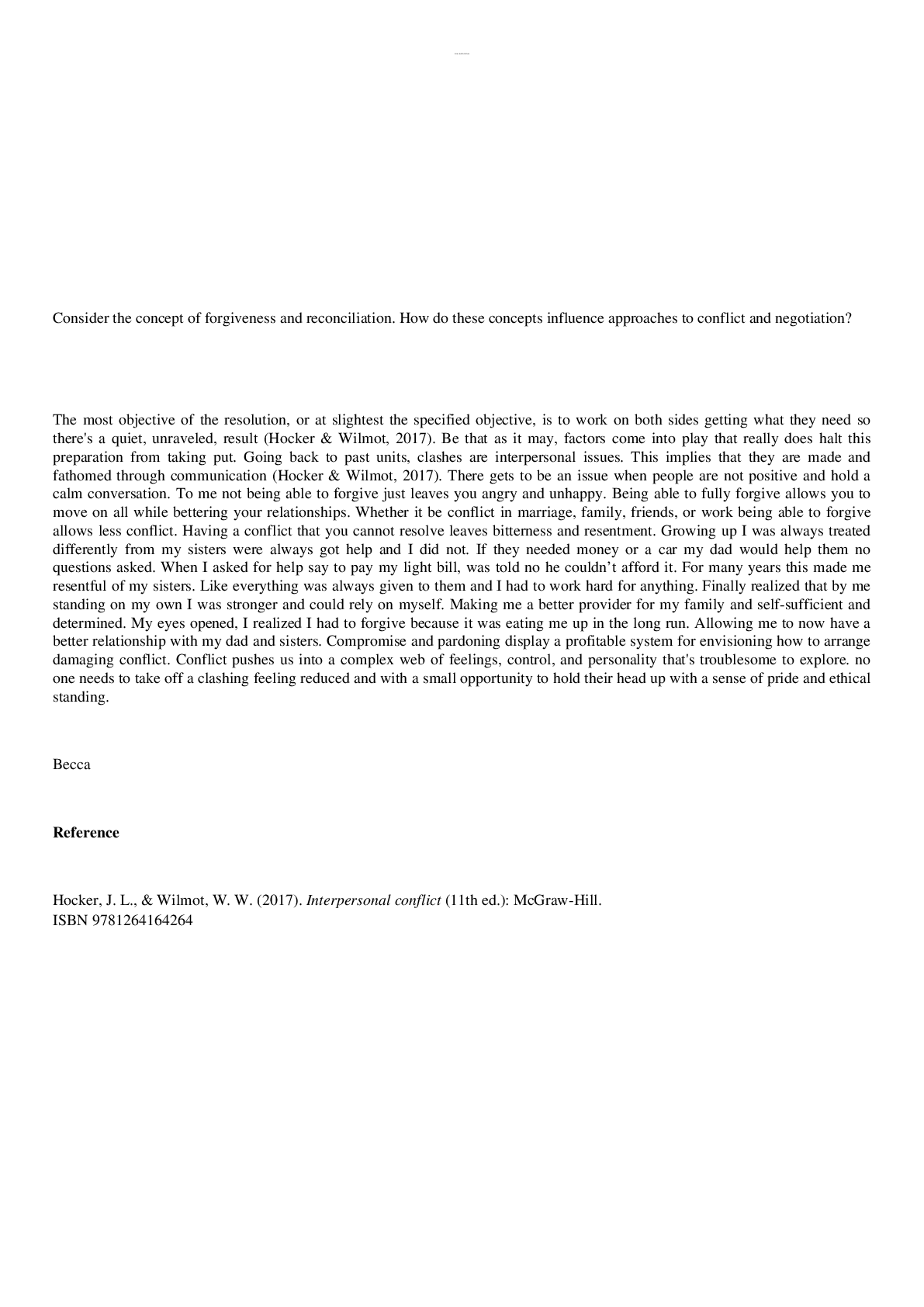
COM 312 Test 1|34 Questions with Verified Answers Conflict - CORRECT ANSWER An expressed struggle between at least two interdependent parties, who perceive incompatible goals, scarce resources, and ... interference from others in achieving their goals. Key Elements of Conflict - CORRECT ANSWER 1. Family 2. Non-Platonic Relationships 3. Platonic Relationships 4. The Workplace What role does conflict play in relationships? - CORRECT ANSWER The way couples handle conflict is a great indicator as to how successful their relationship will be. Conflict is natural and plays a huge role in relationships. How does familial conflict impact children? - CORRECT ANSWER Conflict, like in relationships, is just as common in families. As a child grows up, they see how their older family members deal with conflict, and mirror it. If a child grows up with parents who avoid conflict, so will the child. If a child grows up with parents who are dominant, the child will most likely mimic that. Destructive Conflict - CORRECT ANSWER Destructive conflict is the kind of conflict that results in danger, or having negative results. Four Horseman of Destructive Conflict - CORRECT ANSWER 1. Criticizing 2. Defensiveness 3. Stonewalling 4. Contempt Escalatory Spiral - CORRECT ANSWER Emotion laden and careless exchanges become worse and worse on both sides of the relationship. De-escalatory Spiral - CORRECT ANSWER Both parties retrieve from each other. Avoidance Spiral - CORRECT ANSWER Active attempts by both parties to lessen dependence on each other. TRIP Goals - CORRECT ANSWER The types of goals seen in conflicts. T-opic R-elationship I-dentity P-rocess TOPIC goal - CORRECT ANSWER -The topic goal is the goal each party wants. -Concerns: Scarce resources, not enough of what people want is available, causing conflict. RELATIONSHIP goal - CORRECT ANSWER -What the parties in conflict are in relation to each other. -Concerns: sometimes the talk as "who are we to each other" never happens -Meta-arguments arise (topics when the underlying issue is the relational aspect) IDENTITY goal - CORRECT ANSWER -"Who am I" in this interaction. The identity of each party. Face-saving comes into play. -Concerns: When one's identity is threatened, people become destructive and less flexible PROCESS goal - CORRECT ANSWER -What communication process will be used? -Concerns: Many times, both parties have different views on how to handle the conflict. Types of Power - CORRECT ANSWER Designated, Distributive, Integrative Designated Power - CORRECT ANSWER Given to a person by their position. Distributive Power - CORRECT ANSWER Having power over the other party. Integrative Power - CORRECT ANSWER All parties have equal amounts of power. Orientations to Power - CORRECT ANSWER Designted, Either/Or, Both/And, Power Denial Either/Or Power - CORRECT ANSWER When both parties see one as having more power than the other, or vice-versa. The power to move others against their will. Both/And Power - CORRECT ANSWER When both parties are willing to compromise their power to meet in the middle. They are willing to see multiple options and consider both. Feminine approach. Power Denial - CORRECT ANSWER When there is a reluctance to talk about power. -denying something was said -denying you said something -denying you said something to someone -denying the situation even existed Behavior of individuals in LOW power - CORRECT ANSWER Feel helpless. Will make moves at others' expense in order to gain power. Behavior of individuals in HIGH power - CORRECT ANSWER Can form altered views of themselves and will act aggressively in order to keep their power. Individual Power Currencies (RICE) - CORRECT ANSWER How much you have to offer the other party and how much they value your resources plays into how much power you have RICE - CORRECT ANSWER R-esources I-nterpersonal Linkages C-ommunication Skills E-xpertise Resources - CORRECT ANSWER Controlling the resources you have to retain power. (ie. parents withhold money, cars, privacy, etc. from their teenagers.) Interpersonal Linkages - CORRECT ANSWER Gaining power by the connections you have with other people. Communication Skills - CORRECT ANSWER Power through being able to communicate well and build relationships. Expertise - CORRECT ANSWER Power in knowledge of something. Conflict Styles - CORRECT ANSWER Obliging Integrating Compromising Avoidance Dominant Ways to BALANCE power: - CORRECT ANSWER Dialogue, restraint, focus on interdependence, calm persistence, etc. Mid-Range of Emotions - CORRECT ANSWER Being conscious of your emotions. Being expressive enough to express your thoughts, but not to the point of blowing things out of proportion. What is true of emotions? - CORRECT ANSWER Emotions are never wrong. Emotions are true to the situation we believe to be happening. People can be experiencing the same situation, but have different emotions based on the way they interpret it. [Show More]
Last updated: 2 years ago
Preview 1 out of 4 pages
Buy this document to get the full access instantly
Instant Download Access after purchase
Buy NowInstant download
We Accept:
Can't find what you want? Try our AI powered Search
Connected school, study & course
About the document
Uploaded On
Dec 12, 2023
Number of pages
4
Written in
All
This document has been written for:
Uploaded
Dec 12, 2023
Downloads
0
Views
47
Scholarfriends.com Online Platform by Browsegrades Inc. 651N South Broad St, Middletown DE. United States.
We're available through e-mail, Twitter, Facebook, and live chat.
FAQ
Questions? Leave a message!
Copyright © Scholarfriends · High quality services·