COM 312 Final Exam 53 Questions with Verified Answers
Face - CORRECT ANSWER -The image people have of themselves
Positive Face - CORRECT ANSWER -our belief that we are likable and worth of other's respect
Auto
...
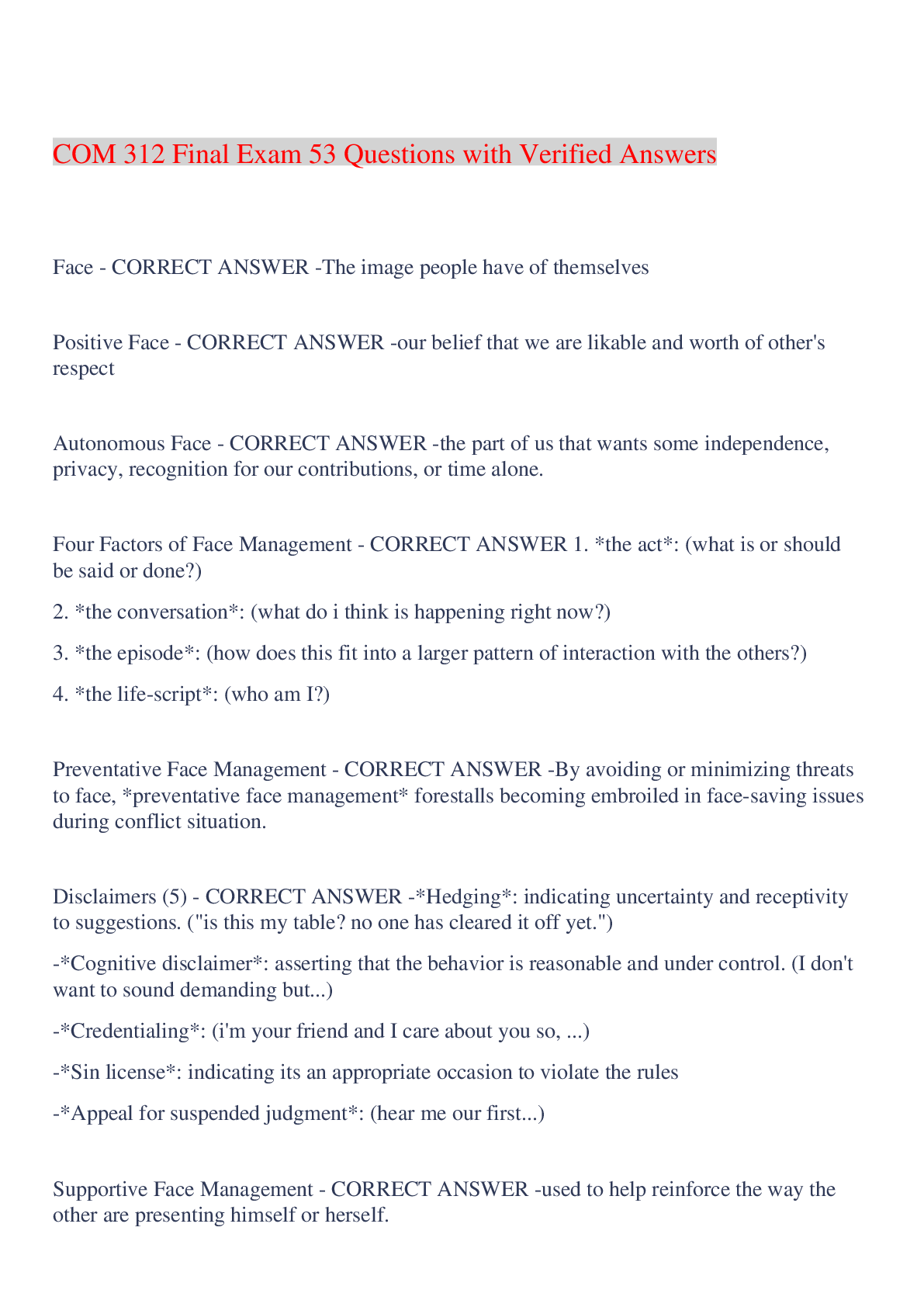
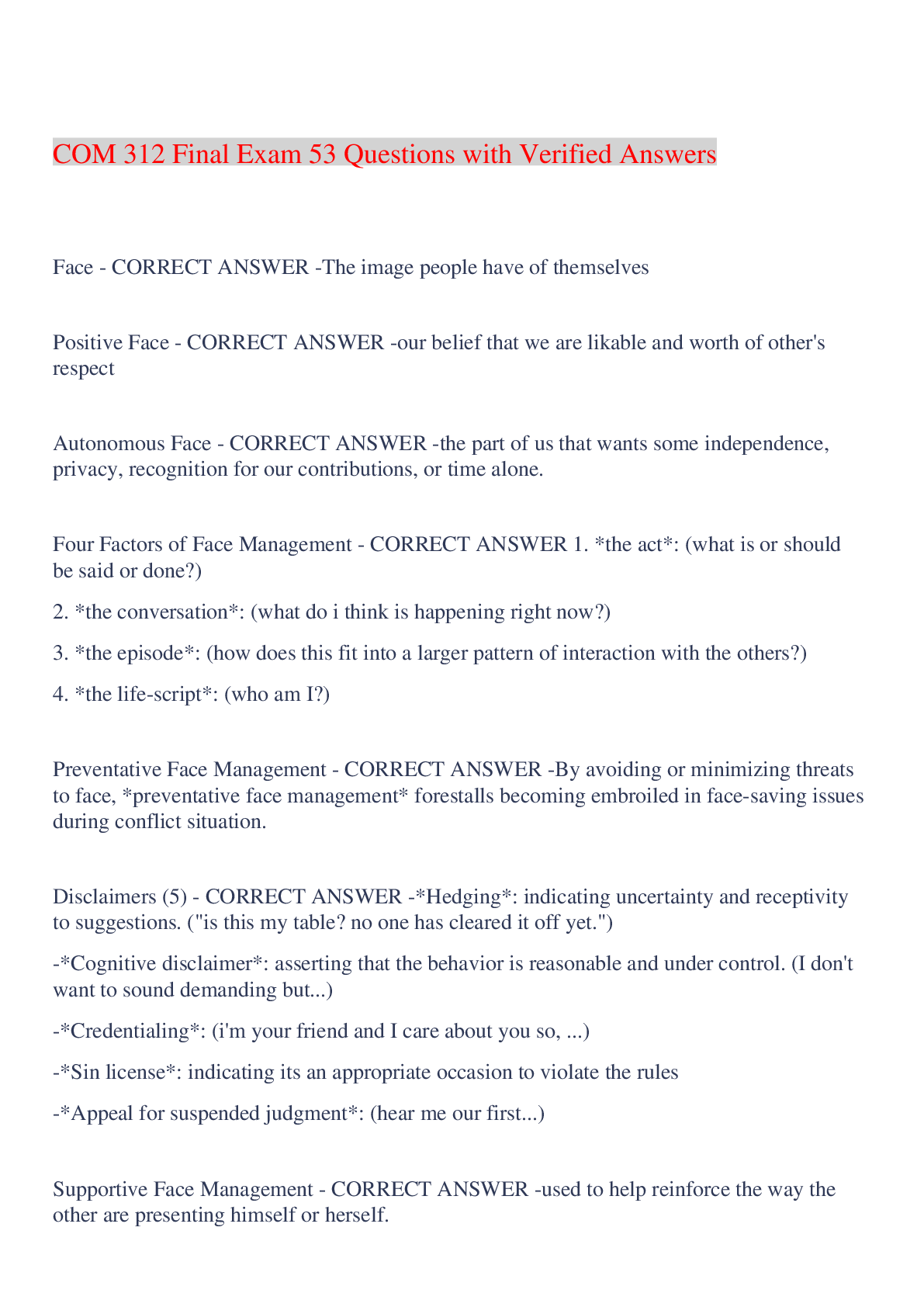
COM 312 Final Exam 53 Questions with Verified Answers
Face - CORRECT ANSWER -The image people have of themselves
Positive Face - CORRECT ANSWER -our belief that we are likable and worth of other's respect
Autonomous Face - CORRECT ANSWER -the part of us that wants some independence, privacy, recognition for our contributions, or time alone.
Four Factors of Face Management - CORRECT ANSWER 1. *the act*: (what is or should be said or done?)
2. *the conversation*: (what do i think is happening right now?)
3. *the episode*: (how does this fit into a larger pattern of interaction with the others?)
4. *the life-script*: (who am I?)
Preventative Face Management - CORRECT ANSWER -By avoiding or minimizing threats to face, *preventative face management* forestalls becoming embroiled in face-saving issues during conflict situation.
Disclaimers (5) - CORRECT ANSWER -*Hedging*: indicating uncertainty and receptivity to suggestions. ("is this my table? no one has cleared it off yet.")
-*Cognitive disclaimer*: asserting that the behavior is reasonable and under control. (I don't want to sound demanding but...)
-*Credentialing*: (i'm your friend and I care about you so, ...)
-*Sin license*: indicating its an appropriate occasion to violate the rules
-*Appeal for suspended judgment*: (hear me our first...)
Supportive Face Management - CORRECT ANSWER -used to help reinforce the way the other are presenting himself or herself.
Corrective Face Management - CORRECT ANSWER -statements meant to ameliorate the effect of face-threatening messages.
Scanning - CORRECT ANSWER -the process of checking out the perceptions being created. (e.g. "are we on the same page?")
The Repair Sequence - CORRECT ANSWER -a specialized version of the conflict process where a triggering event is followed by initiation, differentiation, and perhaps resolution.
Repair Sequence Steps (4) - CORRECT ANSWER 1. *Offending Situation*: the other's behavior is seen as intentionally hurtful, whether or not that person did intend it.
2. *Reproach*: request for an explanation of an offense from the one offended.
3. *Remedy*: an account, concession, or apology supplied by an offender.
4. *Acknowledgment*: evaluation of the account supplied by the one offended.
Restoration Strategies (4) (From least to most restorative) - CORRECT ANSWER 1. *Excuses*: admit that the offense occurred but deny responsibility for it. (i was drunk)
2. *Justifications*: acknowledge that an act was committed while claiming that, it hurt no one. (it's a PRANK!)
3. *Concessions*: admit the offender's guilt and offer restitution. (i will make things right; i will change my ways)
4. *Apologies*: admissions of blameworthiness and regret on the part of the offender. (forgive me)
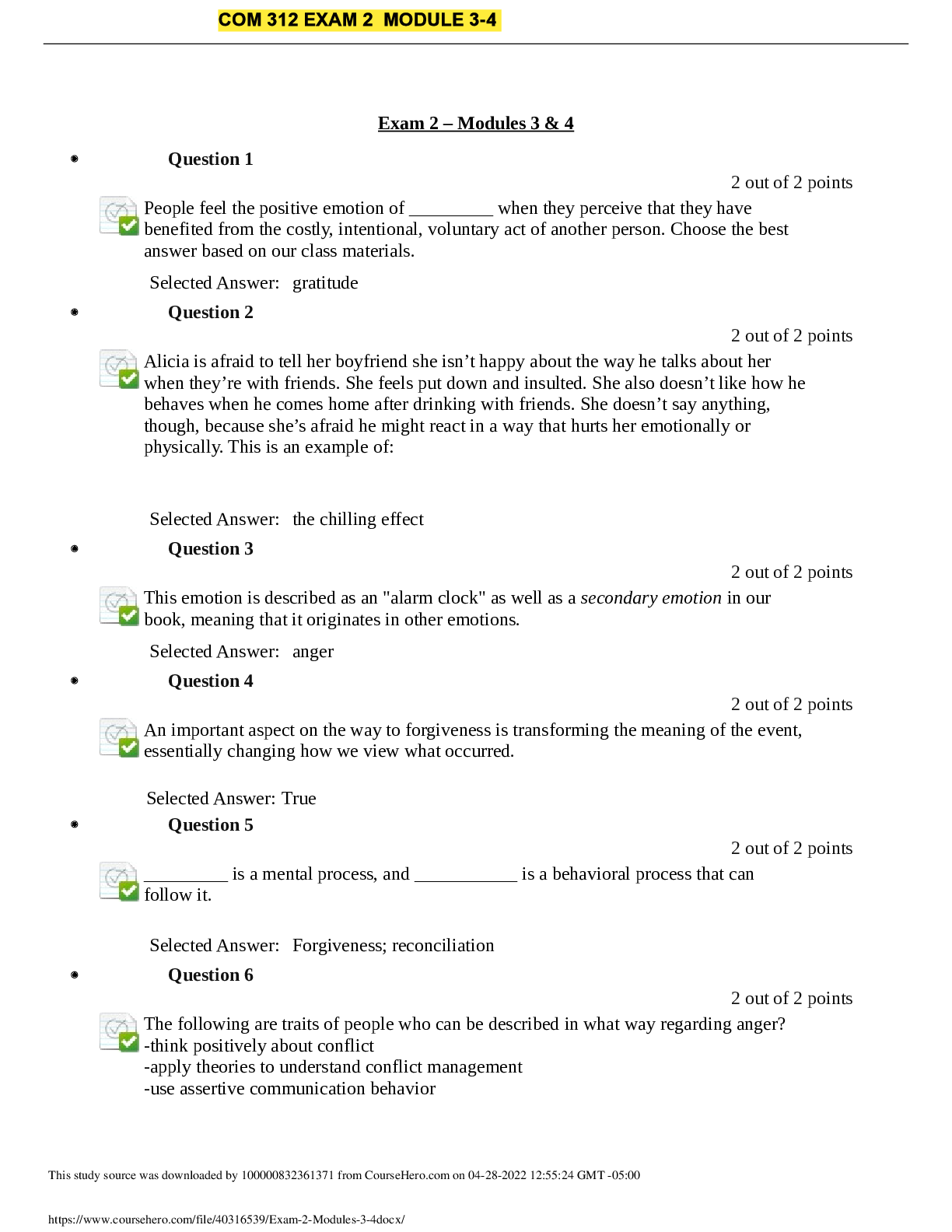
Role of adrenaline and cortisol during stress and anger. - CORRECT ANSWER -when experiencing stress we have a boost of adrenaline to handle the stress.
-Cortisol slows everything down that is non-essential (immune system) to focus on the core issues.
-amgidala is the fight or flight.
4 types of stress and how they differ from each other. - CORRECT ANSWER 1. *Eustress*: good kind of stress; short term and encourages us to take more seriously and expend more energy on important activities.
2. *Hypostress*: underload; when we feel anxious b/c we're bored or unchallenged by our situation.
3. *Hyperstress*: when too many tasks and responsibilities pile up on us and we are unable to adapt to the changes or cope w/ all that is happening.
4. *Distress*: when we lose control over a situation and the source of stress is unclear to the individual.
The Activities Approach to Managing Stress - CORRECT ANSWER -eating sensibly, getting enough sleep, living a balanced life, spend time w/ good friends, saying "no" to requests you can't really take on, all to manage the amount of stress in your life.
ABC Model of Stress - CORRECT ANSWER -A: Activating event or the stressor (e.g. anticipated life events)
-B: beliefs or our relevant thoughts
-C: consequences or effects and reaction to the stressor.
Self-Talk - CORRECT ANSWER -verbalizing, either out loud or to ourselves, inner messages.
-used to improve the way we think about other potentially stressful events.
Develop a Playful Spirit - CORRECT ANSWER -a way to manage stress
-by changing our attitude on life and developing a playful spirit, it enables us to lighten up.
How Anger Differs from irritation or Annoyance. - CORRECT ANSWER -we experience irritation or annoyance when someone or something frustrates our desires, but *anger* carries with the desire to get even or seek revenge.
Anger-ins - CORRECT ANSWER -they do not express their anger to the person who has upset them.
-they are avoiders and accommodators or people suffering form the chilling effect cycle.
Ventilation Approach - CORRECT ANSWER -used by anger-ins
-people who vent their anger to others, like a friend, parent, colleague, rather than the offensive person.
Anger-outs - CORRECT ANSWER -people who are quick to express their anger, vocally or physically, to the person who upset them.
-often aggressive
Anger Controllers - CORRECT ANSWER -assertive individuals who don't let their feelings control how they respond in conflict situations.
-practice S-TLC (Stop, Think, Listen, and Communicate)
Relational Transgressions - CORRECT ANSWER -extremely problematic situations in which core rules of a relationship are violated, leaving high emotional residues.
Emotional Residues - CORRECT ANSWER -people experience lingering emotional responses to the memory of the transgression. (e.g. a romantic partner lied to you; experiencing shock, disbelief, hurt, anger, etc.)
Forgiveness - CORRECT ANSWER -is a cognitive process that consists of letting go of feelings of revenge and desires to retaliate.
Unforgiveness - CORRECT ANSWER -is a cognitive process in which one doesn't let go of feelings of revenge and maintains a desire to retaliate.
Revenge - CORRECT ANSWER -is a behavior based on the notion of "an eye for an eye".
-characterizes the cycle of violence in which each aggressive act is followed by more aggressive behavior.
Reconciliation - CORRECT ANSWER -a behavioral process in which we take actions to restore a relationship or create a new one following forgiveness.
Physical Health Benefits of Forgiveness. - CORRECT ANSWER -sleeping better
-those who forgive are in better health than those who don't.
-people who express trait-like forgiveness = lower blood pressure.
Equifinality - CORRECT ANSWER -part of cooperative negotiation
-the parties' goals are mutual gain, but they are open to a number of ways to achieve a win-win solution.
Stages of Negotiation - CORRECT ANSWER 1. Recognizing the opportunity to negotiate
2. Preparation
3. Information sharing
3. Bargaining
4. Coming to terms/Finalizing the agreement
BATNA (Best Alternative to a Negotiated Agreement) - CORRECT ANSWER -your status quo.
-It's your best option outside of the negotiation. You have something else to fall back on if the negotiation doesn't go your way.
-Can be good or bad.
-can change while in the negotiation.
Characteristics of Competitive Negotiators - CORRECT ANSWER -an exchange in which one starts high, concedes slowly, exaggerates the value of one's concessions, conceals info, argues forcefully, and out waits the other.
-views collaboration as persuasion attempts.
-WIN-LOSE
-Little to no trust
Brainstorming - CORRECT ANSWER -a process that requires you, the other party, and any one else you can involve in the process to list all possible solutions, irrespective of their initial feasibility.
Different forms of Alternative Dispute Resolution (ADR) (5) - CORRECT ANSWER 1. *Arbitration*: a neutral 3rd party considers both sides and makes a decision. No appeal.
2. *Adjudication*: neutral judge and jury in the legal system hear attorneys who prosecute or defend people. may appeal later.
3. *Ombudsperson*: one who cuts through the red tape on behalf of individuals who feel abused by the larger system (gov. agencies) in which they work, study, or seek support.
4. *Conciliation*: neutral 3rd party practices "shuttle diplomacy" by traveling back and forth b/t conflicting parties who are unable to meet.
5. *Mediation*: neutral 3rd party facilitates comm. b/t conflicting parties so they may work out their own mutually acceptable agreement.
How much control do the conflicting parties have in the different forms of ADR? - CORRECT ANSWER 1. Arbitration: None; no appeals
2. Adjudication: Some; can make an appeal
3. Ombudsperson: none?
4. Conciliation: ALL
5. Mediation: ALL; they get to decide on a mutually agreeable solution.
Advantages of Mediation (3) - CORRECT ANSWER 1. restores comm. and helps normalize relations
2. allows for full participation by conflicting parties
3. has a high success rate of at least 80%.
Types of conflicts or disputes you can take to mediation. - CORRECT ANSWER -noisy neighbor, sexual and racial harassment, minor assault, breach of contract, landlord-tenant and buyer-seller disputes, small claims, bad checks, trespassing, and a variety of interpersonal issues; gossip and rumors, misunderstandings, friendship issues, and post-breakup disputes.
The role mediators have in decision making process. - CORRECT ANSWER -None, the decision is made by the conflicting parties.
-mediators are there to facilitate communication and collaboration and have to deal w/ whatever decision the two parties come to.
Stages of Mediation (6) - CORRECT ANSWER 1. *Intake*: preliminary phase in which the parties seek help from a third person who decides to intervene.
2. *Opening Statement*: explaining the purpose and process of mediation, including the mediator's role as facilitator of comm. and lays out rules that structure the mediation.
3. *Conflicting Parties' Views of the Dispute*: discuss each parties view of the problem.
4. *Common Ground*: consists of attitudes, values, behaviors, expectations, and goals that the parties share and can be used as a basis for an agreement.
5. *Final Agreement*: Making a mutually satisfying agreement.
6. *Ending the Mediation*: signing a written copy of the agreement and set a time in the future to meet back up and revisit the topic to see if the solution worked.
Paternity Leave in the USA - CORRECT ANSWER -in US there is the least amount of paid parental leave than any country.
Types of Workplace Conflict. - CORRECT ANSWER ...
Instrumental/Task Conflcit - CORRECT ANSWER -occurs when there is disagreement b/t supervisors and subordinates or among members of a team over how to get a job done - the instrumental goals.
Relationship Conflict - CORRECT ANSWER -occurs when workers experience w/ one another issues of power, trust, supportiveness, competition, and differences over the rules that govern various types of workplace relationships.
Identity Conflict - CORRECT ANSWER -occurs when others treat a person contrary to the way that person sees himself or herself.
Process Conflict - CORRECT ANSWER -has to do with disagreements over the management style that is typical of a particular organization.
Diversity-Based Conflict - CORRECT ANSWER -when people w/ different heritages find that these differences clash.
Tuckman's Group Development Model - CORRECT ANSWER -*Forming*: unfamiliarity w/ people who are in the work group, and what they bring to it creates some conflicts over differing expectations.
-*Storming*: people begin to feel some identification w/ the group but don't really feel a sense of unity around its purpose.
-*Norming*: fall into regular patterns of behaviors when solving conflict, clarify goals.
-*Performing*: conflict serves to focus individuals on reaching consensus on expectations regarding problem-solving behaviors and accomplishing instrumental goals. Team works together great.
Features that must be present for instance to be considered workplace bullying. (4) - CORRECT ANSWER -intensity
-repetition
-duration
-power disparity
Politeness Strategies - CORRECT ANSWER - *Bald on Record*: Blunt (Least Polite)
-*Positive Face*: reinforce positive views
-*Negative Face*: "not telling you how to live your life"
-*Off the Record*: indirect
-*Don't Say Anything*: foregoing (Most Polite)
Ted Talk on Work/Life Balances - CORRECT ANSWER -through small minor changes to your work life balance you achieve a better life.
Ted Talk on Stress - CORRECT ANSWER -Stress releases oxitocin and it makes us seek out others
-only when stressed was viewed negatively, did it have a correlation to early death.
[Show More]