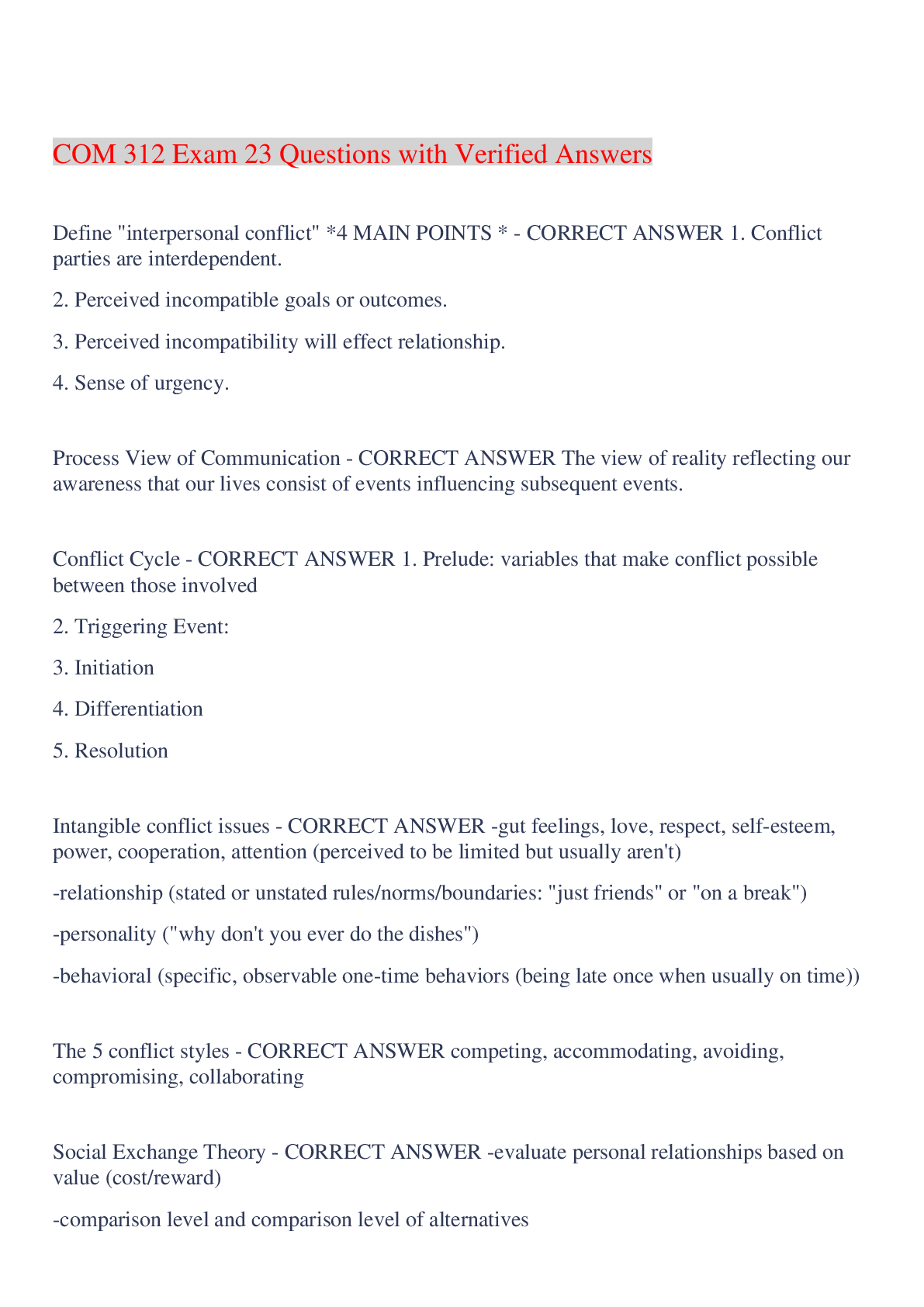
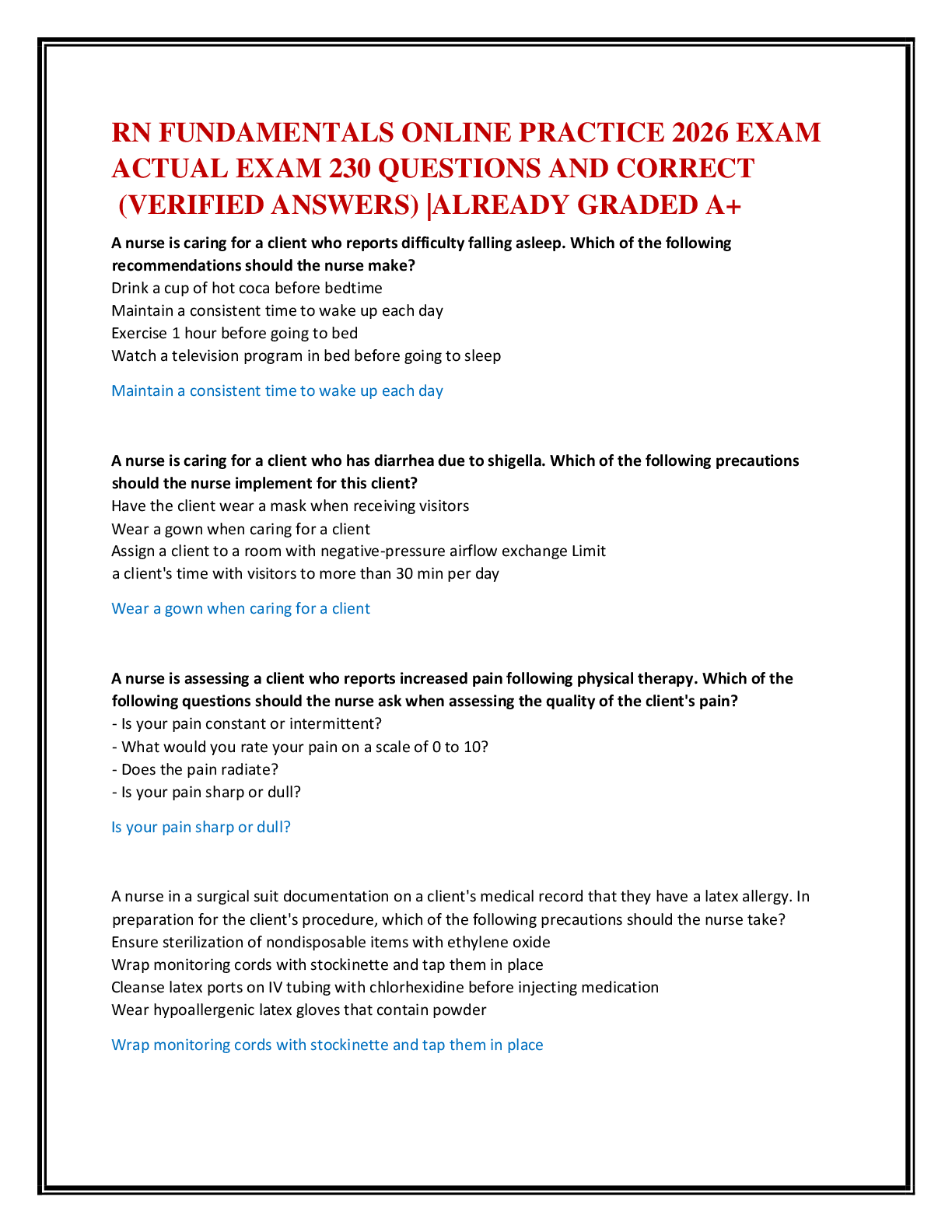
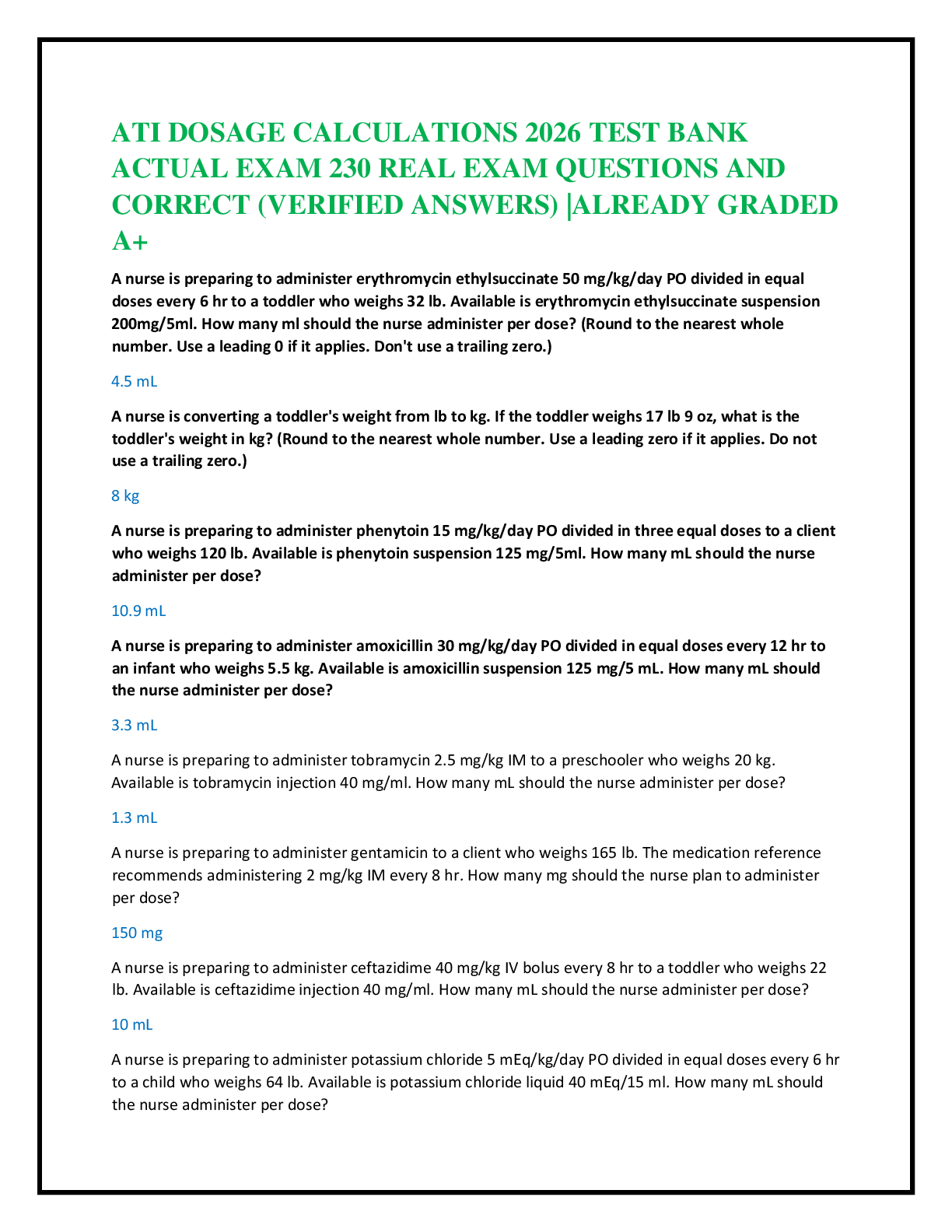
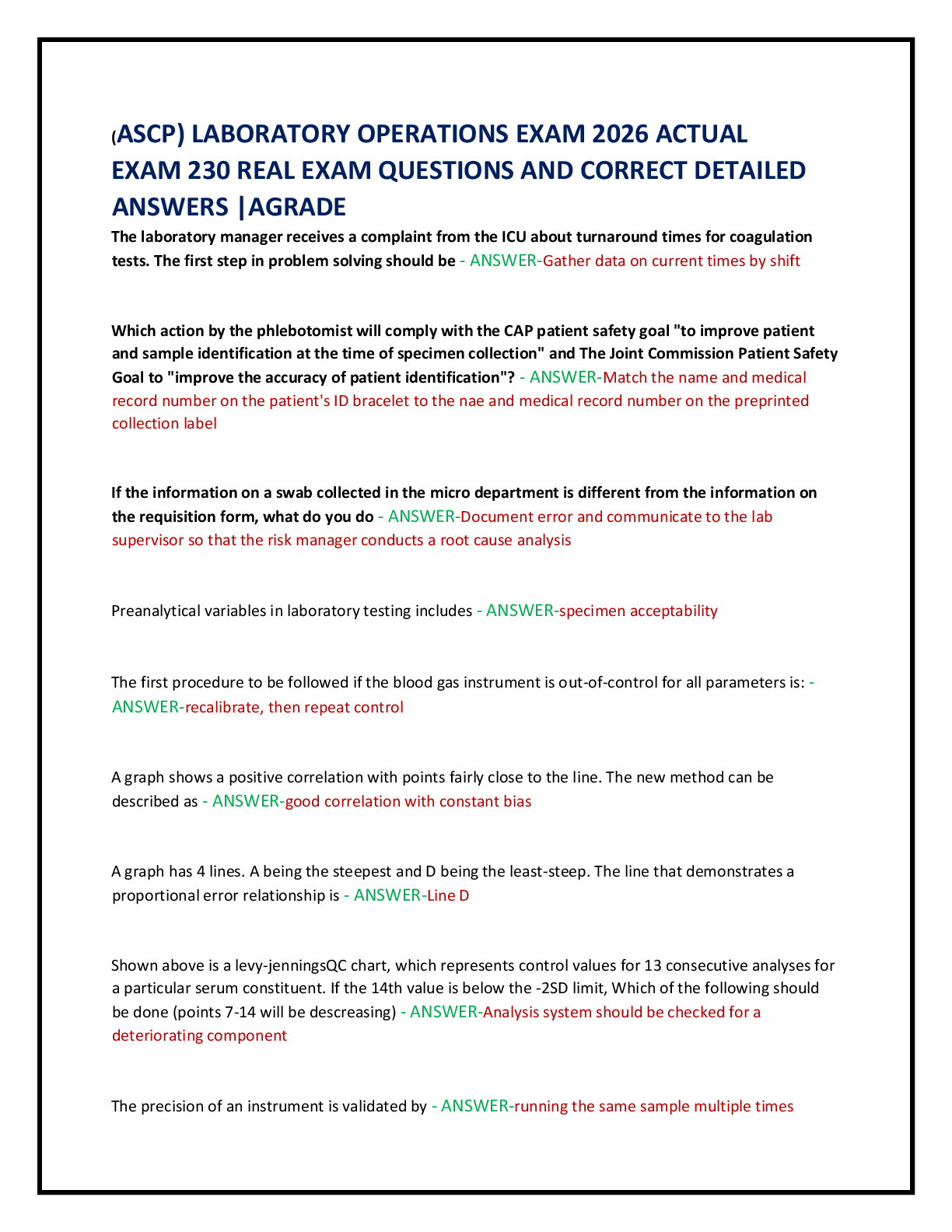
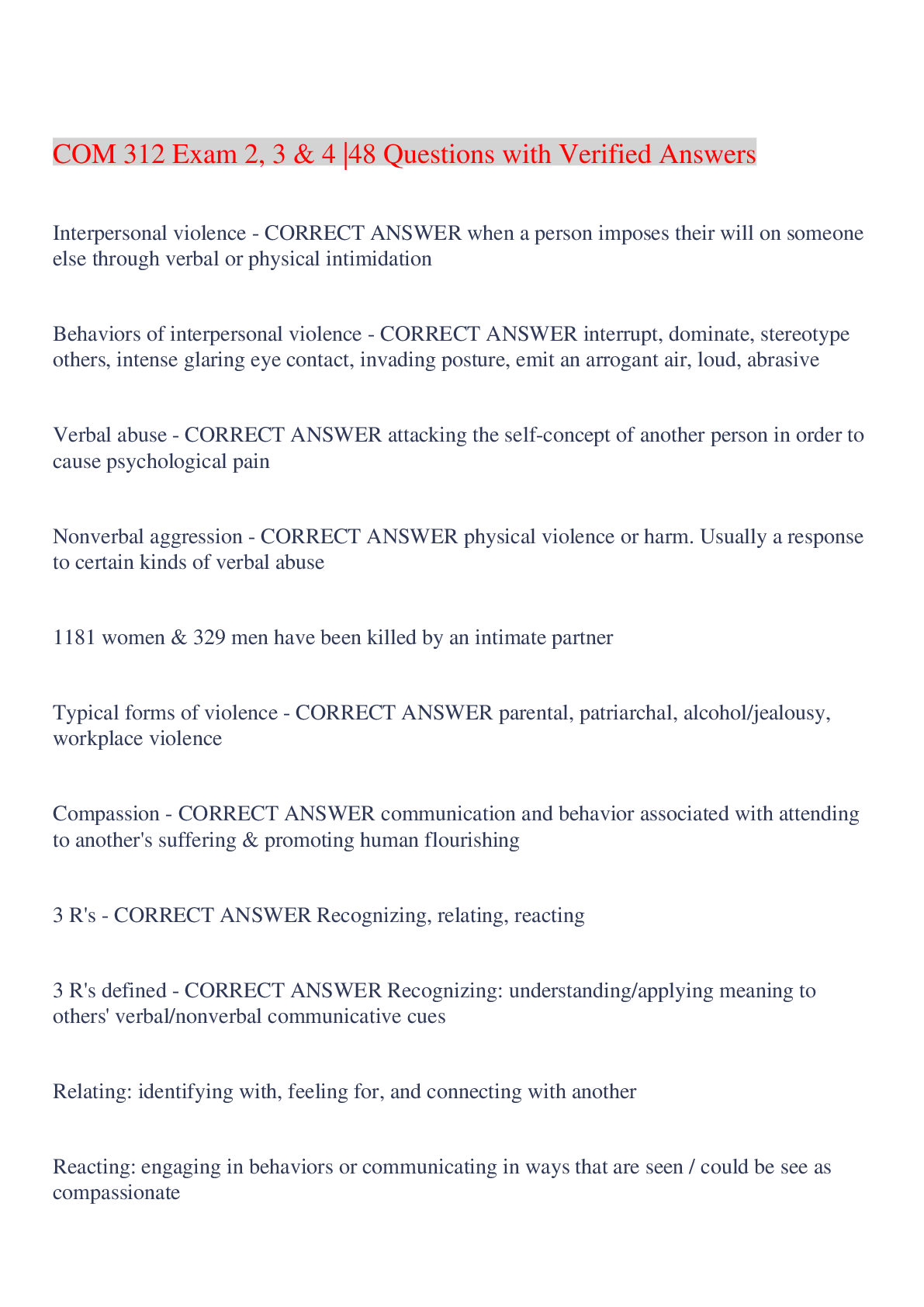
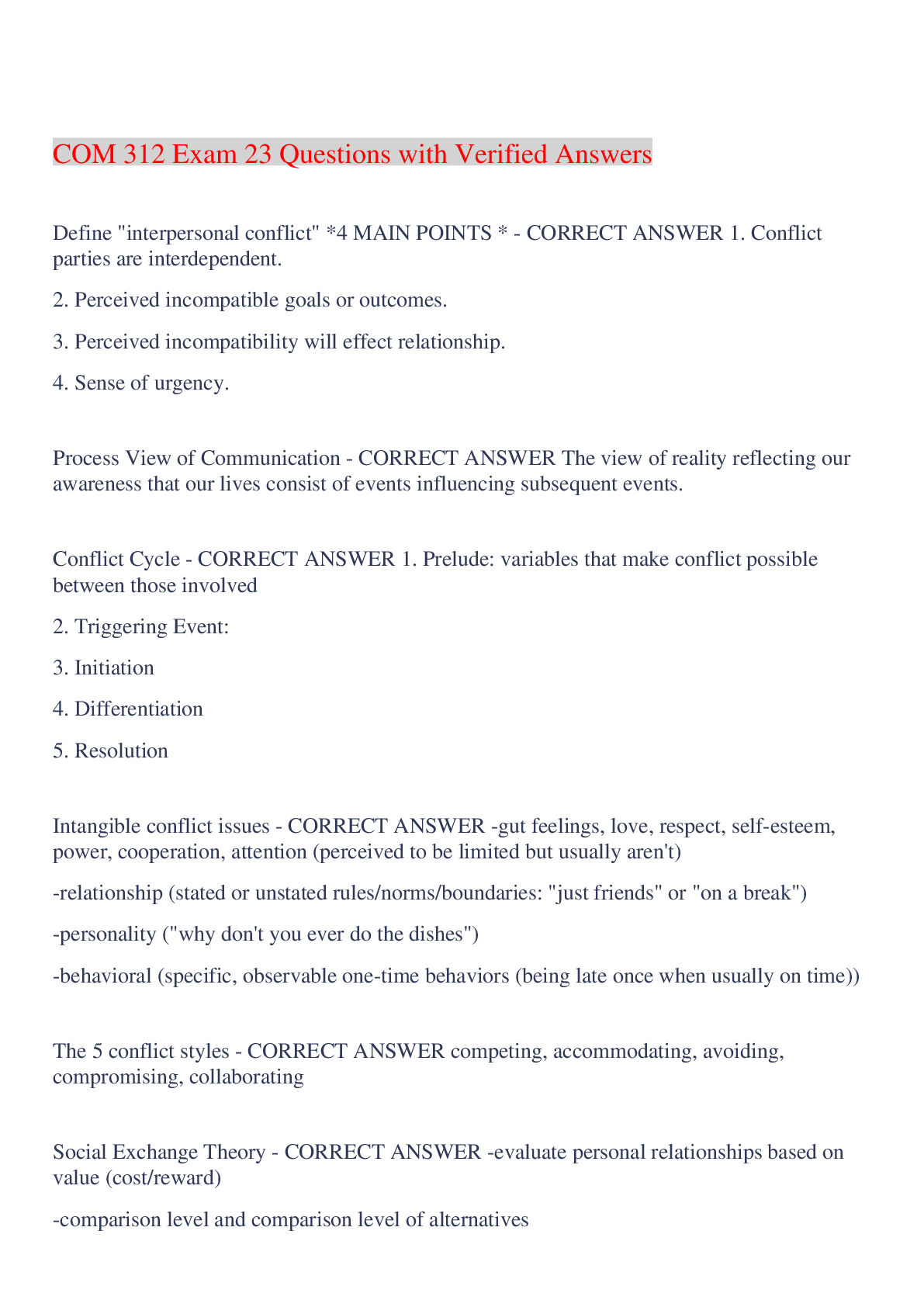
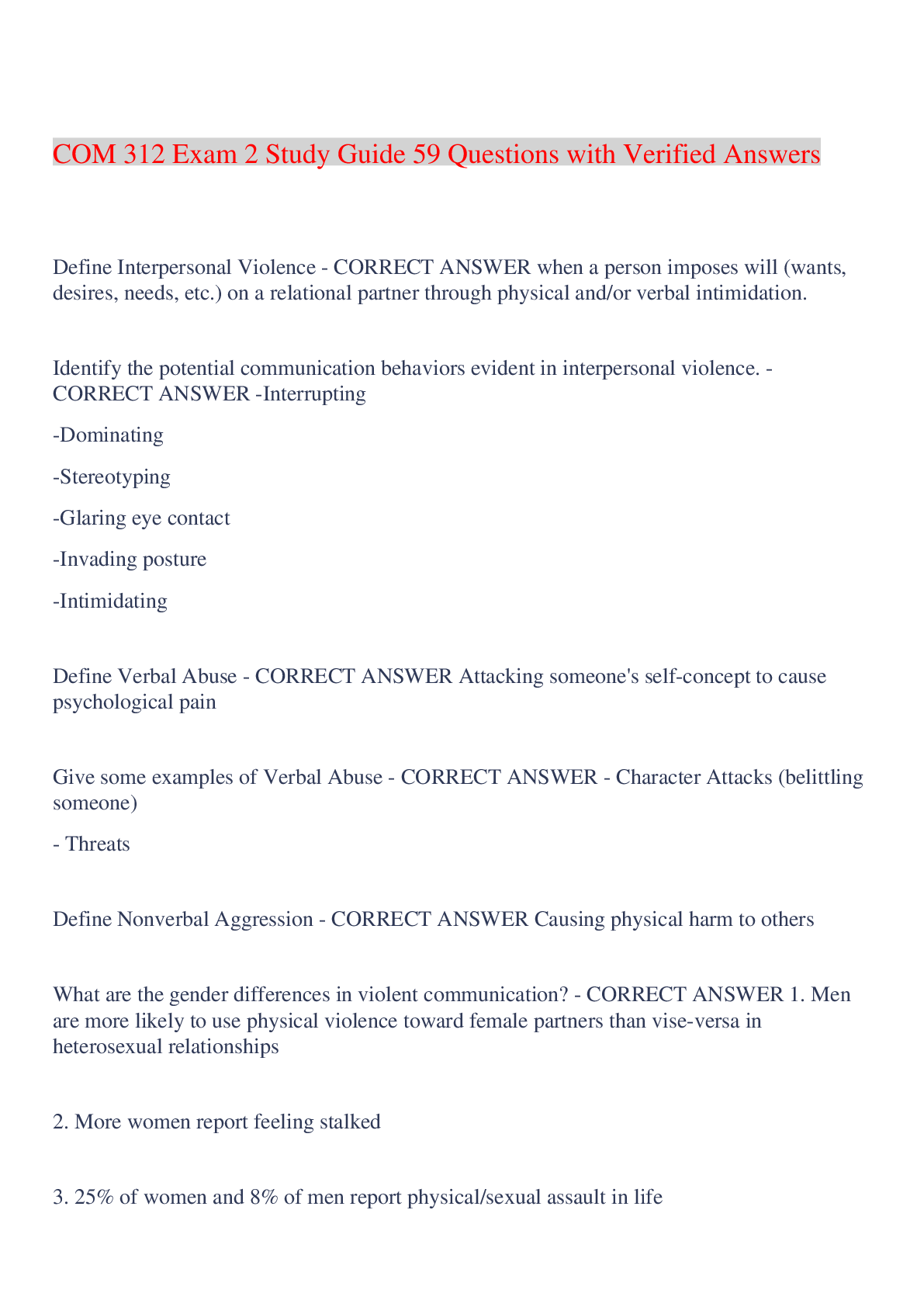
COM 312 Exam 23 Questions with Verified Answers Define "interpersonal conflict" *4 MAIN POINTS * - CORRECT ANSWER 1. Conflict parties are interdependent. 2. Perceived incompatible goals or outcom ... es. 3. Perceived incompatibility will effect relationship. 4. Sense of urgency. Process View of Communication - CORRECT ANSWER The view of reality reflecting our awareness that our lives consist of events influencing subsequent events. Conflict Cycle - CORRECT ANSWER 1. Prelude: variables that make conflict possible between those involved 2. Triggering Event: 3. Initiation 4. Differentiation 5. Resolution Intangible conflict issues - CORRECT ANSWER -gut feelings, love, respect, self-esteem, power, cooperation, attention (perceived to be limited but usually aren't) -relationship (stated or unstated rules/norms/boundaries: "just friends" or "on a break") -personality ("why don't you ever do the dishes") -behavioral (specific, observable one-time behaviors (being late once when usually on time)) The 5 conflict styles - CORRECT ANSWER competing, accommodating, avoiding, compromising, collaborating Social Exchange Theory - CORRECT ANSWER -evaluate personal relationships based on value (cost/reward) -comparison level and comparison level of alternatives Attribution Theory - CORRECT ANSWER -actions we take or what we think about a person based on their actions or behaviors -internal: I played really bad -external: they got lucky (Attributed to outside forces) (look up) Uncertainty Theory - CORRECT ANSWER False conflict (look up) Trained Incapacities - CORRECT ANSWER -abilities and talents (positive attributes) that may limit you in a conflict -being goal oriented in a conflict you miss out on important details just to finish I-statements - CORRECT ANSWER If feel.. (feeling statement) When I.. (problematic statement) Because... (consequences) I like (goal statement) 6-Step Confrontation Process - CORRECT ANSWER -process in which parties call attention to the issues between them and express their feelings, needs and wants 1. Preparation 2. Arrange Meeting 3. Interpersonal Confrontation (actual confrontation) 4. Consider other person's point of view 5. resolve problem 6. follow up Interpersonal Violence Cycle - CORRECT ANSWER 1) Triggering Effect: for the person abused, triggers fear; for the abuser, triggers aggression. 2) Initiation of Conflict: Generally through competing and destructive messages. 3) Differentiation Phase: Escalating verbal abuse; attack-withdrawal pattern, may escalate to physical violence. 4) Resolution Phase: Conflict not resolved; issues are dropped or suppressed; conflict sometimes ended by third party. 5) Prelude to Conflict: Perceptions of past unresolved conflict and episodes of violence. Chilling Effect Cycle a lot like the conflict cycle (think of relationships) - CORRECT ANSWER 1. Prelude: one partner fears relationship ending or physical violence 2. Triggering event: fearful partner decides if conflict is worth risk/effort 3. Conflict avoided 4. Unresolved grievances decreased commitment repeats until relationship terminates 5. Conflict stops after triggering event and is never initiated 6. Passive-aggressive may be best option (seek outside help) Role of power in conflict and sharing power - CORRECT ANSWER -influences your ability to -sharing power: must be shared by the person who has more power -abandon physical power markers such as titles or awards Groupthink - CORRECT ANSWER -when one group wants consensus, cohesion -people keep ideas to themselves, they don't want to ruin the cohesiveness Abilene Paradox - CORRECT ANSWER individual doesn't go against the grain of the group for fear of being excluded/separated Reasons why women don't ask (supplementary reading) - CORRECT ANSWER -Typically accept what is given in the first place (Page 4) -Afraid of how they will come off to the employer (bossy/demanding) (Page 12) -Not a generational problem. Consistent across different generations. (Page 3) Consequences of not asking (supplementary reading) - CORRECT ANSWER -Higher salaries for people who do ask. (Page 2) -Promotions go to others, stay at positions they are overqualified for. (Page 11) -Not looking as strong/assertive to an employer. (Pages 9-10) List the 4 key elements of principled negotiation (supplementary reading) - CORRECT ANSWER 1. Separate the people from the problem 2. Focus on interests not positions 3 & 4 we don't know Separate the people from the problem (supplementary reading) - CORRECT ANSWER -We tend to tangle relationships with problems -past issues in that relationship become involved with current problem -people tend to take discussion about the problem as a personal attack -goal: to separate feelings you have towards that person from the present issue -how: discuss your perceptions, acknowledge and try to understand their emotions Focus on interests not positions (supplementary reading) - CORRECT ANSWER -Orange example: one person wants the peel, the other wants the juice -Interests motivate people Interpersonal Violence Definition - CORRECT ANSWER -when a person imposes their will on a relational partner through physical or verbal intimidation -may have emotional, mental and physical effects Identifying Interests - CORRECT ANSWER Ask why / why not "Why do you want that?" [Show More]
Last updated: 2 years ago
Preview 1 out of 4 pages
Buy this document to get the full access instantly
Instant Download Access after purchase
Buy NowInstant download
We Accept:
Can't find what you want? Try our AI powered Search
Connected school, study & course
About the document
Uploaded On
Dec 13, 2023
Number of pages
4
Written in
All
This document has been written for:
Uploaded
Dec 13, 2023
Downloads
0
Views
31
Scholarfriends.com Online Platform by Browsegrades Inc. 651N South Broad St, Middletown DE. United States.
We're available through e-mail, Twitter, Facebook, and live chat.
FAQ
Questions? Leave a message!
Copyright © Scholarfriends · High quality services·