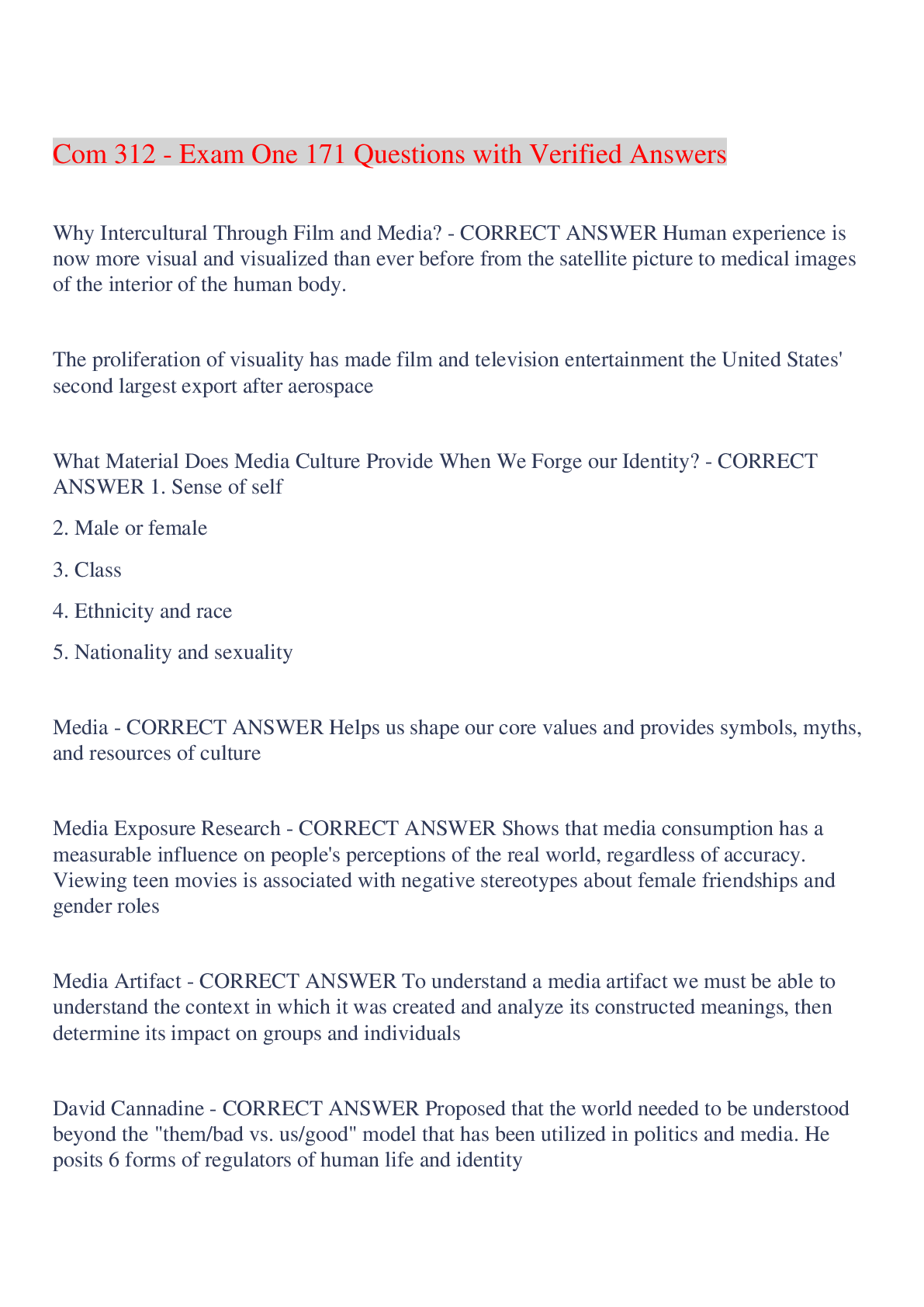
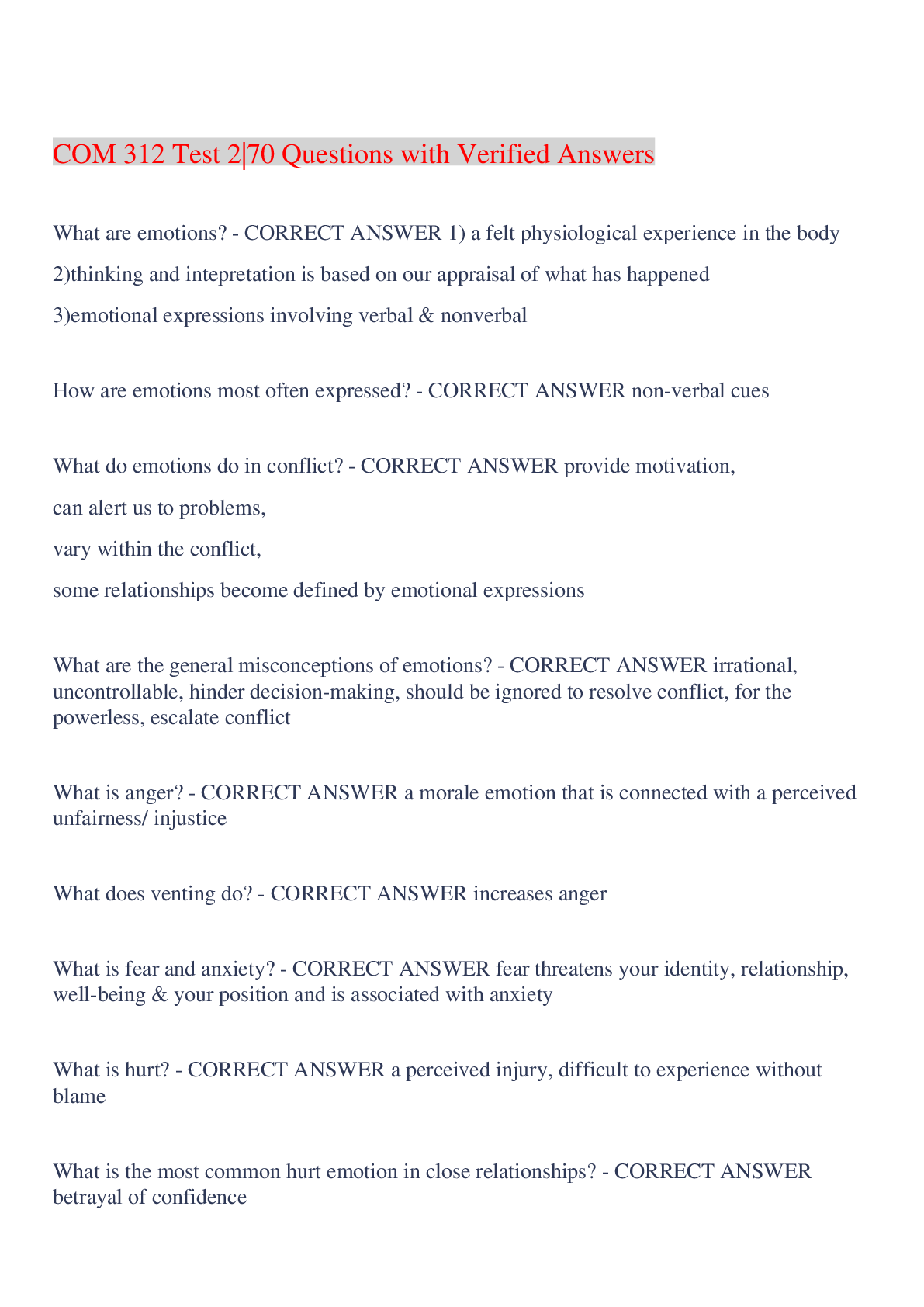
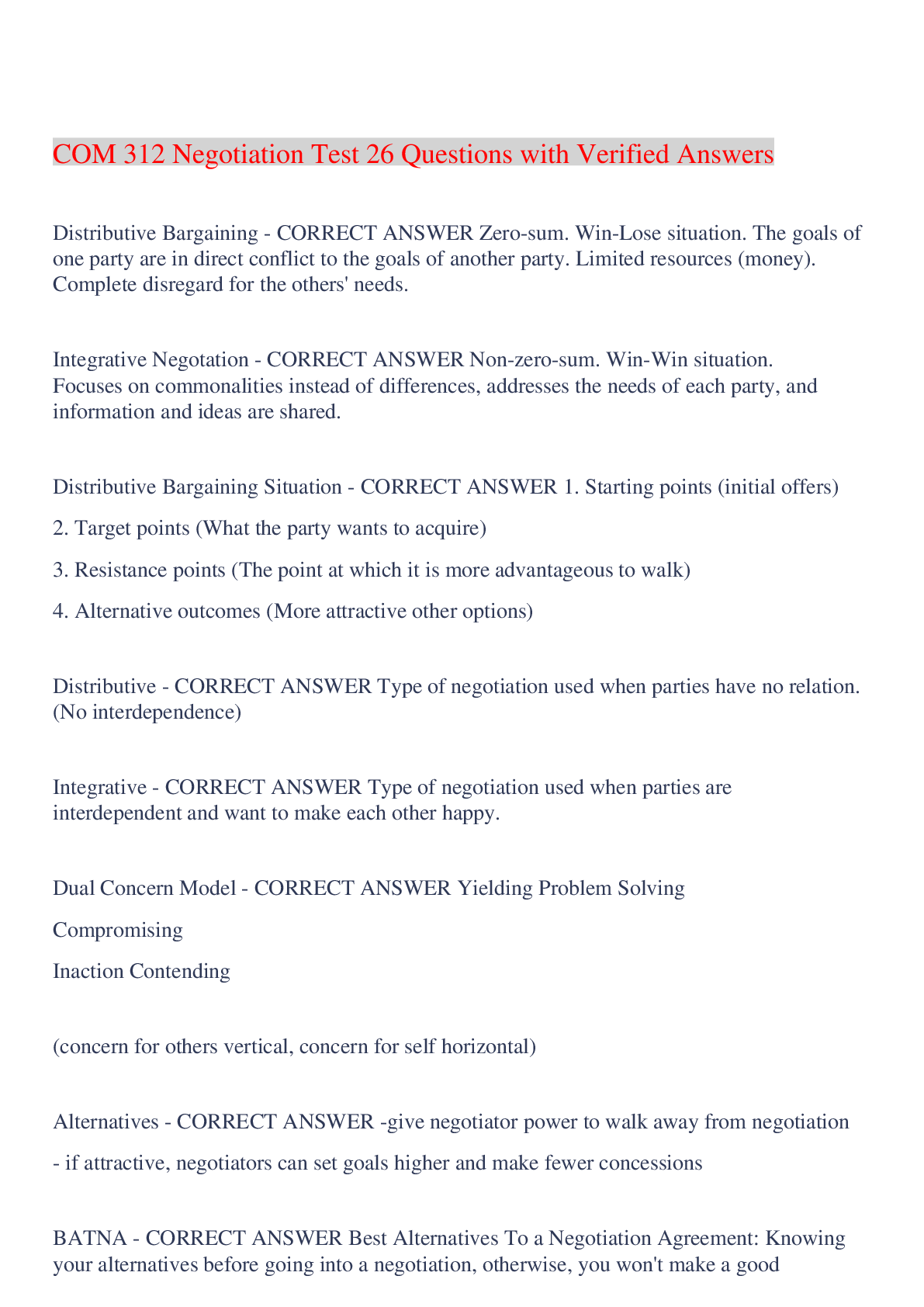
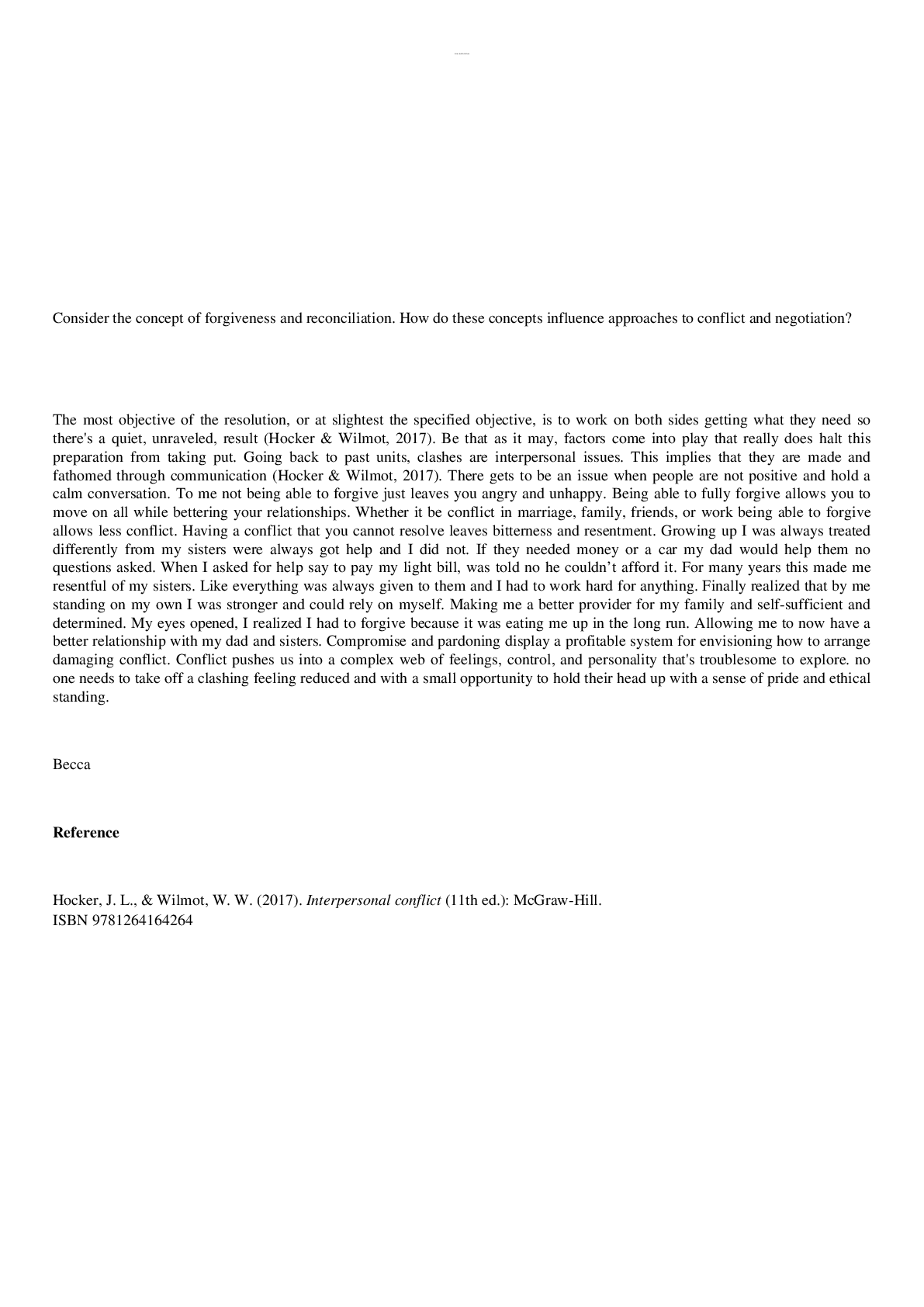
COM 312 Final Exam 58 Questions with Verified Answers What are the 4 waves of immigration? - CORRECT ANSWER The first wave 1607-1830 The second wave- 1830's-1880's The third wave- 1890's-1920'a ... The fourth wave- 1965-today First Wave of Immigration - CORRECT ANSWER -1607-1830 -Protestants from Northwestern europe Also Spanish, French, and Native American -Brought Indentured servants and African Slaves Second Wave of Immigration - CORRECT ANSWER -1830's-1880's -Irish Catholics Germans Chinese -Frightened by the Germans they had their own theaters, newspapers, libraries, schools, curls, taverns, and places of worship -Chinese Exclusion Act of 1882 stopped all chinese immigration they couldn't be US citizens until 1943 Third Wave of Immigration - CORRECT ANSWER -1890's-1920's -Italy Russia Poland Hungary -Religious Differences: Catholic & Jewish What was the Great Black Migration of 1915-1920 - CORRECT ANSWER Transformed rural farming blacks into urban factory workers, forced into their own ethnic neighborhoods, Race riots, great white flight created todays suburbs, Lynching in America - CORRECT ANSWER Blacks were getting to uppity, to protect women (fear of sexual assault), From 1882-1968 there were 4,743 reported lynchings mostly public Immigration Quota Act - CORRECT ANSWER 1921 & 29 Capped immigration to 150,000 Set quotas for southern and eastern europeans Allowed All northern europe Completely ban all Asians/chinese What groups are coming to the USA in the last 10 years? - CORRECT ANSWER Mexico, China, India, Philippines, Cuba, DR, Vietnam, Iraq, El Salvador, Pakistan, Jamaica What are the 8 cultural dimensions - CORRECT ANSWER 1. Perception of Self 2. Power Distance 3. Time Orientation 4. Activity Orientation 5. Social Mobility 6. Relationship with Material 7. Moral Human Nature Orientation 8. Relationship with Nature Perception of self - CORRECT ANSWER Individual Cultures: taught that individual needs and desires take precedence over what is best for the group/culture Collective Cultures: taught group/cultural needs take precedence over the desires of individuals (East Asia and West USA & Europe) Power Distance - CORRECT ANSWER Vertical Power Cultures: encourage respect for rank and status Horizontal Power Cultures: Taught to challenge rank and to question the status of the powerful Time Orientation - CORRECT ANSWER Past: grounded in tradition (vertical cultures) Present: living for the moment Future: Eye on the future Activity Orientation - CORRECT ANSWER Doing (External): stressing the external world of tasks & accomplishments (focus on the hard material world) Being and Becoming (Internal): Stressing the internal world of thought, spirituality, & relationships (focus on the soft human) Social Mobility - CORRECT ANSWER Socially Stagnant Cultures: Limited access to power and improvement (Always vertical cultures: people in power stay in power) Socially Dynamic Cultures: Stress equal access to power & improvement for all (Always horizontal cultures: Power can always be lost or gained) Relationship with Material - CORRECT ANSWER Materialistic Cultures: Love the external world of things (Often doing cultures with their external focus) Non-Materialistic Cultures: Emphasis on the Internal world of relationships and the spiritual Moral Human Nature Orientation - CORRECT ANSWER Good: have you been taught that humans naturally do good (Doing good comes easy without thinking or struggle) Evil: Have you been taught that humans naturally gravitate towards evil? (Being bad comes easy, without thinking or struggle) Relationships With Nature - CORRECT ANSWER 1) Humans dominate nature (Often doing & materialistic cultures with their focus on things and production) 2) Humans are inter-connected with nature 3) Nature dominates humans What do the cultural dimensions help you do? - CORRECT ANSWER Know yourself better Know other cultures better Reaffirm the things you like and change the things that will improve life What are the 4 rites of passage? - CORRECT ANSWER -Coming of Age -Marriage -Death What function do they play in societies? - CORRECT ANSWER What is their place in our modern world? - CORRECT ANSWER What are the 10 coming of age rituals? - CORRECT ANSWER Binary Thinking - CORRECT ANSWER -Humans divide their world into 2 groups -Located at the 2 extremes -Within seconds you start dividing/labeling everyone into binary categories Implicit Personality Theory - CORRECT ANSWER -Search for one big trait to guide binary categorization -Brain judges a book by its cover so it seems less diverse -Positive (halo) Negative (devil) Fundamental Attribution Error - CORRECT ANSWER -We all give ourselves the benefit of the doubt -Our attributes favor us -Attributions of others always cheat them Out-group Homogeneity Effect - CORRECT ANSWER -Human brain quickly categorizes and assigns everything into a group -We belong to in-groups -Others belong to out groups Expectation Bias - CORRECT ANSWER -These expectations distort how we interpret the objective world -The white and black kid video of what they are doing right or wrong Confirmation Bias - CORRECT ANSWER -Most people past age 18 will never change their foundational beliefs Key aspects of Hinduism - CORRECT ANSWER Eustress - CORRECT ANSWER short-term; encourages positive actions and attitudes Hypostress - CORRECT ANSWER under-load; anxiety from boredom or lack of challenge EX: not having a job over the summer Hyperstress - CORRECT ANSWER too many things, unable to adapt/cope Anger: - CORRECT ANSWER Alarm clock, the "righteous" emotion, response to fear and other emotions Anger Ins - CORRECT ANSWER Avoiders and accommodators, don't admit to anger, passive aggressive Anger Outs - CORRECT ANSWER Express anger to offender, vocal and physical, automatic reactions, quick to criticize/blame Anger Controllers - CORRECT ANSWER Don't let feelings control responses Responding to others' anger - CORRECT ANSWER Stay calm, listening diffuses others anger, acknowledge source Relational Transgressions - CORRECT ANSWER Problematic situation, relationship's core value violated, leave emotional residues Core Relational Rules - CORRECT ANSWER Define expectations for behavior, differs based on relationship Forgiveness - CORRECT ANSWER Cognitive process that consists of letting go of feelings of revenge and desire to retaliate Hurt - hate - healing - coming together Reconciliation - CORRECT ANSWER Behavioral process to take actions to restore a relationship after forgiveness 5 Steps to Forgiveness - CORRECT ANSWER 1. Account and Apology: main reason for not forgiving 2. Acceptance of account and apology or its absence: reframing event and offender, can't change the past 3. Forgiveness may not be communicated 4. Transforming the relationship (if desired) 5. Actions confirm forgiveness: self ful-filling prophecies Tangible Conflict Issues - CORRECT ANSWER Scarce resources, often all or nothing (money, people, space, objects) BATNA - CORRECT ANSWER Best Alternative to Negotiated Agreement Bargaining Range - CORRECT ANSWER Resistance point (MIN) - bargaining range - aspiration point (MAX) Cooperative vs. Competitive negotiation - CORRECT ANSWER Separate people from problem, seek commonalities, "we" statements Dispute - CORRECT ANSWER leads to need 3rd party because it cannot be resolved Role of Mediator - CORRECT ANSWER Neutral 3rd party, no decision - making power over outcome, facilitator of communication Skills of mediator - CORRECT ANSWER Unbiased, suspend judgment, confidentiality, "I" statements, open mind Mediation process - CORRECT ANSWER 1. Intake: why mediator is needed 2. Opening Statement: purpose, process, roles, rules 3. Hear Parties Views: check accuracy, identify key terms (CAUCUS: solo convo with each participants) 4. Common Ground: Fractionation: breaking down smaller parts of tissue and solving those first Reframing: clarify statement 5. Final Agreement: careful, specific wording, behavioral commitments Goal Differences: - CORRECT ANSWER Instrumental/task, relationship, identity, process conflict Intractable Issues - CORRECT ANSWER - Communication and negotiation are not enough - Conflicting values, beliefs, and rituals - Very difficult to resolve - Fueled by distrust and dislike - right vs wrong Worldview - CORRECT ANSWER - How we interpret the world - Socialization - Values, beliefs, and rituals Patriotism - CORRECT ANSWER pride for your country Nationalism - CORRECT ANSWER Belief your country is the best, other countries would benefit if yours ruled it The "Other" - CORRECT ANSWER - Someone who is a member of the out-group - Moral conflicts: Inability to understand other, disregard other's arguments, persuasion -> perception of other as pervert, stupid Responses to the "Other" (4) - CORRECT ANSWER o Demonizing: others should be feared and eliminated o Colonization: inferiority and contempt o Generalizing: stereotype and individual o Vaporizing: how do we do this? Privilege - CORRECT ANSWER o Power-shaping the world o Makes life earlier for some, often seen by privileged o System caters to privileged [Show More]
Last updated: 2 years ago
Preview 1 out of 8 pages
Buy this document to get the full access instantly
Instant Download Access after purchase
Buy NowInstant download
We Accept:
Can't find what you want? Try our AI powered Search
Connected school, study & course
About the document
Uploaded On
Dec 14, 2023
Number of pages
8
Written in
All
This document has been written for:
Uploaded
Dec 14, 2023
Downloads
0
Views
67
Scholarfriends.com Online Platform by Browsegrades Inc. 651N South Broad St, Middletown DE. United States.
We're available through e-mail, Twitter, Facebook, and live chat.
FAQ
Questions? Leave a message!
Copyright © Scholarfriends · High quality services·