*NURSING  >  EXAMs  >  COM 312 Negotiation Test 26 Questions with Verified Answers,100% CORRECT (All)

COM 312 Negotiation Test 26 Questions with Verified Answers,100% CORRECT

Document Content and Description Below

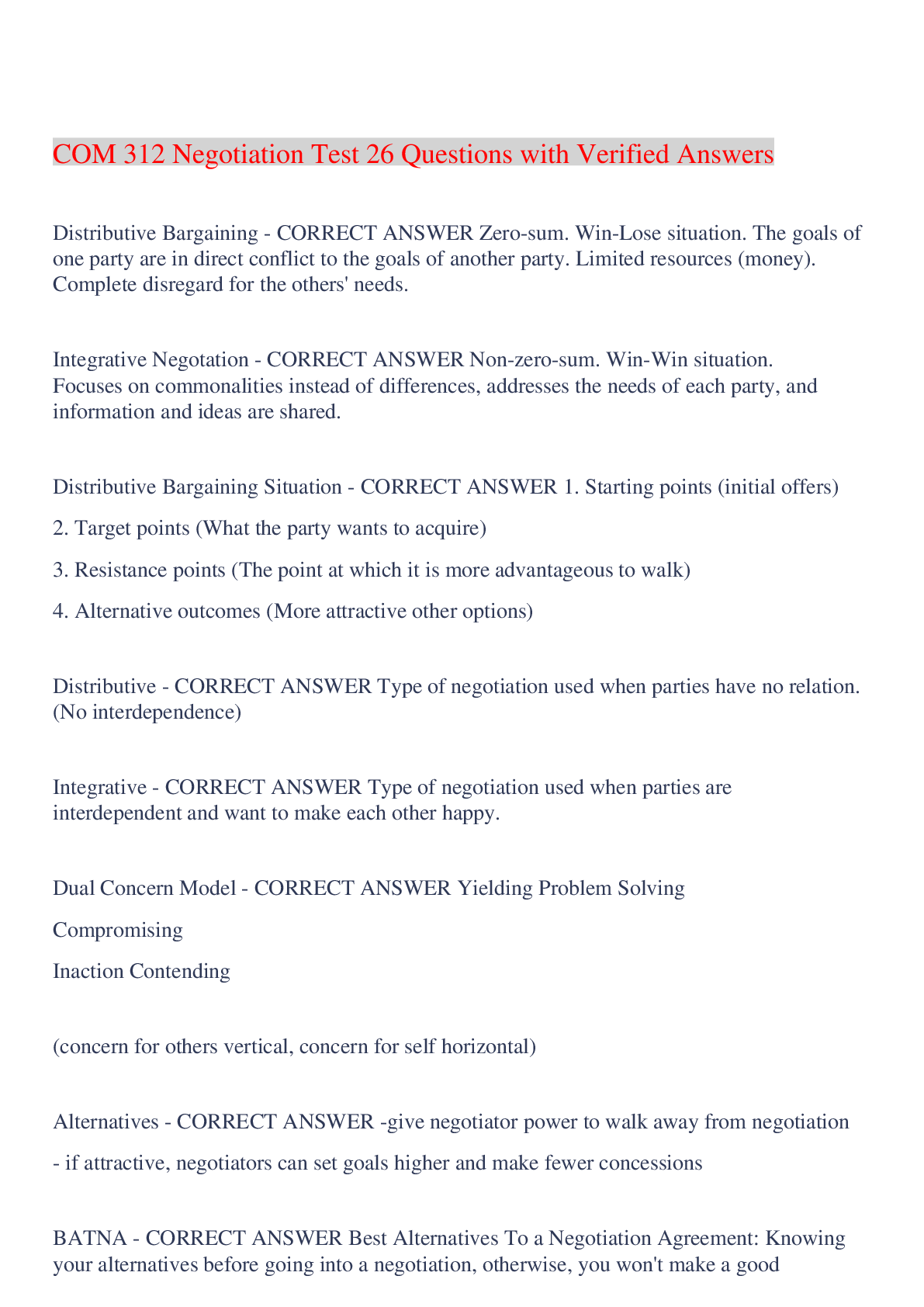
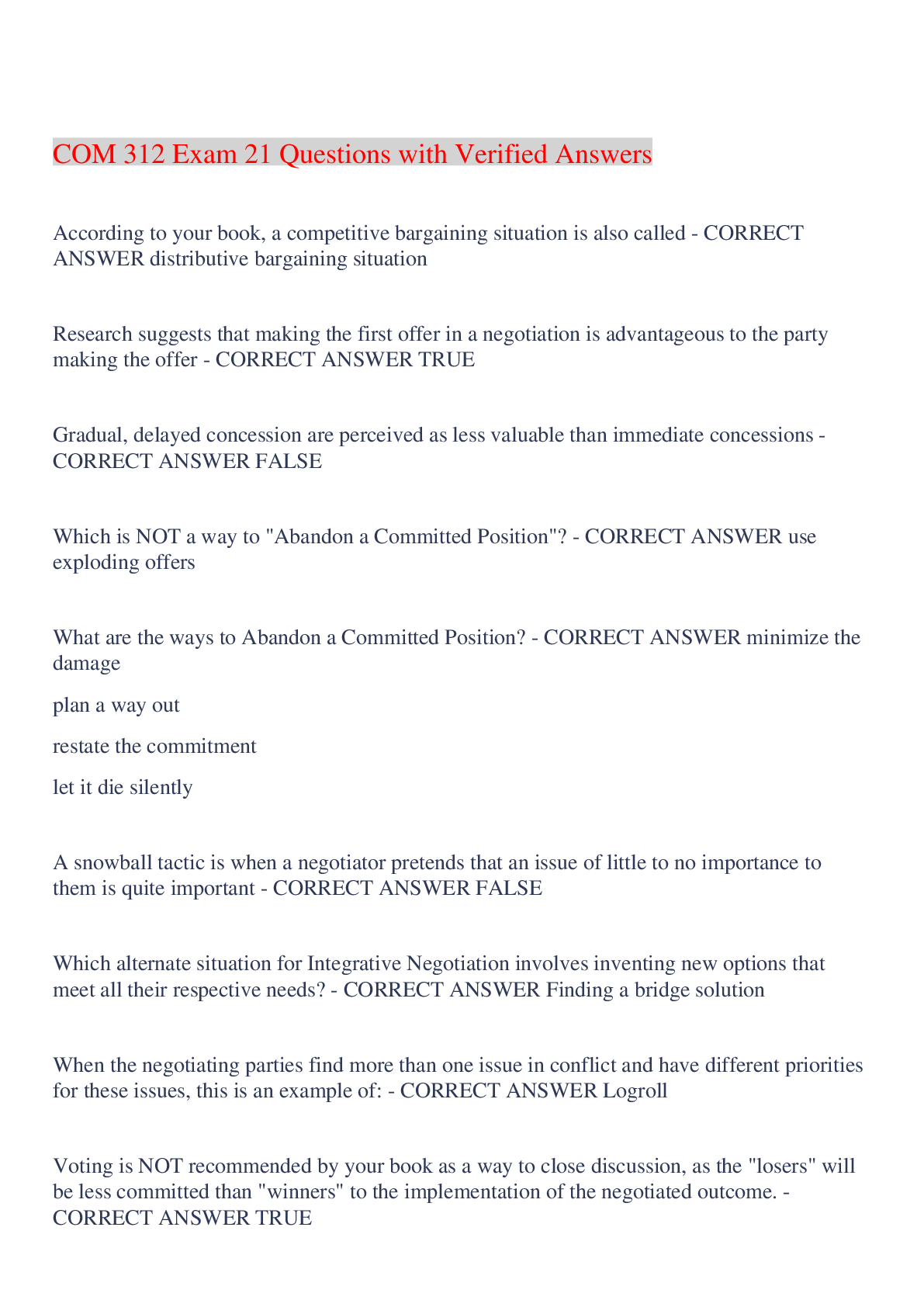
COM 312 Negotiation Test 26 Questions with Verified Answers Distributive Bargaining - CORRECT ANSWER Zero-sum. Win-Lose situation. The goals of one party are in direct conflict to the goals of ... another party. Limited resources (money). Complete disregard for the others' needs. Integrative Negotation - CORRECT ANSWER Non-zero-sum. Win-Win situation. Focuses on commonalities instead of differences, addresses the needs of each party, and information and ideas are shared. Distributive Bargaining Situation - CORRECT ANSWER 1. Starting points (initial offers) 2. Target points (What the party wants to acquire) 3. Resistance points (The point at which it is more advantageous to walk) 4. Alternative outcomes (More attractive other options) Distributive - CORRECT ANSWER Type of negotiation used when parties have no relation. (No interdependence) Integrative - CORRECT ANSWER Type of negotiation used when parties are interdependent and want to make each other happy. Dual Concern Model - CORRECT ANSWER Yielding Problem Solving Compromising Inaction Contending (concern for others vertical, concern for self horizontal) Alternatives - CORRECT ANSWER -give negotiator power to walk away from negotiation - if attractive, negotiators can set goals higher and make fewer concessions BATNA - CORRECT ANSWER Best Alternatives To a Negotiation Agreement: Knowing your alternatives before going into a negotiation, otherwise, you won't make a good argument. Dilemmas in Mutual Adjustment - CORRECT ANSWER 1. Honesty (How much of the truth do you share with the other party) 2. Trust (How much of what the other party shares with you can you believe) Characteristics of a Negotiation Situation - CORRECT ANSWER - 2 or more parties - conflict of needs and desires - negotiate because parties think they can get a better deal - expect a give and take process -parties search for an agreement -successful includes management of tangibles and resolution of intangibles Mutual Adjustment - CORRECT ANSWER -continues throughout negotiation as both parties influence each other - key causes of changes that occur -understand how people will adjust = effective Commitments - CORRECT ANSWER Making these in a distributive negotiation reduces the flexibility of the other party and keeps you looking stronger. Strategies for closing the deal - CORRECT ANSWER 1. Provide alternatives 2. Assume the close 3. Split the difference 4. Exploding offers (You have '24 hours' to respond) 5. Deal sweeteners Hardball Tactics - CORRECT ANSWER Used to pressure negotiators to do things they would not otherwise do. - good cop/bad cop - lowball/highball - bogey - the nibble - chicken - intimidation - aggressive behavior - snow job Good cop/Bad Cop - CORRECT ANSWER One negotiator being good while the other is bad Lowball/Highball - CORRECT ANSWER Starting off with an extremely high or low opening offer they know they will never achieve. This will cause the other party to reevaluate their opening offer. Bogey - CORRECT ANSWER Negotiators pretending this is a topic of little or no importance The Nibble - CORRECT ANSWER Negotiators ask for a small concession to go along with an item not previously discussed. Chicken - CORRECT ANSWER Negotiators using a large bluff of a threatened action to force the other party to "chicken out" Intimidation - CORRECT ANSWER Intimidating the other party to agree Aggressive Behavior - CORRECT ANSWER Using aggressive behavior to get the other party to agree Snow Job - CORRECT ANSWER Tactic used when negotiators overwhelm the other party with so much information, they have trouble determining what is important, causing them to become distracted. Key steps in Integrative Negotiation - CORRECT ANSWER 1. Identify the problem 2. Understand the problem fully (identify needs of both sides) 3. Generate alternative solutions 4. Evaluate and select among alternatives Characteristics of Integrative Negotiation - CORRECT ANSWER - common goal - faith in abilities - belief in validity of positions - motivation to work together - trust - communcation Common Goal - CORRECT ANSWER A goal that is being shared equally among one another. Joint Goal - CORRECT ANSWER A goal that comprises of a collective effort to combine differing individual goals together. [Show More]

Last updated: 2 years ago

Preview 1 out of 4 pages

Buy Now

Instant download

We Accept:

Payment methods accepted on Scholarfriends (We Accept)
Preview image of COM 312 Negotiation Test 26 Questions with Verified Answers,100% CORRECT document

Buy this document to get the full access instantly

Instant Download Access after purchase

Buy Now

Instant download

We Accept:

Payment methods accepted on Scholarfriends (We Accept)

Reviews( 0 )

$7.50

Buy Now

We Accept:

Payment methods accepted on Scholarfriends (We Accept)

Instant download

Can't find what you want? Try our AI powered Search

43
0

Document information


Connected school, study & course


About the document


Uploaded On

Dec 14, 2023

Number of pages

4

Written in

All

Seller


Profile illustration for securegrades
securegrades

Member since 5 years

118 Documents Sold

Reviews Received
24
3
3
0
5
Additional information

This document has been written for:

Uploaded

Dec 14, 2023

Downloads

 0

Views

 43

Recommended For You

Get more on EXAMs »

$7.50
What is Scholarfriends

Scholarfriends.com Online Platform by Browsegrades Inc. 651N South Broad St, Middletown DE. United States.

We are here to help

We're available through e-mail, Twitter, and live chat.
 FAQ
 Questions? Leave a message!


Copyright © Scholarfriends · High quality services·