Telemetry Interpretation and Dysrhythmias Exam 26 Questions with Verified Answers
ECG/EKG - CORRECT ANSWER *P Wave*
- Impulse coming from the SA node
- Normal electrical impulses 60-100 beats/min
*QRS*
- Indicat
...
Telemetry Interpretation and Dysrhythmias Exam 26 Questions with Verified Answers
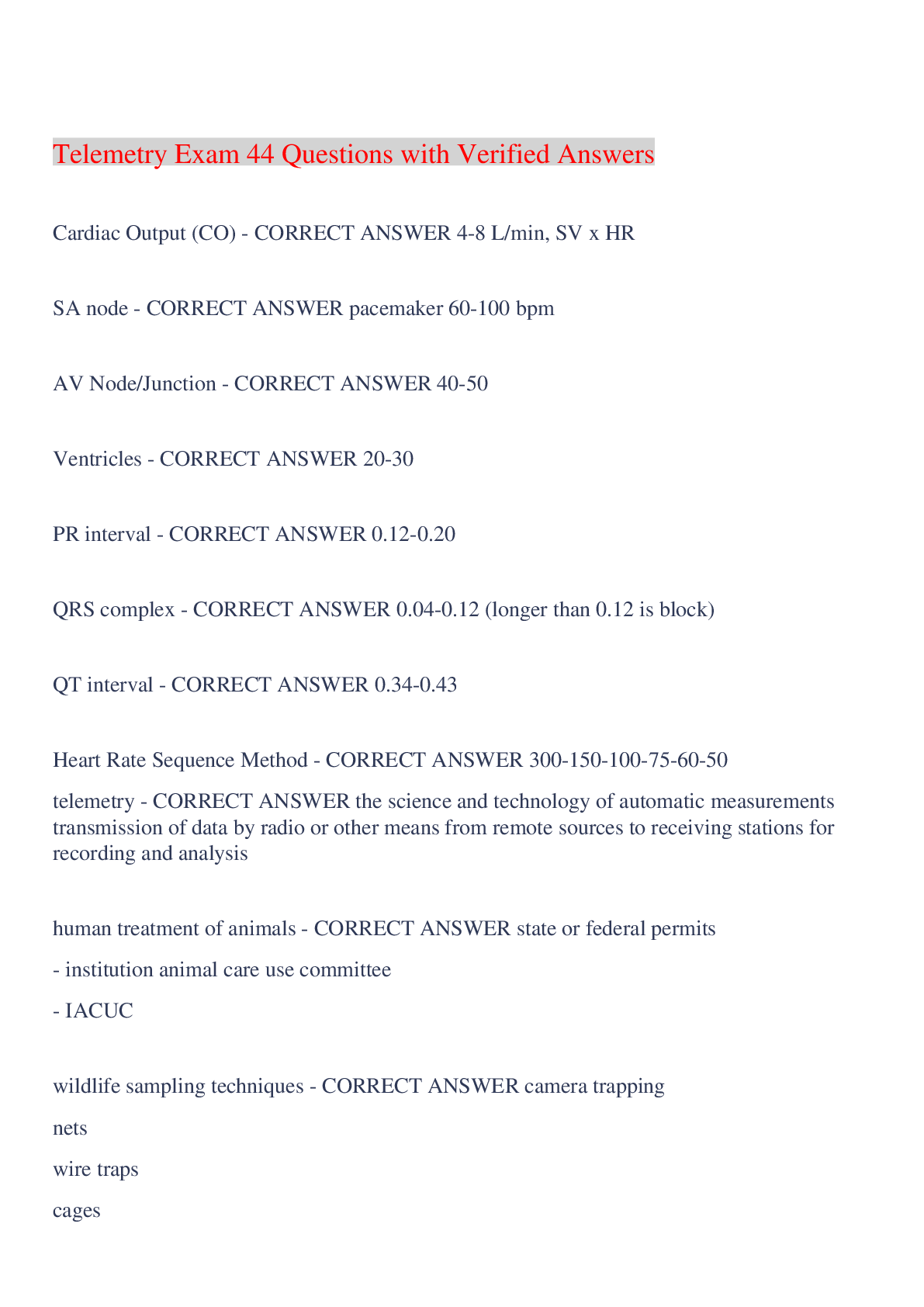
ECG/EKG - CORRECT ANSWER *P Wave*
- Impulse coming from the SA node
- Normal electrical impulses 60-100 beats/min
*QRS*
- Indicates ventricles are contracting
*T-Wave*
- Resting/repolarization period of the heart
Intervals - CORRECT ANSWER *PR Interval*
- Represents the time between atrial firing and ventricular firing
- *If this is longer than normal there is an electrical block somewhere between the atria and ventricles*
*ST Segment* - not measured, usually flat and level with the baseline
- Vertical change or *ST elevation of 1 mm or more* is correlated with *acute myocardial infarction or pericarditis*
- *ST depression more than 1mm represents injury: no cell death to the tissue - injury can be reversed*
*QT Interval*
- Represents the amount of time it takes for the ventricles to fire and recover or reload
- Will be elongated with overdoses
Hyperkalemia - CORRECT ANSWER * >4.5 mEq = tall peaked T waves*
* >8 mEq/L = wide QRS*
- High K+ slows the firing ability of the ventricles and increases the reloading ability
*Treatment*
- Kayexelate
- Lasix
- Insulin via IV push
*Complications*
- V-tach
- V-fib
Hypokalemia - CORRECT ANSWER * <3.5 mEq/L often a result of diuretic therapy*
- Prolongs the reloading of the ventricles
- Elongates the T wave or U wave may show up
*Treatment*
- Replace K+
AV Blocks - CORRECT ANSWER *Differentiated by their PR interval*
*First Degree*
- All sinus impulses eventually reach ventricles
- *Long PR interval*
*Second Degree*
- Some sinus impulses reach the ventricles, others do not
- Irregular rhythm
- *PR interval can eventually skip a QRS interval*
- *One beat will be skipped*
*Third-Degree*
- No sinus impulses between P and QRS
- No coordination between P and QRS
- *Very low heart rate*
- Pacemaker candidate - can lead to cardiac arrest
*Treatment*
- Pacemaker
- Cardioversion
First Degree AV Block - CORRECT ANSWER
Second Degree AV Block - CORRECT ANSWER
Third Degree AV Block - CORRECT ANSWER
Pacemakers - CORRECT ANSWER Electronic devices that can be used to initiate a heartbeat when the internal system is malfunctioning
*Abnormalities*
- *Failure to capture*: ventricles fail to respond to the pacemaker impulses. On the EKG tracing, the pacemaker spike will appear but it will not be followed by a QRS complex
- *Failure to pace*: occurs when the pacemaker does not generate and electrical impulse. On and EKG tracing, pacemaker spikes will be missing
*Temporary Pacing*
- Can place atria, ventricles, or both. Often needed as supportive treatment after a drug toxicity, MI, and/or other electrolyte imbalances
*Permanent Pacing*
- Bradycardia, failing SA node, ect.
*Permanent Pacemaker*
- Implantable cardioverter defibrillator
- Identify and treat dysrhythmias
- Indications: bradycardia, failing SA node
Failure to Capture - CORRECT ANSWER
Failure to Pace - CORRECT ANSWER
Cardioversion - CORRECT ANSWER Synchronized, low energy shock
*Common Indications*
- Unstable A-fib
- Atrial flutter
- Supraventricular tachycardia
*Utilized if medications fail to convert abnormal rhythm*
- Amiodarone
- Adenosine
- Cardizem
- Diltiazem
*Shock with or just after the peak of the R Wave*
- Can precipitate ventricular fibrillation if shock occurs on the T-wave
- Make sure to put the synch button on
Cardioversion: Procedure - CORRECT ANSWER *Preprocedure*
- Prepare sedation: Versed
- Ensure emergency equipment is at bedside
- Shave chest hair if necessary
*Intraprocedure*
- Place pads
- Infuse sedative
- Ensure the SYNC button is engaged
- Ensure the R wave is accurately marked by the machine
- Deliver shock and assess rhythm
- Frequently assess cardiac and respiratory status
5 Steps to ECG Rhythm Analysis - CORRECT ANSWER *1. Determine the speed of heart rate*
- Calculate the rate
- Slow, normal, fast
*2. Determine heart rhythm*
- Regular or irregular
*3. Is it preceded by a P wave?*
- Yes or no
*4. Determine Complex*
- Narrow or wide
*5. Do all complexes look the same?*
- Yes or no
Step 1: Calculating Rate - CORRECT ANSWER 6 second strip (5 lg blocks = 1 second of time)
- Count the number of R was and multiply x10
- 6 waves x10 = rate of 60
Step 2: Determining the Heart Rhythm - CORRECT ANSWER Look for extra beats or abnormal rhythms that would indicate abnormalities
Step 3: Is it preceded by a P wave? - CORRECT ANSWER - P waves prior to the QRS complex indicates a normal conduction pathway
- If the P wave is absent it could mean an abnormality in this pathway
Steps 4&5: Complex - CORRECT ANSWER - Look for wide complexes that may indicate conduction abnormalities
- Are each complex along this strip the same?
- If they are not, it could indicate abnormalities along the pathway
Normal Sinus Rhythm - CORRECT ANSWER Rate 60-100
- Regular rhythm
- P wave present
- Complexes normal and similar
Sinus Tachycardia - CORRECT ANSWER > 100 bpm
- Regular rhythm
- P wave present
- Complexes normal and similar
*Treatment*
- Correct electrolytes
- Treat infection
- Treat anxiety
Sinus Bradycardia - CORRECT ANSWER <60 bpm
- Regular rhythm
- P wave present
- Complexes normal and similar
*Treatment*
- Atropine
- Epinephrine
- Pacemaker
- Treat underlying cause
Supraventricular Tachycardia (SVT) - CORRECT ANSWER 140-250 bpm
- Regular rhythm
- *P wave often not present*
- Complexes normal and similar
*Manifestations*
- Palpitations
- Racing HR
- Anxiety
- Dizziness
- Fatigue
*Treatment*
- Vagal maneuvers
- Adenosine
- Beta blockers
- Verapamil
- Cardioversion
Atrial Fibrillation - CORRECT ANSWER *Hard to count so rate can vary*
- Irregular rhythm
- Chaotic electrical signals
- Complexes normal and similar
*Manifestatons*
- Decreased cardiac output
- Hypotension
- Fatigue
- Angina
*Medications*
- Cardioversion
- Amiodarone
- Treat underlying cause
- Anticoagulants
- Digoxin
Atrial Flutter - CORRECT ANSWER Rate can vary
- Regular rhythm
- AV conduction problem
- Complexes normal and similar
*Manifestations*
- Digoxin
- Amiodarone
- Cardioversion
Ventricular Tachycardia - CORRECT ANSWER Often a rate of 170 or more
- Regular rhythm
- *P wave absent*
- Complexes wide but similar
*Manifestations*
- Flutter sensation
- Palpitations
- SOB
- Severe hypotension
*Causes*
- MI
- Ischemia
*Treatment*
- Lidocaine
- Amiodarone
- Cardioversion
- Correct electrolytes
- Treat underlying cause
Ventricular Fibrillation - CORRECT ANSWER - Rapid and disorganized
- Irregular rhythm
- *P wave absent*
- Complexes wide and chaotic with each one different
*Manifestations*
- CARDIAC ARREST
- No pulse
- LOC
- No breathing
*Causes*
- Severe MI
- Dig toxicity
- Potassium imbalance
- Metabolic acidosis
*Treatment*
- Defibrillation & CPR
- Epinephrine
- Lidocaine
[Show More]