Normal Newborn
UNFOLDING Reasoning
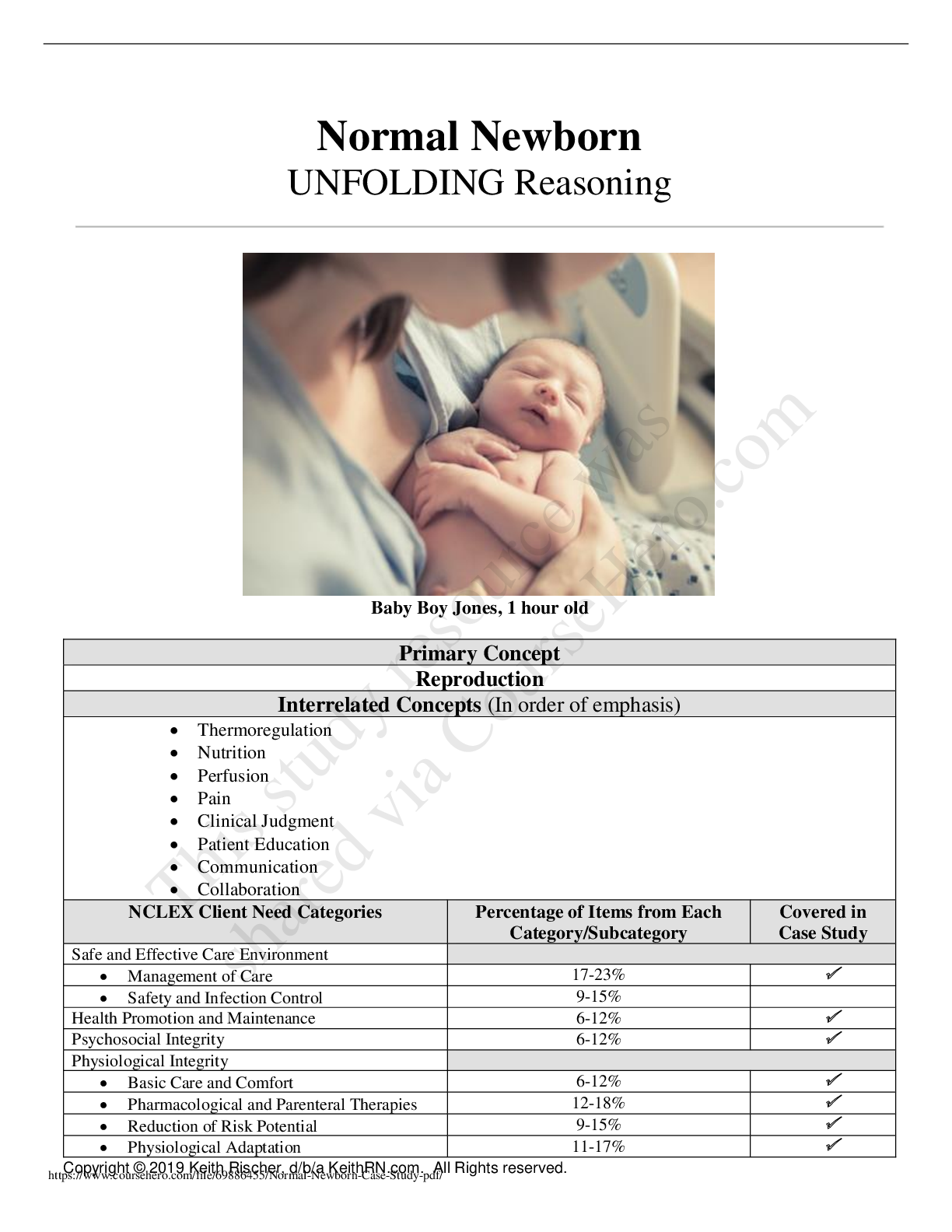
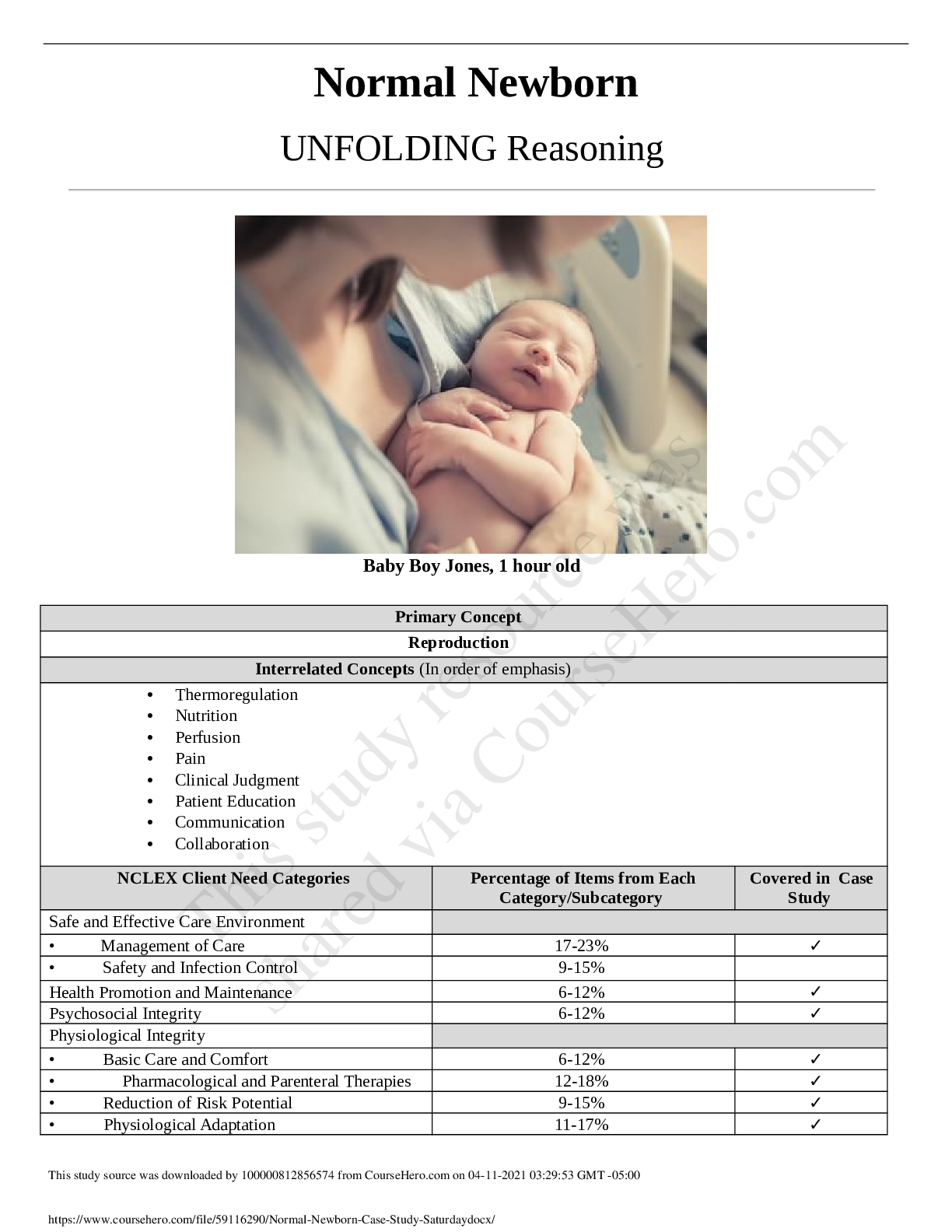
Baby Boy Jones, 1 hour old
Primary Concept
Reproduction
Interrelated Concepts (In order of emphasis)
• Thermoregulation
• Nutrition
• Perfusion
• Pain
• Clinical Judgment
• P
...
Normal Newborn
UNFOLDING Reasoning
Baby Boy Jones, 1 hour old
Primary Concept
Reproduction
Interrelated Concepts (In order of emphasis)
• Thermoregulation
• Nutrition
• Perfusion
• Pain
• Clinical Judgment
• Patient Education
• Communication
• Collaboration
NCLEX Client Need Categories Percentage of Items from Each
Category/Subcategory
Covered in
Case Study
Safe and Effective Care Environment
• Management of Care 17-23% ✓
• Safety and Infection Control 9-15%
Health Promotion and Maintenance 6-12% ✓
Psychosocial Integrity 6-12% ✓
Physiological Integrity
• Basic Care and Comfort 6-12% ✓
• Pharmacological and Parenteral Therapies 12-18% ✓
• Reduction of Risk Potential 9-15% ✓
• Physiological Adaptation 11-17% ✓
https://www.coursehero.com/file/69886455/Normal-Newborn-Case-Study-pdf/
This study resource was
shared via CourseHero.comCopyright © 2019 Keith Rischer, d/b/a KeithRN.com. All Rights reserved.
History of Present Problem
One hour after Delivery:
Anne is a 17-year-old, gravida 1 para 1 who is 39 weeks gestation. She recently experienced a normal spontaneous
vaginal delivery without the use of pain medications or an epidural. She delivered a baby boy who was placed skin to
skin following delivery. You assign Apgars of 8 and 9. Baby voided right after delivery. Weight: 7 lbs. 0 oz. (3.2 kg), 20
inches (50.8 cm) long. After he had his first feeding, erythromycin ointment was applied to his eyes. Vitamin K and
hepatitis B vaccine (after consent given) were administered in right and left thigh in the outer aspect of the left thigh.
Ann is Group Beta Strep (GBS) positive and received antibiotics at 36 weeks and 3 doses before delivery, blood type is
B-, and rubella positive. Cord blood was sent.
Personal/Social History:
Anne has her mother with her for support. She seems to be tired but is holding and interacting with the baby
appropriately. The father of the baby is not involved. Anne plans on breastfeeding for “awhile.” Anne still lives at home,
and her mother plans to help with the new baby and appears supportive.
What data from the histories are RELEVANT and must be interpreted as clinically significant by the nurse?
(Reduction of Risk Potential)
RELEVANT Data from Report: Clinical Significance:
RELEVANT Data from Social History: Clinical Significance:
Patient Care Begins: You complete your assessment:
What VS data are RELEVANT and must be interpreted as clinically significant by the nurse?
(Reduction of Risk Potential/Health Promotion and Maintenance)
RELEVANT VS Data: Clinical Significance:
Current VS: P-Q-R-S-T Pain Assessment:
T: 97.0 F/36.1 C (axillary) Provoking/Palliative:
P: 130 (regular) Quality:
R: 50 (irregular) Region/Radiation:
BP: none taken Severity: NIPS score 0
O2 sat: pink in color/no
central cyanosis noted
Timing:
*Anne is a mom at age 17
*Gravida 1 para 1
*She had the baby at 39 weeks. full-term baby, *baby's
weight 3.2 Kg, baby'sheight 50.8 cm.*Erythromycin was
given. * Mom tested positivefor rubella.*Apgar score 8
and 9. * Vaccine Hep B and Vitamin k was given to the
baby. * Baby voided. *skin to skin.
*teen pregnancy requires a lot of social support and patient education *requires pt education.
*we expect a healthy baby. * average for the gestational period.*Protect the baby's eyes
from mom's body/vaginal fluid.* If she had her MMR vaccine, she does not an additional
vaccine since she has rubella antibodies. * Normal.*Vaccine Hep B protects againsthep b.
VitaminK helps in blood clotting.* Meconium is expected to be passed during the first 24 hrs
after birth.
* Helps in temperature regulation, blood glucose levels. protects against postpartum
hemorrhage through the release of oxytocin.
*Teen mom,Gravida 1 para 1
*Her mother supports her.
*The father of the baby is not involved.
*Her Mom seems to be tired but is holding
and interacting with the baby
*Social support, Client's education.
*Good Support system
*Single mother, needs more support.
*Even though she is tired, she is taking care of the baby.she
is a good support system for her.
*T: 97.0 F/36.1 C (axillary)
*P 130 regular
*R 50 irregular
*O2 sat: pink in color/no
central cyanosis noted
NIPS score 0
*normal temperatureis between97.7 f up to 100.4 f, 97.0 is slightly below normal.Monitor
baby's T.
* P is WNL.
*R is WNL.
O2 sat is WNL,
https://www.coursehero.com/file/69886455/Normal-Newborn-Case-Study-pdf/
This study resource was
shared via CourseHero.comCopyright © 2019 Keith Rischer, d/b/a KeithRN.com. All Rights reserved.
What assessment data are RELEVANT and must be interpreted as clinically significant by the nurse?
(Reduction of Risk Potential/Health Promotion and Maintenance)
RELEVANT Assessment Data: Clinical Significance:
Clinical Reasoning Begins…
1. Interpreting relevant clinical data, what is the primary concern? What primary health-related concepts does this
primary problem represent? (Management of Care/Physiologic Adaptation)
Problem: Pathophysiology of Problem in OWN Words: Primary Concept:
Collaborative Care (Newborn Orders): Medical Management
(Pharmacologic and Parenteral Therapies)
Care Provider Orders: Rationale: Expected Outcome:
Vital signs q 30 mins until stable for 2 hours,
then every 4-6 hrs
May place skin to skin if vital signs stable
May bathe after 6-8 hours, then bathe prn
Recommend and encourage exclusive
breastfeeding.
Breastfeed PRN, minimum of 8-10 times in 24
hours. No more than four-hour gap in feedings.
Feed infant based on feeding cues.
Similac/Enfamil 6-10 mL every 3-4 hours based
on infant’s feeding cues
Frequent skin to skin contact with mother or
partner
Current Assessment:
GENERAL
APPEARANCE:
Calm, quiet, and in a crib next to the bed.
RESP: Lusty cry, breath sounds clear, irregular, non-labored respiratory effort, no nasal flaring, no
grunting noted.
CARDIAC: Pink, warm & dry, heart sounds regular with no abnormal beats, pulses strong, acrocyanosis
present in hands and feet, no central cyanosis noted.
NEURO: Fontanelles flat and soft, good tone, slight flexion of arms and legs
*General appearance is calm and
quiet.
*Resp
*Neuro, Slight flexion
WNL
*WNL it is normal for newborns to have irregular R. Continue to
monitor.
*Maybe it is a result of the baby being tired.continue to monitor
for any changes.
low temperature
of the baby's
body
(Hypothermia)
97.0 F
The newborn is presentinga problem of thermoregulation, He is hypothermic. It
is very important to have a body temperature between 97.7 F- 100.4 F, which
reflects an acceptable level between heat loss and heat production. The baby is
slightly hypothermic, this could be related to low blood glucose( hypoglycemia)
or an infection. Skin to skin is very important and effective in newborns
thermoregulation.
thermoregulation
in newborns
frequentassessmentof V.S to monitor
any changes.
*Helps in thermoregulation of
newborns, blood glucose levels.
protects against postpartum
hemorrhage through the release of
oxytocin. Also it promotes bonding.
* Early bath may cause cold stress.
*Breastfeeding helps in releasing
oxytocin which helps in preventing
postpartum
hemorrhage.immunoglobulin Iga for
the newborn.
Make sure the newborn gets enough
nutrients.
Expect the newborn VS to be WNL.
Bring up the T to be WNL.
*Give bath after 8 hrs to avoid cold
stress and protect the newborn's
vernix.
* baby is well fed.measured by how
many wet diapers , void stool (bowel
movement)
No wt loss of more than 10% first
few days
*All screenings, tests and panels
are done before discharge to make
sure that the newborn is healthy and
does not need any intervention.
Expected that the baby has normal
level of bilirubin, pass hearing test
and pass the congenital heart
screening.
https://www.coursehero.com/file/69886455/Normal-Newborn-Case-Study-pdf/
This study resource was
shared via CourseHero.comCopyright © 2019 Keith Rischer, d/b/a KeithRN.com. All Rights reserved.
Weight at birth and then every evening
Input and Output every shift
Newborn work up (blood type, Coombs) if the
mother is Rh negative
The newborn screen at greater than 24 hours
Transcutaneous bilirubin level prior to discharge
Newborn hearing screen before discharge
Congenital heart screening
Collaborative Care: Nursing
2. What body system(s) will you assess most thoroughly based on the primary/priority concern?
(Reduction of Risk Potential/Physiologic Adaptation)
PRIORITY Body System: PRIORITY Nursing Assessments:
3. What nursing priority (ies) will guide your plan of care? (Management of Care)
Nursing PRIORITY:
PRIORITY Nursing Interventions: Rationale: Expected Outcome:
Monitor weight, usually, 5 to 10% wt
loss 1st few days, regained within
10-14 days.
rhoGAM should be given if the mom is
RH- and the newborn is RH+.
Metabolic
metabolic screening is done after 24
hrs to make sure that the newborn is
well fed,
this checks the liver function, high
level of bilirubin is concerning and
cause jaundice.
Test the baby's hearing before
discharge.
Check O2 sat on the foot and the finger
Integumentary system priority is to check VS especially T, and prevent
further heat loss. Check the skin color, and O2 sat
in the extremities.
prevent further heat loss,minimize
cold stress,maintain skin
temperature WNL, continuously
monitor T, prevent rapid warming,
and use a cap to prevent heat loss
from the head.Skin to skin.
if no interventions are taken to prevent heat
loss, the newborn might suffer severe
hypothermia and cold stress. leading to
metabolic acidosis, hypoglycemia, and even
death.
after taking the
appropriate
interventions the
newborn's T will be
WNL.
-
-
-
-
-
-
Continued
[Show More]




 – Chamberlain College of Nursing.png)
 – Chamberlain College of Nursing.png)