Normal Newborn
Primary Concept
Reproduction
Interrelated Concepts (In order of emphasis)
• Thermoregulation
• Nutrition
• Perfusion
• Pain
• Clinical Judgment
• Patient Education
• Communication
• Collaboratio
...
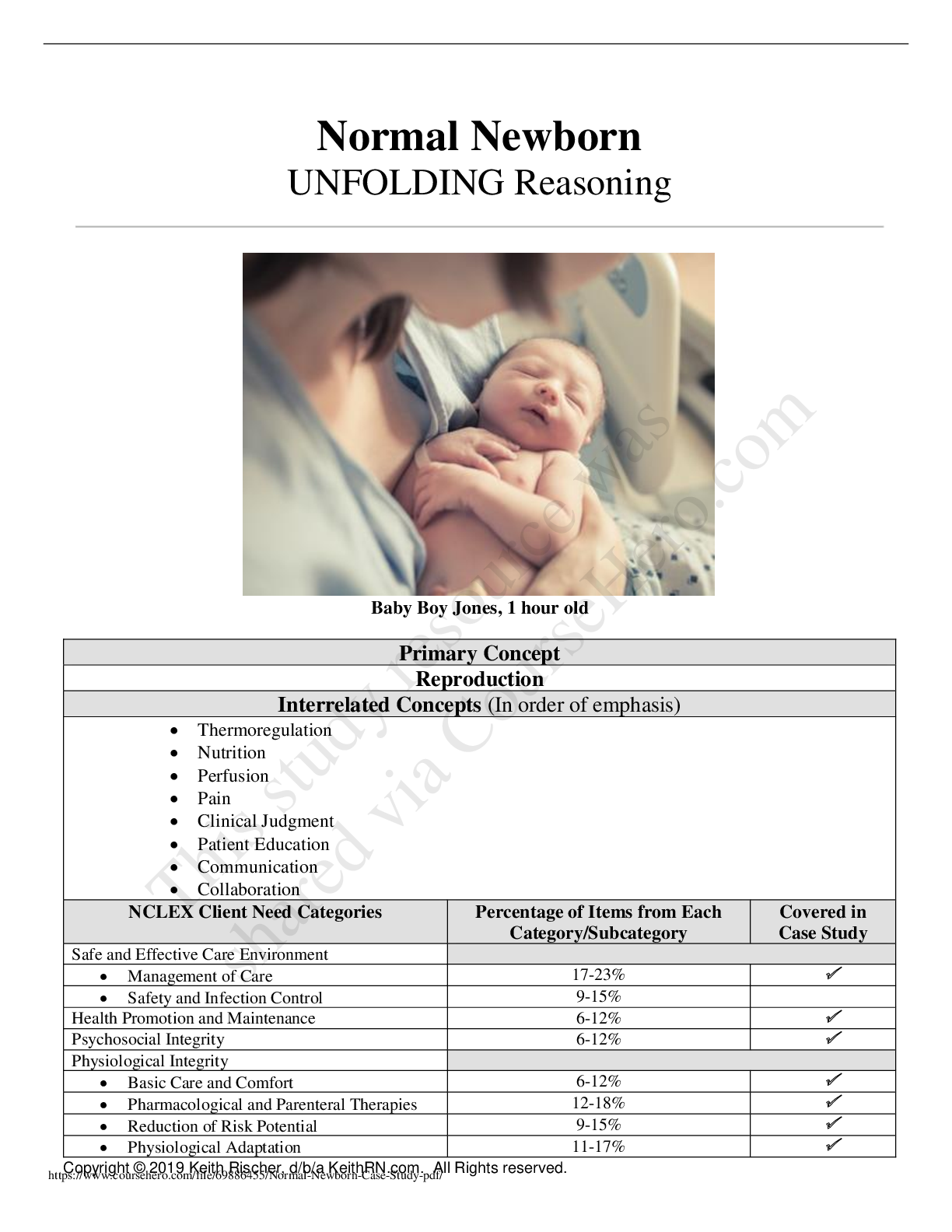
Normal Newborn
Primary Concept
Reproduction
Interrelated Concepts (In order of emphasis)
• Thermoregulation
• Nutrition
• Perfusion
• Pain
• Clinical Judgment
• Patient Education
• Communication
• Collaboration
NCLEX Client Need Categories Percentage of Items from Each
Category/Subcategory
Covered in Case
Study
Safe and Effective Care Environment
• Management of Care 17-23% ✓
• Safety and Infection Control 9-15%
Health Promotion and Maintenance 6-12% ✓
Psychosocial Integrity 6-12% ✓
Physiological Integrity
• Basic Care and Comfort 6-12% ✓
• Pharmacological and Parenteral Therapies 12-18% ✓
• Reduction of Risk Potential 9-15% ✓
• Physiological Adaptation 11-17% ✓
UNFOLDING Reasoning
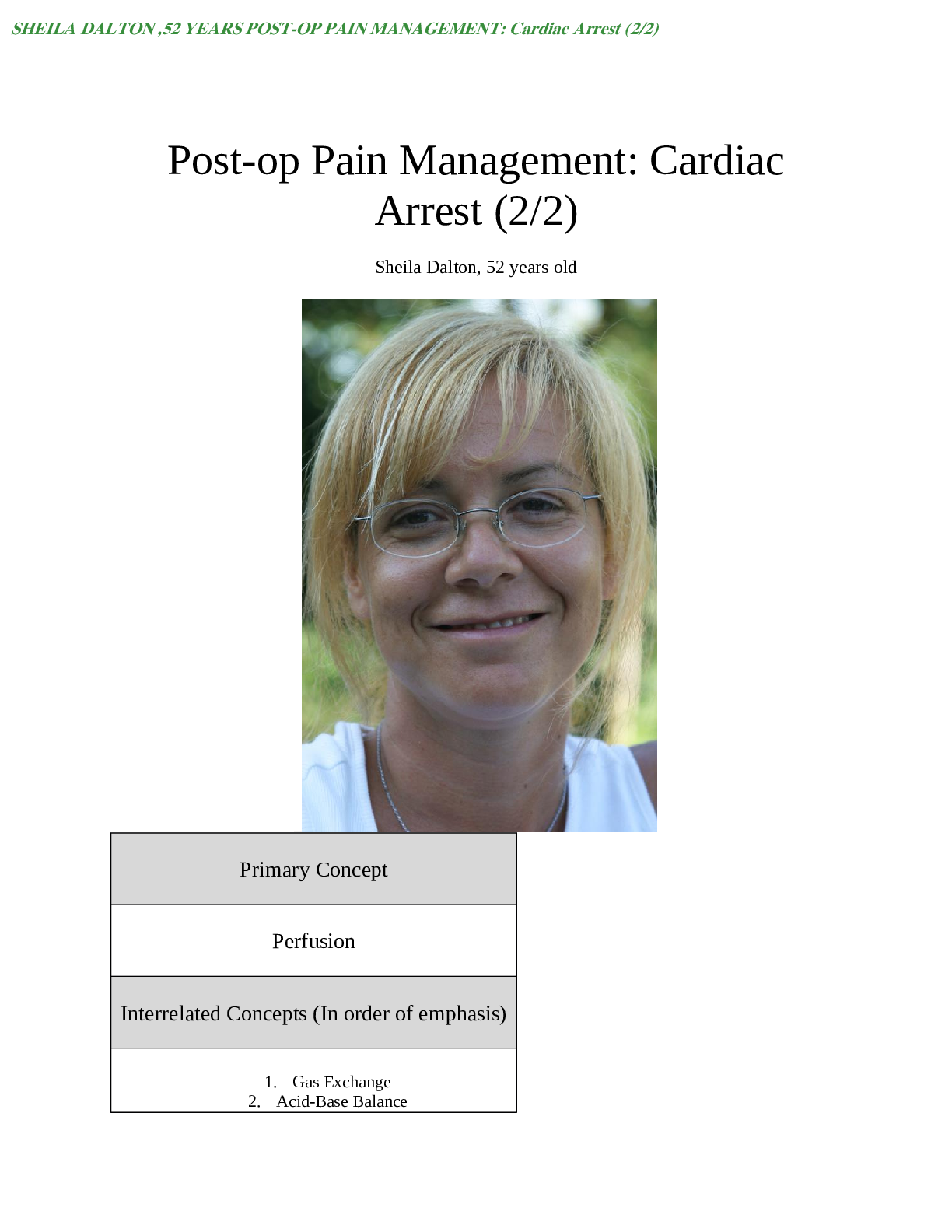
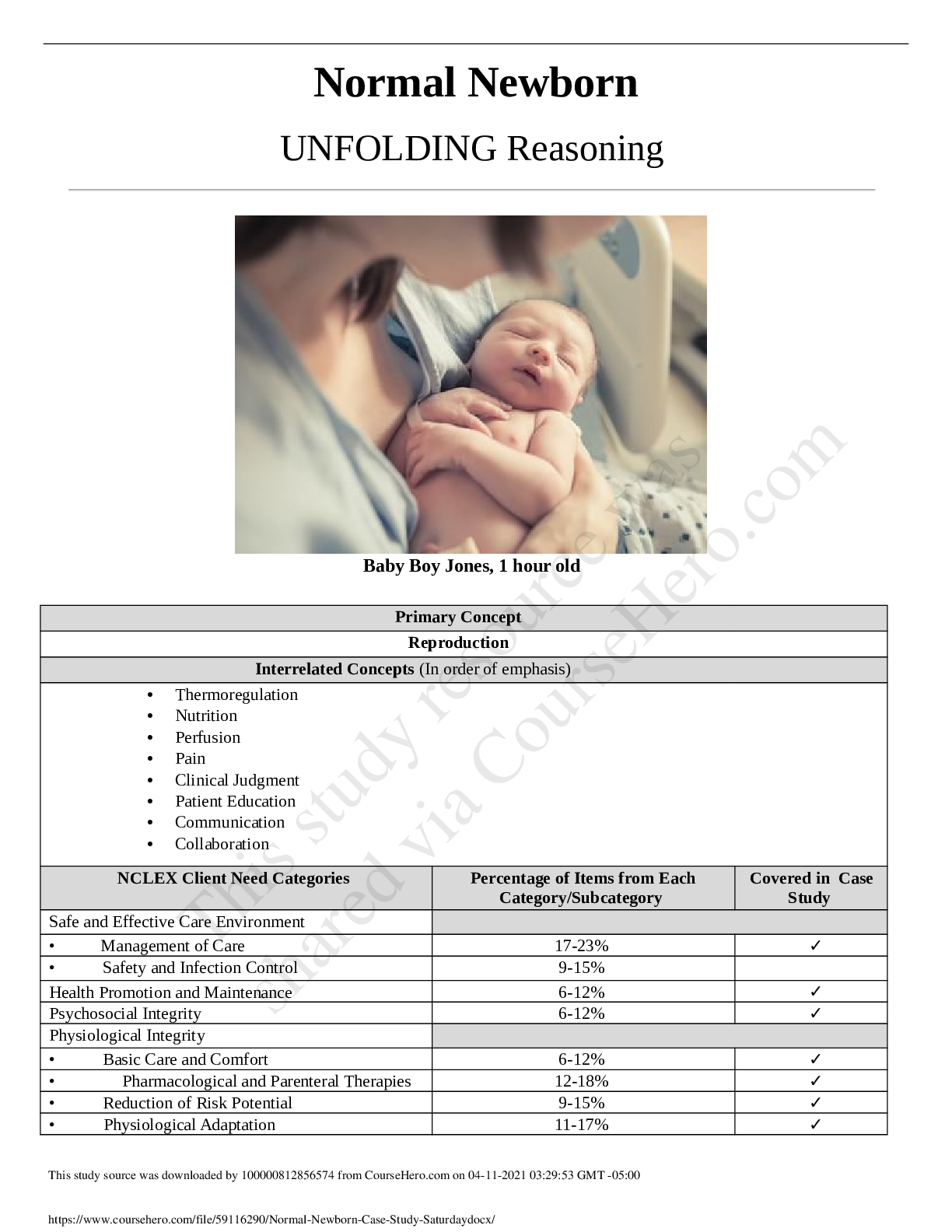
Baby Boy Jones, 1 hour old
This study source was downloaded by 100000831988016 from CourseHero.com on 04-10-2022 09:14:15 GMT -05:00
https://www.coursehero.com/file/59116290/Normal-Newborn-Case-Study-Saturdaydocx/
History of Present Problem
One hour after Delivery:
Anne is a 17-year-old, gravida 1 para 1 who is 39 weeks gestation. She recently experienced a normal spontaneous vaginal
delivery without the use of pain medications or an epidural. She delivered a baby boy who was placed skin to skin
following delivery. You assign Apgars of 8 and 9. Baby voided right after delivery. Weight: 7 lbs. 0 oz. (3.2 kg), 20 inches
(50.8 cm) long. After he had his first feeding, erythromycin ointment was applied to his eyes. Vitamin K and hepatitis B
vaccine (after consent given) were administered in right and left thigh in the outer aspect of the left thigh. Ann is Group
Beta Strep (GBS) positive and received antibiotics at 36 weeks and 3 doses before delivery, blood type is B-, and rubella
positive. Cord blood was sent.
Personal/Social History:
Anne has her mother with her for support. She seems to be tired but is holding and interacting with the baby
appropriately. The father of the baby is not involved. Anne plans on breastfeeding for “awhile.” Anne still lives at home,
and her mother plans to help with the new baby and appears supportive.
What data from the histories are RELEVANT and must be interpreted as clinically significant by the nurse?
(Reduction of Risk Potential)
RELEVANT Data from Report: Clinical Significance:
-Normal spontaneous delivery reported
-No pain medications used
-Apgar’s of 8 & 9
-Baby voided
-All vaccines given to baby
-There really isn’t anything of clinical significance
here, perhaps because everything appears as either an
expected finding and/or appropriate intervention and
procedure.
RELEVANT Data from Social History: Clinical Significance:
-Patient’s mother is present as a support system—
patient still lives at home with her
-Baby’s father will not be involved
-Patient plans on breastfeeding (for undetermined
amount of time)
-She is holding and interacting with baby
-It appears that the patient is doing well at this point in
time. She is interacting with her baby and wants to
breast feed. She has a solid support system, which is
important due to her young age.
Patient Care Begins: You complete your assessment:
Current VS: P-Q-R-S-T Pain Assessment:
T: 97.0 F/36.1 C (axillary) Provoking/Palliative:
P: 130 (regular) Quality:
R: 50 (irregular) Region/Radiation:
BP: none taken Severity: NIPS score 0
O2 sat: pink in color/no
central cyanosis noted
Timing:
What VS data are RELEVANT and must be interpreted as clinically significant by the nurse? (Reduction
of Risk Potential/Health Promotion and Maintenance)
RELEVANT VS
Data:
Clinical Significance:
-Temperature of
97.0
-Baby’s temp is lower than we’d like to see and he his respiratory rate is on the high end
of acceptable range so it’s something I’m going to want to keep an eye on. But all other
This study source was downloaded by 100000831988016 from CourseHero.com on 04-10-2022 09:14:15 GMT -05:00
https://www.coursehero.com/file/59116290/Normal-Newborn-Case-Study-Saturdaydocx/
-RR of 50/irregular clinical findings are as expected, and he’s only been in this world for 1 hour.
Current Assessment:
GENERAL
APPEARANCE:
Calm, quiet, and in a crib next to the bed.
RESP: Lusty cry, breath sounds clear, irregular, non-labored respiratory effort, no nasal flaring, no
grunting noted.
CARDIAC: Pink, warm & dry, heart sounds regular with no abnormal beats, pulses strong, acrocyanosis
present in hands and feet, no central cyanosis noted.
NEURO: Fontanelles flat and soft, good tone, slight flexion of arms and legs
What assessment data are RELEVANT and must be interpreted as clinically significant by the nurse?
(Reduction of Risk Potential/Health Promotion and Maintenance)
RELEVANT Assessment Data: Clinical Significance:
-Irregular respiratory rate is noted
-Clear breath sounds, non-labored effort
with no signs of distress
-Heart sounds auscultated, neg for cyanosis
-Fontanelles are within range and flexion is
present
-Flexion of arms and legs
-Everything thing in this assessment appears with appropriate
ranges and findings
-The only abnormality is the irregular respiratory rate, however
everything else indicates that baby is doing well and still in the
adjustment phase
-“Slight” flexion is reported
Clinical Reasoning Begins…
1. Interpreting relevant clinical data, what is the primary concern? What primary health-related concepts does this
primary problem represent? (Management of Care/Physiologic Adaptation)
Problem: Pathophysiology of Problem in OWN Words: Primary
Concept:
-Our largest
concern at
this point is
cold stress on
the newborn
-As the newborn was delivered at 39 weeks and has only been on the
outside for about an hour, this is the time he is most susceptible to cold
stress. Failure to prevent this causes an increase in metabolic activity which
will have a negative impact on some of the other operating systems in the
body. Full term babies remain in a flexed position to help maintain warmth,
and this is also a time when skin to skin is important as well as frequent
feeding.
-This comes down
to thermoregulation of the
newborn
This study source was downloaded by 100000831988016 from CourseHero.com on 04-10-2022 09:14:15 GMT -05:00
https://www.coursehero.com/file/59116290/Normal-Newborn-Case-Study-Saturdaydocx/
Collaborative Care (Newborn Orders): Medical Management
(Pharmacologic and Parenteral Therapies)
Care Provider Orders: Rationale: Expected Outcome:
-Vital signs q 30 mins until stable for 2
hrs—then every 4-6 hrs
-May place skin to skin if vital signs
stable
-May bathe after 6-8 hours, then bathe prn
-Recommend and encourage exclusive
breastfeeding.
Breastfeed PRN, minimum of 8-10
times in 24 hours. No more than
four-hour gap in feedings. Feed
infant based on feeding cues.
Similac/Enfamil 6-10 mL every 3-
4 hours based on infant’s feeding
cues
-Weight at birth and then every evening
-Input and Output every shift
-Newborn work up (blood type, Coombs)
if the mother is Rh negative
-The newborn screen at greater than 24
hours
-Transcutaneous bilirubin level prior to
discharge
-Newborn hearing screen before discharge
-Congenital heart screening
-It’s important to be frequently assessing
the baby’s vitals in order to quickly
determine if there is any type of change or
decline
-Skin to skin is essential in helping to
thermoregulate the baby
-Breastfeeding is the gold standard
whenever possible, but if formula is being
used, education needs to be provided so
that it is being done appropriately
-Weights should be performed at the same
time of day and using the same scale.
However, baby was weighed the first time
should continue
-I&Os help demonstrate if baby is eating
enough since they are not able to speak
and wear diapers
-Bilirubin should be checked to confirm
liver function
-Hearing and CHD screenings should be
tested prior to discharge to allow time for
baby to acclimate and for fluid to exit
places it should not be in
-It’s expected that baby’s
vitals signs are all within
acceptable ranges during
all checks.
-The baby should be skin
skin if stable with
frequent breastfeeding
performed.
-They should be getting
weight twice a day every
day, and I&Os should be
consistently monitored
until discharge
-Bilirubin levels will be
within normal ranges
prior to discharge to
ensure no occurrence of
jaundice
-All screenings, including
hearing and CHD will be
completed prior to
discharge but after 24hrs
after birth
Collaborative Care: Nursing
2. What body system(s) will you assess most thoroughly based on the primary/priority concern?
(Reduction of Risk Potential/Physiologic Adaptation)
PRIORITY Body System: PRIORITY Nursing Assessments:
The two systems we’re going to assess the most
are the respiratory and cardiovascular, as these
two systems will show reveal manifestations the
earliest.
-Assessment of vital signs for the first three hours is
essential. Temperature and all other VS should be getting
assessed every 30min for the first couple of hours after birth
until the newborn has demonstrated stability in all areas
This study source was downloaded by 100000831988016 from CourseHero.com on 04-10-2022 09:14:15 GMT -05:00
https://www.coursehero.com/file/59116290/Normal-Newborn-Case-Study-Saturdaydoc
[Show More]









.png)