EDF 6225 exam 1|68 Questions with Verified Answers
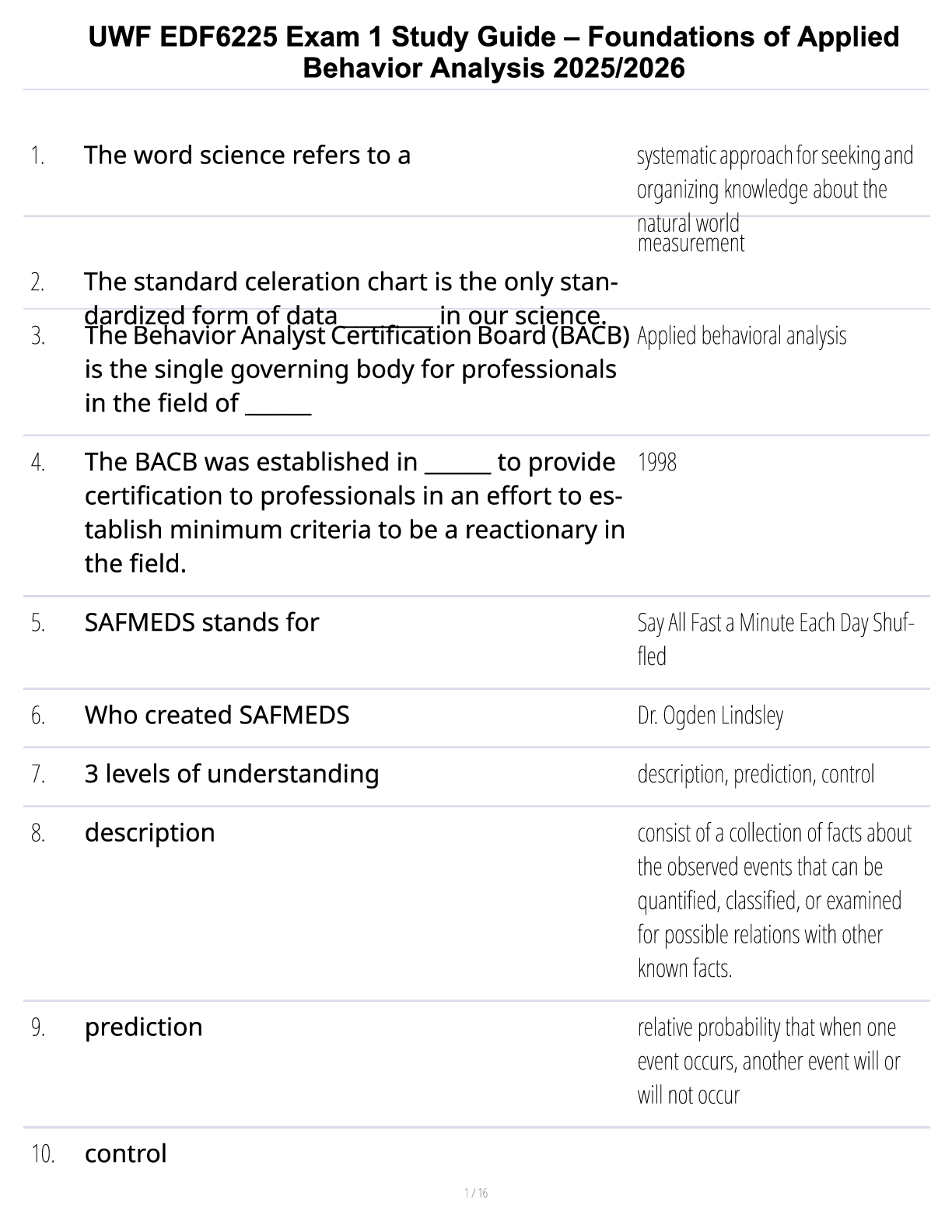
science - CORRECT ANSWER Systematic approach for seeking & organizing knowledge about the natural world
purpose of science - CORRECT ANSWER ◦To achieve a thorough
...
EDF 6225 exam 1|68 Questions with Verified Answers
science - CORRECT ANSWER Systematic approach for seeking & organizing knowledge about the natural world
purpose of science - CORRECT ANSWER ◦To achieve a thorough understanding of the phenomena under study
ABA seeks to - CORRECT ANSWER discover the real truths (not those held by certain groups, organizations, etc.)
Three different types of investigations provide different levels of understanding - CORRECT ANSWER 1. description
2. prediction
3. control
description - CORRECT ANSWER ◦Collection of facts about observed events that can be quantified, classified, & examined for possible relations with other known facts
◦Often suggests hypotheses or questions for additional research
prediction - CORRECT ANSWER ◦Relative probability that when one event occurs, another event will or will not occur
◦Based on repeated observation revealing relationships between various events
◦Demonstrates correlation between events
◦No causal relationships can be interpreted
◦Enables preparation
control - CORRECT ANSWER ◦Highest level of scientific understanding
◦Functional relations can be derived
Specific change in one event (dependent variable)....
Can reliably be produced by specific manipulations of another event (independent variable)...
And the change in the dependent variable was unlikely to be the result of other extraneous factors (confounding variables)
◦Events can only really be "co-related"
Nearly impossible to factor out all other possible "causes"
attitudes of science - CORRECT ANSWER - Definition of science lies within the behavior of scientists, not the instruments or materials they use
- Only known as science due to an overriding idea of "scientific method"
- Fundamental assumptions about the nature of events
6 attitudes of science - CORRECT ANSWER 1. DETERMINISM
2. EMPIRICISM
3. EXPERIMENTATION
4. REPLICATION
5. PARSIMONY
6. PHILOSOPHIC DOUBT
determinism - CORRECT ANSWER - Assumption upon which science is predicted
- Presumption that the universe is a lawful and orderly place in which all phenomena occur as the result of other events
- Events do not just occur at will
- Events are related in systematic ways
empiricism - CORRECT ANSWER - Practice of objective observation of phenomena of interest
- What all scientific knowledge is built upon
- "Objective" is the key to gaining a better understanding of what is being studied
experimentation - CORRECT ANSWER - Basic strategy in most sciences
- Experiment:
◦Controlled comparison of some measure of the phenomenon of interest (dependent variable) under two of more different conditions in which only one factor at a time (independent variable) differs from one condition to another
replication - CORRECT ANSWER - The repetition of experiments to determine the reliability and usefulness of findings
- Includes the repetition of independent variable conditions within experiments
- Method for which mistakes are discovered
parsimony - CORRECT ANSWER - The idea that simple, logical explanations must be ruled out, experimentally or conceptually, before more complex or abstract explanations are considered
- Help scientists fit findings within the field's existing knowledge base
philosophical doubt - CORRECT ANSWER - The continuous questioning of the truthfulness and validity of all scientific theory and knowledge
- Involves the use of scientific evidence before implementing a new practice, then constantly monitoring the effectiveness of the practice after its implementation
science relies on - CORRECT ANSWER determinism as its fundamental assumption
science's prime directive = - CORRECT ANSWER empiricism
science's basic strategy - CORRECT ANSWER experimentation
science's requirement for believability - CORRECT ANSWER replication
science's conservative value - CORRECT ANSWER parsimony
science's guiding conscience - CORRECT ANSWER philosophical doubt
behavior analysis is composed of 3 major branches - CORRECT ANSWER 1. behaviorism
2. experimental analysis of behavior (EAB)
3. ABA
behaviorism - CORRECT ANSWER philosophy of the science of behavior
EAB - CORRECT ANSWER basic research
ABA - CORRECT ANSWER - Development of a technology for improving behavior
- Can only be understood in the context of the philosophy & basic research traditions & findings
recognized as moving the field of psychology in a new direction - CORRECT ANSWER watson
Watson argued that - CORRECT ANSWER subject matter for psychology should be the study of observable behavior, not states of mind or mental processes
early form of behaviorism known as - CORRECT ANSWER ◦stimulus-response (S-R) psychology (Watsonian behaviorism)
◦Created foundation for the study of behavior as a natural science
BF skinner (founder of EAB) discussed two types of behavior - CORRECT ANSWER 1. respondent
2. operant
respondent behavior - CORRECT ANSWER ◦Reflexive behavior
◦Ivan Pavlov (1927)
◦Respondents are elicited ("brought out") by stimuli that immediately precede them
◦Antecedent stimulus & response it elicits form a functional unit called a reflex
◦Involuntary responses
◦Occur whenever eliciting stimulus is present
◦S-R model
operant behavior - CORRECT ANSWER ◦Behavior is shaped through the consequences that immediately follow it
◦Three term contingency
◦S-R-S model
◦Behaviors that are influenced by stimulus changes that have followed the behavior in the past
EAB outlined specific methodology for its practice - CORRECT ANSWER - The rate or frequency of response is the most common dependent variable
- Repeated or continuous measurement is made of carefully defined response classes
- Within-subject experimental comparisons are used instead of designs comparing the behavior of experimental & control groups
- Visual analysis of graphed data is preferred over statistical inference
- A description of functional relations is valued over formal theory testing
radical behaviorism - CORRECT ANSWER Attempts to explain all behavior, including private behavior (e.g. thinking & feeling
methodological behaviorism - CORRECT ANSWER A philosophical position that views behavioral events that cannot be publicly observed as outside the realm of science.
mentalism - CORRECT ANSWER ◦Approach to understanding behavior that assumes that a mental or "inner" dimension exists that differs from a behavioral dimension & that phenomena in this dimension either directly cause or at least mediate some forms of behavior
◦Relies on hypothetical constructs and explanatory fictions
◦Dominated Western intellectual thought & most psychological theories (e.g. Descartes, Freud, Piaget)
mentalism relies on - CORRECT ANSWER ◦the premise of explanatory fiction (e.g. "knowledge")
- A fictitious variable that often is simply another name for the observed behavior that contributes nothing to an understanding for the variables responsible for developing (or maintaining) the behavior
Circular view of the cause & effect
structuralism - CORRECT ANSWER ◦Rejects all events that are not operationally defined by objective assessment
◦Restrict activities to descriptions of behavior
◦Make no scientific manipulations; do not address causal questions
methodological behaviorism rejects - CORRECT ANSWER all events that are not operationally defined by objective assessment
- Deny existence of "inner variables" or consider them outside the realm of scientific account
- Acknowledge the existence of mental events but do not consider them in the analysis of behavior
◦Use scientific manipulations to search for functional relationships between events
◦Restrictive view since it ignores major areas of importance
3 assumptions of radical behaviorism - CORRECT ANSWER ◦Private events such as thoughts and feelings are behavior
◦Behavior that takes place within the skin is distinguished from other ("public") behavior only by its inaccessibility
◦Private behavior has no special properties & is influenced by (i.e. is a function of) the same kinds of variables as publicly accessible behavior
radical behaviorism seeks to - CORRECT ANSWER understand all human behavior
radical behaviorism is - CORRECT ANSWER far-reaching and thoroughgoing
- ◦Dramatic departure from other conceptual systems
Fuller (1949) - CORRECT ANSWER ◦One of the first studies to report the human application of operant behavior
◦Participant: 18-year-old boy with profound mental retardation
◦Arm-raising response was conditioned by injecting a small amount of a warm sugar-milk solution into the participant's mouth every time he moved his right arm
Ayllon & Michael (1959) - CORRECT ANSWER ◦"The Psychiatric Nurse as a Behavioral Engineer"
◦Formed the basis for branch of behavior analysis that would later be called applied behavior analysis (ABA)
◦Described techniques based on principles of behavior to improve the functioning of chronic psychotic or mentally retarded residents
1960s - CORRECT ANSWER ◦Researchers began to apply principles of behavior in an effort to improve socially important behavior
◦Techniques for measuring behavior & controlling & manipulating variables were sometimes unavailable, or inappropriate
◦Little funding was available
◦No ready outlet for publishing studies
Difficult to communicate findings
application of behavioral principles to educational systems provided the foundation for - CORRECT ANSWER ◦behavioral approaches to curriculum design
◦instructional methods
◦classroom management
◦generalization and maintenance of learning
1960s and 1970s - CORRECT ANSWER ◦Many new university programs were developed in applied behavior analysis
◦Teaching & research conducted in these programs made major contributions to the rapid growth of the field
"Some Current Dimensions of Applied Behavior Analysis" (Baer, Wolf, & Risley) - CORRECT ANSWER - Founding fathers of the new discipline (ABA)
- Defined the criteria for judging adequacy of research & practice in ABA & outlined the scope of work for those in the science
- Most widely cited publication in ABA
- Remains standard description of the discipline
JABA - CORRECT ANSWER - First journal in U.S. To deal with applied problems & gave researchers using methodology from the experimental analysis of behavior an outlet for publishing their findings
- Flagship journal of ABA
Baer, Wolf, and Risley (1968) recommended the following seven defining dimensions for research or behavior change programs - CORRECT ANSWER Applied
Behavioral
Analytic
Technological
Conceptual
Effective
Generality
applied - CORRECT ANSWER ◦Investigates socially significant behaviors with immediate importance to the participant(s)
examples of applied - CORRECT ANSWER ◦Examples include behaviors such as:
Social
Language
Academic
Daily living
Self-care
Vocational
Recreation and/or leisure
behavioral - CORRECT ANSWER ◦Precise measurement of the actual behavior in need of improvement & documents that it was the participant's behavior that changed
The behavior in need of improvement and it is a study of behavior
The behavior must be measurable
Important to note whose behavior has changed
analytic - CORRECT ANSWER ◦Demonstrates experimental control over the occurrence and non-occurrence of the behavior (a functional relation is demonstrated)
◦Functional & replicable relationships
technological - CORRECT ANSWER ◦Written description of all procedures in the study is sufficiently complete and detailed to enable others to replicate it
◦All operative procedures are identified and described in detail & clarity
Replicable technology
conceptually systematic - CORRECT ANSWER ◦Behavior change interventions are derived from basic principles of behavior
◦Better enable research consumer to derive other similar procedures from the same principle(s)
◦Assist in integrating discipline into a system instead of a "collection of tricks"
effective - CORRECT ANSWER ◦Improves behavior sufficiently to produce practical results for the participant(s)
◦Improvements in behavior must reach clinical or social significance
◦Extent to which changes in the target behavior(s) result in noticeable changes
generality - CORRECT ANSWER ◦Produces behavior changes that last over time...
◦Appear in other environments (other than the one in which intervention was implemented)...
◦Or spread to other behaviors (those not directly treated by the intervention)
ABA offers society an approach toward solving problems that is: - CORRECT ANSWER Accountable
Public
Doable
Empowering
Optimistic
accountable - CORRECT ANSWER ◦Created by the focus on
Accessible environmental variables that reliably influence behavior
Reliance on direct & frequent measurement to detect changes in behavior
Detect successes and failures
Allow changes to be made
public - CORRECT ANSWER ◦Visible, explicit, & straightforward
◦Of value across a very broad spectrum of fields
Doable
◦Not prohibitively complicated or arduous
◦Variety of individuals are able to implement principles and interventions
◦Does involve more than just "learning to do some procedures"
empowering - CORRECT ANSWER ◦Provides practitioners with real tools that work
◦Raises confidence
◦Increases confidence for future challenges
Optimistic
◦Possibilities for each individual (Strain et al., 1992)
◦Detect small improvements
◦Positive outcomes yield a more optimistic attitude about future successes
◦Peer-reviewed literature provides many examples of success
ABA is - CORRECT ANSWER ◦A scientific approach to improving socially significant behavior...
◦In which procedures derived from the principles of behavior are systematically applied to improve socially significant behavior...
◦And to demonstrate experimentally that the procedures employed were responsible for the improvement in behavior
6 key components of ABA - CORRECT ANSWER 1. Guided by attitudes of methods of scientific inquiry
2. All behavior change procedures are described & implemented in a systematic, technological manner
3. Only procedures conceptually derived from the basic principles of behavior are circumscribed by the field
4. Focus is socially significant behavior
5. Seeks to make meaningful improvement in important behavior
6. Seeks to produce an analysis of the factors responsible for improvement
Domains of behavior analytic science - CORRECT ANSWER ◦Behaviorism
◦Experimental analysis of behavior (EAB)
◦Applied behavior analysis (ABA)
◦Professional practice
behaviorism addresses - CORRECT ANSWER theoretical and philosophical issues
EAB involves - CORRECT ANSWER ◦Basic research
◦Experiments in laboratory settings with both human participants and nonhuman subjects
◦Goal of discovering & clarifying fundamental principles of behavior
ABA experiments are aimed at - CORRECT ANSWER ◦discovering & clarifying functional relations between socially significant behavior & its controlling variables
professional practice - CORRECT ANSWER ◦Providing behavior analytic services to consumers
◦Design, implement, & evaluate behavior change programs that consist of behavior change tactics derived from fundamental principles of behavior
Discovered by basic researchers
Experimentally validated for their effects on socially significant behavior by applied researchers
[Show More]