Unit 12: Abnormal Behavior
I. Introduction
A. People love to study the abnormal. By studying abnormal psychology, the hope is
to gain a better understanding of normal psychology.
B. 450 million people worldwide are e
...
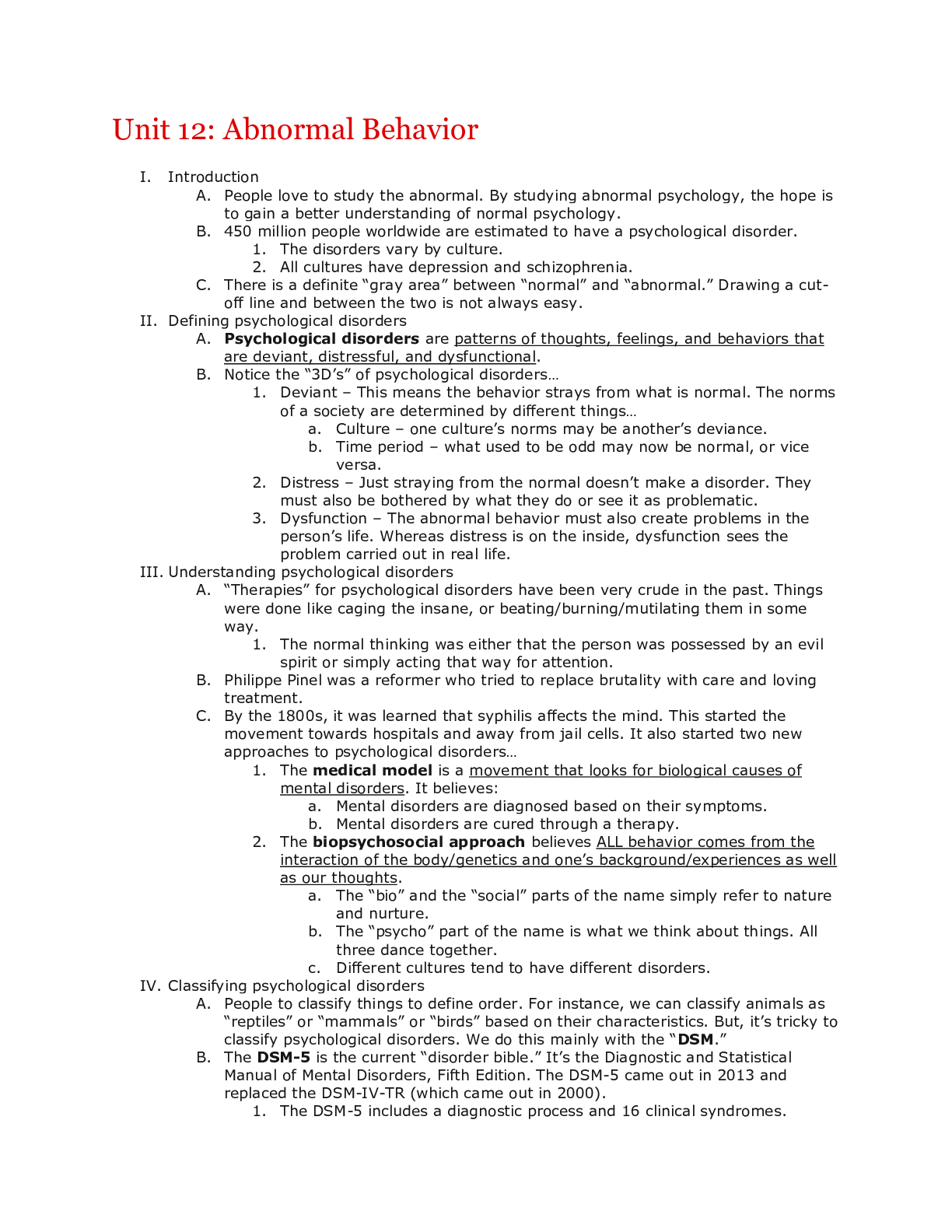
Unit 12: Abnormal Behavior
I. Introduction
A. People love to study the abnormal. By studying abnormal psychology, the hope is
to gain a better understanding of normal psychology.
B. 450 million people worldwide are estimated to have a psychological disorder.
1. The disorders vary by culture.
2. All cultures have depression and schizophrenia.
C. There is a definite “gray area” between “normal” and “abnormal.” Drawing a cutoff line and between the two is not always easy.
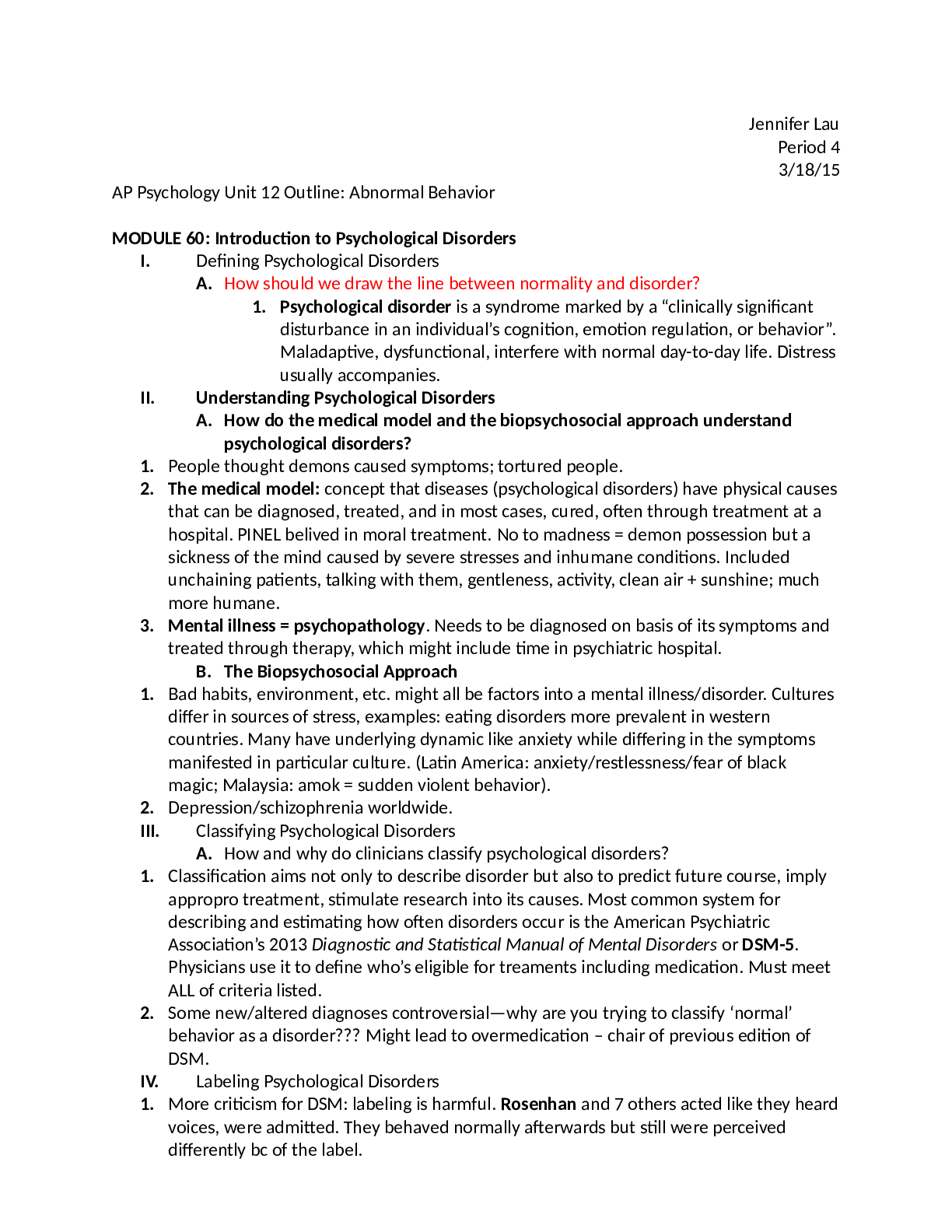
II. Defining psychological disorders
A. Psychological disorders are patterns of thoughts, feelings, and behaviors that
are deviant, distressful, and dysfunctional.
B. Notice the “3D’s” of psychological disorders…
1. Deviant – This means the behavior strays from what is normal. The norms
of a society are determined by different things…
a. Culture – one culture’s norms may be another’s deviance.
b. Time period – what used to be odd may now be normal, or vice
versa.
2. Distress – Just straying from the normal doesn’t make a disorder. They
must also be bothered by what they do or see it as problematic.
3. Dysfunction – The abnormal behavior must also create problems in the
person’s life. Whereas distress is on the inside, dysfunction sees the
problem carried out in real life.
III. Understanding psychological disorders
A. “Therapies” for psychological disorders have been very crude in the past. Things
were done like caging the insane, or beating/burning/mutilating them in some
way.
1. The normal thinking was either that the person was possessed by an evil
spirit or simply acting that way for attention.
B. Philippe Pinel was a reformer who tried to replace brutality with care and loving
treatment.
C. By the 1800s, it was learned that syphilis affects the mind. This started the
movement towards hospitals and away from jail cells. It also started two new
approaches to psychological disorders…
1. The medical model is a movement that looks for biological causes of
mental disorders. It believes:
a. Mental disorders are diagnosed based on their symptoms.
b. Mental disorders are cured through a therapy.
2. The biopsychosocial approach believes ALL behavior comes from the
interaction of the body/genetics and one’s background/experiences as well
as our thoughts.
a. The “bio” and the “social” parts of the name simply refer to nature
and nurture.
b. The “psycho” part of the name is what we think about things. All
three dance together.
c. Different cultures tend to have different disorders.
IV. Classifying psychological disorders
A. People to classify things to define order. For instance, we can classify animals as
“reptiles” or “mammals” or “birds” based on their characteristics. But, it’s tricky to
classify psychological disorders. We do this mainly with the “DSM.”
B. The DSM-5 is the current “disorder bible.” It’s the Diagnostic and Statistical
Manual of Mental Disorders, Fifth Edition. The DSM-5 came out in 2013 and
replaced the DSM-IV-TR (which came out in 2000).
1. The DSM-5 includes a diagnostic process and 16 clinical syndromes.2. It does not try to explain causes but tries to describe the disorder.
3. The DSM-5 is structured as follows:
a. Axis I – Is a clinical syndrome present?
i. Disorders usually diagnosed in infancy, childhood, and
adolescence
ii. Delirium, dementia, and other cognitive disorders
iii. Mental disorders due to general medical condition
iv. Substance-related disorders
v. Schizophrenia and other psychotic disorders
vi. Mood disorders
vii. Anxiety disorders
viii.Somatoform disorders
ix. Factitious disorders (intentionally faked)
x. Dissociative disorders
xi. Eating and sleep disorders
xii. Sexual disorders and gender identity disorder
xiii.Impulse-control disorders not classified elsewhere
xiv.Adjustment disorders
xv. Other conditions that may be a focus of clinical attention
b. Axis II – Is a personality disorder or mental retardation present?
c. Axis III – Is a general medical condition, such as diabetes,
hypertension, or arthritis, also present?
d. Axis IV – Are psychological or environmental problems, such as
school or housing issues, also present?
e. Axis V – What is the global assessment of this person’s
functioning?
4. The DSM gets good and bad marks…
a. The DSM has been praised for being rather reliable in diagnoses.
b. The DSM has been criticized for being too broad.
i. Almost any behavior could be stretched into being some
type of “disorder.”
ii. The number of categories has increased from 60 in the
1950s to 400 today.
iii. Also, the number of people diagnosed with something has
increased substantially.
1. What used to be the regular “ups and downs of life”
is now “bipolar disorder.”
2. What used to be sassiness is now “oppositional
defiance disorder.”
3. What used to be fidgety is now “ADHD.”
V. Labeling psychological disorders
A. Many say putting a label on a person is not right. It generates expectations for
that person and puts him or her in a box.
B. David Rosenhan did a study in 1973 on labels. He and other normal people lied
and said they heard voices talking to them. They were diagnosed with disorders.
1. The initial fact they were diagnosed might be okay. But later, the “causes”
of their supposed problems were also pinpointed.
C. In another experiment, people watched others on TV. The watchers were shown
different labels for the people they were watching. Thus, the watchers drew
different conclusions about the people on TV.
D. Someone just out of prison or a mental hospital has trouble getting a job.
E. Hollywood tends to perpetuate stereotypes too of mental disorders. A person is
usually either funny, freaky, or a psychotic killer.
1. People with mental disorders are rarely violent, but often the victims.
F. Labels can also lead to the self-fulfilling prophecy where a person’s
expectations cause the expected result.
[Show More]

.png)



.png)